How a century of land loss turned drought into famine
In 2021 the UN’s World Food Programme warned that the hunger in Madagascar’s far south could become the first famine caused by climate change. Drought brought it on. But the land had long since lost the plants and soil that once carried families through dry years. Five years later, the hunger has returned to the same town.
European Society of Medicine · November 2026
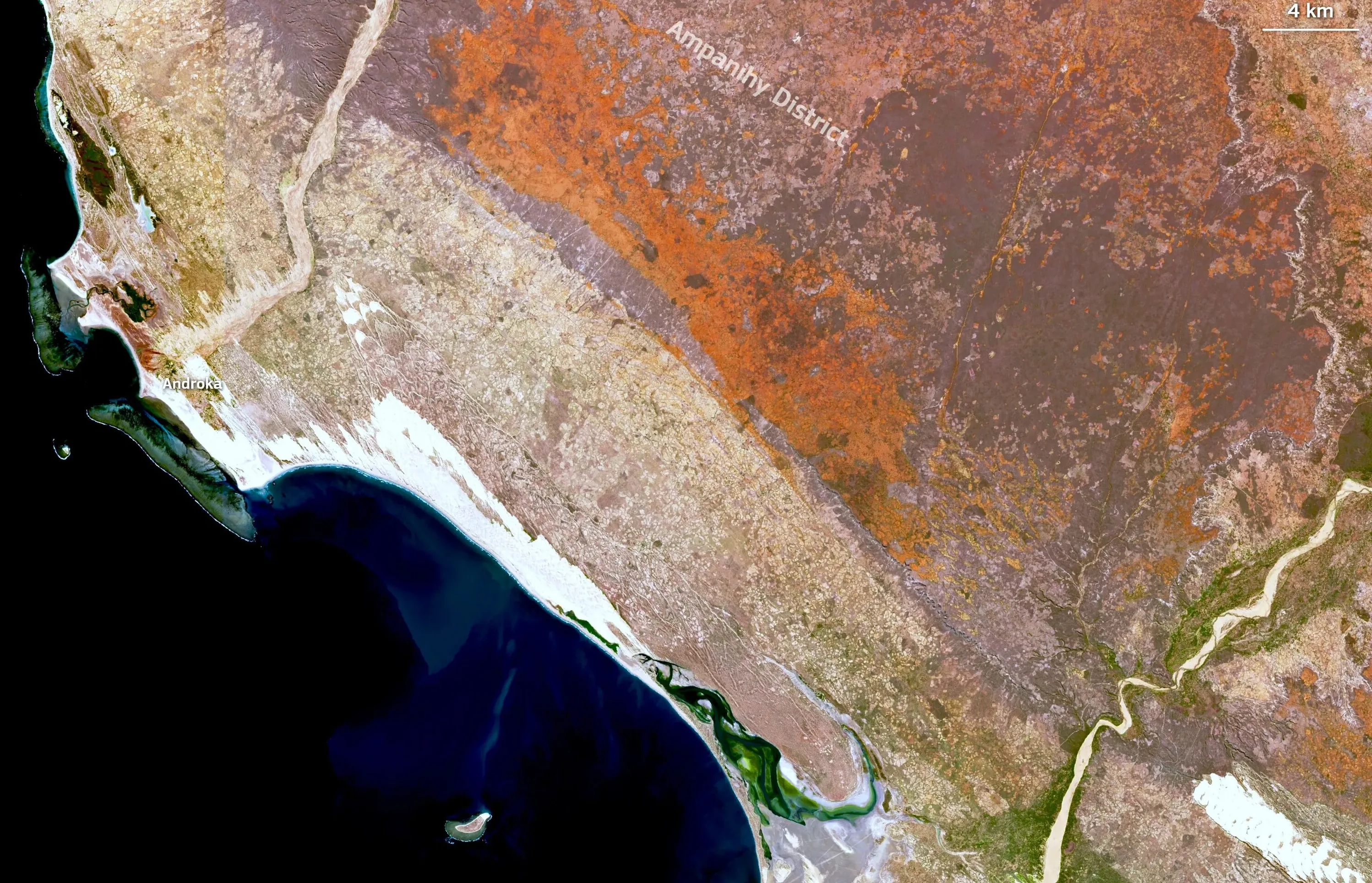
Ampanihy district, southern Madagascar, seen by Copernicus Sentinel-2 on 6 August 2021
I. Ifotaka, September 2026
The porridge line
On a September morning in Ifotaka, a small town of wooden shacks and corrugated iron huts in the far south of Madagascar, a pot of flour porridge was simmering on a stove. About a dozen children were waiting for it. Their arms were thin and their bellies were swollen, the outward signs of bodies that have gone short of food for a long time. While they waited, a member of staff slipped away. She had just been told that a malnourished two-year-old had died.1
The feeding centre belongs to the World Food Programme. It opened in 2023, after the famine of 2021 and 2022, when this town was its epicentre and some 30,000 people in the surrounding countryside of sandy soil and cactus came close to starving. To survive, families boiled pieces of cactus and scraps of animal hide.2,1 The centre was built so that it would not happen again. Now the south had brought in its second poor harvest in a row, and its staff were preparing for a repeat.1
At the programme’s office, Eva Razafindrazaka, 51, held her grandson, who was being treated for malnutrition. She could not water her crops, she said, because they were too far from the communal water point.1
Ifotaka is a rural commune of about 35,000 people strung along the Mandrare, some 45 kilometres from the district town of Amboasary.3,4 Most families are Antandroy herders and farmers who keep zebu, goats and sheep and grow maize, cassava, sweet potato and beans.5 They have lived with dry years for centuries.
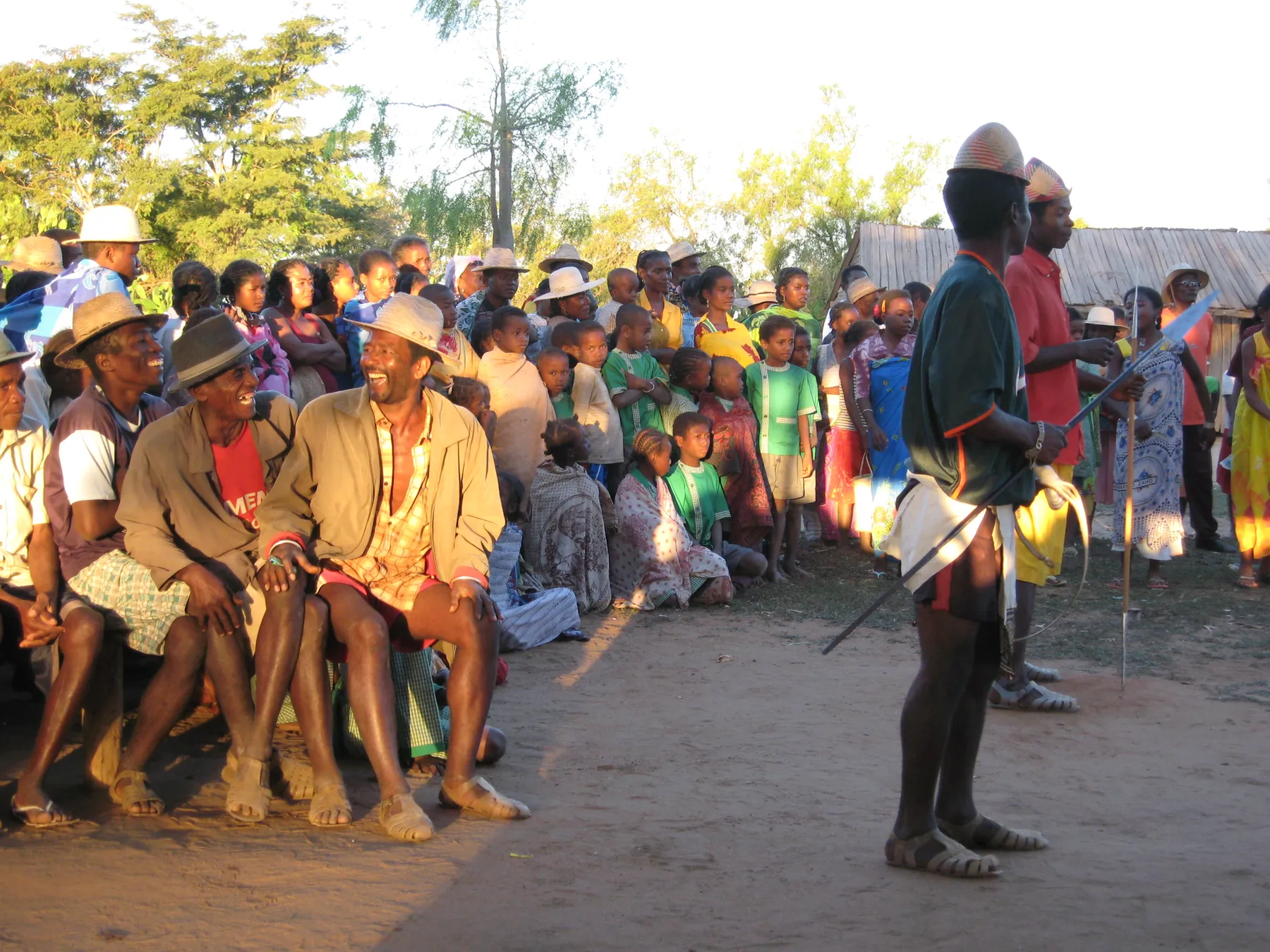
Ifotaka. An Antandroy dance, May 2008. Photo: Woodlouse, CC BY-SA 2.0.
The famine that made Ifotaka’s name in 2021 was blamed on the rain. Its roots go back a century, to a plant.
II. The far south, 1924–1931
The cactus that fed the south
The Antandroy, “the people of the thorns”, can live with dry years. What they cannot live with is losing the plants that carry them through those years. In the 1920s they lost one.
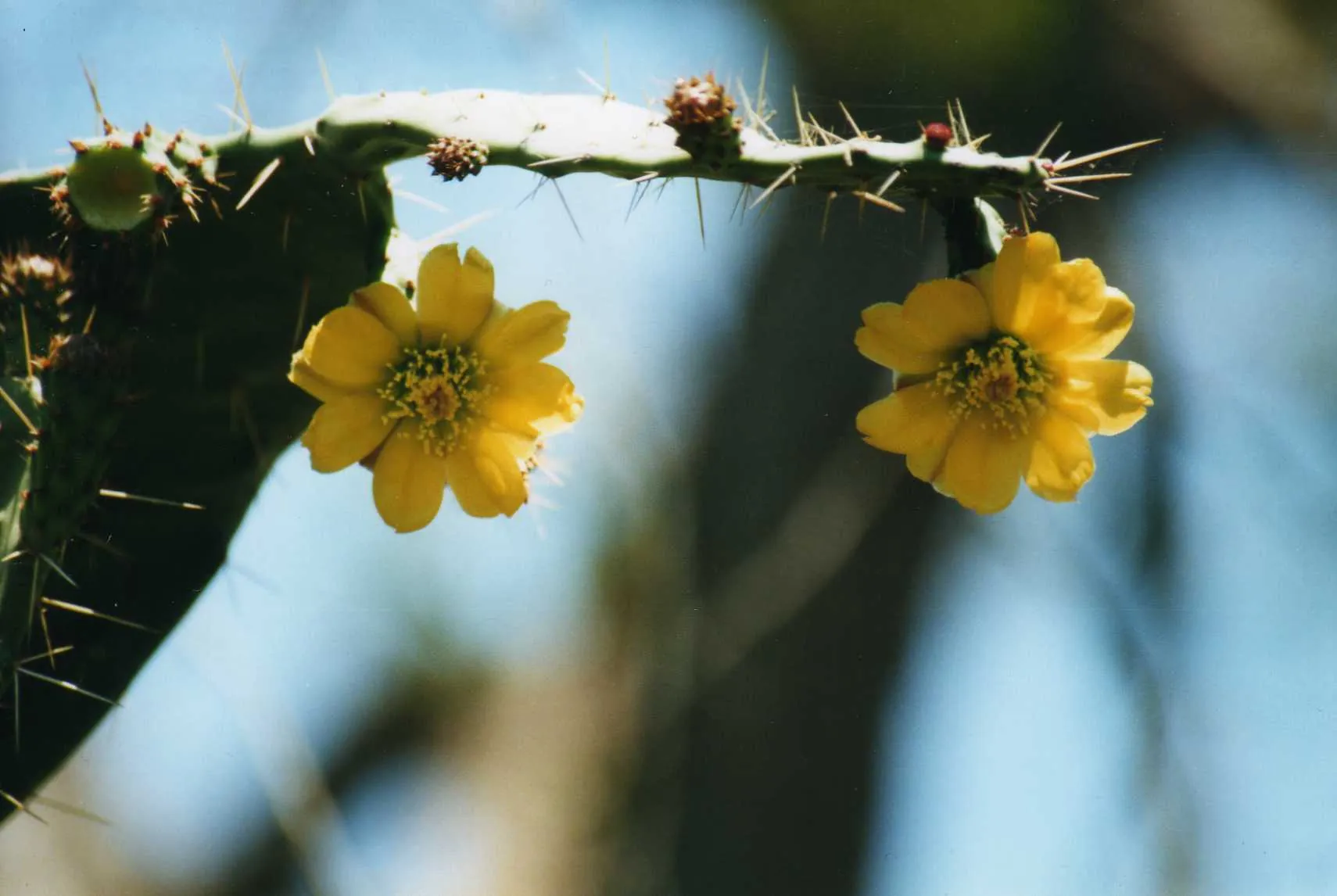
Raketa. Prickly pear in flower near Amboasary. Photo: Leonora (Ellie) Enking, CC BY-SA 2.0.
In the early twentieth century, much of the far south was covered by a dense thicket of prickly pear cactus, which the Malagasy call raketa. It was a fence, a pantry and a water store. Cattle ate the pads and people ate the fruit from August to February. The thicket also sheltered fighters who resisted French colonial rule.6,7 The colonial administration wanted it gone. In November 1924, pads infested with a cochineal insect were released near Toliara, and within four years the insect had destroyed the raketa almost everywhere.7
Then the rains failed. In the drought of 1930 and 1931, cattle that had always survived dry seasons on cactus had nothing to eat. According to accounts from the time, about 1,000 people and some 10,000 zebu died.7,8 The drought was a weather event. What turned it into a famine was, in large part, what had happened to the land.
A century of hungry seasons
· · ·
1924
A cochineal insect is released on the raketa cactus. Within four years the thickets are gone.7
Poor harvest. In Beraketa, four-year-old Julio is treated for malnutrition.12
2026
A second poor harvest, and El Niño. By October, six child deaths at Amboasary hospital.1
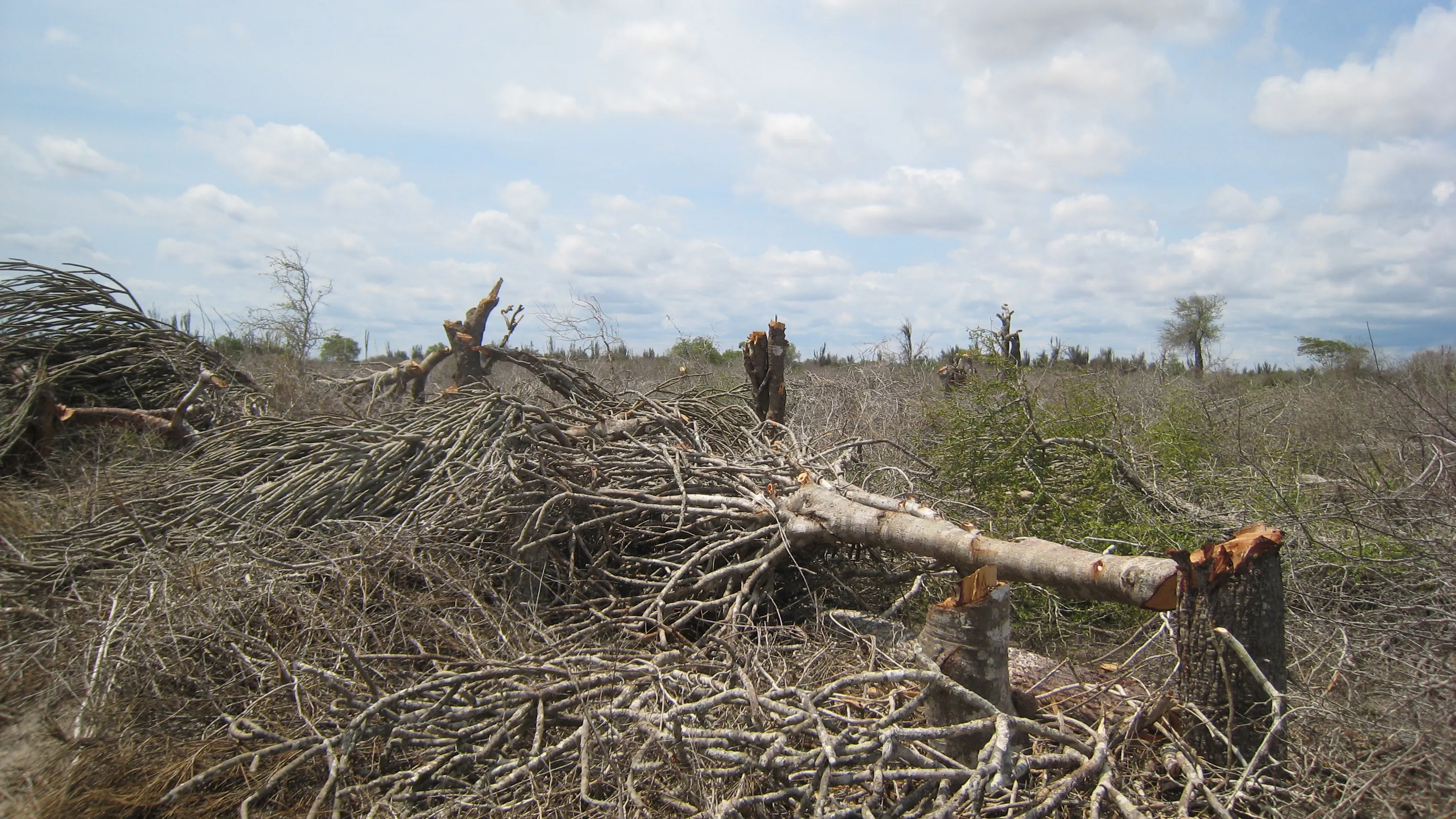
Spiny forest destruction near Beloha, Androy. Photo: Maky (Alex Dunkel), CC BY-SA 3.0
The forest
The far south’s natural cover is spiny forest: a thicket of drought-adapted trees found nowhere else on Earth. Its roots and fallen leaves are what hold the sandy ground together.
1953–2014
Over the decades that followed the famine, that cover thinned. Madagascar lost 44 percent of its natural forest between 1953 and 2014.13 In the early 2000s, the spiny forests of the south were being cleared faster than any other forest type on the island, for charcoal, building wood, grazing and new fields.14
What is left
Cleared spiny forest near Beloha, in the belt where the red winds blow. Without trees and roots, nothing slows the wind at ground level, and nothing holds the soil when it comes.
III. Ifotaka, before 2020
Sand without a skin
In Ifotaka the pressure on the land is plain to see. The best ground lies along the Mandrare, where the river leaves silt and water is close to the surface. Much of it grows sisal, a fibre crop. According to the local protected area’s plan, sisal covers about two thirds of neighbouring Amboasary commune and a large part of Ifotaka’s river plain. Families short of land have moved their fields onto the sandy ground away from the river, and into the forest.5
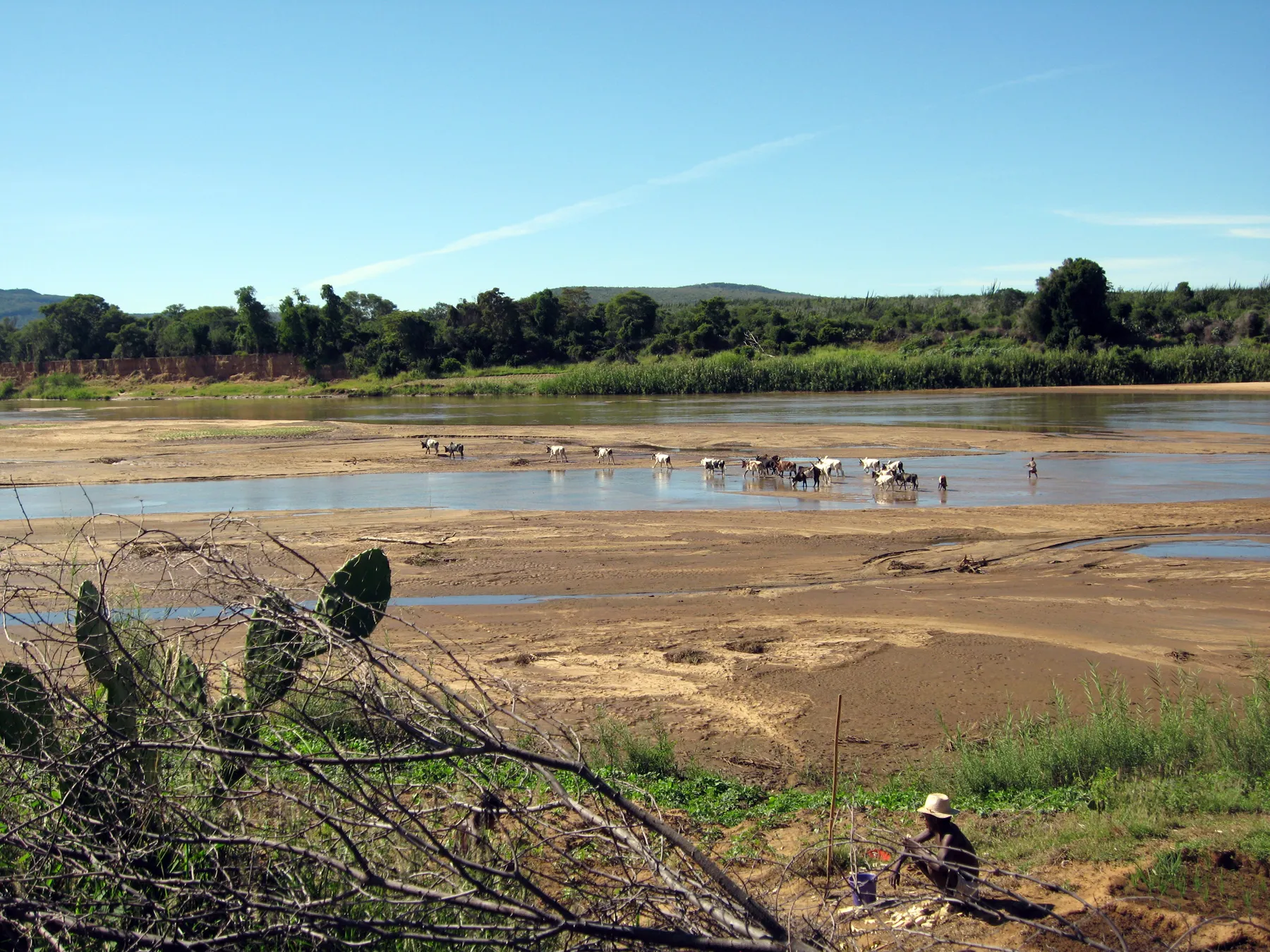
The Mandrare at Ifotaka. The river in the dry season, May 2008. Photo: Woodlouse, CC BY-SA 2.0.
Some forest survives. Groves around the tombs of the ancestors are kept by taboo, and since 2015 about 22,000 hectares of spiny thicket and riverside forest along a bend of the Mandrare have been a protected area.15,5
When French soil scientists mapped the sandy ground beyond the river in the 1950s, its organic matter rarely topped 1 percent even under natural cover, and it held water extremely poorly.16 Under trees, roots bind it and fallen leaves slowly become organic matter, which works like a sponge, holding rain where roots can reach it. Cleared and farmed, it soon loses that thin store. In the dry season, when fodder runs short, herds graze the crop residues that should cover it, leaving it bare for the windiest months.17 The sun bakes the surface, rain runs off instead of soaking in, and the wind lifts the finest particles first, the ones that carry most of the fertility.18,19
Where families eat what they grow, a worn-out field means smaller, less reliable harvests first, and in time poorer food. “Farmers don’t return what they take away and consequently soils are degraded,” the soil scientist Rattan Lal has said. In Nigeria in the 1970s he grew five times as much maize as local farmers by covering the soil with crop residues instead of ploughing.20 This was the ground Ifotaka’s farmers were working when the rains failed in 2020.
IV. Ifotaka, 2020
When even the cactus stopped fruiting
At the end of September 2020, Ifotaka’s mayor made an emergency appeal. He reported that eight children in the commune had died for lack of food. The regional governor, who came to see for himself, said it was not yet certain that hunger had killed them.9
People in the south have a word for these hungry times: kere. They come often enough that families have a plan for them, and that year Ifotaka watched the plan run out. In Fenoaivo, a village in the commune, Soanatoetse, a mother of ten, went looking for the fruit of the prickly pear, the food of the lean months. The heat and the missing rain had left the plants near the village almost bare. “We can only find cactus fruit, even the red ones, kilometres from our village,” she told UNICEF.21
Her family spent its savings buying food it would normally have grown, until cassava, maize and sweet potato began to disappear from the market and prices kept rising. They cut down to one meal a day. Her two-year-old son, Nasoloazo, became malnourished and had to be treated at a nutrition centre.21
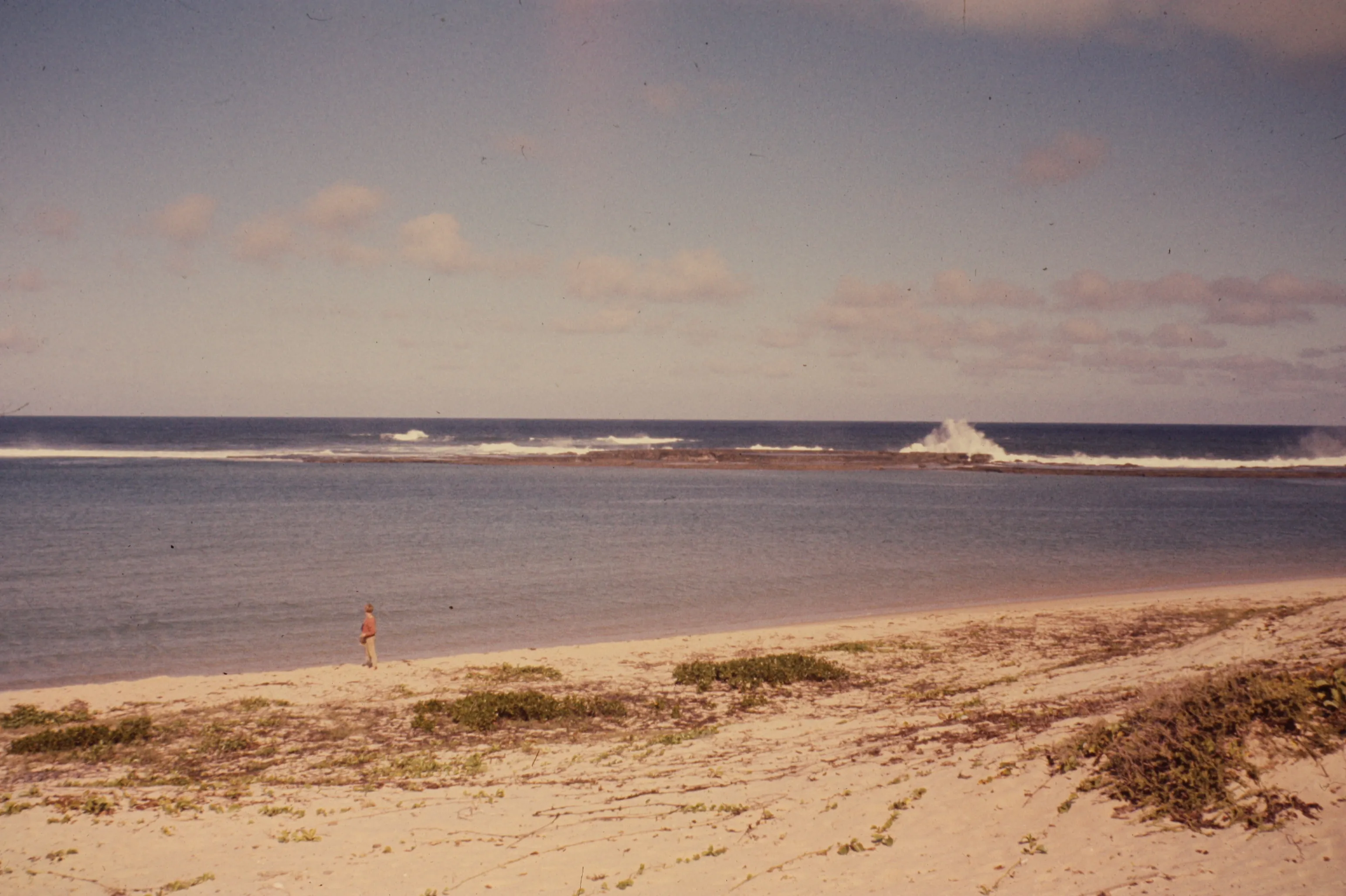
The coast at Faux Cap, Androy, in the 1970s. Photo: Madagascar74, CC BY-SA 3.0
The red wind
In the south they call it tiomena: tio, wind, and mena, red. It is a storm of dust and sand that can blot out the sun.22
2020–2021
That season the tiomena kept coming. The national weather service recorded at least five in the first weeks of 2021 alone, across a belt about 200 kilometres wide between the Mandrare River, which runs past Ifotaka, and the town of Beloha. The winds piled sand on fields, forests, villages and cemeteries.22
Tanandava
In the area of Tanandava, in Ifotaka’s district of Amboasary, a local anthropology student told Mongabay that the residents of one village had abandoned it altogether.
All their houses were buried in the sand raised by the tiomena.22
A longer season
A climate researcher at the University of Toliara told Mongabay that the trade wind that brings the tiomena used to blow from mid-May to mid-October. Now, he said, it blows almost all year.22
Buried
A father named Sambo showed UNICEF what was left of his cassava field after the wind and sand had passed.
Now we’re buying cassava when we’re supposed to be harvesting it.23
V. Ifotaka, 2021
A year without a harvest
By the start of 2021 the clinics were filling. In the districts of Amboasary, which contains Ifotaka, and neighbouring Ambovombe, admissions of children with the most dangerous form of malnutrition rose from 400 in January 2020 to 2,700 in January 2021.24
That April, the analysts who grade hunger for the United Nations and the government placed about 14,000 people in Amboasary district in “catastrophe”, the worst of the five phases on their scale, where starvation and death are evident. No one in Madagascar had been placed in that phase since the scale was introduced there in 2016.10
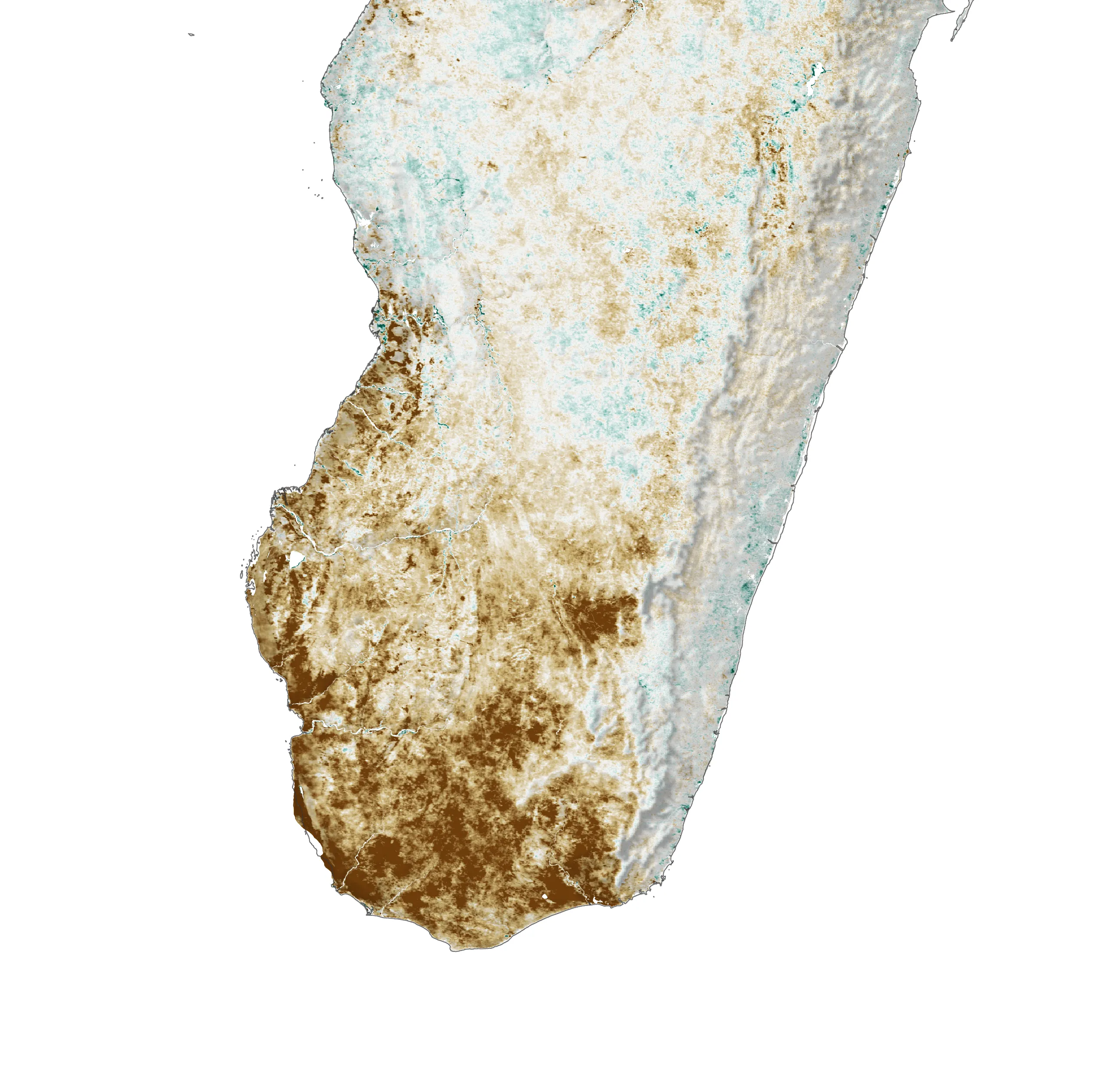
The south turned brown. Vegetation greenness from July 2020 to July 2021 compared with the 2000–2015 average. Brown areas were far less green than normal. NASA Earth Observatory, public domain.
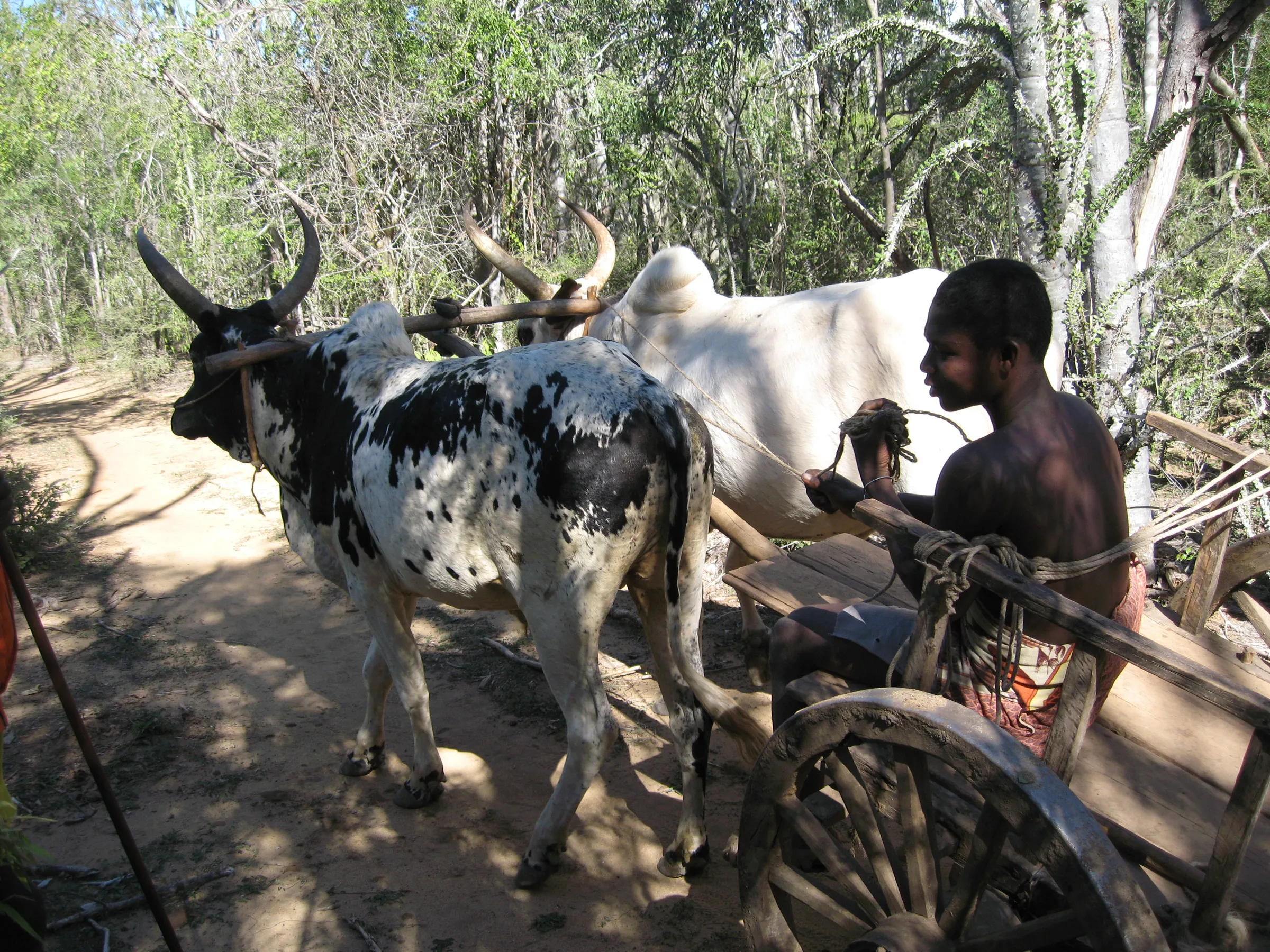
A zebu cart in the spiny forest near Ifotaka, 2008. Photo: Woodlouse, CC BY-SA 2.0
Ifotaka, 2021
“Nothing to eat, nothing to plant,” a correspondent for the French news agency Agence France-Presse (AFP) wrote from Ifotaka in September 2021. “The last rain in Ifotaka fell in May, for two hours.”25
Fenoaivo, August 2021
In Fenoaivo, Tsihorogne Monja kept watch over the body of his father, who had died in June. It lay in a separate hut, partly covered by a cloth. The family could not afford a cow to feed mourners, so there could be no funeral.
My father was very hungry. He ate too much cactus and tuber bark. That’s what killed him. It’s like he was poisoned.
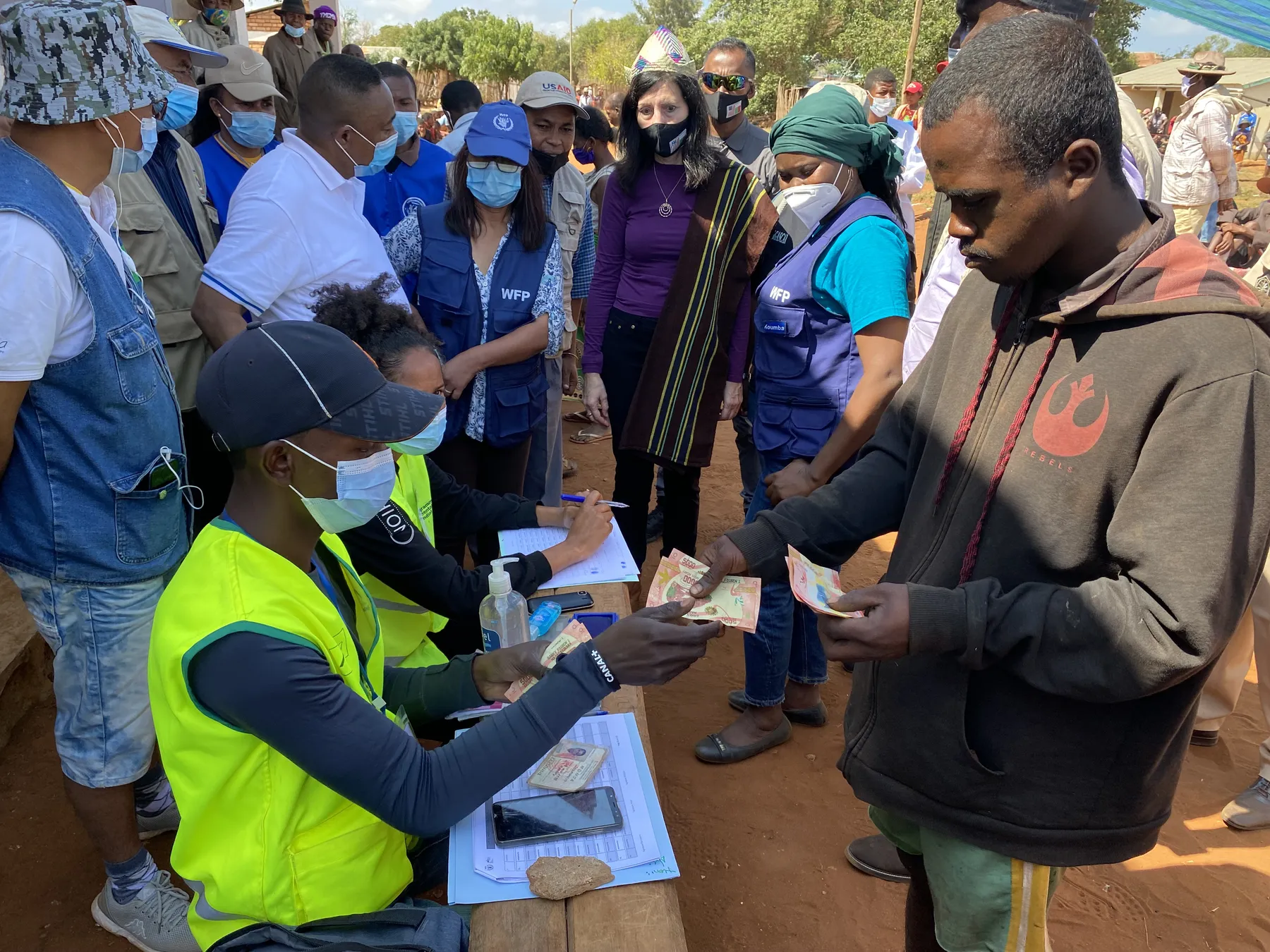
The help that reached Ifotaka was mostly cash. From December 2020, UNICEF and the government’s social fund paid families in the commune a monthly allowance. UNICEF reported that by September 2021 the payments covered every household in the commune, about 7,550 families, at 100,000 ariary, roughly 26 US dollars, a month.3 On the ground the money arrived unevenly: around Ifotaka that month, AFP found that only about 90 of 500 people listed for the payment had received it.25 The money paid for meals. The fields stayed bare.
Cash in hand. A World Food Programme cash distribution in southern Madagascar, August 2021. Photo: USAID, public domain.
VI. The far south, 2021
A famine blamed on the sky
By mid-2021 the crisis had a headline. The World Food Programme, the UN’s food agency, warned that it could become the first famine in the world caused by climate change, and the phrase travelled around the world.26 It was a powerful message. The first scientific test of the claim, published that December, found it overstated.
That test came from the World Weather Attribution group, which measures how much climate change alters the odds of extreme weather. The two rainy seasons of 2019–20 and 2020–21 had brought only about 60 percent of normal rainfall to the far south, a drought expected about once every 135 years. But the researchers found no statistically significant role for human-caused climate change in making it more likely.27
“The driver of the famine or the food security is very much the high vulnerability of the people of the region.”Friederike Otto, Imperial College London, co-author of the attribution study, to the Associated Press28
A later study, published in 2024, looked at the timing of the rains within each season. It found that the rainy season in the south is becoming shorter, and estimated that climate change made the drought of 2019–20 between about two and five times as likely.29 Scientists still disagree about how large the climate signal is. Both groups expect the risk of droughts like this one to grow as the planet warms.
Whichever estimate is right, the drought is only part of what happened. Dry years come to the far south again and again, and not all of them end with children dying of hunger. The south had seen that once before, in 1930, when the rains failed on land that had just lost its cactus. In 2021 they failed on sandy fields with little cover left, under a wind that buried crops, in a region that was poor, cut off and almost entirely dependent on rain-fed farming.
VII. Agnarafaly, 2021–2022
The orange village
The government’s answer, in Ifotaka itself, was a settlement. At Agnarafaly, in the commune on the border between Anosy and Androy, it laid out rows of orange one-room shelters across 200 hectares for families fleeing the drought, with a tenth of a hectare of land for each household. Families who farmed their plot for five years could earn the title to it.30
“You have sheep, goats and poultry. All your cultivation plots are equipped with drip [irrigation] systems,” President Andry Rajoelina told the first families when he launched the settlement at the end of September 2021. “The aim is to ensure your livelihood so you will not depend on any aid.”30 That day, 80 families received certificates for their plots, and the government said the scheme would grow to 2,000 households.11
The famine eased only with the harvest of May 2022. That year 15 malnourished children died at the hospital in Amboasary, an hour from Ifotaka by four-wheel drive, a kind of vehicle that, AFP noted, no local owns.1
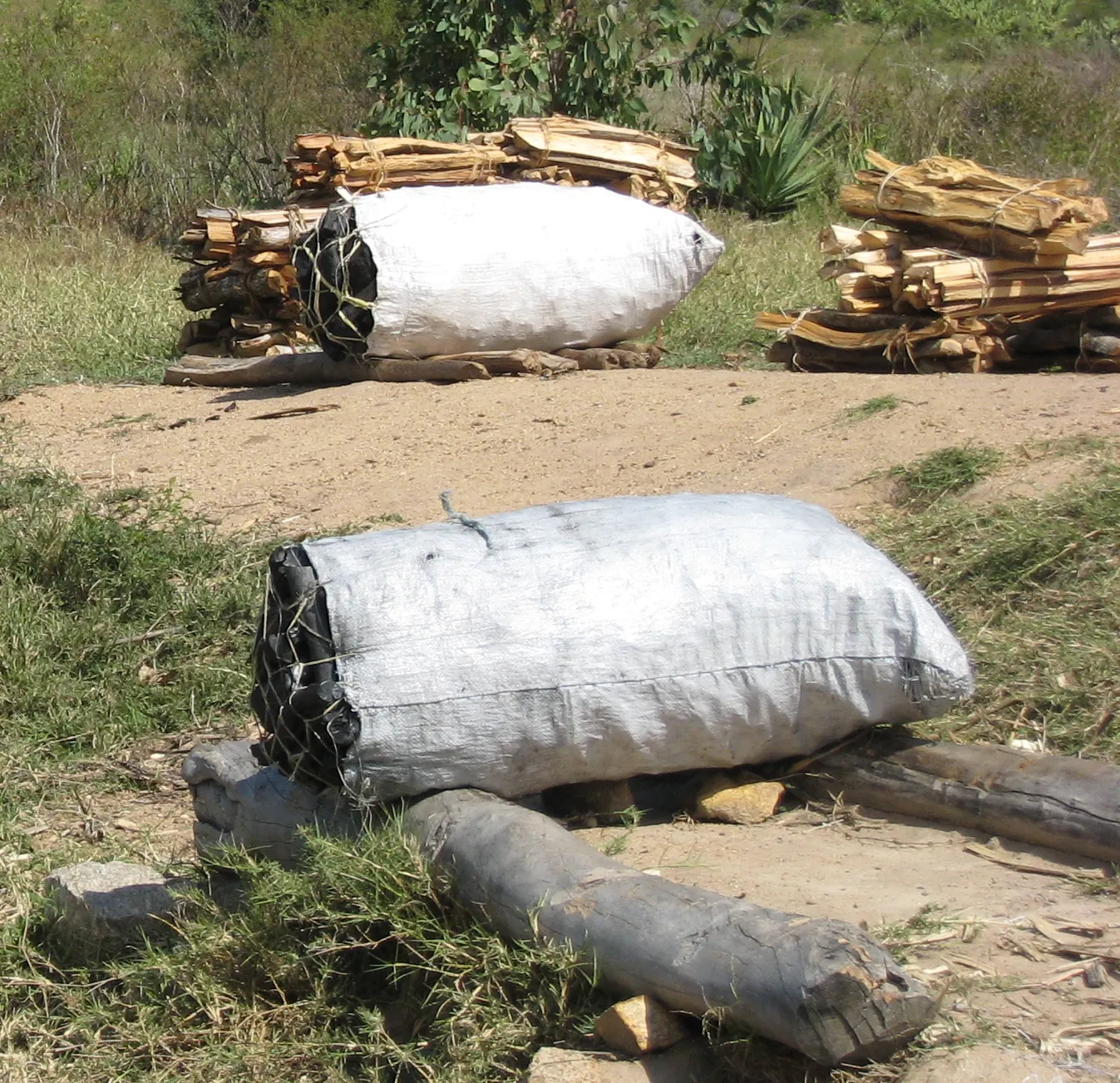
Soja, a man in his forties, had come to Agnarafaly in 2021 with an extended family of 13, walking four hours from his village in Androy and crossing the Mandrare. By 2022 about 160 households lived in the camp. When Mongabay visited, December rains had turned it into a swamp and flooded the shelters. The goats and chickens handed out less than two years earlier were gone. “Some animals were felled by disease. Others were stolen. For this cropping season, we sold our utensils to buy seeds,” he said. Most families depended on food aid. “We are going out to make charcoal and sell it so we can eat.”30
For sale. Charcoal and firewood at the roadside on the way to Berenty, Amboasary district, 2009. Photo: Maky (Alex Dunkel), CC BY-SA 3.0.
He did not want to leave. “We will not go back. It’s worse there,” he said of the land across the river. “The problem is when it floods, there is no place to sleep.”30
In 2023 the World Food Programme opened its feeding centre in the town, the one where the porridge line would form again three years later.2
VIII. Beraketa, 2025
Smaller than the other boys
Between the famines, hunger in Ifotaka did not go away. It became quieter. Beraketa is a village of a little over a thousand people in the commune, two hours by road from Fort-Dauphin (Tolagnaro). Hanta, a woman in her thirties, farms a hectare of cassava, maize and beans there, and her husband, Mamelasoa, makes charcoal. They have seven children. The youngest, Julio, is four.12
The last real rain came early in 2025, with the cyclones Honde and Jude. After that, the tributary of the Mandrare that serves as the village’s main water point ran dry. A few maize plants came up and were eaten by locusts. Cassava rose beyond the family’s reach, and the leafy greens that used to go with it became the meal. Like their parents in every kere before them, they fell back on red cactus fruit and tubers dug in the forest.12
Julio began to lose weight. He grew irritable and his belly swelled. “My son seemed smaller than other boys his age,” Hanta said. “I could not afford to give him a varied diet. Our harvests declined and we had less food at home.”12
She was describing what doctors call wasting. A child loses weight fast, the immune system weakens, and common illnesses such as malaria and diarrhoea become dangerous. Caught in time, it can be reversed in weeks. The slower damage, stunting, comes from years of too little food and leaves a child short for their age, with lasting effects on body and brain. A good harvest cannot undo it. Even before the famine, 42 percent of Madagascar’s young children were stunted, among the highest rates in the world.10
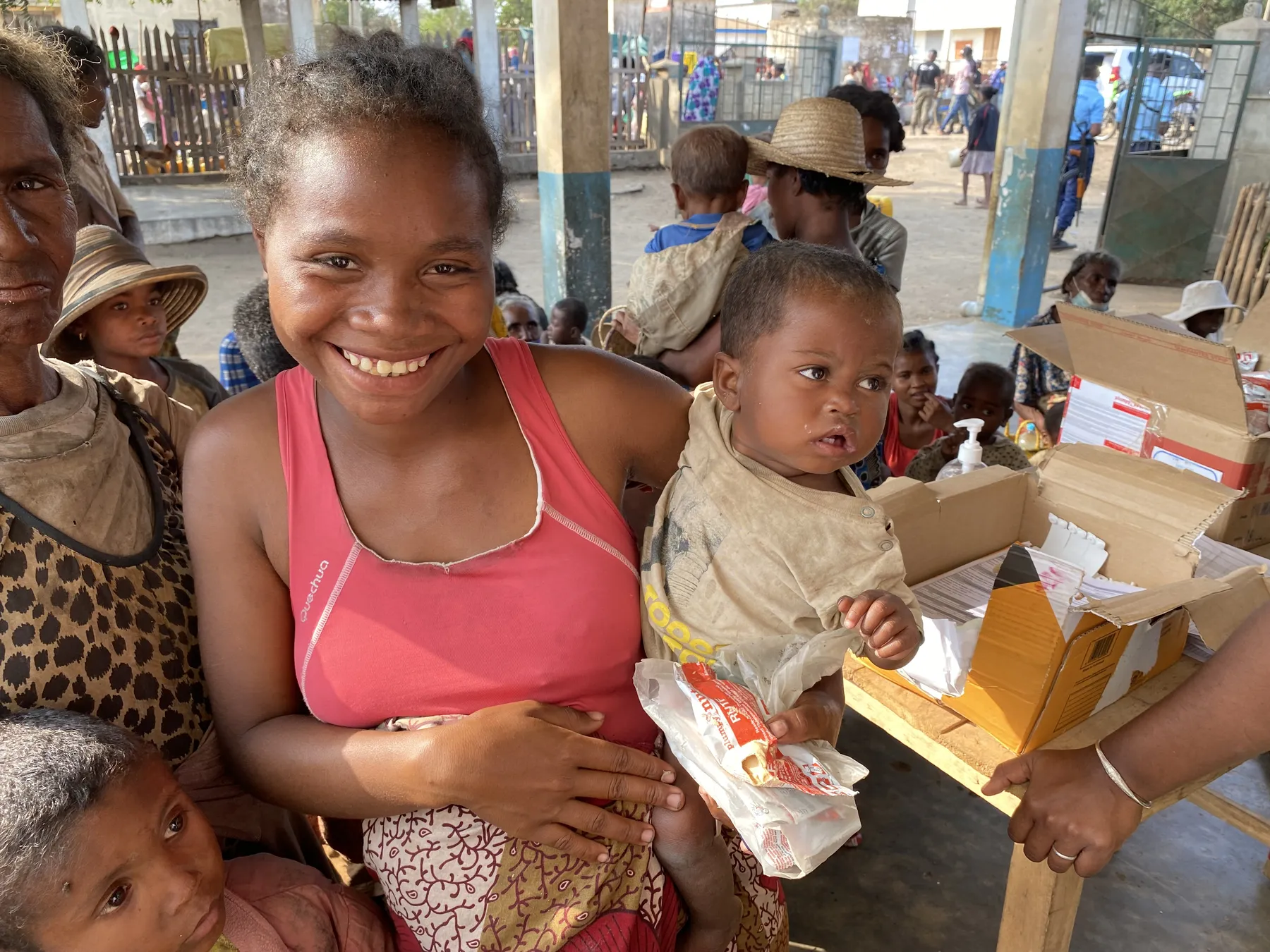
In June, community workers screened the village’s children, and the coloured band they wrapped around Julio’s upper arm showed he was moderately malnourished. In July he was admitted for 18 days to Beraketa’s community nutrition site, one of a network the World Food Programme has run with Madagascar’s national nutrition office since 2024. Every day he got a hot meal of porridge made from maize, cassava, cowpea and groundnut flour, cooked by the village’s mères lumières, mothers whose own children are thriving, and time to play.12
The arm band. A screening in southern Madagascar, August 2021. Green means the child is well nourished; yellow and red mean acute malnutrition. Photo: USAID, public domain.
Two weeks in, he was better. “Julio has regained his energy. He plays and smiles again,” his mother said. At the July weighing he had put weight back on, the community health worker Vola Rahelisoa confirmed.12 Treatment brought Julio back from wasting. It could not give his family back their harvest, and the next one was already failing.
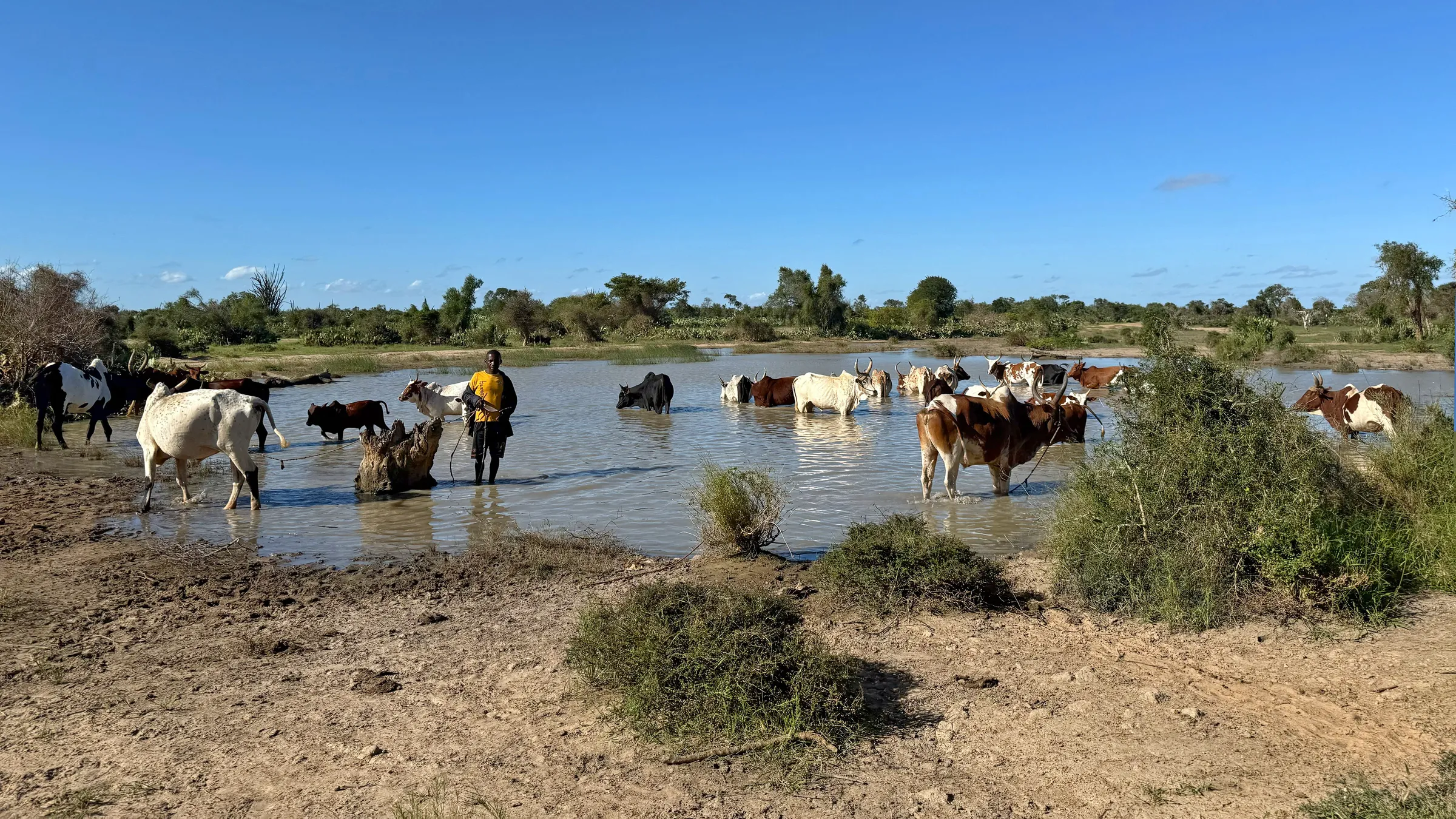
Zebu at a pond in Androy, March 2025. Photo: Kevin Gepford, CC BY-SA 4.0
Ankilimiary
West of Ifotaka, in the Androy village of Ankilimiary, people had stopped planting altogether. The sand kept coming.
We were afraid to plant anything because the sand would destroy it. Our fields were left untouched, out of fear.
Botoasa, village chief of Ankilimiary, to the World Bank31
Holding the sand
The village planted the dunes and the edges of its fields with native plants chosen to grip sand: laloasy, lalanda and mozotse. Within a few months, according to the World Bank’s account, the young plants were thriving and the dunes had stopped moving.31
The fields return
Our crops are growing again, and the soil is protected. We have regained hope.
Ankilimiary is part of MIONJO, a government programme funded by the World Bank and run in Androy and Anosy with Catholic Relief Services, which pays people to plant and protect. In August 2025 the World Bank said communities had reforested 1,020 hectares, stabilised more than 1,094 hectares of dunes and planted 100 kilometres of windbreaks.31 The project’s formal progress report two months later was more modest: 30 kilometres of windbreaks against a target of 168 by 2028. In the same report, 29 percent of the vulnerable households it serves said their ability to grow food had been restored.32
Those figures count work done, not harvests saved. The World Food Programme, which has fixed dunes on the coast since 2017, had its Madagascar programme reviewed by independent evaluators in 2023. They found its resilience work “relatively small in scale and insufficient to counter the effects of shocks and the underlying causes of food insecurity and malnutrition”, and said more evidence was needed to confirm its effects.33
The south has run this experiment before, with mixed results: a 2005 review of soil conservation found that a triple hedge of casuarina, acacia and saltbush “works well and has been adopted by farmers” in the Ambovombe basin, while earlier eucalyptus windbreaks were steadily cut down for firewood.34
Elsewhere in the south the repairs were smaller and mostly about water. Since 2024, Action contre la Faim has built three sand dams in Anosy and the south-west: walls across seasonal riverbeds that trap sand, and with it water, below the surface. Tananaze, a 52-year-old village chief and father of 14 who hauled stones for one of them, says he can now irrigate his fields through the dry season. “My harvests have improved and that changes everything.” One dam was damaged by the same cyclones that brought Beraketa its last rain, and repairs were held up by the collapse of US aid funding.4
None of this had yet been tested by a year like 2021.
X. Ifotaka, 2026
Bracing for El Niño
Five years after its launch, Agnarafaly had a primary school, a lower secondary school and a communal market that was 95 percent complete by May 2026, built by an agriculture programme funded by the African Development Bank.35 But it stood on the same sand, under the same rain, as the rest of the commune.
Seven years from space. Green vegetation across the far south each month, January 2019 to September 2026, measured by NASA’s MODIS satellite. Brown is bare or dry ground.36
After erratic rain, the harvests of July and August were below average for a second year running. Analysts expected “crisis”, the middle of the five phases of hunger, across the whole Grand South from October. The strengthening El Niño was expected to bring late, thin rains and higher temperatures, delaying planting, shrinking the area sown and cutting the farm work poor families rely on for income through the lean season from November to March.37 In Manindra, a coastal village in the neighbouring commune of Sampona, the farmer James Tsirimalaza, 46, told AFP that the rains normally begin in late September. “Unfortunately,” he said, “there’s no rain.”1
426,000people in the far south projected to be in “emergency”, the phase below catastrophe, between October and February, up from 25,000 in March to May38
39%of children under five in the Grand South projected to be acutely malnourished by April 2027, nearly 270,000 children1
3.7mpeople across Madagascar projected to face crisis-level hunger or worse, October 2026 to February 202738
“We haven’t seen that in the country before,” the World Food Programme’s country director, Tania Goosens, told AFP of the national projection. “So it’s even worse than in 2021–2022.”1 Across the island, more than half a million children under five could suffer acute malnutrition before next April, about 78,000 of them in its most dangerous, severe form.39
The help that met the last famine was thinner this time. The World Food Programme planned to support 720,000 people in 2026 but had barely half the funding it needed. At the hospital in Amboasary, six malnourished children with medical complications had died by early October, against 15 in the whole of 2022. A US-funded service that paid to bring patients in and train health workers had ended two months before AFP’s visit.1
Aid can bring a wasted child back within weeks, as it did for Julio. Whether the next dry year becomes a famine depends on slower work: rebuilding soil that can hold its own water.
In Ifotaka this October, the porridge is still simmering and the children are still waiting. Not everyone is. One evening, as the cattle were brought in for the night, Manjomaro Andrianantenaina, 25, was pushing solar panels home on a wheelbarrow, its wooden wheels sinking into the sand. He had spent more than two million ariary, about 450 dollars, on a well and a solar pump, more than most families in the region can afford. “I used to worry about the lack of rain when it was hot,” he said. “Now I wait for the sun so I can pump water from underground.”1
· · ·
How this story was reported
This story was written by the Global Nutrition Alliance of the European Society of Medicine from published sources: reporting by AFP, RFI, Mongabay and L’Express de Madagascar; reports and statements from the World Food Programme, UNICEF, the United Nations in Madagascar, the World Bank, Action contre la Faim, the Integrated Food Security Phase Classification and FEWS NET; programme evaluations; and peer-reviewed research. We did not conduct new interviews. The people in this story were interviewed by different organisations at different times, and we do not know what happened to them afterwards. Quotations are reproduced as originally published and attributed to the outlet that recorded them; quotations from French sources are our translations. Figures are for the dates and areas given in each source.
Global Health Center
Global Nutrition Alliance
The Global Nutrition Alliance brings together researchers, clinicians and public health experts working on nutrition and food systems, to share evidence and to inform policy. It is part of the Global Health Center of the European Society of Medicine.
AFP, “Famine-scarred southern Madagascar braces for El Nino”, 7 October 2026, via France 24. france24.com
AFP, French-language version of the same dispatch, 7 October 2026, via France 24. france24.com
UNICEF, Madagascar Humanitarian Situation Report, September 2021. unicef.org
Action contre la Faim, “Sand dams to fight against food insecurity in the South”, 23 July 2025. actioncontrelafaim.org
Nord-Ifotaka protected area, management plan (in French), via the Madagascar protected areas portal. protectedareas.mg
Ralaingita, M. I. et al. (2022). The Kere of Madagascar: a qualitative exploration of community experiences and perspectives. Ecology and Society 27(1):42. ecologyandsociety.org
Allorge, L. and Matile, L. Cactus et cochenilles introduits à Madagascar : mise au point à l’appui des collections historiques du MNHN à Paris, citing Decary (1931). ilerouge.org
Kaufmann, J. C. Prickly pear cactus and pastoralism in southwest Madagascar. Ethnology. aquila.usm.edu
RFI, report on drought and food insecurity in Madagascar’s far south (in French), 1 October 2020. rfi.fr
World Food Programme, Madagascar Country Brief, April 2021. reliefweb.int
2424.mg, report on the launch of the Titre Vert project at Agnarafaly (in French), 2 October 2021. 2424.mg
United Nations in Madagascar / World Food Programme, “Au sud de Madagascar, des recettes locales pour vaincre la malnutrition infantile”, January 2026. madagascar.un.org
Vieilledent, G. et al. (2018). Combining global tree cover loss data with historical national forest cover maps to look at six decades of deforestation and forest fragmentation in Madagascar. Biological Conservation 222. pdf
Waeber, P. O. et al. (2015). Dry forests in Madagascar: neglected and under pressure. International Forestry Review 17(S2). pdf
Madagascar protected areas portal, Nord-Ifotaka protected area profile, accessed October 2026. protectedareas.mg
Hervieu, J. Notice sur la carte pédologique de reconnaissance au 1/200 000, feuille 64 : Ambovombe. Institut de recherche scientifique de Madagascar / ORSTOM (map published 1956). ird.fr
Rakotondramanana, Husson, O. and Enjalric, F. (2010). Documentation and Synthesis of Conservation Agriculture in Madagascar. GSDM for FAO, pp. 9, 62 and 69. gsdm-mg.org
Lal, R. (2004). Soil carbon sequestration impacts on global climate change and food security. Science 304(5677). doi.org
Lal, R. (2016). Soil health and carbon management. Food and Energy Security 5(4). doi.org
FAO, “Soils should have rights too”, interview with Rattan Lal, 2020. fao.org
UNICEF Madagascar, “Le programme Tosika Kere dans le Sud de Madagascar”, 2 June 2021. unicef.org
Kessler, R., “Dusty winds exacerbate looming famine in Madagascar’s deep south”, Mongabay, 29 January 2021. mongabay.com
UNICEF Madagascar, “Between Hope and Doubt in Madagascar: Recovering from Severe Malnutrition”, 27 January 2021. unicef.org
World Food Programme, Madagascar Country Brief, February 2021. reliefweb.int
AFP, “Desolate villages face famine in Madagascar drought”, 17 September 2021, via Phys.org. phys.org
UN News, “Madagascar: Severe drought could spur world’s first climate change famine”, 21 October 2021. news.un.org
Harrington, L. J. et al. (2022). Limited role of climate change in extreme low rainfall associated with southern Madagascar food insecurity, 2019–21. Environmental Research: Climate. iopscience.iop.org
Borenstein, S., “Study: Climate change not causing Madagascar drought, famine”, Associated Press, 1 December 2021. archived
Rigden, A. et al. (2024). Climate change linked to drought in Southern Madagascar. npj Climate and Atmospheric Science. nature.com
Vyawahare, M., “Can land titles save Madagascar’s embattled biodiversity and people?”, Mongabay, 14 August 2023. mongabay.com
World Bank, “Partnering for Resilience with the Government of Madagascar, World Bank, and CRS”, 1 August 2025. worldbank.org
World Bank, Implementation Status & Results Report, Support for Resilient Livelihoods in the South of Madagascar (MIONJO, P171056), sequence 10, 21 October 2025, p. 8. worldbank.org
WFP Office of Evaluation, Évaluation du plan stratégique de pays du PAM à Madagascar 2019–2023, vol. 1, December 2023, para. 22. wfp.org
Chabalier, P. (2005). Bilan et évaluation des travaux et réalisations en matière de conservation des sols à Madagascar. Réseau érosion et GCES, Antananarivo. cirad.fr
Ihariliva, M., “Toliara: Un projet répond à des besoins dans le Sud”, L’Express de Madagascar, May 2026. lexpress.mg
NASA, MODIS Terra Vegetation Indices 16-Day (MOD13Q1), normalised difference vegetation index, January 2019 to September 2026, via NASA Global Imagery Browse Services (GIBS). earthdata.nasa.gov
FEWS NET, Madagascar Food Security Outlook Update: Below-average harvests drive an early lean season in the Grand South, August 2026 – January 2027. reliefweb.int
IPC, Madagascar: Acute Food Insecurity and Malnutrition Snapshot, May 2026 – April 2027, July 2026. reliefweb.int
Echos Santé, “Madagascar : la famine menace plus de 500 000 tout-petits”, 25 September 2026, reporting IPC data published by Save the Children. echosante.info
Images
Title image: contains modified Copernicus Sentinel data (2021), processed by the European Union, Ampanihy district, 6 August 2021, cropped. Wikimedia Commons
Map: Global Nutrition Alliance, from geoBoundaries (CC BY 4.0) and OpenStreetMap contributors (ODbL).
Zebu cart in the spiny forest near Ifotaka, May 2008: Woodlouse, CC BY-SA 2.0, cropped. Flickr
The Mandrare at Ifotaka, May 2008: Woodlouse, CC BY-SA 2.0, resized. Flickr
Antandroy dance, Ifotaka, May 2008: Woodlouse, CC BY-SA 2.0, resized. Flickr
Cash distribution, August 2021: USAID, public domain. Flickr
Arm-band screening, August 2021: USAID, public domain. Flickr
Vegetation map: NASA Earth Observatory, public domain. Wikimedia Commons
Satellite time-lapse: Global Nutrition Alliance, from NASA MODIS Terra 16-day vegetation index imagery (public domain) via NASA GIBS, recoloured, with map data from geoBoundaries (CC BY 4.0) and OpenStreetMap contributors (ODbL).