


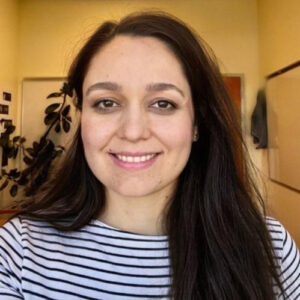
Meltem Elitas
Associate Professor
Sabanci University - Karlsruhe Institute of Technology
Biography
Meltem Elitas, Ph.D.
Associate Professor, Sabancı University | Visiting Professor, Karlsruhe Institute of Technology
Dr. Meltem Elitas is an Associate Professor of Mechatronics Engineering at Sabancı University in Turkey and an Alexander von Humboldt Visiting Professor at the Karlsruhe Institute of Technology, Germany. She earned her Ph.D. in Bioengineering and Biotechnology from EPFL (École Polytechnique Fédérale de Lausanne), where she pioneered single-cell analysis methods to study mycobacterial persistence. Following her doctoral studies, she completed a postdoctoral fellowship in Biomedical Engineering at Yale University, developing microfluidic tumor microenvironments to interrogate glioma–macrophage interactions.
Dr. Elitas leads interdisciplinary research bridging microfabrication, microfluidics, dielectrophoresis, and advanced imaging to elucidate the behavior of cancer and immune cells under stress and to develop innovative diagnostic platforms. Her work has resulted in over 35 peer-reviewed publications, several patents, and major international grants, including the prestigious Horizon 2020 Marie Skłodowska-Curie Individual Fellowship and Alexander von Humboldt Award.
She is an editorial board member for journals such as Scientific Reports and Sensors and serves as a program committee member for SPIE conferences on emerging topics in artificial intelligence. Dr. Elitas is a committed mentor and educator who has supervised numerous graduate students and contributed to community outreach programs to inspire the next generation of scientists and engineers.
Her current research focuses on designing microfluidic-based artificial microecologies to study antibiotic stress responses and on developing precision biosensors and lab-on-a-chip devices for biomedical applications. Dr. Elitas is an active member of the European Society of Medicine and other leading professional societies in bioengineering, robotics, and clinical microbiology.
Research Interests
Dr. Elitas’s research lies at the interface of bioengineering, microfabrication, and biomedical sciences. Her main interests include:
Microfluidics and Lab-on-a-Chip Technologies: Design and development of microfluidic devices to model complex biological microenvironments, such as tumor–immune interactions and microbial communities.
Single-Cell Analysis: Investigating phenotypic heterogeneity, antibiotic tolerance, and cellular signaling at the single-cell level using microfabrication and advanced imaging techniques.
Dielectrophoresis-Based Characterization: Application of dielectrophoresis for label-free quantification, separation, and mechanophenotyping of cancer, immune, and bacterial cells.
Biosensor Development: Creating portable, low-cost diagnostic platforms, including LAMP-based nucleic acid detection systems for resource-limited settings.
Cancer–Immune Cell Interactions: Studying how macrophages and microglia influence tumor progression and therapy resistance in glioblastoma models.
Antibiotic Stress Responses: Exploring bacterial persistence mechanisms and metabolic adaptation under antibiotic exposure using NMR, EPR, and microfluidic assays.
Biomedical Device Innovation: Development of multifunctional laparoscopic instruments and assistive surgical devices.
Translational Applications: Bridging engineering approaches and clinical needs to advance diagnostics, therapeutic monitoring, and personalized medicine.
Key Publications
Elitas M., Brower K., Lu Y., Chen J.J., Fan R. A microchip platform for interrogating tumor–macrophage paracrine signaling at the single-cell level. Lab on a Chip 14, 3582–3588 (2014). https://doi.org/10.1039/C4LC00676C
Revealing antibiotic tolerance of the Mycobacterium smegmatis xanthine/uracil permease mutant using microfluidics and single-cell analysis. Antibiotics 10 (2021). https://doi.org/10.3390/antibiotics10070794
Yildizhan Y., Islam M., Martinez-Duarte R., Elitas M. Dielectrophoretic separation of live and dead monocytes using 3D carbon-electrodes. Sensors 17, 2691 (2017). https://doi.org/10.3390/s17112691
Kaygusuz D., Vural S., Aytekin A.O., Lucas S.J., Elitas M. DAIMONDNA: A portable, low-cost loop-mediated isothermal amplification platform for naked-eye detection of genetically modified organisms in resource-limited settings.
Biosensors and Bioelectronics 141, 111409 (2019). https://doi.org/10.1016/j.bios.2019.111409
Elitas M., Martinez-Duarte R., Dhar N., McKinney J.D., Renaud P. Dielectrophoresis-based purification of antibiotic-treated bacterial subpopulations. Lab on a Chip 14, 1850–1857 (2014). https://doi.org/10.1039/C4LC00109E
Sengul E., Elitas M. Single-cell mechanophenotyping in microfluidics to evaluate behavior of U87 glioma cells. Micromachines 11 (2020). https://doi.org/10.3390/mi9110561
Vural Kaymaz S., Ergenç A.F., Aytekin A.Ö., Lucas S.J., Elitas M. A low-cost, portable, and practical LAMP device for point-of-diagnosis in the field. Biotechnology and Bioengineering 119, 994–1003 (2022). https://doi.org/10.1002/bit.28025
Professional Links
Research Interests
Dr. Elitas’s research lies at the interface of bioengineering, microfabrication, and biomedical sciences. Her main interests include: Microfluidics and Lab-on-a-Chip Technologies: Design and development of microfluidic devices to model complex biological microenvironments, such as tumor–immune interactions and microbial communities. Single-Cell Analysis: Investigating phenotypic heterogeneity, antibiotic tolerance, and cellular signaling at the single-cell level using microfabrication and advanced imaging techniques. Dielectrophoresis-Based Characterization: Application of dielectrophoresis for label-free quantification, separation, and mechanophenotyping of cancer, immune, and bacterial cells. Biosensor Development: Creating portable, low-cost diagnostic platforms, including LAMP-based nucleic acid detection systems for resource-limited settings. Cancer–Immune Cell Interactions: Studying how macrophages and microglia influence tumor progression and therapy resistance in glioblastoma models. Antibiotic Stress Responses: Exploring bacterial persistence mechanisms and metabolic adaptation under antibiotic exposure using NMR, EPR, and microfluidic assays. Biomedical Device Innovation: Development of multifunctional laparoscopic instruments and assistive surgical devices. Translational Applications: Bridging engineering approaches and clinical needs to advance diagnostics, therapeutic monitoring, and personalized medicine.