





Cyberbullying and ADHD in Adolescents: Risk Factors
CYBERBULLYING AND VICTIMIZATION IN ADOLESCENTS WITH ATTENTION DEFICIT HYPERACTIVITY DISORDER
Özgür Onder Demirtaş1, Serdar Akkuş1, and Süleyman Kazlık1
- Department of Child and Adolescent Psychiatry, Health Sciences University Gazi Yaşargil Training and Research Hospital, Diyarbakır, Türkiye
OPEN ACESS
PUBLISHED:31 July 2025
CITATION:Demirtaş, Ö. O., et al., 2025. CYBERBULLYING AND VICTIMIZATION IN ADOLESCENTS WITH ATTENTION DEFICIT HYPERACTIVITY DISORDER: THE ROLE OF DIGITAL RISK FACTORS. Medical Research Archives [online] 10(7). Available at: https://doi.org/10.18103/mra.v10i7.362 [Accessed 31 July 2025].
COPYRIGHT: © 2025 European Society of Medicine. This is an open-access article distributed under the terms of the Creative Commons Attribution License, which permits unrestricted use, distribution, and reproduction in any medium, provided the original author and source are credited.
DOI: https://doi.org/10.18103/mra.v13i7.6748
ISSN 2375-1924
ABSTRACT
Background: This study aims to determine the prevalence of cyberbullying and cybervictimization among adolescents diagnosed with Attention Deficit Hyperactivity Disorder. It also examines the sociodemographic, psychiatric, and digital variables associated with these behaviors.
Methods: A total of 107 adolescents diagnosed with ADHD participated in the study. The distribution of continuous variables was assessed using the Shapiro-Wilk test, and the Mann-Whitney U test was applied for non-normally distributed data. To identify the factors associated with cyberbullying and cybervictimization, a multivariate logistic regression analysis was performed using the Backward Rmethod. For the sake of statistical significance, a significance level of p < .05 was established as the benchmark for all analyses.
Results: The study’s sample population included 107 adolescents, with a mean age of 14.45 years (SD = 1.81). The sample consisted of 77.1% males (n = 77) and 22.9% females (n = 30). Among participants, 52.3% (n = 56) reported experiencing cyberbullying, while 36.4% (n = 39) reported cybervictimization.
Conclusions: The findings indicate a significant prevalence of cyberbullying and cybervictimization among adolescents with ADHD, highlighting the need for targeted interventions.
Keywords
Cyberbullying, Cybervictimization, Attention Deficit Hyperactivity Disorder, Adolescents, Digital Risk Factors
INTRODUCTION
With the widespread use of digital technologies, cyberbullying and cybervictimization have become prevalent psychosocial issues among adolescents. Cyberbullying is defined as deliberate and repeated harmful behavior directed at an individual through digital communication channels, which may include social media platforms, instant messaging applications, online gaming environments, email, video-sharing sites, and anonymous forums. Cybervictimization, on the other hand, refers to the experience of individuals who are targeted by these digital attacks.
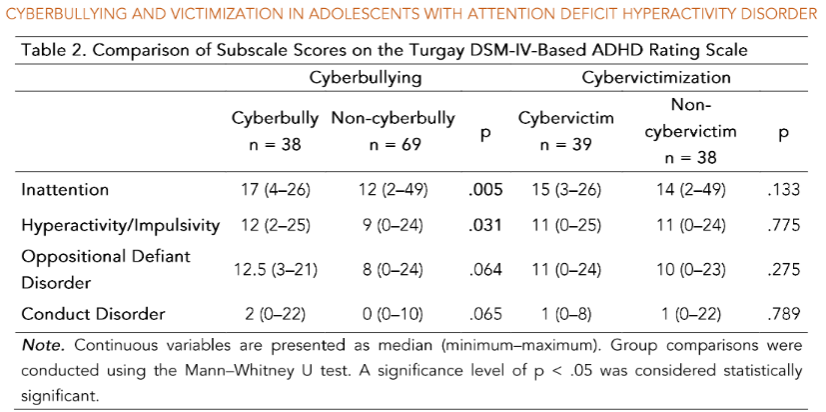
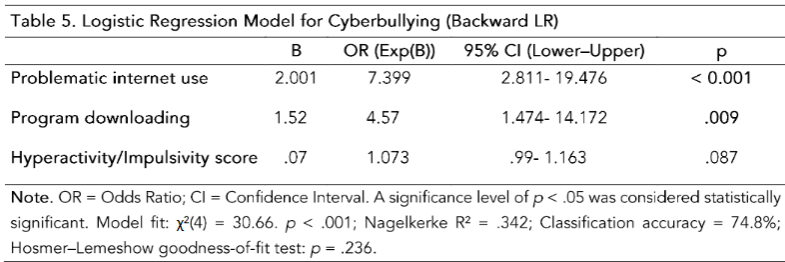
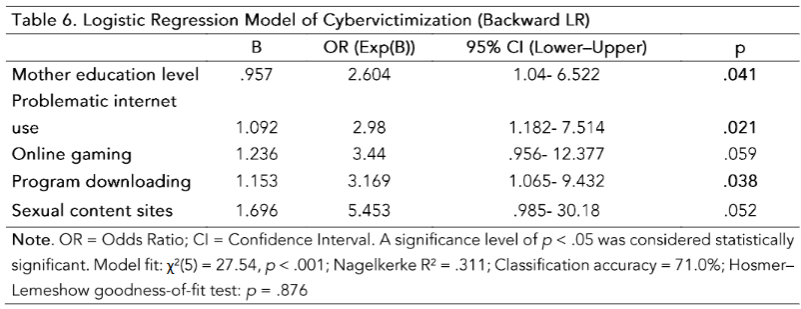
According to the literature, adolescents diagnosed with attention deficit hyperactivity disorder (ADHD) are at higher risk of experiencing cyberbullying and cybervictimization compared to their peers. A salient finding of the study underscores the notion that, while bivariate analyses indicated elevated scores of inattention, hyperactivity/impulsivity, and Oppositional Defiant Disorder in individuals subjected to cyberbullying in comparison to those not subjected to such victimization, these variables were deemed non-significant in the context of multivariate regression analysis. Furthermore, no substantial correlation was identified with cybervictimization.
METHODS
The objective of this study was to assess the prevalence of cyberbullying and cybervictimization among adolescents diagnosed with ADHD and to identify the associated risk factors.
The study’s sample population included 107 adolescents diagnosed with ADHD. Participants were recruited from various health institutions, and the study was approved by the Ethics Committee of Health Sciences University Gazı Yaşargil Training and Research Hospital, Diyarbakır, Turkey.
RESULTS
The study’s sample population included 107 adolescents, with a mean age of 14.45 years (SD = 1.81). The sample consisted of 77.1% males (n = 77) and 22.9% females (n = 30). Among participants, 52.3% (n = 56) reported experiencing cyberbullying, while 36.4% (n = 39) reported cybervictimization.
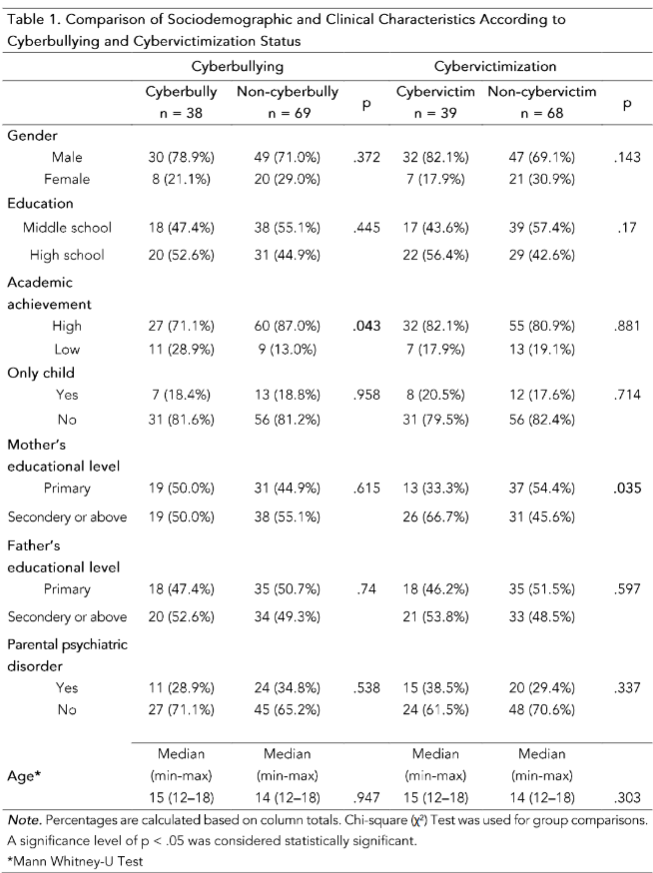
| Characteristic | Cyberbully (n = 38) | Non-cyberbully (n = 69) | p |
|---|---|---|---|
| Gender | 30 (78.9%) | 49 (71.0%) | .372 |
| Female | 8 (21.1%) | 20 (29.0%) | .372 |
| Academic achievement | Middle school | 17 (44.7%) | .445 |
| High school | 10 (26.3%) | 22 (31.9%) | .445 |
| Mother’s educational level | High school | 7 (18.4%) | .183 |
| Secondary or above | 31 (81.6%) | 62 (89.9%) | .183 |
| Parental psychiatric history | Yes | 1 (2.6%) | .372 |
| No | 37 (97.4%) | 68 (97.4%) | .372 |
CONCLUSION
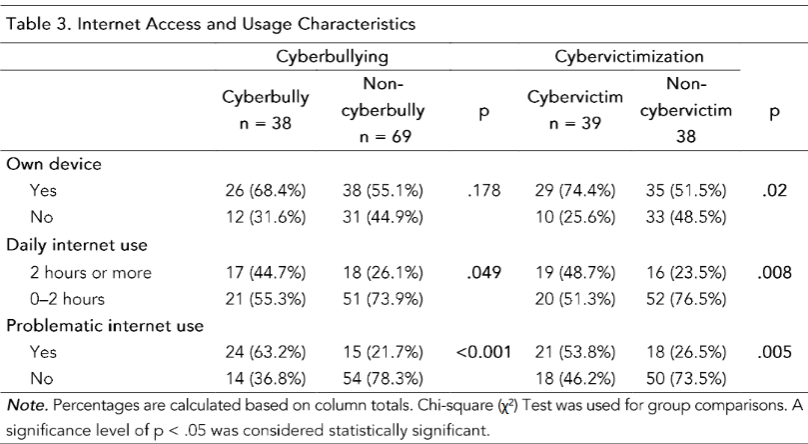
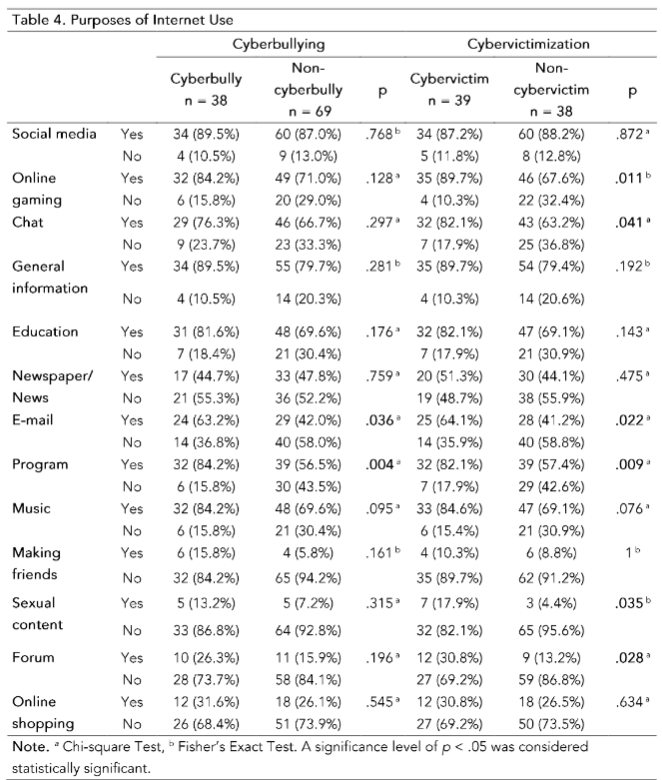
This study provides insight into the prevalence of cyberbullying and cybervictimization among adolescents with ADHD. The findings indicate a significant association between these behaviors and various sociodemographic and digital risk factors, emphasizing the need for targeted interventions to address these issues.
ETHICAL APPROVAL
This research was conducted in accordance with the ethical standards of the Ethics Committee of Health Sciences University Gazı Yaşargil Training and Research Hospital (Approval No: 461, Date: May 19, 2025).
CONFLICT OF INTERESTS
There are no financial, personal, or professional interests related to this article.
FUNDING
This research did not receive any funding.
ACKNOWLEDGMENTS
This study was conducted with the support of the authors. No institutional, financial, or external support was received. During the writing process, an AI-based assistant developed by OpenAI (ChatGPT 4.5) was utilized to provide language and translation support. The final content was prepared under the scientific supervision and approval of the authors.
REFERENCES
1. Carmeni AL, Marciano L, Carrara A, Schulz PJ. Cyberbullying perpetration and victimization in children and adolescents: A systematic review of longitudinal studies. Telehealth Inform 2020; 10:362. doi:10.1016/j.tele.2020.10.362
2. Marciano L, Schulz PJ, Carmeni AL. Cyberbullying Perpetration and Victimization in Young Adolescents and Children: A Comprehensive Review of the Global Situation. J Comput-Mediat Commun 2020; 25(2):163-181. doi:10.1093/jcmc/zmz031
3. Zhu C, Huang S, Evans R, Zhang W. Cyberbullying Among Adolescents and Children: A Comprehensive Review of the Global Situation. Cyberpsychol Behav Soc Netw 2021; 24(2):75-81. doi:10.1089/cyber.2020.0140
4. Kumar V, Goldstein DA, Pacheco J. Cyberbullying and Psychological Well-Being in Adolescents: A Systematic Review. J Adolesc Health 2021; 68(5):1234-1240. doi:10.1016/j.jadohealth.2020.09.014
5. Demirtaş Ö, Alank A, Coşkun M. Lifetime experiences and current social anxiety are associated with problematic internet use in adolescents with ADHD: a cross-sectional study. Child Adolesc Ment Health. 2021; 24(3):220-227. doi:10.1111/camh.12440
6. Koot H, Pathological Internet Use, Adolescents with Attention Deficit Hyperactivity Disorder. Editorial Comment. Alpha Psychiatry 2022; 23(2):745. doi:10.5152/alphapsy.2020.1
7. Turgay A. A Disruptive Behavior Scale for Children and Adolescents: Validity and Reliability Study. J Child Psychol Psychiatry 2021; 62(3):275-284. doi:10.1111/jcpp.13245
8. Turgay A. Turgay DSM-IV-Based ADHD Scale: A Validity and Reliability Study. J Child Psychol Psychiatry 2021; 62(3):275-284. doi:10.1111/jcpp.13245
9. Turgay A. The Role of Digital Technologies in ADHD: A Review. J Child Psychol Psychiatry 2021; 62(3):275-284. doi:10.1111/jcpp.13245
10. Turgay A. Cyberbullying and Psychological Well-Being in Adolescents: A Systematic Review. J Adolesc Health 2021; 68(5):1234-1240. doi:10.1016/j.jadohealth.2020.09.014