

Impact of Facebow on Complete Denture Outcomes
Does the fabrication of conventional complete dentures using articulators with facebow lead to better clinical results? A scoping review
Fernández E1., Guzmán JP1., Padilla P2., Acosta H2., Stuven J.3
- Fernández E., Cirujano Dentista, D.D.S. Especialista en Rehabilitación Oral, Profesor Asociado, Docente Clínica Integrada del Adulto II y Postgrado de Rehabilitación Oral, Universidad San Sebastián. Santiago de Chile.
 http://orcid.org/0000-0003-2257-8877
 - Guzmán JP., Cirujano Dentista, D.D.S. Especialista en Rehabilitación Oral, Profesor Asistente, Docente Clínica Integrada del Adulto II y Postgrado de Rehabilitación Oral, Universidad San Sebastián. Santiago de Chile. http://orcid.org/0009-0008-1175-631X
- Padilla P., Cirujano Dentista, D.D.S. Especialista en Rehabilitación Oral, Profesor Asistente, Docente Clínica Integrada del Adulto I. Universidad San Sebastián. Santiago de Chile. http://orcid.org/0000-0002-8241-8368
- Acosta H., Cirujano Dentista, D.D.S. Profesor Instructor, Docente Clínica Integrada del Adulto I. Universidad San Sebastián. Santiago de Chile.
- http://orcid.org/0009-0008-0386-0133
- Stuven J., Cirujano Dentista, D.D.S. Especialista en Rehabilitación Oral, Profesor Asistente, Docente Clínica Integrada del Adulto II. Universidad San Sebastián. Santiago de Chile. http://orcid.org/0009-0006-1727-8588
OPEN ACCESS
PUBLISHED: 28 February 2025
CITATION : Fernández, E., Guzmán, JP., et al., 2025. Does the fabrication of conventional complete dentures using articulators with facebow lead to better clinical results? A scoping review. Medical Research Archives, [online] 13(2). https://doi.org/10.18103/mra.v13i2.6164
COPYRIGHT: © 2025 European Society of Medicine. This is an open-access article distributed under the terms of the Creative Commons Attribution License, which permits unrestricted use, distribution, and reproduction in any medium, provided the original author and source are credited.
DOI: https://doi.org/10.18103/mra.v13i2.6164
ISSN 2375-1924
Abstract
Objective: to establish whether there is high-quality evidence to support the hypothesis that the use of facebow, results in improved devices as compared to those elaborated using the simplified technique.
Methods: a scoping review of the relevant literature was performed to search for high-quality clinical evidence to confirm or refute such hypothesis.
Results: the absence of conclusive findings that favor the use of adjustable articulators with functional impression has minimal impact and does not translate into increased rates of patient satisfaction, comfort, or improvement in masticatory efficiency.
Conclusions: the use of semi-adjustable articulators with facebow is a valid alternative to produce full dentures, not only in teaching contexts, since their use is currently supported by solid quality scientific evidence.
Keywords: Conventional complete denture technique, conventional complete denture method, traditional complete denture technique, simplified complete denture technique, simplified complete denture method.
Introduction and Problem Formulation
The fabrication of acrylic complete dentures (ACDs) remains one of the most used therapeutic approaches for edentulous patients, both in Chile and worldwide (OMS, 2022; MINSAL, 2022; Ereifej et al. 2024). Although great progress has been made in the field of oral rehabilitation with implants, ACDs continue to offer advantages such as lower cost and the avoidance of surgeries involving osseointegrated implants in high risk patients or in those who cannot afford this option due to their socio-economic situation (Ereifej et al., 2024). Furthermore, such is the scale of acrylic denture fabrication at the primary and secondary level of public sector healthcare in Chile that a recent study calculated an average of 1 million prostheses (partial and complete acrylic dentures) fabricated per year between 2017 and 2019 (Danke et al., 2024) a fact that would merit further questioning and investigation.
In undergraduate Dentistry degree programs of Chilean universities, it is common for institutions to teach pedagogical units that aim for students to learn how to make ACDs, since it has been demonstrated that ACDs improve quality of life and oral health of edentulous people (Rojas-Gómez et al. 2017; Yáñez-Haro et al., 2023). It should be noted that these individuals represent a significant percentage of the Chilean population (17.6% of edentulous people were reported in 2019 in the age group 65-74 years) (MINSAL 2019; Instituto Nacional de Estadística 2017). Moreover, to care for (at least) one edentulous patient remains a requirement for approval during the course of the degree. The official bibliography proposed in the curriculum of programs (at least in 2024) is based on books and texts that describe – in general – ACD fabrication protocols that include techniques such as functional impression, border molding, use of facebow, mounting of occlusal rims on semi-adjustable articulators, dental articulation in semi-adjustable articulators, among others. Several of these techniques are even procedurally evaluated among the students. This set of techniques are al., 2015; Ye Ye et al. 2016; Ceruti et al., 2017; Kawai et al., 2018; Ereifej et al., 2024) which, based on the results found by recent top-quality scientific evidence (Jo et al., 2015; Paulino et al., 2015; Ye Ye et al., 2016; Ceruti et al., 2017; Kawai et al., 2018; Ereifej et al., 2024), have a considerably low level of support that back them up in the case of a more rigorous analysis (Carlsson, 2010; MINSAL, 2020; Jo et al., 2015; Paulino et al., 2015; Ye Ye et al., 2016; Ceruti et al., 2017; Kawai et al., 2018; Ereifej et al., 2024).
This handbook is intended to specifically focus on the mounting of occlusal rims (or wax rims) and artificial teeth for the purpose of aesthetic testing, vertical dimension measurement, and assessment of occlusion. This procedure can be performed both on semi-adjustable articulators (which implies the use of a facebow), and on occluders (hinge articulators; or average value articulators that do not use a facebow). In teaching contexts, the first type has been traditionally more used than the latter in Chilean and North American dental schools (Carlsson, 2010; Ereifej et al., 2024). The arguments supporting the use of semi-adjustable articulators with facebow are in line with the desire to represent maxillomandibular relationships and characteristics of static and dynamic occlusion of artificial teeth of ACDs in a rigorous way, and are related to the anatomy and functionality of the TMJ, in contrast to the use of occluders that would only enable the evaluation of static occlusion, or the partial evaluation of dynamics (average value articulators). The simplicity of using the occluder has also been associated with lower-quality processes and final outcomes. However, and contrary to what has traditionally been taught, current evidence advocates for simplified techniques in ACD fabrication, which includes the use of occluders over the use of articulators (Jo et al., 2015; Paulino et al., 2015; Ye Ye et al., 2016; Ceruti et al., 2017; Kawai et al., 2018; Ereifej et al., 2024). In addition to the above, it is quite common for occluders to be more frequently used in dental professional practice, instead of the semi-adjustable articulator (Ye Ye et al., 2016), generating important contradictions between the academia and the national professional sphere.
In order to be in line with the declared graduate profile of the degree program, it is necessary to teach clinical protocols that are supported by quality scientific evidence, which allows us to elucidate if it is pertinent to continue teaching (and demanding) the use of semi-adjustable articulators for these cases, or if it will be necessary to modify or rather update the contents and examinations of the relevant pedagogical units.
Search and bibliographic selection
On the basis of the guiding question: Is there high-quality evidence to show that the mounting on semi-adjustable articulators yields better results than the mounting on occluders in the case of ACD fabrication?, search and selection criteria were defined as follow: (1) randomized clinical trials, systematic reviews and meta-analyses; (2) year of publication must be from 2014 onwards; (3) studies must be in English; and (4) both the abstract and the article must be available on MEDLINE. In vitro studies, clinical reports or other types of publications were not considered, nor were studies that had been published prior to 2014 or that were not in English or Spanish. For the MEDLINE search, the key terms used were: “conventional complete denture technique” or “method”. A search was also simplified complete denture technique” or “method”. The terms simplified method of simplified techniques in oral rehabilitation that exclude the steps of secondary impression and/or border molding and/or use of semi-adjustable articulator with facebow (Ye Ye et al., 2016). No statistical analysis was conducted on the results of the selected articles, but they were rather summarized in a didactic way to invite reflection around the current consensus on the subject.
Results
After conducting the search of literature that fit the inclusion criteria, 10 articles were selected, from which the following considerations or conclusions are drawn.
Jo et al described, that complete dentures fabricated by two experienced dentists using a conventional method resulted in significantly higher overall patient satisfaction compared to dentures made using a simplified method. No significant differences were observed in oral health-related quality of life between the two methods. In this study, the “simplified technique” simply consisted of omitting the step of a final impression with border molding. In both study groups, an average value articulator was used, which does not use a facebow but does allow the reproduction of eccentric movements.
Paulino et al stated, that there are no differences between the 2 methods (conventional or simplified) in terms of chewing efficiency, patient satisfaction or quality of the prostheses. In addition, they concluded that the simplified method saves clinical time and reduces costs. The authors suggested that dental schools should consider this simplified methodology when designing complete denture courses. However, the following considerations should be taken into account: The article included 6 studies that presented methodologies too diverse to enable a meta-analysis to be performed, and only one of those studies (Heydecke, 2008) specifically mentioned the use of occluders versus facebow articulators.
Ye et al. concluded that the simplified method can fully or partially replace the traditional method, since it is more cost-effective, efficient and ensures quality. Specific rules should be designed to restrict the execution of this technique, as well as further research should be conducted when it comes to more complex cases. The authors indicate that, despite the settled definitions, the studied articles differ greatly in their understanding of what a simplified technique entails: some do not perform secondary impressions; others do not perform border molding; others do not mount casts on articulators with facebow. The methods were varied and not always thoroughly described in the studies.
Mengatto et al. found that no significant differences were noted in terms of masticatory performance, quality of complete denture fabrication or chewing ability, regardless of the method used (conventional or simplified). In this case, the authors do indicate that the simplified technique involved skipping the step of secondary impressions and mounting without facebow.
Ceruti et al. concluded that the simplified method requires a shorter time frame and constitutes an acceptable alternative for the fabrication of complete dentures. The authors did not specify the methods used to record maxillomandibular relationships between both study groups, that is, whether or not an articulator was used.
Kawai et al described that, after 10 years of follow-up, no differences were found between the outcomes obtained when complete dentures were fabricated using a conventional or simplified method. Dental schools are encouraged to implement modifications to their training programs on complete denture manufacturing.
Lira-Oetiker et al found no significant differences with respect to patient satisfaction or overall quality of complete dentures manufactured by either conventional or simplified techniques. The use of the simplified technique is supported due to its easy implementation and reduced costs. Dental schools are recommended to include this alternative methodology to fabricate complete dentures. The authors indicate that their simplified method involves alginate impressions and the use of an occluder.
Al-Ansani et al noted that complete dentures, manufactured by either the conventional or simplified method, yielded similar results in terms of patient satisfaction and impact on quality of life. Complete dentures made using simplified methods translated into reduced manufacturing time and lower cost. Of the 11 studies included in the meta-analysis, 3 mentioned the use of an occluder and 2 mentioned average value articulators, which do not use a facebow.
Suman et al observed that there is no clinical evidence that the use of facebow is essential in complete denture fabrication. Simplified methods may yield similar results as more complex techniques. The authors included 15 studies from 1978 to 2019, with an emphasis on the use or non-use of articulators using facebow. This would be one of the most important studies for the subject discussed herein.
Ereifej et al found that the simplified technique resulted in greater patient satisfaction with respect to speech, complete denture retention and denture stability, as well as overall satisfaction with complete maxillary dentures, compared to the conventional approach. A recommendation is made to incorporate the simplified method into the public health system and also into the academic curriculum. This study puts special emphasis on the simplification of the impression stage. In both study groups, average value articulators, which do not use a facebow, were used.
Of the 10 articles initially included, only 6 (Ho et al., 2015; Mengatto et al., 2017; Lira-Oetiker et al., 2018; Al-Ansari et al., 2019; Suman et al., 2021; Ereifej et al., 2024) specified the methodology for recording maxillomandibular relationships. In order to increase the weight of the evidence presented in this paper, it was then decided to carry out a second literature search (in this case totally intentional), with two methodologies: (1) using the bibliographic references of the articles already selected that explicitly mentioned the use or non-use of articulators, occluders and/or facebow; and (2) adding another database, in this case Epistemónikos, with the same keywords used at the beginning. After this second intentional search, the following articles were added, from which the following considerations and conclusions were extracted.
Kawai et al. found that no significant differences were observed with respect to patient satisfaction or perceived quality of complete dentures manufactured using either traditional or simplified methods. These results support the use of simplified techniques, which are easier to master and should reduce treatment costs. Educators should consider these findings when designing curricula for prosthodontic training. When functional impression and border molding, as well as facebow, were used together, they did not have a significant impact on the results obtained between the study groups.
Heydecke et al noted that the use of complex recordings of maxillomandibular relationships with the use of a facebow does not appear to improve patients’ ratings in terms of satisfaction, stability of the prosthetic device, or chewing ability. The study groups used either a facebow with semi-adjustable articulators, or average value articulators, which do not use a facebow. Patients received two sets of complete dentures (one of each was fabricated with the conventional technique and the other with administered questionnaires in order to know patients’ assessment.
Cunha et al described that dentures fabricated using a simplified protocol recover the masticatory performance of edentulous patients to the same extent as with a conventional protocol. Both protocols resulted in similar chewing ability, with the simplified method yielding a slightly better outcome in terms of facilitating feeding. In short, a simplified method for complete denture fabrication can restore masticatory function at least as well as the conventional protocol. The study specified the use or non-use of facebow in the study groups, as well as simplifying the impression stage.
Omar et al found no significant differences in the level of satisfaction of complete denture wearers, nor in patients’ assessments of complete denture quality, whether they were fabricated using the conventional protocol or one of the three simpler variations of the protocol. In the absence of conclusive findings that favor traditional techniques, the prescription of conventional time-consuming techniques as a standard of care should be questioned. The inclusion of simpler techniques in undergraduate education should be considered. Researchers modified the number of impressions and the mounting step, which did or did not include the use of a facebow articulator. Participants were divided into 4 study groups (2 impressions using facebow; 2 impressions without facebow; 1 impression using facebow; and 1 impression without facebow).
Farias-Neto et al concluded that current scientific evidence suggests that facebow transfer is not imperative to achieve better clinical outcomes in prosthodontics. Randomized clinical trials suggest that simpler approaches to complete denture fabrication and occlusal splints may have acceptable results, while no clinical studies have assessed their use in fixed and removable partial dentures. Eight studies conducted between 1950 and 2013 were included, which were focused on the use or non-use of facebow. In addition, this is one of the most robust studies in this context that was found in the literature search, along with the article by Vijyanta Suman et al., 2021.
Núñez et al noted that there was a significant improvement in satisfaction with complete dentures and oral health-related quality of life after the insertion of new dentures. The traditional protocol did not show superiority over the simplified protocol for complete denture fabrication.
Da Silva Girundi et al reported that the simplified technique presented similar quality, masticatory function and patient perception when compared to the traditional technique. This study included 60 participants, divided into two groups (traditional technique and simplified technique). Assessments were performed pre-treatment (baseline) and at 2 and 4 months after adaptation to the new complete dentures. The variables evaluated were satisfaction, oral health-related quality of life (OHRQoL), denture quality; and in terms of functionality, masticatory performance and swallowing threshold were assessed.
The results obtained by Miyayasu et al indicated that the total cost of the conventional method was significantly higher than that of the simplified method. In this study, the “simplified technique” simply consisted of omitting the step of a final impression with border molding. In both study groups the authors used an average value articulator, which does not use a facebow.
De Villa Camargos et al concluded that the simplified method for the fabrication of complete dentures could produce prostheses with functional quality and patient satisfaction comparable to those produced with the conventional method, even when they were made by dental students. Thirty-six participants were included in this study, divided into two groups (conventional technical method and simplified method). In the conventional method, the position of maxillary rims was transferred to a semi-adjustable articulator through a facebow. In the simplified method, occlusal plane orientation and maxillomandibular relationships were obtained using record bases. Camper’s table was employed for a standardized mounting (15 degrees) of the upper cast in the articulator. The results showed that there was no significant difference between the two methods with respect to OHRQoL, patient satisfaction, denture quality, or masticatory performance.
Discussion
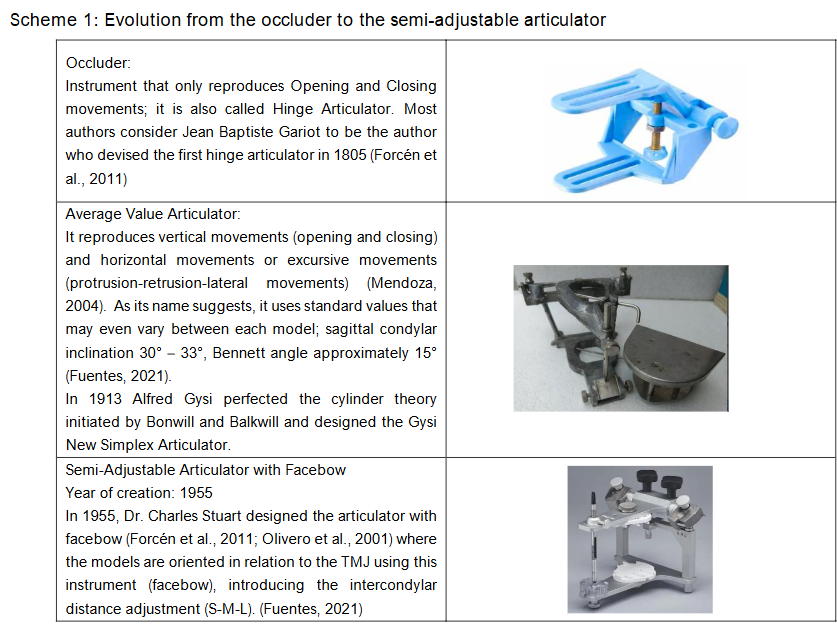
Whereas in theory the terms “simplified complete denture” or “simplified techniques” refer to a set of techniques that exclude secondary impressions, border molding, and also the use of a semi-adjustable articulator with facebow for the fabrication of ACDs (Ye Ye et al., 2015), in practice this definition is inconstant, and differs among the authors of the studies, in the fact that one or more of the aforementioned stages may be omitted. This situation is also described in the article by Ye Ye (Ye Ye et al., 2015). However, in those studies that do specify the mounting technique of occlusal rims, three groups are distinguished between the studies: 1) semi-adjustable articulator with facebow; 2) occluder; and 3) average value articulator, which also does not use facebow (Refer to Scheme 1). For the purposes of this review, and at the discretion of the authors, in those studies where the use of average value articulators (e.g. Gysi) is described, the results would be comparable to those obtained with the use of occluders.
In the results observed in this review, of the 16 studies that were retrieved through searches, 8 explicitly indicated the use of articulator versus occluder or average value articulator (Ayami et al., 2015; Machado et al., 2017; Lira-Oetiker et al., 2018; Suman et al., 2021; Kawai et al., 2005; Heydecke et al., 2008; Cunha et al., 2013; Omar et al., 2013), and in all of them it was not possible to demonstrate any superiority of the use of the semi-adjustable articulator with facebow in ACD fabrication protocols. This would imply that the technological evolution of these devices, focused on representing as accurately as possible the morphology, characteristics of the TMJ, and relationship with the skull, would not ultimately have major clinical implications in this field. The sophistication of the maxillomandibular record does not represent a better quality of ACDs, nor does it represent a better perception of the patient regarding their ACDs (Kawai et al., 2005; Heydecke et al., 2008; Cunha et al., 2013; Omar et al., 2013).
In general, all the studied articles indicated that simplification of protocols (both of impressions and maxillomandibular records) would be a positive advance in ACD fabrication, since they entail fewer sessions, reduced laboratory costs, and improved patient comfort. In addition to the above, the evidence shows that the use of a facebow or a traditional technique with peripheral sealing and functional impression has minimal impact and does not translate into increased rates of patient satisfaction, comfort, or improvement in masticatory efficiency (Kawai et al., 2005; Heydecke et al., 2008).
When considering the variable “bone resorption”, the manufacture of complete dentures using a mucostatic technique translates into a reduction of residual ridge resorption in patients with decreased bone density (Tripathi 2019). Both clinically and academically, the available scientific evidence supports simplified protocols for the fabrication of ACDs.
Conclusions
In the absence of conclusive findings that favor the use of semi-adjustable articulators with facebow over other options during the fabrication of acrylic complete dentures, simplified protocols (i.e., the use of occluders or average value articulators) should be considered as a valid alternative not only in teaching contexts, since their use is currently supported by solid quality scientific evidence.
In any case, future research must use the best possible study designs to resolve existing controversies and uncertainties. The dental community should take an active part in this process (Carlsson, 2010).
Conflict of Interest:
None.
Funding Statement:
None.
Acknowledgements:
None.
References:
- Global Oral Health Status Report: Towards universal health coverage for oral health by 2030. World Health Organization. Accessed verified December 10, 2024. https://www.who.int/publications/i/item/9789240061484.
- Ministerio de Salud (MINSAL). Orientaciones técnico-administrativas para la ejecución del programa odontológico integral 2022. Available at: https://www.studocu.com/cl/document/universidad-del-alba/clinica-de-odontogeriatria/0-orientacion-tecnica-programa-odontologico-integral-2022-extracto-mas-sonrisas/44611977. Accessibility verified December 10, 2024.
- Ereifej NS, Oweis YG, Manaseer WE, Omoush SA, Awwad MA, Sartawi S. Simplified versus conventional complete dentures: A randomized crossover clinical trial. Journal of Prosthetic Dentistry. 2022;131(1):50-55. doi:10.1016/j.prosdent.2022.02.002
- Danke K, Bevensee I, Silva AB, et al. Rehabilitation with removable dentures in adults and older people with partial or total edentulism: Chilean Public Health System Experience, 2017-2019. Archives of Gerontology and Geriatrics Plus. Published online September 1, 2024:100084. doi:10.1016/j.aggp.2024.100084
- Rojas-Gómez PN, Mazzini-Torres MF, Romero-Rojas K. Pérdida dentaria y relación con los factores fisiológicos y psico-socio económicos. DOAJ (DOAJ: Directory of Open Access Journals). Published online April 1, 2017. doi:10.23857/dc.v3i2.446
- Haro DY, López-Alegría F. Influencia de la salud oral en la calidad de vida de los adultos mayores: una revisión sistemática. International Journal of Interdisciplinary Dentistry. 2023;16(1):62-70. doi:10.4067/s2452-55882023000100062
- Proyecciones de Población. Default. https://www.ine.gob.cl/estadisticas/sociales/demografia-y-vitales/proyecciones-de-poblacion
- Ministerio de Salud (MINSAL). (2019). Informe encuesta nacional de salud 2016-2017 Salud Bucal. Available at: https://goo.gl/oe2iVt. Accessibility verified December 10, 2024
- Jo A, Kanazawa M, Sato Y, Iwaki M, Akiba N, Minakuchi S. A randomized controlled trial of the different impression methods for the complete denture fabrication: Patient reported outcomes. Journal of Dentistry. 2015;43(8):989-996. doi:10.1016/j.jdent.2015.05.007
- Paulino MR, Alves LR, Gurgel BCV, Calderon PS. Simplified versus traditional techniques for complete denture fabrication: A systematic review. Journal of Prosthetic Dentistry. 2014;113(1):12-16. doi:10.1016/j.prosdent.2014.08.004
- Ye Y, Sun J. Simplified Complete Denture: A Systematic review of the literature. Journal of Prosthodontics. 2016;26(4):267-274. doi:10.1111/jopr.12463
- Mengatto C, Gameiro G, Brondani M, Owen C, MacEntee M. A Randomized Controlled Trial of Mastication with Complete Dentures Made by a Conventional or an Abbreviated Technique. The International Journal of Prosthodontics. 2017;30(5):439-444. doi:10.11607/ijp.4741
- Ceruti P, Mobilio N, Bellia E, Borracchini A, Catapano S, Gassino G. Simplified edentulous treatment: A multicenter randomized controlled trial to evaluate the timing and clinical outcomes of the technique. Journal of Prosthetic Dentistry. 2017;118(4):462-467. doi:10.1016/j.prosdent.2017.01.024
- Kawai Y, Muarakami H, Feine JS. Do traditional techniques produce better conventional complete dentures than simplified techniques? A 10-year follow-up of a randomized clinical trial. Journal of Dentistry. 2018;74:30-36. doi:10.1016/j.jdent.2018.04.027
- Lira‐Oetiker M, Seguel‐Galdames F, Quero‐Vallejos I, Uribe SE. Randomised clinical trial of patient satisfaction with traditional and simplified complete dentures. Journal of Oral Rehabilitation. 2018;45(5):386-392. doi:10.1111/joor.12617
- Al-Ansari A, Tantawi ME. Patient-reported outcomes and efficiency of complete dentures made with simplified methods: A meta-analysis. Dental and Medical Problems. 2019;56(4):411-418. doi:10.17219/dmp/109945
- Suman V, Sonnahalli N, Chowdhary R. Use of Facebow device in prosthodontics: A systematic review on randomized control trials. The Journal of Indian Prosthodontic Society. 2021;21(1):11. doi:10.4103/jips.jips_197_20
- Carlsson GE. Some dogmas related to prosthodontics, temporomandibular disorders and occlusion. Acta Odontologica Scandinavica. 2010;68(6):313-322. doi:10.3109/00016357.2010.517412
- Ministerio de Salud (MINSAL). Resumen ejecutivo Guía de Práctica Clínica Salud Oral Integral. Tratamiento y Rehabilitación Oral en Personas Adultas y Personas Mayores con Edentulismo Parcial o Total. https://diprece.minsal.cl/wp-content/uploads/2022/08/RE_GPC_Edentulismo_2018_-corregir-autores-03082022-v4.pdf. Accessibility verified December 10, 2024
- Nuñez MCO, Silva DC, Barcelos BA, Leles CR. Patient satisfaction and oral health‐related quality of life after treatment with traditional and simplified protocols for complete denture construction. Gerodontology. 2013;32(4):247-253. doi:10.1111/ger.12078
- Kawai Y, Murakami H, Shariati B, et al. Do traditional techniques produce better conventional complete dentures than simplified techniques? Journal of Dentistry. 2005;33(8):659-668. doi:10.1016/j.jdent.2005.01.005
- Heydecke G, Vogeler M, Wolkewitz M, Türp JC, Strub JR. Simplified versus comprehensive fabrication of complete dentures: Patient ratings of denture satisfaction from a randomized crossover trial. BDJ. 2008;205(6):325. doi:10.1038/sj.bdj.2008.807
- Regis RR, Cunha TR, Della Vecchia MP, Ribeiro AB, Silva‐Lovato CH, De Souza RF. A randomised trial of a simplified method for complete denture fabrication: patient perception and quality. Journal of Oral Rehabilitation. 2013;40(7):535-545. doi:10.1111/joor.12063
- Omar R, Al-Tarakemah Y, Akbar J, Al-Awadhi S, Behbehani Y, Lamontagne P. Influence of procedural variations during the laboratory phase of complete denture fabrication on patient satisfaction and denture quality. Journal of Dentistry. 2013;41(10):852-860. doi:10.1016/j.jdent.2013.07.013
- Farias‐Neto A, Dias AHM, De Miranda BFS, De Oliveira AR. Face‐bow transfer in prosthodontics: a systematic review of the literature. Journal of Oral Rehabilitation. 2013;40(9):686-692. doi:10.1111/joor.12081
- Owen C. Appropriatech: Prosthodontics for the many, not just for the few. The International journal of prosthodontics. 2004;17. 261-2.
- Da Silva Girundi FM, Marcello-Machado RM, Girundi ALG, Gonçalves TMSV, Del Bel Cury AA, Da Silva WJ. Performance of complete dentures fabricated with the simplified and the traditional technique: A randomized clinical trial. Journal of Prosthetic Dentistry. 2021;130(2):229-237. doi:10.1016/j.prosdent.2021.08.024
- Miyayasu A, Kanazawa M, Jo A, Sato Y, Minakuchi S. Cost-effectiveness analysis of two impression methods for the fabrication of mandibular complete dentures. Journal of Dentistry. 2017;68:98-103. doi:10.1016/j.jdent.2017.10.006
- De Villa Camargos G, Armenine TE, Paleari AG, Nascimento GMO, Munhoz MFV. Teaching Complete Denture Procedures to Dental Students By Conventional or Simplified Methods: A Randomized Clinical Trial. Journal of Dental Education. 2019;83(3):303-313. doi:10.21815/jde.019.023
- Forcén A, Martínez-Lage J, Ruiz M. Articuladores: historia, fundamentos y consideraciones clínicas. Publicado el: 11/01/2011. Accessed verified October, 16 2024. http://www.redoe.com/ver.php?id=117
- Mendoza de Elías R. Manual de manejo del articulador Whip Mix. 1a Edición. Imprenta Universitaria de la Universidad Autónoma de Ciudad Juárez; 2004.
- Fuentes R. Articuladores Dentales. 1a Edición Editorial Nueva Mirada; 2021: 11, 15. Available in: https://nuevamiradaediciones.cl/libros/articuladores-dentales/. Accessed verified October, 16 2024.