





Human and Planetary Health: Benefits of Plant-Based Diets
“`html
Balancing Human and Planetary Health Through Plant-Based Diet
Rattan Lal
Abstract
Dietary preferences, with strong implications for health and sustainability, including climate change, is an emerging scientific discipline of nutrition ecology. Unsustainable poor food choices are a serious health issue as is a growing concern in undernourished populations (hidden hunger) is also a growing concern in developed nations. A transition based on plant-based diets (PBDs) is gaining momentum in the interest of enhancing human wellbeing and restoring planetary processes including ecological sustainability.
Keywords
Plant-based diets, human health, planetary health, sustainability, nutrition ecology
Introduction
Hunger and malnutrition is driving major causes of diseases (i.e., obesity, diabetes, hypertension, some cancers, malnutrition), and growing risks of civil unrest and political instability. The adverse effects of predominantly animal-based diets (ABDs) on planetary processes include anthropogenic global warming, water scarcity, loss of biodiversity etc. Therefore, a trend of shifting from ABDs to plant-based diets (PBDs) is gaining momentum in the interest of enhancing human wellbeing and restoring planetary processes. Interest in PBDs is also growing because of the ecological sustainability.
Table 1. Examples of reduction in greenhouse gas emissions
| Approach | Impact | References |
|---|---|---|
| Life Cycle Analysis (LCA) | Reduces GHG emissions | Coelho et al., 2021 |
| Cohort & randomized control | Reduces food-related EFP | Agnoletto et al., 2023 |
Health and Nutrition
Vegetarian diet (VD): It is a vegan diet plus fish and seafood, but no meat, eggs, and dairy.
Vegetarian Diet (VD): It includes VGD plus fish and seafood, but no meat, eggs, and dairy.
Flexitarian Diet (FD): It is semi-vegetarian diet that focuses on plant-based food while occasionally including meat. It is a combination of flexible and vegetarian diets.
Territorial Diversified Diet (TDD): It is a flexitarian style diet that includes plant-based food along with seasonal locally sourced food. Some examples of TDD are Mediterranean and New Nordic Diet.
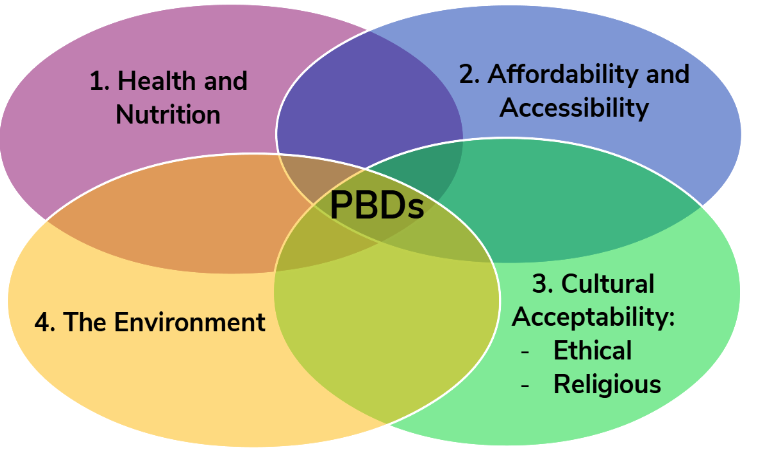
Reduction in Greenhouse Gas Emissions by Adoption of PBDs
One of the ecological benefits of adopting PBDs is the reduction of greenhouse gas emissions (GHGs) from predominantly animal-based foods. While more context-specific research may be needed to check the carbon-footprint (CF) of PBDs, the data from some examples listed in Table 2 are a cause of optimism. Several approaches, including the life cycle assessment (LCA) indicate reduction in CFP by decrease in emission of methane (CH4) and nitrous oxide (N2O) through adoption of PBDs.
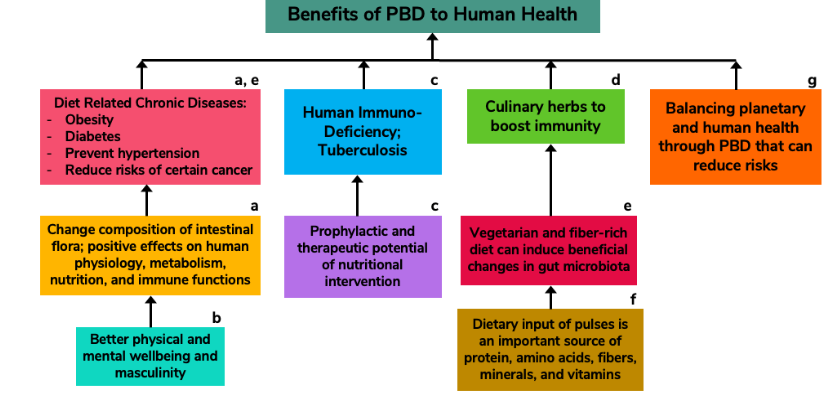
One-Health Benefit of PBDs
The One-Health model is gaining momentum among agronomists, veterinarians, human nutritionists, and those concerned with planetary health. The data in Table 3 outlines examples of the PBDs that also support the One-Health model as confirmed through diverse approaches including LCA, cohort and randomized control trials of diverse and well-planned diets.
Table 3. One-Health Benefit Impact
| Approach | Impact | References |
|---|---|---|
| Life Cycle Analysis | Reduces health indicators | Viroli et al., 2021 |
| Veganism | Addresses simultaneously issues of food, health, climate change | Agnoletto et al., 2022 |
Health Risks of PBDs and Environmental Impacts
Despite numerous benefits pertaining to PBDs, there are some health issues of PBDs which are neither properly planned nor adequately balanced. Important among these concerns (Table 4) are dietary deficiencies, low digestibility, existence of some anti-nutritional factors.
Table 4. Health risks of PBDs and Environmental Impacts
| Causes of Malnutrition in PBDs | Impact | References |
|---|---|---|
| Lack of essential nutrients | Increases anti-nutritional compounds | Kampoloutou and Scazzina, 2022 |
| Deficiency of Fe and Zn | Increases risk of non-communicable diseases | Adoh, 1954 |
Planetary Benefits of PBD
Planetary benefits of PBDs include reduced CFP, decreasing emission of GHGs, increasing above and below-ground biodiversity, sparing land for human health.
General Considerations
An objective assessment of PBDs includes the health impacts of PBDs on human health and the environment. The risks of nutrient deficiencies in vulnerable populations under PBDs are aggravated by dietary preferences which may contain suboptimal levels of essential nutrients.
Conclusions
Human health is at a critical crossroads of growing environmental challenges, and the adoption of PBDs is a viable option for addressing these challenges while promoting health benefits.
References
1. Lal R. The soil nexus: our common future. SCIENCE AND PLANT NUTRITION. 2015;64:568.
2. Aavik K, Vegan M. Vegan Men’s Food and Health Practices: A Recipe for a New Holistic Sustainability. AMERICAN JOURNAL OF MEN’S HEALTH. 2021;15(1).
3. Coelho C, Pometlová F, van der Werf H. Environmental Life Cycle Assessment of Diets with Improved Omega-3 Fatty Acid Profiles. PLOS ONE. 2016;11(8):e016397.
4. Viroli G, Kampoloutou A, Gena H. Exploring Benefits and Barriers of PBDs. NUTRIENTS. 2023;15(1).
5. Agnoletto A, Sadler E, Triplett M. Nutritional and environmental impacts of PBDs. JOURNAL OF HUMAN NUTRITION AND DIETETICS. 2023;36(3).
“`