

Early History of Radioactive Material Transportation
Radium Boxes: On the Early History of the Transportation of Radioactive materials
Dr. Aske Hennelund Nielsen1, Dr. Maria Rentzsch2
- Chair of Science, Technology and Gender Studies at the Friedrich-Alexander-Universität Erlangen-Nürnberg
OPEN ACCESS
PUBLISHED: 30 November 2024
CITATION: Nielsen, AH. and Rentetzi, M., 2024. Radium Boxes: On the Early History of the Transportation of Radioactive materials. Medical Research Archives, [online] 12(11).
https://doi.org/10.18103/mra.v12i11.5935
COPYRIGHT © 2024 European Society of Medicine. This is an open-access article distributed under the terms of the Creative Commons Attribution License, which permits unrestricted use, distribution, and reproduction in any medium, provided the original author and source are credited.
DOI https://doi.org/10.18103/mra.v12i11.5935
ISSN 2375-1924
Abstract
The transport of radioactive materials has been an issue that has preoccupied professionals working with radiation in medical settings for over a century. With this editorial, we look back at the history of how radioactive materials – particularly radium – was moved and transported by early radiologists at the beginning of the 20th century. After its discovery, radium was quickly commodified and sold in a variety of contexts, with medicine one of the primary ones. In these early days, radium was often shipped in small crates by the post, however, the precious mineral was not only radioactive and therefore dangerous, it was also highly valuable. This also led the main international organisation working on radiation protection of this period, the International Radiological Congress, to issue recommendations for the proper transport of radium. These recommendations also had important implications for radiological, clinical practice, and how radium was stored and transported within the clinic. The article concludes that the transportation of radioactive materials continues to be an important topic that occupies scientific and medical bodies.
Introduction
How do you transport radioactive materials? While the answer to many professionals working with radiation today might seem rudimentary – if still complex – this was not always the case. For decades, international, scientific discussions have been ongoing on how to best transport radioactive materials in a safe and practical matter. As advertised by the International Atomic Energy Agency (IAEA): “Each day thousands of shipments of radioactive materials, including waste and spent nuclear fuels, are transported globally. The IAEA strongly promotes the implementation of its transport safety regulations in all Member States, which has resulted in an exemplary worldwide transport safety and security record for over 50 years.”¹ Indeed, after the IAEA was founded in the 1957 and started to formulate regulations for transportation, some of the main concerns lay in how to ensure that packages containing radioactive materials did not leak radiation to their surroundings also by using proper packing: “… in order to prevent the release of the radioactive materials, the packages must be resistant to fire, water and shocks in foreseeable normal and accidental circumstances.”²
However, the history on the transportation of radioactive materials dates back many decades before the foundation of the IAEA, to the very earliest days of radiation research and the history of radiology as it was being formed in the early 20ᵗʰ century. In this article, we aim to show that the transportation of radioactive goods and materials has always a central, but perhaps overlooked,³ aspect of radiological and nuclear medicine history, that still continues to be very relevant to this. In order to do this, we highlight the early efforts of various radiation scientists and radiologists in trying to devise ways of transporting what was quickly recognized as not only dangerous substances, but also very expensive and costly materials that could not easily be replaced. We thereby show that the transportation of radioactive materials has always presented a challenge for nuclear industries – be that the early sale and distribution of radium as is the case in this article – or in the post-war period, where nuclear materials proliferated in more and more industries and sectors,⁴ and to the current day.
The Early Days
In the first decades after the discovery of x-rays by Wilhelm Conrad Röntgen in 1895 in Germany, a groundswell of interest started in what this hitherto unknown form of radiation was capable of, and what other potential forms of radiation still existed undiscovered. In 1903, Marie and Pierre Curie together with the physicist Henri Becquerel received the Nobel Prize for their common research on the “discovery of spontaneous radioactivity”.⁵ Becquerel and the Curies had gained a large interest in researching radiation forms, with Marie Curie being particularly interested in minerals that seemingly had innate radioactive properties. By the late 1890s, Marie Curie believed to have discovered two such minerals: Polonium, named after her native country Poland, and Radium, named after its radioactive properties.⁶ Radium, under whose name major commercial product, used in many and varied contexts, and especially within medicine.⁷
Already at this early stage in the history of radiation, the transportation of materials was essential, but the scale and setting were vastly different than what would come later. In order to extract even very small amounts of radium, huge quantities of pitchblende ore were needed. The largest producer around the turn to the 20ᵗʰ century was the St. Joachimsthal mine in what today is the Czech Republic but then was the Austro-Hungarian Empire. The Curies managed to secure a deal with the Austro-Hungarians for the import of raw pitchblende ore, at first around 1,1 ton in 1898–1899, which grew exponentially to 23,6 tons by 1906.⁸ Processing these large quantities of ore into radium was a huge undertaking, too large for a laboratory. Thus, the Curies secured industrial help to carry out the chemical reduction process.⁹
This laborious, industrial scale production of a radioactive material also reveal radium’s scientific, economic, and commercial value. From these tones of raw ore, only grammes of radium were produced.
However, this process was well worth it, as radium was a sought-after commodity for scientific and medical purpose. Already by the early 20ᵗʰ century, radium was one of the most valuable commodities in the world, with a contemporary observer noting in 1904 that: “It has been estimated that under existing conditions radium is worth about three thousand times its weight in pure gold”¹⁰. Indeed, a report by A.E. Hayward of the Radium Institute in London in 1922 stated that at current market prices one gramme of radium bromide cost about 15.000 pounds, however, “… at least, two grammes are necessary for the production of emanation in sufficient amount to treat even a modest number of patients daily, it is obvious that the handling of radium emanation in a really adequate manner can only be undertaken at hospitals or institutes which are in a position to incur a very large capital charge in acquiring the requisite amount of radium salt”¹¹.
Despite radium’s value and the large industrial undertakings in Europe and the US to produce commercial grade materials of it, by the early 1920s, it was estimated that around 160 grammes of radium was available worldwide, of which most was used in medical settings.⁷⁹ However, even this small amount of radium was estimated to be worth 4 million UK pounds in 1922, which calculated for inflation would be around 187,3 million pounds today,¹² meaning that each gramme of radium in 1922 had a worth of 25 thousand pounds, or 1,17 million pounds in today’s currency.
The first Medical Uses and the First Transportation
When it became clear that the natural radioactive emanations of radium had similar properties as x-rays, radiologists got excited.¹³ The first medical experiments seemed to have started around 1900 and quickly took off after this. One of the earliest experiments was carried out by the German physician Herman Strebel in 1900. Strebel conducted preliminary medical experiments and comparisons, using radium, uranium and pitchblende ore from the Joachimsthal mine to compare their ability to exterminate bacteria. He exposed colonies of the bacteria M. Prodigiosus (also known as serratia marcescens) to each respective mineral,¹⁴ and then placed the colonies in an incubator chamber for 48 hours to allow the bacteria to multiply. His work showed that radium was the only material that had some effect on the bacteria, effectively killing everything in the areas exposed. Strebel was overly cautious. Trying different experimental configurations, he tested multiple times to ensure that the observed effects were due to radium and not any other material. He over and again confirmed that radium was an effective bacterial exterminator. Strebel reached this conclusion using only a very small quantity of radium, around 20 mg., which he had received from Professor Dr. Graetz (possibly the physicist Leo Graetz from München) to carry out these tests.
The result seemed to have major effects in medicine. As Strebel argued: “If only… the radium could penetrate the patient’s body much better and cure diseases and bacteria, then the treatment of these illnesses would be made much less complicated…” [authors’ translation]. Other radiologists followed suit. Over the next years radium was used for medical reasons and in various formats and forms. Most popular at this early stage was the direct application of radium onto cancerous tumours in the body. The community of radiologists and radium therapists developed a variety of applicators and relevant instruments.¹⁵ Radium started to become a standardized part of radiological work.
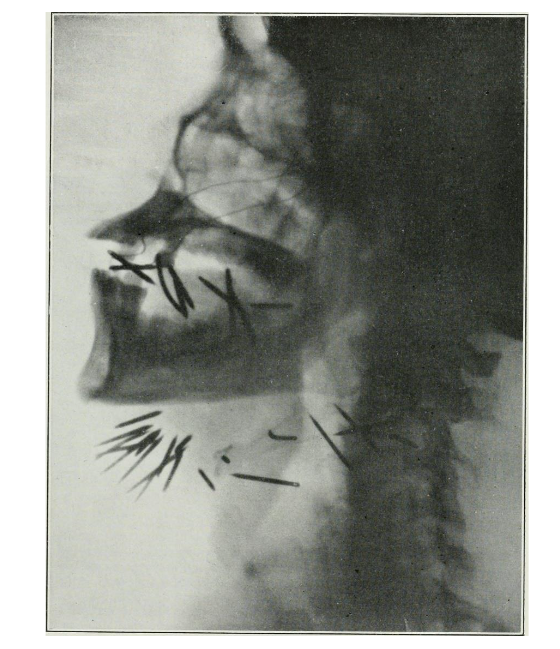 Figure 1: X-ray of the lower cranium and neck of a patient undergoing radium treatment of the tongue and glands with “radium needles”. From the archives from around 1921/22. The needles were inserted directly into the tumor to treat carcinoma of the tongue. The picture is taken from Boggs, Russell N. “The Treatment of Epithelioma by Radium”. Radium. July 1922. Volume 1 (New Series), No. 123-124. P. 115, figure 2.
The International Standards of Radium Boxes
But how did these early radium therapists got a-hold of the radium used in cancer treatment? Radium was indeed a scarce material, and only few centres across the world carried out the difficult industrial and chemical process of its commercialization. The common method was to ship radium products upon request and payment. But shipping radium by post presented issues of both protection and economic interest. As the dangers of radiation, and especially radium, were recognized, more thorough safety precautions had to be carried out taking into consideration those who handled it. However, priority was given to the material itself—an astronomically expensive object that ought to reach its destination safely.
By the early 1930s, the transportation of radioactive materials became an issue of international concern. At the International Radiological Congress (IRC), the main international body dealing with the standardization of radiation units and radiation protection in the inter-war period, a consensus was settling in for the best practice of transporting radium.¹⁶ According to the 1928 recommendations of the IRC, radium applicators contained in glass tubes had to be placed into a larger, lead container. By then, it was known that lead was an effective agent to block and contain radioactive emanations, thereby avoiding any accidental exposure.¹⁷ The next step was to place the lead container with the applicator inside into a wooden box, which could be handed-off to the post office. The IRC recommendation was clear: “Discretion should be exercised in transmitting radium salts by post. In the case of small quantities it is recommended that the container should be lined throughout with lead not less than 3 mms. thick. It is more satisfactory to transport large quantities by hand in a suitably designed carrying case.”¹⁸ In 1931 the IRC slightly revised this paragraph suggesting a wider lead lining of the box from from 3 mm. to 5. cm.¹⁹
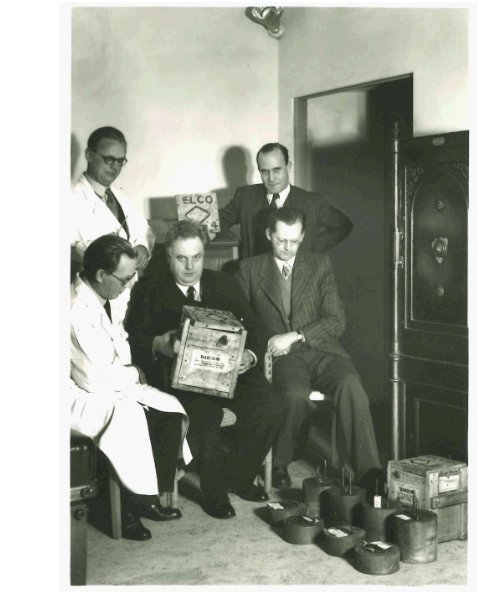
Figure 2: The Swedish medical physicist Rolf Sievert (middle) with his staff at the radiological clinic Radiumhemmet in Stockholm around 1930. Sievert is sitting with a wooden box labelled “Radium”, and next to him on the ground are lead cannisters of various sizes used to store the radium in small glass tubes. Source: Fjällgatan. Department of Radiophysics. S. Benner, E. Berven, R. Sievert, T. Magnusson and A. Forsberg. The 1930s. Unpacking radium. Stored in the National Radiation Protection Institute’s archive format K2:1. National Archives number RA/420660
Postal Work and Clinical Practice
The above developments demonstrate the lengths to which radiologists took to introduce new safety initiatives for transporting radium. Yet it also shows the impact these new regulations had on practicing radium therapy in the clinic. In order to protect both personnel and patients from the constant emanations of radium, many radiological clinics and other institutes started to use safes with lead linings to contain the radium emanations. Medical technologies that used radium varied in size and shape: from small applicators such as needles and seeds to radium guns for cancer treatment. All those required specialized safes and containers to properly store and transport
them. Radium safes were outfitted with smaller drawers and compartments, that would be opened or manipulated to take out the smaller radium instruments.²⁰ To transport radium products, specialized lead cannisters and cylinders would be used for instance for radium needles.²¹ These were small pointed pieces of metal with a radium tip that would be inserted or applied into a tumour to a specific area of the human body.
Conclusions
The early history of radiation is in some ways a history of transportation and mobility, of moving huge amounts of raw pitchblende ore across borders to produce tiny amounts of radium; of shipping this radium across the world to radiological clinics and hospitals; of moving these radioactive sources in lead cannisters to avoid any potential overexposure to radiation. These developments were initiated on an international level, when various radiological groups faced the need to ship radioactive materials used in their medical experiments and treatments. Yet radiologists needed to protect not only themselves and their patients, but also their precious radium as well. Medical concerns went hand in hand with economic interests.
Despite international recommendations issued by the IRC, some scientists found it difficult to give up their old habits. Take, as an example, the chemist George de Hevesy. While researching the practical applications of radioisotope technologies in the 1930s in Copenhagen, he undertook a trip to the Carlsberg Laboratory by tram with a radium-beryllium source wrapped in old newspapers! As one of his biographers Hilde Levi argued, Hevesy “was not disturbed by such minor technicalities” meaning the transport of radioactive sources around the city. Despite this cavalier attitude to radiation protection, Hevesy did take the precaution to place the newspaper-wrapped radium on the far end of the tram, while he sat at the opposite end, to maximise the distance to the material. “As he reached his destination, he picked it up and walked the rest of the way to the laboratory; in the afternoon the source was carried back to the institute via the same route.”²²
Transporting radioactive materials remains one of the major challenges for the nuclear industry even today. This was also recently seen by an accident in February 2023 in Western Australia, where a strong radioactive capsule got lost while being transported from the Rio Tinto’s Gudai-Darri mines to Perth. The tiny capsule, only the size of a coin, fell off a truck while enroute from the mines to the capital of Western Australia. The government mobilized a two weeks intensive search in the fear of public health risks. When the capsule was eventually found, the authorities established an exclusion zone and surveyed the area for contamination. Overall, the event triggered not only scientific but also political and legal discussions about safety measures during the transportation process.²³ This incidence is indicative of the importance placed on transportation safety both by state governments and international regulatory organizations. As long as nuclear energy is used, there will be radioactive materials that must be transported across an increasingly interconnected world. What remains a question is how to best protect the public and those that handle radioactive packages.
Conflicts of Interest:
The authors do not have any conflicts of interest to disclose.
Funding:
This publication is part of the “Living with Radiation: The Role of the International Atomic Energy Agency in the History of Radiation Protection” (HRP-IAEA) project that has received funding from the European Research Council (ERC) under the European Union’s Horizon 2020 research and innovation programme (Grant agreement No770548), https://hrp-iaea.org
Acknowledgements:
None.
References
[1] Transporting radioactive materials. IAEA. June 8, 2016. Accessed August 1, 2024.
https://www.iaea.org/topics/transporting-radioactive-materials.
[2] Transport of Radioactive Materials. IAEA Bulletin. 1960; 2(2): 15-17.
[3] Among the few exceptions is Rentetzi, M. Packaging Radium, Selling Science: Boxes, Bottles and Other Mundane Things in the World of Science. Annals of Science. 2011;68:3: 375-399. doi 10.108 0/00033790.2011.587999. See also a relevant video produced by Rentetzi: Rentetzi M. The Box: Commonplace Artifacts in the Production of Scientific Knowledge. YouTube. January 20, 2016. Accessed October 7, 2024.
https://youtu.be/kl5sInu9htk?si=CYYUiT29Hneh3vbo.
[4] Creager ANH. Life Atomic: A History of Radioisotopes in Science and Medicine. The University of Chicago Press; 2015.
[5] The Nobel Prize in Physics 1903. NobelPrize.org. Accessed October 7, 2024. https://www.nobelprize.org/prizes/physics/1903/summary/.
[6] Mould RF. The discovery of radium in 1898 by Maria Sklodowska-Curie (1867-1934) and Pierre Curie (1859-1906) with commentary on their life and times. The British Journal of Radiology. 1998;71(8 52):1229-1254. doi:10.1259/bjr.71.852.10318996
[7] Rentetzi M. Seduced by Radium: How Industry Transformed Science in the American Marketplace. University of Pittsburgh Press; 2022.
[8] Rentetzi M. Trafficking Materials and Gendered Experimental Practices: Radium Research in Early 20th Century Vienna. Columbia University Press; 2009.
[9] Roqué X. Marie Curie and the Radium Industry: A preliminary sketch. History and Technology. 1997; 13(4):267-291. doi:10.1080/07341519708581911
[10] Simpson, E. M. Radium. The American Journal of Nursing. 1904;4(7):526-528. doi:10.2307/3402004
[11] Pinch, A. E. Hayward. A Report of the Work Carried Out at the Radium Institute, London. Radium. 1922 July;1(2):124-146.
[12] Historical inflation calculator. Accessed August 2, 2024. https://inflationhistory.com/en-US/?currency=GBP&amount=4000000&year=1922.
[13] Womack J Radiation Evangelists. Technology, Therapy, and Uncertainty at the Turn of the Century. Jeffrey Womack. Pittsburgh University Press; 2020.
[14] Strebel, H. Zur Frage der lichttherapeutischen Leistungsfähigkeit des Induktionsfunkenlichtes nebst Angabe einiger Versuche über die bakterienfeindlichen Wirkung der Becquerelstrahlen. RöFo. 1900-1901; 4:125-132.
[15] Gibson AL. Radium therapy. The American Journal of Nursing. 1923;24(3):167-171. doi:10.230 7/3406883
[16] Rentetzi, Maria; Nielsen, Aske Hennelund. Setting Radiation Protection Standards: The First Radiology Congress in 1925. Medical Research Archives, [S.l.]. 2024;12,(6). doi:10.18103/mra.v12 i6.5445.
[17] Thomas A. INVISIBLE LIGHT: The Remarkable Story of Radiology. CRC Press, Taylor & Francis Group; 2022.
[18] International recommendations for X-ray and radium protection. Acta Radiologica. 1928;9(3 Suppl):62-65. doi:10.1177/0284185128009s3.113.
[19] The Work of the International X-Ray Unit Committee and the International X-Ray and Radium Protection Commission during the III International Congress of Radiology in Paris 1931. Acta Radiologica. 1931:os-12(6):586–594. doi:10.1177/028418513101200608.
[20] Wigoder S. B. Some modifications in radium safes, carriers and collars. The British Journal of Radiology. 1933;6(65):301-304. doi:10.1259/0007-1285-6-65-301.
[21] Lazarus, Paul. K. Therapeutische Anwendung der Radioelemente (Radium, Mesothorium, Radiothorium, Thorium X, Aktinium X) einschließlich der Tiefen- und intratumoralen Radiumtherapie, wie der radioaktiven Heilquellen in Lazarus, Paul (ed.) Handbuch der gesamten Strahlenheilkunde. Zweiter Band: Strahlenklinik und spezielle therapeutische Methodik. Springer, 1931. doi:10.1007/978-3-642-99267-4.
[22] Levi, Hilde. George de Hevesy: life and work: a biography. Copenhagen: Rhodos, 1985.
[23] Belot H. Tiny Radioactive capsule lost in Australian outback found by side of 1,400km stretch of Road. The Guardian. February 1, 2023. Accessed September 25, 2024.
https://www.theguardian.com/australia-news/2023/feb/01/tiny-radioactive-capsule-lost-in-australian-outback-found-by-side-of-1400km-stretch-of-road.