

Narcissistic and Dependent Traits in Interpersonal Dynamics
Narcissistic and Dependent Behaviors in an Iterated Prisoner’s Dilemma Game
Anastasiia Korolevskaia1, Lawrence Ian Reed1*, Jill M. Hooley2
- Department of Psychology, New York University
- Department of Psychology, Harvard University
OPEN ACCESS
PUBLISHED:31 October 2024
CITATION: Korolevskaia, A., Reed, L.I., et al., 2024. Narcissistic and Dependent Behaviors in an Iterated Prisoner’s Dilemma Game. Medical Research Archives, 12(10).
https://doi.org/10.18103/mra.v12i10.5773
COPYRIGHT: © 2024 European Society of Medicine. This is an open-access article distributed under the terms of the Creative Commons Attribution License, which permits unrestricted use, distribution, and reproduction in any medium, provided the original author and source are credited.
DOI https://doi.org/10.18103/mra.v12i10.5773
ISSN 2375-1924
ABSTRACT
Interpersonal formulations are used to define, understand, and diagnose personality disorders. The accuracy of these formulations rests on a clear understanding of how those with personality pathology behave in interpersonal situations. To test these formulations, we conducted 4 experiments across 2 studies examining how participants with trait dependence and narcissism respond to predetermined strategies in an iterated prisoner’s dilemma. These predetermined strategies were: always cooperate, cheat once then always cooperate (Study 1), always cheat, and cooperate once then always cheat (Study 2). Results indicated that trait dependency promoted cooperation, particularly against the cheat-once-then-always-cooperate strategy and in early interactions with the cooperate-once-then-always-cheat strategy. However, there was no evidence that trait narcissism reduces cooperation. Our results suggest a nuanced association between trait personality pathology and cooperation, which is influenced by others’ behavior over repeated interactions.
Keywords: personality disorders, narcissistic personality disorder, dependent personality disorder, interpersonal, prisoner’s dilemma
Narcissistic and Dependent Behaviors in an Iterated Prisoner’s Dilemma Game
Personality disorders are largely understood by the specific interpersonal difficulties that profoundly affect the individual and their relationships with others. This is supported by numerous large-scale studies revealing that personality disorders are linked to distinct patterns of interpersonal dysfunction¹–³. It is also reflected in the current DSM-5-TR definitions of many personality disorders⁴. For example, narcissistic personality disorder is defined as a pattern of grandiosity, need for admiration, and lack of empathy. Dependent personality disorder is defined as a pattern of submissive and clinging behavior related to an excessive need to be taken care of. Moreover, the proposed DSM-5 Section III states that disturbances in self (identity and self-direction) and interpersonal functioning (empathy and intimacy) are at the core of personality pathology.
These interpersonal difficulties are well conceptualized within the interpersonal perspective. Traditional interpersonal theory originated with the assumption that pathological behavior is best understood by examining interpersonal processes⁵–⁷. The basic assumption is that these interpersonal processes are governed by thoughts, feelings, and behaviors that motivate predictable recurring patterns between the self and others. These processes aim to reduce anxiety and/or preserve self-esteem by establishing consistent patterns of interaction⁵–⁷.
Contemporary integrative interpersonal theory (CIIT) follows the traditional emphasis on the self in relation to others⁸–¹¹. Here, adaptive functioning is defined as the ability to sustain interpersonal interactions in ways that satisfy the needs of the self and the other. In contrast, dysfunction is defined as the inability to sustain interpersonal interactions resulting from a breakdown of one or more internal processes (i.e., thoughts, feelings, behaviors, motivations, etc.)². Ultimately, CIIT views personality pathology as a sustained pattern of interpersonal dysfunction¹³.
One of the most powerful contributions of interpersonal theory lies in its empirically supported and falsifiable models, including the interpersonal circumplex¹⁴. The interpersonal circumplex is a two-dimensional model plotting interpersonal styles along two orthogonal dimensions. The first dimension is agency, which ranges from dominance on one end to submissiveness on the other. The second is affiliation, which ranges from warmth/friendliness on one side and coldness/hate on the other. The circumplex is further divided into segments that represent blends of interpersonal styles varying along both dimensions. For example, the style blending coldness and dominance would be described as competitive-exploitative, arrogant-calculating, and vindictive. On the opposite side of the circumplex, the style blending warmth and submissiveness would be described as docile-dependent, unassuming-ingenuous, and exploitable.
The interpersonal principle of complementarity makes specific predictions regarding how interpersonal styles along the circumplex will interact. Specifically, it predicts that dominance will provoke submissiveness and vice versa. Each will provoke the opposing response. However, it predicts that warmth/friendliness and coldness/hate will each provoke the same (mirrored) response. For example, warm dominance would provoke warm submissiveness while cold dominance would provoke cold submissiveness.
A promising body of evidence suggests that the interpersonal styles along the circumplex are associated with specific personality disorders¹⁵–¹⁷. For example, narcissistic personality disorder shows its highest associations with dominant and dominant/warm traits such as intrusiveness, domineeringness, and vindictiveness. Based on the principle of complementarity, these should provoke submissiveness and warmth/submissiveness. In contrast, dependent personality disorder shows its highest associations with submissive and submissive/warm traits such as non-assertiveness, exploitability, and over nurturance. These should provoke dominance and vindictiveness.
Although these studies describe the interpersonal styles associated with personality disorders, they are based on self-report and/or expert judgment¹⁵,¹⁷,¹⁸. These findings have provided evidence for the interpersonal perspective, validated the measures used to describe interpersonal styles, and informed clinical assessments. However, they also raise the question: “Do those with personality disorders behave in accordance with self-reports and expert judgements?” The answer stands to greatly improve interpersonal formulations of personality pathology.
The integration of behavioral economics into the study of personality pathology has helped to answer this question. Economic games provide objective and clearly defined interpersonal interactions that are easily compared across studies. Furthermore, they are not susceptible to the biases and errors inherent in self-report and expert judgement.
Importantly, economic games can model countless interactions. For example, previous research shows decreased cooperation among participants with borderline personality disorder using a repeated exchange, trust, and risk games¹⁹–²⁰. Similarly, narcissistic and antisocial personality pathology have been associated with decreased cooperation in one-shot and iterated prisoner’s dilemma games²¹,²². Finally, a study using a coordination game (the Battle of the Sexes) found that trait narcissism was associated with dominant behavior while trait dependency was associated with submissive behavior²³.
The iterated prisoner’s dilemma game²⁴ can precisely model complementarity in personality pathology. In the (one-shot) prisoner’s dilemma, two players independently and simultaneously decide to cooperate or cheat. If both players cooperate, they both receive a modest payoff. If they both cheat, they both receive a smaller payoff. However, if one player cooperates and the other player cheats, the cooperating player earns nothing while the cheating player earns the highest possible payoff. In the iterated prisoner’s dilemma, these decisions are made repeatedly with the total payoff being equal to the sum of payoffs from each iteration. Using the iterated prisoner’s dilemma, we can test predictions regarding how interpersonal styles interact by observing how participants behave in response to those who behave submissively (cooperate) and those who behave dominantly (cheat).
We aimed to examine how individuals with trait narcissism and trait dependency behaved in response to partners behaving submissively and dominantly. We conducted 4 experiments across 2 studies examining how participants with trait dependence and trait narcissism responded to predetermined strategies in an iterated prisoner’s dilemma game. In Study 1, the first experiment paired participants with a partner who cooperated at each iteration. The second experiment paired participants with a partner who cheated on the first iteration and then cooperated on every subsequent iteration. In Study 2, the first experiment paired participants with a partner who cheated at each iteration. The second experiment paired participants with a partner who cooperated on the first iteration, then cheated on every subsequent iteration. Participants were told their partners’ decision after each iteration in each experiment. Based on the predictions of the interpersonal principle of complementarity, we hypothesized that increased trait narcissism would predict continued cheating and trait dependence would predict continued cooperation.
Study 1
METHOD
Procedure. Participants gave consent and read a description of the procedure. Participants read that they would answer questions about their personality and play a game with another Prolific participant. The order that participants completed the personality measures and game was counterbalanced to reduce any potential order effects. Participants earned $2.00 for completing the task, and they could earn an additional bonus depending on the decisions made by them and the other participant. Most participants completed the task in under 10 min (M = 9.85, SD = 3.71).
Iterated Prisoner’s Dilemma Games. A set of instructions was presented before the game. Participants read: You’ll be asked to play the same game several times with another Prolific participant. Although the story behind the game is fictional, the earnings are real. The decisions that you make will affect your and the other participant’s earnings in the game. Any money you and the other participant earn will be paid to you as bonus payments.
You and the other Prolific participant will play between 7 to 12 rounds of the game (you won’t know which round will be the last). To streamline the study, the real-time decisions your partner makes will be pre-programmed based on your decisions and the decisions of a typical Prolific participant.
These instructions were followed by a backstory. Participants read:
You and the other participant will use a magic machine. You both will begin each round with 1 coin (worth $0.05). If one of you puts in a coin, the other player gets three coins — and vice versa. In each round, you both can either choose to COOPERATE by putting in a coin, or CHEAT by not putting in a coin.
Participants then read the earnings for each iteration:
If you and your partner both decide to put in a coin, you both end up with 3 coins.
If you and your partner both decide not to put in a coin, you both end up with 1 coin.
If you decide to put in a coin and your partner decides not to put in a coin, you end up with nothing and your partner ends up with 4 coins.
If you decide not to put in a coin and your partner decides to put in a coin, you end up with 4 coins and your partner ends up with nothing.
Participants were then told that their total bonus payment would be the sum of their earnings from each iteration and viewed a payoff matrix (Figure 1).
Figure 1 Iterated prisoner’s dilemma game payoffs each round.
Game Payoffs
| Your Choice: Put in Coin | Your Choice: Don’t Put in Coin | |
|---|---|---|
| Your Partner’s Choice: Put in Coin | 3 coins for You 3 coins for Your Partner | 4 coins for You 0 coins for Your Partner |
| Your Partner’s Choice: Don’t Put in Coin | 0 coins for You 4 coins for Your Partner | 1 coin for You 1 coin for Your Partner |
After reading the instructions, participants answered 2 comprehension questions (e.g., “Let’s say that your partner decides to put in a coin. How many coins will you earn this round if you decide NOT to put in a coin?”). If they answered incorrectly, they could try again. Participants had to answer both questions correctly to continue.
To provoke specific interpersonal responses in real time, the decisions of each participant’s matched partner were predetermined. In the first predetermined condition, the other player cooperated during each round. In the second condition, the other player cheated in the first iteration and then cooperated in every subsequent iteration. Rather than paying participants only on the basis of the decisions they made, we chose to base participants’ payments on their decisions in response to either those of their matched participant or the predetermined condition (whichever was greater). This was done as a courtesy to maximize participants’ earnings.
Trait Personality. We chose self-report measures of trait dependency and narcissism that were brief and applicable to both clinical and non-clinical samples. Trait dependency was measured using the Dependent Personality Questionnaire²⁶. In the DPQ, participants are presented with eight questionnaire items and must rate the extent that it applies to them on a 4-point scale ranging from yes, definitely to no, not at all. Example items include “I am an independent person” and “I rely a lot on my family and friends.” Potential scores in the DPQ range from 0 to 24.
Trait narcissism was measured using the Narcissistic Personality Inventory (NPI-40)²⁷. In the NPI, participants are presented with 40 pairs of opposing statements and must choose the one that best describes them. For example, “I find it easy to manipulate people” (narcissistic response) and “I do not like it when I find myself manipulating other people” (non-narcissistic response). The NPI-40 assesses trait narcissism continuously on a range of non-clinical and clinical populations. Potential scores on the NPI range from 0 to 40. The NPI has shown good reliability and validity²⁸–²⁹. A recent meta-analysis has reported a mean population reliability coefficient of 0.82³⁰.
Data Analysis. This study was preregistered on the Open Science Framework (https://doi.org/10.17605/OSF.IO/VEFW), and we reported all measures, manipulations, data exclusions, and sample size determinations. De-identified data are available on OSF (https://osf.io/xtuq7/view_only=886f13132004329b0ea79255c9df543).
RESULTS
Participants
We recruited 200 participants through Prolific, which generates high quality data²⁵ and can provide good participant reimbursement. We planned to collect a sample size of approximately 100 per condition, and we did not analyze the data until all of the responses were collected. Because they failed the attention check, 6 participants were excluded. This left 194 (61 male, 132 female, and 1 other) in the sample. Participants’ mean age was 36.40 years (SD = 11.80) and their ethnicities were as follows: 175 White, 12 Asian, 3 Black, and 4 other). Participants resided in the United Kingdom (188) or in the United States (6). The studies from each experiment in this manuscript were approved by the New York University Institutional Review Board (IRB FY2023-6854).
Always cooperate
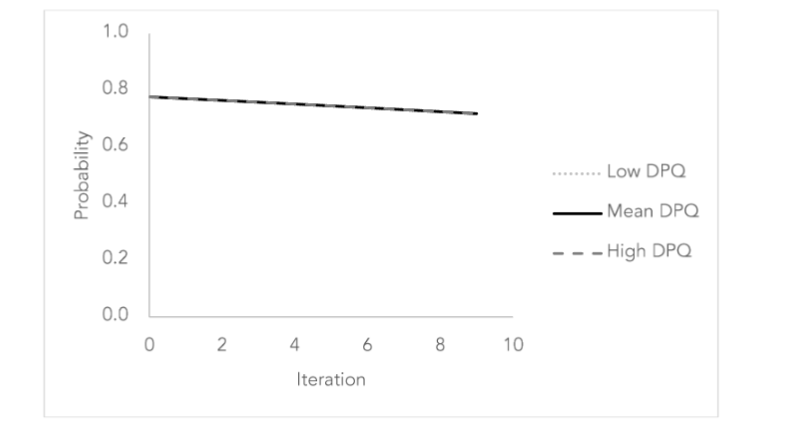
We conducted two repeated-measures logistic regression analyses via the SPSS GEE command; one using trait dependency (DPQ) as a predictor and the other using trait narcissism (NPI) as a predictor. To make the results easier to interpret, both DPQ and NPI scores are reported as percentages of the maximum possible score of the original scale (POMP)³¹. This linearly transforms each scale to range from 0 to 100. For example, a value of 50 on a POMP scale is translated to 50% of the maximum possible score on the original scale independent of its range. Each analysis entered iteration, trait personality (either dependency or narcissism) and their interaction term as predictors of behavior (cooperate or cheat). When entering DPQ as a predictor (see Table 1), we found no influence of trait dependency, iteration, or their interaction on cooperation (trait dependency: X² (1) < .001, p = .991; iteration: X² (1) = .292, p = .589; interaction: X² (1) = .064, p = .800. The predicted probability model is shown in Figure 2.
Table 1
Fixed effects estimates from repeated-measures logistic regression models.
| Condition | Predictor | B | p-value | 95% CI LL | 95% CI UL |
|---|---|---|---|---|---|
| Always Cooperate | Trait Dependency | 0.000 | 0.991 | -0.027 | 0.027 |
| Iteration | -0.035 | 0.589 | -0.164 | 0.093 | |
| Iteration × Trait Dependency | 0.000 | 0.800 | -0.003 | 0.003 | |
| Always Cooperate | Trait Narcissism | -0.002 | 0.870 | -0.020 | 0.017 |
| Iteration | -0.072 | 0.017 | -0.131 | -0.013 | |
| Iteration × Trait Narcissism | 0.001 | 0.479 | -0.002 | 0.004 | |
| Cheat Once, Then Cooperate | Trait Dependency | 0.018 | 0.023 | 0.002 | 0.033 |
| Iteration | -0.071 | 0.154 | -0.168 | 0.027 | |
| Iteration × Trait Dependency | 0.001 | 0.239 | -0.001 | 0.004 | |
| Cheat Once, Then Cooperate | Trait Narcissism | -0.020 | 0.058 | -0.041 | 0.001 |
| Iteration | 0.066 | 0.205 | -0.036 | 0.168 | |
| Iteration × Trait Narcissism | -0.004 | 0.073 | -0.008 | 0.000 |
Note: B = beta, CI = confidence interval; LL = lower limit; UL = upper limit. Point estimates are reported as the percentage of the maximum score (POMP) values. POMP values range from 0 to 100, independent of the range of the scale. Bold indicates significant effect.
Figure 2 Always cooperate. Predicted probability of cooperation for predictors from the generalized estimating equation model (Dependent Personality Questionnaire and iteration). Includes predicted probabilities for Low DPQ (1 standard deviation below the mean), mean DPQ, and High DPQ (1 standard deviation above the mean).
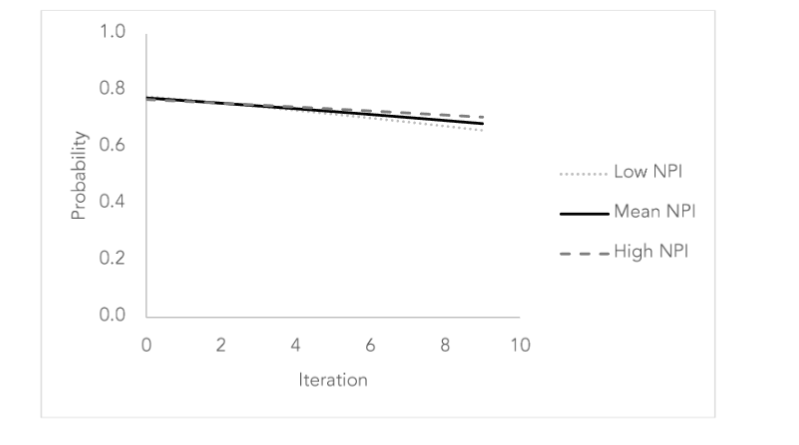
When entering NPI as a predictor (see Table 1), we found that cooperation rates decreased over iterations (X² (1) = 5.696, p = .017). In contrast, there was no influence of trait narcissism or any interaction (trait narcissism: X² (1) = .027, p = .870; interaction: X² (1) = .501, p = .479). The predicted probability model is shown in Figure 3.
Figure 3 Always cooperate. Predicted probability of cooperation for predictors from the generalized estimating equation model (Narcissistic Personality Inventory and iteration). Includes predicted probabilities for Low NPI (1 standard deviation below the mean), mean NPI, and High NPI (1 standard deviation above the mean).
CHEAT ONCE THEN ALWAYS COOPERATE
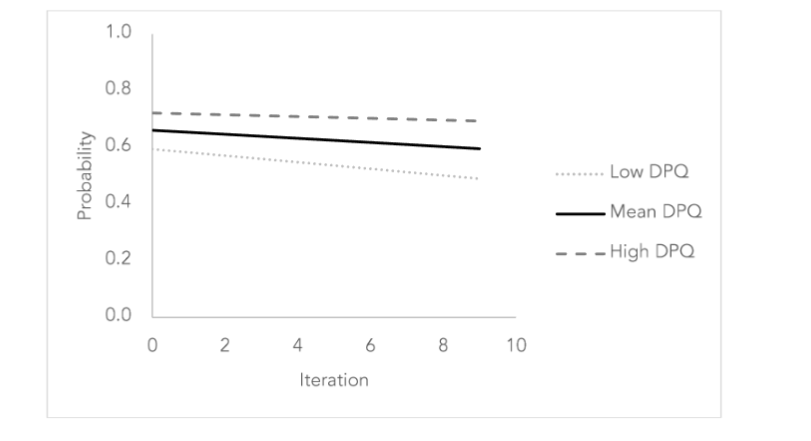
We conducted two additional repeated-measures logistic regression analyses via the SPSS GEE command. When entering DPQ as a predictor (See Table 1), we found that trait dependency was associated with an increase in cooperation (X² (1) = 5.151, p = .023). In contrast, there was no influence of iteration or any interaction (iteration: X² (1) = 2.029, p = .154; interaction: X² (1) = 1.389, p = .239). The predicted probability model is shown in Figure 4.
Figure 4 Cheat once, then Always cooperate. Predicted probability of cooperation for predictors from the generalized estimating equation model (Dependent Personality Questionnaire and iteration). Includes predicted probabilities for Low DPQ (1 standard deviation below the mean), mean DPQ, and High DPQ (1 standard deviation above the mean).
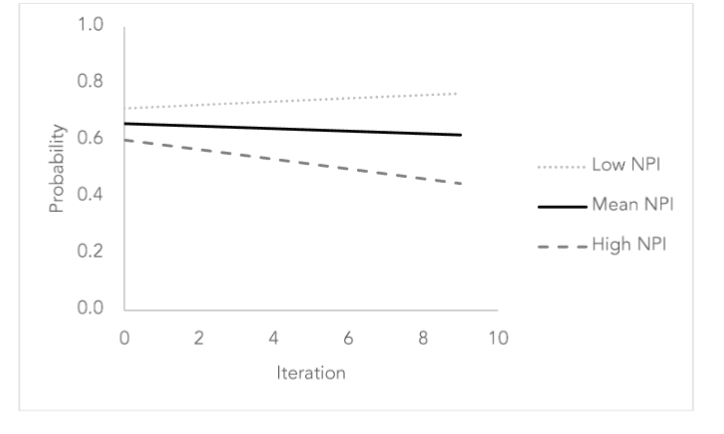
When entering NPI as a predictor (See Table 1), we found no influence of trait narcissism, iteration, or their interaction on cooperation (trait narcissism: X² (1) = 3.606, p = .058; iteration: X² (1) = 1.608, p = .205; interaction: X² (1) = 3.211, p = .073). The predicted probability model is shown in Figure 5.
Figure 5 Cheat Once, then always cooperate. Predicted probability of cooperation for predictors from the generalized estimating equation model (Narcissistic Personality Inventory and iteration). Includes predicted probabilities for Low NPI (1 standard deviation below the mean), mean NPI, and High NPI (1 standard deviation above the mean).
Study 2
METHOD
Procedure. Participants played the same iterated prisoner’s dilemma game as those in Study 1 with one exception: participants played against a predetermined strategy that either always cheated or cooperated on the first iteration and then cheated on every subsequent iteration.
Data Analysis. This study was preregistered on the Open Science Framework (https://doi.org/10.17605/OSF.IO/9U527), and we reported all measures, manipulations, data exclusions, and sample size determinations. De-identified data are available on OSF (https://osf.io/xtuq7/view_only=886f13132004329b0ea79255c9df543).
RESULTS
Participants
We recruited an additional 200 participants through Prolific. As in Study 1, we planned to collect a sample size of 100 participants per condition, and we did not analyze the data until all of the responses were collected. Because they failed the attention check, 16 participants were excluded. This left 184 (51 male, 132 female, and 1 other) in the sample. Participants’ mean age was 38.49 (SD = 13.509) and their ethnicities were as follows: 157 White, 11 Asian, 3 Black, and 13 other). Participants resided in the United Kingdom (179) or the United States (4) (one participant’s data was missing).
Always Cheat
As in Study 1, we conducted two repeated-measures logistic regression analyses via the SPSS GEE command; one using trait dependency (DPQ) as a predictor and the other using trait narcissism (NPI) as a predictor. As in Study 1, POMP scores were used to make the results easier to interpret. Each entered iteration, trait personality (either dependency or narcissism) and their interaction term as predictors of behavior (cooperate or cheat).
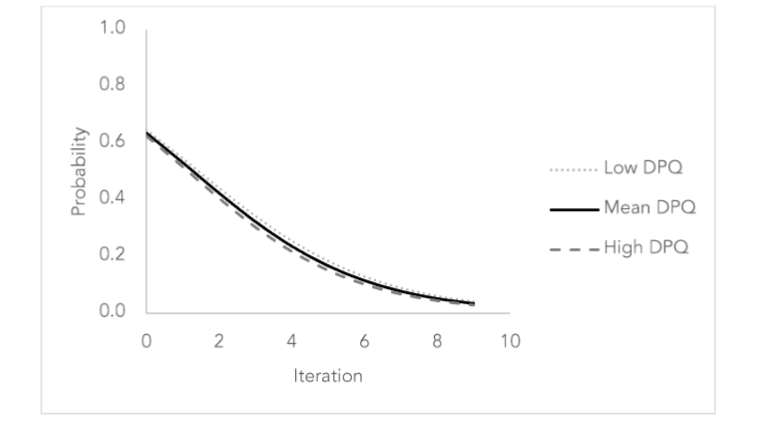
When entering DPQ (See Table 2) as a predictor, we found that cooperation rates decreased over iterations (X² (1) = 6.148, p = .013). In contrast, there was no influence of trait dependency or any interaction (trait dependency: X² (1) = .187, p = .666; interaction: X² (1) = .022, p = .881). The predicted probability model is shown in Figure 6. Table 2
Fixed effects estimates from repeated-measures logistic regression models.
| Condition | Predictor | B | p-value | 95% CI LL | 95% CI UL |
|---|---|---|---|---|---|
| Always Cheat | Trait Dependency | -0.003 | 0.666 | -0.018 | 0.012 |
| Iteration | -0.394 | 0.013 | -0.705 | -0.083 | |
| Iteration × Trait Dependency | -0.001 | 0.881 | -0.007 | 0.006 | |
| Always Cheat | Trait Narcissism | -0.006 | 0.499 | -0.022 | 0.011 |
| Iteration | -0.432 | <0.001 | -0.595 | -0.270 | |
| Iteration × Trait Narcissism | 0.001 | 0.803 | -0.007 | 0.009 | |
| Cooperate Once, Then Cheat | Trait Dependency | 0.017 | 0.118 | -0.004 | 0.038 |
| Iteration | -0.226 | 0.029 | -0.428 | -0.024 | |
| Iteration × Trait Dependency | -0.006 | 0.026 | -0.011 | -0.001 | |
| Cooperate Once, Then Cheat | Trait Narcissism | -0.023 | 0.014 | -0.041 | -0.005 |
| Iteration | -0.671 | <0.001 | -0.818 | -0.525 | |
| Iteration × Trait Narcissism | 0.009 | <0.001 | 0.005 | 0.013 |
Note: B = beta, CI = Confidence interval; LL = Lower limit; UL = upper limit. Point estimates are reported as the percentage of the maximum score (POMP) values. POMP values range from 0 to 100, independent of the range of the scale. Bold indicates significant effect.
Figure 6 Always cheat. Predicted probability of cooperation for predictors from the generalized estimating equation model (Dependent Personality Questionnaire and iteration). Includes predicted probabilities for Low DPQ (1 standard deviation below the mean), mean DPQ, and High DPQ (1 standard deviation above the mean).
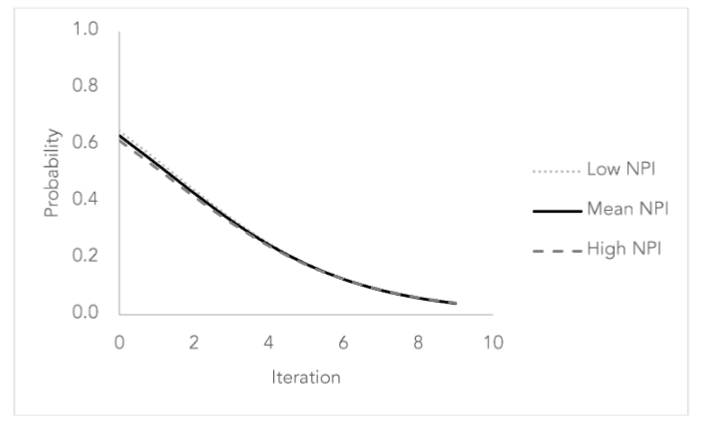
When entering NPI as a predictor (See Table 2), we found that cooperation rates decreased over iterations (X² (1) = 27.260, p < .001). In contrast, there was no influence of trait narcissism or any interaction (trait narcissism: X² (1) = .457, p = .449; interaction: X² (1) = .062, p = .803). The predicted probability model is shown in Figure 7.
Figure 7 Always cheat. Predicted probability of cooperation for predictors from the generalized estimating equation model (Narcissistic Personality Inventory and iteration). Includes predicted probabilities for Low NPI (1 standard deviation below the mean), mean NPI, and High NPI (1 standard deviation above the mean).
Cooperate Once Then Always Cheat
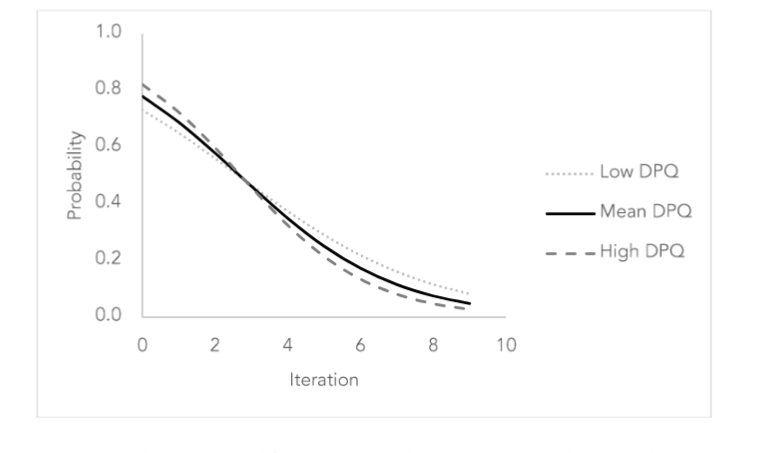
We conducted two additional repeated-measures logistic regression analyses via the SPSS GEE command. When entering DPQ as a predictor (See Table 2), we found no influence of trait dependency (X² (1) = 2.442, p = .118). In contrast, cooperation rates decreased over iterations (X² (1) = 4.786, p = .029). Crucially, a significant interaction showed that trait dependency was associated with increased cooperation in early iterations and decreased cooperation in later iterations (X² (1) = 4.974, p = .026). The predicted probability model is shown in Figure 8.
Figure 8 Cooperate once, then always cheat. Predicted probability of cooperation for predictors from the generalized estimating equation model (Dependent Personality Questionnaire and iteration). Includes predicted probabilities for Low DPQ (1 standard deviation below the mean), mean DPQ, and High DPQ (1 standard deviation above the mean).
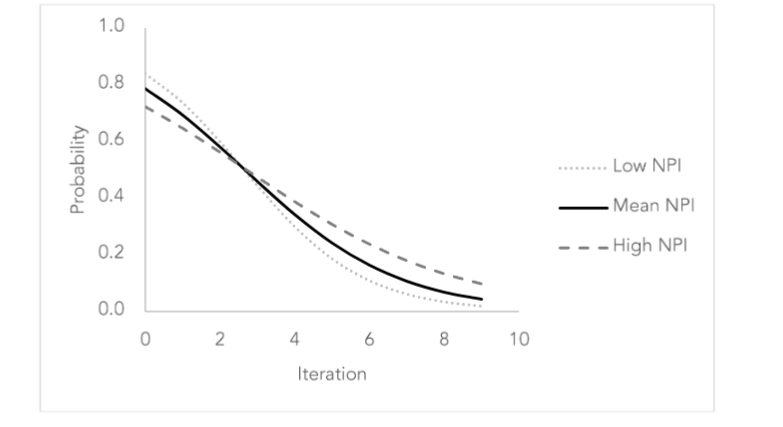
When entering NPI as a predictor (See Table 2), we found that trait narcissism was associated with increased cooperation (X² (1) = 6.011, p = .014) and that cooperation decreased across iterations (X² (1) = 80.596, p < .001). Crucially, a significant interaction showed that trait narcissism was associated with decreased cooperation in early iterations and increased cooperation in later iterations (X² (1) = 19.186, p < .001). This interaction is the opposite of that for trait dependency. The predicted probability model is shown in Figure 9.
Figure 9 Cooperate once, then always cheat. Predicted probability of cooperation for predictors from the generalized estimating equation model (Narcissistic Personality Inventory and iteration). Includes predicted probabilities for Low NPI (1 standard deviation below the mean), mean NPI, and High NPI (1 standard deviation above the mean).
Discussion
We examined the interpersonal styles of participants with trait dependence and narcissism in response to predetermined strategies in an iterated prisoner’s dilemma game. The results partially supported our hypotheses. Trait dependency was associated with increased cooperation across iterations only when interacting with a player who cheated once, then cooperated. However, we found that trait dependency was associated with increased cooperation in early rounds and decreased cooperation in later rounds when interacting with a player who cooperated once, then cheated. We found no support for the hypothesis that trait narcissism was associated with cheating. In contrast to our hypotheses, trait narcissism was associated with decreased rates of cooperation in early rounds and increased cooperation in later rounds when interacting with a player who cooperated once, then cheated. However, a non-significant trend suggests that trait narcissism may be associated with decreased cooperation when interacting with a player who cheats once, then cooperates.
We found increased rates of cooperation among participants with trait dependency across iterations when playing with a partner who cheated once, then always cooperated. This is consistent with interpersonal formulations of dependent personality disorder and research associating it with submissive interpersonal styles¹⁵,¹⁷. This finding suggests that those with trait dependency remain loyal despite enduring an instance of cheating. This could be adaptive in situations where a partner mistakenly cheats or when a partner’s actions are misinterpreted as cheating.
However, we also found that trait dependency was associated with increased cooperation in early rounds and decreased cooperation in later rounds when playing with a partner who cooperated once and then always cheated. Although not inconsistent with the interpersonal formulations of dependent personality disorder, this suggests that those with trait dependency are not unwaveringly loyal. This could be adaptive in situations when interacting with a partner who falsely advertises an intention to cooperate throughout a repeated interaction.
Interestingly, trait narcissism was associated with decreased cooperation in early rounds and increased cooperation in later rounds when playing with a partner who cooperated once then always cheated. One interpretation of this finding is that participants with trait narcissism felt remorse after cheating a cooperative partner on the first round. However, this is not consistent with the interpersonal formulations of narcissistic personality disorder or the DSM-5-TR criteria (i.e., a sense of entitlement, interpersonally exploitative, and lacking empathy)⁴. Future research might benefit by pairing self-reported questions with behavioral data. Another interpretation is that participants with trait narcissism were motivated to cooperate by a need to be seen positively. This is consistent with conceptualizations of narcissistic personality disorder that focus on self-aggrandizement³².
Several aspects of our sample and methodology provide additional context for the results. Our online sample was a non-clinical population consisting of mostly women. Women differ from men in the prevalence and presentation of both narcissistic personality disorder and dependent personality disorder³³–³⁵. Additionally, participants were playing online. It is possible that anonymous face-to-face interactions might affect participants’ behavior. Additionally, we used the NPI-40 to measure trait narcissism. Future works could extend our approach using the Five Factor Narcissism Inventory-Short Form³⁶ or the Narcissistic Grandiosity Scale³⁷ or the Narcissistic Vulnerability Scale³⁸.
Conclusion
In conclusion, we found partial support for the hypothesis that trait dependency would be associated with increased cooperation and no support for the hypothesis that trait narcissism would be associated with decreased cooperation. These results shed light on both the trait³⁹,⁴⁰ and interpersonal⁴¹,⁴² models that form our current and future formulations of personality disorders. They suggest that the characteristic interpersonal behaviors that define personality pathology may depend upon specific patterns of others’ behavior. Future research using both behavioral and self-reported measures stands to increase our understanding of the impact of personality on the self and others.
Conflict of Interest:
The authors have no conflicts of interest to declare.
Funding Statement:
None.
Acknowledgements:
The authors would like to thank Patrick Shrout for his statistical consultations.
Author Note
Anastasiia Korolevskaia –
https://orcid.org/0000-0002-0172-5885
Lawrence Ian Reed –
https://orcid.org/0000-0002-6921-5398
Jill M. Hooley –
https://orcid.org/0000-0002-1162-3540
References
1. Cohen P, Crawford TN, Johnson JG, Kasen S. The Children in the Community Study of Developmental Course of Personality Disorder. J Personal Disord. 2005;19(5):466-486. doi:10.1521/ pedi.2005.19.5.466
2. Gunderson JG. Ten-Year Course of Borderline Personality Disorder: Psychopathology and Function From the Collaborative Longitudinal Personality Disorders Study. Arch Gen Psychiatry. 2011;68(8) :827. doi:10.1001/archgenpsychiatry.2011.37
3. Zanarini MC, Frankenburg FR, Reich DB, Fitzmaurice G. Time to Attainment of Recovery From Borderline Personality Disorder and Stability of Recovery: A 10-year Prospective Follow-Up Study. Am J Psychiatry. 2010;167(6):663-667. doi:10.1176/appi.ajp.2009.09081130
4. American Psychiatric Association. Diagnostic and Statistical Manual of Mental Disorders (5th Ed., Text Rev.). 5th ed., text rev.; 2022. https://doi.org/10.1176/appi.books.9780890425787
5. Leary T. Interpersonal Diagnoses of Personality. Ronald; 1957.
6. McLemore CW, Benjamin LS. Whatever Happened to Interpersonal Diagnosis? Am Psychol. 1979;34 (1):17-34.
7. Sullivan H. The Interpersonal Theory of Psychiatry. Norton; 1953.
8. Hopwood CJ, Wright AGC, Ansell EB, Pincus AL. The Interpersonal Core of Personality Pathology. J Personal Disord. 2013;27(3):270-295. doi:10.1521/ pedi.2013.27.3.270
9. Pincus AL. A contemporary integrative interpersonal theory of personality disorders. In: Major Theories of Personality Disorder. 2nd ed. Guilford press; 2005:282-331.
10. Pincus AL, Hopwood CJ. a contemporary interpersonal model of personality pathology and personality disorder. In: The Oxford Handbook of Personality Disorders. Oxford University Press; 2012:372-398.
11. Wright AGC, Pincus AL, Hopwood CJ. Contemporary Integrative Interpersonal Theory: Integrating Structure, Dynamics, Temporal Scale, and Levels of Analysis. Published online 2023.
12. Wright AGC, Ringwald WR, Hopwood CJ, Pincus AL. It’s time to replace the personality disorders with the interpersonal disorders. Am Psychol. 2022;77(9):1085-1099. doi:10.1037/amp 0001087
13. Hopwood CJ, Wright AGC, Bleidorn W. Person–environment transactions differentiate personality and psychopathology. Nat Rev Psychol. 2022;1(1):55-63. doi:10.1038/s44159-021-00004-0
14. Hopwood CJ, Pincus AL, Wright AGC. The Interpersonal Situation. In: The Oxford Handbook of Psychological Situations. Oxford University Press; 2020:94-121.
15. Haslam N, Reichert T, Fiske AP. Aberrant social relations in the personality disorders. Psychol Psychother Theory Res Pract. 2002;75(1):19-31. doi:10.1348/147608302169526
16. Locke KD. Circumplex Scales of Interpersonal Values: Reliability, Validity, and Applicability to Interpersonal Problems and Personality Disorders. J Pers Assess. 2000;75(2):249-267. doi:10.1207/S1 5327752JPA7502_6
17. Monsen JT, Hagtvet KA, Havik OE, Eilertsen DE. Circumplex structure and personality disorder correlates of the Interpersonal Problems Model (IIP-C): Construct validity and clinical implications. Psychol Assess. 2006;18(2):165-173. doi:10.1037/ 1040-3590.18.2.165
18. Locke KD. Circumplex Scales of Interpersonal Values: Reliability, Validity, and Applicability to Interpersonal Problems and Personality Disorders. J Pers Assess. 2000;75(2):249-267. doi:10.1207/S1 5327752JPA7502_6
19. King-Casas B, Sharp C, Lomax-Bream L, Lohrenz T, Fonagy P, Montague PR. The Rupture and Repair of Cooperation in Borderline Personality Disorder.
20. Unoka Z, Seres I, Áspán N, Bódi N, Kéri S. Trust Game Reveals Restricted Interpersonal Transactions in Patients With Borderline Personality Disorder. J Personal Disord. 2009;23(4):399-409. doi:10.1521/ pedi.2009.23.4.399
21. Mokros A, Menner B, Eisenbarth H, Alpers GW, Lange KW, Osterheider M. Diminished cooperativeness of psychopaths in a prisoner’s dilemma game yields higher rewards. J Abnorm Psychol. 2008;117(2):406-413. doi:10.1037/0021-843X.117.2.406
22. Rilling JK, Glenn AL, Jairam MR, et al. Neural Correlates of Social Cooperation and Non-Cooperation as a Function of Psychopathy. Biol Psychiatry. 2007;61(11):1260-1271. doi:10.1016/j. biopsych.2006.07.021
23. Simon L, Reed LI. Narcissistic and dependent behaviors in the Battle of the Sexes game. Personal Disord Theory Res Treat. 2021;12(3):286-290. doi:10.1037/per0000437
24. Rapoport A, Chammah A. Prisoner’s Dilemma: A Study in Conflict and Cooperation. Vol 165. University of Michigan Press; 1965.
25. Peer E, Rothschild D, Gordon A, Evernden Z, Damer E. Data quality of platforms and panels for online behavioral research. Behav Res Methods. 2021;54(4):1643-1662. doi:10.3758/s13428-021-01694-3
26. Tyrer P, Morgan J, Cicchetti D. The Dependent Personality Questionnaire (DPQ): A Screening Instrument for Dependent Personality. Int J Soc Psychiatry. 2004;50(1):10-17. doi:10.1177 /0020764004038754
27. Raskin RN, Hall CS. A Narcissistic Personality Inventory. Psychol Rep. 1979;45(2):590-590. doi: 10.2466/pr0.1979.45.2.590
28. Raskin R, Terry H. A principle-components analysis of the Narcissitic Personality Inventory and further evidence of its construct validity. J Pers Soc Psychol. 1988;54:890-902.
29. Rhodewalt F, Morf CC. Self and interpersonal correlates of the narcissistic personality inventory: A review and new findings. Res Personal. 1995;29:1-23.
30. Miller BK, Nicols KM, Clark S, Daniels A, Grant W. Meta-analysis of coefficient alpha for scores on the Narcissistic Personality Inventory. Denissen J, ed. PLOS ONE. 2018;13(12):e0208331. doi:10.137 1/journal.pone.0208331
31. Cohen P, Cohen J, Aiken LS, West SG. The Problem of Units and the Circumstance for POMP. Multivar Behav Res. 1999;34(3):315-346. doi:10.12 07/S15327906MBR3403_2
32. Rhodewalt F, Tragakis MW, Finnerty J. Narcissism and self-handicapping: Linking self-aggrandizement to behavior. J Res Personal. 2006;40(5):573-597. doi:10.1016/j.jrp.2005.05.001
33. Kubarych TS, Aggen SH, Kendler KS, Torgersen S, Reichborn‐Kjennerud T, Neale MC. Measurement non‐invariance of DSM‐IV narcissistic personality disorder criteria across age and sex in a population‐based sample of Norwegian twins. Int J Methods Psychiatr Res. 2010;19(3):156-166. doi:10 .1002/mpr.318
34. Pulay A, Stinson FS, Dawson D, et al. Prevalence, Correlates, Disability, and Comorbidity of DSM-IV Schizotypal Personality Disorder: Results From the Wave 2 National Epidemiologic Survey on Alcohol and Related Conditions. Prim Care Companion J Clin Psychiatry.
35. Schulte Holthausen B, Habel U. Sex Differences in Personality Disorders. Curr Psychiatry Rep. 2018;20(12):107. doi:10.1007/s11920-018-0975-y
36. Sherman ED, Miller JD, Few LR, et al. Development of a Short Form of the Five-Factor Narcissism Inventory: The FFNI-SF. Psychol Assess. 2015;27(3):1110-1116. doi:10.1037/pas0000100
37. Rosenthal SA, Hooley JM, Montoya RM, Van Der Linden SL, Steshenko Y. The Narcissistic Grandiosity Scale: A Measure to Distinguish Narcissistic Grandiosity From High Self-Esteem. Assessment. 2020;27(3):487-507. doi:10.1177/107 3191119858410
38. Crowe ML, Edershile EA, Wright AGC, Campbell WK, Lynam DR, Miller JD. Development and validation of the Narcissistic Vulnerability Scale: An adjective rating scale. Psychol Assess. 2018;30(7):978-983. doi:10.1037/pas0000578
39. Crego C, Widiger TA. Core traits of psychopathy. Personal Disord Theory Res Treat. 2022;13(6):674-684. doi:10.1037/per0000550
40. Hopwood C, Pincus A, Wright A. The Interpersonal Situation. In: The Oxford Handbook of Psychological Situations. Oxford University Press; 2019:94-121.
41. Widiger TA, Hines A. The Diagnostic and Statistical Manual of Mental Disorders, Fifth Edition alternative model of personality disorder. Personal Disord Theory Res Treat. 2022;13(4):347-355. doi:10.1037/per0000524
42. Clark LA, Watson D. The trait model of the DSM–5 alternative model of personality disorder (AMPD): A structural review. Personal Disord Theory Res Treat. 2022;13(4):328-336. doi:10.1037 /per0000568