


Healthcare Leadership: Driving Innovation and Performance
Healthcare Leadership: Leading for Creativity, Innovation, and Performance by Changing Organizational Culture in Healthcare
Jijo Paul, Ph.D., M.Phil., E.MBA., MS.¹²
- Varian, a Siemens Healthineers company, Advanced Oncology Services (AOS), 3100 Hansen Way, Palo Alto, California 94304, United States.
- Sutter Health Ridley-Tree Cancer Center, Department of Radiation Oncology, 540 W Pueblo St, Santa Barbara, California 93105, United States.
OPEN ACCESS
PUBLISHED: 31 October 2024
CITATION: Paul, J., 2024. Healthcare Leadership: Leading for Creativity, Innovation, and Performance by Changing Organizational Culture in Healthcare. Medical Research Archives, [online] 12(10).
https://doi.org/10.18103/mra.v12i10.5099
COPYRIGHT: © 2024 European Society of Medicine. This is an open-access article distributed under the terms of the Creative Commons Attribution License, which permits unrestricted use, distribution, and reproduction in any medium, provided the original author and source are credited.
DOI https://doi.org/10.18103/mra.v12i10.5099
ISSN 2375-1924
ABSTRACT
Leadership is one of the critical factors for organizational creativity, innovation, and performance. Organizational culture is a significant strategic element that stimulates creativity, innovation, and performance to strengthen the organization and compete. This study aims to investigate and understand the leading role of leadership in creativity, innovation, and organizational performance to foster team performance. Since workplace culture and employee attitudes are vital predictors of organizational innovation and performance, looking deep into leadership roles improves organizational performance by enhancing work culture in healthcare.
Innovation sessions provide great opportunities to redesign solutions and encourage divergent thinking in teams, and these innovations dramatically depend on the leaders and the team’s psychological safety. Teams’ innovative ideas should be recognized/consistently rewarded and encouraged to work flexibly to bring creative ideas forward for further innovations. Organizational performance reports should address goal policies and management limitations; a balanced scorecard method could help leaders balance various pressing parameters. Institutional goals are foundational building blocks to achieve its mission and vision; setting up, aligning, and tracking enables the department to work towards a single objective by contributing everyone to the project for growth. Breaking down goals into smaller pieces helps leaders stay on track, identify team members meeting key results, and measure progress toward a goal.
An easy way to diagnose organizational culture is by conducting an institutional survey, which reflects the inner mind of the organization and workplace culture. An organizational culture begins with excellent mission and vision statements guiding leaders’ values and objectives. The timeline setup for goals supports the leaders in managing and achieving goals on time, and regular monitoring is suggested to track progress. Demarcating and applying metrics to milestones support progress tracking, and the goal reports identify the organization’s vision for growth and expansion. Excellent leaders are desired to promote organizational creativity and innovation to improve organizational performance by enhancing work culture in healthcare.
Keywords: Healthcare, leadership, creativity, innovation, organizational performance, culture, radiology, oncology.
Introduction
Healthcare leadership is crucial in predicting organizational creativity and innovation, and many studies demonstrate clear evidence of a relationship between leadership and enhancing workplace creativity and innovation¹. Numerous organizations depend on creativity and innovation for business success, and good leadership is vital to the success of organizational creative efforts. Transformational leadership is indispensable for creativity and innovation²³. Leadership practically influences formulation, adoption, implementation, and innovation as the leaders oversee strategic decisions, policy-making, control resources, and monitor project progress; furthermore, a previous study identified that creativity and leadership are potential mediators⁴. Employee mistreatment generates feelings of injustice, stress, and negative emotions in working staff, undermining trust, commitment, and collaboration, resulting in internally declining creativity and innovation. Proactive measures such as a culture of respect and equality, policies against abusive practices, and resolving conflicts can help create a positive work environment to foster creativity and innovation in the workplace. Working staff should feel comfortable speaking up by creating a supportive atmosphere and be rewarded for their innovative contributions⁵.
Systematic integration of organizational culture with leadership development is desired to generate excellent leaders who can successfully impact organizational performance and face challenges; hence, a strategic leadership management concept is vital to success. Leadership’s impact on team behavior influences organizational performance by building an ethical work environment that shapes employee behaviors and attitudes toward desired organizational outcomes⁶. Valuable insights into the organizational culture and a transformational leadership style are necessary to improve organizational performance⁷. An organizational cultural transformation is a complex, multi-level, uncertain, and cautious process. Cultural reform efforts may not always generate anticipated results for many organizations, and studies in healthcare indicate that such attempts may induce severe functional disturbances or dysfunctions⁸. Organizational culture plays a prominent role in the internal environment, directly influencing employees’ work behavior and attitudes. Good leadership-employee interactions influence outstanding contributions to team communications, collaborations, and job satisfaction⁹. Many benefits may come through the implementation of group organizational culture, including improving psychological well-being, reducing distress symptoms, and promoting leadership behaviors¹⁰. Organizational leadership is responsible for building work ethics and instilling values through organizational culture among team members. Credible leadership creates positive organizational cultures, increases work engagement through organizational culture, and is a perfect mediator for credible leadership influences on work engagement¹¹. Hospital culture is directly associated with patient treatment outcomes; however, little is known about the cultures associated with multi-organization environments¹²–¹⁶. Innovation through creativity needs long-term visibility and profitability; innovation efforts’ complex/cautious nature demonstrates leaders’ significance in managing innovative processes. This article emphasizes the leading role of leaders in facilitating creative problem-solving processes that impact organizational performance through innovation; furthermore, it provides an integrative understanding of the influence of organizational culture on creativity, innovation, and organizational performance.
The present research review study gathered and systematically reviewed published journal articles on the role of leadership in healthcare, creativity, innovation, organization performance, culture, oncology, and radiology streams from PubMed, MEDLINE, Google Scholar, and medRxiv electronic platforms. An ethics committee or institutional review board (IRB) approval is not necessary to perform this study due to the exclusion of patient or patient-related information.
1) LEADING FOR CREATIVITY AND INNOVATION IN HEALTHCARE
a) Explore creativity and innovation.
The primary objective of an innovation session is to generate a new or redesigned approach to a currently existing problem or a project¹⁷. Innovative meetings focus on creative ideas, designing/redesigning products, or developing new healthcare business/service opportunities. A previous publication explores different types of innovations, including incremental and radical¹⁸. The innovation session offers opportunities to work collaboratively with the team, generate ideas, allow everyone to participate, and reflect on accomplishments together. Invite everyone in the institution to innovation sessions, also called brainstorming sessions, to surface various opportunities for innovation. The leaders must figure out important questions to discuss in the session and focus on addressing critical issues to generate new ideas. A reflection provides vital results after brainstorming sessions, and the leaders derive decisions from these reflections.
For example, there have been discussions on reducing patient radiation dose while maintaining image quality at a standard level from a computed tomography (CT) imaging device in radiology. This CT imaging device is used to image patients in a hospital setup, and the research team conducted brainstorming sessions to find ways to reduce patient radiation dose for imaging while maintaining excellent image quality for diagnostic purposes. The exact problem is the image quality, and the patient dose are directly related. Since radiation harms humans, the as low as reasonably achievable (ALARA) principle plays a crucial role in medicine in minimizing the dose to patients during medical imaging. Radiologists appreciate good image quality with reduced patient dose¹⁹. Multiple ideas emerged in the brainstorming sessions, including using reduced energy and current for imaging, reducing source-detector rotation angle, reducing rotation time, and many more to minimize patient doses. The latest versions of CT imagers use these dose reduction techniques to reduce patient dose while maintaining image quality at an appreciated level. The CT imaging system operated using fixed radiation exposure parameters determined by scanning protocol, but the innovative ideas derived changed the scenarios of the device’s operation today. The device manufacturing company’s involvement supported achieving determined goals, and the concept of automatic exposure control (AEC) continuously altered exposure factors such as voltage and current based on the patient thickness to achieve an appreciated image quality, helping reduce patient doses²⁰,²¹.
b) Generating New Ideas
Simple mathematical models like the BLG Innovation Matrix help generate new ideas; Table 1 provides a BLG innovation matrix that includes incremental and radical changes with paradigm shift. The innovation matrix detected that the most important innovation that creates a paradigm shift is the Automatic Exposure Control (AEC) system application. AEC is one of the most important technologies used today in medical imaging to reduce patient dose, which automatically modulates the X-ray tube current or energy to compensate for variations in patient radiation attenuation²¹.
This radical technological shift is highly beneficial, especially for pediatric CT imaging during medical emergencies. The advantages of the AEC include reducing patient doses considerably while improving image quality without dose penalty and supporting medical diagnosis and department policies. Technological innovations in the medical and healthcare sectors are significant, and AEC technology established a new universal standard for medical imaging. A paradigm shift or continuous technological improvements are essential to achieve high-end technology that benefits patients and the community; furthermore, explorative research activities should be encouraged in organizations.
Table 1: Shows a BLG innovation matrix that includes incremental and radical changes with paradigm shift.
The BLG Innovation Matrix
| Product | Process | Structure | Market | |
|---|---|---|---|---|
| Continuous improvement | CT imaging device | Multiple technical advancements in CT components | Involve x-ray tube, detector system, processing and reconstruction system, hardware system, software, etc. | Medical and healthcare |
| Incremental change | CT protocol | Reduce imaging parameters (energy, current, slice thickness, etc.) | Software package and ability to control protocol specifically | Medical and healthcare |
| Radical change | Changing rotational angle | Technical advancements reduce scanning angles and improve image processing | Reduce x-ray source-detector rotation angle and change field size | Medical and healthcare |
| Paradigm shift | Automatic Exposure Control (AEC) | Technical advancements completely changed the concept of image quality and simultaneously reduced patient dose. | Introduction of an AEC system (which affects software and hardware) | Medical and healthcare |
Most organizations focus on creating new products in innovative efforts; however, such approaches alone are inadequate. Innovative efforts require moving beyond new products and services; a more comprehensive approach to growth will be necessary for market innovation and business expansion. Technological innovation usually requires large-scale research implementations to design advanced products and adopt novel marketing methods to expand businesses and services. Technological innovations encourage divergent thinking, which should be encouraged in the organization. One example is applying AEC technology to other medical devices, such as cone-beam CT and planar imaging²²–²⁴. These innovations are not easy to work with, but certainly not impossible. Support from device manufacturing companies to discuss and develop further would go a long way. The leaders can conduct follow-up brainstorming meetings to generate ideas and conduct additional experiments for further innovations.
c) Encourage divergent thinking
Innovation strongly depends on the team members’ psychological safety, which depends on leaders and their engagement in discussions. Psychological safety is created by the tonality and the language used by the group leaders. It is essential to determine how to encourage divergent thinking after an innovation in leadership practices. Maintaining an overall positive tone of conversation between leaders and working staff in the workplace in daily management practice would be helpful. Excellent leaders continuously try to maintain a positive conversation tone, provide constructive feedback to team members, and create a continuous sense of partnership. Leaders always follow a nonjudgmental team dialog without undermining people by making little judgmental comments. Ensuring employees are psychologically safe in the workplace for creativity and innovation would be significant. Innovations should be rewarded, and the team should be free to take innovative ideas forward for further innovations, which is termed rewarding innovation with responsibility²².
The first step to starting innovation is creating an environment where employees feel comfortable coming up with new ideas and challenging conventions. Leaders have a significant role in making this environment that allows freedom for team members to succeed and fail with equal value. Leadership should motivate employees by providing flexibility and freedom, encouraging subordinate self-development, rewarding innovations, and improving creative thinking²⁵. Leaders can offer more relaxation to the team members to determine their roles by giving them more control to inspire innovation by making them feel valued. Other rewards for innovating ideas are tangible rewards that positively count efforts, offer promotions, and ask what they want. The team should have adequate flexibility and autonomy to make creative decisions; such a workplace can be psychologically safe and conducive to innovation.
2. SELECTING SUITABLE PERFORMANCE MEASURES FOR ORGANIZATIONS
a) Objectives and measures in organizations
Organizations need a balance of measures (balanced scorecard) drawn from all four perspectives: financial, customer, internal processes, and learning and growth²⁶,²⁷. Many organizations rely too heavily on measures of one type at the expense of the other types. The categories and measures that usually get the most attention in the balanced scorecard are financial and customer-related. Financial objectives included maximization of revenue, reducing operating expenses, and minimizing liability. Customer objectives are related to increasing departmental quality and service awareness, which improves patient satisfaction.
For example, prospective beneficiaries can be measured based on their understanding of departmental services and treatment offerings, as measured by phone surveys over previous years. The organization is highly cautious about its finances and customer services and always tries to improve these parameters as much as possible. The least attention may be given to the employees’ learning and growth measures to increase employee awareness of present best practices in medicine and identify new cost-reduction opportunities.
Ideally, the balance of measures drawn from all four perspectives (financial, customer, internal processes, and learning and growth) should be equal (weighted 25% each); however, some parameters show a higher weight than others. For example, some cancer hospitals may pay more attention to financial and customer services than employees’ learning and growth objectives. In that case, the relative imbalance affects employees’ working performance to a certain extent because the department uses high-end technologies to treat patients. Some long-experienced employees may have difficulty working with the latest technologies due to the lack of software training. Routine clinical work may continue without disturbances; however, installation of new devices or an upgrade influences their work efficiency.
Treatment technologies and strategies are changing fast; new research discoveries greatly influence patient treatments daily. Maintaining up-to-date knowledge in the healthcare sector is essential for more positive patient outcomes, and a lack of education and training certainly negatively influences treatment effectiveness²⁸. The decisions related to accelerating continuing education, developing hands-on training opportunities, and providing facilities to access new journals, departmental presentations, vendor presentations, etc., would influence the employee’s working knowledge. These education training-related decisions should emerge from the organizational leadership and the leaders.
b) Build a balanced Scorecard (BSC)
When creating a balanced scorecard, one must think about the unit and identify some of the main strategies pursued. The objectives of each plan should be added to the appropriate categories in the balanced scorecard, as shown in Table 2. To tackle the imbalance in measures drawing from four perspectives, the department consulted the treatment machine vendors to increase engagement using various educational activities, including hands-on training, PowerPoint presentations, etc.
There are many departmental meetings to seek ways to improve internal processes. Institutions can collaborate with nearby universities to increase academic activities and provide employees with access to specialty journals. Table 2: The objectives of each strategy are placed within the appropriate categories of the balanced scorecard.
| Objectives | Performance measures | Targets | Initiatives |
|---|
Financial Perspective
Maximize revenue
- Revenue from patient treatments
- Increase the revenue by +10% in quarter 1
- Initiated proper treatment paths for patients. Converted patient chart closing reporting system online
Reduce operating expenses and minimize liability
- General operating expenses based on accepted principles
- Operating expenses reduced by 2% per month
- Computerized patient data and able to check the status by intranet facility. Reduce departmental accounting staff by 3/4
Customer Perspective
Increase awareness of departmental quality in services
- Number of patients experiencing delay or lacking proper treatments
- 15% delay reduction time per patient in a month
- Expand public relations activities. Making decisions to reduce patient waiting time during treatment
Improve patient satisfaction
- Percentage of patients satisfied or extremely satisfied on a survey
- The survey shows an overall increase in satisfaction by 10%
- Established phone connections directly to physicians for their consultation. Encouraged online patient consultations
Internal Processes Perspective
Resource efficiency
- Increase volunteer productivity at work time
- +15% by quarter 2
- Encouraged medical or paramedical students to volunteer within the department for fixed hours. Decided to take students for training in various sections
Improve patient satisfaction
- Average patient waiting time for treatment
- An improved patient satisfaction by 12% due to a reduction in waiting time
- Provided appointment time for patient treatments. The reduction in patient waiting time improved patient satisfaction
Learning & Growth Perspective
Increase employee awareness of current best practices in medicine
- It can be used for a survey score or a successful completion of a test
- An increase in survey score of 20% compared to last time
- The department is tied to a university to encourage academic activities. Allowed two hours per week for PowerPoint presentations
Employee safety
- Percentages of employees who encountered safety issues
- Safety issues reduced by 7% compared to last year
- Initiate steps for clinical employee safety training with the research staff. Established lab/ BSL/ fire safety training sessions
c) Create a strategy map
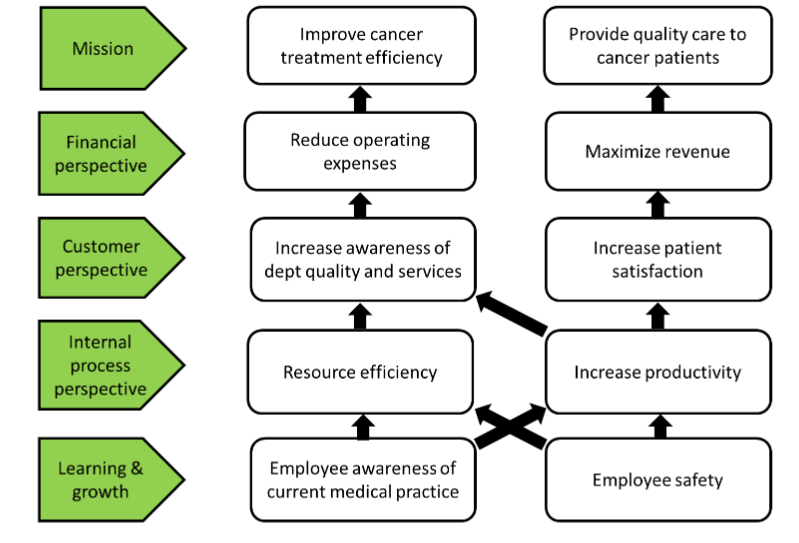
The balanced scorecard describes the causal links between the objectives; each objective has a cause-and-effect relationship with at least one objective, and some of the objectives may link causally to more than one objective. A simple PowerPoint program can be used to create these objectives causal links to create a strategy map. Figure 1 shows a simple strategy map based on financial, customer, internal, and learning and growth perspectives.
Figure 1: display drawing of a simple strategy map based on financial, customer, internal, and learning and growth perspectives.
d) Align Scorecard
The strategy map shows key areas of alignment with other units, which display unit interactions with others internally. For example, institution management may treat finance objectives separately for each department. In this case, no cause-effect relationship exists for financial objectives with other departments. However, the other three groups have a cause-effect relationship for the customer, internal process, and learning and growth perspectives. The customer care perspective indeed leads in organizations more than learning and growth. If the corresponding objectives in the other units fall into the same BSC perspective, the other units’ customer and learning growth perspectives fall into. Both customer and learning perspectives are increasing awareness of departmental quality/services and improving patient satisfaction.
The learning and growth perspective enhances employee awareness of present best practices in medicine and employee safety. Larger organizations may detect some misalignment and try to balance the scorecard factors equally for all four perspectives; however, this BSC may lack some due to the absence of proper attention.
e) Performance reporting in the organization
The completed scorecard report outlines the organization’s broad goals and guidelines, and these goals are provided to the department’s chief so that the efforts and resources are directed to the exact needs. The goal policies and limitations should be discussed in the departmental meetings, and a balanced scorecard should be generated. The document should be supplied to the department manager once the board of directors has finalized goals and constraints, expecting to align the department to the new strategy.
The balanced scorecard framework chooses to operationalize the departmental goal policies and align the resources appropriately to achieve those goals. The departmental staff members conducted several internal strategy meetings to develop an initial set of operational and strategic objectives that aligned with the hospital’s goal policies. The balanced scorecard framework would provide the best opportunity to accomplish new objectives by aligning the organization to the new strategy. The next step was to develop a set of process and performance measures, and revisions were made to the scorecard, which provided a more accurate performance summary. Following the original scorecard’s development, the department initiates developing strategies through a cascading process.
Suppose the department’s objective is maximizing financial performance and reducing operating expenses by introducing new initiatives, and its performance can be measured using revenue from patient treatments and general operating expenses based on accepted principles. Based on the customer perspective, objectives like increasing awareness of departmental quality and improving patient satisfaction can be measured using a satisfaction survey. According to the internal process perspective, objectives like resource efficiency or improved patient satisfaction can be calculated using increased volunteer productivity work time and average patient waiting time for treatment. Regarding learning and growth objectives, increased employee awareness of current best practices in medicine and safety parameters can be measured using a survey score or a test to find the percentage of employees who encountered safety issues.
A balanced scorecard often includes a section dedicated to listing, describing, and sourcing the measures used. This is an excellent time to compare changes in measurement since the last report and further discuss the limitations of the measures. Suppose the department aims to boost financial performance by reducing operating expenses by introducing new expense-saving initiatives. The performance can be measured using revenue from patient treatments and the general operating costs based on the accepted principles.
f) Recommendations
Ideally, the balance of measures drawn from all four perspectives (financial, customer, internal processes, and learning and growth) should be equal (weighted 25% each). However, some imbalance is noted in the scorecard (financial and customer), and these perspectives show a higher weightage than other parameters (internal process and learning and growth). The decisions related to additional continuing education, hands-on training, and the facility to access new journals, departmental presentations, vendor presentations, etc., would benefit the working staff.
The reported relative imbalance influences employees’ work efficiency to a certain extent, primarily because the department uses high-end technologies to treat patients. It is imperative to keep up-to-date knowledge in healthcare to benefit patients and maintain diagnostic and treatment quality²⁹. The lack of education and training negatively impacts treatment effectiveness. To tackle the imbalance in measures, the department can consult machine/software vendors to increase their engagement through various educational activities, including hands-on training, presentations, etc. There are many departmental meetings to seek ways to improve internal processes. Collaborating with universities to develop academic activities and access specialty journals for employees would go a long way.
3. DIAGNOSING ORGANIZATIONAL CULTURE AND EMPLOYEE SATISFACTION
a) Diagnosing organizational culture
The easy way to diagnose organizational culture is to conduct an employee satisfaction survey by gathering responses from the working staff³⁰. A survey can reveal plenty of information about the department and institution, and all members will agree that the quality of work in the department is of utmost importance, leading to greater patient satisfaction³¹. The organization should fully or partially allow its employees to set goals and implement activities. Many organizations are too lazy to provide updated mission, vision, values, and goals to stakeholders; the supervisors pay special attention to do this to develop a better organizational culture. Leaders should provide frequent updates about the organization’s mission, vision, and goals³². The survey directly reflects the inner mind of the organization and the organizational culture.
Team members are critical to any organization’s success³³; high-level frequent communication, the opportunity to express member feelings, praise and recognition, and active goal-setting involvement are essential. The present survey information can be compared to the previous surveys to determine improvements or declines since the last survey. The group-level differences can be analyzed, which helps data comparison in various demographics within the organization. This analysis can help to understand unique employee perceptions across departments to target collective efforts better.
It is possible to present findings to the leadership team to initiate discussions on takeaways, areas of focus, and potential action plans. Share relevant insights and other statistics with employees to demonstrate that their feedback has been heard. Survey results and analyses can be open to the managers, and they can provide additional insights into the results. Special focus groups with employees can discuss survey results, hindered issues, insights, and actionable steps. Create employee engagement action plans at both the organizational and team levels³⁴; first, focus on the main areas to work on as an organization and then utilize those broader goals to guide managers at the team level. The plan should include action items, assignments, and timelines. Communicate the current and foreseeable changes based on the survey to the employees regularly, and further continue communications with employees regarding various actions implemented throughout the year.
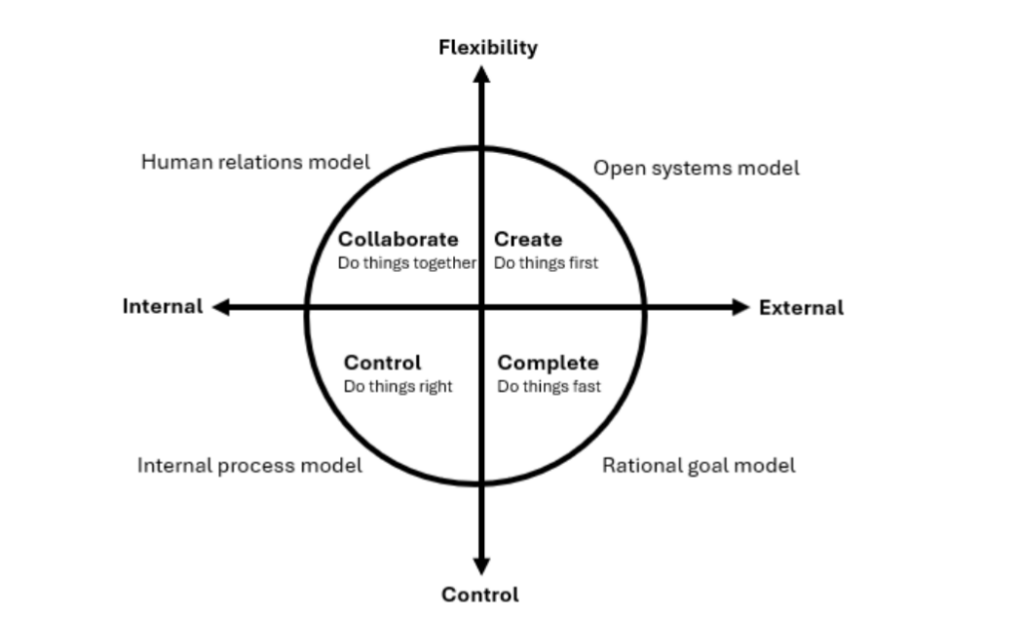
A competing value map is generated and shown in Figure 2. It can be used to detect the present position of the teams and can be identified as the team located in the human relations model region. This human relations quadrant emphasizes flexibility, internal focus, morale, cohesion, and human resource development as criteria for effectiveness. The organization thrives in this model, which values group cohesion, widespread communication, and strong, nurturing relationships with tight social networks.
Discussing the extent of present culture relates to the organization’s vision and values and the institutional business strategies; moreover, the leadership should behave consistently and effectively with values. A great culture begins with a good vision and mission statements; these simple statements guide the values of an organization and provide objectives. These objectives properly align with every employee’s decision. The vision statement is a simple but foundational element of the culture, and the values of an organization are at the core of its culture.
The initial step in creating organizational culture is to formulate its mission and vision statements and determine the values that the employees need to hold. Leaders are responsible for identifying the organization’s cultural vision and driving the organization towards the right direction. Culture comes directly from the behavior of the leaders³⁴; they communicate the culture to the stakeholders involved and inspire the whole organization. The vision statement demonstrates the organization’s future position, which can be utilized to formulate internal decision-making. This statement describes what the organization hopes to achieve and engages the stakeholders to make them more productive³⁷.
A few points help the process a little more accessible by examining the vision, defining the mission, and evaluating values. The business strategies and organizational behavior should be consistent with the cultural values.
Figure 2: shows a competing values map that can be used to detect the team’s position, and it can be found as the team is in the Human Relation Model region.
b) Align strategy and culture
A defined goal is the cornerstone of any organization, and the leaders try to work hard toward achieving it³⁸; for example, in building a skilled workforce to provide high-quality medical care to cancer patients, the leaders recruit physicians, nurses, therapists, medical physicists, front desk, administrators, and managers into the department. The providers need accurate information about how to provide care for a person with cancer, which includes the benefits of early diagnosis, addressing the physical, cognitive, emotional, and behavioral symptoms of the disease, and supporting caregivers as they cope with the physical and emotional aspects of their caregiving responsibilities. Enhanced specialist training is undoubtedly needed to prepare them to face unique challenges from cancer patients³⁹.
Goal setting is significant, and there are many benefits to setting goals. A specified goal provides a clear focus and direction to help identify whether the team is on track to achieve it. If the leaders set a time to complete tasks, employees can alter their pace accordingly to get it done. Setting goals provides the most straightforward way to measure the organization’s success⁴⁰, and the goal should be well aligned with the institutional mission, vision, and values. Goals and objectives are the building blocks of achieving the institution’s mission and vision.
Prioritizing a clear, concise communication pathway is one of the most critical strategies for organizations to achieve their goals⁴¹,⁴². The ideas expressed by the employees should be listened to, and they should be encouraged to share their knowledge and information during the formulation, implementation, and evaluation stages. This approach would create secure communication between leaders and team members and help to confirm they are all on the same page with the same goal and vision. Continuous employee engagement by holding departmental meetings is essential to achieving the formulated goals and ensuring all employees attend and talk about how the organization is trying to reach its mission, vision, and goals. Maintaining transparency about successes and failures is significant and helps employees to be more engaged and productive⁴². Conducting a survey related to the department’s mission and vision helps the employees realize their vision and understand how they play a vital role in it. Leaders should explain the organization’s mission and goals and their alignment with the vision since some employees may lean towards one aspect of the vision. Try to get feedback from the team members explaining what went wrong, which may be due to the vision not being challenging enough or too demanding.
The stakeholders should feel their work has a purpose, and the leaders should meet them regularly, setting up goals relevant to the employees and discussing the goals that align with the department’s vision. Therefore, employees feel more meaningful and will be more engaged in achieving those goals. Success will come once everybody is on the same page and headed toward the same goal. A goal, such as a timely and accurate disease diagnosis and treatment, is vital for any healthcare organization. Several patients with cancers are undiagnosed in time until their symptoms have become severe. A timely disease diagnosis is critical for patient management and leads to curative and positive outcomes⁴³.
The inability to access proper diagnosis and treatment due to the lack of insurance or limited finances is a significant concern for many patients. Early cancer detection is crucial for positive treatment outcomes, especially when this is true for younger patients with positive diseases. The healthcare organization needs modern devices with expert staff to ensure timely and accurate diagnoses⁴⁴,⁴⁵.
c) Track cultural goals
Cultural goal implementation consists of several actions, including facilitating specific training for care professionals to strengthen the workforce and provide high-quality care to cancer patients⁴⁶,⁴⁷. Educating and training healthcare staff by delivering several grants specifically budgeted for cancer education and training activities would go a long way. The department should continue educating clinical staff on recent research findings and clinical practice tools for assessment, diagnosis, and management.
Develop unified medical care nationally using a standard curriculum designed for the workforce to develop further skills to provide high-quality patient care, ensure timely and accurate diagnosis, and follow high-quality cancer care guidelines and measures. Develop resources for integrated care with partners and providers; they can offer numerous webinars to support professionals and caregivers focusing on cancer.
The organization should provide professionals with full access to the latest research articles to maximize patient benefits. Collaborating with other cancer organizations, the department can develop scholar programs to assist graduate-level students⁴⁸. Staff can participate in the institution’s various educational, partnership, and research activities to improve knowledge.
A full-time social worker service in the institution can help patients to get full benefits. Providing access to educational resources for care staff, decision support mechanisms, and initiating chart rounds in the department help ensure every patient receives standard care from the institution. Facilitating a decision-support mechanism for clinicians using computer-based systems would be beneficial.
Providing interdisciplinary team training for recognizing, assessing, and managing cancer would go a long way. Revising wage standards is another option⁵⁰. Low wages have been identified as problematic for long-term care providers in recruiting and retaining institutional employees, potentially reducing care quality. Establishing and implementing timelines for specific objectives are paramount in achieving goals.
The team follows some basic steps to gain proper alignment with goals, such as setting up intelligent goals, creating a timeline, measuring progress, implementing coaching and support, recognizing hard work, and encouraging development⁵¹. Regular monitoring according to a predetermined schedule is necessary to track progress accurately. Goal tracking enables the department to align all employees to work towards the same goal so that everyone can contribute to the project for growth and improvement⁵². Several benefits are noted, such as clarity of purpose, greater unity, increased productivity, fewer mistakes, improved proficiency, more opportunities for future projects, better chance of meeting budget targets, and increased satisfaction. Continuous tracking of goal progress is an excellent method to motivate a team; even a tiny win motivates the entire team. They shared the organization’s vision with the team before beginning a tracking process. Define and set clear goals and ensure all team members know what they must do and the expectations they must meet. Breaking down goals into smaller steps supports employees and managers in staying on track and helps team members to meet the key results, as well as the team to measure progress towards a goal.
The next step is developing milestones to accomplish to achieve overarching goals³³. Leaders can set up incremental accomplishments that help team members focus on the subsequent best actions they must tackle. Apply metrics to milestones by framing reliable metrics to support tracking progress toward goals. Key results sometimes include a key performance indicator or a metric. A measurable indicator is required to determine milestones, and creating checkpoints supports checking how the team works towards the goal. The checkpoints support reminding a pause, assessing the team’s progress, and celebrating any milestones reached. Checkpoints are the time to analyze and evaluate progress goals according to the plan or any required corrective actions.
Incorporating software and tools allows the team members, project leaders, and stakeholders to monitor the collective efforts toward organizational goals easily⁵³. All leaders know the importance of setting goals in an organization, but monitoring progress is an entirely different process. Tracking goals using milestones and other metrics is essential for the team members to remain motivated during the process, reach the finish line, and celebrate accomplishments. Numerous methods can be used to track project milestones, including paper, email, online management systems, software, etc. Online management systems properly track the critical milestones of projects, and this system allows tracking of the work progress of the team members and their communications. In addition, everyone can watch the teammates’ progress to ensure they are all meeting their individual goals.
Goal reports help clarify the organization’s vision for growth, and writing a business report is best achieved when the goals are outlined in an intelligent format. The goals should be specific, measurable, attainable, realistic, and time-bound⁵¹. The goals report consists of a degree of measurability to the progress of goals that supports the organization’s efforts toward meeting them. The goals should be achievable, provide parameters with basic questions, and be realistic; moreover, they should be assessed for effectiveness and progress. Created goals should be realistic; goals do not work well in business when they are too lofty and require financial sanctions. Take an honest look at the company, then craft the goals based on where the organization wants to go, given its limitations.
Open communication with employees and stakeholders can help formulate a precise and realistic picture, and a timetable should be included when writing a department goals report. The timetable can provide deadlines to meet the goals and help to push the team to achieve the goals; moreover, the timing should be more straightforward and realistic.
Conclusion
Innovation sessions in healthcare provide novel opportunities and redesigned approaches to problems by inviting team members to participate in brainstorming sessions to identify opportunities for innovation. Innovation requires a more comprehensive approach to organizational growth for market innovation and business expansion, moving beyond new products and services. Innovations encourage divergent thinking within the team, and the leaders should support the diverse thinking processes for future innovations. Innovations depend on psychological safety, which depends on the leader’s language, tonality, and approach to discussions. Leaders try to provide constructive feedback to the team members and create a continuous partnership with the team to maintain the employees’ psychological safety. The team should be rewarded with innovative ideas, encouraged to work flexibly, and free to take creative ideas forward responsibly.
A balanced scorecard is helpful for healthcare organizations, but many rely heavily on measures of one type at the expense of the other. Organizational performance reporting for goal policies with management limitations should be developed using a balanced scorecard method, and the document should be provided to the managers once the goals are finalized, with the expectation of aligning the team with the new strategy.
Conducting an employee satisfaction survey in the organization is the easiest way to diagnose organizational culture, and a survey can reveal in-depth institutional information and improvements. The survey reflects the inner mind of the organization and the organizational culture, and the team members are critical for its success. The survey results are discussed in the group with other managers to determine hindered issues, insights, and actionable steps; moreover, employee engagement action plans can be created by focusing on predetermined goals.
Excellent communication is necessary for various actions implemented annually; consistent leadership behavior with institutional strategies and values is essential. A great culture begins with an organizational vision and mission statements; these simple statements guide leaders by providing objectives and values. The goal should be aligned well with the institutional building blocks of the mission, vision, and values, and the stakeholders are on the same page with the same goal and vision. Transparency in the success and failures of an institution helps employees be more engaged and productive.
Organizational culture improved by using educational resources, chart rounds in the department, decision support tools, or revised wage standards for long-term care providers. Establishing timelines for goals is a significant step to managing and achieving goals on time, and regular monitoring is required to track progress. Goal tracking enables the department to align every employee working toward the same goal, motivating the team. Develop milestones to accomplish overarching goals and apply metrics to milestones by framing reliable metrics to support tracking the progress toward goals.
Key results sometimes include a key performance indicator or a metric, creating checkpoints to support checking a team’s progress toward a goal. The collective efforts toward organizational goals can be monitored using software tools; tracking goals using milestones and other metrics is essential for the team members to remain motivated. Goal reports help identify the organization’s vision for growth and expansion, and formulating a business goal report is best achieved by the goals outlined in an intelligent format.
Organizational goals should be realistic, specific, precise, measurable, attainable, and time-bound to be implemented effectively. The healthcare organizational culture is a complex, multi-dimensional concept with no existing generalized assessment method; however, maintaining workplace culture is essential to produce creativity and innovation for brighter organizational performance.
Conflict of Interest:
None.
Funding Statement:
None.
Acknowledgements:
None.
References
1. Hughes DJ, Lee A, Tian AW, et al. Leadership, creativity, and innovation: A critical review and practical recommendations. The Leadership Quarterly. 2018; 29(5):549-569
2. Lee A, Legood A, Hughes D, et al. Leadership, creativity and innovation: a meta-analytic review. European Journal of Work and Organizational Psychology. 2020;29(1):1-35
3. Paul J. Role of strategic leaders in unexpected healthcare crisis management. Medical Research Archives. 2024. https://doi.org/10.18103/mra.v12i4.5345
4. Huang Z, Sindakis S, Aggarwal S, et al. The role of leadership in collective creativity and innovation: Examining academic research and development environments. Front. Psychol. 2022;13:1060412
5. Mehraein V, Visintin F, Pittino D. The dark side of leadership: A systematic review of creativity and innovation. Int J Manag Rev. 2023;25:740-767
6. Nandasinghe G. Leadership and organization performance: A Review on theoretical and empirical perspectives. Global Journal of Management and Business Research. 2020; 20(4):41
7. Nguyena NP, Hang NTT, Hiep N, et al. Does transformational leadership influence organisational culture and organisational performance: Empirical evidence from an emerging country. IIMB Management Review. 2023;35:382–392
8. Scott T, Mannion R, Davies HTO, et al. Implementing culture change in health care: theory and practice. Int J Qual Health Care. 2003;15(2):111-8
9. Tsai Y. Relationship between organizational culture, Leadership behavior and job satisfaction. BMC Health Serv Res. 2011;14:11:98.
10. Dextras-Gauthier J, Gilbert MH, Dima J, et al. Organizational culture and leadership behaviors: is manager’s psychological health the missing piece? Front Psychol. 2023; 28:14:1237775
11. Srimulyani VA, Hermanto YB. Organizational culture as a mediator of credible leadership influence on work engagement: empirical studies in private hospitals in East Java, Indonesia. Humanit Soc Sci Commun. 2022;9(1):274
12. Linnander E, McNatt Z, Boehmer K, et al. Changing hospital organisational culture for improved patient outcomes: developing and implementing the leadership saves lives intervention. BMJ Qual Saf. 2021; 30(6):475-483
13. Curry LA, Spatz E, Cherlin E, et al.. What distinguishes top-performing hospitals in acute myocardial infarction mortality rates? A qualitative study. Ann Intern Med 2011;154(6):384–90.
14. McFadden KL, Stock GN, Gowen CR. Leadership, safety climate, and continuous quality improvement: impact on process quality and patient safety. J Nurs Adm. 2014;44(10):S27-37
15. Singer S, Lin S, Falwell A, et al.. Relationship of safety climate and safety performance in hospitals. Health Serv Res 2009;44(2):399–421.
16. Taylor N, Clay-Williams R, Hogden E, et al.. High performing hospitals: a qualitative systematic review of associated factors and practical strategies for improvement. BMC Health Serv Res. 2015;24:15:244.
17. Acar OA, Tarakci M, van Knippenberg D. Creativity and innovation under constraints: A Cross-disciplinary integrative review. Journal of Management. 2019;45(1):96-121
18. Zhang X. Incremental innovation: Long-term impetus for design business creativity. Sustainability. 2022;14(22):14697
19. Paul J, Chacko A, Saccomandi P, et al. Effect of diagnostic cone-beam computed tomography protocols on image quality, patient dose, and lesion detection. Phys Med. 2016;32(12):1575-1583
20. Paul J, Schell B, Kerl JM, et al. Effect of contrast material on image noise and radiation dose in adult chest computed tomography using automatic exposure control: a comparative study between 16-, 64- and 128-slice CT. Eur J Radiol. 2011;79(2):e128-32
21. Paul J, Krauss B, Banckwitz R, et al. Relationships of clinical protocols and reconstruction kernels with image quality and radiation dose in a 128-slice CT scanner: study with an anthropomorphic and water phantom. Eur J Radiol. 2012;81(5):e699-703
22. Paul J, Chacko A, Farhang M, et al. Ultrafast cone-beam computed tomography: a comparative study of imaging protocols during image-guided therapy procedure. Biomed Res Int. 2015;2015:4 67850. https://doi.org/10.1155/2015/467850
23. Paul J, Mbalisike EC, Vogl TJ. Radiation dose to procedural personnel and patients from an X-ray volume imaging system. Eur Radiol. 2013;23 (12):3262-70
24. Paul J, Jacobi V, Farhang M, et al. Radiation dose and image quality of X-ray volume imaging systems: cone-beam computed tomography, digital subtraction angiography and digital fluoroscopy. Eur Radiol. 2013;23(6):1582–93
25. Kim M, Beehr TA, Prewett MS, et al. Employee responses to empowering leadership: A meta-analysis. Journal of Leadership & Organizational Studies. 2018;25(3):257-276
26. Pierce E. A balanced scorecard for maximizing data performance. Front Big Data. 2022;5:821103.
27. Tawse A, Tabesh P. Thirty years with the balanced scorecard: What we have learned. Business Horizons. 2023;66:123-132
28. Kosklin R, Lammintakanen J, Kivinen T. Knowledge management effects and performance in health care: a systematic literature review. Knowledge Management Research & Practice. 2023; 21(4):738–748
29. Paul J. Innovative healthcare digital transformations during and after the COVID-19 pandemic crisis. Medical Research Archives. 2024. https://doi.org/10.18103/mra.v12i5.5297
30. Huebner LA, Zacher H. Following up on employee surveys: A conceptual framework and systematic review. Front Psychol. 2021;12:801073
31. Ferreira DC, Vieira I, Pedro MI, et al. Patient satisfaction with healthcare services and the techniques used for its assessment: A systematic literature review and a bibliometric analysis. Healthcare (Basel). 2023;11(5):639
32. Cakir FS, Adiguzel Z. Analysis of leader effectiveness in organization and knowledge sharing behavior on employees and organization. Sage Open. 2020;10(1)
33. Paul J. Healthcare leadership: Leading organizational change management for radiation oncology practices. Medical Research Archives. 2024 https://doi.org/10.18103/mra.v12i9.5786
34. Cardarelli R, Slimack M, Gottschalk G, et al. Translating provider and staff engagement results to actionable planning and outcomes. J Patient Exp. 2020; 7(4):534–540
35. Qin X, Wang BL, Zhao J, et al. Learn from the best hospitals: a comparison of the mission, vision and values. BMC Health Serv Res. 2023;23:792.
36. Warrick DD. What leaders need to know about organizational culture. Business Horizons. 2017; 60(3):395-404
37. Paul J. Navigating strategic change process in healthcare organizations during unexpected crisis. Medical Research Archives. 2024. https://doi.org/10.18103/mra.v12i3.5213
38. Molz R. How leaders use goals. Long Range Planning. 1987;20(5):91-101
39. Berardi R, Morgese F, Rinaldi S, et al. Benefits and limitations of a multidisciplinary approach in cancer patient management. Cancer Manag Res. 2020;12:9363-9374.
40. Pervaiz S, Li G, He Q. The mechanism of goal-setting participation’s impact on employees’ proactive behavior, moderated mediation role of power distance. PLoS One. 2021;16(12): e0260625.
41. Paul J. What do medical physicists do? Leadership and challenges in administration and various business functions. Adv Radiat Oncol. 2022;7(6):100947.
42. Paul J. Strategies for effective crisis management in healthcare systems: Patient safety and lessons learned. Medical Research Archives. 2024. https://doi.org/10.18103/mra.v12i7.5424
43. Cone EB, Marchese M, Paciotti M et al. Assessment of time-to-treatment initiation and survival in a cohort of patients with common cancers. JAMA Netw Open. 2020;3(12): e2030072.
44. Graber ML. Taking steps towards a safer future: Measures to promote timely and accurate medical diagnosis. Am J Med. 2008;121(5):S43-6
45. Nass SJ, Cohen MB, Nayar R, et al. Improving cancer diagnosis and care: Patient access to high‐quality oncologic pathology. Oncologist. 2019;24 (10):1287-1290.
46. Reblin M, D’Almeida H, Barrios-Monroy V, et al. Training cancer caregiver navigators: experiences from implementing the eSNAP and caregiver navigator intervention. Support Care Cancer. 2022;30(12):10263-10272
47. Patel MI, Sundaram V, Desai M, et al. Effect of a lay health worker intervention on goals-of-care documentation and on health care use, costs, and satisfaction among patients with cancer – A randomized clinical trial. JAMA Oncol. 2018;4 (10):1359-1366
48. Goodwin N. Understanding integrated care. Int J Integr Care. 2016;16(4):6
49. Hedges JR, Soliman KFA, Southerland WM, et al. Strengthening and sustaining inter-institutional research collaborations and partnerships. Int J Environ Res Public Health. 2021;18(5):2727
50. Petersen LA, Woodard LD, Urech T, et al. Does pay-for-performance improve the quality of health care? Ann Intern Med. 2006;145(4):265-72
51. van der Hoek M, Groeneveld S, Kuipers B. Goal setting in teams: Goal clarity and team performance in the public sector. Rev Public Pers Adm. 2018;38(4):472-493.
52. Höpfner J, Keith N. Goal missed, self hit: Goal-setting, goal-failure, and their affective, motivational, and behavioral consequences. Front Psychol. 2021;12:704790
53. Al-Aidaros HAA, Mazni O. Software project management approaches for monitoring work in progress – A review. Journal of Engineering and applied sciences. 2017;12(15):3851-57