


Impact of Motivation on Pharmacy Student Performance
Intrinsic Motivation and Learning Strategies: Their Impact on Pharmacy Students’ Academic Performance and Standardized Exams
Maula R. Graham, PharmD1, Karen L. Hardinger, PharmD2
- Associate Dean for Academic Affairs, University of Missouri – Kansas City School of Pharmacy
2464 Charlotte Street, HSB 2313
Kansas City, MO 64108 - Clinical Professor, Director of Assessment, University of Missouri – Kansas City School of Pharmacy
2464 Charlotte Street, Kansas City, Missouri
OPEN ACCESS
PUBLISHED: 30 April 2025
CITATION: Graham, M.R. and Hardinger, K.L., 2025. Intrinsic Motivation and Learning Strategies: Their Impact on Pharmacy Students’ Academic Performance and Standardized Exams. Medical Research Archives, [online] 13(4).
https://doi.org/10.18103/mra.v13i4.6448
COPYRIGHT © 2025 European Society of Medicine. This is an open-access article distributed under the terms of the Creative Commons Attribution License, which permits unrestricted use, distribution, and reproduction in any medium, provided the original author and source are credited.
DOI https://doi.org/10.18103/mra.v13i4.6448
ISSN 2375-1924
ABSTRACT
Objective:
To investigate the role of motivational factors and learning strategies in predicting academic success and performance on standardized examinations among pharmacy students.
Methods:
The Motivated Strategies for Learning Questionnaire was used to assess students’ motivation as well as their learning strategies. A retrospective analysis was conducted to examine the relationship between the Motivated Strategies for Learning Questionnaire scores and pre-pharmacy admission characteristics, academic performance, and scores on standardized tests [Pharmacy College Admission Test, Pharmacy Curriculum Outcomes Assessment, and Pre-North American Pharmacist Licensure Examination and North American Pharmacist Licensure Examination].
Results:
Data from 720 students were included. Intrinsic motivation significantly correlated with GPA during semesters 3 through 5 of the pharmacy program. However, motivation scales did not show significant relationships with performance on standardized tests. Learning strategies such as metacognitive self-regulation and elaboration were commonly employed yet were not strongly correlated with grade point average or test outcomes. Resource management strategies, including time management and effort regulation, were utilized by students but did not directly predict academic success.
Conclusion:
Intrinsic motivation plays a significant role in academic performance. Students with higher intrinsic motivation consistently achieved higher grade point averages, indicating the importance of fostering a sense of internal drive and commitment to the curriculum.
Keywords:
Motivated Strategies for Learning Questionnaire (MSLQ), Pharmacy Education, Academic Performance, Test Anxiety, Standardized Examinations
MESH Terms:
Pharmacy Education, Learning Strategies, Self-Efficacy, Test Anxiety, Academic Performance, Motivation, Standardized Tests, Time Management, Effort Regulation
Introduction
As pharmacists seek to become recognized providers under Federal and State law, graduates of Doctor of Pharmacy (PharmD) programs must acquire a broad range of knowledge, skills, and abilities essential for contemporary practice. To ensure that graduates are well-equipped to make informed therapeutic decisions that promote patient health and well-being, the PharmD curriculum should provide a strong foundation in factual knowledge. The ability to engage in a range of professional activities and tasks also allows the graduate to be an effective contributor of the healthcare team.²,³,⁴ The overarching goal of the professional PharmD degree program is to foster student success by enabling the achievement of course objectives and curricular outcomes.⁵ Numerous factors influence a student’s ability to meet these outcomes, and considerable research has been dedicated to identifying individual student characteristics that may impact academic performance.⁶,⁷,⁸,⁹,¹⁰,¹¹,¹² Understanding why some students excel academically and others struggle allows for early, proactive intervention and tailored support.
Self-regulated learning refers to students actively participating in their learning process by setting educational goals, evaluating progress, and modifying their study strategies. Self-regulated learning maximizes the degree to which learning occurs. Motivational beliefs and learning methods are two components of self-regulated learning and are positively related to academic performance. A tool commonly used to assess academic motivation and learning strategies is the Motivated Strategies for Learning Questionnaire (MSLQ). This validated instrument evaluates students’ intrinsic and extrinsic motivations, as well as their preferred study strategies within a course context.¹³
The MSLQ consists of two sections: the motivation section, which measures students’ goals, their perceived value of the course, self-confidence in their ability to succeed, and test anxiety; and the learning strategies section, which focuses on how students approach studying and the resources they utilize.¹³ Previous studies using the MSLQ have found that self-efficacy and test anxiety are significant predictors of student achievement across various educational contexts. For example, research in physical therapy and pharmacy programs has demonstrated that these factors, in combination with strategies like critical thinking, explain a substantial portion of the variance in student grades.¹⁴,¹⁵
Additionally, studies in medical and dental education have shown that motivation and self-regulated learning strategies, such as task value and beliefs about learning control, are associated with academic success. However, the impact of self-efficacy and test anxiety has been shown to vary based on factors like gender, socioeconomic status, and academic ability.¹⁶,¹⁷,¹⁸,¹⁹
Students should have and faculty do have a vested interest in student success as does the Accreditation Council for Pharmacy Education (ACPE). ACPE requires pharmacy schools to ensure the selection of a qualified, diverse student body and to implement measures that support student success throughout the program. However, recent challenges in the field, such as the discontinuation of the Pharmacy College Admission Test (PCAT), shrinking applicant pool and declining North American Pharmacist Licensure Examination (NAPLEX) pass rates, have prompted schools to explore alternative methods for assessing students’ potential for academic success.
While the MSLQ has been used extensively within individual courses, its broader applicability in predicting success across an entire curriculum warrants further investigation. Therefore, the purpose of this study was to examine how the MSLQ can predict pharmacy students’ performance in both the curriculum and on standardized examinations.
Methods
A retrospective analysis was conducted at a school of pharmacy within a public university. The study was deemed a quality improvement activity by the University of Missouri-Kansas City (UMKC) Social Sciences Institutional Review Board, and therefore, it was exempt from formal review.
The analysis included data from the UMKC School of Pharmacy classes of 2020 through 2024. The study compared students’ MSLQ scale scores with their pre-pharmacy admissions characteristics, academic performance throughout the curriculum, and outcomes on standardized examinations, including the PCAT, the Pharmacy Curriculum Outcomes Assessment (PCOA), and the Pre-North American Pharmacist Licensure Examination (Pre-NAPLEX) and NAPLEX.
MSLQ Administration
Pharmacy students are required to complete the MSLQ during the first semester of their first professional year. The questionnaire comprises 81 items designed to assess both students’ motivational orientation and their use of various learning strategies.
The motivation section contains 31 items that evaluate students’ goals and value beliefs related to their courses.The learning strategies section includes 31 items focusing on students’ cognitive and metacognitive strategies, alongside 19 items addressing resource management.
Students rate each item on a seven-point Likert scale ranging from 1 (“not at all true of me”) to 7 (“very true of me”). Items that are reversed (negatively worded) are appropriately recoded during analysis.
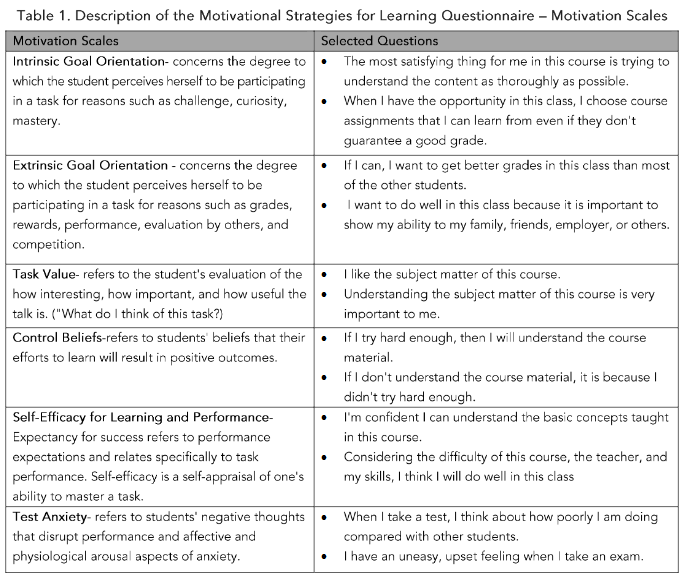
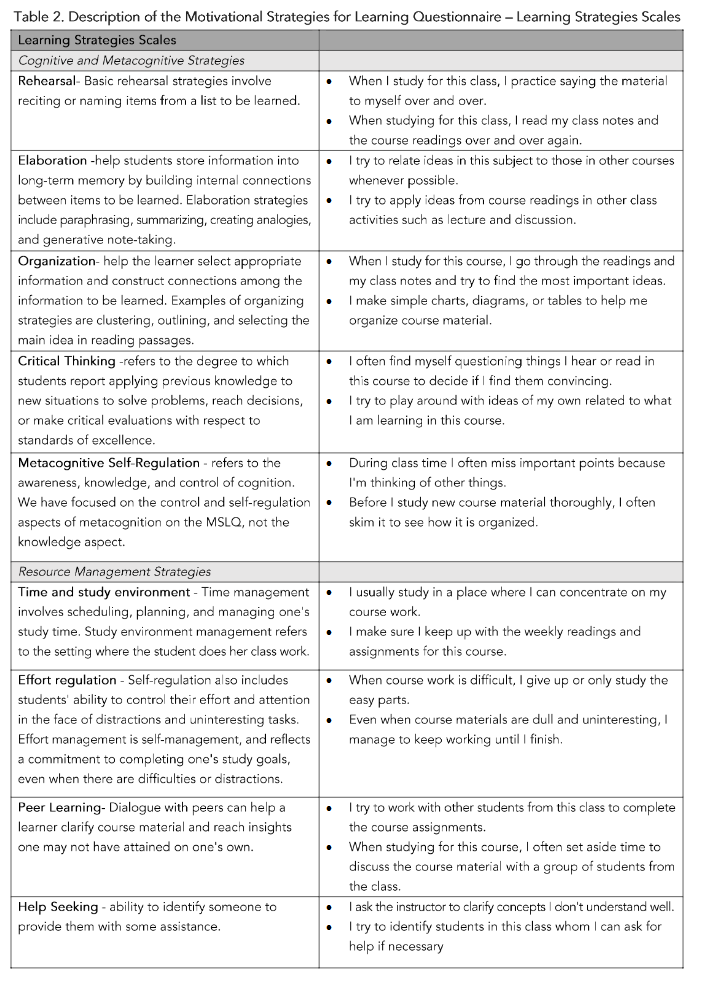
Although the MSLQ is designed to assess motivation and strategies within a single course, pharmacy students at UMKC respond to the items considering all required courses for the first semester. After completing the questionnaire, students receive a results report and are instructed to create a personalized academic success plan addressing areas where their scale scores were below a threshold of three. Students must discuss their results and plan with their faculty advisor. Individual success plans are stored in an electronic database accessible to both students and advisors.
Results
A total of 720 students graduated from the UMKC School of Pharmacy between 2020 and 2024, with 719 students completing the MSLQ and included in the analysis.
Table 3. MSLQ Scale Means
| Motivation Scales | Number | Mean | SD |
|---|---|---|---|
| Intrinsic Goal Orientation | 710 | 5.08 | 1.00 |
| Extrinsic Goal Orientation | 709 | 4.90 | 1.13 |
| Task Value | 709 | 5.50 | 1.05 |
| Control Beliefs | 708 | 5.57 | 0.93 |
| Self-Efficacy for Learning and Performance | 709 | 5.53 | 0.99 |
| Test Anxiety | 709 | 3.72 | 1.53 |
Learning Strategies Scales
| Scale | Number | Mean | SD |
|---|---|---|---|
| Rehearsal | 709 | 4.86 | 1.16 |
| Elaboration | 708 | 4.76 | 1.15 |
| Organization | 708 | 4.55 | 1.33 |
| Critical Thinking | 709 | 3.86 | 1.23 |
| Metacognitive Self-Regulation | 710 | 4.89 | 0.90 |
Resource Management Strategies
| Scale | Number | Mean | SD |
|---|---|---|---|
| Time and Study | 710 | 5.34 | 0.85 |
| Effort Regulation | 710 | 5.32 | 1.11 |
| Peer Learning | 707 | 4.05 | 1.52 |
| Help Seeking | 709 | 4.49 | 1.13 |
Motivational factors exhibited notable variability. Students rated their intrinsic motivation (5.08 ± 1.00) higher than their extrinsic motivation (4.09 ± 1.13), indicating a greater sense of internal drive toward academic achievement than external incentives.
Students also demonstrated a high perceived value for course material, reflected by high average ratings for:
-
Task value (5.50 ± 1.05)
-
Control of learning beliefs (5.57 ± 0.93)
-
Self-efficacy for learning and performance (5.53 ± 0.99)
These results suggest that students generally felt confident in their ability to succeed in the program and believed their efforts would produce positive academic outcomes.
Conversely, test anxiety was relatively low, with a mean score of 3.72 ± 1.53, indicating minimal distress surrounding assessments.
Regarding learning strategies, metacognitive self-regulation (4.89 ± 0.90), elaboration (4.76 ± 1.15), and rehearsal (4.86 ± 1.16) emerged as the predominant strategies employed by students.
Critical thinking was less frequently used, with an average score of 3.86 ± 1.23.
Students most frequently used time management and study environment strategies (5.34 ± 0.85) and effort regulation (5.32 ± 1.11). However, peer learning and help-seeking strategies were used less often, suggesting students tended to study independently rather than collaborate or seek assistance.
Pre-Pharmacy Admission Characteristics
Motivation strategies did not show significant correlations with pre-pharmacy admission characteristics.
However, certain cognitive and metacognitive learning strategies were associated with academic performance.
For example:
-
Rehearsal strategy
-
Positively correlated with prerequisite math and science GPA
-
Negatively correlated with cumulative GPA
-
-
Critical thinking
-
Negatively correlated with PCAT score
-
-
Peer learning
-
Positively correlated with cumulative GPA
-
Negatively correlated with PCAT composite score
-
Table 4. Correlation of MSLQ Scale Scores with Pre-Pharmacy Admission Characteristics and Pharmacy School Performance
| Motivation Scales | PCAT Composite | M/S GPA | Pre-Req GPA | Cum GPA | S1 GPA | S2 GPA | S3 GPA | S4 GPA | S5 GPA | S6 GPA |
|---|---|---|---|---|---|---|---|---|---|---|
| Intrinsic | -0.040 | 0.021 | 0.011 | 0.017 | 0.039 | 0.063 | 0.084* | 0.081* | 0.081* | 0.078 |
| Extrinsic | -0.011 | -0.024 | -0.033 | -0.011 | -0.030 | -0.003 | -0.006 | -0.007 | -0.007 | -0.012 |
| Task Value | -0.010 | 0.028 | 0.028 | 0.022 | -0.012 | 0.001 | 0.008 | 0.009 | 0.034 | 0.022 |
| Control Beliefs | -0.004 | 0.010 | 0.010 | 0.015 | 0.025 | 0.032 | 0.015 | 0.005 | 0.021 | 0.008 |
| Self-Efficacy | -0.038 | 0.013 | 0.018 | 0.028 | -0.040 | -0.036 | -0.042 | -0.040 | -0.016 | -0.024 |
| Test Anxiety | 0.018 | 0.033 | 0.045 | 0.041 | -0.007 | 0.007 |
0.005 |
Cognitive and Metacognitive Strategies
| Scale | PCAT Composite | M/S GPA | Pre-Req GPA | Cum GPA | S1 GPA | S2 GPA | S3 GPA | S4 GPA | S5 GPA | S6 GPA |
|---|---|---|---|---|---|---|---|---|---|---|
| Rehearsal | 0.019 | 0.088* | 0.068 | -0.077* | 0.021 | 0.013 | 0.001 | -0.017 | -0.007 | -0.021 |
| Elaboration | -0.018 | 0.054 | 0.044 | 0.051 | 0.019 | 0.004 | -0.013 | -0.017 | -0.016 | -0.031 |
| Organization | -0.027 | 0.018 | 0.011 | 0.019 | -0.029 | -0.002 | -0.043 | -0.039 | -0.043 | -0.063 |
| Critical Thinking | -0.085* | 0.006 | 0.008 | 0.009 | -0.050 | -0.056 | -0.064 | -0.057 | -0.044 | -0.054 |
| Metacognitive Self-Regulation | -0.021 | 0.071 | 0.056 | 0.067 | 0.009 | -0.027 | -0.033 | -0.030 | -0.031 | -0.041 |
Resource Management Strategies
| Scale | PCAT Composite | M/S GPA | Pre-Req GPA | Cum GPA | S1 GPA | S2 GPA | S3 GPA | S4 GPA | S5 GPA | S6 GPA |
|---|---|---|---|---|---|---|---|---|---|---|
| Time and study space | 0.039 | 0.020 | 0.006 | 0.014 | -0.006 | -0.029 | -0.003 | -0.014 | -0.021 | -0.029 |
| Effort regulation | 0.032 | 0.036 | 0.050 | 0.038 | -0.037 | -0.041 | -0.004 | 0.004 | -0.014 | -0.025 |
| Peer Learning | 0.101** | 0.056 | 0.037 | 0.078* | 0.019 | -0.003 | 0.008 | 0.003 | 0.006 | 0.002 |
| Help Seeking | -0.061 | 0.006 | -0.011 | 0.039 | -0.017 | -0.049 | -0.052 | -0.054 | -0.044 | -0.043 |
Pharmacy College Admission Test (PCAT), Math and science (M/S), Semester (S), Grade point average (GPA)
Pharmacy School Performance
Intrinsic motivation had positive and significant correlations with GPA from semesters 3 through 5 of the PharmD program (r = 0.81–0.84, p < 0.05), suggesting that students who were intrinsically motivated performed better academically during the middle portion of the program.
No significant relationships were found between other motivation scales (extrinsic motivation, task value, control of learning beliefs, self-efficacy, and test anxiety) and pharmacy school GPA.
Similarly, cognitive and metacognitive learning strategies, as well as resource management strategies, were not significantly correlated with pharmacy school GPA.
Standardized Test Performance
Motivation scales showed no significant correlations with performance on standardized tests, including the:
-
PCOA
-
Pre-NAPLEX
-
NAPLEX
However, critical thinking negatively correlated with Pre-NAPLEX performance (r = −0.102, p < 0.01), though no similar relationship was found for the PCOA or NAPLEX.
Additionally, resource management strategies were not associated with standardized test performance.
Table 5. Correlation of MSLQ Scale Scores and Performance on Standardized Tests
| Motivation Scales | PCOA | Pre-NAPLEX | NAPLEX |
|---|---|---|---|
| Intrinsic | 0.067 | 0.044 | -0.106 |
| Extrinsic | -0.019 | -0.014 | 0.008 |
| Task Value | -0.029 | 0.012 | -0.053 |
| Control Beliefs | -0.021 | 0.033 | -0.048 |
| Self-Efficacy | -0.036 | 0.018 | 0.006 |
| Test Anxiety | -0.001 | -0.019 | -0.056 |
Learning Strategies Scales
| Scale | PCOA | Pre-NAPLEX | NAPLEX |
|---|---|---|---|
| Rehearsal | 0.010 | 0.007 | -0.044 |
| Elaboration | -0.038 | -0.044 | -0.076 |
| Organization | -0.048 | -0.058 | -0.073 |
| Critical Thinking | -0.070 | -0.102** | 0.002 |
| Metacognitive Self-Regulation | -0.049 | -0.040 | -0.037 |
Resource Management Strategies
| Scale | PCOA | Pre-NAPLEX | NAPLEX |
|---|---|---|---|
| Time and study | -0.046 | 0.002 | -0.094 |
| Effort regulation | -0.022 | -0.007 | -0.051 |
| Peer Learning | -0.025 | -0.042 | -0.022 |
| Help Seeking | -0.020 | -0.029 | -0.044 |
PCOA: Pharmacy Curriculum Outcomes Assessment
Pre-NAPLEX: Pre-North American Pharmacist Licensure Examination
Discussion
The results of this study highlight the varying impact of motivational factors, learning strategies, and resource management on both academic performance in pharmacy school and standardized test outcomes.
Although motivation did not show significant correlations with pre-pharmacy admission characteristics, certain learning strategies, such as rehearsal and critical thinking, were associated with GPA and PCAT scores. This suggests that specific cognitive and metacognitive strategies may play a role in early academic success.
In pharmacy school, intrinsic motivation emerged as a significant predictor of GPA in semesters 3 through 5, underscoring the importance of fostering intrinsic drive among students for sustained academic performance.
However, other motivation scales, including:
-
extrinsic motivation
-
task value
-
self-efficacy
-
test anxiety
were not significantly correlated with pharmacy school GPA. This finding suggests that intrinsic motivation, rather than external factors or perceived self-efficacy, may be more crucial for long-term success in the PharmD program.
Learning strategies, both cognitive and metacognitive, as well as resource management strategies, did not correlate with pharmacy school GPA. This indicates that academic performance may be more strongly influenced by motivation than by the strategies employed.
Interestingly, critical thinking showed a negative correlation with Pre-NAPLEX scores, potentially pointing to an over-reliance on critical thinking strategies that may not align with the format or expectations of standardized exams.
These findings suggest that while critical thinking is valuable in clinical settings, its application may not always translate effectively to standardized test formats.
Similarly, the lack of significant associations between resource management strategies (such as time management and effort regulation) and academic performance suggests that while these strategies support overall student success, they may not directly influence performance metrics.
Implications for Student Success in Pharmacy Education
The results of this study have several implications for improving student success in pharmacy programs.
Given the positive association between intrinsic motivation and academic performance, efforts to foster intrinsic motivation among students could be an effective strategy for improving academic outcomes.
Additionally, the finding that critical thinking was negatively correlated with Pre-NAPLEX performance highlights the need for tailored support that helps students balance critical thinking with the specific skills required for standardized exams.
Furthermore, although resource management strategies like time management and effort regulation were not directly correlated with academic performance, they may still be valuable for supporting students in their daily study habits and long-term success.
Pharmacy programs could integrate these strategies into student success programs to help students develop effective study habits and reduce stress.
Development efforts should also focus on equipping faculty advisors with strategies to support students’ intrinsic motivation and cognitive strategies.
Faculty advisors could be trained to recognize when students may need more targeted interventions based on their MSLQ results, such as personalized feedback on critical thinking or time management.
These strategies could be integrated into a formalized student success plan that is regularly reassessed to ensure continuous improvement.
Limitations
This study has several limitations that should be considered when interpreting the results.
The data were drawn from a single school of pharmacy, which may limit the generalizability of the findings to other institutions and health disciplines.
The study includes students from only four graduating classes, which may not fully capture the diversity of experiences and learning strategies within a broader cohort.
Additionally, the last cohort (Class of 2024) completed the MSLQ during the COVID-19 pandemic, when coursework was delivered in hybrid mode with half of required courses conducted in person and the other half online.
Lastly, the MSLQ was used to help students identify personal characteristics that could hinder their academic performance within the PharmD curriculum rather than a specific course. Students may not have fully understood the directions and may have completed the survey based on the course the MSLQ was administered in.
have influenced the validity of the responses, as students’ engagement with different types of learning strategies may vary between courses.
Conclusion
The findings from this study suggest that intrinsic motivation and effective resource management strategies, such as time management and effort regulation, are important factors influencing performance in pharmacy school. While motivation and learning strategies did not significantly predict pre-pharmacy GPA or standardized test performance, addressing test anxiety, promoting intrinsic motivation, and fostering effective study strategies could support student success throughout the PharmD program.
Future research should explore the broader applicability of these findings across different institutions and investigate additional factors that may contribute to student achievement in pharmacy education.
Grants and/or funding information:
None
Acknowledgement:
None
Conflict of interest statement:
The authors have no conflicts of interest to report.
Ethics Approval and Informed Consent:
This study was deemed a quality improvement activity and exempt from formal review.
References
1. Accreditation Council for Pharmacy Education. Accreditation standards and key elements for the professional program in pharmacy leading to the doctor of pharmacy degree (“standards 2025”). Accessed April 7, 2025. https://www.acpe-accredit.org/pdf/ACPEStandards2025.pdf
2. Medina MS, Plaza CM, Stowe CD, et al. Center for the Advancement of Pharmacy Education 2013 Educational Outcomes. Am J Pharm Educ. 2013;77(8):162. doi:10.5688/ajpe778162
3. Joint Commission of Pharmacy Practitioners. The Pharmacists’ Patient Care Process. Accessed April 7, 2025. https://jcpp.net/patient-care-process/
4. Accreditation Council for Pharmacy Education. AACP Curriculum Outcomes and Entrustable Professional Activities (COEPA) 2022. Published November 2022. Accessed April 7, 2025. https://www.aacp.org/sites/default/files/2022-11/coepa-document-final.pdf
5. Persky AM, Lee E, Schlesselman LS. Perception of learning versus performance as outcome measures of educational research. Am J Pharm Educ. 2020;84(7):ajpe7782. doi:10.5688/ajp e7782
6. Hardinger K, Schauner S, Graham M, Garavalia L. Admission predictors of academic dismissal for provisional and traditionally admitted students. Curr Pharm Teach Learn. 2013;5:33-38. doi:10.1016/j.cptl.2012.09.010
7. Schauner S, Hardinger KL, Graham MR, Garavalia L. Admission variables predictive of academic struggle in a PharmD program. Am J Pharm Educ. 2013;77(1):Article 8. doi:10.5688/ajpe 7718
8. Carroll CA, Garavalia LS. Factors contributing to the academic achievement of pharmacy students: use of the Goal Efficacy Framework. Am J Pharm Educ. 2004;68(4):88. doi:10.5688/aj680488
9. Stegers-Jager KM, Cohen-Schotanus J, Themmen APN. Motivation, learning strategies, participation and medical school performance. Med Educ. 2012;46(7):678-688. doi:10.1111/j.1365-2923.2012.04284.x
10. Credé M, Kuncel NR. Study Habits, Skills, and Attitudes: The third pillar supporting collegiate academic performance. Perspect Psychol Sci. 2008; 3(6):425-453. doi:10.1111/j.1745-6924.2008.00089.x
11. Sansgiry SS, Bhosle M, Sail K. Factors that affect academic performance among pharmacy students. Am J Pharm Educ. 2006;70(5):Article 104: 1-9. doi:10.5688/aj7005104
12. Boekaerts M. Self-regulated learning: where we are today. Int J Educ Res. 1999;31(6):445-457. doi:10.1016/S0883-0355(99)00014-2
13. Pintrich PR, Smith DAF, Garcia T, McKeachie WJ. A manual for the use of the Motivated Strategies for Learning Questionnaire (MSLQ). University of Michigan; 1991. Accessed April 8, 2025.
https://files.eric.ed.gov/fulltext/ED338122.pdf
14. Moulton J, Vecchiarelli C, Cheng MS. Do chosen learning strategies predict academic performance in first-year DPT anatomy students? J Phys Ther Educ. 2024;38(2):100-106. doi: 10.1097/J TE.0000000000000320.
15. Galal S, Vyas D, Ndung’u M, Wu G, Webber M. Assessing learner engagement and the impact on academic performance within a virtual learning environment. Pharmacy (Basel). 2023;11(1):36. doi:10.3390/pharmacy11010036
16. Broks VMA, Dijk SW, Van den Broek WW, Stegers-Jager KM, Woltman AM. Self-regulated learning profiles including test anxiety linked to stress and performance: a latent profile analysis based across multiple cohorts. Med Educ. 2024; 58(5):544-555. doi:10.1111/medu.15283
17. Zilundu PLM, Chibhabha F, Yu G, Fu R, Zhou LH. Pre-clinical medical students’ use of motivational and cognitive study strategies during anatomy learning: a three-year cross-sectional survey. Anat Sci Educ. 2022 May;15(3):522-534. doi: 10.1002/a se.2070.
18. Almalki SA. Influence of motivation on academic performance among dental college students. Open Access Maced J Med Sci. 2019;7 (8):1374-1381. doi:10.3889/oamjms.2019.319
19. Kauffman CA, Derazin M, Asmar A, Kibble JD. Relationship between classroom attendance and examination performance in a second-year medical pathophysiology class. Adv Physiol Educ. 2018;42(4):593-598. doi:10.1152/advan.00123.2018