

Impact of Diethylstilbestrol on Gender Identity Disorders
Gender identity disorders: a legacy of fetal exposition to Diethylstilbestrol, an Endocrine Disruptor Chemical
Marie-Odile Soyer-Gobillard1, Laura Gaspari2, Charles Sultan3
- Sorbonne University, CNRS, Paris, France
- Association HHORAGES-France, Perpignan, France
- Unité d’Endocrinologie-Gynécologie Pédiatrique, CHU Montpellier, Université de Montpellier, 34090 Montpellier, France
OPEN ACCESS
PUBLISHED:31 March 2025
CITATION: Soyer-Gobillard, M-O., et al., 2025. Gender identity disorders: a legacy of fetal exposition to Diethylstilbestrol, an Endocrine Disruptor Chemical.
Medical Research Archives, [online] 13(3).https://doi.org/10.18103/mra.v13i3.6342
COPYRIGHT: © 2025 European Society of Medicine. This is an open-access article distributed under the terms of the Creative Commons Attribution License, which permits unrestricted use, distribution, and reproduction in any medium, provided the original author and source are credited.
DOI https://doi.org/10.18103/mra.v13i3.6342
ISSN 2375-1924
ABSTRACT
Several data analysed in the first part of this report demonstrate that fetal exposure to xenoestrogen Diethylstilbestrol could have a significant impact on the sexual orientation identity and gender-related behavior: for example, the increase of cases of male homosexuality and the decrease in cases of female homosexuality in US populations of children prenatally exposed to Diethylstilbestrol.
In the second part of this work, we report several cases from the French cohort HHORAGES of transgender identity change, Male to Female, of individuals formerly exposed in utero to Diethylstilbestrol. This high prevalence (1.58%) of male to female transgenderism on a cohort of 253 Diethylstilbestrol sons demonstrates for the first time that exposure to xenoestrogen during fetal life has an effect on male sex identity and behavior. Moreover, a qualitative study still in progress realized via the Association Diethylstilbestrol-Sons USA reveals a significant percentage of XY male-to-female transsexuals among a population in utero exposed to Diethylstilbestrol.
In the third part of this article, we report from a study of The University of California Los Angeles, School of Law’s Williams Institute, in 2022 and from a major IPSOS Institute survey in 2024 on the dramatic increase in gender dysphoria among adolescents identifying as “Trans” and whose number in the USA has doubled to 1.6 million during the 5 years between 2017 and 2022.
It is highly likely that other endocrine disruptors than Diethylstilbestrol, also mediated by the identical estrogen nuclear receptors ER α and ER β activity, may have the same effect on human sexual identity.
Keywords: Synthetic sex hormones, Diethylstilbestrol, Fetal exposure, Sexual orientation identity, Endocrine Disruptor Chemical(s).
Keywords
- Diethylstilbestrol
- Endocrine disruptor
- Gender identity
- Sexual orientation
- Fetal exposure
Introduction
In this review we have focused on sexual orientation and gender identity of children exposed in utero to Diethylstilbestrol (DES), a synthetic xenoestrogen considered as Endocrine Disruptor Chemical (EDC), administered to their mothers during pregnancy. Sexual orientation is defined by the emotional and sexual attraction that one person has for another. It differs from gender identity, which is feeling male or female, a sex that does not necessarily correspond with the birth sex determined genetically by the male (XY) or female (XX) sex chromosomes and by the sexual organs visible at birth. The American Psychiatric Association, publisher of the Diagnostic and Statistical Manual of Mental Disorders (DSM-5, 2024)¹, states that “gender nonconformity is not in itself a mental disorder”.
Initially described as substances likely to disrupt the androgen/estrogen balance, EDCs can alter thyroid function (particularly during fetal life), metabolic balance (mainly via adipose tissue), immune defences, microbiota activity, cell growth, the level of oxidative stress, and neurodevelopment, during periods of vulnerability such as fetal life, childhood, adolescence and adulthood. Sex steroids (androgens, estrogens) are key players in the sexual differentiation of the brain. They play a role in the proliferation and migration of neurons, in neuronal differentiation and in synaptic plasticity (Soyer-Gobillard et al., 2023)². Moreover, thyroid hormones are essential for neurogenesis, neuronal migration, differentiation of neurons and glial cells, and myelination. At the same time, they promote the maturation of oligodendrocytes. Any alterations in thyroid function will therefore impact this essential process of neurodevelopment. Any chemical disturbance with estrogenic or anti-androgenic activity will be able therefore to activate/repress the gonadotropic axis and impact reproductive functions. Finally, it is accepted that during fetal life androgens are involved in the structure and function of brain centers, which play an important role in the establishment of male sexual identity. It is therefore legitimate to suggest that any anti-androgenic chemical substance would, potentially, be capable of generating a gender identity disorder in boys. (Gaspari, Soyer-Gobillard et al., 2024)³.
Fetal exposure to xenoestrogen Diethylstilbestrol could have an important impact on the sexual orientation identity and gender-related behavior
1. EFFECT OF PRENATAL EXPOSURE TO DIETHYLSTILBESTROL ON INCREASING OF MALE HOMOSEXUALITY
An association of prenatal DES exposure with sexual orientation and gender identity has been extremely well documented by Troisi et al., (2020)⁴ in a study on 3,306 women (2,220 exposed vs 1,086 unexposed) and 1,848 men (933 exposed vs 915 unexposed), these data coming from five US cohorts: National Cancer Institute (NCI) cohort, Women Health Study (WHS) cohort, Dieckmann cohort, National Cooperative DES Adenosis Project (DESAD) cohort, Mayo Clinic cohort. They concluded that women who were prenatally exposed to DES were less likely to have a lesbian or bisexual orientation (a strong inverse association with a lesbian identity (OR 0.44, 95% CI 0.25–0.76)) while DES-exposed men were somewhat more likely to report being gay or bisexual. Citing Troisi et al.: “Among men, the OR for DES in relation to reporting a nonheterosexual sexual orientation identity was 1.4 (95% CI 0.82–2.4), and ORs were similar for having a gay identity (1.4, 95% CI 0.72–2.85) and bisexual identity (1.4, 95% CI 0.57–3.5) (Table 1). However, this study does not go into detail regarding transgender people in particular.”
Table 1. Distribution of sexual orientation and gender identity among people from several US cohorts according to whether they had suffered prenatal DES exposure or not. From Troisi et al.⁴ Gender Identity and Sexual Orientation Identity in Women and Men Prenatally Exposed to Diethylstilbestrol. Arch Sex Behav. 2020; 49(2): 447–454. Courtesy of Springer.
Women
| Exposed | Unexposed | OR (95% CI)ᵃ | |
|---|---|---|---|
| N = 2220 | N = 1086 | ||
| Sexual orientation identity | |||
| Heterosexual | 2142 (96.5) | 1037 (95.5) | 1.00 |
| Nonheterosexual | 67 (3.0) | 43 (4.0) | 0.61 (0.40–0.92) |
| Gay or Lesbian | 30 (1.4) | 28 (2.6) | 0.44 (0.25–0.76) |
| Bisexual | 33 (1.5) | 12 (1.1) | 0.96 (0.48–1.92) |
| Other | 4 (0.18) | 3 (0.28) | — |
| Preferred not to respond | 11 (0.50) | 6 (0.55) | — |
Gender identity
| Woman | 2214 (99.7) | 1085 (99.9) | |
| Man | 1 (0.05) | 0 (0.0) | |
| Other | 1 (0.05) | 0 (0.0) | |
| Preferred not to respond | 4 (0.18) | 1 (0.1) |
Men
| Exposed | Unexposed | OR (95% CI)ᵃ | |
|---|---|---|---|
| N = 933 | N = 915 | ||
| Sexual orientation identity | |||
| Heterosexual | 883 (94.6) | 884 (96.6) | 1.00 |
| Nonheterosexual | 36 (3.9) | 25 (2.7) | 1.39 (0.82–2.37) |
| Gay | 21 (2.3) | 15 (1.6) | 1.44 (0.72–2.85) |
| Bisexual | 13 (1.4) | 8 (0.87) | 1.41 (0.57–3.49) |
| Other | 2 (0.22) | 2 (0.22) | — |
| Preferred not to respond | 14 (1.5) | 6 (0.66) | — |
Gender identity
| Woman | 1 (0.11) | 0 (0.00) | |
| Man | 930 (99.7) | 910 (99.3) | |
| Other | 1 (0.11) | 1 (0.11) | |
| Preferred not to respond | 1 (0.11) | 4 (0.44) |
ᵃ Odds ratios (OR) are from either binary logistic regression (nonheterosexual vs. heterosexual (reference group) as the dependent variable and DES as an independent variable) or polytomous logistic regression models (gay or lesbian, bisexual vs. heterosexual (reference group) as the dependent variable and DES as an independent variable). Models also included birth year (continuous), education and cohort as independent variables.
2. CHANGING OF SEXUAL ORIENTATION IDENTITY OF IN UTERO EXPOSED CHILDREN AND CONTAMINATION BY AN ENDOCRINE DISRUPTOR SUCH AS DIETHYLSTILBESTROL
The results presented by Troisi et al., (2020)⁴ (almost a doubling of cases of male homosexuality and a halving of cases of female homosexuality) are particularly important because they confirm in men the first hypotheses developed by Haney, Newbold and McLachlan (1984)⁵ or Adamson et al., (2008)⁶, these authors observing on animal (mouse, rat) that DES suppresses testicular testosterone production.
More precise evidence remained to be provided concerning the etiology of Male XY to Female transsexualism after excluding possible genetic disorders of sex development such as: XY 5 alpha reductase deficiency (Maimoun et al 2011)⁷ or XY complete androgen insensitivity syndrome (Sultan et al., 2023)⁸.
2.1. Female Transgender Identity after Prenatal Exposure to Diethylstilbestrol: Report from a French National Diethylstilbestrol Cohort.
To demonstrate the effects of synthetic estrogen and/or progestin treatments on the neurodevelopment of in utero exposed children, we conducted observations on a French population, the HHORAGES cohort, composed of more than 1,300 families most of whose mothers have taken DES during their pregnancies. This cohort is inscribed to the epidemiological portal of INSERM (French National Institute for Medical Research) and AVIESAN (National Alliance for Life Sciences and Health) (Soyer-Gobillard et al., 2016, 2021)⁹¹⁰.
Data were collected from 1,934 children born to 1,200 mothers in the HHORAGES cohort (Figure 1), based on answers to a detailed questionnaire (Soyer-Gobillard & Sultan, 2012)¹¹. 1,225 children were exposed to synthetic hormones, estrogens, estroprogestins or progestins alone. In 302 families, the first born was exposed, and was unaffected by any disorder and constituted an intrafamilial control (Figure 2).
It could be noted that in the HHORAGES cohort, among the 1,225 children exposed in utero, 1/3 suffered with somatic disorders (genital malformations, sterility, cancers), 1/3 with psychiatric disorders such as schizophrenia, bipolarity, eating disorders, anxiety, severe depression) and 1/3 exhibited both types of disorder (Soyer-Gobillard et al., 2024)¹².
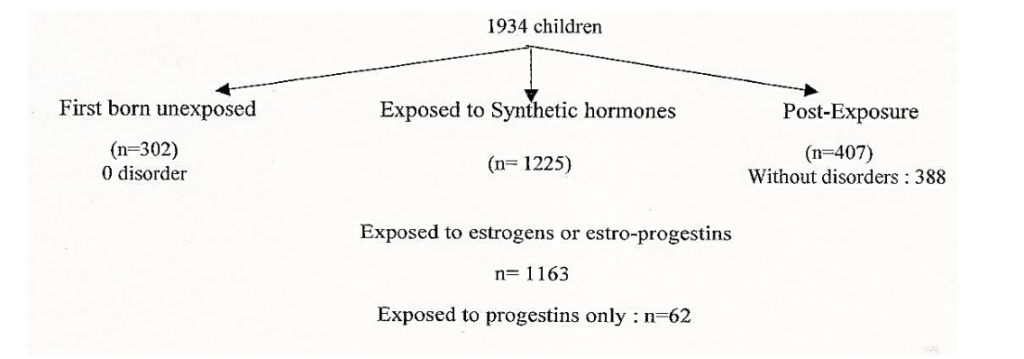
Figure 1 caption:
Figure 1. Exposure to synthetic hormones of 1,934 children from a French cohort of 1,200 mothers. From Soyer-Gobillard MO, Gaspari L, Yao P et al. Prenatal exposure to progestins: impact on neurodevelopment of the child. In: C. Martin, V.R. Preedy & R. Rajendram (Eds.), Factors affecting Neurodevelopment; Academic Press London/Elsevier Inc; 34, pp. 395-408, 2021¹⁰. Courtesy of Elsevier.
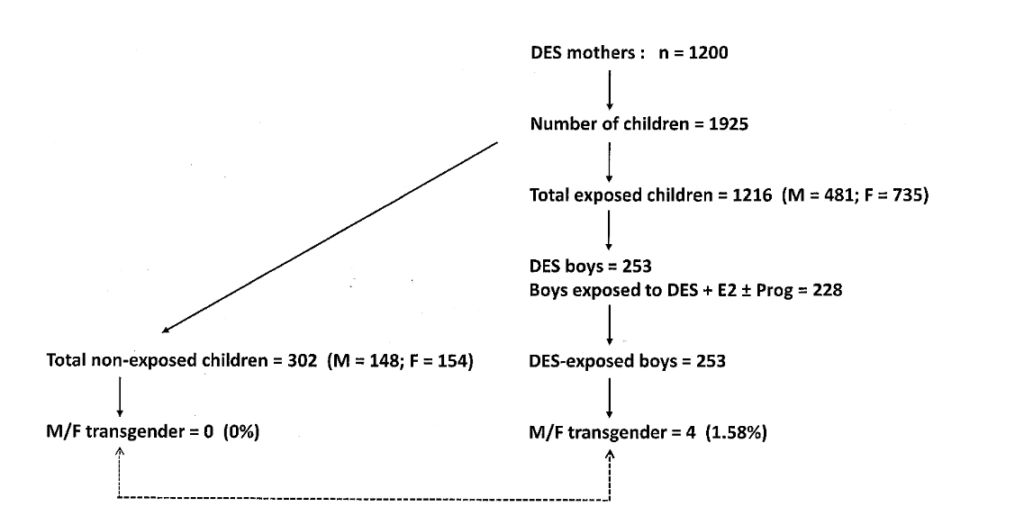
Figure 2 caption:
Figure 2. Patients of the HHORAGES cohort in which four DES-sons transgenders M/F were identified among 253 boys exposed to DES. From Gaspari L, Soyer-Gobillard MO, Kerlin S, et al. Early Female Transgender Identity after Prenatal Exposure to Diethylstilbestrol: Report from a French National Diethylstilbestrol (DES) Cohort. J. Xenobiot. 2024³; 14: 166–175. Courtesy of MDPI.
In this cohort of 1,200 mothers treated with synthetic hormones during their pregnancy, 253 boys were exposed to DES during their fetal life. Included and excluded patients are shown in Figure 2. Four of these DES-sons contacted the HHORAGES Association and identified as transgender women themselves after completing a specific questionnaire, the XY karyotyping having been verified at the local hospital at their time of transition.
The prevalence was 1.58%, versus 0% among the unexposed eldest pre-DES controls. Three out of four of these people underwent surgical reassignment followed by hormone treatment, the fourth underwent hormone treatment only.
These clinical data allow us to suggest for the first time that male to female transgenderism in DES sons is associated with DES exposure.
2.2. A study from the Association Diethylstilbestrol-sons USA
In a qualitative US study still in progress mentioned by Gaspari, Soyer-Gobillard et al., (2024)³, one of the authors, Scott Kerlin, via the Association DES-Sons USA, analysed a sample of 500 men with verified prenatal exposure to DES and reported 90 individuals identified as transsexual XY Male to Female and 65 individuals suspected, but without confirmed, exposure.More extensive surveys and interviews are needed to establish the complete scope of DES exposure effects in this group of people.A comparison can be made between the high percentage of Male to Female Transgenders T (90/500 exposed men) in the USA observed by S. Kerlin (Gaspari, Soyer-Gobillard et al., 2024)³ compared to the figures in our French study.
In both cases, these are declarations made to patient associations. Indeed, a link can be made between the large number of observed cases of young American transgender people and the number of French cases presently reported from the HHORAGES cohort.
Indeed, it has been shown that the average DES dosages in the USA were much higher (high-dose medians: 7,550–12,742 mg) (Palmer et al., 2006)¹³, than the average doses administered in France and considered as « medium–low dose » (4.05 mg) (Tournaire et al., 2012)¹⁴.See Figure 3.So, it is probable that in this case the high doses prescribed in America (Figure 3) influenced the greater number of cases occurring.
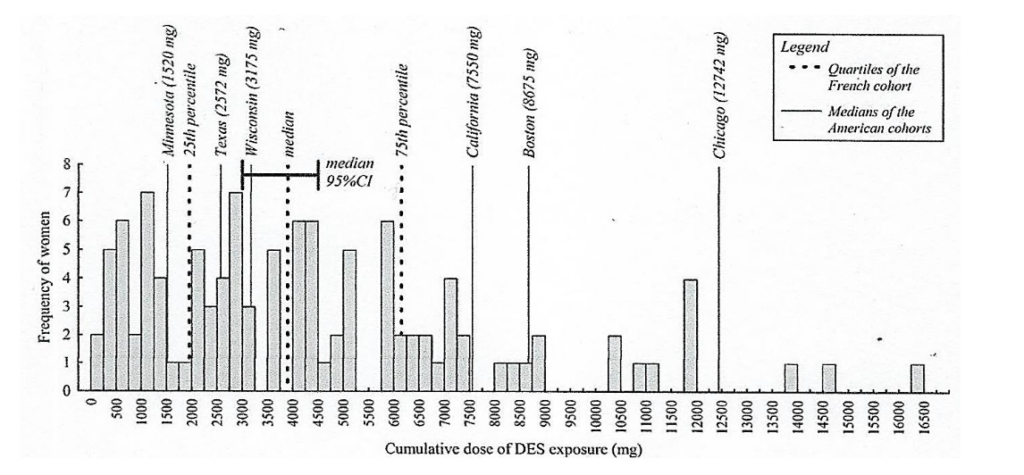
Figure 3. Comparison of cumulative doses of DES exposure between American (US) and French populations.
From Tournaire et al.,¹⁴ Diethylstilbestrol exposure: evaluation of the doses received in France. Eur. J. of Epidemiology. 2012; (4): 315-318. Courtesy of Authors and of Springer.
3. A spectacular increase in the transsexual population and gender dysphoria among the younger generations (Z-generation, born on 1997 and later).
According to the **DSM-5 (2024)**¹, gender dysphoria is felt like a discomfort or a conflict with one’s biological sex, assigned at birth. (Table 1).
Table 2. Diagnostic criteria for gender dysphoria. From DSM-5 (2024)¹
Diagnostic and Statistical Manual of Mental Disorders (DSM-5) diagnostic criteria for gender dysphoria
Gender dysphoria in adults and adolescents
Marked difference between an individual’s experienced/expressed gender and assigned gender with significant distress or problems functioning lasting at least 6 months and is accompanied by at least two of the following:
-
A marked incongruence between one’s experienced/expressed gender and primary and/or secondary sex characteristics
-
A strong desire to be rid of one’s primary and/or secondary sex characteristics
-
A strong desire for the primary and/or secondary sex characteristics of the other gender
-
A strong desire to be of the other gender
-
A strong desire to be treated as the other gender
-
A strong conviction that one has the typical feelings and reactions of the other gender
Gender dysphoria in children
In children, gender dysphoria diagnosis must involve significant distress or impairment in functioning accompanied by at least six of the following lasting at least 6 months:
-
A strong desire to be of the other gender or an insistence that one is the other gender
-
A strong preference for wearing clothes typical of the opposite gender
-
A strong preference for cross-gender roles in make-believe play or fantasy play
-
A strong preference for toys, games or activities stereotypically used or engaged in by the other gender
-
A strong preference for playmates of the other gender
-
A strong rejection of toys, games, and activities typical of one’s assigned gender
-
A strong dislike of one’s sexual anatomy
-
A strong desire for the physical sex characteristics that match one’s experienced gender
The distress caused by this disparity can be intense and can have mental health complications, including suicide attempts. In 2017, Frisen et al.⁵ reported the dramatic increase of gender dysphoria among adolescents identifying as “Trans” in Sweden, as in Italy (Di Ceglie, 2018)¹⁶ (Figure 4).In a recent study (2022)¹⁷ of the UCLA School of Law’s Williams Institute (USA), the authors reported that in the USA their number has doubled in the 5 years between 2017 and 2022, reaching 1.6 million. It must be noted that 1.4% of 13- to 17-year-olds and 1.3% of 18- to 24-year-olds were transgender.
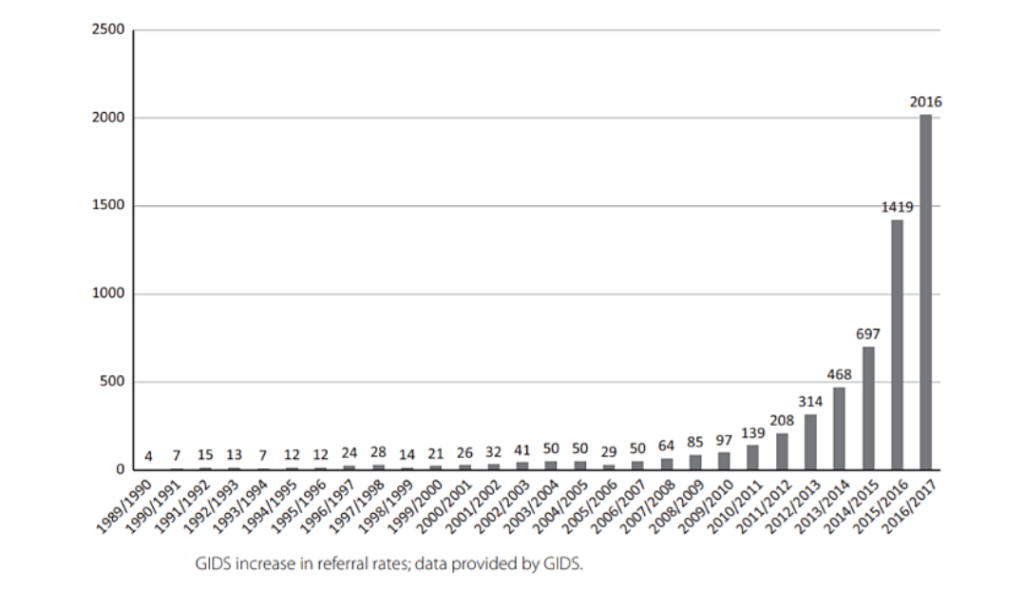
Figure 4. Evolution of population of young people with gender dysphoria between 1990 and 2017
From Di Ciglie¹⁶ Autonomy and decision-making in children and young people with gender dysphoria. In: Shaw M & Bailey S (Eds) Justice for children and families: A development perspective Shaw M, Bailey S, eds. Cambridge University Press 2018¹⁶: pp.145-153.
Moreover, a major IPSOS survey in 2024¹⁸ on the populations of 26 countries in the world shows that in the generations born between 1965 and 1980, Lesbian, Gay, Bisexual, Transgender (LGBT) people represent 9% of the population on average, while they represent 5% of Baby Boomers (born between 1948-1964), 6% of Generation X (born between 1965-1980), 11% among “millennials” (born between 1981-1996) and 17% among Generation Z (born in 1997 and after).
It is interesting to note that our results are consistent with observations made over recent decades, of an increase in the number of transgender people reported globally.
Discussion
EFFECT OF PRENATAL EXPOSITION TO DES ON CHILDREN NEURODEVELOPMENT AND ON THE SEXUAL ORIENTATION IDENTITY AND GENDER-RELATED BEHAVIOR
Synthesized by Dodds in 1938¹⁹, the powerful xenoestrogen DES, a tar derived from petroleum, was administered to millions of pregnant women worldwide up until 1971 in the USA and the 1980s in Europe, supposedly to prevent miscarriages or for comfort, whereas as early as that very year Lacassagne (1938)²⁰ had shown its ability to trigger cancers in rats.
In prenatally exposed children, DES is responsible for somatic disorders (Tournaire, 2014)²¹ and psychiatric disorders (Kebir and Krebs 2012)²², (Soyer-Gobillard et al., 2016); its epigenetic action (hypermethylation) at the level of the functioning of certain genes involved in neurodevelopment (ZFP57, ADAMTS9)²³²⁴²⁵ and genitourinary tract development for the latter, was shown in 2017 by Rivollier et al.²⁶.
The epigenetic mechanism of DES makes its action de facto transmissible to future generations both on a somatic, cognitive and psychiatric level (Kioumourtzoglou et al., 2018)²⁷, (Gaspari et al., 2021)²⁸, (Soyer-Gobillard et al., 2021)²⁹.
Moreover, it has high affinities for the nuclear estrogen receptors ERα and ERβ, located in a part of brain, the amygdala (Zou et al., 2017)³⁰, even more so than estradiol (Kniper et al., 1997)³¹ (17 α-ethinylestradiol) often prescribed as a complement but banned for pregnant women in 1980.
Following the questioning of Meyer-Bahlburg et al., (1985)³² and Ehrhardt et al., (1987)³³, Retha Newbold (1993)³⁴ confirmed the hypothesis of a relationship between in utero exposure to DES concerning the sexual orientation identity and gender-related behavior of the exposed children.
After submitting detailed questionnaires, excluding intrinsic genetic factors and comparing with unexposed controls, she observed few changes only in the female behavior of DES girls.
In 1995, Meyer-Bahlburg et al.³⁵ examined the hypothesis that prenatal estrogens contribute to the development of human sexual orientation and their data were compatible with that proposition.
However, the study of Titus-Ernstoff et al., (2003)³⁶ on a cohort of 2,684 men and 5,686 women with documented exposure status provided only limited support for the hypothesis that prenatal exposure to DES influences the psychosocial characteristics of adult men and women.
On the other hand, both in animals (mouse) (Haney, Newbold and McLachlan 1984)⁵ and in humans (Adamson et al., 2008)⁶, authors observed that DES suppresses testicular testosterone production with the inherent effects thereof (Leary et al., 1984)³⁷.
EFFECT OF OTHER ENDOCRINE DISRUPTING CHEMICALS ON CHILDREN NEURODEVELOPMENT AND ON THE SEXUAL ORIENTATION IDENTITY AND GENDER-RELATED BEHAVIOR
Research on the effect of endocrine disrupting chemicals on children’s neurodevelopment is developing as can be seen by numerous systematic reviews and meta-analysis (Özel and Rüegg, 2022)³⁸, (Ramirez et al., 2022)³⁹, (Yang et al., 2024)⁴⁰.
On the contrary the causal mechanisms of transgenderism development are not yet totally identified, whether anatomical, genetic, biological, or environmental.
As it is multifactorial, the etiology of transsexuality is still difficult to grasp and the large number and variety of environmental factors that potentially influence it must be considered.
might also exert an influence complicates this area of research even more. In addition, there is another factor that could be taken into account, that of the widespread use of the Combined Oral Contraceptives (COCs) either by means of estro-progestative (17-α-ethinylestradiol plus progestin) or progestin alone both being highly lipophilic. Note that the prescription of 17-α-ethinylestradiol to pregnant women has been forbidden since 1980, but it remains the synthetic estrogen with the highest but sales figures. Over the past decade, more and more studies have reported the ability of COCs to impact the nervous system of women and trigger depressive disorders that can lead to suicide (Soyer-Gobillard et al., 2024)¹².
Moreover, it is also possible that these estrogens sometimes stored for years in adipose tissue, are released through the placenta during a subsequent pregnancy and contaminate the developing fetal brain. Foreman et al., (2019)⁴¹ suggest that gender dysphoria may have a polygenic basis, estrogens altering the masculinization of the fetal brain and contributing to a female transgender identity. These data reinforce the highlighting of a prenatal androgen action on differentiation and imprinting of Central Nervous System (CNS) centers.
Conclusion
Regarding the deleterious legacy left by DES, this xenoestrogen is considered THE model Endocrine Disruptor Chemical (EDC) (Robotti, 2021)⁴² acting both somatically and psychiatrically and its action being moreover multi- and trans-generational (Titus, 2021)⁴³, (Kioumourtzoglou et al., 2018)²⁷, (Gaspari et al., 2021)²⁸, (Soyer-Gobillard et al., 2021)²⁹.
The descendants of DES treated women currently represent more than 50 million people worldwide, to which are added those who are in daily contact with all other mixtures of EDCs whose action at the neurodevelopmental level is strong. As with DES, other EDCs are likely to alter the action of fetal androgens on the development of gender identity in XY children and adolescents. They could therefore represent a risk factor for the development of female transsexualism.
Author Contributions
Conceptualization, M.-O.S.-G. and C.S.; methodology, M.-O.S.-G. and C.S.; validation, L.G. and C.S.; formal analysis, C.S.; investigation, M.-O.S.-G. and C.S.; resources, M.-O.S.-G.; writing—original draft preparation, writing—review and editing, M.-O.S.-G. and C.S.; supervision, C.S.; project administration, M.-O.S.-G.; All authors have read and agreed to the published version of the manuscript.
Conflicts of Interest
M.-O. S.-G. is a researcher and President unpaid of the HHORAGES-France Association as well as a mother concerned with DES and other synthetic hormones. The authors declare that the research was conducted in the absence of any commercial or financial relationships that could be construed as a potential conflict of interest. HHORAGES-France Association is financed exclusively by subscriptions and donations.
Funding
This research received no external funding.
Acknowledgments
This work could not continue without the daily ongoing support of the HHORAGES-France families and board, especially Mauricette P. †, Yette Bl., Aimée I., Pierre D.
Authors warmly acknowledge Professor Terence Preston (University College London) for corrections and critical review of the manuscript.
HHORAGES-France, a patient association, is registered at the Epidemiological Portal of French Health Databases INSERM (French National Institute for Medical Research) and AVIESAN (National Alliance for Life Sciences and Health)
(epidemiologiefrance.aviesan.fr).
Use of Artificial Intelligence
AI or AI-assisted tools were not used in drafting any aspect of this manuscript
References
1. Diagnostic and Statistical Manual of Mental Disorders, Fifth Edition, Text Revision (DSM-5-TR). American Psychiatric Association Publishing. 2024. 1,275 pp. https://Doi/book/10.1176/appi.books.9780890425787
2. Soyer-Gobillard MO, Gaspari L, Paris F et al. Effects of prenatal exposure to synthetic sex hormones on neurodevelopment: a biological mechanism. Front Mol Neurosci., 2023; 16 :12374 29. Doi: 10.3389/fnmol.2023.1237429.
3. Gaspari L, Soyer-Gobillard MO, Kerlin S et al. Early Female Transgender Identity after Prenatal Exposure to Diethylstilbestrol: Report from a French National Diethylstilbestrol (DES) Cohort. J Xenobiot. 2024; 14(1):166-175. Doi: 10.3390/jox14 010010.
4. Troisi R, Palmer JR, Hatch EE et al. Gender Identity and Sexual Orientation Identity in Women and Men Prenatally Exposed to Diethylstilbestrol. Arch Sex Behav. 2020; 49(2): 447-454. Doi: 10.1007/s 10508-020-01637-7. Epub 2020 Jan 23.
5. Haney AF, Newbold RR, McLachlan JA. Prenatal diethylstilbestrol exposure in the mouse: Effects on ovarian histology and steroidogenesis in vitro. Biology of Reproduction 1984; 30: 471-478.
6. Adamson NA, Brokken LJ, Paranko J et al. In vivo and in vitro effects of flutamide and diethylstilbestrol on fetal testicular steroidogenesis in the rat. Reproductive Toxicology 2008; 25: 76-83. Doi :10.1016
7. Maimoun L, Philibert P, Cammas B, et al. Phenotypical, biological, and molecular heterogeneity of 5α-reductase deficiency: An extensive international experience of 55 patients. J. Clin. Endocrinol. Metab. 2011; 96 : 296–307. Doi : 10.1210/jc.2010-1024. Epub 2010 Dec 8.
8. Sultan C Gaspari L Kalfa N et al. Chapter 16 Androgen insensitivity syndrome. In Genetic Steroid Disorders, 2nd ed.; New, M.I., Ed. Academic Press: San Diego CA USA 2023 pp. 327–341.
9. Soyer-Gobillard MO, Paris F, Gaspari L et al. Association between fetal DES-exposure and psychiatric disorders in adolescence/adulthood: evidence from a French cohort of 1002 prenatally exposed children. Gynecol Endocrinol. 2016; 32(1): 25- 29. Doi: 10.3109/09513590.2015.1063604. Epub 2015 Jul 14.
10. Soyer-Gobillard MO, Gaspari L, Yao P, Sultan Ch. Prenatal exposure to progestins: impact on neurodevelopment of the child. (25 pp., 2 Figs., 5 Tables). In: C. Martin, V.R. Preedy & R. Rajendram (Eds), Factors affecting Neurodevelopment 2021 Academic Press London/Elsevier Inc. 34, pp. 395-408.
11. Soyer-Gobillard MO, Sultan Ch. Behavioral and Somatic Disorders in Children exposed in utero to Synthetic Hormones: A Testimony-Case Study in a French Family Troop. In: “State of the Art of Therapeutic Endocrinology”, Sameh Magdeldin Ed, Niigata University, Japan. InTech, 2012, pp. 67-86.
12. Soyer-Gobillard M.-O, Gaspari L, Sultan C. Some Insights into the Impact of Exposure to Synthetic Sex Hormones on the Human Cen¬tral Nervous System: A Never-Ending Story. J Sexual Med Reprod Health 2024; 5: 7.
13. Palmer JR, Wise LA, Hatch EE et al. Prenatal diethylstilbestrol exposure and risk of breast cancer. Cancer Epidemiol Biomarker Prev. 2006; 15 :1509-1514. Doi: 10.1158/1055-9965.EPI-06-0109.
14. Tournaire M, Devouche E, Epelboin S et al. Diethylbestrol exposure: evaluation of the doses received in France. Eur. J. of Epidemiology 2012; 27 (4): 315-318. Doi: 10.1007/s10654-012-9677-7
15. Frisen L, Söder O, Rydelius PA. Dramatic increase of gender dysphoria in youth. Lakartidningen. 2017; 114: EFMY
16. Di Ciglie D. Autonomy and decision-making in children and young people with gender dysphoria. In: Shaw M & Bailey S (Eds) Justice for children and families: A development perspective 2018 pp.145-153. Cambridge UK: Cambridge University Press.
17. UCLA School of Laws’s Williams Institute. Report on Trangenders, 2022. California, USA.
18. IPSOS LGBT+ PRIDE REPORT 2024. A 26-Country Ipsos Global Advisor Survey. June 2024 © Ipsos | LGBT+ Pride 2024.
19. Dodds EG, Goldberg L, Larson W et al. Oestrogenic activity of certain synthetic compounds. Nature. 1938 ; 141 : 247-248.
20. Lacassagne A. The appearance of mammary adenocarcinomas in male mice treated by a synthetic estrogenic substance. Weekly reports of the Society of Biology and its affiliates. 1938; 12 : 641-643.
21. Tournaire M, Epelboin S, Devouche E. Histoire du Diethylstilbestrol. Therapie. 2014 ; 69 : 101-114.
22. Kebir O, Krebs MO. Diethylstilbestrol and risk of psychiatric disorders: a critical review and new insights. World J Biol Psychiatry. 2012; 13(2): 84-95. https://Doi.org/10.3109/15622975.2011.560280
23. Quenneville S, Verde G, Corsinotti A et al. In embryonic stem cells, ZFP57/KAP1 recognize a methylated hexanucleotide to affect chromatin and DNA methylation of imprinting control regions. Mol Cell. 2011 ;44(3) :36172. https://Doi.org/10.1016/j.molcel.2011. 08.032 PMID :22055183
24. Lemarchant S, Pruvost M, Montaner J et al. ADAMTS proteoglycanases in the physiological and pathological central nervous system. J Neuroinflammation. 2013; 10: 133. https:// Doi.org/10.1186/1742-2094-10-133.
25. Mittaz L, Russell DL, Wilson T, et al. ADAMTS-1 is essential for the development and function of the urogenital system. Biol Reprod. 2004; 70: 1096-1105 https://Doi.org/10.1095/biolreprod.103.023911.
26. Rivollier F, Chaumette B, Bendjemaa N, et al. Methylomic changes in individuals with psychosis, prenatally exposed to endocrine disrupting compounds: Lessons from diethylstilbestrol. PloS One. 2017; 12 (4): 1–18.
https://Doi.org/10.1371/journal.pone.0174783. e0174783.
27. Kioumourtzoglou MA, Coull BA, O’Reilly ÉJ et al. Association of Exposure to Diethylstilbestrol During Pregnancy With Multigenerational Neurodevelopmental Deficits. JAMA Pediatr. 2018; 172(7):670-677. Doi: 10.1001/jamapediatrics.2018.0 727.PMID : 29799929.
28. Gaspari L, Soyer-Gobillard MO, Paris F et al. Multigenerational endometriosis: Consequence of fetal contamination by DES in an informative family. Environmental Health. 2021; 20(1): 96. ff10.1186/s12940-021-00780-5ff. ffhal- 03338915
29. Soyer-Gobillard MO, Gaspari L, Paris F et al. Prenatal contamination by DES and multigenerational transmission of psychiatric disorders in an informative family. International Journal of Environmental Research and Public Health. 2021; 18 (19): 9965, https://Doi.org/10.3390 /ijerph 1819996.
30. Zou Y, Lu Q, Zheng et al. Prenatal levonorgestrel exposure induces autism-like behavior in offspring through ERβ suppression in the amygdala. Molecular Autism. 2017; 8: 1–16. https://Doi.org/ 10.1186/s13229-017-0159-3.
31. Kniper GG, Carlsson B, Grandien K et al. Comparison of the ligand binding specificity and transcript tissue distribution of estrogenreceptors alpha and beta. Endocrinology. 1997; 138: 863-870.
32. Meyer-Bahlburg HF, Ehrhardt AA, Feldman JF et al. Sexual activity level and sexual functioning in women prenatally exposed to diethylstilbestrol. Psychosomat Med. 1985 ; 47 (6) :497-511.
33. Ehrhardt AA, Feldman JF, Rosen LR, et al. Psychopathology in prenatally DES-exposed females current and life-time adjustement. Psychosomat Med. 1987; 49 (2):183-196.
34. Newbold RR. Gender related bahavior in women exposed to Diethylstilbestrol. Env Health Perspectives. 1993 ; 101 (3) : 208-213.
35. Meyer-Bahlburg HFL, Ehrhardt AA, Rosen LR et al. Prenatal estrogens and the development of homosexual orientation. Developmental Psychology. 1995; 31(1): 12–21. https://Doi.org/10.1037/0012-1649.31.1.12
36. Titus-Ernstoff L, Perez K, Hatch EE et al. Psychosexual characteristics of men and women exposed prenatally to diethylstilbestrol. Epidemiology. 2003; 14: 155–160.
37. Leary F, Resseguie L, Kurland L et al. Males exposed in utero to diethylstilbestrol. J. of American Medical Association. 1984; 252: 2984-2989.
38. Özel1 F, Rüegg J. Exposure to endocrine-disrupting chemicals and implications for neurodevelopment. Dev Med Child Neurol. 2023; 65:1005–1011. Doi : 10.1111/dmcn.15551.
39. Ramírez V, Gálvez-Ontiveros V, González-Domenech PJ et al. Role of endocrine dirupting chemicals in children neurodevelopment. Environmental Research. 2022; 203: 111890. https://Doi.org/10.1016/j.envres.2021.111890
40. Yang Z, Zhang J, Wang M et al. Prenatal endocrine-disrupting chemicals exposure and impact on offspring neurodevelopment: a systematic review and meta-analysis. NeuroToxicology. 2024; 103: 335-357. PMID :39013523 Doi: 10.1016/j.neuro.2024.07.006
41. Foreman M, Hare L, York K et al. Genetic Link Between Gender Dysphoria and Sex Hormone Signaling. J. Clin. Endocrinol. Metab. 2019; 104: 390–396. Doi: 10.1210/jc.2018-01105.
42. Robotti S. The heritable legacy of diethylstilbestrol: a bellwether for endocrine disruption in humans. Biol Reprod, 2021; Sep 14 ;105(3): 687-689. https://Doi: 10.1093/biolre/ioab146.
43. Titus L. Evidence of intergenerational transmission of diethylstilbestrol health effects: hindsight and insight. Biol Reprod. 2021; 105(3) : 681-686. Doi: 10.1093/biolre/ioab153.