

Infectious Diseases and Global Instability: A Study

The Association between Infectious Diseases, Mental Impairments, Violent Behavior, and Global Instability

Robert C Bransfield, MD, DLFAPA¹²

  1. Hackensack Meridian School of Medicine, Nutley, NJ 07110, USA.
  2. Rutgers-Robert Wood Johnson Medical School, Piscataway, NJ 08854, USA.
    https://orcid.org/0000-0002-9326-6478

OPEN ACCESS

PUBLISHED: 31 January 2025

CITATION: Bransfield, RC., 2025. The Association between Infectious Diseases, Mental Impairments, Violent Behavior, and Global Instability. Medical Research Archives, [online] 13(1).
https://doi.org/10.18103/mra.v13i1.6178

COPYRIGHT: © 2025 European Society of Medicine. This is an open-access article distributed under the terms of the Creative Commons Attribution License, which permits unrestricted use, distribution, and reproduction in any medium, provided the original author and source are credited.

DOI https://doi.org/10.18103/mra.v13i1.6178

ISSN 2375-1924


ABSTRACT

It is necessary to better understand and prevent all contributors to violence. A 2017 hypothesis stated—if a pandemic causing mental impairments increasing the risk of violence occurred, it could contribute to global instability. The association between infectious disease, mental impairments, violence, and global instability has never been adequately researched. A review is performed to evaluate all the facets of this possible association.

A sequence of events contributes to the association between infectious diseases and global instability. Degraded environments are conducive to emerging and expanding infectious diseases. Infections can alter brain functioning by immune system mediated and other pathophysiological mechanism that can increase the risk of mental impairments contributing to mental illnesses and/or violent behavior. Parasites, particularly zoonotic and vector-borne, sometimes manipulate their host in a manner that propagates their survival (Manipulation Hypothesis). Through this, or other pathophysiology, infectious diseases can contribute to violent behavior in both animals and humans. When influential individuals or groups of influential individuals acquire infectious diseases that contribute to violent tendencies, it can have greater societal and global impact (critical mass dynamic). Infectious diseases are not equally distributed throughout the world. Countries and geographic areas with greater infections and vector-borne zoonotic disease burdens correlate with a higher prevalence of violence. In a global community, this can contribute to global instability.

Impairments from the SARS-CoV-2 pandemic are associated with an increased risk of mental impairments and violent behavior. Global violence and instability have increased following the pandemic based upon changes in the Global Peace Index.

Although the data reviewed has limitations, evidence suggests infectious diseases, including the recent SARS-CoV-2 pandemic, may contribute to mental impairments with resultant increased risk of violence and global instability. A collaborative One Health research and intervention approach can help prevent violence both regionally and globally.

Keywords: Afghanistan, Borrelia, COVID, Iceland, Lyme disease, Malaria, One Health, Peace, Relapsing Fever Borrelia, SARS-CoV-2, Syphilis, Violence, War
Introduction

The title of a 2017 presentation by the author in Paris, France was—Could a Pandemic Causing Mental Dysfunction Contribute to Global Instability? The hypothesis was—If a pandemic occurs that causes the type of mental impairments that increase the risk of violence, it could cause global instability¹. At that time, it was an untested hypothesis. Since the onset of the SARS-CoV-2 pandemic, the validity of this hypothesis can now be tested. While testing this hypothesis, it is relevant to also explore whether any other infectious diseases contribute to mental impairments, violence, and global instability.

Violence has greatly impacted history, with periods of advances and declines in civilization associated with cycles of collaboration and conflict. Collaboration, compassion and empathy are a part of our functioning that allows us to collectively experience great achievements and a better quality of life. However at different times in history, and in different geographical locations, conflict, violent behavior, and a decline in quality of life are more prevalent. The stability of the world and quality of life are greatly compromised by violence. The economic impact of violence on the global economy in 2023 was $19.1 trillion. This is equivalent to 13.5 percent of global gross domestic product, or $2,380 per person².

Violence needs to be differentiated from normal aggression and competition, which are a part of our innate functioning. The interplay between compassion and collaboration vs. competition, and aggression constantly occur in both mammalian and human functioning. Extremes of competitive aggression are normally restrained by opposing social bonds and social structures that support social collaboration and cooperation. When aggression becomes violence, is it just a part of human functioning? Are humans just fundamentally violent? This is a serious concern with the development of more advanced weapons. If violence is not a fundamental part of human functioning, is it instead caused by an inadequately understood pathological process?

If violence is caused by a pathological process, a better understanding of all the contributors to violence could help to develop strategies to prevent or reduce some of the causes of violence and avoid the later consequences. A more restricted, or silo mentality, approach studies it from a limited perspective and may overlook some of the significant causes of violence. A more inclusive approach is to combine research from multiple scientific disciplines to better understand the contributors and sequences in the development of violent behavior.

When violence is studied, there are many deterrents, chronic contributors, and acute triggers for violence. Both neurological impairments and social structure impairments are particularly associated with an increased risk of conflict and violent behavior³⁻⁵. An example of this is studies of death row inmates revealing 100% had both neurological impairments and a history of abuse⁶⁻⁷.

Are we overlooking some of the explanations for the neurological impairments associated with violent behavior? It has been recognized that a number of infectious diseases contribute to the type of mental impairments that increase the risk of violence³⁻⁸. Some parts of the world have been endemic for violence for hundreds or thousands of years. People from these regions live more peacefully in other parts of the world. If infectious diseases are associated with violent behavior on an individual level, the possibility exists that geographical areas with higher infectious disease loads may be associated with a greater risk of violent behavior. We are now living in a global community. The September 11, 2001 al-Qaeda attacks and other similar events have demonstrated violence in remote parts of the world are no longer confined there, but instead have the potential for global impact.

The most common current response to violence is a deterrent approach. This involves the determination of guilt and punishment of the offender on an individual level, or military posturing or responses on a national level. On a local level this includes law enforcement, court processes, penal, and correctional systems. On a global level it consists of national defensive systems, armies, and advanced weapon “defense” technology. Vast resources are consumed to deter violence and to contend with the consequences of violence.

A better understanding of violence would facilitate directing some of those resources towards prevention to deter violence at earlier stages of development. It is essential to respond to violent incidents in a manner similar to the response to plane crashes. With each episode, all the contributors and failures are to be analyzed followed by corrective, preventative, actions.

Although the association between infectious diseases and mental illness has been studied to some extent⁹, the association between infectious diseases and violence has not been adequately studied.

This article shall test the previously stated hypothesis and review other infections that may have contribute to global instability. The review shall include an evaluation of the sequences involved that may contribute to any association between infectious diseases, mental impairments, violence, and global instability.


Methods

The question to be addressed is—do some infectious diseases contribute to mental impairments, violence, and global instability?

The question is explored by reviewing a series of data that collectively address different facets of the involved sequences. Here the question is addressed by a review and evaluation of the literature from electronic databases, including PubMed and Google Scholar, for relevant information. The references discovered in searches were also reviewed for additional relevant references. In addition, references were also drawn from the library previously accumulated by the author. The search included a review of animal and human medical literature, including infectious diseases, psychimmunology, neurochemistry, and brain physiology; historical records; and epidemiological data. Only peer reviewed literature was included with the exception of epidemiological databases and a few historical sources. In these cases, the most scientifically sound sources of information were given priority over sources that appeared more speculative.

The series of reviews include:

  • Environmental changes and increased infectious disease
  • Zoonotic and vector-borne diseases impact upon humans
  • Parasites manipulation of the behavior of their hosts
  • Infectious diseases contributing to violent behavior in animals
  • Infectious diseases contributing to violent behavior in humans
  • Pathophysiology of an association between infectious diseases and violence
  • The behavior of influential individuals impaired by infectious diseases
  • Infections contributing to violent behavior of individuals with an impact on a greater social or global level
  • Geographical association between infectious disease burden and violence
  • Soldiers returning from conflict zones having acquired infectious disease associated with violence
  • SARS-CoV-2 pandemic resulting in mental impairments that may have contributed to violence
  • Global instability since the SARS-CoV-2 pandemic has occurred
  • Other pandemics contributed to mental impairments that may have been associated with violence

The question of a geographical association between infectious disease burden and violence is first addressed by identifying The Global Peace Index (GPI) most peaceful and least peaceful countries in 2021¹⁰. These countries are then compared for infectious disease burdens with the use disability-

adjusted life year (DALY), a World Health Organization metric for disability. One DALY represents the loss of the equivalent of one year of full health. DALYs for a disease or health condition are the sum of the years of life lost due to premature mortality and the years lived with a disability due to prevalent cases of the disease or health condition in a population. The most current statistics compiled for DALY rates from communicable, neonatal, maternal & nutritional diseases are available from 2021¹¹. Communicable diseases account for most of the DALY statistics¹¹. The GPI and DALY scores for all 163 countries are plotted on a scatter graph to evaluate any possible trends. Since the most recent DALY scores are for 2021, the same year, 2021, is used in ranking GPI scores.

The GPI, DALY, and latitude of the 10 countries with the most favorable GPI are compared to the 10 countries with the least favorable GPI for 2021 and analyzed.

The hypothesis proposed at the 2017 Paris meeting is tested. It stated—If a pandemic occurs that causes the type of mental impairments that increase the risk this violence, it could cause global instability¹. These impairments could be both emotional and cognitive¹. Since we have now had the SARS-CoV-2 pandemic, the validity of this hypothesis is evaluated by questioning whether research demonstrated the pandemic caused mental impairments that increased the risk of violence, and whether there was greater global instability since the epidemic began based upon the Global Peace Index (GPI)¹¹.

The results of the data review are discussed, conclusions are drawn, and future directions are then discussed by addressing further research and actions are needed to address the association between infectious disease, mental impairments, violence, and global stability.


Results

ENVIRONMENTAL CHANGES AND INCREASED INFECTIOUS DISEASE
Parasites reproduce more quickly than hosts, allowing them to evolve and adapt more quickly to rapidly changing environments associated with reductions in biodiversity, climate changes, chemical pollution, landscape transformations and species introductions¹². Other human influences on the planet includes domestic and wild animals encounters, deforestation, outdoor recreational activities, urbanization, agriculture impact, habitat changes, melting permafrost, technological impacts, rapid population growth, international travel, globalization, inequalities in resources, cultural and religious conflicts, political instability, conflict zones, and large population migrations. These changes are associated with an increased risk of zoonotic diseases, and the consequences of these infections¹³. Since 2022, 44 countries have experienced a 10-fold increase in the incidence of at least one of 13 infectious diseases compared with a pre-pandemic baseline¹⁴,¹⁵. A significant example is an increase in syphilis¹⁶.

In summary, environmental changes increase infectious diseases, particularly zoonotic diseases.


ZOONOTIC AND VECTOR-BORNE DISEASES IMPACT UPON HUMANS

Zoonotic diseases are infections that are spread between animals and people. The pathogens in these diseases may include bacteria, parasites, and viruses. SARS-CoV-2 is a zoonotic disease¹⁷ and many pandemics, such as plague, were zoonotic diseases. Approximately 60% of emerging human pathogens and around 75% of all emerging infectious diseases are zoonotic. Human activities which increase the interaction between humans and animals increase the risk of transmission of zoonotic infections¹⁸.

Vector-borne diseases are disease from an infection transmitted to humans and other animals by blood feeding arthropods, such as mosquitoes, ticks, mites, and fleas. They often have complex life cycles with definitive hosts, intermediate hosts, arthropod vectors, and environmental reservoirs. Vector-borne diseases account for more than 17% of all infectious diseases, causing more than 700 000 deaths annually¹⁹. Many vector-borne diseases are also zoonotic diseases.

In summary, zoonotic vector-borne diseases are diseases that can be transmitted between animals and humans and are also spread by vectors such as mosquitoes, ticks, mites, and fleas. Examples include Lyme disease, West Nile virus, dengue fever, malaria, toxoplasmosis, bartonellosis, rabies, avian flu and plague, all of which may have significant impact upon humans.


PARASITES MANIPULATION OF THE BEHAVIOR OF THEIR HOSTS

Despite humans being the most cognitively advanced species, bacteria are a more dominant life form on earth²⁰. The Manipulation Hypothesis states a number of parasites purposefully alter the behaviour of their hosts in a specific manner that increases the probability of their transmission to an uninfected host.

One example is toxoplasmosis which can reduce the fear of cats or the speed of reaction in infected rodents²¹. Another example is toxoplasmosis increasing sexual promiscuity²². Rabies is an example of an infected host transmitting the infection to another host by increased aggressive behavior²³. In most cases, humans are an incidental host to a zoonotic infection. The altered behavior that benefits parasite transmission may be maladaptive for the host with symptoms that can include excessive passivity, hypersexuality, increased aggressiveness, and/or other symptoms²⁴,²⁵,²⁶,²⁷,²⁸,²⁹,³⁰,³¹.

In summary, parasites sometimes manipulate the behavior of their hosts.


INFECTIOUS DISEASES CONTRIBUTING TO VIOLENT BEHAVIOR IN ANIMALS

Animals are in both cooperative and competitive situations. There is normal competition for territory, resources and mating. Functional forms of aggressive behavior are a means of communication throughout the animal kingdom³². Cases of violent behavior associated with infectious diseases in animals have been reported in multiple species, including dogs, horses, chimpanzee, and pigs; and multiple other animal species with rabies virus³³,³⁴.

In summary, animal models of excessive aggression have demonstrated parasites change host’s behavior and cause violence in a number of species.


INFECTIOUS DISEASES CONTRIBUTING TO VIOLENT BEHAVIOR IN HUMANS

Cases of excessive aggression and violence in humans have been reported associated with Bartonella, Borrelia burgdorferi, Encephalitis lethargica agent, Hepatitis E virus, Herpes simplex virus, Malaria, Measles virus, Mycoplasma, Neurosyphilis, Parvovirus, Plasmodium (Malaria), sepsis, Rabies virus, Relapsing Fever Borrelia, Streptococcus pyogenes (group A Strep), Toxoplasma gondii (Toxoplasmosis), Treponema pallidum (syphilis), viral encephalitis, Western Equine Encephalitis, and Viral Encephalitis³³,³⁴.

Infectious diseases may disrupt neurological functioning and contribute to violence from the development of a number of different symptoms. This has been studied in greater detail with Lyme disease. Most aggression with Lyme disease was impulsive, sometimes provoked by intrusive symptoms, sensory stimulation, or frustration, and was invariably bizarre and senseless. Postinfection clinical findings associated with increasing homicidality that separated them from the non-homicidal late stage Lyme/tick-borne disease patients within the 95% confidence interval included suicidality, sudden abrupt mood swings, explosive anger, paranoia, anhedonia, hypervigilance, exaggerated startle response, disinhibition, nightmares, depersonalization, intrusive aggressive images, dissociative episodes, derealization, intrusive sexual images, marital/family problems, legal problems, substance abuse, depression, panic disorder, memory impairments, neuropathy, cranial nerve symptoms, and decreased libido. Homicides in this group were associated with predatory aggression, poor impulse control, and psychosis³⁵.

In summary, a number of infectious diseases contribute to violence in human and different types of violence may occur.


PATHOPHYSIOLOGY OF AN ASSOCIATION BETWEEN INFECTIOUS DISEASES AND VIOLENCE

The association between infections and violence are studied with case reports, pathophysiological.

studies, autopsy studies, and epidemiological studies. Intact mental functioning facilitates the maintenance of intact social structures and a peaceful resolution of competitions and conflicts. In contrast, violent behavior is the result of the interaction of multiple contributors, failed deterrents and acute triggers, such as the post-acute effects of infectious diseases²,³⁵,³⁶. Some infectious diseases, in susceptible individuals, can increase the risk of violence³,⁹,³⁷,³⁸. A significant number of these infections are zoonotic and zoonotic vector-borne diseases⁹. Infections and the immune reactions to them have caused impairments that have been associated with three basic types of violence associated with mental impairments—predatory aggression, impulse control disorders and psychotic violence³⁹,⁴⁰. Predatory aggression may involve stalking and is seen in serial killers. Impulse control disorders are excessive responses to provocation and are the most common form of aggression. Psychotic aggression is associated with paranoia or delusions³⁹. Predatory aggression is a particular concern, since it can be ruthless and well planned with a lack of empathy³⁹,⁴⁰.

Some of the pathophysiology is mediated by the immune system, and associated with increases in proinflammatory cytokines, interleukin 6, and Interleukin 1 beta; which have been associated with aggressive and self-destructive behavior⁴¹,⁴²,⁴³. The proinflammatory state associated with some acute and post-acute infectious diseases can alter tryptophan catabolism which decreases serotonin and melatonin and increases quinolinic acid, a neurotoxin³⁴. This metabolic change has been studied with human immunodeficiency virus (HIV),⁴⁴ Lyme disease,⁴⁵ malaria and toxoplasmosis⁴⁶. It can affect brain functioning by increasing the risk of both suicide and violence, and has been termed “the death formula”³,⁴⁷,⁴⁸,⁴⁹.


PATHOPHYSIOLOGY: EMOTIONAL IMPAIRMENTS

The combined effect of the pathophysiology described and other processes can alter neural functioning. The right ventromedial prefrontal cortex plays an important role in mediating the empathic response in the healthy brain. The orbital frontal cortex plays a crucial role in constraining impulsive outbursts, while the anterior cingulate cortex recruits other brain regions in the response to conflict⁵⁰. The amygdala, is involved in the production of a fear response and other negative emotions⁵¹. Injury from infectious disease or other trauma can have different effects depending upon which one of these brain region and circuit are involved. For example, brain dysfunction from infectious diseases can impair recognition of social emotions following amygdala damage⁵². Dysfunction of the prefrontal cortex, the anterior cingulate, the amygdala and white matter communication from infections can contribute to disinhibition and violence⁵³,⁵⁴,⁵⁵. Some types of injury and brain dysfunction can cause a lack of empathy which can result in ruthless predatory behavior⁵⁶. Punitive deterrents may have limited effectiveness in individuals who are impulse prone and/or suicidal. A review of 50 homicidal late stage Lyme/tick-borne disease patients demonstrated 49 of the 50 patient were also suicidal³.


PATHOPHYSIOLOGY: COGNITIVE IMPAIRMENTS

Besides emotional impairments, many infections are also associated with chronic cognitive impairments⁵⁷,⁵⁸,⁵⁹,⁶⁰,⁶¹,⁶². A comprehensive review of the infections that may cause cognitive impairments included Borrelia (Lyme disease), Chikungunya Virus, Coccidial meningitis, COVID-19 or long COVID, Dengue Virus, Ebola, Epstein Barr Virus, Helminthiases, Hepatitis C Virus, Human Herpes Virus, Human Immunodeficiency Virus (HIV), Human T Lymphocyte Virus (HTLV), Malaria, Murine Typhus, Neurosyphilis, Varicella Zoster, and Zika Virus⁶³. Many of these infections are zoonotic and vector-borne disease. The review also identified 245 million people worldwide as being cognitively impaired from long COVID, myalgic encephalomyelitis/chronic fatigue syndrome (ME/CFS), and fibromyalgia⁶³.

In summary, multiple studies have shown that reduced cognitive abilities increase the risk of criminality and violence⁶⁴,⁶⁵,⁶⁶.


PATHOPHYSIOLOGY SUMMARY

In summarizing this section, infectious diseases, and the immune, biochemical, neurotransmitter, and the neural circuit reactions to them can cause impairments that may be associated with violence. Many patients with post-acute infectious diseases have no, or only mild aggressiveness tendencies. However there are some who experience explosive anger, impulsivity, and predatory homicidal tendencies³.


THE BEHAVIOR OF INFLUENTIAL INDIVIDUALS IMPAIRED BY INFECTIOUS DISEASES

When an infection does contribute to violent behavior in a person who influences others, there is a risk of a greater negative impact. The presence of predatory aggression in a person who influences others is a particular concern. As previously stated, a number of infections are associated with violent behavior⁷. The impact of infectious diseases upon the behavior of influential individuals has not been adequately studied. One exception is syphilis, which has long been recognized as potentially contributing to violent tendencies⁶⁷,⁶⁸,⁶⁹. Based upon different levels of evidence and speculation, some influential individuals were considered to have had syphilis, with a potential impact upon their behavior. Individuals suspected to have had mental symptoms associated with syphilis in some historical publications include Ivan the Terrible,⁷⁰,⁷¹,⁷² Henry VIII of England,⁷³,⁷⁴ Edward Teach (Blackbeard),⁷⁵ Pope Alexander VI,⁷⁶ Emperor Charles V,⁷⁷ Edward IV of England,⁷⁸ Henry III of France,⁷⁹ Charles VIII of France,⁸⁰ Catherine the Great,⁸¹ and John Wilkes Booth⁸². Al Capone,⁸³,⁸⁴,⁸⁵ Idi Amin Dada,⁸⁶ Adolf Hitler,⁸⁷,⁸⁸,⁸⁹ and questionably Vladimir Lenin⁹⁰,⁹¹,⁹²,⁹³ were also considered to have had syphilis. They all had a similar pattern with a lack of empathy and ruthless behavior, followed by increasing cognitive and neurological decline in mid-life.

It has been speculated that Adolf Hitler may have also had encephalitis lethargica and his obsessions and mannerisms may in part have been a manifestation of the residual effects of an attack of encephalitis lethargica acquired during the First World War. Encephalitis lethargica has been associated with violent behavior⁹⁴,⁹⁵. Other prominent residual effects of encephalitis lethargica include an atypical form of Parkinson’s disease, occurring weeks to decades after the acute stage of encephalitis lethargica⁹⁶,⁹⁷,⁹⁸. When an encephalopathic individual is in Bavaria and Austria, they may have exacerbations of mental symptoms and aggression associated with rapid barometric pressure drops associated with the Foehn winds blowing from the Alps⁹⁹,¹⁰⁰,¹⁰¹.

In summary, some influential individuals may have been impaired by infectious diseases. There has been a historical attention to syphilis, but it is quite possible that other infectious diseases, not identified at the time, may have impacted the behavior of influential individuals.


INFECTIONS CONTRIBUTING TO VIOLENT BEHAVIOR OF INDIVIDUALS WITH AN IMPACT ON A GREATER SOCIAL OR GLOBAL LEVEL

If impairments that increase the risk of violence occur in only a few individuals, their behavior may be restrained by the larger majority of higher functioning individuals and an intact social structure. Violence may be deterred in societies that embrace eight key factors—well-functioning government, sound business environment, acceptance of the rights of others, good relations with neighbors, free flow of information, high levels of human capital, low levels of corruption, and equitable distribution of resources¹⁰. However, violence has been considered to be a contagious disease. It meets the definitions of a disease, and can be contagious since it can be spread from one person to another. Also, victims of violence have an increased risk of perpetrating violence on others¹⁰².

In summary, if highly influential individuals or a significant minority develop violent tendencies from any cause, and the numbers affected reach a critical size, a cascade of behavioral changes can occur, overturning stable social norms¹⁰³. This critical mass dynamic involving violent behavior can sometimes disrupt the deterrents and magnify violent behaviors¹⁰⁴,¹⁰⁵.

GEOGRAPHICAL ASSOCIATION BETWEEN INFECTIOUS DISEASE BURDEN AND VIOLENCE

Pathogen are not equally distributed throughout the world, and there have been changes in the prevalence of infectious diseases at different times in history. These change may be associated with environmental changes, epidemics and pandemics. Human and animal parasites are more prevalent towards equatorial regions and less prevalent towards polar regions¹⁰⁶,¹⁰⁷. In addition, different areas of the world and different countries have different environmental, ecosystem, sanitation, and healthcare considerations that result in infectious diseases being unequally distributed throughout the world. It is difficult to categorize very large countries that contain many different ecosystems, such as Russia and the United States.


COMPARING PEACEFULNESS AND INFECTIOUS DISEASE LOADS IN DIFFERENT COUNTRIES

Peace and violence are not equally distributed throughout the world. The Global Peace Index (GPI) is a composite index measuring the peacefulness of countries. It is made up of 23 quantitative and qualitative indicators each weighted on a scale of 1–5. The lower the score the more peaceful the country. Based upon the GPI 2021 statistics, Iceland is the most peaceful country in the world with a 1.112 GPI¹⁰. Afghanistan is the least peaceful country in the world for the past eight of nine years¹⁰.

A statistic for comparison is the national rates of communicable diseases, which also include neonatal and nutritional diseases. DALY rates for communicable diseases, neonatal, and nutritional diseases per 100,000 people¹¹ were compared with the most current data which is from 2021. The majority of the higher DALY numbers are for communicable diseases rather than for neonatal and nutritional diseases. The lower the score, the lower the infectious disease burden. The DALY is 846 for Iceland¹¹. By comparison, the DALY is 20,369 for Afghanistan¹¹.

Afghanistan has extremely poor sanitation. Local food and water sources (including ice) are heavily contaminated with pathogenic bacteria, parasites, and viruses. Risk is year-round and countrywide, including in major urban areas. The climate and ecological habitat support large populations of arthropod vectors, including mosquitoes, ticks, and sand flies. Significant disease transmission is sustained countrywide, including in urban areas. Malaria is the major vector-borne risk¹⁰⁸. Vector-borne diseases include Crimean-Congo Hemorrhagic Fever, Malaria, Sand Fly Fever, Dengue Fever, Yellow Fever, Japanese Encephalitis, African Trypanosomiasis, Cutaneous Leishmaniasis, Plague, Rift Valley fever, Chikungunya, Schistosomiasis, aerosolized dust or soil contact disease, Lassa fever, Filariasis, Trench Fever, Five-Day Fever, Wolhynia Fever, Boutonneuse (Mediterranean), Fever Cutaneous Leishmaniasis (zoonotic), Cutaneous Leishmaniasis (anthroponic), Visceral Leishmaniasis, Q Fever, Rocky Mountain Spotted Fever, West Nile Fever, Sindbis Fever, Siberian Tick Typhus, Mite-borne Typhus (Tsutsugamushi Fever), Louse-borne Typhus, Epidemic Typhus, Murine Typhus, Endemic Typhus Fever, Epidemic Relapsing Fever, Tick-borne Relapsing Fever, Leptospirosis, Leptospira icterohaemorrhagiae, L. hebdomadis, L. tarassovi, L. grippotyphosa, L. pomona, L. javanica, L. canicola, L. ballum, and L. bataviae. Other infectious diseases include Measles, Diphtheria, Meningitis, Influenza, Tuberculosis, Acute respiratory infections, Meningococcal meningitis, Poliomyelitis, Anthrax, Leptospirosis, Rabies, Enterotoxigenic Escherichia coli, Campylobacter, Shigella, Salmonella, Cryptosporidium spp., Giardia lamblia, Entamoeba histolytica, Amoebiasis, Hepatitis A and E, Typhoid, and Paratyphoid Fever¹⁰⁸,¹⁰⁹.

Other countries with unfavorable GPI such as Yemen¹¹⁰,¹¹¹,¹¹²,¹¹³ South Sudan,¹¹⁴ Syria,¹¹⁵ and Iraq¹¹⁶ also had high parasite, zoonotic disease and infectious disease burdens.

By comparison, Iceland has the most favorable GPI, and has longevity, and health and infectious diseases are considerably better¹¹⁷. There are no mosquitoes in Iceland. Ticks are rare in Iceland and Lyme disease has rarely been identified in Iceland¹¹⁸. Other countries with favorable GPI such as New Zealand¹¹⁹ and Denmark,¹²⁰ also have low parasite, zoonotic disease and infectious disease burdens.

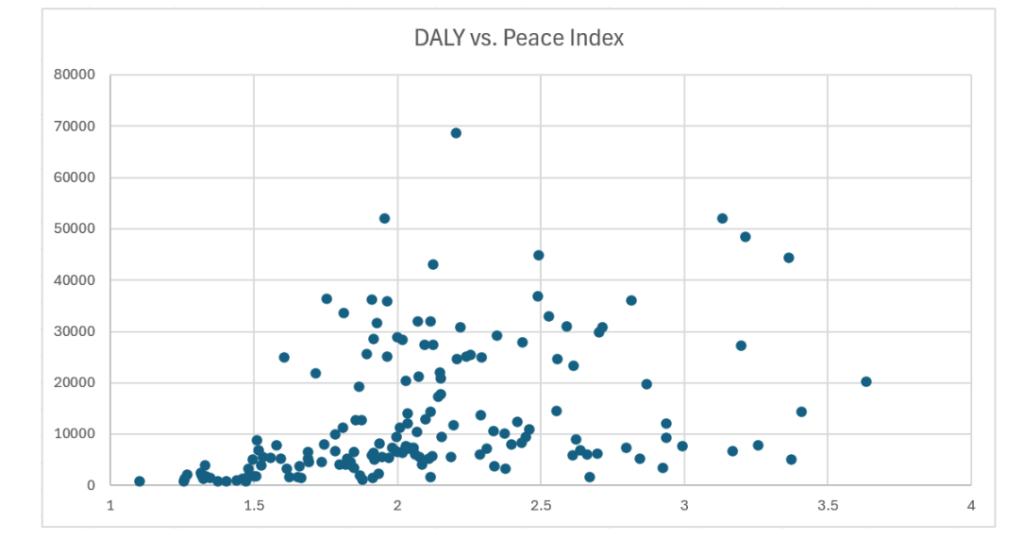
The peacefulness (GPI) and communicable disease rates (DALY) of all 163 countries are compared in Figure 1. There is a general trend that more peaceful countries (low GPI) have lower communicable disease rates (low DALY), and less peaceful countries have a higher communicable disease rates.


This image has an empty alt attribute; its file name is image-330-1024x539.png

Figure 1: Disability Adjusted Life Years (DALY) scores compared to Global Peace Index (GPI) scores for 163 countries 2021. Lower GPI scores (more peaceful) generally correlate with lower DALY (communicable disease rates) scores.


Table 1 lists the ten most peaceful countries (lowest GPI) and the ten least peaceful countries (highest GPI), DALY (2021 data) and latitude. The more peaceful countries demonstrate a trend towards lower communicable disease rates (low DALY), and are generally in higher latitudes and/or have alpine environments. Less peaceful countries generally have higher communicable disease rates (DALY). Higher latitude countries generally have less parasitic diseases, and lower latitude countries generally have more parasitic diseases⁹⁸,⁹⁹. Russia is an exception as a higher latitude country with an unfavorable GPI and an unfavorable DALY.


Table 1: Countries with the 10 highest and lowest Global Peace Scores are compared to Disability Adjusted Life Years for rates from communicable, neonatal, maternal & nutritional diseases and latitude. There is a general association between low GPI (peacefulness), low DALY (less infectious disease burden) and higher latitude.

Country & GPS Rank (Highest & Lowest 10) Global Peace Score (GPS) Disability Adjusted Life Years (DALY) Latitude
1 Iceland 1.1 846 65 N
2 New Zealand 1.253 949 35–47 S
3 Denmark 1.256 1,427 56 N
4 Portugal 1.267 2,143 30–42 N
5 Slovenia 1.315 2,520 45–47 N
6 Austria 1.317 2,000 47 N
7 Switzerland 1.323 1,421 47 N
8 Ireland 1.326 1,844 33 N
9 Czech Republic 1.329 4,071 48–51 N
10 Canada 1.33 1,915 42–83 N
154 Russia 2.993 7,666 41–82 N
155 Central African Republic 3.131 52,092 2–11 N
156 Libya 3.166 6,798 25 N
157 Democratic Republic of Congo 3.196 27,384 4 N–14 S
158 Somalia 3.211 48,505 10 N
159 Iraq 3.257 7,962 33 N
160 South Sudan 3.363 44,446 3–13 N
161 Syria 3.371 5,171 35 N
162 Yemen 3.407 14,370 15 N
163 Afghanistan 3.631 20,369 33 N

The Middle East-North Africa region remained the world’s least peaceful region. It includes four of the ten least peaceful countries. All these countries in both groups, other than Ireland, have always been ranked amongst the ten most peaceful or least peaceful countries¹⁰. Historically, Sub-Sahara Africa and parts of Latin America and the Caribbean are also conflict zones¹²¹,¹²².


LYME DISEASE PREVALENCE IN A CONFLICT ZONE

In an effort to understand other possible geographical variables, it is recognized the prevalence of some infections are dependent upon regional ecosystems. An example is Lyme disease, a zoonotic vector-borne global disease that has been associated with violent behavior in some individuals³,⁹,¹²³. Lyme disease is the most common vector-borne in the United States¹²⁴. A meta-analysis of 89 studies estimated there was a 14.5% global prevalence of seropositivity for Borrelia burgdorferi¹²⁵. In contrast to the 14.5% global prevalence, a study in Bosra Province, Iraq, the seropositivity of 389 psychiatric patients was 66% for Borrelia spp¹²⁶. Iraq has a history of being a conflict zone. A study of patients with neuropsychiatric Lyme disease demonstrated 1% developed homicidality after infection⁶².


GEOGRAPHICAL PATTERNS OF INFECTIOUS DISEASE, COGNITIVE IMPAIRMENTS, AND VIOLENCE

A study addressing cognitive functioning and infectious diseases put forward the hypothesis that “The worldwide distribution of cognitive ability is determined in part by variation in the intensity of infectious diseases. These correlations are robust worldwide, as well as within five or six world regions. Infectious disease remains the most powerful predictor of average national IQ”¹²⁷. The article describing the study was withdrawn due to “several critiques claiming that they contain substantial inaccuracies and biases.” However, “the authors acknowledged at least some of the claimed flaws, but they maintained that the inferences from the data were nevertheless reliable”¹²⁸. As stated previously, reduced cognitive abilities are associated with an increased risk of criminality and violence⁶⁴,⁶⁵,⁶⁶.


SUMMARY: GEOGRAPHICAL PATTERNS OF INFECTIOUS DISEASE BURDENS AND VIOLENCE

A global study linking the frequency of conflicts to the intensity of infectious disease found a causal association between infectious diseases and intrastate armed conflict and civil war, because variation in the

intensity of infectious disease occurred first, which were followed by variation in the frequency of intrastate armed conflict and civil war, rather than the opposite¹²⁹.

In summary, there is a geographical association between infectious disease burdens and violent behavior.


SOLDIERS RETURNING FROM CONFLICT ZONES HAVING ACQUIRED INFECTIOUS DISEASE ASSOCIATED WITH VIOLENCE

If violence is associated with regional infectious diseases, soldiers returning from these conflict zones may be returning with infectious diseases that may increase their risk of violent behaviors. It is important to differentiate this from the higher probability of the risk for violence caused by military service from violence caused by military training or combat-related trauma.

Soldiers returning from foreign wars often return with new and unusual infectious diseases. Some infections are often associated with compromised war zone environments and the stress of war in a foreign land. It is also possible some infections could have contributed to the wars they were in. Examples include the Plague of Athens 429 B.C., escape from Kaffa (Bubonic Plague 1347), French troops returning from Naples (Syphilis (1494/1495), and First World War (tuberculosis, typhus fever, typhoid fever, dysentery, scarlet fever, diphtheria, measles, whooping cough, smallpox, cholera, venereal diseases, particularly syphilis, encephalitis lethargica, Spanish flu)¹³⁰. The residual effect of these infections may have caused encephalopathy in some of the next generation of leaders and in millions in Europe and throughout the world, possibly contributing to World War II¹³⁰. In addition, Cerebral Malaria in some Vietnam veterans,¹³¹ and Mycoplasma, a possible contributor to Gulf War Syndrome¹³²,¹³³.

The association between infections and violent behavior has been weakly demonstrated with data from some soldiers returning from areas with higher endemic diseases associated with an increased probability of aggressive tendencies.


SARS-CoV-2 PANDEMIC RESULTING IN MENTAL IMPAIRMENTS THAT MAY HAVE CONTRIBUTED TO VIOLENCE

The pandemic was a possible contributor to an increase in cognitive impairments¹³⁴,¹³⁵,¹³⁶,¹³⁷,¹³⁸,¹³⁹,¹⁴⁰, mental disorders¹⁴¹,¹⁴² and substance abuse¹⁴³,¹⁴⁴. Collectively these impairments are associated with an increased risk of violence, and other studies have demonstrated an increase in violence associated with the SARS-CoV-2 pandemic¹⁴⁵,¹⁴⁶ including gun violence,¹⁴⁷ violence against children,¹⁴⁸ domestic violence,¹⁴⁹ and elder abuse¹⁵⁰.

In summary, the SARS-CoV-2 pandemic result in mental impairments that may have contributed to violence.


GLOBAL INSTABILITY SINCE THE SARS-CoV-2 PANDEMIC HAS OCCURRED

Based upon GPI data, conflict deaths are at the highest level in the century contributing to a decline in world peace. “Deaths from internal conflict, neighboring countries relations, and external conflicts fought all recorded significant deteriorations, with the total number of conflict-related deaths increasing by 96 percent”¹⁵¹.

Although the conflict in Ukraine was the primary driver of this increase, increases in conflict were also seen in many other countries, particularly in Sub-Saharan Africa and the Asia Pacific area. Even excluding the violence occurring in Ukraine, there has been an increase in the level of conflict since 2019. Conflict-related deaths rose by 45 percent in the year prior to Russia’s invasion of Ukraine, with over 100,000 total deaths in 2021 being recorded¹⁵¹. The war in Ukraine had a significant impact on global peacefulness, with Ukraine and Russia having the largest and fifth largest deteriorations in GPI respectively¹⁵¹.

In summary, there is more global instability since the SARS-CoV-2 pandemic.


OTHER PANDEMICS CONTRIBUTED TO MENTAL IMPAIRMENTS THAT MAY HAVE BEEN ASSOCIATED WITH VIOLENCE

Other pandemics include the Antonin Plague (165–180), Plague of Justinian (541–542), Japanese Smallpox Epidemic (735–737), Black Death (1347–1351), Smallpox (1520), 17th Century Great Plagues (1700), Cholera 6 Outbreaks (1817–1923), The Third Plague (1855), Yellow Fever (Late 1800s), Russian Flu (1899–1900), Spanish Flu (1918–1919), Asian Flu (1957–1958), Hong Kong Flu (1968–1970), HIV/AIDS (1981–Present), SARS (2002–2003), Swine Flu (2009–2010), MERS (2012–Present), and (2014–2016) Ebola¹⁵². Besides extensive death and disability, plagues have contributed to collapses of empires, social disruptions, infrastructure disruptions, border disruptions, decline of trade, shortages of food and other essentials, economic decline, migration, civil war and genocide¹⁵³,¹⁵⁴.

The development of violent behavior was recognized with the COVID-19 and Spanish Flu pandemics¹⁵⁵,¹⁵⁶,¹⁵⁷,¹⁵⁸. HIV/AIDS is associated with psychiatric and cognitive impairments¹⁵⁷ and sexual violence¹⁶⁰,¹⁶¹. Some pandemics did split societies with accusations and violence¹⁶².

There a few studies addressing the association between pandemics and scapegoating and persecution of minority groups, including migrants¹⁶³. However epidemics did not inevitably give rise to violence and hatred. Sometimes they did the opposite, as seen with epidemics of unknown causes in antiquity, the Great Influenza of 1918–19 and yellow fever across numerous cities and regions in America and Europe. These epidemics unified communities, overcoming previous social, political, religious, racial and ethnic conflicts.

In summary, some other pandemics may have contributed to mental impairments that may have been associated with violence.


Discussion

The concept that microbes can alter free will and contribute to violent behavior and lead to global instability is an opinion that has been expressed¹⁶⁴,¹⁶⁵, but is not broadly recognized. To evaluate whether the SARS-CoV-2 pandemic or other infectious diseases contribute to violent behavior and global instability, a series of reviews combining information from different scientific fields were addressed, which collectively evaluate the sequence that is relevant to this question.

The first review addressed environmental decline with a One Health approach. This is a collaborative strategy that aims to optimize the health of people, animals, plants and the environment¹⁶⁶. Since parasites adapt more rapidly that hosts to rapidly changing environments, recent environmental changes have increased infectious disease and the associated consequences. Zoonotic diseases and zoonotic vector-borne diseases are significant emerging infectious diseases associated with environmental changes. Some are emerging diseases, while others are instead an emerging awareness of diseases that have already been present with limited awareness of their full pathophysiological effects.

These parasites, particularly zoonotic parasites, sometimes have a capacity to manipulate their host in a manner that propagates their survival (Manipulation Hypothesis). The infectious diseases caused by these parasites can sometimes contribute to aggressiveness and violent behavior in both animals and humans. Although we see ourselves as the dominant species on this planet, we are not. Microbes can have a significant impact upon our free will by impacting behavior, sometimes causing pathological behavior, including violence.

The pathophysiology explaining this association is mostly immune mediated that results in brain circuit dysfunction which cause a number of emotional and cognitive impairments. These impairments increase the risk of violent behavior in different individuals, including violence associated with diminished impulse control, predatory behavior, and psychosis.

If a small number of individuals develop impairments that contribute to violence, their behavior may have limited impact or be restrained by the majority of higher functioning individuals and an intact social structure. However, when an influential individual, a groups of influential individuals, and/or an excessive number of individuals develop violent tendencies, it can have a greater societal and global community impact as a result of violence as an infectious disease and critical mass dynamics¹⁰³,¹⁰⁵.

As previously reviewed, infectious diseases and the consequences of infectious diseases are not equally distributed throughout the world. Countries and geographical areas with greater infectious disease burdens and more vector-borne zoonotic diseases are generally more likely to have a higher prevalence of aggressiveness and violence. In one study, when the prevalence of infection fluctuate, the increases of violence follows the increases in infection which supports a causal association¹²⁹. Higher latitude countries and higher altitude countries generally have less infectious disease load and are more peaceful than lower latitude countries with greater infectious disease loads. There are exceptions. Singapore is an equatorial country with a favorable GPI and low infectious disease load, and Russia is a higher latitude country with a lower GPI and greater infectious disease load¹⁰,¹¹. Clearly other variables need to be analyzed when considering national and regional risks of violence.

This study did not review which infectious diseases may be associated with the risk of violence in different geographical regions.

An association was demonstrated between infectious diseases, lower latitude countries and regions and violent behavior. It is therefore necessary to research which infections may be contributory, particularly in these higher risk areas. There are obstacles researching this question. There may be a significant delay between the infection and the development of violent behavior¹²⁹. In addition, some of the countries involved have limited public health surveillance capabilities, and some of the pathogens involved may have not yet been identified. Cerebral malaria is one infectious disease that is more prevalent in equatorial areas that is associated with violent behavior¹⁶⁷,¹⁶⁸,¹⁶⁹,¹⁷⁰,¹⁷¹,¹⁷². Relapsing Fever is more common in Mexico, Central and South America, the Mediterranean, Central Asia, and throughout much of Africa¹⁷³,¹⁷⁴. Relapsing Fever Borrelia was found in an autopsy of a patient who committed assaults, homicide and suicide³⁴. Many other infections need to be considered on a regional basis¹⁷⁵,¹⁷⁶,¹⁷⁷.

The association between infections and violent behavior has been weakly demonstrated with data from some soldiers returning from areas with higher endemic diseases associated with an increased probability of aggressive tendencies¹³⁰,¹³³. This offers some limited additional support for the position that violent tendencies may have an environmental contributor.

The 2017 hypothesis stated—If a pandemic causing mental impairments increasing the risk of violence occurred, it could contribute to global instability. The SARS-CoV-2 pandemic has resulted in some mental impairments that may have contributed to an increased risk of violence. Global instability has increased since the SARS-CoV-2 pandemic². Some pandemics in history may have also contributed to mental impairments associated with violence.

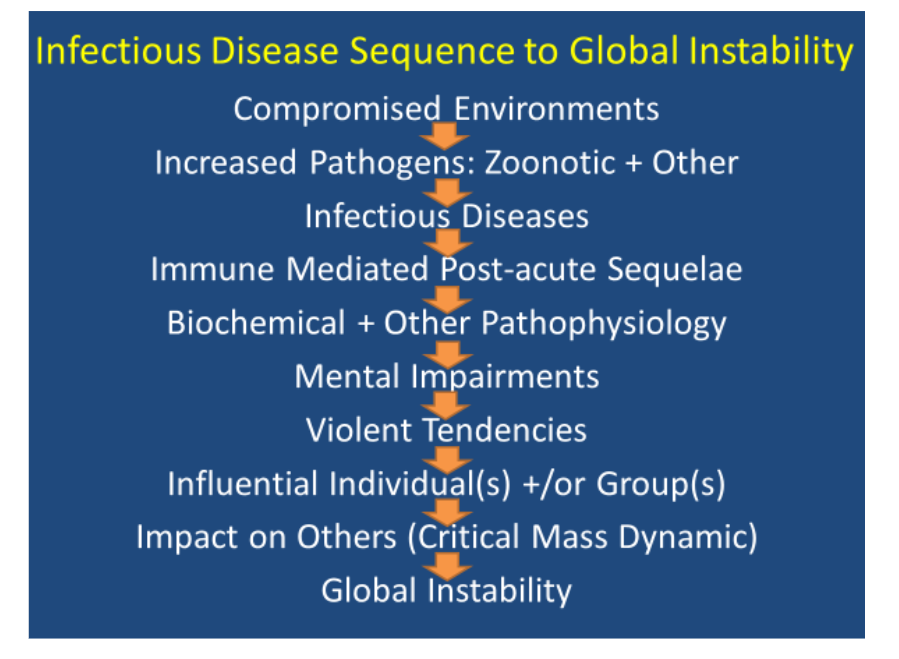
Although not possible to conclude with certainty, based on the information available, there is the suggestion that some infectious diseases contribute to mental impairments, violence and global instability, as illustrated by Figure 2.

This image has an empty alt attribute; its file name is image-331.png

Conclusion

Although the data reviewed has limitations, there is evidence to suggest that infectious diseases, including the recent pandemic, may contribute to mental impairments with resultant increased risk of violence and global instability. Sometimes infectious diseases compromise free will.

Each of the sections summarized would benefit from more detailed studies. There would be benefit identifying which infections may be associated with violent behavior in each geographical area. Collaborative research efforts are needed between psychiatrists, infectious disease physicians, public health officers, government officials and others with a One Health approach that recognizes the interactions of the multiple systems involved. There is a need for relevant surveillance, education, public awareness, prevention, and treatment.

Greater attention to hygiene, infection control, prevention, education, diagnosis, treatment of infectious diseases, recognizing the association between infectious disease and violence, and mental health care can help prevent violence on both a regional and global level. Improved infection control may be more effective towards improving global stability than military approaches. Any failures of corrective interventions may have very serious ramifications.

When future epidemics occur, more attention is needed to reduce the potential adverse mental and behavioral effects.


Conflicts of Interest Statement:

The author has provided expert testimony in criminal cases concerning infectious diseases and violence.


Funding Statement:

This study received no specific grants from public, commercial, or not-for-profit funding agencies. Funding for publication costs were supported by Project Lyme.


Acknowledgements:

Dr. Kenneth Friedman, Dr. Rosalie Greenberg, and Dr. Lynn Gilbert are recognized for providing peer review prior to submission, and Douglas Bransfield for technical assistance.


References

1. Bransfield RC. Could a Pandemic Causing Mental Dysfunction Contribute to Global Instability? Paper presented at: International Lyme and Associated Diseases 7th European Conference; May 19, 2017; Paris, France.

2. Institute for Economics & Peace. Global Peace Index: Global peace deteriorates as violence costs world $19.1 trillion in 2023. 11 June 2024 Available online: https://efe.com/en/portada-america/2024-06-11/global-peace-deteriorates-as-violence-costs-world-19-1-trillion-in-2023/#:~:text=Global%20Peace%20Index:%20Violence%20Costs,trillion%20in%202023%20%2D%20EFE%20Noticias&text=The%20economic%20impact%20of%20violence,No%20Sales (Accessed 21 October 2024.)

3. Bransfield RC. Aggressiveness, violence, homicidality, homicide, and Lyme disease. Neuropsychiatr Dis Treat. 2018;14:693-713. doi: 10.2147/NDT.S155143.

4. Fazel S, Philipson J, Gardiner L, Merritt R, Grann M. Neurological disorders and violence: a systematic review and meta-analysis with a focus on epilepsy and traumatic brain injury. J Neurol. 2009;256(10):1591-602. doi: 10.1007/s00415-009-5134-2.

5. Elliott FA. Violence: The Neurologic Contribution: An Overview. Arch Neurol. 1992;49 (6):595–603. doi:10.1001/archneur.1992.0053030 0027006.

6. Lewis DO, Pincus JH, Feldman M, Jackson L, Bard B. Psychiatric, neurological, and psychoeducational characteristics of 15 death row inmates in the United States. Am J Psychiatry. 1986;143(7):838-45. doi: 10.1176/ajp.143.7.838.

7. Feldman M, Mallouh K, Lewis DO. Filicidal abuse in the histories of 15 condemned murderers. Bull Am Acad Psychiatry Law. 1986;14(4):345–352.

8. Blomström Å, Kosidou K, Kristiansson M, Masterman T. Infection during childhood and the risk of violent criminal behavior in adulthood. Brain Behav Immun. 2020;86:63-71. doi: 10.1016/j.bbi.2 019.02.026.

9. Bransfield RC, Mao C, Greenberg R. Microbes and Mental Illness: Past, Present, and Future. Healthcare (Basel). 2023;12(1):83. doi: 10.3390/healthcare12010083.

10. Vision of Humanity. Overall GPI Score. Available online:
https://www.visionofhumanity.org/maps/#/ (Accessed 24 October 2024).

11. IHME, Global Burden of Disease (2024) – with minor processing by Our World in Data. “DALY rates from communicable, neonatal, maternal & nutritional diseases” [dataset]. IHME, Global Burden of Disease, “Global Burden of Disease – Deaths and DALYs” [original data]. Available online: https://ourworldindata.org/grapher/burden-of-disease-rates-from-communicable-neonatal-maternal-nutritional-diseases (Accessed 26 October 2024).

12. Mahon MB, Sack A, Aleuy OA, et al. A meta-analysis on global change drivers and the risk of infectious disease. Nature. 2024;629, 830–836. https://doi.org/10.1038/s41586-024-07380-6.

13. Kilpatrick AM, Randolph SE. Drivers, dynamics, and control of emerging vector-borne zoonotic diseases. Lancet. 2012;380(9857):1946-55. doi: 10.1016/S0140-6736(12)61151-9.

14. Feinmann J. Analysis reveals global post-covid surge in infectious diseases. BMJ. 2024;385: q1348. doi: 10.1136/bmj.q1348.

15. Rana MS, Usman M, Alam MM, et al. Changes in the prevalence of infectious diseases before and after the COVID-19 pandemic in Pakistan. J Infect. 2023;86(4):415-416. doi: 10.1016/j.jinf.2023.01.020.

16. Rubin R. Syphilis Has Surged for Reasons That Go Beyond the Pathogen That Causes It. JAMA. 2024;332(2):92–95. doi:10.1001/jama.2024.2978.

17. Haider N, Rothman-Ostrow P, Osman AY et al. COVID-19-Zoonosis or Emerging Infectious Disease? Front Public Health. 2020;8:596944. doi: 10.3389/fpubh.2020.596944.

18. Esposito MM, Turku S, Lehrfield L, Shoman A. The Impact of Human Activities on Zoonotic Infection Transmissions. Animals (Basel). 2023;13 (10):1646. doi: 10.3390/ani13101646.

19. WHO. Vector-borne diseases. 26 September 2024. Available online: https://www.who.int/news-room/fact-sheets/detail/vector-borne-diseases (Accessed 26 October 2024).

20. Thompson A. Plants Are the World’s Dominant Life-Form. Scientific American. 1 August 2018. Available online:
https://www.scientificamerican.com/article/plants-are-the-worlds-dominant-life-form/ (Accessed 25 October 2024).

21. Ihara F, Nishimura M, Muroi Y, et al. Toxoplasma gondii Infection in Mice Impairs Long-Term Fear Memory Consolidation through Dysfunction of the Cortex and Amygdala. Infect Immun. 2016; 84(10):2861-70. doi: 10.1128/IAI.00217-16.

22. Alvarado-Esquivel C, Estrada-Martínez S, Ramos-Nevárez A, et al. Is Toxoplasma gondii Infection Associated with Sexual Promiscuity? A Cross-Sectional Study. Pathogens. 2021;10(11): 1393. doi:10.3390/pathogens10111393.

23. Jackson AC. Diabolical effects of rabies encephalitis. J Neurovirol. 2016;22(1):8-13.
doi: 10.1007/s13365-015-0351-1.

24. Flegr J. Influence of latent Toxoplasma infection on human personality, physiology and morphology: pros and cons of the Toxoplasma-human model in studying the manipulation hypothesis. J Exp Biol. 2013;216(Pt 1):127-33. doi: 10.1242/je b.073635.

25. Steffen HM. Wie beeinflussen Parasiten das Verhalten ihres Wirts? Die parasitäre Manipulations hypothese [Behavioural Changes Caused by Parasites: The Parasite Manipulation Hypothesis]. Dtsch Med Wochenschr. 2020;145(25):1848-1854. German. doi: 10.1055/a-1220-8737.

26. Poulin R. Parasite manipulation of host behavior: an update and frequently asked questions. Adv. Study Behav. 2010;41:151–186. doi: 10.101 6/S0065-3454(10)41005-0.

27. Moore J. An overview of parasite-induced behavioral alterations—and some lessons from bats. J Exp Biol. 2013;216:11–17. doi: 10.1242/je b.074088.

28. Hart BL. Behavioural defences in animals against pathogens and parasites: parallels with the pillars of medicine in humans. Phil Trans R Soc. 2011;B 366:3406–3417. doi: 10.1098/rstb.2011.0092.

29. Klein SL. Parasite manipulation of the proximate mechanisms that mediate social behavior in vertebrates. Physiol Behav. 2003;79:441–449. doi: 10.1016/S0031-9384(03)00163-X).

30. Poulin R. ‘Adaptive’ changes in the behaviour of parasitized animals: a critical review. Int J Parasitol. 1995;25:1371–1383. doi: 10.1016/0 020-7519(95)00100-X).

31. Ashby B, Boots M. Coevolution of parasite virulence and host mating strategies. Proc Natl Acad Sci. USA. 2015;112, 13 290–13 295. doi: 10.1073/p nas.1508397112.

32. Natarajan D, Caramaschi D. Animal violence demystified. Front Behav Neurosci. 2010;4:9. doi: 10.3389/fnbeh.2010.00009.

33. Raihani NJ, Bell V. An evolutionary perspective on paranoia. Nat Hum Behav. 2019;3(2):114-121. doi: 10.1038/s41562-018-0495-0.

34. Bransfield RC, Goud Gadila SK, Kursawe LJ, Dwork AJ, Rosoklija G, Horn EJ, Cook MJ, Embers ME. Late-stage borreliosis and substance abuse. Heliyon. 2024;10(10):e31159. doi: 10.1016/j.heliyo n.2024.e31159.

35. Sariaslan A, Lichtenstein P, Larsson H, Fazel S. Triggers for violent criminality in patients with psychotic disorders. JAMA Psychiatry. 2016;73(8): 796–803.

36. Volavka J. Triggering violence in psychosis. JAMA Psychiatry. 2016;73(8):769–770.

37. Thornhill R, Fincher CL. Parasite stress promotes homicide and child maltreatment. Philos Trans R Soc Lond B Biol Sci. 2011;366(1583):3466–3477.

38. Lester D. Toxoplasma gondii and homicide. Psychol Rep. 2012;111(1):196–197.

39. Stahl SM, Morrissette DA, Munter N. Stahl’s Illustrated Violence. Cambridge UK: Cambridge University Press; 2014.

40. Stahl SM. Deconstructing violence as a medical syndrome: mapping psychotic, impulsive, and predatory subtypes to malfunctioning brain circuits. CNS Spectr. 2014;19(5):357–365.

41. Heath NM, Chesney SA, Gerhart JI, et al. Interpersonal violence, PTSD, and inflammation: potential psychogenic pathways to higher C-reactive protein levels. Cytokine. 2013;63(2):172–178.

42. Copeland WE, Wolke D, Lereya ST, Shanahan L, Worthman C, Costello EJ. Childhood bullying involvement predicts low-grade systemic inflammation into adulthood. Proc Natl Acad Sci U S A. 2014;111(21):7570–7575.

43. Bob P, Raboch J, Maes M, et al. Depression, traumatic stress and interleukin-6. J Affect Disord. 2010;120(1–3):231–234.

44. Heyes MP, Brew BJ, Martin A et al. Quinolinic acid in cerebrospinal fluid and serum in HIV-1 infection: relationship to clinical and neurological status. Ann Neurol. 1991;29(2):202-9. doi: 10.1002/ana.41029 0215.

45. Halperin JJ, Heyes MP. Neuroactive kynurenines in Lyme borreliosis. Neurology. 1992; 42(1):43-50. doi: 10.1212/wnl.42.1.43.

46. Hunt NH, Too LK, Khaw LT et al. The kynurenine pathway and parasitic infections that affect CNS function. Neuropharmacology. 2017; 112(Pt B):389-398. doi: 10.1016/j.neuropharm.201 6.02.029.

47. Huang YS, Ogbechi J, Clanchy FI, Williams RO, Stone TW. IDO and Kynurenine Metabolites in Peripheral and CNS Disorders. Front Immunol. 2020;11:388. doi: 10.3389/fimmu.2020.00388.

48. Bransfield RC. The psychoimmunology of Lyme/tick-borne diseases and its association with neuropsychiatric symptoms. Open Neurol J. 2012; 6:88–93.

49. Coccaro EF, Lee R, Coussons-Read M. Elevated Plasma Inflammatory Markers in Individuals with Intermittent Explosive Disorder and Correlation with Aggression in Humans. JAMA Psychiatry. 2014;71(2):158–165. doi:10.1001/jamapsychiatry.2013.3297

50. Shamay-Tsoory SG, Tomer R, Berger BD, Aharon-Peretz J. Characterization of empathy deficits following prefrontal brain damage: the role of the right ventromedial prefrontal cortex. J Cogn Neurosci. 2003;15(3):324–337.

51. Adolphs R, Tranel D, Damasio H, Damasio A. Impaired recognition of emotion in facial expressions following bilateral damage to the human amygdala. Nature. 1994;372(6507):669–672.

52. Adolphs R, Baron-Cohen S, Tranel D. Impaired recognition of social emotions following amygdala damage. J Cogn Neurosci. 2002;14(8):1264–1274.

53. Siever LJ. Neurobiology of aggression and violence. Am J Psychiatry. 2008;165(4):429–442.

54. Davidson RJ, Putnam KM, Larson CL. Dysfunction in the neural circuitry of emotion regulation – a possible prelude to violence. Science. 2000;289(5479):591–594.

55. Lane SD, Kjome KL, Moeller FG. Neuropsychiatry of aggression. Neurol Clin. 2011; 29(1):49-64, vii. doi: 10.1016/j.ncl.2010.10.006.

56. Hillis AE. Inability to empathize: brain lesions that disrupt sharing and understanding another’s emotions. Brain. 2014;137(Pt 4):981-97. doi: 10.10 93/brain/awt317.

57. Muzambi, R., Bhaskaran, K., Rentsch, C.T. et al. Are infections associated with cognitive decline and neuroimaging outcomes? A historical cohort study using data from the UK Biobank study linked to electronic health records. Transl Psychiatry. 2022;12;385. doi: 10.1038/s41398-022-02145-z.

58. Jaywant A, Gunning FM, Oberlin LE, et al. Cognitive Symptoms of Post–COVID-19 Condition and Daily Functioning. JAMA Netw Open. 2024; 7(2):e2356098. doi:10.1001/jamanetworkopen.2023.56098.

59. Hernandez-Ruiz V, Letenneur L, Fülöp T, Helmer C et al. Infectious diseases and cognition: do we have to worry? Neurol Sci. 2022;43(11):62 15-6224. doi: 10.1007/s10072-022-06280-9.

60. Reis PA, Castro-Faria-Neto HC. Systemic Response to Infection Induces Long-Term Cognitive Decline: Neuroinflammation and Oxidative Stress as Therapeutical Targets. Front Neurosci. 2022;15: 742158. doi: 10.3389/fnins.2021.742158.

61. Bransfield, R.C. Neuropsychiatric Lyme Borreliosis: An Overview with a Focus on a Specialty Psychiatrist’s Clinical Practice. Healthcare (Basel). 2018;6:104. doi: 10.3390/healthcare6030104.

62. Bransfield RC, Aidlen DM, Cook MJ, Javia S. A Clinical Diagnostic System for Late-Stage Neuropsychiatric Lyme Borreliosis Based upon an Analysis of 100 Patients. Healthcare (Basel). 2020;8 (1):13. doi: 10.3390/healthcare8010013.

63. Friedman KJ, Ruhoy IS, Fennell PA. The Possible Infectious Origins of Myalgic Encephalomyelitis/Chronic Fatigue Syndrome and Fibromyalgia and Other Infectious Diseases Causing Cognitive Consequences’, in Hedges DW, Gale SD, Erickson LD (eds), Infectious Diseases in Neurocognitive and Neuropsychiatric Medicine. Oxford Academic, 24 Oct. 2024), doi:10.1093/oso/9780192870414.003.0001

64. Bantjes J, Rabie S, Almirol E et al. Associations between violence, criminality, and cognitive control deficits among young men living in low resource communities in South Africa. Aggress Behav. 2020; 46(1):5-15. doi: 10.1002/ab.21867.

65. Frisell T, Pawitan Y, Långström N. Is the association between general cognitive ability and violent crime caused by family-level confounders? PLoS One. 2012;7(7):e41783. doi: 10.1371/journa l.pone.0041783.

66. Wallinius M, Nordholm J, Wagnström F, Billstedt E. Cognitive functioning and aggressive antisocial behaviors in young violent offenders. Psychiatry Res. 2019;272:572-580. doi: 10.1016/j.p sychres.2018.12.140.

67. Liang CS, Bai YM, Hsu JW et al. The Risk of Sexually Transmitted Infections Following First-Episode Schizophrenia Among Adolescents and Young Adults: A Cohort Study of 220 545 Subjects. Schizophr Bull. 2020;46;795–803.

68. Saini HS, Sayre M, Saini I, Elsharkawy N. Neurosyphilis Presenting as Intermittent Explosive Disorder and Acute Psychosis. Cureus. 2019;11, e6337.

69. Taki El-Din Z, Iqbal H, Sharma A. Neurosyphilis-Induced Psychosis: A Unique Presentation of Syphilis with a Primary Psychiatric Manifestation. Cureus. 2023;15, e36080.

70. Kaplan RM. Syphilis, sex and psychiatry, 1789-1925: Part 1. Australas Psychiatry. 2010;18(1): 17-21. doi: 10.3109/10398560903295709.

71. Wright AD. Venereal disease and the great. Br J Vener Dis. 1971;47:295–306. doi: 10.1136/st i.47.4.295.

72. Weissfeld AS. Infectious Diseases and Famous People Who Succumbed to Them Clinical Microbiology Newsletter. Clinical Microbiology Newsletter. 2009;31:169–172.

73. Brinch O. The medical problems of Henry VIII. Centaurus. 1958;5(3-4):339-69.

74. Shrewsbury JF. Henry VIII: a medical study. J Hist Med Allied Sci. 1952;7(2):141-85. doi: 10.109 3/jhmas/vii.2.141.

75. Sands K, Dennis M, Venkatesh R. “Fr02-06 Down the Chute”. The Journal of Urology. 2020; 203 (203): 293–294. doi:10.1097/JU.0000000000000851.06. S2CID 218949508.

76. Santing CG, Raimond-Waarts L. Sex a Cardinal’s Sin. Punished by Syphilis in Renaissance Rome. Leidschrift Historisch Tijdschrift, 2010;25: 169-182. Available online:
https://research.rug.nl/en/publications/sex-a-cardinals-sin-punished-by-syphilis-in-renaissance-rome (Accessed 26 October 2024).

77. O’Malley CD. Some episodes in the medical history of Emperor Charles V; an imperial problem and the problem of an emperor. J Hist Med Allied Sci. 1958;13(4):469-82. English, French.

78. Salmon M. Evidence for the Presence of Treponemal Disease, Including Syphilis, in Late Medieval Europe. The Medieval Globe. 2021;7(2); 37-87. Available online: https://muse.jhu.edu/article/842358 (Accessed 26 2024).

79. Tampa M, Sarbu I, Matei C, Benea V, Georgescu SR. Brief history of syphilis. J Med Life. 2014;7(1):4-10.

80. Zanello M, Roux A, Gavaret M, et al. King Charles VIII of France’s Death: From an Unsubstantiated Traumatic Brain Injury to More Realistic Hypotheses. World Neurosurg. 2021;156: 60-67. doi: 10.1016/j.wneu.2021.09.056.

81. Morton RS. Did Catherine the Great of Russia have syphilis? Genitourin Med. 1991;67(6):498-502. doi: 10.1136/sti.67.6.498.

82. Staff. Wane State University School of Medicine. Did syphilis really cause John Wilkes Booth to assassinate Abraham Lincoln? April 17, 2018. Available online:
https://today.wayne.edu/medicine/news/2018/04/17/did-syphilis-really-cause-john-wilkes-booth-to-assassinate-abraham-lincoln-23684#:~:text=%22With%20all%20the%20women%20in%20his%20life%2C%20including,and%20what%20finally%20put%20him%20over%20the%20edge.%22 (Accessed 24 October 2024).

83. Bergreen L. Capone: The Man and the Era. New York: Simon and Schuster Paperbacks. ISBN 978-0-684-82447-5. 1994.

84. Sefton AM. The Great Pox that was…syphilis. J Appl Microbiol. 2001;91(4):592-6. doi: 10.1046/j. 1365-2672.2001.01494.x.

85. Weissfeld AS. Infectious Diseases and Famous People Who Succumbed to Them. Clin Microbiol Newsl. 2009;22(31):169-72.

86. Keatley P. Obituary: Idi Amin. The Guardian. August 17, 2003. Available online:
https://www.theguardian.com/news/2003/aug/18/guardianobituaries (Accessed 25 October 2024).

87. Retief FP, Wessels A. Did Adolf Hitler have syphilis? S Afr Med J. 2005;95(10):750, 752, 754, 756.

88. Hayden, Deborah. Pox: Genius, Madness, And the Mysteries of Syphilis. Basic Books. ISBN 978-0786724130. OCLC 50725392. 2008.

89. Sacks O. Awakenings. New York: Harper Perennial; 1973.

90. Chivers, C. J. “A Retrospective Diagnosis Says Lenin Had Syphilis”. The New York Times. 22 June 2004

91. Brinn D. Israeli researchers solve mystery of Lenin’s death. July 25, 2004, Updated September 13, 2012. Available online:
https://www.israel21c.org/israeli-researchers-solve-mystery-of-lenins-death/ (Accessed on 24 October 2024).

92. Manaev G. What happened to Lenin’s brain after death? October 01, 2020. Available online: https://www.rbth.com/history/332791-what-happened-to-lenins-brain (Accessed 24 October 2024).

93. Bhattacharyya KB. Adolf Hitler and His Parkinsonism. Ann Indian Acad Neurol. 2015;18(4): 387-90. doi: 10.4103/0972-2327.169536.
Wright AD. Venereal disease and the great. Br J Vener Dis. 1971;47:295. doi: 10.1136/sti.47.4.295.

94. Auden GA. Behaviour changes supervening upon encephalitis in children. Lancet. 1922;200: 901–904.

95. Ruiz V. ‘A disease that makes criminals’: Encephalitis lethargica (EL) in children, mental deficiency, and the 1927 Mental Deficiency Act. Endeavour. 2015;39:44–51.

96. Gupta R, Kim C, Agarwal N, Lieber B, Monaco EA 3rd. Understanding the Influence of Parkinson Disease on Adolf Hitler’s Decision-Making during World War II. World Neurosurg. 2015;84 (5):1447-52. doi: 10.1016/j.wneu.2015.06.014.

97. Tselis A, Booss J. Behavioral consequences of infections of the central nervous system: with emphasis on viral infections. J Am Acad Psychiatry Law. 2003;31(3):289-98.

98. Bhattacharyya KB. Adolf Hitler and His Parkinsonism. Ann Indian Acad Neurol. 2015;18(4): 387-90. doi: 10.4103/0972-2327.169536.
Wright AD. Venereal disease and the great. Br J Vener Dis. 1971;47:295. doi: 10.1136/sti.47.4.295.

99. Lickiewicz, J., Piotrowicz, K., Makara-Studzińska, M. (2023). The Weather, Aggression, and Aggressive Behavior in Psychiatric Hospitals. In: Martin, C., Preedy, V.R., Patel, V.B. (eds) Handbook of Anger, Aggression, and Violence. 2023, Springer, Cham. https://doi.org/10.1007/978-3-030-98711-4_65-1

100. Mikutta CA, Pervilhac C, Znoj H, Federspiel A, Müller TJ. The Impact of Foehn Wind on Mental Distress among Patients in a Swiss Psychiatric Hospital. Int J Environ Res Public Health. 2022, 19(17):10831. doi: 10.3390/ijerph191710831.

101. Greve F, Kanz KG, Zyskowski M, von Matthey F, Biberthaler P, Muthers S, Matzarakis A, Lefering R, Huber-Wagner S. The influence of foehn winds on the incidence of severe injuries in southern Bavaria – an analysis of the TraumaRegister DGU®. BMC Musculoskelet Disord. 2020, 21(1):568.
doi: 10.1186/s12891-020-03572-z.

102. Forum on Global Violence Prevention; Board on Global Health; Institute of Medicine; National Research Council. Contagion of Violence: Workshop Summary. Washington (DC): National Academies Press (US); 2013 Feb 6. II.9, Violence is a Contagious Disease. Available online:
https://www.ncbi.nlm.nih.gov/books/NBK207245/ (Accessed 24 October 2024).

103. Iacopini I, Petri G, Baronchelli A. et al. Group interactions modulate critical mass dynamics in social convention. Commun Phys. 2022;5:64. doi: 10.1038/s42005-022-00845-y

104. Collins, R. Theorizing the time-dynamics of violence. Violence: Int Jl. 2020;1(1), 166-184. https://doi.org/10.1177/2633002420907768.

105. Malthaner, S. Processes of Political Violence and the Dynamics of Situational Interaction. IJCV. 2017;11, 1-10. doi: 10.4119/UNIBI/ijcv.627.

106. Ecology Drives the Global Distribution of Human Diseases. PLoS Biol. 2004;2(6):e186.
doi: 10.1371/journal.pbio.0020186.

107. Møller AP. Evidence of Larger Impact of Parasites on Hosts in the Tropics: Investment in Immune Function within and outside the Tropics. Oikos. 1998;82(2), 265–270. https://doi.org/10.2307/3546966.

108. Infectious diseases in Afghanistan: Report by the Global Disaster Information Network (GDIN). 7 Nov 2001. Available online:
https://reliefweb.int/report/afghanistan/infectious-diseases-afghanistan-report-global-disaster-information-network-gdin (Accessed 24 October 2024).

109. Wallace MR, Hale BR, Utz GC, et al. Endemic Infectious Diseases of Afghanistan, Clinical Infectious Diseases. 2002;34:S171–S207. doi: 10.1086/340704

110. Burki T. Infectious diseases in Yemen. Lancet Infect Dis. 2021;21(5):610-611. doi: 10.1016/S1473-3099(21)00218-8.

111. The Lancet Infectious Diseases. Cholera in Yemen: war, hunger, disease…and heroics. Lancet Infect Dis. 2017;17(8):781. doi: 10.1016/S1473-30 99(17)30406-1.

112. USAID. Disease vector Hazard Report: Yemen chrome-extension://efaidnbmnnnibpcajpcglclefindmkaj/https://vectormap.si.edu/downloads/VHazardReports/DVHR_Yemen.pdf.

113. WHO update on health situation and needs in Yemen at today´s UN bi-weekly press briefing in Geneva. 21 Apr 2023. Available online:
https://reliefweb.int/report/yemen/who-update-health-situation-and-needs-yemen-todays-un-bi-weekly-press-briefing-geneva (Accessed 24 October 2024).

114. USAID. Health and the People of South Sudan. Available online:
https://www.usaid.gov/south-sudan/global-health#:~:text=Malaria%2C%20HIV/AIDS%2C%20and,increase%20access%20to%20clean%20water. (Accessed 24 October 2024).

115. Tarnas MC, Almhawish N, Karah N, Sullivan R, Abbara A. Communicable diseases in northwest Syria in the context of protracted armed conflict and earthquakes. Lancet Infect Dis. 2023;23(11): e477-e481. doi: 10.1016/S1473-3099(23)00201-3.

116. Marou, V., Vardavas, C.I., Aslanoglou, K. et al. The impact of conflict on infectious disease: a systematic literature review. Confl Health. 18;27 (2024). https://doi.org/10.1186/s13031-023-00568-z

117. State of Health in the EU Iceland Country Health Profile 2022. Available online: chrome-extension://efaidnbmnnnibpcajpcglclefindmkaj/https://health.ec.europa.eu/system/files/2021-12/2021_chp_is_english.pdf (Accessed 24 October 2024).

118. Vigfusson HB, Hardarson HS, Ludviksson BR, Gudlaugsson O. Lyme disease in Iceland – Epidemiology from 2011 to 2015. Laeknabladid. 2019;105(2):63-70. Icelandic. doi: 10.17992/lbl.20 19.02.215.

119. Christie S, Tobias M. The burden of infectious disease in New Zealand. Aust N Z J Public Health. 1998;22(2):257-60. doi: 10.1111/j.1467-842x.199 8.tb01184.x.

120. Hvidberg MF, Johnsen SP, Davidsen M, Ehlers L. A Nationwide Study of Prevalence Rates and Characteristics of 199 Chronic Conditions in Denmark. Pharmacoecon Open. 2020;4(2):361-380. doi: 10.1007/s41669-019-0167-7.

121. IISS. The Armed Conflict Survey 2022: Sub-Saharan Africa Regional Analysis. 18th November 2022. Available online:
https://www.iiss.org/online-analysis/online-analysis/2022/11/acs-2022-sub-saharan-africa/ (Accessed 17 November 2024).

122. ACLED. Regional Overview Latin America and the Caribbean October 2024. 8 November. Available online: 32024.
https://acleddata.com/2024/11/08/latin-america-and-the-caribbean-overview-october-2024/ (Accessed 17 November 2024).

123. Bransfield RC. Intrusive symptoms and infectious encephalopathies. Neurol Psychiatry Brain Res. 2016;22:3–4.

124. Mead P. Epidemiology of Lyme Disease. Infect Dis Clin North Am. 2022;36(3):495-521.
doi: 10.1016/j.idc.2022.03.004.

125. Dong Y, Zhou G, Cao W, et al. Global seroprevalence and sociodemographic characteristics of Borrelia burgdorferi sensu lato in human populations: a systematic review and meta-analysis. BMJ Glob Health. 2022;7(6):e007744. doi: 10.1136/bmjgh-2021-007744.

126. Madhi DK, Issa AH, Al-Luaibi Y, Al-Maliki QN. First report of Borrelia spp. and Borreliella spp. in blood, urine, and buccal cavity of patients with psychiatric disorder in Basra Province, Iraq. Drug Invention Today. 2019;11(11):2927-2932.

127. Eppig C, Fincher CL, Thornhill R. Parasite Prevalence and the Worldwide Distribution of Cognitive Ability. In: Institute of Medicine (US) Forum on Microbial Threats. The Causes and Impacts of Neglected Tropical and Zoonotic Diseases: Opportunities for Integrated Intervention Strategies. Washington (DC): National Academies Press (US); 2011. A3. Available from: https://www.ncbi.nlm.nih.gov/books/NBK62514/ (Accessed 24 October 2024).

128. Proceedings B editorial team. Retraction: ‘Parasite prevalence and the worldwide distribution of cognitive ability’ (2010), by Eppig, Fincher and Thornhill. Proc Biol Sci. 2024;291(2017):20240463. doi: 10.1098/rspb.2024.0463.

129. Letendre K, Fincher CL, Thornhill R. Does infectious disease cause global variation in the frequency of intrastate armed conflict and civil war? Biol Rev. 2010;85:669-83. doi: 10.1111/j.1469-185X.2010.00133.x.

130. Bransfield RC. Did Infections Caused by World War I Contribute to Causing World War II? Contagion Live. January 5, 2018. Available online: https://www.contagionlive.com/view/did-infections-caused-by-world-war-i-contribute-to-causing-world-war-ii (Accessed 24 October 2024).

131. Varney NR, Roberts RJ, Springer JA, Connell SK, Wood PS. Neuropsychiatric sequelae of cerebral malaria in Vietnam veterans. J Nerv Ment Dis. 1997;185(11):695-703. doi: 10.1097/000 05053-199711000-00008.

132. Nicolson GL, Nasralla MY, Haier J, Pomfret J. High frequency of systemic mycoplasmal infections in Gulf War veterans and civilians with Amyotrophic Lateral Sclerosis (ALS). J Clin Neurosci. 2002;9(5):525-9. doi: 10.1054/jocn.2001.1075.

133. Nicholson G. Chronic Mycoplasmal Infections in Gulf War Veterans’ Children and Autism Patients. Medical Veritas. 2005;2:383-387 2005. doi: 10.1588/medver.2005.02.00047

134. Wood, G.K., Sargent, B.F., Ahmad, ZUA. et al. Post-hospitalisation COVID-19 cognitive deficits at one year are global and associated with elevated brain injury markers and grey matter volume reduction. Nat Med. 2024. doi: 10.1038/s41591-024-03309-8.

135. Ladds E, Darbyshire JL, Bakerly ND, Falope Z, Tucker-Bell I. Cognitive dysfunction after covid-19. BMJ. 2024;384:e075387. doi: 10.1136/bmj-20 23-075387.

136. Zhao S, Martin EM, Reuken PA, et al. Long COVID is associated with severe cognitive slowing: a multicentre cross-sectional study. EClinicalMedicine. 2024;68:102434. doi: 10.1016/j.eclinm.2024.102434.

137. Miskowiak KW, Fugledalen L, Jespersen AE, et al. Trajectory of cognitive impairments over 1 year after COVID-19 hospitalisation: Pattern, severity, and functional implications. Eur Neuropsychopharmacol. 2022;59:82-92. doi: 10.1016/j.euroneuro.2022.04.004.

138. Hampshire A, Azor A, Atchison C, et al. Cognition and Memory after Covid-19 in a Large Community Sample. N Engl J Med. 2024;390(9): 806-818. doi: 10.1056/NEJMoa2311330.

139. Cheetham NJ, Penfold R, Giunchiglia V, et al. The effects of COVID-19 on cognitive performance in a community-based cohort: a COVID symptom study biobank prospective cohort study. EClinicalMedicine. 2023;62:102086. doi: 10.1016/j.eclinm.2023.102086.

140. Al-Aly Z, Rosen CJ. Long Covid and Impaired Cognition – More Evidence and More Work to Do. N Engl J Med. 2024;390(9):858-860. doi: 10.1056/NEJMe2400189.

141. Clemente-Suárez VJ, Martínez-González MB, Benitez-Agudelo JC, et al. The Impact of the COVID-19 Pandemic on Mental Disorders. A Critical Review. Int J Environ Res Public Health. 2021;18(19):10041. doi: 10.3390/ijerph181910041.

142. Nakamura, Z.M., Nash, R.P., Laughon, S.L. et al. Neuropsychiatric Complications of COVID-19. Curr Psychiatry Rep. 2021;23:25. doi: 10.1007/s11920-021-01237-9.

143. Temirpulotovich TB, Uzokboevich TA, Murodullaevich KR, Bahtiyarovich AR, Xazratovich KZ, Toshevich RH. The Impact of Medical and Social Factors on Alcohol Abuse in Patients with Alcoholism During the Covid-19 Pandemic. Journal of Pharmaceutical Negative Results. 2022;8195-8200. doi: 10.47750/pnr.2022.13.S09.959.

144. Melamed OC, Hauck TS, Buckley L, Selby P, Mulsant BH. Article Commentary: COVID-19 and Persons with Substance use Disorders: Inequities and Mitigation Strategies. Substance Abuse. 2020;41(3):286-291. doi: 10.1080/08897077.202 0.1784363

145. Polo, Sara M.T. “A Pandemic of Violence? The Impact of COVID-19 on Conflict” Peace Economics, Peace Science and Public Policy. 2020;26(3):202 00050. doi: 10.1515/peps-2020-0050

146. Whiteman PJ, Macias-Konstantopoulos WL, Relan P, Knopov A, Ranney ML, Riviello RJ. Violence and Abuse: A Pandemic Within a Pandemic. West J Emerg Med. 2023;24(4):743-750. doi: 10.5811/w estjem.58405.

147. Sutherland M, McKenney M, Elkbuli A. Gun violence during COVID-19 pandemic: Paradoxical trends in New York City, Chicago, Los Angeles and Baltimore. Am J Emerg Med. 2021;39:225-226. doi: 10.1016/j.ajem.2020.05.006.

148. de Oliveira SMT, Galdeano EA, da Trindade EMGG, et al. Epidemiological Study of Violence against Children and Its Increase during the COVID-19 Pandemic. International Journal of Environmental Research and Public Health. 2021;18(19):10061. doi: 10.3390/ijerph181910061

149. Boserup B, McKenney M, Elkbuli A. Alarming trends in US domestic violence during the COVID-19 pandemic. Am J Emerg Med. 2020,38(12):2753-2755. doi: 10.1016/j.ajem.2020.04.077.

150. Filipska K, Biercewicz M, Wiśniewski A, et al. High Rate of Elder Abuse in the Time of COVID-19—A Cross Sectional Study of Geriatric and Neurology Clinic Patients. J. Clin. Med. 2021;10, 4532. doi: 10.3390/jcm10194532

151. Institute for Economics & Peace. Global Peace Index 2024: Measuring Peace in a Complex World, Sydney, June 2024. Available from: http://visionofhumanity.org/resources (accessed 25 August 2024).

152. Buch Institute. COVID-19: The Past, Present and Future of Pandemics. April 5, 2021. Available online: https://www.buckinstitute.org/blog/covid-19-the-past-present-and-future-of-pandemics/?utm_source=google&utm_campaign=9875367091&utm_content=114572789704&utm_term=&utm_medium=460160308540&gad_source=1&gclid=Cj0KCQjwu8uyBhC6ARIsAKwBGpQ9_V7OPRIPaJUicES9zy8G3jrCgLCbecLvdh9mwFsQe3fyFxw-c0UaAtT9EALw_wcB (Accessed 24 October 2024).

153. Sam, Regi. “TRACKING THE CHRONOLOGY OF EPIDEMICS AND PANDEMICS”. Journal of Natural Remedies. 2022;21 (3):100–105.

154. UNECO. The spread of Disease along the Silk Roads: Smallpox. Available online:
https://en.unesco.org/silkroad/content/spread-disease-along-silk-roads-smallpox#:~:text=By%20the%207th%20century,Northern%20Africa%2C%20Spain%20and%20Portugal (Accessed 11 November 2024).

155. Dalekou S, Michaleas SN, Tsitsika AK, Karamanou M. Comparative study of pandemics and their impact on children and adolescents: COVID-19 and Spanish Flu. Infez Med. 2023;31(2): 131-139. doi: 10.53854/liim-3102-1.

156. Roberts JD, Tehrani SO. Environments, Behaviors, and Inequalities: Reflecting on the Impacts of the Influenza and Coronavirus Pandemics in the United States. Int J Environ Res Public Health. 2020;17(12):4484. doi: 10.3390/ijerph1712 4484.

157. Auden, G.A. Behaviour changes supervening upon encephalitis in children. Lancet 1922;200: 901–904.

158. Ruiz, V. ‘A disease that makes criminals’: Encephalitis lethargica (EL) in children, mental deficiency, and the 1927 Mental Deficiency Act. Endeavour. 2015;39:44–51.

159. Singer EJ, Thames AD. Neurobehavioral Manifestations of Human Immunodeficiency Virus/AIDS: Diagnosis and Treatment. Neurol Clin. 2016;34(1):33-53. doi: 10.1016/j.ncl.2015.08.003.

160. Klot JF, Auerbach JD, Berry MR. Sexual violence and HIV transmission: summary proceedings of a scientific research planning meeting. Am J Reprod Immunol. 2013;69 Suppl 1(0 1):5-19.
doi: 10.1111/aji.12033.

161. Ijeoma Aniekwu N, Atsenuwa, A. Sexual Violence and HIV/AIDS in Sub-Saharan Africa: An Intimate Link. Local Environment, 2007;12(3), 313–324. doi: 10.1080/13549830601098289.

162. Cohn SK. Pandemics: waves of disease, waves of hate from the Plague of Athens to A.I.D.S. Hist J. 2012;85(230):535-555. doi: 10.1111/j.1468-2281.2012.00603.x.

163. Jedwab R, Khan AM, Russ J, Zaveri ED. Epidemics, pandemics, and social conflict: Lessons from the past and possible scenarios for COVID-19. World Dev. 2021;147:105629. doi: 10.1016/j.w orlddev.2021.105629.

164. Bransfield RC. Can High Disease Burden Make Some Parts of the World More Prone to Violence’ 11 Jan 2018. Available online: www.contagionlive.com/videos/can-high-disease-burden-make-some-parts-of-the-world-more-prone-to-violence (Accessed 28 December 2024).

165. Bransfield RC. Can Infectious Disease Physicians Help Prevent Violence? Contagion Live. 17 April 2018. Available online:
https://www.contagionlive.com/view/can-infectious-disease-physicians-help-prevent-violence (Accessed 28 December 2024).

166. Mackenzie JS, Jeggo M. The One Health Approach-Why Is It So Important? Trop Med Infect Dis. 2019;4(2):88. doi: 10.3390/tropicalmed4020088.

167. Matteo Cervellati, Elena Esposito, Uwe Sunde; Epidemic Shocks and Civil Violence: Evidence from Malaria Outbreaks in Africa. Rev. Econ. Stat. 2022; 104 (4): 780–796. doi: https://doi.org/10.1162/rest_a_01050

168. Koren O, Bukari KN. (Re)Emerging disease and conflict risk in Africa, 1997-2019. Nat Hum Behav. 2024;8(8):1506-1513. doi: 10.1038/s41562-024-01929-1.

169. Paaijmans KP, Read AF, Thomas MB. Understanding the link between malaria risk and climate. Proc Natl Acad Sci U S A. 2009;106(33): 13844-9. doi: 10.1073/pnas.0903423106.

170. Ssenkusu JM, Hodges JS, Opoka RO, Idro R, Shapiro E, John CC, Bangirana P. Long-term Behavioral Problems in Children With Severe Malaria. Pediatrics. 2016;138(5):e20161965. doi: 10.1542/p eds.2016-1965. Erratum in: Pediatrics. 2017;140(5): e20172709. doi: 10.1542/peds.2017-2709.

171. Idro R, Kakooza-Mwesige A, Asea B, Ssebyala K, Bangirana P, Opoka RO, Lubowa SK, Semrud-Clikeman M, John CC, Nalugya J. Cerebral malaria is associated with long-term mental health disorders: a cross sectional survey of a long-term cohort. Malar J. 2016;15:184. doi: 10.1186/s12936-016-1233-6.

172. Ssemata AS, Nakitende AJ, Kizito S, Thomas MR, Islam S, Bangirana P, Nakasujja N, Yang Z, Yu Y, Tran TM, John CC, McHenry MS. Association of severe malaria with cognitive and behavioural outcomes in low- and middle-income countries: a meta-analysis and systematic review. Malar J. 2023;22(1):227. doi: 10.1186/s12936-023-04653-9.

173. Dworkin MS, Schwan TG, Anderson DE Jr, Borchardt SM. Tick-borne relapsing fever. Infect Dis Clin North Am. 2008;22(3):449-68, viii. doi: 10.1016/j.idc.2008.03.006.

174. Goubau PF. Relapsing fevers. A review. Ann Soc Belg Med Trop. 1984;64(4):335-64.

175. Boodman C, Fongwen N, Pecoraro AJ, Mihret A, Abayneh H, Fournier PE, Gupta N, van Griensven J. Hidden Burden of Bartonella Quintana on the African Continent: Should the Bacterial Infection Be Considered a Neglected Tropical Disease? Open Forum Infect Dis. 2023;11(2):ofad672. doi: 10.1093/ofid/ofad672.

176. Adegboye O, Gayawan E, James A, Adegboye A, Elfaki F. Bayesian spatial modelling of Ebola outbreaks in Democratic Republic of Congo through the INLA-SPDE approach. Zoonoses Public Health. 2021;68(5):443-451. doi: 10.1111/zph.12828.

177. Cheslock MA, Embers ME. Human Bartonellosis: An Underappreciated Public Health Problem? Trop Med Infect Dis. 2019;4(2):69. doi: 10.3390/tropicalmed4020069.

Interested in publishing your own research?
ESMED members can publish their research for free in our peer-reviewed journal.
Learn About Membership

Call for papers

Have a manuscript to publish in the society's journal?