




Trust and Solidarity Impact on COVID-19 Vaccine Perception
The Trust and Solidarity as Factor Influencing Community Perceptions of the Effectiveness Covid-19 Vaccine in Indonesia
Abstract
This research aims to analyze the extent of public perception in 10 major Indonesian cities regarding the effectiveness of the Covid-19 vaccine so far, in terms of Trust and Solidarity as sub-dimensional aspects of social capital. The sociodemographic characteristics obtained from the survey results are age, education and occupation. The research coverage of 10 major cities in Indonesia includes: Menado, Bali, Padang, Palembang, Makasar, Medan, Jabodetabek, Bandung, Yogya and Surabaya, where Jabodetabek covers the areas of Jakarta, Bogor, Depok, Tangerang and Bekasi. The research approach was carried out on a quantitative basis, using purposive sampling technique, where 500 respondents were taken from online survey. The research results show that Trust and Solidarity have a positive impact on public perceptions regarding the effectiveness of the Covid-19 vaccine.
Keywords
- Covid-19
- Vaccine
- Trust
- Solidarity
- Public Perception
- Indonesia
Introduction
The Covid-19 pandemic has left behind much devastation, not only in terms of health but also in economic, social, and even mental aspects. The wheel of daily routines for all of humanity on Earth seemed to come to a halt, with movement restricted to staying at home to break the chain of the Covid-19 virus. Along the way, the Covid-19 vaccine was released to address the larger pandemic outbreak and provide better immunity, so that people could become healthier. However, in reality, not all people were willing to be vaccinated, and many even refused, citing disbelief in the disease or considering it merely a conspiracy. Loss of life, property, separation between families, relatives, and friends left its own trauma, even when the vaccine was launched, as most people still didn’t believe all of this was caused by the Covid-19 virus.
Furthermore, conflicting information on social media made people doubt the effectiveness of the Covid-19 vaccine, leading to refusal of vaccination. There were also some opinions questioning whether the Covid-19 vaccine was halal for certain religious communities. Although some people rejected and disbelieved, the majority of people in Indonesia accepted and believed in the effectiveness of the Covid-19 vaccine. The strong Eastern culture in Indonesia also helped boost people’s confidence in the effectiveness and safety of the Covid-19 vaccine through the social capital sub-dimension of Trust and Solidarity. Based on this background, I conducted research on the influence of Trust and Solidarity related to public perception of the effectiveness of the Covid-19 vaccine by taking sample respondents from 10 major cities in Indonesia, namely: Jabodetabek (Jakarta, Bogor, Depok, Tangerang, and Bekasi), Bandung, Yogyakarta, Surabaya, Medan, Palembang, Padang, Bali, Manado, and Makassar.
Previous Research
A. SOCIAL CAPITAL, TRUST AND SOLIDARITY
Social capital can be defined as the relationship between individuals within the networks existing in a community. Social capital is formed due to elements of trust, values, and norms prevailing in society. This leads to good interpersonal relationships that enable them to overcome financial, skill, and even health problems. Social capital contains elements of volunteerism, participation, and social trust (general trust). This trust can be accumulated through cooperation in community participation networks. Additionally, social capital reduces operational costs and economic transactions, as well as knowledge in the form of knowledge transfer.
Social capital is characterized by the following elements: (1) Sense of Responsibility; (2) Anxiety; (3) Honesty; (4) Cooperation; (5) Inclusiveness; (6) Trust in Each Other; (7) Sense of Togetherness; (8) Openness between One Another; and (9) Sense of Comfort and Security. Social capital is the capability that exists within a community or society, with three measures of social capital, namely: (1) Trust; (2) Norms; and (3) Networks. Communities with high social capital generally help each other in paying loans, fulfilling daily needs, and dealing with social pressures/difficulties experienced by the group. Social capital is also generated from social relationships, good behavioral norms, and enforcement of rules in society. Social capital also serves as a platform for promotion and cooperation in business, thus reducing transaction costs and increasing profits. Social capital is effectively practiced among groups of individuals with similar demographic backgrounds who facilitate each other’s needs.
Furthermore, divide social capital into 3 (three) groups:
- Input Dimension, which includes groups and networks and trust and solidarity;
- Process/Operational Dimension, which includes collective action and cooperation and information and communication;
- Output/Implementation Dimension, which encompasses social cohesion and inclusion and empowerment and political action.
In this study, the sub-dimension taken is Trust and Solidarity. Trust and Solidarity include aspects of trust and solidarity between individuals towards elements of the surrounding environment, including relatives, close friends, neighbors, and even outsiders who are already considered part of their group. These outsiders are already considered family or trusted individuals based on daily interaction experiences. Trust is a latent variable that must be measured using other variables and will be formed through experiences that develop over time.
B. PERCEPTION OF COVID-19 VACCINE EFFECTIVENESS
Perceptions of virus spread positively correlate with trust in government institutions, concern about COVID-19, acceptance of anti-COVID-19 vaccines, and compliance with regulations. The perception that exposure to Covid-19 is relatively low among young age groups is a reason for the low uptake of Covid-19 vaccines in this group. Therefore, the role of healthcare workers in providing information that meets public expectations is crucial in decision-making regarding vaccination, especially trust in COVID-19 vaccines. Vaccine hesitancy has become a major concern for many countries, influenced by reports on vaccine safety, efficacy, and effectiveness, which affect individual perceptions of vaccines and the Covid-19 virus. Lack of understanding and distrust of COVID-19 vaccines can be caused by conflicting information from media, leading to doubts about the effectiveness of COVID-19 vaccines. Some believe that this virus outbreak is a fraud created by superpowers and health authorities to extract money. Public perceptions related to conspiracy theories regarding science, medicine, and health-related topics influence the rejection of COVID-19 vaccines. Other factors that cause hesitancy towards Covid-19 vaccination are generally due to concerns about safety and efficacy, as well as the influence of negative news coverage in the media.
Additionally, lack of awareness about vaccine benefits and the belief of being immune to SARS-CoV-2 virus infection are reasons for unwillingness to be vaccinated. Ideological factors, beliefs, socio-demographics, and income levels influence public perceptions regarding the effectiveness of the Covid-19 vaccine. The main reasons for the low uptake of COVID-19 vaccines are lack of trust in vaccines, with people being concerned about side effects (79.8%) and needing more time to understand the vaccine (89.5%), as well as the importance of considering benefits and risks (84.7%) before vaccination. Another 23% reported difficulties in accessing vaccination services. Hesitancy towards the Covid-19 vaccine is one of the ten biggest threats to global health, where people choose not to get vaccinated. Women may be more concerned about vaccine safety compared to men, as social roles and gender roles influence individual attitudes, beliefs, and behaviors. At ages 30-44, women tend to be more stressed about family responsibilities compared to men and may be more cautious and hesitant about new treatments and vaccines.
Facts and perceptions surrounding COVID-19 vaccination have a significant impact on people’s readiness to accept the vaccine. People expect transparency in vaccine trials to gain trust in the vaccine, as well as for it to be free, safe, and with minimal/no side effects. Health authorities play a crucial role in explaining these aspects to the public, including why various vaccines are used for the same virus to prevent misunderstandings in society. Healthcare professionals have access to credible and adequate information about vaccines. Additionally, it’s important for the government to collaborate with private health services in providing education and information about vaccination programs, including local religious leaders. This approach will successfully help increase access to vaccines and expand vaccination coverage across the population. Health workers who do not trust the vaccine are unlikely to recommend it to their patients or accept it themselves.
Methods
This research uses a quantitative approach by distributing online questionnaires to 500 respondents spread across 10 major cities in Indonesia: Jabodetabek (Jakarta, Bogor, Depok, Tangerang, and Bekasi), Bandung, Yogyakarta, Surabaya, Medan, Palembang, Padang, Bali, Manado, and Makassar, using purposive sampling technique. The research hypothesis to be tested is that there is a relationship between Trust and Solidarity and Public Perception of the Effectiveness of the Covid-19 Vaccine.
Results
Based on the results of survey data processing, the following descriptive statistics are obtained based on respondent profiles, namely age, education level, and type of occupation:
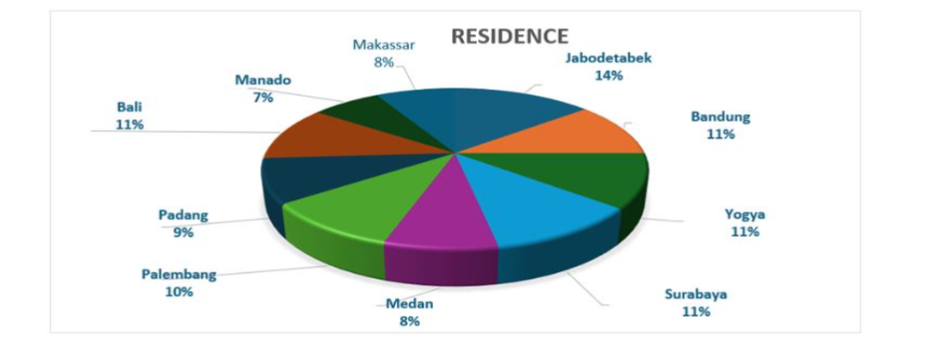
Based on the distribution of respondents shown in Figure 1 above, it can be seen that the largest number of respondents are in Jabodetabek, located on the island of Java, while the smallest number are in Manado City on the island of Sulawesi.
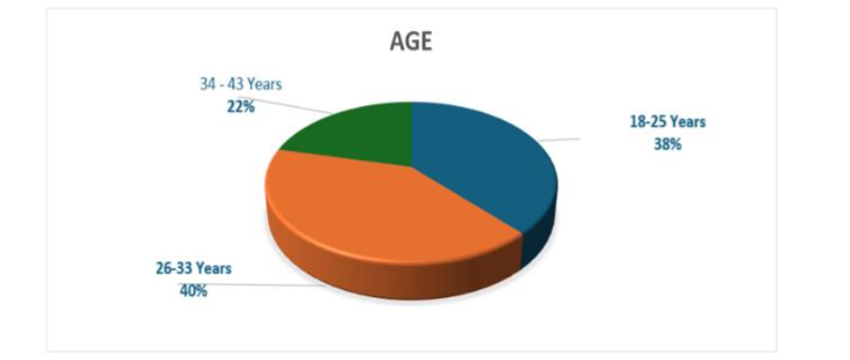
Most respondents fall within the age range of 26-33 years, totaling 40%, and the smallest number falls within the age range of 34-43 years, as shown in Figure 2.
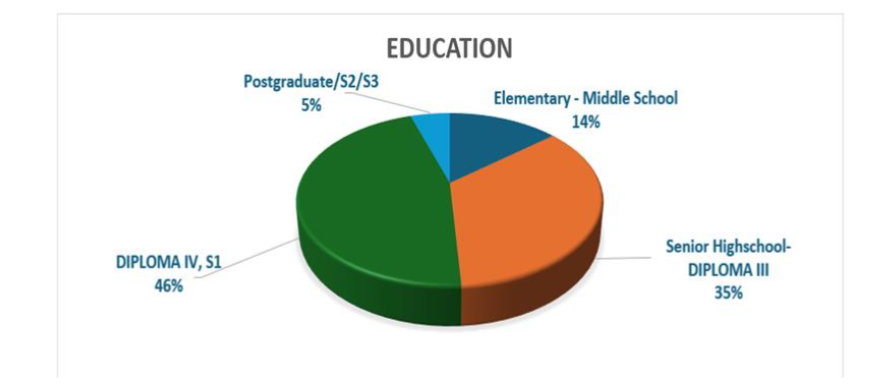
Based on the picture, it appears that the majority of respondents have a highest level of education at the middle level, with Diploma IV to S1 (Bachelor’s degree) holders making up 46% of the respondents. The least represented group is those who have completed their postgraduate education, including S2 (Master’s degree) and S3 (Doctoral degree) holders, who make up only 5% of the respondents.
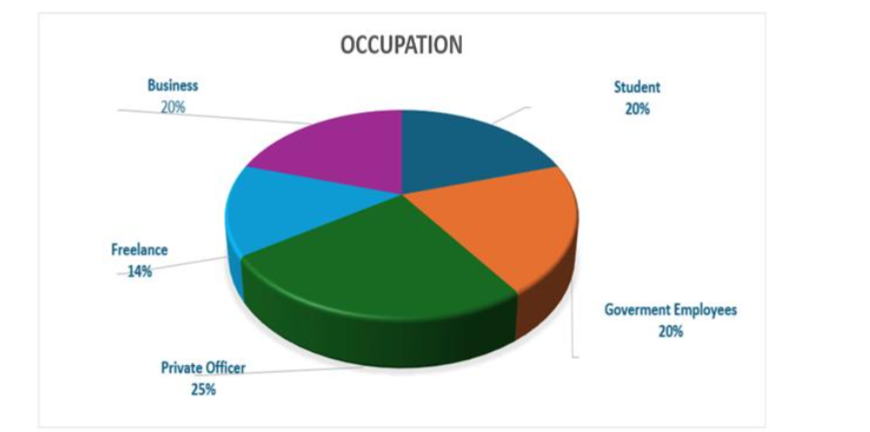
The majority of respondents have a job as a private employee (25%), while the least is a freelancer or freelance worker (14%), as shown in Figure 4 above.
| CHOICE OF ANSWER | 1 = Very agree | 2 = Disagree | 3 = Agree | 4 = Very disagree |
|---|---|---|---|---|
| I am giving donations freely to those who are experiencing both moral and material difficulties due to the impact of the COVID-19 pandemic, which has been ongoing until now. | ||||
| I am giving donations freely and attention to those who have been infected with COVID-19 during the pandemic until now. | ||||
| I am giving donations freely and attention to those who have passed away due to COVID-19 during the pandemic until now. |
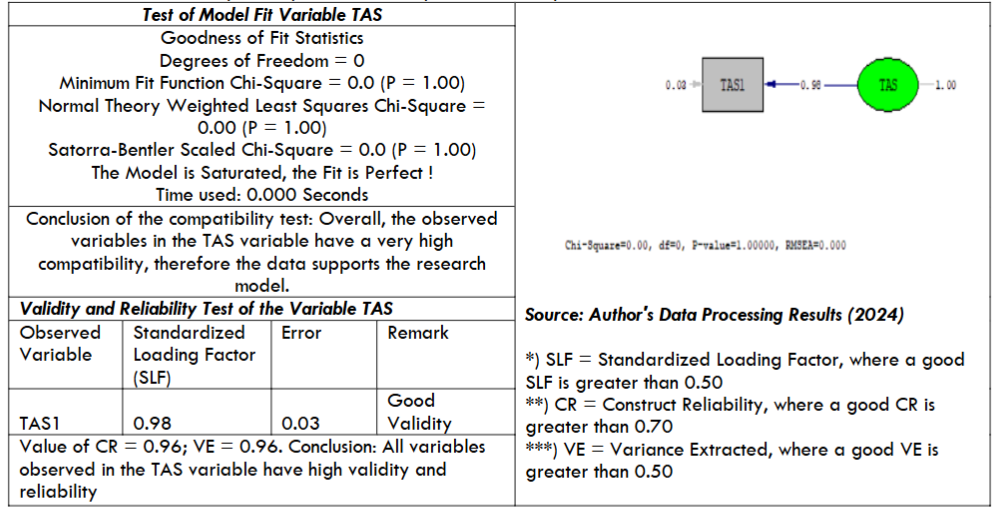
Based on the compatibility test, overall, the observed variables in the TAS variable have a very high compatibility, therefore the data supports the research model.
Validity and Reliability Test of the Variable TAS:
| Observed Variable | Standardized Loading Factor (SLF) | Error | Remark |
|---|---|---|---|
| TAS1 | 0.98 | 0.03 | Good Validity |
The result of the model testing for the first-order latent variable TAS1, which is a single indicator, is the only valid and observed variable that represents the respondents’ perception in 10 major cities in Indonesia. The variable has a Standardized Loading Factor (SLF) value greater than 0.50. In contrast, other observed variables are not valid, as they have SLF values less than 0.50. The reliability of this variable is very good, with a Cronbach’s Alpha (CR) value greater than 0.70, which is 0.96, and a Variance Extracted (VE) value greater than 0.50, which is also 0.96. This indicates that respondents are willing to contribute to others who have experienced moral or material misfortune due to the COVID-19 pandemic, which has been ongoing since the pandemic hit (TAS 1).
| CHOICE OF ANSWER | 1 = Very agree | 2 = Disagree | 3 = Agree | 4 = Very disagree |
|---|---|---|---|---|
| I believe that COVID-19 vaccination is essential for maintaining physical health (EFEK 1) | ||||
| I believe that the COVID-19 vaccine does not contain harmful substances that can harm health (EFEK 2) | ||||
| I believe that the COVID-19 vaccine does not have negative effects after being administered to the community (EFEK 3) | ||||
| I believe that booster/vaccination boosters are crucial for increasing immunity in the future (EFEK 4) | ||||
| I will recommend my family, friends, and colleagues to get vaccinated against COVID-19, including booster shots, to live a healthier life (EFEK5) | ||||
| I think that the COVID-19 vaccination program implemented by the government so far has prevented an increase in COVID-19 infection cases (EFEK6) | ||||
| I think that the COVID-19 vaccination program implemented by the government so far has reduced the number of deaths caused by the COVID-19 pandemic (EFEK7) |
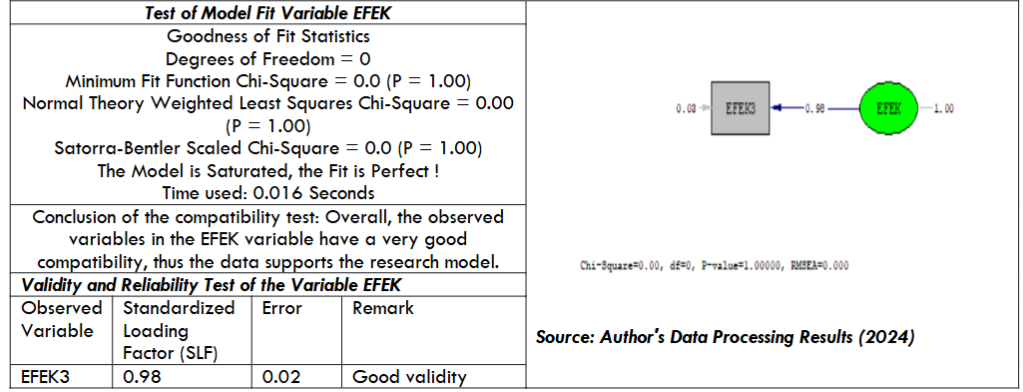
Based on the compatibility test, overall, the observed variables in the EFEK variable have a very good compatibility, thus the data supports the research model.
Validity and Reliability Test of the Variable EFEK:
| Observed Variable | Standardized Loading Factor (SLF) | Error | Remark |
|---|---|---|---|
| EFEK3 | 0.98 | 0.02 | Good validity |
The first-order latent variable model measurement of EFEK3, which is a single indicator, is the only observed variable that is valid and represents the respondents’ perception in 10 major cities in Indonesia. The Standardized Loading Factor (SLF) value is > 0.50. Other observed variables are not valid, as they have an SLF value < 0.50. The reliability of this model is very good, with a value of CR > 0.70, which is 0.97, and VE > 0.50, which is also 0.97. This indicates that respondents’ trust in the Covid-19 vaccine does not have a negative impact on the community after it is administered (EFEK3).
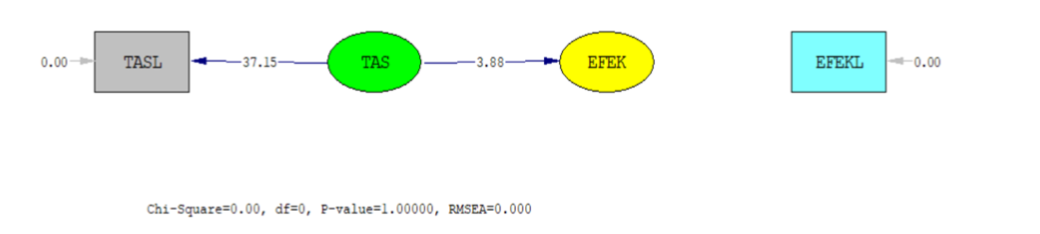
The relationship between two variables, Trust and Solidarity, and Public Perception of the Effectiveness of Covid-19 Vaccine can be seen in Figure 5 below. The value of t obtained from the structural model test is 3.88 (greater than 1.96), which means that it is proven that there is a positive relationship between Trust and Solidarity with Public Perception of the Effectiveness of COVID-19 Vaccines. The community will believe in the effectiveness and safety of the COVID-19 vaccine if they see people around them getting vaccinated and not experiencing any negative effects on their health. This also gives them confidence that the vaccine is not harmful to the body, which is consistent with the findings. The widespread confidence in the effectiveness of the COVID-19 vaccine makes it easier for the government and local health authorities to implement their programs. However, there are still some individuals who do not trust the effectiveness and safety of the COVID-19 vaccine in their body, so they refuse to get vaccinated at all, which means they do not have a vaccination certificate and it is difficult for them to engage in outdoor activities.
Discussion
The COVID-19 pandemic, which has spread across the globe, has not only affected the health aspect, but also the economy, social, and other aspects. During the pandemic, we are not allowed to freely engage in outdoor activities, and many offices, factories, and businesses have had to shut down, resulting in a large wave of layoffs worldwide. In these difficult circumstances, survey respondents stated that they helped each other during the pandemic, especially for those experiencing economic difficulties, not only by providing moral support, motivational encouragement, and optimistic spirit, but also by providing material assistance. This material assistance is not just limited to cash aid but also provides job opportunities for those who run online businesses on social media during the pandemic. Even some textile companies have been flooded with orders for face masks. The sense of mutual trust and solidarity makes people optimistic about surviving the COVID-19 pandemic because they feel supported and are not alone in facing adversity.
Trust and Solidarity (TAS) in Indonesian society is an essential aspect of daily life, particularly during the COVID-19 pandemic. Community members help each other, provide first aid information, especially for those with comorbidities and underlying health conditions. During the COVID-19 pandemic, community members share information about the importance of vaccines and getting booster shots to break the chain of virus transmission. This situation is consistent with the findings. Many negative information about vaccines affecting human bodily organs has been circulating on social media, causing some people to refuse vaccination. If this situation persists, it will make it difficult to track the spread of COVID-19 in various regions. When trust and solidarity grow in the community, they motivate each other, whether it’s family, relatives, or neighbors around them, to receive the COVID-19 vaccine as a mandatory program, free of charge from the government and local health authorities. With a conducive situation, there is a positive perception among community members about the effectiveness of the COVID-19 vaccine.
Conclusion
The conclusion of this research is that: (1) the response to COVID-19 control in each region becomes a significant factor that affects people’s perception of the effectiveness of COVID-19 vaccines; (2) testimonies from COVID-19 survivors who have been well-treated by local health facilities also influence people’s perception and trust in the effectiveness of COVID-19 vaccines; and (3) social capital, specifically Trust and Solidarity, which are intangible assets, play a significant role in the positive dissemination of COVID-19 vaccines in Indonesia.
References
- Ahiakpa, J. K., Cosmas, N. T., Anyiam, F. E., Enalume, K. O., Lawan, I., Gabriel, I. B., Oforka, C. L., Dahir, H. G., Fausat, S. T., Nwobodo, M. A., Massawe, G. P., Obagha, A. S., Okeh, D. U., Karikari, B., Aderonke, S. T., Awoyemi, O. M., Aneyo, I. A., & Doherty, F. V. (2022). COVID-19 vaccines uptake: Public knowledge, awareness, perception and acceptance among adult Africans. PLoS ONE, 17(6 June). https://doi.org/10.1371/journal.pone.0268230
- Anderson, A., Lewis, D. F., Shafer, P., Anderson, J., & LaVeist, T. A. (2023). Public trust is earned: Historical discrimination, carceral violence, and the COVID-19 pandemic. Health Services Research, 58(S2), 218–228. https://doi.org/10.1111/1475-6773.14187
- Casey, B. H. (2023). Covid-19: did higher trust societies fare better? Discover Social Science and Health, 3(1). https://doi.org/10.1007/s44155-023-00035-3
- Chitphuk, S., Stitchantrakul, W., Ongphiphadhanakul, B., Kueanjinda, P., & Lerksuthirat, T. (2022). Public Perceptions On Twitter About Covid-19 Vaccines In Thailand (Vol. 53, Issue 4). https://pypi.org/project/twint/
- Corsten, C., Vang, Z. M., Gold, I., Goldenberg, M. J., Juarez, F. P. G., Weinstock, D., Smith, M. J., Krajden, O., & Solomonova, E. (2023). Understanding COVID-19 vaccine hesitancy in Canada. Vaccine, 41(48), 7274–7280. https://doi.org/10.1016/j.vaccine.2023.10.058
- Dhankher, R., Mukhopadhyay, A., Bhowmick, S., Thimmappa, L., Singh, R., Joshi, P., & Rani, J. (2023). Perception regarding COVID-19 vaccine and COVID appropriate behavior among adolescents at a tertiary hospital, West Bengal: A longitudinal survey. Clinical Epidemiology and Global Health, 21. https://doi.org/10.1016/j.cegh.2023.101277
- Douedari, Y., Alhaffar, M., Khanshor, A., Alhiraki, O. A., Marzouk, M., & Howard, N. (2023). “COVID-19 is just another way to die…”: a qualitative longitudinal study of frontline COVID-19 response governance across Syria. BMJ Global Health, 8(12). https://doi.org/10.1136/bmjgh-2023-013199
- Do, S. G. (2009). Impacts of Social Capital on Entrepreneurship, Innovation, and Economic Development in the Knowledge Economy. Ulsan.
- Gidado, S., Musa, M., Ba’aba, A. I., Francis, M. R., Okeke, L. A., Bukar, F. L., Nguku, P. M., Hadejia, I. S., Hassan, I. A., Bande, I. M., Onuoha, M., Usman, R., Ugbenyo, G., Godwin, N., Ilori, E., Abulfathi, A. A., Mshelia, L. A., Mohammed, A. M., Abdullahi, M. M., … Atkins, S. (2024). Knowledge, risk perception and uptake of COVID-19 vaccination among internally displaced persons in complex humanitarian emergency setting, Northeast Nigeria. BMC Public Health, 24(1). https://doi.org/10.1186/s12889-024-18164-y
- Hakim, M. S., Mansoor, G. F., Walizada, A. W., Saeed, K. M. I., Naeemi, S., & Fazil, F. A. (2023). General publics’ perception toward COVID-19 vaccines in Afghanistan, 2021. Human Vaccines and Immunotherapeutics, 19(2). https://doi.org/10.1080/21645515.2023.2228164
- Imtiaz Khan, N., Mahmud, T., & Nazrul Islam, M. (2022). COVID-19 and black fungus: Analysis of the public perceptions through machine learning. Engineering Reports, 4(4). https://doi.org/10.1002/eng2.12475
- Jung, S. O., & Son, Y. H. (2023). Public Perception Before and After COVID-19 Vaccine Pass for the Unvaccinated to Eat Alone: Social Media Data Analytics. Inquiry (United States), 60. https://doi.org/10.1177/00469580231169407
- Kiptoo, J., Isiiko, J., Yadesa, T. M., Rhodah, T., Alele, P. E., & Mulogo, E. M. (2024). COVID-19 vaccine hesitancy: assessing the prevalence, predictors, and effectiveness of a community pharmacy based counseling intervention. BMC Public Health, 24(1), 663. https://doi.org/10.1186/s12913-024-11137-2
- Kosic, A., Kana Kenfack, C. S., & Dionisi, E. (2024). The relationship between populism and attitudes on vaccine against COVID-19: Trust in institutions as a moderation factor. Analyses of Social Issues and Public Policy, 24(1), 150–169. https://doi.org/10.1111/asap.12378
- Kyakuwa, N., Abaasa, A., Mpooya, S., Kalutte, H., Atuhairwe, C., Perez, L., & Kikaire, B. (2024). Non-uptake of COVID-19 vaccines and reasons for non-uptake among healthcare workers in Uganda: a cross-sectional study. BMC Health Services Research, 24(1), 663. https://doi.org/10.1186/s12913-024-11137-2
- Li, S., Hao, J., Su, Y., Zhan, H., Zhou, N., Qiu, Y., Lu, Y., Sun, K., & Tian, Y. (2024). COVID-19 vaccine hesitancy and influencing factors among Chinese hospital staff: a cross-sectional study. Scientific Reports, 14(1). https://doi.org/10.1038/s41598-024-55001-z
- Liu, Q., & Pan, H. (2020). Investigation on Life Satisfaction of Rural-to-Urban Migrant Workers in China: A Moderated Mediation Model. Environmental Research and Public Health, 17(2454), 1–14.
- Luo, C., Chen, A., Cui, B., & Liao, W. (2021). Exploring public perceptions of the COVID-19 vaccine online from a cultural perspective: Semantic network analysis of two social media platforms in the United States and China. Telematics and Informatics, 65. https://doi.org/10.1016/j.tele.2021.101712
- Makwana, M. N., Shekhda, H. J., & Rupani, M. P. (2024). Acceptance and expectations of healthcare workers and community during the COVID-19 vaccine rollout in Bhavnagar city, western India: a qualitative exploration. BMC Health Services Research, 24(1). https://doi.org/10.1186/s12913-024-10885-5
- Manu, E., Douglas, M., Kushitor, M. K., Komesuor, J., Ampomah, M. A., & Opoku, N. O. (2024). Lay beliefs of COVID-19 vaccine refusal among intercity commercial drivers in the Volta region of Ghana: recommendations for improved vaccine uptake. Tropical Diseases, Travel Medicine and Vaccines, 10(1). https://doi.org/10.1186/s40794-023-00214-9
- Mir, A. A., Rathinam, S., & Gul, S. (2022). Public perception of COVID-19 vaccines from the digital footprints left on Twitter: analyzing positive, neutral and negative sentiments of Twitterati. Library Hi Tech, 40(2), 340–356. https://doi.org/10.1108/LHT-08-2021-0261
- Mitchell, A., Larson, K. L., Pfeiffer, D., & Rosales Chavez, J.-B. (2024). Planning for Urban Sustainability through Residents’ Wellbeing: The Effects of Nature Interactions, Social Capital, and Socio-Demographic Factors. Sustainability, 16(10), 4160. https://doi.org/10.3390/su16104160
- Moges, T. K., & Mitiku, A. G. (2023). Impact of COVID-19 pandemic on the people’s choice of urban public transportation modes and mobility in Addis Ababa and Hawassa city, Ethiopia. Urban, Planning and Transport Research, 11(1). https://doi.org/10.1080/21650020.2023.2193233
- Mohamed, N. A., Solehan, H. M., Rani, M. D. M., Ithnin, M., & Arujanan, M. (2023). Understanding COVID-19 vaccine hesitancy in Malaysia: Public perception, knowledge, and acceptance. PLoS ONE, 18(4 April). https://doi.org/10.1371/journal.pone.0284973
- Mpanje, D., Gibbons, P., & McDermott, R. (2018). Social Capital in Vulnerable Urban Settings: An Analytical Framework. Journal of International Humanitarian Action, 3(4), 1–14.
- Narayan, D and Michael Woolcock. 2016. Measuring Social Capital: An Integrated Questionnaire. Washington DC: World Bank Working Paper No. 18.
- Nawaz Ali, G. G. M., Rahman, M. M., Hossain, M. A., Rahman, M. S., Paul, K. C., Thill, J. C., & Samuel, J. (2021). Public perceptions of covid-19 vaccines: Policy implications from us spatiotemporal sentiment analytics. Healthcare (Switzerland), 9(9). https://doi.org/10.3390/healthcare9091110
- Nurbaiti and Chotib. (2020). The Impact of Social Capital On Welfare: The Evidence From Urban Informal Sector In East Flood Canal (BKT), Jakarta. IOP Conference Series: Earth and Environmental Science, 436012004.
- Purnawati, I. G. A., & Sudibia, I. K. (2019). Social Capital-Based Women Empowerment to Improve Business Performance. South East Asia Journal of Contemporary Business, Economics and Law, 18(5), 166–173.
- Qian, X, Y.Caia & C. Yin. 2019. Driving Force Grassoorts Self-Governance in Beijing’s Neighborhoods Social Capital, Community Network and Community Service Motivation. Journal of Local Self Government 17(1):159-177.
- Roy, D. N., Azam, M. S., & Islam, E. (2023). Multi-dimensional potential factors influencing COVID-19 vaccine booster acceptance and hesitancy among university academic community in Bangladesh: A cross-sectional comparative study. PLoS ONE, 18(4 April). https://doi.org/10.1371/journal.pone.0281395
- Saleh, S. N., McDonald, S. A., Basit, M. A., Kumar, S., Arasaratnam, R. J., Perl, T. M., Lehmann, C. U., & Medford, R. J. (2023). Public perception of COVID-19 vaccines through analysis of Twitter content and users. Vaccine, 41(33), 4844–4853. https://doi.org/10.1016/j.vaccine.2023.06.058
- Snyder, J., & Zenone, M. (2023). Vaccine related crowdfunding on a ‘Freedom Fundraising’ platform. PLoS ONE, 18(7 July). https://doi.org/10.1371/journal.pone.0288539
- Walliar, T., Khan, B., Newstead, S., Al-Assadi, G., Salter, S. M., Seubert, L., Carlson, S. J., & Attwell, K. (2023). “Fighting the pandemic!” Western Australian pharmacists’ perspectives on COVID-19 vaccines: A qualitative study. Vaccine, 41(48), 7234–7243. https://doi.org/10.1016/j.vaccine.2023.10.045
- Yibeltal, K., Workneh, F., Melesse, H., Wolde, H., Kidane, W. T., Berhane, Y., & van Wees, S. H. (2024). “God protects us from death through faith and science”: a qualitative study on the role of faith leaders in combating the COVID-19 pandemic and in building COVID-19 vaccine trust in Addis Ababa, Ethiopia. BMJ Open, 14(4). https://doi.org/10.1136/bmjopen-2023-071566
- Zhao, W., Russell, C. M., Jankovsky, A., Cannon, T. D., Pittenger, C., & Pushkarskaya, H. (2024). Information processing style and institutional trust as factors of COVID vaccine hesitancy. Scientific Reports, 14(1). https://doi.org/10.1038/s41598-024-60788-y
- Zoller, T. D. (2010). The Dealmaker Milieu: The Anatomy of Social Capital in Entrepreneurial Economies. ProQuest LLC, 1–15.