


Managing Patient Anxiety in Esthetic Dentistry
Beyond Osseointegration: Managing Patient Anxiety by Preserving the “Smile Identity” via a Digital Workflow – A Case Report Discussion
Ahmad Soolari, DMD, MS1* and Amin Soolari, DDS2
- Adjunct Professor, West Virginia University, Department of Periodontics, School of Dentistry, Morgantown, WV, USA
*Email: [email protected] - Periodontics Department, University of Florida, Gainesville, FL, USA
Email: [email protected]
OPEN ACCESS
PUBLISHED 31 May 2026
CITATION Soolari, A., and Soolari, A, 2026. Beyond Osseointegration: Managing Patient Anxiety by Preserving the “Smile Identity” via a Digital Workflow – A Case Report Discussion. Medical Research Archives, [online] 14(5). https://doi.org/10.18103/mra.v14i5.7472
COPYRIGHT © 2026 European Society of Medicine. This is an open-access article distributed under the terms of the Creative Commons Attribution License, which permits unrestricted use, distribution, and reproduction in any medium, provided the original author and source are credited.
DOI https://doi.org/10.18103/mra.v14i5.7472
ISSN 2375-1924
ABSTRACT
Extraction in the maxillary anterior region, the “esthetic zone” is a significant emotional event that often triggers an “identity crisis” for the patient. Success in this region is defined not only by osseointegration but by the seamless replication of natural anatomy that a patient has been attached to for their entire life. This paper discusses the management of a 58-year-old female with a fractured maxillary central incisor. It explores a multidisciplinary approach combining atraumatic extraction, immediate implant placement, and a “Digital” workflow. By utilizing pre-extraction intraoral scanning and provisionalization, clinicians can mitigate patient anxiety and achieve “invisible” restorations that meet high esthetic, functional, and psychological demands.
Keywords: Esthetic zone, Patient psychology, digital smile design, Immediate implant placement, Dental anxiety, soft tissue preservation.
CASE REPORT
Beyond Osseointegration: Managing Patient Anxiety by Preserving the “Smile Identity” via a Digital Workflow – A Case Report Discussion
Introduction
The esthetic zone, primarily involving the maxillary anterior teeth, is the focal point of facial harmony and human communication. While clinical success is often measured by “white and pink” esthetics, the transition from a natural tooth to a prosthesis involves a deep layer of patient psychology. For many, the upper front teeth are integral to their self-identity. Patients are often emotionally attached to the unique nuances of their smile—the specific shape and position they have seen in the mirror for decades.
Recent literature suggests that the loss of an anterior tooth is more than a functional deficit; it is a social disability. Studies using the Oral Health Impact Profile (OHIP-14) indicate that anterior tooth loss causes significantly higher psychological discomfort compared to posterior loss. The prospect of extraction triggers acute anxiety, as patients fear a permanent change in their appearance and “sense of self”.
For the clinician, the challenge is twofold: managing this patient anxiety while battling the biological “countdown” that begins at extraction. The loss of a tooth inevitably leads to alveolar bone resorption—particularly of the thin buccal plate, and subsequent soft tissue collapse. To achieve a predictable outcome, the clinician must shift from “replacing” a tooth to “duplicating” nature. This discussion explores the strategies required to bridge the gap between surgical necessity and patient identity, utilizing a case report to highlight a modern digital workflow.
Modern clinical frameworks now emphasize a digital workflow that integrates CBCT data with intraoral scans to create a “virtual patient” for prosthetically driven implant positioning. This study explores how a digital workflow can bridge the gap between surgical necessity and the patient’s psychological need to “duplicate” nature.
CASE PRESENTATION
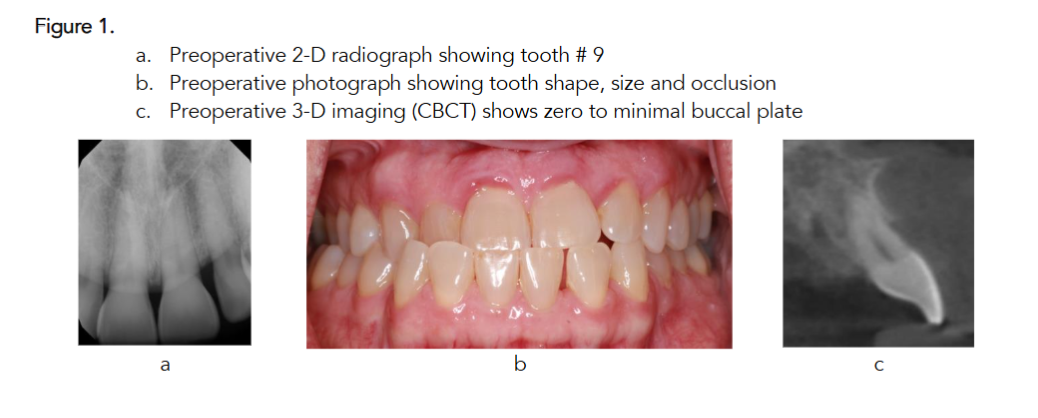
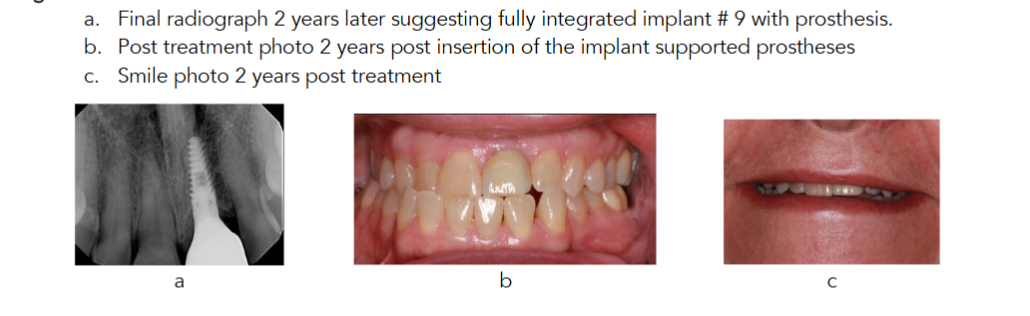
A 58-year-old female patient presented with a fractured maxillary left central incisor (tooth #9) following trauma. Clinical and radiographic examination revealed the tooth was non-restorable due to a deep subgingival fracture, though it possessed adequate apical bone support and healthy adjacent teeth.
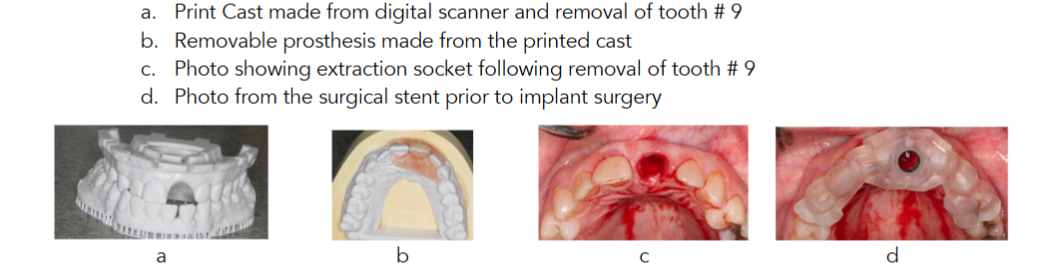
The patient expressed significant concern about the esthetic outcome, emphasizing that she did not want to “give up” the look of her natural tooth. She feared an artificial appearance and was anxious about the interim period between extraction and final restoration. To address these concerns, the treatment plan included a digital workflow: pre-extraction scanning, atraumatic extraction, immediate implant placement, and immediate provisionalization to maintain the “identity” of her smile.
1. Preservation of Soft Tissue Architecture
The gingival architecture in the esthetic zone is critical for a natural appearance. Tooth extraction typically leads to soft tissue collapse, resulting in papillary loss and an uneven gingival margin. In this case, careful handling of the soft tissues was essential. We employed minimally invasive extraction techniques using periotomes to detach the periodontal ligament without traumatizing the thin buccal bone. By avoiding a traditional flap (flapless surgery), we preserved the blood supply to the overlying gingiva, which is the primary defense against recession.
2. Managing Alveolar Bone Resorption
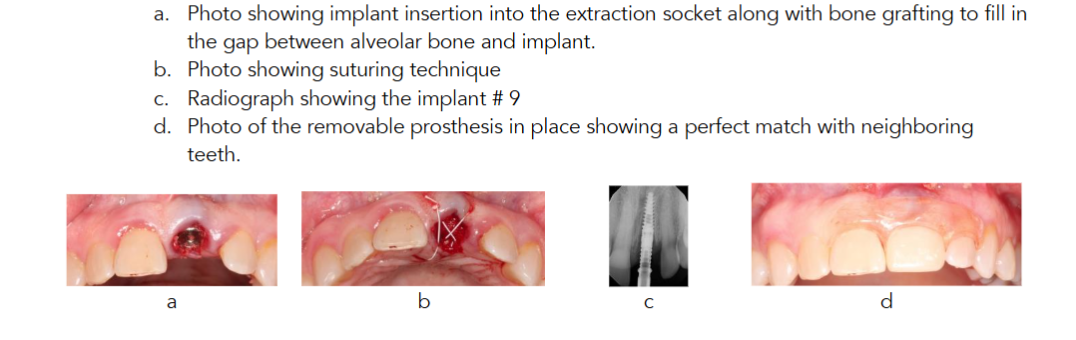
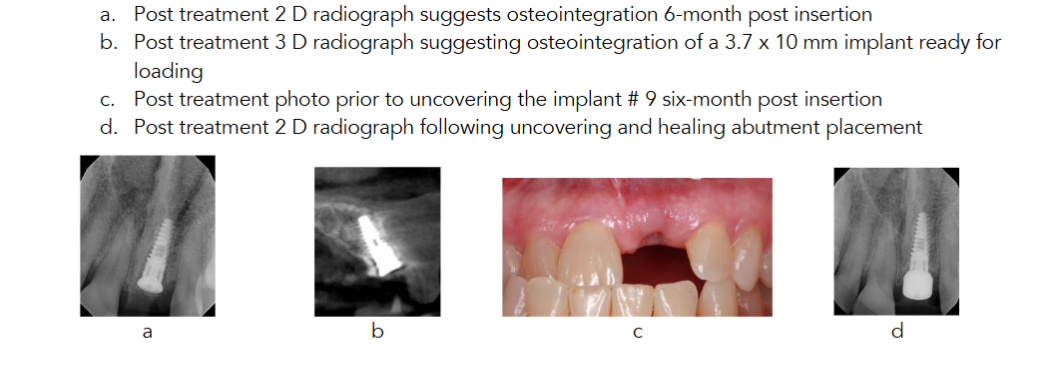
Following extraction, resorption of the buccal plate is inevitable, often occurring within the first six months. This can compromise implant stability and the final “emergence profile.” In this case, immediate implant placement was chosen to maintain the alveolar ridge dimensions. To further protect the ridge, “dual-zone” grafting was performed, placing bone graft material in the gap between the implant surface and the internal buccal plate to act as a scaffold for new bone formation.
3. The Digital Workflow
To meet the patient’s demand for duplication, a fully digital workflow was initiated:
- Pre-Extraction Intraoral Scan: A 3D digital impression was captured before extraction, recording the exact micro-morphology and incisal edges of tooth #9.
- 3D Printing/Milling: An immediate provisional crown was fabricated that was a 1:1 replica of the patient’s natural tooth.
This workflow ensures that the patient never experiences a change in their visual identity. The provisional crown acts as a “biological scaffold,” supporting the gingival scallop in the exact shape the tissue was accustomed to.
4. Immediate Provisionalization and Function
Immediate provisionalization is the key to managing patient anxiety. In this case, the custom-made provisional was placed immediately after the implant. Beyond the psychological relief of not having a “gap,” the restoration allowed for the evaluation of phonetics and occlusion. The provisional was adjusted to be out of active occlusion to prevent excessive forces on the healing implant while ensuring the patient could speak and smile naturally.
Discussion
Successful management of the esthetic zone requires a multidisciplinary approach that integrates surgery, prosthodontics, and psychology.
Psychological Integration: Modern dentistry must acknowledge that “technical success” does not always equal “patient satisfaction.” The use of Digital Smile Design (DSD) serves as a communication tool that aligns the patient’s expectations with achievable results. When a patient sees their own natural anatomy being preserved through digital tools, their perioperative anxiety is significantly reduced.
Surgical Precision: Atraumatic techniques and the use of piezoelectric surgery help preserve the surrounding hard tissues, which are essential for maintaining esthetic contours. Immediate placement has been shown to reduce bone resorption, but it requires careful case selection and high primary stability. Recent studies demonstrate that immediate implant placement improves oral health-related quality of life compared to delayed protocols.
Digital Precision: The shift toward digital workflows—including cone-beam computed tomography (CBCT) and guided surgery—enhances the predictability of implant positioning. Soft tissue augmentation, such as connective tissue grafts, remains a valuable adjunct for improving gingival thickness and long-term esthetic stability.
Conclusion
Extraction in the esthetic zone is a complex procedure that transcends mechanical tooth replacement. The “challenge” lies in duplicating the patient’s natural anatomy to protect their self-identity. As demonstrated in this case, the combination of atraumatic surgical techniques and a digital workflow allows clinicians to meet high expectations. By addressing the psychological impact of tooth loss and employing restorative-driven digital planning, we can achieve outcomes that are biologically sound and emotionally satisfying for the patient. Integrating surgical precision with digital restorative planning meets the high esthetic and psychological demands of patients by protecting their self-identity.
Conflict of Interest Statement: None.
Funding Statement: None.
Acknowledgements: None.
FIGURES:
References:
- Campos LA Etal. Use of Oral Health Impact Profile-14 (OHIP-14) in Different Contexts. What Is Being Measured? Int J Environ Res Public Health, 2021 Dec 20;18(24):13412
- Zhang, Zewei, Et al. Patterns and predictors of tooth extraction-related anxiety at sequential perioperative stages. BMC Oral Health.2025 Aug 31;25(1):1387
- Su N, Etal. Psychosocial oral health-related quality of life impact: A systematic review. J Oral Rehabil 2021 Mar;48(3):282-292
- Zhang, Zewei Etal. Patterns and predictors of tooth extraction-related anxiety at sequential perioperative stages. BMC Oral Health. 2025 Aug 31;25(1):1387
- Gamal N and Et al. Post-extraction volumetric analysis of alveolar ridge contour using subepithelial connective tissue graft in esthetic zone: a randomized controlled clinical trial. Clin Oral Investig. 2023 Nov;27(11):6503-6512.
- Brenes C Etal. Evaluation of Prosthetic Outcomes and Patient Satisfaction With 3D-Printed Implant-Supported Fixed Prosthesis. Cureus. 2023 Jul 27;15(7):e42537
- Buser, D., et al. Long-term stability of contour augmentation with early implant placement following single tooth extraction in the esthetic zone. Journal of Periodontology, 2017, 88(1), 43-51.
- Chen, S. T., et al. Immediate or early placement of implants following tooth extraction: review of biologic basis and clinical procedures. Int J Oral Maxillofac Implants, (2004),22(Suppl), 12-25.
- Weigl P, Et al. Esthetically driven immediate provisionalization in the anterior zone: 5-year results from a prospective study evaluating 3.0-mm-diameter tapered implants. Clinical Oral Investig. 2024 Jul 31;28(8):460.
- Belser, U. C., et al. Outcome evaluation of early placed maxillary anterior single-tooth implants using objective esthetic criteria. Journal of Periodontology 2009 Jan;80(1):140-51.
- Garcia P P, Etal. Digital smile design and mock-up technique for esthetic treatment planning with porcelain laminate veneers. J conserve Dent. 2018 Jul-Aug; 21(4);455-458
- Yang, Yi Etal. Impact of Immediate vs Delayed Dental Implants on Survival, Patient Satisfaction, and Quality of Life. Oral Health Prev Dent. 2026 Feb 10:24:77-88.
- Zucchelli, G., et al. 5-year outcomes after coverage of soft tissue dehiscence around single implants: A prospective cohort study. Eur J Oral Implantol. 2018;11(2):215-224.