






AI-Driven Design Thinking in Pre-Medical Education
“`html
AI-Driven Design Thinking: Transforming Learning Efficiency in Pre-Medical Education
Pongkiat Ekvitthayankul, P. and Parathon Ekvitthayankul, P.
ORCID: 0000-0001-6100-5726, The European Society of Medicine
PUBLISHED 30 April 2025
OPEN ACCESS
ABSTRACT
The integration of Artificial Intelligence (AI) in pre-medical education has the potential to enhance learning efficiency, problem-solving skills, and interdisciplinary knowledge integration. However, limited research has investigated AI-driven Design Thinking approaches in this domain. This study aims to evaluate the effectiveness of AI-powered learning tools in improving pre-medical students’ problem-solving and critical-thinking skills. In particular, AI integration in pre-medical education has the potential to enhance knowledge retention, conceptual understanding, and interdisciplinary learning, preparing students for the complex challenges of medical training and practice.
Keywords
- Artificial Intelligence
- Design Thinking
- Learning Efficiency
- Pre-Medical Education
- Problem-Solving Skills
1. Introduction
1.1 BACKGROUND AND SIGNIFICANCE
Artificial Intelligence (AI) is rapidly transforming the educational landscape by enabling personalized learning, adaptive assessments, and data-driven decision-making. AI-powered tools offer students real-time feedback, customized learning paths, and interactive simulations, improving their problem-solving and critical-thinking skills. In particular, AI integration in pre-medical education has the potential to enhance knowledge retention, conceptual understanding, and interdisciplinary learning, preparing students for the complex challenges of medical training and practice.
1.2 DESIGN THINKING (DT)
A structured, human-centered problem-solving approach that emphasizes understanding challenges, generating solutions, prototyping, and iterative learning. In education, DT fosters creative problem-solving, analytical reasoning, and innovation.
1.3 AI-Driven Learning Tools
ChatGPT, OpenAI, and DeepSeek AI-powered platforms that provide automated tutoring, adaptive assessments, and personalized learning experiences.
2. Methodology
2.1 EXPERIMENTAL DESIGN
The research follows a four-phase experimental design over four weeks:
- Pre-Test (Week 1)
- Students take baseline assessments in Mathematics, Physics, Chemistry, and Biology.
- The study includes problem-solving tasks, conceptual questions, and analytical reasoning problems.
- No assistance is provided during this phase.
2.2 EXPERIMENTAL PROCEDURE
Each student experienced AI-assisted learning environments:
- AI-assisted learning engagement
- Perceived learning effectiveness
- Problem-solving skills
Students are compared with pre-test results to measure learning efficiency improvements.
2.3 DATA COLLECTION METHODS
Data collection methods included:
- Student Surveys & AI Usage Analysis
- Correlation analysis measured interdisciplinary performance relationships between subjects.
2.4 DATA ANALYSIS APPROACH
To determine the effectiveness of AI-driven Design Thinking, statistical methods will be used:
| Analysis Type | Purpose |
|---|---|
| Descriptive Statistics | Mean, standard deviation, and distribution of pre-test & post-test scores |
| Paired t-tests | Compare pre-test and post-test scores to assess learning efficiency improvements. |
| ANOVA (Analysis of Variance) | Analyze differences in AI impact across disciplines. |
| Chi-Square Tests | Measure correlations between AI tool usage and student performance. |
3. Results and Discussion
3.1 KEY OBSERVATIONS FROM PRE-TEST RESULTS
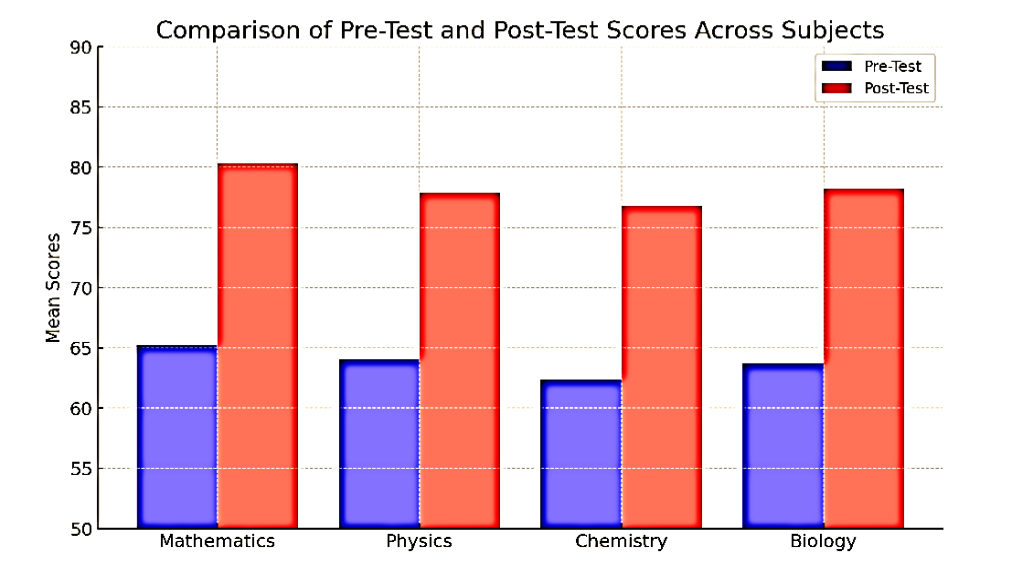
Statistically significant improvement in all subjects (p < 0.001) indicated that AI-assisted learning significantly improved performance across all disciplines.
3.2 CORRELATION ANALYSIS OF SUBJECT PERFORMANCE
Correlation analysis showed strong positive relationships between pre-test and post-test phases, suggesting that AI-assisted learning had a uniform impact across disciplines.
| Subjects | Correlation (Pre vs. Post) |
|---|---|
| Mathematics vs. Physics | 0.76 |
| Mathematics vs. Chemistry | 0.76 |
| Mathematics vs. Biology | 0.79 |
3.3 SUBJECT-WISE PERFORMANCE IMPROVEMENT
AI tools were applied across Mathematics, Physics, Chemistry, and Biology, leading to varying levels of improvement. The statistical significance across subjects suggests that AI effectiveness differs based on the complexity and nature of each discipline.
3.4 SUMMARY OF FINDINGS
This study examined AI-driven learning interventions in Mathematics, Physics, Chemistry, and Biology to assess their impact on pre-medical students’ performance. The results confirm that AI-supported learning strategies significantly enhance problem-solving skills across multiple subjects.
4. Conclusion
This study examined AI-driven learning interventions in Mathematics, Physics, Chemistry, and Biology to assess their impact on pre-medical students’ performance. The results confirm that AI-supported learning strategies significantly enhance problem-solving skills across multiple subjects.
4.1 IMPLICATIONS FOR AI-BASED LEARNING IN PRE-MEDICAL EDUCATION
AI learning tools, particularly for conceptual subjects like Biology, can be utilized to create a more effective educational environment.
5. References
- Almoudi, A., & Awaz, Z. (2021). Project-based learning strategy for teaching molecular biology: A study of students’ perceptions. Education in Medicine Journal. Retrieved from link
- Althewi, A., & Albsod, O. (2022). Exploring medical students’ attitudes on computational thinking in a Saudi university: Insights from a factorial analysis study. Frontiers in Education. Retrieved from link
- Kawintra, T., Kraitikruet, R., Ekvitthayankul, P., Muangsirithaworn, K., & Ekvitthayankul, P. (2022). A comparative study of AI-driven and instructor-led education in pre-medical chemistry courses. Computers & Education, 177, 104365.
“`