


Carbon Footprint of Neurological Conferences: A Study
The Annual Carbon Footprint of In-Person Attendance at Major Neurological Conferences
Luciana Pelosi, MD 1 and Hannah Blumhardt LLB (Hons) 2
- Department of Medicine, Faculty of Medical and Health Science, Waipapa Taumata Rau, University of Auckland, Auckland, New Zealand
- Te Herenga Waka – Victoria University of Wellington, Wellington, New Zealand
OPEN ACCESS
PUBLISHED 31 July 2025
CITATION Pelosi, L., and Blumhardt, H., 2025. The Annual Carbon Footprint of In-Person Attendance at Major Neurological Conferences. Medical Research Archives, [online] 13(7). https://doi.org/10.18103/mra.v13i7.0000
COPYRIGHT: © 2025 European Society of Medicine. This is an open-access article distributed under the terms of the Creative Commons Attribution License, which permits unrestricted use, distribution, and reproduction in any medium, provided the original author and source are credited.
DOI https://doi.org/10.18103/mra.v13i7.0000
ISSN 2375-1924
ABSTRACT
Background: Anthropogenic climate change is the greatest threat to health of our century, including increased risk and severity of neurological diseases. Policies to contain the progression of climate change to within the adaptability of the human system demand urgent reduction in carbon emissions across all sectors. Neurologists should not be exempt. Global travel to conferences is the main source of academia’s carbon emissions. Lack of awareness of the extent of the problem and of the urgency of effective intervention may explain the lack of mitigating actions from the neurological community. We aimed to provide a conservative estimate of neurologists’ annual CO2 emissions from in-person attendance at some of their main global conferences.
Methods: The number of in-person attendees at some major international neurological conferences in 2022/2023 was assessed by a Google search. The CO2 emissions per capita (tCO2/person) was calculated by obtaining the average of the values published in four studies of non-neurological conferences. The total tCO2 emissions from all attendees at the neurological conferences was then compared to the annual tCO2/person in various countries world-wide.
Results: Thirteen conferences were identified with a total of 47,956 attendees. The total tCO2 emissions was then calculated at 93,994 (1.96 tonnes x 47,956 attendees). This equated to annual tCO2/person ranging from >2.0 million people in several African countries to 6.700 in Canada.
Conclusion: This simple analysis based on literature values to calculate carbon emissions by attendees, shows staggering figures that only represent a partial annual contribution from the neurological discipline. In the context of a climate crisis that requires urgent actions, neurologists should carefully consider their choices and implement actions to effectively reduce the carbon cost of their conferences.
Keywords: Neurologists, conferences, in-person attendance, carbon footprint, virtual
Introduction
We are living in a climate change crisis, which is having disastrous effects on people lives, especially in the most economically disadvantaged communities. Awareness of the extent of the problem and of the urgency of effective intervention to block its progression, is paramount to motivate action. “Public health is the principal argument for climate action”. Climate change is “fundamentally a health crisis” and is affecting the most vulnerable communities “here and now”. Without urgent effective action, this crisis will rapidly evolve to catastrophic effects that are beyond the adaptive capacity of the human system. All aspects of human health are affected; neurological diseases are no exception. Health practitioners thus have a special responsibility to act to mitigate emissions. The academic community in particular should lead by example and implement effective measures to reduce their own contribution to global greenhouse gas emissions.
Several studies over the past decades have shown that global travel to conferences and other scientific/learning gathering events is the main source of the academic community’s carbon emissions. Compared to other professions, academics produce much more emissions, due to their frequent air travel. “A scientist’s air travel for one intercontinental conference can result in two to five tCO2eq. This is well above the annual limit of 1.5–2.3 tCO2 per capita required to mitigate climate change and comply with the Paris Agreement to limit warming to the 1.5°C target by 2030.” Long-distance travel has become normalised within academic work-culture, where face-to-face interaction is considered necessary for professional development, education and knowledge sharing. For this reason, effective mitigating actions from our neurological community to reduce, significantly, our annual contribution to CO2 emissions have been scarce. The lack of effective action may also be at least partly due to an underestimation of the seriousness of the climate crisis or, underestimation of the weight of our own contribution. In fact, no studies have looked specifically at the neurological community’s contribution to CO2 emissions from conference attendance. Therefore, we aimed to provide the neurologists with a conservative estimate of their annual CO2 emissions from in-person attendance at some of their main conferences worldwide.
Methods
A Google search was conducted to assess the number of attendees at some major international neurological conferences that occurred worldwide over a 12 month period in 2022/2023. The one year time frame was chosen because the Paris agreement recommendations are for annual emissions. The search words were ‘American Academy of Neurology or American Neurological Association, European Academy of Neurology, World Federation of Neurology, Stroke, World Stroke conference, European Stroke Organization, Multiple Sclerosis, ECTRIMS, ACTRIMS, Consortium of Multiple Sclerosis Centre, Neuromuscular diseases, International Congress on Neuromuscular Diseases, World Muscle Society, AANEM, Alzheimer’s Association International Conference, Alzheimer Europe.’ Inclusion was restricted to conferences for which the number of in-person attendees was available.
A precise estimate of the carbon emissions for each attendee would have required details of the country of origin and travel arrangements of each attendee at each conference, which were not available. Because of that, we calculated the CO2 emissions per capita for each attendee, by obtaining the mean of the values published in four studies of non-neurological conferences (Table 1):
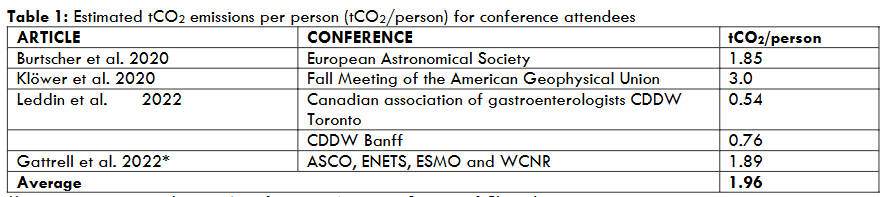
1. The study by Leddin et al. calculated the travel-related emissions of the Canadian attendees at two main annual meetings of the Canadian association of gastroenterologists, one in Toronto and one in Banff, with 534 and 502 Canadian attendees, respectively. Transport included long-haul and short-haul flights, train, car and coach.
2. In the study by Klower et al, calculations were based on the emissions of 28,000 attendees at the Fall meeting of the American Geophysical Union, held in San Francisco, the world’s largest Earth- and space-science conference. “Seventy-five per cent of the emissions were generated by intercontinental flights for one-way distances greater than 8,000 km…”
3. Burtsher et al. calculated the emissions of 1,240 attendees at the annual European Astronomical Society in Lyon who travelled by European or intercontinental flights, and train.
4. Gattrell et al. calculated the carbon emissions of 1,723 anticipated in-person attendees to four conferences: American Society of Clinical Oncology [ASCO], European Neuroendocrine Tumor Society [ENETS], European Society for Medical Oncology [ESMO], World Congress for NeuroRehabilitation [WCNR]). Calculations included travel, accommodation and congress attendance. “Travel accounted for 91–96% of total emissions, mainly through long distance and business-class air travel.”
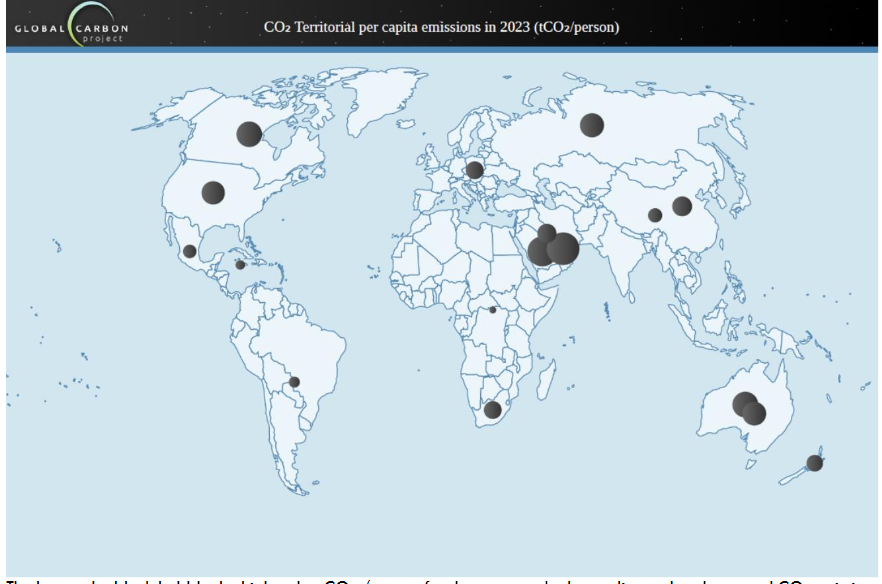
The total CO2 emissions from all attendees at the neurological conferences was then compared to the annual tCO2/person in various countries world-wide on the Global Carbon Atlas.
Results
Thirteen neurological international conferences were identified. These occurred in eight countries (five in the United States, six in Europe and two in Canada) across two continents (North America and Europe) (Table 2). The total number of in-person attendees was 47,956 (mean 3688.9; range 1000 to 8639 per conference).
The average tCO2/person emissions for conference attendance across the four reference studies was calculated at 1.96 (Table 1).
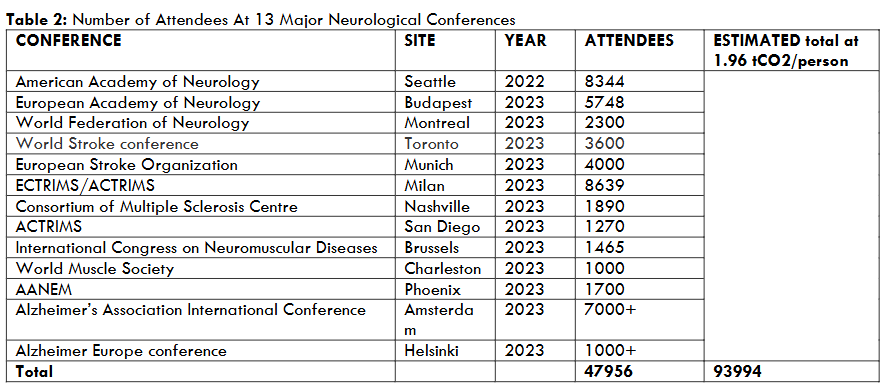
The total tCO2 emissions was then calculated at 93,994 (1.96 tonnes x 47,956 attendees). On the Global Carbon Atlas (2023), this equated to the annual CO2 emissions per capita of >2.0 million people in several African countries (or, using a different analogy, more than a third of the annual tCO2 emissions of the entire population of some African countries, such as, the Central African Republic), 313.313 people in Afghanistan, 134.277 in Bangladesh and, on average within territorial regions, 93.994 persons in Africa, 49.470 in Central America, 44.759 in India, 14.000 in Europe, 11.324 in China, 7800 in North America or Oceania, 7.200 in the Russian Federation, or 6.700 in Canada.
Many duplications in scientific contents and learning activities were noted across the conferences, which were annually staged by different Societies, as well as many repetitions of content from one year to another (although these observations were not systematically analysed).
Discussion
This estimate of the annual CO2 emissions produced by in-person attendance at 13 major neurological conferences is quite staggering, particularly if compared to the annual per capita emissions of some of the world’s lowest-income countries. It should be noted that the latter include some of the communities that are most affected by the climate crisis.
The CO2 emissions calculated in this study represent only the partial contribution of a single medical discipline, and as such, only a small part of the total carbon footprint of thousands of in-person academic events each year. Our neurological community and the medical community in general should acknowledge and consider this sober realisation.
Conferences are important to share and acquire knowledge, and to establish connections between people with common research and professional interests. Conferences have been traditionally held with in-person attendance. However, in-person attendance has been questioned over the past few decades on the grounds of environmental cost and inclusivity. On this note, it may also be of interest that none of the conference venues included in this study were in the countries most impacted by the climate crisis and, although a systematic analysis of conference attendance by country was not possible due to insufficient data on the demographics of the attendees, the representation from low economy communities was generally very poor. This raises fundamental issues of equity in education and exchange of scientific knowledge.
The disastrous effects of climate change on health are undisputed. This should create an ethical dilemma for medical professionals attending conferences. Global policies to contain the progression of climate change within the adaptability of the human system demand a reduction in carbon emissions in all sectors. There is no reason why the medical academia community should be exempt. In fact, medical professionals have a special responsibility to lead by example. The experience during the COVID-19 pandemic restrictions provided ample demonstration that virtual meetings can effectively meet all the demands of our scientific community. With regard to neurology in particular, the biannual World Congress of Neurology, held in Rome in 2021 as a fully virtual event, was considered a great success with over 4,400 participants from 120 countries, “more than 270 speakers and experts”, participating in a scientific program consisting of “more than 150 scientific sessions presented in different formats – plenary lectures, scientific sessions, teaching courses, free communication sessions and regional symposia”. So, we also have successful models of virtual conferences to refer to, to help the transition away from on-site meetings.
Under the current circumstances, until a viable solution is found for sustainable long-distance travelling, neurologists should consider transitioning to more sustainable practices to reduce their carbon footprint. The most effective measure would be to make virtual events the norm and in-person events significantly reduced. However, there are other more amenable options that could be considered in the meantime, that would still achieve a significant reduction of carbon emission in comparison to the traditional modus operandi. For example:
- Reducing the number of large international annual conferences by holding them every second or third year and alternating the in-person or hybrid conference with on-line events, lectures or courses;
- Increasing the use of the hybrid model for the main conferences, which offers both in-person and digital attendance, thus reducing the number of attendees who travel, while also improving conference accessibility;
- Finding conference venues that minimise the travel distance for most participants, or offering multi-hub conferences so attendees travel to the closest hub; and/or
- Mainstreaming the practice of medical institutions allocating travel budgets or carbon budgets as part of institutional sustainability policies, in order to cap the number and distance of flights taken by academics in each department. The process of allocating the available budget amongst staff could also help to prioritise sending early career academics to conferences to present their research.
In addition to the environmental advantages, these measures would reduce significantly the economic cost of scientific interaction, thus addressing the compelling issue of current inequalities in education and the sharing of medical knowledge. A systematic discussion of advantages and limitations of on-site vs. virtual or hybrid conferences (including measures to avoid a potential rebound effect where greater uptake of online and hybrid meetings leads to greater energy use/new environmental loads in unanticipated areas) is beyond the scope of this article, as are other considerations, such as duplication of scientific and learning materials across conferences and over subsequent years. We recommend these all as topics of future studies that could provide valuable insights in the restructuring of future events.
Despite its limitations (including the calculation of the CO2 per capita emissions, which was based on literature values, and the criteria of inclusions that restricted the analysis to a limited number of annual neurological events), this analysis shows alarming figures that should generate concern in the neurological and general medical community. While it is true that effective changes require collective global actions agreed between states, it is also clear that actions will not occur without cultural changes that motivate a transition to more sustainable behaviours. Evidence-based action from professional communities may play a significant role in this respect.
Conclusions
The annual contribution to carbon emissions by in-person attendance at neurological conferences was calculated conservatively at 93,994 tonnes. These staggering figures only represent a partial contribution from our discipline. This simple analysis based on literature values to calculate carbon emissions by attendee shows alarming figures that should generate concern in the neurological and general medical community. In the context of a climate crisis “that is fundamentally a health crisis” requiring urgent mitigating actions, neurologists should carefully review their methods for education and knowledge exchange.
Declaration
We confirm that we have read the Journal’s position on issues involved in ethical publication and affirm that this report is consistent with those guidelines. The authors have no potential conflicts of interest to be disclosed.
References
- Costello A, Abbas M, Allen A, et al. Managing the health effects of climate change: Lancet and University College London Institute for Global Health Commission. Lancet 2009; 373: 1693–733. doi: 10.1016/S0140-6736(09)60935-1
- Romanello M, di Napoli C, Green C et al. The 2023 report of the Lancet Countdown on health and climate change: the imperative for a health-centred response in a world facing irreversible harms. Lancet 2023; 402: 2346-94. doi: 10.1016/S0140-6736(23)01859-7
- International Court of Justice. Verbatim record 2024/54 for public sitting held on Friday 13 December 2024, at 3 p.m., at the Peace Palace (Request for Advisory Opinion submitted by the General Assembly of the United Nations). 2024. https://www.icj-cij.org/sites/default/files/caserelated/187/187-20241213-ora-02-00-bi.pdf (accessed Dec 17, 2024).
- WHO. COP29 special report on climate change and health: health is the argument for climate action. 2024. https://cdn.who.int/media/docs/defaultsource/environment-climate-change-and-health/58595-who-cop29-specialreport_layout_9web.pdf?sfvrsn=dd2b816_8 (accessed Dec 17, 2024).
- Wang J, Hu X, Yang T et al. Ambient air pollution and the dynamic transitions of stroke and dementia: a population-based cohort study. eClinicalMedicine 2024;67: 102368. doi: 10.1016/j.eclinm.2023.102368. eCollection 2024 Jan.
- Le Quéré C, Capstick S, Corner A et al. Towards a culture of low-carbon research for the 21st Century. Tyndall Centre for Climate Change Research. 2015 http://www.tyndall.ac.uk/sites/default/files/twp161.pdf
- Passalacqua, A. 2021. The Carbon Footprint of a Scientific Community: A Survey of the Historians of Mobility and Their Normalized yet Abundant Reliance on Air Travel. 2021. Journal of Transport History 2021; 42:121–41.
- Stroud, J. T., & Feeley, K. J. Responsible academia: Optimizing conference locations to minimize greenhouse gas emissions. Ecography 2015; 38(4), 402–404.
- Whitmarsh, L., Capstick, S., Moore, I., Köhler, J., & Le Quéré, C. Use of aviation by climate change researchers: Structural influences, personal attitudes, and information provision. Global Environmental Change 2020; 65, Article 102184.
- Gore, T. Carbon inequality by 2030: Per capita consumption emissions and the 1.5°C goal. Institute for European Environmental Policy & Oxfam, 2021; 1–12.
- Bousema, T., Selvaraj, P., Djimde, A. A., Yakar, D., Hagedorn, B., Pratt, A., Barret, D., Whitfield, K., & Cohen, J. M. Reducing the carbon footprint of academic conferences: The example of the American Society of Tropical Medicine and Hygiene. The American Journal of Tropical Medicine and Hygiene 2020; 103(5), 1758.
- Leddin D, Galts C, McRobert E, Igoe J, Singh H, Sinclair P. The Carbon Cost of Travel to a Medical Conference: Modelling the Annual Meeting of the Canadian Association of Gastroenterology. Journal of the Canadian Association of Gastroenterology 2022; 5(2): 52–58. https://doi.org/10.1093/jcag/gwab021
- Klöwer M, Hopkins D, Allen M, Higham J. An analysis of ways to decarbonize conference travel after COVID-19. Nature. 2020;583(7816):356–59.
- Burtscher L, Barret D, Borkar AP et al. The carbon footprint of large astronomy meetings. Nature Astronomy 2020, 4 (9): 823–25.
- Gattrell WT, Barraux A, Comley S, Whaley M, Lander N. The Carbon Costs of In‑Person Versus Virtual Medical Conferences for the Pharmaceutical Industry: Lessons from the Coronavirus Pandemic. Pharmaceutical Medicine 2022; 36:131–42. https://doi.org/10.1007/s40290-022-00421-3
- Global Carbon Atlas Project. Global Carbon Atlas. 2023. http://www.globalcarbonatlas.org/en/CO2-emissions. (Accessed June 2025)
- Viglione G. A year without conferences? How the coronavirus pandemic could change research. Nature 2020; 579: 327-29.
- Holden MH, Butt N, Chauvenet A, Plein M, Stringer M and Chadès I. Academic conferences urgently need environmental policies. Nature Ecology & Evolution 2017; 1: 1211-12.
- Pelosi l, Simon N. Neuromuscular ultrasound training courses in the post COVID-19 era: Is virtual training here to stay, and should the pre-pandemic training design be revised? Muscle & Nerve 2022;65:1–3.
- Tawfik EA, van Alfen N, Cartwright MS et al. Virtual neuromuscular ultrasound courses during COVID-19 pandemic: Leveraging technology to enhance learning opportunities. Muscle Nerve. 2022;65(1):29-33. doi:10.1002/mus.27415
- Raby CL,Madden JR. Moving academic conferences online: Aids and barriers to delegate participation. Ecology and Evolution 2021; DOI: 10.1002/ece3.7376
- Pelosi., and Blumhardt, HP., 2024. Climate Change and Health: Health Academics Could Do More to Build Upon the Success of Virtual Conferences During the Covid-19 Pandemic. Medical Research Archives, [online] 12(7). https://doi.org/10.18103/mra.v12i7.5538
- Foramitti J, Drews S, Klein F, Konc T. The virtues of virtual conferences. Journal of Cleaner Production 2021; 294, 126287.