

Cigarette Use and Subjective Well-Being in Students
Cigarette Consumption and Its Relationship with Subjective Well-Being in University Students: A Comparative Analysis between Bogotá and Bucaramanga
Laura Elizabeth Castro-Jimenez ¹, Bryan David Pinzon-Porras ¹⁻²
OPEN ACCESS
PUBLISHED: 30 June 2025
CITATION Castro-Jimenez, LE., and Pinzon-Porras, BD., 2025. Cigarette Consumption and Its Relationship with Subjective Well-Being in University Students: A Comparative Analysis between Bogotá and Bucaramanga. Medical Research Archives, [online] 13(7). https://doi.org/10.18103/mra.v13i7.6776
COPYRIGHT © 2025 European Society of Medicine. This is an open-access article distributed under the terms of the Creative Commons Attribution License, which permits unrestricted use, distribution, and reproduction in any medium, provided the original author and source are credited.
DOI: https://doi.org/10.18103/mra.v13i7.6776
ISSN 2375-1924
ABSTRACT
Objective: This study aimed to analyze the relationship between cigarette consumption and subjective well-being among university students in two Colombian cities: Bogotá and Bucaramanga.
Methods: A cross-sectional, comparative, and correlational study was conducted using secondary data from 895 undergraduate students enrolled in public and private universities. Cigarette use (item P_4) was measured on a five-point Likert scale. Subjective well-being was assessed through composite scores from the validated Healthy Lifestyle Questionnaire, including emotional well-being, social relationships, and academic-family balance. Bivariate analyses were conducted using chi-square tests, t-tests, ANOVA, and non-parametric equivalents. Spearman correlations assessed the association between smoking and well-being indicators. A multiple linear regression model was applied, adjusting for gender, city, and academic semester.
Results: Most students reported never smoking cigarettes, with a higher prevalence of frequent and very frequent use in Bucaramanga. Statistically significant but weak positive correlations were found between cigarette consumption and well-being scores (ρ range: 0.100–0.148). Multivariate analysis showed that cigarette consumption was not a significant predictor of overall subjective well-being. However, gender and city of residence were significant: women and students in Bucaramanga reported lower well-being scores. Academic semester also influenced well-being, with early-semester students reporting higher scores.
Conclusions: Cigarette use did not appear to be a direct predictor of subjective well-being when adjusted for sociodemographic variables. Findings suggest that smoking behavior in university settings may be associated with emotional coping or socialization patterns. Prevention strategies should adopt a comprehensive, gender-sensitive, and context-specific approach that addresses the social and emotional dimensions of tobacco use.
Keywords: Tobacco Use, Students, Subjective Well-Being, Health Behavior
Introduction
Tobacco use remains one of the leading modifiable risk factors associated with noncommunicable chronic diseases and premature mortality worldwide. Although global smoking rates have declined in the general population, various studies report a persistent prevalence among young people, particularly during the university stage. This life phase is characterized by significant transitions involving greater autonomy, academic stress, and new social relationships—conditions that may facilitate the initiation or consolidation of substance use, including cigarette smoking.
In Latin America, the situation is no different. According to data from the Pan American Health Organization, approximately 17% of individuals aged 18 to 24 have tried cigarettes at least once, and between 7% and 10% are regular users. Despite public campaigns and regulatory restrictions, accessibility and social acceptance of tobacco in certain university settings continue to be barriers to its eradication.
The university environment is a strategic setting for addressing tobacco use, not only due to the concentration of young people in formation, but also because educational institutions can play a key role in shaping healthy lifestyles. Research has shown that exposure to prevention programs, the implementation of smoke-free campus policies, and access to psychosocial support are protective factors against tobacco use among students.
Beyond the preventive approach, it is essential to analyze cigarette consumption from a broader public health perspective, taking into account its interaction with other dimensions of well-being, such as emotional state, quality of social relationships, academic performance, and perceived life satisfaction. This holistic perspective aligns with the Sustainable Development Goals (SDGs), particularly Goal 3, which aims to ensure healthy lives and promote well-being for all at all ages.
Subjective well-being among university students has gained increasing attention in the international literature, due to its relationship with academic performance, mental health, and persistence in higher education. Well-being is understood as a multidimensional construct that includes emotional, social, family, and academic factors, and whose perception may vary depending on contextual variables such as gender, academic semester, or city of residence.
Several studies have found significant associations between the use of psychoactive substances and decreased levels of perceived well-being. In particular, cigarette smoking has been linked to symptoms of anxiety, depression, and lower life satisfaction among university students. However, its use has also been documented as a coping mechanism, suggesting an ambivalent relationship between smoking and well-being.
In this regard, cigarettes may serve social and emotional functions in certain contexts, especially when used to reduce stress or facilitate interaction within peer groups. This phenomenon has been observed even in individuals who do not exhibit physical dependence on tobacco, but who engage in occasional use in response to emotional or social pressures. Although often perceived as harmless, this type of consumption may pose a latent long-term health risk.
Moreover, variables such as gender, city of residence, and academic semester may influence both smoking patterns and perceptions of well-being. Studies conducted in Latin America have shown that female university students report higher levels of stress and emotional distress, while male students show higher rates of tobacco use. Likewise, urban context, local policies, and institutional culture may affect how students cope with academic and personal challenges.
Despite the abundance of international research on the subject, there is still a knowledge gap in Colombia regarding the relationship between cigarette consumption and subjective well-being among university students, particularly when comparing different regions of the country. Most studies have focused on prevalence and risk factors, often neglecting a comprehensive understanding of the subjective and contextual implications of tobacco use in this population.
Therefore, the objective of this study was to analyze the relationship between cigarette consumption and subjective well-being among university students in the cities of Bogotá and Bucaramanga, comparing smoking levels by city, gender, and academic semester, and identifying possible associations between these variables and the dimensions of perceived well-being.
Methodology
STUDY DESIGN
This was a cross-sectional, comparative, and correlational study with a quantitative approach, based on secondary data analysis from a structured survey administered to undergraduate students in the cities of Bogotá and Bucaramanga. The primary variable of interest was cigarette consumption (item P_4), measured on a Likert-type scale from 1 (never) to 5 (very frequently). Additional variables included sociodemographic factors (age, gender, city, academic semester) and dimensions of subjective well-being, such as emotional well-being, social relationships, and academic-family balance, derived from composite scores.
PARTICIPANTS
A non-probabilistic convenience sampling method was used, comprising 895 undergraduate students enrolled in public and private universities in Bogotá and Bucaramanga. Inclusion criteria included active enrollment in the second academic semester of 2023 and voluntary agreement to participate in the study. The sample consisted of 54.9% men and 45.1% women, with a mean age of 21.36 years (SD = 4.82).
DATA COLLECTION INSTRUMENT
Data were collected using the Healthy Lifestyle Questionnaire (CEVS), a version that has been validated and adapted for the Colombian university population. The questionnaire includes 34 Likert-type items grouped into four dimensions: physical/mental health, social relationships, ethical/moral values, and academic-family environment. Response options are based on a five-point ordinal scale ranging from “never” (1) to “always” (5).
DATA COLLECTION PROCEDURE
After signing the informed consent form, participants were invited to complete the questionnaire via digital platforms. Anonymity and confidentiality of participants’ identities and responses were ensured, following ethical principles for research involving human subjects.
DATA ANALYSIS
Descriptive statistics (means, standard deviations, frequencies, and percentages) were calculated to characterize the sample and describe cigarette consumption patterns. Bivariate analyses were performed to examine differences in cigarette use according to city, gender, and academic semester, using:
- Chi-square tests for comparisons between categorical variables,
- Independent samples t-tests or Mann–Whitney U tests (depending on data normality) to compare well-being scores across consumption levels,
- Analysis of variance (ANOVA) or Kruskal–Wallis tests to assess differences by semester or consumption categories.
Correlational analyses were conducted to evaluate the strength and direction of the association between cigarette use and subjective well-being indicators, using:
- Spearman’s rho coefficient for ordinal and non-parametric variables.
Finally, a multivariate model was constructed using multiple linear regression, as the distribution of item P_4 (cigarette consumption) did not significantly deviate from normality and met the assumptions for linear modeling. Although ordinal logistic regression was considered, it was not applied, as the Likert-based responses showed adequate linear trends for the purpose of this analysis. Statistical analyses were performed using SPSS version 29 or R version 4.5.0, with a significance level set at p < 0.05.
ETHICAL CONSIDERATIONS
Participation in the study was voluntary. After receiving a full explanation of the study’s purpose, all participants provided informed consent, in accordance with the ethical principles and regulations outlined in the Declaration of Helsinki (1964) governing research involving human subjects. The study also complied with the provisions of Resolution 8430 of 1993 from the Colombian Ministry of Health, which establishes scientific, technical, and administrative guidelines for health research in the country.
Results
The analyzed sample included university students from the cities of Bogotá and Bucaramanga. Descriptive analysis showed that most participants reported not smoking cigarettes. However, significant differences were observed in consumption patterns between the two cities.
As shown in the table on cigarette consumption distribution by city, 89.1% of students in Bogotá reported that they never smoke cigarettes, compared to 80.5% in Bucaramanga. Conversely, “very frequent” consumption was more prevalent in Bucaramanga (5.4%) than in Bogotá (1.8%). These results suggest a higher prevalence of cigarette use in Bucaramanga, particularly at moderate and high frequency levels.
| City | Occasionally (%) | Almost Never (%) | Frequently (%) |
|---|---|---|---|
| Bogotá | 2.8 | 1.1 | 8.5 |
| Bucaramanga | 2.1 | 0.0 | 18.8 |
This differential pattern may be related to contextual factors such as the urban environment, availability of recreational spaces, social pressure, or perceived risk in each city. Further analyses will explore whether these differences persist when controlling for variables such as gender, academic semester, and subjective well-being scores.
A Spearman correlation analysis was conducted to assess the relationship between the frequency of cigarette use and global scores of subjective well-being. The results revealed weak but statistically significant positive correlations between cigarette consumption and the following variables: academic-family total: ρ = 0.100; p = 0.003; academic-family weighting: ρ = 0.100; p = 0.003; academic/total weighting: ρ = 0.100; p = 0.003; and overall well-being score: ρ = 0.148; p < 0.001. This relationship is visually represented in Figure 1, which shows the weak positive trend between cigarette consumption frequency and subjective well-being scores.
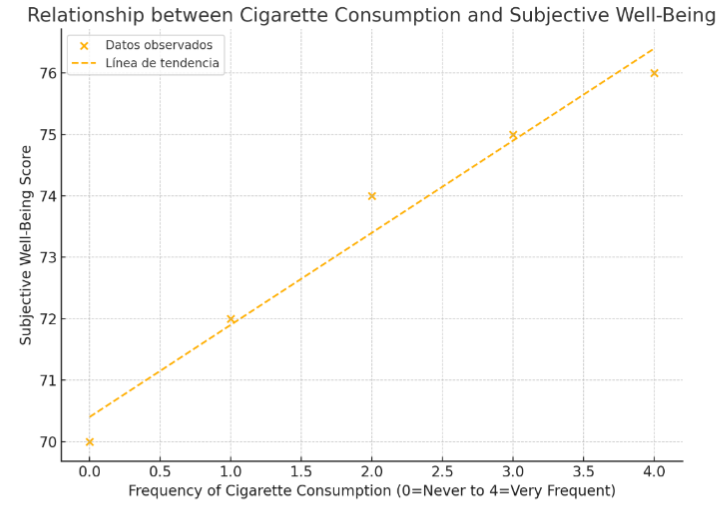
Although the correlations between cigarette consumption and well-being indicators were statistically significant, their strength was weak (ρ = 0.100–0.148), suggesting limited practical relevance. This highlights the need to interpret these findings cautiously, as statistical significance in large samples does not necessarily imply substantive or clinical importance. This finding is counterintuitive and may be related to the perception of cigarette use as a form of emotional regulation or a coping strategy in demanding academic contexts.
The statistical significance of these findings reinforces the need to explore these relationships further using multivariate models adjusted for city, gender, and academic semester, as presented in the following section.
To estimate the predictive effect of cigarette consumption on overall subjective well-being, a multiple linear regression model was adjusted, controlling for gender, city of residence, and academic semester. The model indicated that cigarette consumption was not a significant predictor of total well-being when controlling for other variables. In contrast, gender showed a statistically significant effect: women (coded as 2.0) scored, on average, 2.97 points lower in subjective well-being compared to men (p = 0.002). City of residence was also significant: students in Bucaramanga (coded as 2) scored 4.90 points lower in overall well-being compared to those in Bogotá (p = 0.020). Lastly, academic semester had a positive and significant effect, particularly for students in semester 2, who scored an average of 5.83 points higher in overall well-being compared to the reference group (p = 0.001). The results of the multiple regression analysis are summarized in Figure 2, which visually displays the magnitude and direction of each predictor’s effect on subjective well-being.
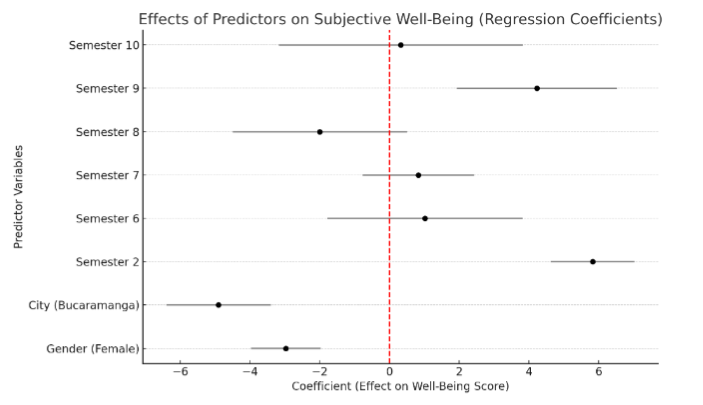
These findings indicate that, when controlling for sociodemographic and academic factors, cigarette use weakens as a direct predictor of well-being, suggesting the presence of intervening or mediating variables in the relationship between smoking behavior and perceived well-being.
Discussion
The aim of this study was to analyze cigarette consumption and its relationship with subjective well-being among university students in two Colombian cities: Bogotá and Bucaramanga. Through descriptive, correlational, and multivariate analyses, notable differences in smoking patterns between both cities were identified, alongside weak but statistically significant associations between cigarette use and various dimensions of student well-being. These findings contribute to the growing body of literature that seeks to understand health behaviors in university populations from an integrated biopsychosocial perspective.
In general terms, the majority of university students surveyed reported not engaging in regular cigarette smoking. However, the prevalence of “frequent” and “very frequent” smoking was noticeably higher in Bucaramanga compared to Bogotá. This regional disparity echoes findings from previous studies conducted in other Latin American contexts, which have shown that urban environment, local cultural norms, and peer group dynamics significantly influence the initiation, maintenance, and normalization of tobacco use among young adults. Additionally, socioeconomic conditions, the density of tobacco outlets, and local enforcement of anti-smoking policies may also account for these differences, highlighting the importance of place-based approaches to tobacco control.
A deeper city-specific analysis revealed that students in Bucaramanga tend to smoke more frequently than their counterparts in Bogotá. This variation may be attributed not only to environmental and cultural factors but also to institutional variables such as the availability and accessibility of health promotion initiatives, the presence of supportive university wellness services, and the degree to which campuses foster health-protective environments. These findings align with prior research indicating that the effectiveness of tobacco prevention and cessation programs is often contingent upon the strength and consistency of their implementation within academic settings. Thus, addressing smoking behaviors requires not only individual-level interventions but also structural and organizational changes within universities.
Interestingly, correlation analyses identified weak but positive associations between cigarette use and subjective well-being indicators. This result is counterintuitive given that numerous studies have established an inverse relationship between tobacco consumption and mental or emotional well-being. One possible explanation lies in the use of cigarettes as a maladaptive emotional coping mechanism or as a tool for social integration within specific peer groups. Smoking, in this context, may temporarily alleviate stress or foster a sense of belonging, thereby generating short-term improvements in subjective well-being despite its long-term risks. This phenomenon has been widely documented in the literature on emotional self-regulation and substance use among university populations.
The instrumental use of tobacco as a form of emotional regulation or social adaptation is not new and has been linked to various psychosocial pressures faced by university students. For example, academic overload, family expectations, financial insecurity, and social isolation may all serve as triggers for smoking initiation, especially during transitional periods such as the first years of university life. However, while such behaviors may provide temporary psychological relief, they can also pave the way for dependency and long-term harm to physical, psychological, and social health. This dual role of smoking—as both a coping strategy and a risk factor—underscores the complexity of addressing tobacco use in young adult populations.
When adjusting for key variables such as city, gender, and academic semester, the multivariate model revealed that cigarette use was no longer a significant predictor of overall subjective well-being. In contrast, gender and city maintained statistically significant effects. Specifically, female students consistently reported lower well-being scores than their male counterparts, a finding that corroborates a substantial body of evidence indicating higher rates of stress, anxiety, and emotional burden among female university students. These gender-based disparities highlight the need for more targeted psychosocial support and mental health interventions that take into account the unique stressors and vulnerabilities faced by women in academic environments.
The city of residence also emerged as a relevant factor, with students in Bucaramanga reporting lower levels of overall well-being than those in Bogotá. Potential explanations for this include structural disparities between universities—such as differences in institutional resources, availability of extracurricular programs, and access to mental health services—as well as broader socioeconomic inequalities between the two regions. These findings suggest that interventions to promote student well-being must be tailored to the specific needs, challenges, and contexts of each university community.
Another notable finding was the association between academic semester and subjective well-being. Students in earlier semesters tended to report higher levels of well-being compared to those in advanced stages of their academic journey. This pattern has been observed in previous research on academic burnout, where increased academic demands, performance pressure, and proximity to graduation are associated with higher levels of psychological distress and reduced well-being. This highlights the importance of designing longitudinal support systems that accompany students throughout their academic progression, particularly during peak periods of stress.
These findings have important practical implications for the development of tobacco prevention and health promotion strategies within higher education settings. Rather than adopting approaches that focus exclusively on restricting or penalizing tobacco use, it is crucial to implement comprehensive, multi-level interventions that integrate emotional education, stress management, and the creation of inclusive, health-promoting campus environments. Such programs should aim to strengthen students’ sense of institutional belonging, foster positive peer networks, and encourage engagement in physical activity and other protective behaviors. Additionally, gender-sensitive, semester-specific, and regionally adapted interventions are likely to be more effective in supporting student well-being and reducing risk behaviors.
Finally, while the current study did not establish a strong negative association between cigarette consumption and subjective well-being, this should not be interpreted as a minimization of the known risks of smoking. Occasional or socially motivated cigarette use may initially appear benign or even beneficial in the context of emotional coping; however, such behaviors can rapidly evolve into habitual consumption with significant negative consequences for both physical and mental health. Future research should seek to clarify these trajectories through longitudinal designs and in-depth qualitative studies that explore the subjective meanings, motivations, and social contexts of smoking among university students. Such research will be essential for the design of more effective, human-centered, and context-sensitive interventions that move beyond prohibition toward the transformation of the social and emotional conditions that sustain tobacco use.
Conclusions
The findings of this study demonstrate that while regular cigarette use is not widespread among university students in Bogotá and Bucaramanga, significant differences exist between the two cities. Higher levels of frequent and very frequent cigarette consumption were identified in Bucaramanga, suggesting the influence of sociocultural, institutional, and regulatory factors in shaping health-related behaviors. These patterns should be carefully considered by academic authorities and public health officials to design more context-sensitive strategies.
Furthermore, although statistically significant correlations were found between cigarette consumption and some indicators of subjective well-being, their magnitude was low, and cigarette use did not emerge as a direct predictor of overall well-being after controlling for sociodemographic and academic variables. In contrast, factors such as gender, city of residence, and academic semester showed stronger associations with well-being. Women, students from Bucaramanga, and those in later academic semesters reported lower levels of well-being, underscoring the need for differentiated approaches in psychosocial support strategies.
Finally, this study highlights the importance of strengthening substance use prevention policies in higher education institutions through a comprehensive well-being approach. Such efforts should include emotional education, the reinforcement of support networks, early intervention, and the promotion of healthy environments. These actions must be sensitive to gender differences, regional contexts, and academic stages, and should be developed in collaboration with students. It is also recommended that future research address this issue using longitudinal designs and qualitative studies to explore the subjective meanings of smoking among university students, contributing to more effective, contextualized, and human-centered interventions.
References
- World Health Organization. WHO global report on trends in prevalence of tobacco use 2000–2025. 4th ed. Geneva: WHO; 2021.
- Selya AS, et al. Risk factors for smoking in college students: A longitudinal study. Nicotine Tob Res. 2020;22(6):992–8.
- Haardörfer R, et al. Stress and substance use among young adults: a review. J Am Coll Health. 2018;66(6):457–65.
- Organización Panamericana de la Salud. Reporte regional de consumo de tabaco en jóvenes. OPS; 2022.
- Gómez L, et al. El consumo de tabaco en jóvenes universitarios colombianos. Rev Salud Pública. 2020;22(1):78–86.
- Velasco-Sánchez ML, et al. Promoción de la salud y prevención del tabaquismo en entornos universitarios. Rev Esp Salud Pública. 2021;95:e202111078.
- Ortega-Campos E, et al. Programa de intervención en salud mental y bienestar universitario. Int J Environ Res Public Health. 2020;17(24):9442.
- Lanza ST, et al. Patterns of substance use and mental health in college students. J Adolesc Health. 2015;56(6):674–80.
- United Nations. Sustainable Development Goals. Goal 3: Ensure healthy lives and promote well-being for all. New York: UN; 2015.
- Renshaw TL, Bolognino SJ. The College Student Subjective Wellbeing Questionnaire. J Happiness Stud. 2016;17(2):463–84.
- Rojas-Solís JL. Diferencias por género en la percepción del bienestar en estudiantes universitarios. Rev Colomb Psicol. 2019;28(1):11–25.
- Koyanagi A, et al. Cigarette smoking and health outcomes in college populations. Addict Behav. 2021;117:106853.
- Castaño-Perez GA, Calderón-Vallejo GA. Factores asociados al consumo de tabaco en estudiantes universitarios. Rev Latinoam Enferm. 2017;25:e2886.
- Tomsich EA, et al. Smoking for stress relief: A student coping mechanism. J Am Coll Health. 2018;66(3):149–56.
- Sandoya B, et al. Tobacco as coping strategy among Latin American university students. Psicología y Salud. 2022;32(1):45–53.
- Prokhorov AV, et al. From experimentation to habitual use: longitudinal effects of smoking behavior. Prev Med. 2016;91:318–25.
- González-Robledo MC, et al. Estrés académico en mujeres universitarias. Rev Mex Enferm. 2020;28(3):102–9.
- Barreto SM, et al. Social inequality in tobacco consumption among Brazilian university students. Cad Saude Publica. 2019;35(12):e00223018.
- Ruiz-Pérez I, et al. Tabaquismo en estudiantes universitarios colombianos: una revisión sistemática. Rev Iberoam Psicol Salud. 2021;12(1):35–49.
- Blanco F, Ortega A. Consumo de tabaco y diferencias regionales en estudiantes universitarios. Salud Colectiva. 2020;16(2):e290.
- World Health Organization. Tobacco and youth: emerging challenges. Geneva: WHO; 2020.
- Gómez-Restrepo C, et al. Bienestar universitario: una revisión de políticas institucionales en Colombia. Educación Médica. 2018;19(2):73–9.
- Rodríguez-Gómez R. Desigualdades educativas y bienestar subjetivo en jóvenes. Rev Educ. 2017;378:143–68.
- Cabanach RG, et al. Burnout en estudiantes universitarios: diferencias por curso y género. An Psicol. 2015;31(2):522–9.
- U.S. Department of Health and Human Services. The Health Consequences of Smoking: 50 Years of Progress. Atlanta, GA: CDC; 2014.
- Tandon PS, et al. Physical activity, screen time, and sleep in children with mental health problems. J Dev Behav Pediatr. 2019;40(6):458–64.
- Moore GF, et al. Population health intervention research: the place of theories. Trials. 2015;16:495.
- De Looze M, et al. Trends in adolescent alcohol use in Europe: Evidence from the HBSC study. Eur J Public Health. 2020;30(Suppl 5):ckaa165.097.
- Reitz E, et al. The role of coping styles in the relationship between stress and substance use in adolescents. J Adolesc Health. 2016;58(3):330–6.
- Shankar A, et al. Gender differences in mental health and health behavior in university students. Soc Psychiatry Psychiatr Epidemiol. 2017;52(4):413–21.
- Eisenberg D, et al. Gender differences in mental health service use among college students. J Adolesc Health. 2011;48(1):7–13.
- Sáenz M, et al. Institutional support and student well-being in higher education. J Coll Stud Dev. 2020;61(2):203–18.
- León JD, et al. Servicios de bienestar universitario y salud mental: percepciones estudiantiles. Rev Educ Desarro. 2021;38(2):45–60.
- Salanova M, et al. Burnout en estudiantes universitarios: el papel del engagement. An Psicol. 2010;26(1):131–7.
- Arnett JJ. Emerging adulthood and health behaviors. J Adolesc Health. 2007;41(1):14–21.
- Mermelstein R, et al. Long-term consequences of smoking initiation during college years. Health Psychol. 2015;34(10):1061–71.
- Herrera-Pinzón MA, Castro-Jiménez LE, Herreño-Rodríguez DE, Argüello-Gutiérrez YP, Aguirre-Rueda DM, Sánchez-Rojas IA. Confiabilidad del cuestionario de estilos de vida saludable (CEVS) en estudiantes universitarios. Peruvian Journal of Health Care and Global Health. 2023;7(2). doi:10.25176/RPSP.V7I2.623.