





Divergence in Psychological and Physiological Art Responses
A Study on the Divergence between Psychological Evaluation and Physiological Indices during Art Viewing in Immersive Spaces
Ryohei Nakatsu¹, Naoko Tosa¹, Yasuyuki Uraoka², Akane Kitagawa², Koichi Murata², Tatsuya Munaka², Yoshiyuki Ueda¹, Masafumi Furuta², Michio Nomura¹
- Kyoto University, Sakyo, Kyoto, 606-8501 Japan
- Shimadzu Corporation, Seika-cho, Soraku-gun, Kyoto, 619-0237 Japan
1. Introduction
In the modern age, immersive technologies have transformed the way people experience art. Unlike traditional galleries, immersive environments engage the viewer’s body, senses, and emotions simultaneously, often creating a more intense and embodied aesthetic experience. These environments ranging from mirror rooms to large-scale LED installations have expanded the expressive potential of art while introducing new variables that shape the viewer’s psychological and physiological responses.
In art appreciation research, subjective psychological evaluation has long served as the primary measure of aesthetic experience. However, recent advances in psychophysiology have highlighted the importance of incorporating objective indicators such as heart rate variability (HRV) to capture unconscious bodily states that may not be accessible through self-report. This is especially relevant in immersive environments, where spatial and visual design elements can influence autonomic nervous system (ANS) activity in subtle yet significant ways.
Such dual-layered assessment is supported by previous findings in emotion and stress research, which report notable discrepancies between physiological signals and subjective reports. These findings suggest that conscious awareness and bodily responses may be decoupled under certain experiential conditions, raising questions about the sufficiency of self-report measures alone in evaluating complex experiences like art appreciation.
This study investigates this divergence by presenting the same visual art content in two distinct immersive environments: one constructed with mirrors and the other with LED panels. By comparing both psychological ratings (e.g., Impression, Relaxation) and physiological indices (e.g., SDNN, RMSSD, LF/HF), we aim to determine whether participants’ bodily responses align with their conscious impressions or whether a disjunction emerges.
By addressing this question, this study contributes to a deeper understanding of embodied aesthetic experience. It also offers practical insights for the design of immersive environments in art, education, and therapy, where harmonizing psychological engagement with physiological comfort may enhance experiential effectiveness.
2. Materials and Methods
2.1 IMMERSIVE SPACES FOR ART APPRECIATION
It is considered adequate to view art in a space surrounded by art. We constructed two art-enclosed spaces: an immersive space surrounded by mirror displays and an immersive space surrounded by large LED displays.
2.1.1 Immersive Space 1: Immersive space with mirror displays
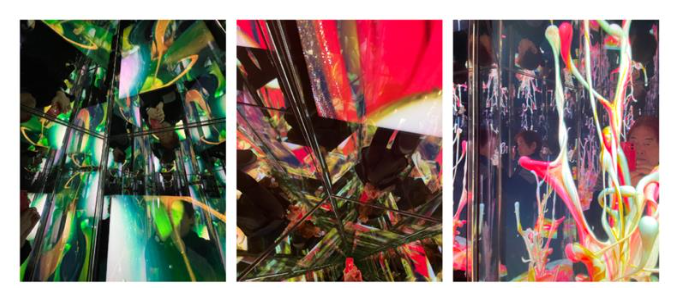
Immersive Space 1 was designed using mirror displays to create a strong sense of spatial infinity, based on the psychological premise that immersion enhances the impact of art appreciation. We adopted a mirror display to achieve this effect.
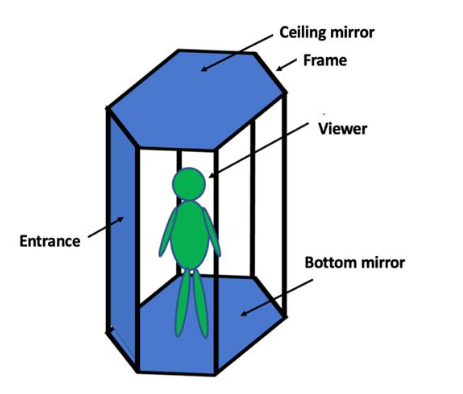
This immersive environment consists of a hexagonal enclosure with three pairs of opposing mirror displays, forming a space where images are infinitely reflected. Art content is displayed on six of these mirror displays. Mirrors are also used for the floor and ceiling, allowing participants to experience the sensation of being surrounded above and below. This design creates a perceptual experience in which viewers see countless images of themselves and the artwork, contributing to a complex visual and emotional effect.
2.1.2 Immersive Space 2: Immersive space surrounded by four large displays
Immersive Space 1 has the following advantages and disadvantages:
- Advantage: By using mirror displays, a closed space of about 1.5 m (width) x 1.5 m (depth) x 2 m (height) can give the impression of being in an infinite space due to the mirror effect.
- Disadvantage: On the other hand, using mirrors results in an endless series of mirror images of the viewers. Therefore, some viewers may feel less immersed in the space because they can see their images.
Considering these advantages and disadvantages, we constructed Immersive Space 2 with the following features to conduct a comparison experiment with Immersive Space 1:
- Features of Immersive Space 2: Large LED displays are used to construct a space instead of a mirror display. Since mirrors are not used, one’s image is not reflected. This eliminates the primary disadvantage of Immersive Space 1, namely, the reduced sense of immersion due to visible self-reflection. On the other hand, it does not give the feeling of being in an endless space like Immersive Space 1.
- Immersive Space 2 is a closed space surrounded by four-sided displays. A 77-inch organic LED panel is used as the display. However, a completely closed space surrounded by displays gives a sense of closure, and it is considered mentally challenging for people with claustrophobia to enter the space. Therefore, we used a mirror for the ceiling and floor.
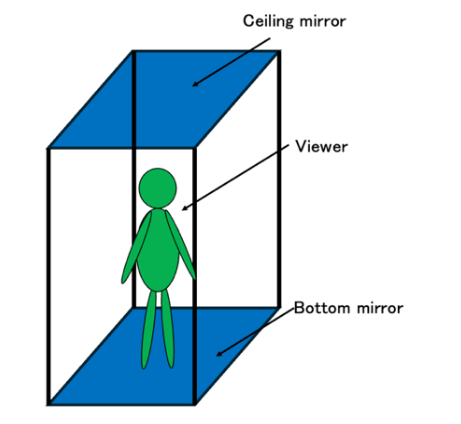
Since Immersive Spaces 1 and 2 have relative characteristics, it would be interesting to compare the two immersive spaces through psychological and physiological experiments.
2.2 CONCEPT OF THE EVALUATION EXPERIMENT
The primary objective of this experiment was to investigate whether differences in immersive spatial environments influence both subjective and physiological responses to art, and whether a divergence exists between the two types of data when participants are exposed to the same artistic content.
To address this question, two immersive spaces with contrasting spatial characteristics were employed: Immersive Space 1, utilizing mirror displays to evoke infinite visual reflections, and Immersive Space 2, employing large LED panels to eliminate visual self-reflection. The same video artwork was shown in both environments to isolate the impact of spatial configuration on participants’ responses.
Each participant viewed two types of visual content—artistic and geometric—under controlled conditions. During the viewing, psychological evaluations were obtained using self-report questionnaires, while physiological responses were recorded through electrocardiographic (ECG) measurements. The experiment followed a standardized sequence that included rest periods, exposure to each content type, and post-exposure assessments.
By integrating subjective and physiological data within a unified experimental design, this study aims to reveal whether consciously reported impressions of art align with, or diverge from, unconscious bodily responses. In doing so, the research sheds light on the complex interplay between spatial perception, emotional appraisal, and autonomic nervous activity in immersive art experiences.
2.3 TEST SUBJECTS
Two independent groups of participants were recruited to evaluate Immersive Spaces 1 and 2, respectively. For Immersive Space 1, data were collected from 40 undergraduate and graduate students at Kyoto University (32 males and 8 females). For Immersive Space 2, a separate group of 52 students (28 males and 24 females) participated. No participants took part in both conditions, ensuring a between-subject design suitable for comparative statistical analysis.
2.4 EXPERIMENTAL PROCEDURE
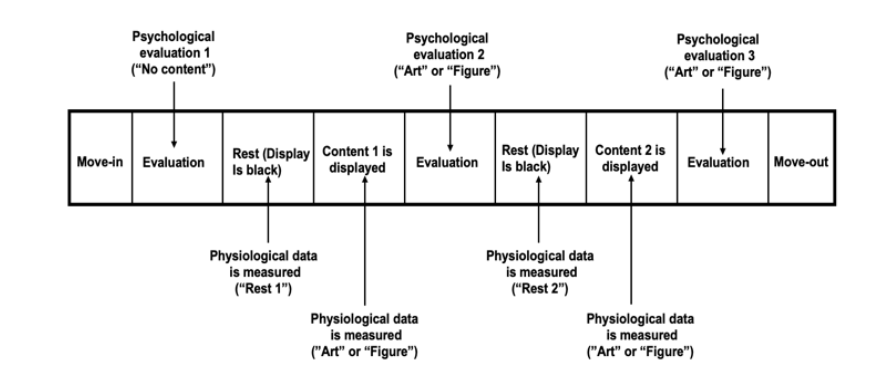
The experimental procedure was designed to assess both psychological and physiological responses to two types of visual content—an artistic video and a neutral geometric animation—under controlled conditions. Each participant underwent a structured sequence of content viewing and measurement.
Upon entering the immersive space, participants first completed a psychological evaluation based on their initial impression of the environment without any visual content (No Content condition). This was followed by a 3-minute resting phase (Rest 1), during which the display remained black and electrocardiographic (ECG) data were recorded to capture a physiological baseline.
Next, participants viewed two visual stimuli in succession—one artistic and one geometric—each lasting three minutes. The order of presentation was randomized across participants. After viewing each content type (Content 1 and Content 2), participants completed a psychological evaluation corresponding to their impressions of the content. A second resting period (Rest 2) was included between the two viewing sessions; however, due to potential carryover effects from the first stimulus, only the data from Rest 1 (Rest hereafter) were used in the analysis.
This integrated procedure enabled the simultaneous collection of subjective and physiological data in response to identical visual stimuli, providing a basis for analyzing potential divergences between conscious experience and autonomic response.
2.5 PSYCHOLOGICAL MEASURES
Psychological responses to the immersive environments and visual content were assessed using a standardized questionnaire based on the semantic differential (SD) method with a 7-point scale. This approach allows participants to rate their impressions along bipolar adjective pairs (e.g., Comfortable-Uncomfortable), capturing subtle nuances in subjective experience.
The evaluation comprised 24 items, grouped into four psychological dimensions:
- Impression, reflecting aesthetic and emotional qualities (e.g., beautiful, interesting)
- Relaxation, indicating perceived calmness and ease (e.g., secure, relaxed)
- Motivation, capturing engagement and curiosity (e.g., motivated, curious)
- Creativity, reflecting imaginative and immersive qualities (e.g., inspired, in the zone)
Each participant completed this evaluation three times during the experimental session: after entering the immersive space (No Content), after viewing the first visual stimulus (Content 1), and after the second stimulus (Content 2). This allowed comparison of subjective impressions across both content types and spatial environments.
Table 1. Evaluation Items
| 1. Impression factor (9 items) |
|---|
| Comfortable – Uncomfortable |
| Friendly – Unfriendly |
| Beautiful – Not beautiful |
| Calm – Restless |
| Interesting – Boring |
| Warm – Cold |
| Changeable – Not changeable |
| Luxury – Sober |
| Individual – Ordinary |
| 2. Relaxation factor (5 items) |
| At ease – Not at ease |
| Secure – Not secure |
| Pleasant – Not pleasant |
| Relaxed – Not relaxed |
| Healed – Not healed |
| 3. Motivation factor (5 items) |
| Enthusiastic – Not enthusiastic |
| Immersed – Not immersed |
| Curious – Not curious |
| Motivated – Not motivated |
| Aroused – Not aroused |
| 4. Creativity factor (5 items) |
| Associate – Do not associate |
| Immersive – Not immersive |
| Activated – Not activated |
| Inspired – Not inspired |
| In the zone – Not in the zone |
2.6 PHYSIOLOGICAL MEASURES
Physiological data were recorded in collaboration with Kyoto University and Shimadzu Corporation using the Human Metrics Explorer (HuME), a multi-sensor system that integrates various wearable devices for synchronized data collection. This system allowed for the simultaneous acquisition of electrocardiographic (ECG), electroencephalographic (EEG), and skin potential data during the experimental sessions.
In the present study, we focused primarily on ECG measurements, as these provide reliable indicators of autonomic nervous system activity through heart rate variability (HRV) analysis. Although EEG and skin potential data were also recorded, they are beyond the scope of this paper and will be analyzed in future work.
The use of HuME enabled noninvasive, high-resolution tracking of participants’ physiological states in real time, ensuring precise alignment with stimulus presentation and enhancing the validity of the recorded data.
3. Contents Used For The Experiments
3.1 ART CONTENT
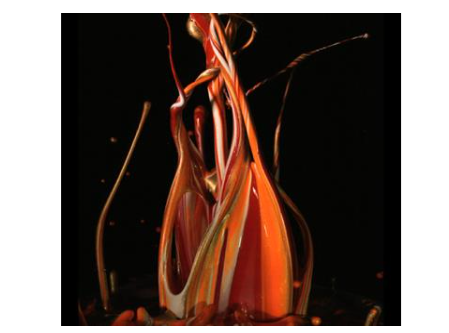
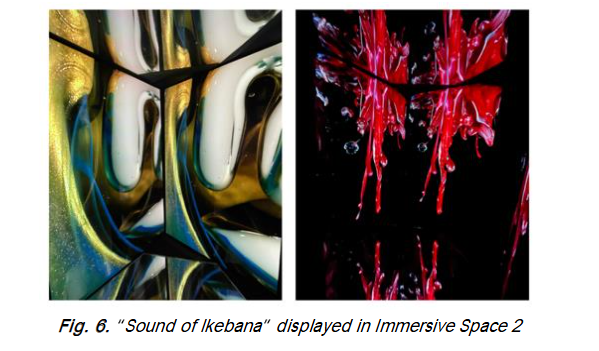
The artistic content used in this experiment was Sound of Ikebana, a video artwork created by one of the authors, Naoko Tosa. The work visualizes sound-induced fluid motion captured using a high-speed camera, producing intricate, organic patterns reminiscent of traditional Japanese flower arrangement called Ikebana. These fluid forms dynamically evolve in response to audio vibrations, resulting in a highly immersive and abstract visual experience.
Sound of Ikebana has been employed in previous studies to evaluate psychological and physiological responses to art, and its vivid visual characteristics and parameter flexibility make it particularly suitable for controlled experimental settings. In the present study, the exact same video segment was used in both immersive spaces to eliminate content variability and isolate the effect of spatial configuration.
3.2 COMPARATIVE CONTENT
To serve as a neutral baseline for comparison with the artistic stimulus, a geometric animation consisting of alternating circles and squares in varying colors was used as the control content. This stimulus was designed to minimize emotional or aesthetic engagement and to lack any symbolic or narrative meaning.
The geometric animation was selected based on preliminary testing in which several visual patterns were evaluated for their emotional neutrality. The chosen version was identified as having the least psychological impact across a set of evaluation criteria, making it suitable for isolating the physiological and psychological effects of the immersive space itself.
By presenting both the artistic and geometric content within the same experimental framework, the study aimed to distinguish spatial influences on responses from those elicited by content complexity or emotional salience.
4. Results
4.1 PSYCHOLOGICAL EVALUATION RESULTS
Since different participants were assigned to Immersive Spaces 1 and 2, a mixed-design analysis of variance (ANOVA) was conducted, incorporating both between-subject and within-subject factors. The between-subject factor was the type of immersive environment (Immersive Space 1 vs. Immersive Space 2), while the within-subject factors included content type (Art, Figure, No Content) and evaluation items.
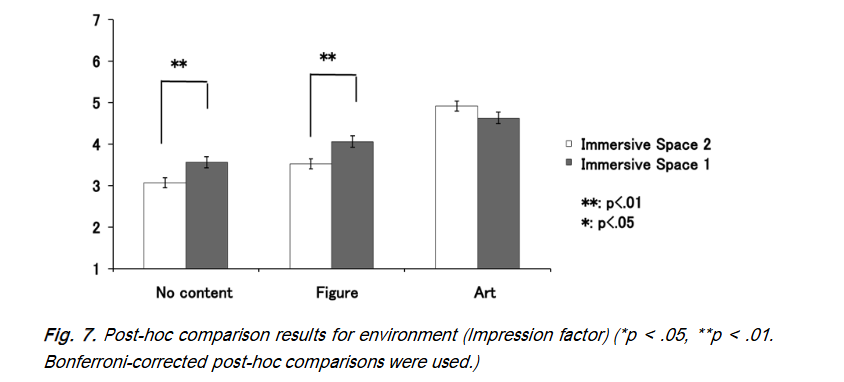
The main effect of the environment on the Impression factor was statistically significant at the 5% level (p = .048). However, post-hoc comparisons revealed no significant difference between Immersive Spaces 1 and 2 for the Art condition. In contrast, for both the Figure and No Content conditions, ratings in Immersive Space 1 were significantly higher than those in Immersive Space 2 at the 1% level.
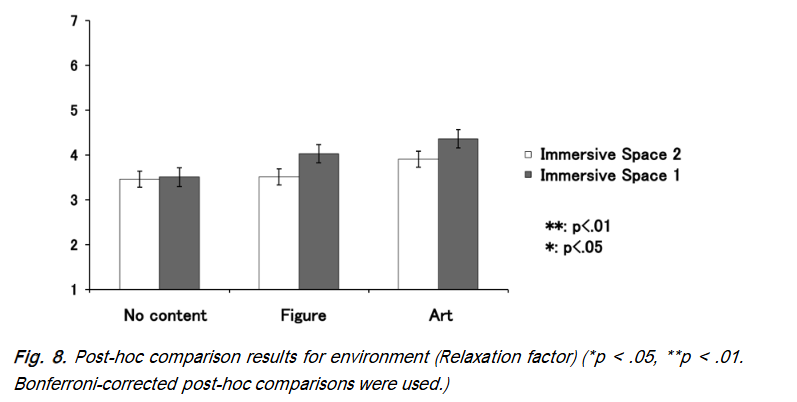
For the Relaxation factor, the main effect of the environment was statistically significant at the 5% level (p = .046). However, post-hoc comparisons indicated no significant differences between Immersive Spaces 1 and 2 for any of the content conditions Art, Figure, or No Content.
For the Motivation factor, the main effect of the environment was statistically significant at the 5% level (p = .018). However, post-hoc comparisons revealed no significant differences between Immersive Spaces 1 and 2 for either the Art or No Content conditions. In contrast, for the Figure condition, ratings in Immersive Space 1 were significantly higher than those in Immersive Space 2 at the 1% level (p = .000).
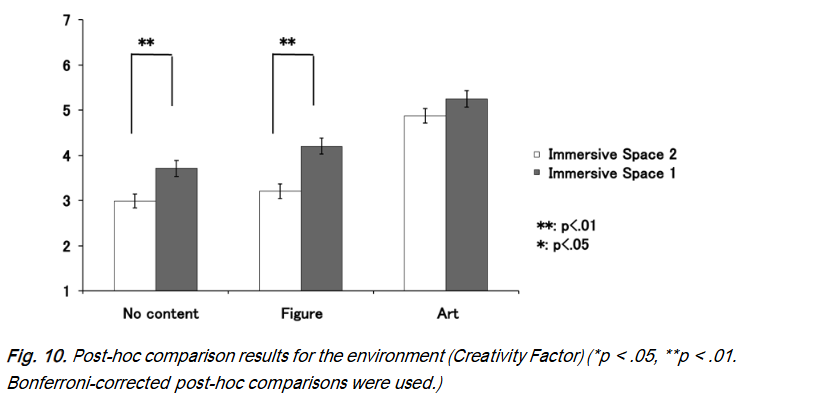
For the Creativity factor, the main effect of the environment was statistically significant at the 1% level (p = .000). However, post-hoc comparisons revealed no significant difference between Immersive Spaces 1 and 2 for the Art condition. In contrast, for both the Figure and No Content conditions, ratings in Immersive Space 1 were significantly higher than those in Immersive Space 2 at the 1% level.
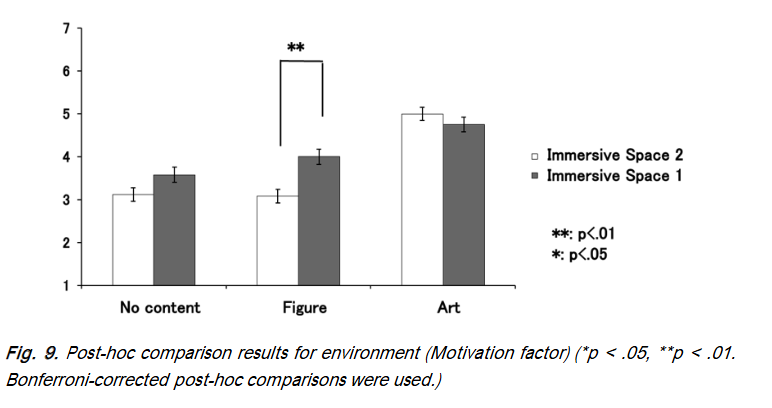
Post-hoc comparison results for environment (Motivation factor) (*p < .05, **p < .01. Bonferroni-corrected post-hoc comparisons were used.)
4.2 PHYSIOLOGICAL EVALUATION RESULTS
4.2.1 Electrocardiographic data used in the analysis
Physiological data including electrocardiography (ECG), electroencephalography (EEG), and skin potential were collected from 40 participants in Immersive Space 1 and 52 participants in Immersive Space 2. Among these, complete datasets across all three modalities were obtained from 22 participants in Space 1 and 39 participants in Space 2. Due to occasional sensor failures or signal loss, data from the remaining participants were excluded from analysis.
This study focuses exclusively on ECG data, which serve as reliable indicators of autonomic nervous system activity. Accordingly, the final sample sizes for ECG analysis were 22 participants for Immersive Space 1 and 39 participants for Immersive Space 2.
4.2.2 Analysis methods
Heart rate variability (HRV), derived from the temporal fluctuations between successive R-waves in electrocardiographic data (RR intervals), was used to assess autonomic nervous system activity. The following HRV indices were calculated from the RR interval time series:
- SDNN: Standard deviation of RR intervals.
- RMSSD: Root mean square of successive RR interval differences.
- pNN50: Percentage of successive RR intervals differing by more than 50 ms.
- HF: High-frequency power component from spectral analysis.
- LF/HF: Ratio of low-frequency to high-frequency power.
Among these, SDNN, RMSSD, pNN50, and HF are commonly interpreted as indicators of parasympathetic activity, while LF/HF is used as an index of sympathetic activity.
Each index was computed as a time series for three content conditions—Art, Figure, and Rest—and the average values within each condition were used for statistical comparisons.
4.2.3 Comparison of Immersive Spaces 1 and 2
To determine whether physiological responses differed significantly between the two immersive environments, ECG data from Immersive Spaces 1 and 2 were directly compared using a two-factor analysis of variance (ANOVA). The two factors included: (1) Environment as a between-subjects factor (Immersive Space 1 vs. Immersive Space 2), and (2) Content Type as a within-subjects factor (Figure, Art, and Rest).
Because different participant groups were assigned to each immersive environment, a mixed-design ANOVA was employed to accommodate the combination of between-subject and within-subject factors.
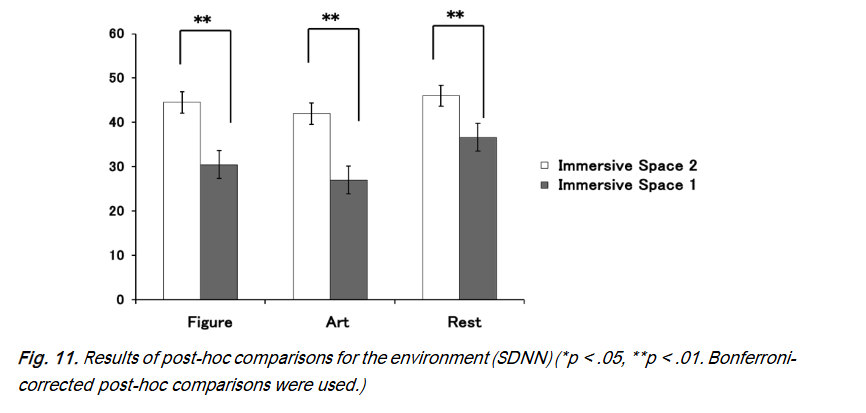
SDNN: The main effect of the environment on SDNN was statistically significant at the 1% level (p = .000). Post-hoc comparisons revealed that SDNN values were significantly higher in Immersive Space 2 than in Immersive Space 1 across all content conditions—Art, Figure, and Rest—at the 1% level.
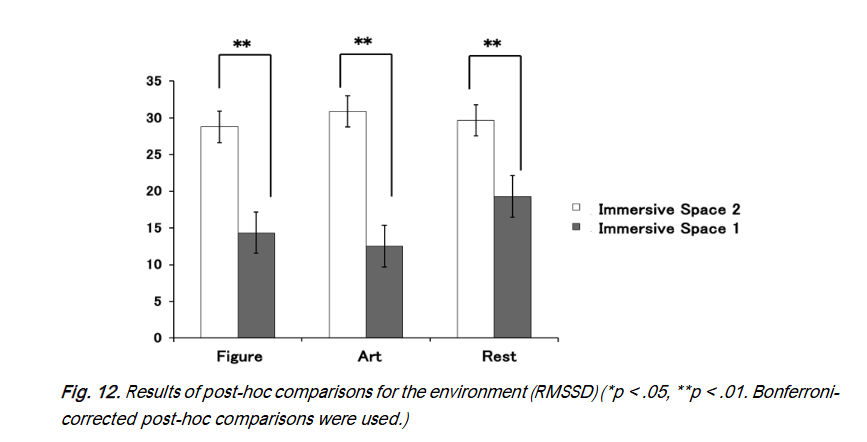
RMSSD: The main effect of the environment on RMSSD was statistically significant at the 1% level (p = .000). Post-hoc comparisons revealed that RMSSD values were significantly higher in Immersive Space 2 than in Immersive Space 1 across all content conditions—Art, Figure, and Rest—at the 1% level.
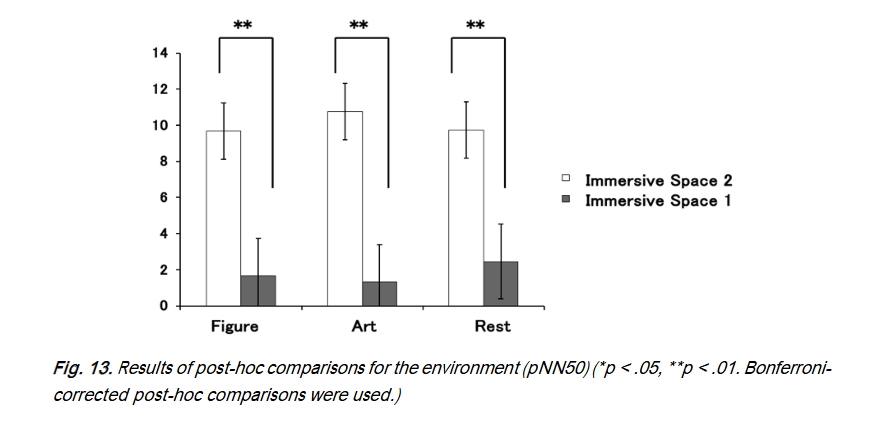
pNN50: The main effect of the environment on pNN50 was statistically significant at the 1% level (p = .002). Post-hoc comparisons revealed that pNN50 values were significantly higher in Immersive Space 2 than in Immersive Space 1 across all content conditions—Art, Figure, and Rest—at the 1% level.
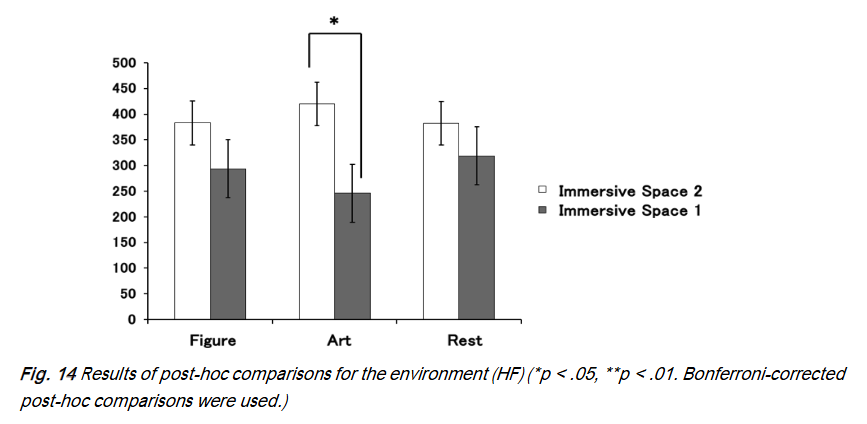
HF: The main effect of the environment on HF was not statistically significant but approached the 5% threshold (p = .082). Nevertheless, post-hoc comparisons revealed that HF values in Immersive Space 2 were significantly higher than those in Immersive Space 1 for the Art condition (p = .015), indicating a notable increase in parasympathetic activity under this environment.
LF/HF: The main effect of the environment on the LF/HF ratio was statistically significant at the 1% level (p = .000). Post-hoc comparisons revealed that LF/HF values were significantly lower in Immersive Space 2 than in Immersive Space 1 for both the Art and Figure conditions (p = .000). For the Rest condition, LF/HF values in Immersive Space 2 were also significantly lower than in Space 1 at the 5% level (p = .028).
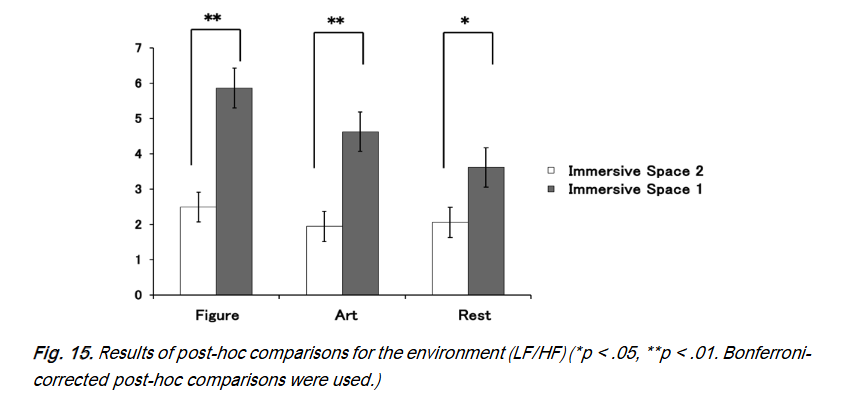
Results of post-hoc comparisons for the environment (LF/HF) (*p < .05, **p < .01. Bonferroni-corrected post-hoc comparisons were used.)
5. Discussion
5.1 SUBJECTIVE EVALUATION AND IMMERSIVE ENVIRONMENTS
The subjective evaluations revealed a clear pattern: significant differences were observed between Immersive Spaces 1 and 2 in the Figure and Rest conditions, but not in the Art condition. This suggests that environmental variations influenced perceptions of neutral or abstract visual stimuli, while evaluations of artwork remained consistent across different spatial contexts.
One explanation is that art viewing invokes more stable cognitive-affective processes that are less susceptible to external environmental changes. Leder et al. proposed that aesthetic experience is structured by prior knowledge, expectations, and top-down schemata. These cognitive mechanisms may buffer the influence of physical context during the appreciation of meaningful stimuli such as artworks.
This interpretation is supported by Cupchik et al., who found that aesthetic experiences involve focused attention and cognitive control, which can decouple the emotional response from environmental distractions. In our study, such mechanisms may have contributed to the robustness of subjective impressions during art appreciation, contrasting with the physiological divergence discussed in later sections.
5.2 PHYSIOLOGICAL DIFFERENCES AND THE ROLE OF THE ENVIRONMENT
Physiological measurements revealed significant differences in autonomic nervous system activity between the two immersive environments during art appreciation. Specifically, parasympathetic indicators such as SDNN, RMSSD, pNN50, and HF were significantly higher in Immersive Space 2, while the LF/HF ratio, representing sympathetic activity, was lower. These results suggest that participants experienced a more relaxed physiological state in the LED-based environment compared to the mirror-based space, despite reporting similar levels of psychological engagement.
This divergence implies that the physical attributes of immersive spaces such as lighting, surface reflectivity, and enclosure can modulate unconscious physiological responses independently of subjective awareness. The LED dome in Immersive Space 2 likely offered a visually soft and enveloping atmosphere, promoting relaxation. In contrast, the reflective and angular features of Immersive Space 1 may have induced a more alert or vigilant state. These differences in physiological reactivity are consistent with previous findings that environmental characteristics can alter autonomic balance.
Importantly, these physiological effects emerged during art viewing, a context typically associated with cognitive-emotional engagement rather than strong arousal. The results indicate that even subtle differences in spatial configuration can influence bodily states during aesthetic experiences. This supports the inclusion of physiological metrics, such as HRV, as complementary tools for assessing experiential quality in immersive environments.
5.3 SUMMARY OF KEY FINDING
While the physiological data revealed significant differences between Immersive Spaces 1 and 2, particularly during the appreciation of art content, the psychological indices showed no such differences across the two environments. Participants rated their experiences in terms of Impression, Relaxation, Motivation, and Creativity similarly in both spaces. This finding suggests that, at a conscious level, participants perceived the immersive environments as comparably engaging and comfortable.
However, autonomic nervous system activity told a different story. In Immersive Space 2, which featured LED-based environmental design, parasympathetic indicators such as SDNN, RMSSD, pNN50, and HF were significantly elevated, while the sympathetic index LF/HF was significantly reduced. These physiological patterns indicate a greater degree of bodily relaxation and calmness, even though participants did not explicitly report stronger psychological effects in this environment.
This discrepancy between subjective self-reports and objective physiological responses highlights an important distinction: individuals may not be fully aware of subtle bodily states elicited by environmental conditions. Previous research has shown that subjective and physiological responses to emotion often diverge, reflecting distinct layers of affective processing. Cela-Conde et al. demonstrated that aesthetic judgments involve both early perceptual and later evaluative stages, and Koelsch emphasized that affective responses can arise from subcortical systems before conscious awareness.
Therefore, integrating physiological measurements alongside psychological evaluations provides a more comprehensive understanding of immersive experiences. Especially in the context of art appreciation, where emotional responses may be subtle and difficult to verbalize, such combined approaches enable more nuanced assessment of how environmental design affects viewers’ internal states.
5.4 COMPARISON WITH PREVIOUS STUDIES
Previous research in environmental psychology has shown that spatial characteristics such as lighting, color, and enclosure can significantly influence affective and physiological responses. For instance, Berman et al. demonstrated that exposure to visually engaging natural scenes improves mood and cognitive performance. Similarly, Valtchanov et al. reported reductions in sympathetic nervous system activity when participants were exposed to immersive nature simulations. These findings align with our observation that participants in the LED-based immersive space exhibited elevated parasympathetic activity, suggesting that even abstract or artificial immersive environments can exert calming physiological effects.
In the domain of art viewing, Brieber et al. found that museum-like settings can increase engagement and viewing time, but do not always alter subjective aesthetic ratings. Their results suggest that contextual factors modulate behavioral responses more than conscious evaluations. Our findings support and extend this view by showing that environmental differences may not affect subjective ratings directly, but still influence physiological indices such as HRV. This provides further evidence that bodily responses offer a distinct and often unconscious layer of aesthetic experience.
Recent studies have also highlighted the utility of physiological markers in evaluating aesthetic and emotional engagement. For example, Khalfa et al. used HRV to assess emotional responses to music and found that parasympathetic activation correlated with pleasant affective states. Although their study focused on auditory stimuli, the principle that autonomic markers reflect unconscious emotional states holds relevance in visual and spatial contexts as well. Our results contribute to this line of research by demonstrating HRV’s sensitivity to spatial design during visual art appreciation.
In contrast to previous work, the present study uniquely combines HRV-based physiological data with subjective psychological ratings in an immersive visual art context. This integrated approach reveals a divergence between conscious experience and autonomic response, a distinction not explicitly addressed in earlier immersive art studies. By capturing this divergence, our findings suggest that immersive spatial design can influence internal affective states even in the absence of explicit self-reported differences, and underscore the value of physiological metrics for evaluating subtle experiential shifts in art perception.
6. Conclusion
This study examined the divergence between subjective psychological evaluations and physiological responses during art viewing in two types of immersive environments. While participants reported similar levels of Impression, Relaxation, Motivation, and Creativity across both spaces, heart rate variability (HRV) indices revealed significantly higher parasympathetic activity in the LED-based immersive space compared to the mirror-based environment. These results suggest that immersive spatial design can influence internal physiological states independently of conscious awareness.
The coexistence of stable subjective impressions and divergent physiological reactions highlights the multi-layered nature of aesthetic experience. By combining psychological and physiological data, this research provides a more comprehensive understanding of how spatial characteristics modulate the art-viewing experience. The use of HRV as a non-invasive marker of unconscious affective response offers valuable insights into how environmental cues shape our bodily engagement with art.
These findings have broader implications for the design of immersive spaces not only in museums and galleries but also in therapeutic, educational, and commercial contexts. Future research may extend this work by incorporating additional physiological measures such as EEG, or by exploring individual differences in sensitivity to spatial contexts. Ultimately, this study contributes to a growing body of literature that emphasizes the importance of integrating subjective and objective approaches in the study of art, space, and emotion.
Nevertheless, this study has certain limitations that warrant consideration. The sample size was relatively modest, and the demographic composition may not fully represent diverse populations with varying cultural or aesthetic backgrounds. In addition, the study focused exclusively on HRV as a physiological index; including other modalities such as electroencephalography (EEG) or galvanic skin response (GSR) could yield a richer understanding of unconscious processes. Future studies should also examine longitudinal effects of repeated exposure to immersive art environments and investigate how personal factors such as artistic expertise or emotional sensitivity influence the observed dissociation between subjective and physiological responses.
References
1. Pujol J, Martínez-Vilavella G, Macià D, Fenoll R, Blanco-Hinojo L. The embodied brain: A review of the neural basis of embodiment in art viewing. Brain Structure and Function. 2021;226(8):2655–2670.
2. Kreibig SD. Autonomic nervous system activity in emotion: A review. Biological Psychology. 2010; 84(3):394–421.
3. Mauss IB, Robinson MD. Measures of emotion: A review. Cognition and Emotion. 2009;23(2):209–237.
4. Critchley HD, Harrison NA. Visceral influences on brain and behavior. Neuron, 2013;77(4):624–638.
5. Nakatsu R, Tosa N, Pang Y, Uraoka Y, Kitagawa A, Murata K, Munaka T, Ueda Y, Furuta M, Nomura M. Effect of Art’s Increasing Human Creativity and Motivation When Viewed in An Immersive Environment. Medical Research Archives. 2024;12 (11):1-12.
6. Kitagawa A, Uraoka Y, Furuta M, Munaka T. Human Metrics Explorer System for Multi-Device Physiological Measurements in Emotion Estimation. Proceedings of SII 2024. 2024;184-189.
7. Pang Y, Tamai H, Tosa N, Nakatsu R. Sound of Ikebana: Creation of Media Art Based on Fluid Dynamics. International Journal of Humanities, Social Sciences, and Education. 2021;8(3):90-102.
8. Ueno Y. Ikebana: The Zen Way of Flowers. Tuttle Publishing. 2023.
9. Nakatsu R, Tosa N, Pang Y, Niiyama S, Uraoka Y, Kitagawa A, Murata K, Munaka T, Ueda Y, Furuta M, Nomura M. Construction of Immersive Art Space and Its Evaluation Using ECG Data. Proceedings of WMSCI2024. 2024.
10. Nakatsu R, Tosa N, Pang Y, Niiyama S, Munaka T, Furuta M, Ueda Y, Nomura M. Construction of Immersive Art Space Using Mirror Display and Its Preliminary Evaluation. Proceedings of WMSCI 2023. 2023;434-439.
11. Leder, H., Belke, B., Oeberst, A., & Augustin, D. A model of aesthetic appreciation and aesthetic judgments. British Journal of Psychology. 2004;95 (4):489–508.
12. Cupchik GC, Vartanian O, Crawley A, Mikulis DJ. (2009). Viewing artworks: Contributions of cognitive control and perceptual facilitation to aesthetic experience. Brain and Cognition. 2009;70(1):84–91.
13. Ulrich RS, Simons RF. Losito BD, Fiorito E, Miles MA, Zelson M. Stress recovery during exposure to natural and urban environments. Journal of Environmental Psychology. 1991;11(3):201–230.
14. Gerber AJ, Kawachi I, Hornig M. (2022). Physiological stress modulation through ambient visual immersion. Frontiers in Psychology. 2022;13: 832417.
15. Mauss IB, Robinson MD. Measures of emotion: A review. Cognition and Emotion. 2009;23(2):209–237.
16. Kreibig SD. Autonomic nervous system activity in emotion: A review. Biological Psychology. 2010; 84(3):394–421.
17. Cela-Conde CJ, Marty G, Maestú F, Ortiz T, Munar E, Fernández A, Roca M, Rossello J, Quensney F. Activation of the prefrontal cortex in the human visual aesthetic perception. Proceedings of the National Academy of Sciences. 2004;101(16):6321–6325.
18. Koelsch, S. Brain correlates of music-evoked emotions. Nature Reviews Neuroscience. 2014;15 (3):170–180.
19. Berman, MG, Jonides J, Kaplan S. The cognitive benefits of interacting with nature. Psychological Science. 2008;19(12):1207–1212.
20. Valtchanov D, Barton KR, Ellard C. Restorative effects of virtual nature settings. Cyberpsychology, Behavior, and Social Networking. 2010;13(5):503–512.
21. Brieber D, Nadal M, Leder H, Rosenberg R. Art in time and space: Context modulates the relation between art experience and viewing time. PLoS ONE. 2014;9(6):e99019.
22. Khalfa S, Isabelle P, Jean-Pierre B, Manon R. Event-related skin conductance responses to musical emotions in humans. Neuroscience Letters, 2002; 328(2):145–149.