

Enhancing Clinical Education: Evidence-Based Strategies
Enhancing Clinical Education for Health Professions Students: Evidence-Based Strategies
Khalid A. Bin Abdulrahman1
- Department of Medical Education, College of Medicine, Imam Mohammad Ibn Saud Islamic University, Riyadh, Saudi Arabia.
Email: [email protected]
OPEN ACCESS
PUBLISHED: 30 April 2025
CITATION: Bin Abdulrahman, KA., 2025. Enhancing Clinical Education for Health Professions Students: Evidence-Based Strategies. Medical Research Archives, [online] 13(4). https://doi.org/10.18103/mra.v13i4.6459
COPYRIGHT © 2025 European Society of Medicine. This is an open-access article distributed under the terms of the Creative Commons Attribution License, which permits unrestricted use, distribution, and reproduction in any medium, provided the original author and source are credited.
DOI https://doi.org/10.18103/mra.v13i4.6459
ISSN 2375-1924
Abstract
The integration of clinical education remains vital for developing students in health professions toward professional practice readiness. This study examines empirically supported approaches to improve clinical education that combine early clinical experiences, diverse patient encounters, and simulation methods. Students who engage in early clinical experiences learn vital competencies, establish professional identity, and build practical healthcare career commitment. The simulation training environment allows healthcare professionals to master complex procedures and implement decision-making skills without risks, thus enhancing patient safety. The section explores patient access problems, teaching staff workload issues, and provides guidance to improve these training approaches. The paper emphasizes how innovative approaches must be integrated into student education to achieve preparedness for contemporary healthcare responsibilities.
Keywords: Clinical Education, Simulation-Based Training, Mentorship and Feedback, Clinical Skills Development.
Introduction
Clinical education is a fundamental requirement for healthcare professionals’ education, which combines classroom learning with practical healthcare experience. The continuous evolution of healthcare systems has developed an urgent demand for skilled professionals who can deliver superior healthcare services. Students obtain essential skills through clinical education, enabling them to succeed in their designated fields. Clinical training builds practical medical and professional competencies, including effective communication skills, critical thinking, and decision-making abilities. Widespread challenges hinder effective clinical education standardization and inclusion within the dynamic demands of contemporary healthcare practice.
The advancement of clinical education practices depends on the application of approaches backed by research. The study notes that early clinical exposure, targeted mentoring, and simulation training all help students improve their clinical skills. These techniques improve student confidence, involvement, and readiness for practical application. Evaluation and feedback strategies benefit students since they steer their learning and keep them updated about their development. Implementing evidence-based approaches helps to generate educational solutions, maximizing efficacy and satisfying modern healthcare demands and educational best practices.
Although clinical education is essential, its success rates are lowered by several difficulties in its use. Key challenges are heavy instructor workloads, inconsistent clinical environments, and limited patient access. Through conventional training methods, students are not ready for the demanding, high-stress present healthcare environment. Two elements of a complete strategy that address these issues are the increase of training access to various clinical environments through technology and the development of faculty capacities using the same technique. Universities and colleges must modify their courses to fit the growing need for interprofessional education since better healthcare results can be attained when students cooperate across specialties.
The review evaluates research-driven methods that aim to boost clinical education through early clinical interaction and a wide range of education experiences and simulation training. Staff and education policymakers have selected these approaches because of their confirmed effectiveness for student learning and ability to handle current deficiencies within healthcare training. The following paper provides concrete guidelines for educational institutions through a detailed examination of these approaches that will help optimize their clinical training environments. Furthermore, this review will present analyses of challenges regarding strategy implementation and suggest solutions for more effective healthcare education integration.
Aim and Scope
The research examines evidence-based methods for improving health professions’ clinical education. It examines how early and diversified clinical exposure and simulation-based training improve students’ clinical skills, professional identity, and real-world practice preparation. This study aims to investigate the advantages, obstacles, and application of these projects so that healthcare education institutions may improve clinical training for following healthcare practitioners.
Early and Diverse Clinical Exposure
Students in health professions programs must fulfill a minimum of practical clinical experience before moving on to more advanced academic curricula. Although preclinical and clinical education has always been taught in different periods, new studies reveal that early on in medical school, students still require chances to interact with patients. According to Ebrahimi et al., this strategy is the best for closing the theoretical medical knowledge gap with actual implementation.
Early clinical education’s close-up and personal view of medical practices help students better grasp patient treatment and feel comfortable performing clinical responsibilities. Early patient exposure helps students enhance their clinical skills, disease detection ability, and patient relations expertise.
Students display professional development and dedication to a healthcare career show within the first several months of their clinical rotations. Early exposure to clinical settings helps students develop the professional habits, fundamental beliefs, and behavioral standards required for their future in healthcare. They develop professional responsibility together with empathetic and medical professional attitudes through early medical school clinical practice. Ebrahimi et al. demonstrate that early clinical exposure enhances student attachments to their profession and professional conduct from education into their medical careers. Healthcare professionals need to experience their initial clinical training because it establishes their devotion to the medical field over time.
Patient communication is essential to healthcare effectiveness, and early clinical practice allows students to build these fundamental communication skills. Student experiences with patients in various settings help them develop communication abilities, including comprehensive history-taking and compassionate information delivery. Through direct patient contact, students improve their verbal and non-verbal communication abilities, thus creating more effective patient care outcomes. Students who engage in healthcare settings early discover how experienced practitioners conduct themselves as they see them practice through direct observation. Studies demonstrate that developing physician training based on communication abilities in its early stages results in enhanced doctor-patient bonds, which in turn enhances treatment success rates.
Students in health professions need confidence as a fundamental skill, while clinical practice during early educational stages effectively develops this skill. Students achieve self-assurance when working with patients and handling clinical assignments because these experiences enhance their sense of competence. Due to their self-assurance, students can manage progressively advanced tasks throughout their educational journey. Student self-confidence receives positive effects from early clinical exposure because this practice offers concrete learning opportunities in supportive settings. Students develop comfort in handling complicated clinical situations after observing their abilities grow because of their initial learning experiences.
The early clinical encounters of students lead to both short-term and long-term advantages for their commitment to the healthcare field. An early introduction to clinical settings leads students to maintain their commitment to healthcare professions and seek specialization. Early exposure to clinical environments enables students to fully understand the healthcare work environment, which consequently strengthens their motivation to serve the field. Students who encounter patients during their early training are highly motivated to grow their skills while continuing their education, which leads to ongoing dedication toward their career progression.
Students achieve the best outcomes from early clinical experience through rotations at multiple healthcare settings, including hospitals, outpatient clinics, community health centers, and telemedicine platforms. They gain a comprehensive understanding of healthcare practice because the diverse clinical settings allow exposure to numerous patients with various medical needs. The wide range of clinical environments allows students to master adjustable approaches that healthcare specialists need in their professional practice.
Through their work with different patient groups, students acquire the competencies required to satisfy the healthcare needs of demographic, socioeconomic, and multicultural communities. By employing documentation procedures and thorough analysis, early clinical experience is ensured to accomplish its intended goals. One can confirm that learning objectives have been met and monitor pupils’ progress using this method. Due to their frequent evaluations, mentors and clinical supervisors are in a prime position to advise students on how to advance in their studies. With organized records, students can use the many learning opportunities and track their progress. Organized evaluations, which helps students improve and provides mentorship, is essential to clinical education.
Early clinical exposure programs have several benefits, but specific obstacles hinder their widespread adoption. A lot of problems arise when the program is put into reality. There are a lot of obstacles, such as limitations on patient access, problems with the organizational structure, and too many early responsibilities. To improve scheduling management, eliminate barriers to patient access, and fortify student support in clinical settings, extensive preparation is required before early clinical exposure. Very few institutions can locate capable mentors to support students along the road while they are just beginning their clinical rotations. These problems must be addressed immediately to guarantee that every student has an equal chance in early clinical training.
Early clinical placement components should be taught in courses offered by healthcare education institutions, allowing students to learn via controlled events with flexibility being possible. Students’ education will be enhanced by chances for learning in healthcare environments that are also used as educational facilities. Virtual platforms enable additional clinical experience when managers limit patients’ capacity to interact with one another in particular healthcare institutions. These strategies will help medical schools give their students additional chances to learn healthcare in many environments, improving their capacity to deliver quality treatment.
Simulation-Based Training as a Supplement to Clinical Experience
Simulation-based training helps medical students immensely since it lets them improve their healthcare procedural and clinical decision-making skills in regulated, safe surroundings. Through the training system, medical professionals practice clinical situations by working with high-fidelity mannequins and standardized patients using virtual reality systems. Simulation training with realistic settings showed Griswold that students acquired essential medical skills and diminished the risks to actual patients at a level comparable to their clinical competency. Essential reasons behind healthcare simulation training are prompt medical choices and duplicate patient safety protocols. Multiple specialized approaches from various sets of clinical practice make up the simulation-based training curriculum. Critical care training requires future professionals to use realistic mannequins to execute simulated procedures and resuscitations and to represent physiological patterns. Standardized patients provide students with a classroom environment to improve their diagnostic skills. Implementing simulated patient exchanges depends on trained actors to perform these scenarios. Virtual reality training platforms allow students to perform complicated medical operations, including surgery and emergency room procedures, without exposure to actual medical threats.
Students preparing for healthcare professions gain substantial advantages from simulation-based education because it serves as a leading method to teach procedural understanding. Students learn medical procedures, including intubation, wound suturing, and intravenous line insertion, through simulation-based training. The training environment allows them to develop their skills without placing anyone in physical danger. Students gain both ability and self-assurance through repeated process practice within secure environments. Research findings demonstrate that students experience improved clinical outcomes after practicing through simulation.
The ability of students to develop their technical skills through experience has proven effective. The simulation treatment offers quick feedback that enables students to learn correct approaches and identify their mistakes. Medical students practice decision-making in real-life situations that require quick thought and careful consideration. These scenarios are built via simulation. The training system encourages participants to practice decision-making, clinical knowledge, and judgment in fake and confusing clinical situations. Simulations help students understand events and manage their time, improving their decision-making. These strategies are developed through computer simulation practice. Students must take these decision-making courses to prepare for fast-paced clinical circumstances that require quick thinking and decisions.
Medical workers can use simulation-based training to improve collaboration and communication. Many students, including nursing and medicine students, participate in simulations. Students learn to deliver high-quality patient outcomes in training simulations through group projects, clear roles and responsibilities, and communication practice. Interdisciplinary team data is crucial for healthcare systems since these teams provide comprehensive patient care. Simulation-based team training improves communication, collaboration, and patient safety. When healthcare workers use simulation to reduce clinical errors, patients are safer. Students learn to handle crises, respond effectively, and limit risks in a realistic scenario without jeopardizing patients. Virtual classrooms let students simulate medical emergencies without endangering people. Medical errors are reduced with simulation training because students learn to handle high-risk clinical settings. Simulation is essential for improving patient safety in medical facilities.
Feedback and debriefing sessions are vital elements of simulation-based training methods. The simulation ends with debriefing activities where students obtain constructive feedback from instructors and classmates. Members of the team provide students with feedback so they can identify their strongest points and areas to improve, strengthening their knowledge acquisition and stimulating self-assessment. Students engage in critical thinking through debriefing activities because they receive mentor and peer feedback about their decisions while reviewing clinical situations. Feedback is crucial in helping students enhance their skills and simulation performance outcomes through future exercises.
Simulation-based training delivers several benefits while facing significant obstacles to overcome. Acquiring and sustaining simulation equipment such as high-fidelity mannequins and virtual reality systems proves expensive for training facilities. The complete replication of unpredictable real-life clinical environments remains challenging due to patient variations and the emotional complexities of patient care. The union between simulation and traditional clinical education enables students to develop comprehensive learning by addressing limitations. The future landscape for simulation-based training expresses optimism because technological advances create new ways to improve medical education. New simulation systems that combine augmented reality and artificial intelligence will boost medical student learning. Established information technology professionals will improve simulation systems by creating tailored learning approaches that give students real-time feedback to improve performance. Simulation-based healthcare training for medical professionals will improve patient outcomes as research advances and efficient simulation technology is implemented in clinical education.
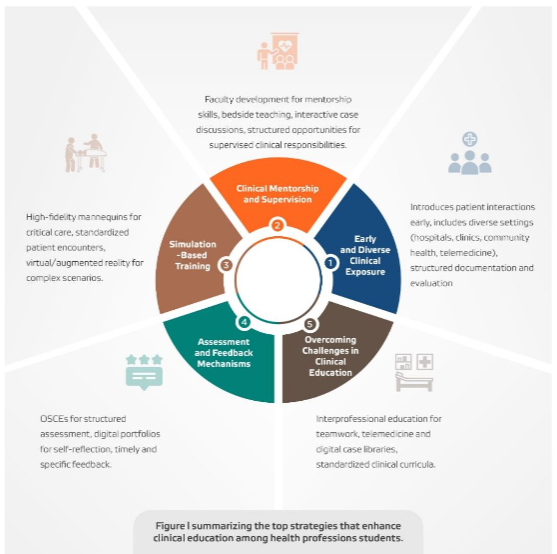
Conclusion and Future Direction
Students who participate in evidence-based clinical education programs that combine early clinical practice with digital resources and simulation have better healthcare job chances. They learn basic healthcare facts, how to connect with patients, and how to work in groups through theoretical instruction and hands-on practice. Educational leaders should use key strategies to produce self-assured healthcare workers despite limited resources and diverse practical training scenarios. These initiatives will educate students on essential skills for future healthcare systems and assist schools in fulfilling current healthcare needs.
Artificial intelligence and augmented reality should be studied more in clinical teaching methods. Students improve modern simulation training technologies by using realistic learning environments. Future research should evaluate how early clinical experience and simulation training influence long-term patient outcomes and the provision of healthcare services. Healthcare facilities’ ability to sufficiently equip their students to cope with changes in the healthcare scene through the continuous development of clinical education techniques and new technological breakthroughs, better patient care and safety results will be possible in the future.
Conflict of Interest:
The author declares that there is no conflict of interest concerning the publication of this article.
Funding Statement:
This paper received no external funding.
Acknowledgements:
None.
References:
- Benner P, Hughes RG, Sutphen M. Clinical Reasoning, Decisionmaking, and Action: Thinking Critically and Clinically. In: Hughes RG, ed. Patient Safety and Quality: An Evidence-Based Handbook for Nurses. Advances in Patient Safety. Agency for Healthcare Research and Quality (US); 2008. Accessed March 16, 2025. http://www.ncbi.nlm.nih.gov/books/NBK2643/
- Buja LM. Medical education today: all that glitters is not gold. BMC Medical Education. 2019;19(1):110. doi:10.1186/s12909-019-1535-9
- Hays RB, Ramani S, Hassell A. Healthcare systems and the sciences of health professional education. Adv Health Sci Educ Theory Pract. 2020;25(5):1149-1162. doi:10.1007/s10459-020-10010-1
- Mochizuki A, Tajima HT, Nobuoka S, Ino M. Early Exposure of Medical Students to Types of Patient Care Provided Across Life Cycle Stages. MedEdPublish. 2019;8:151. doi:10.15694/mep.2019.000151.1
- Portela Dos Santos O, Melly P, Hilfiker R, et al. Effectiveness of Educational Interventions to Increase Skills in Evidence-Based Practice among Nurses: The EDITcare Systematic Review. Healthcare (Basel). 2022;10(11):2204. doi:10.3390/healthcare10112204
- Elendu C, Amaechi DC, Okatta AU, et al. The impact of simulation-based training in medical education: A review. Medicine. 2024;103(27):e38813. doi:10.1097/MD.0000000000038813
- Koukourikos K, Tsaloglidou A, Kourkouta L, et al. Simulation in Clinical Nursing Education. Acta Inform Med. 2021;29(1):15-20. doi:10.5455/aim.2021.29.15-20
- Lam TP, Irwin M, Chow LWC, Chan P. Early introduction of clinical skills teaching in a medical curriculum–factors affecting students’ learning. Med Educ. 2002;36(3):233-240. doi:10.1046/j.1365-2923.2002.01142.x
- Prianto A, Qomariyah UN, Firman F. Does Student Involvement in Practical Learning Strengthen Deeper Learning Competencies? International Journal of Learning, Teaching and Educational Research. 2022;21(2). Accessed March 16, 2025. https://ijlter.org/index.php/ijlter/article/view/4897
- Ayaz O, Ismail FW. Healthcare Simulation: A Key to the Future of Medical Education – A Review. Adv Med Educ Pract. 2022;13:301-308. doi:10.2147/AMEP.S353777
- Singh K, Alomari AMA, Sayed HMA, et al. Barriers and Solutions to the Gap between Theory and Practice in Nursing Services: A Systematic Review of Qualitative Evidence. Nursing Forum. 2024;2024(1):7522900. doi:10.1155/2024/7522900
- Institute of Medicine (US) Committee on the Health Professions Education Summit. Health Professions Education: A Bridge to Quality. (Greiner AC, Knebel E, eds.). National Academies Press (US); 2003. Accessed March 16, 2025. http://www.ncbi.nlm.nih.gov/books/NBK221528/
- Promoting Excellence in Clinical Teaching. J Coll Physicians Surg Pak. Published online July 1, 2023:719-721. doi:10.29271/jcpsp.2023.07.719
- Ebrahimi S, Kojuri J, Ashkani-Esfahani S. Early Clinical Experience: A Way for Preparing Students for Clinical Setting. Galen Medical Journal. 2012;1(2):e15-e15. doi:10.31661/gmj.v1i2.15
- Sarabi N, Yazdi F, Hamidipour N. Effect of early clinical exposure on communication, history-taking, and nursing diagnosis skills: A brief report. Journal of Education and Health Promotion. 2025;14(1):77. doi:10.4103/jehp.jehp_208_24
- Weston LE, Krein SL, Harrod M. Using observation to better understand the healthcare context. Qual Res Med Healthc. 2022;5(3):9821. doi:10.4081/qrmh.2021.9821
- Tayade MC, Latti RG. Effectiveness of early clinical exposure in medical education: Settings and scientific theories – Review. J Educ Health Promot. 2021;10:117. doi:10.4103/jehp.jehp_988_20
- Yu JH, Chang HJ, Kim SS, et al. Effects of high-fidelity simulation education on medical students’ anxiety and confidence. PLoS One. 2021;16(5):e0251078. doi:10.1371/journal.pone.0251078
- K RR, Saini SK. Critical Thinking and Decision Making: Essential Skills in Nursing. Int J Res Pharm Sci. 2022;13(1):61-67. doi:10.26452/ijrps.v13i1.21
- Littlewood S, Ypinazar V, Margolis SA, Scherpbier A, Spencer J, Dornan T. Early practical experience and the social responsiveness of clinical education: systematic review. BMJ. 2005;331(7513):387-391. doi:10.1136/bmj.331.7513.387
- Michael Nnaemeka Ajemba, Chinweike Ikwe, Judith Chioma Iroanya. Effectiveness of simulation-based training in medical education: Assessing the impact of simulation-based training on clinical skills acquisition and retention: A systematic review. World J Adv Res Rev. 2024;21(1):1833-1843. doi:10.30574/wjarr.2024.21.1.0163
- Owen H. Early use of simulation in medical education. Simul Healthc. 2012;7(2):102-116. doi:10.1097/SIH.0b013e3182415a91
- Chun X, Edwards AAN. Mentorship as a Strategy for the Professional Development of Novice Teachers: A Case Study of a Class of International Student Teachers in China. Eur J Teach Educ. 2025;7(1):38-60. doi:10.33422/ejte.v7i1.1446
- Barry A, Shahbaz A. The challenges and opportunities clinical education in the context of psychological, educational and therapeutic dimensions in teaching hospital. BMC Med Educ. 2025;25:154. doi:10.1186/s12909-025-06711-z
- Ewnte B, Yigzaw T. Early clinical exposure in medical education: the experience from Debre Tabor University. BMC Medical Education. 2023;23(1):252. doi:10.1186/s12909-023-04221-4
- Kaminski A, Falls G, Parikh PP. Clerkship Experiences During Medical School: Influence on Specialty Decision. MedSciEduc. 2021;31(3):1109-1114. doi:10.1007/s40670-021-01281-3
- Kouijzer MMTE, Kip H, Bouman YHA, Kelders SM. Implementation of virtual reality in healthcare: a scoping review on the implementation process of virtual reality in various healthcare settings. Implement Sci Commun. 2023;4:67. doi:10.1186/s43058-023-00442-2
- Challa KT, Sayed A, Acharya Y. Modern techniques of teaching and learning in medical education: a descriptive literature review. MedEdPublish (2016). 2021;10:18. doi:10.15694/mep.2021.000018.1
- Flanagan OL, Cummings KM. Standardized Patients in Medical Education: A Review of the Literature. Cureus. 15(7):e42027. doi:10.7759/cureus.42027
- Alayande BT, Forbes C, Masimbi O, et al. The Implementation of Simulation-Based Learning for Training Undergraduate Medical Students in Essential Surgical Care Across Sub-Saharan Africa: a Scoping Review. Med Sci Educ. 2023;34(1):237-256. doi:10.1007/s40670-023-01898-6
- Leal-Costa C, Carrasco-Guirao JJ, Adánez-Martínez MG, et al. Does Clinical Simulation Learning Enhance Evidence-Based Practice? A Quasi-Experimental Study Involving Nursing Students. Clinical Simulation in Nursing. 2024;87:101494. doi:10.1016/j.ecns.2023.101494
- Le KDR. Principles of Effective Simulation-Based Teaching Sessions in Medical Education: A Narrative Review. Cureus. 2023;15(11):e49159. doi:10.7759/cureus.49159
- Chen M, Downing L. Using Simulations to Enhance Students’ Learning in Management Accounting. Journal of Hospitality & Tourism Education. Published online October 1, 2006. Accessed March 17, 2025. https://www.tandfonline.com/doi/abs/10.1080/10963758.2006.10696872
- Schram A, Bonne NL, Henriksen TB, Paltved C, Hertel NT, Lindhard MS. Simulation-based team training for healthcare professionals in pediatric departments: study protocol for a nonrandomized controlled trial. BMC Medical Education. 2024;24(1):607. doi:10.1186/s12909-024-05602-z
- Bendowska A, Baum E. The Significance of Cooperation in Interdisciplinary Health Care Teams as Perceived by Polish Medical Students. Int J Environ Res Public Health. 2023;20(2):954. doi:10.3390/ijerph20020954
- Walls R, Nageswaran P, Cowell A, et al. Virtual reality as an engaging and enjoyable method for delivering emergency clinical simulation training: a prospective, interventional study of medical undergraduates. BMC Medicine. 2024;22(1):222. doi:10.1186/s12916-024-03433-9
- Ryoo EN, Ha EH. The Importance of Debriefing in Simulation-Based Learning: Comparison Between Debriefing and No Debriefing. CIN: Computers, Informatics, Nursing. 2015;33(12):538. doi:10.1097/CIN.0000000000000194
- Abraham R, Singaram VS. Self and peer feedback engagement and receptivity among medical students with varied academic performance in the clinical skills laboratory. BMC Med Educ. 2024;24:1065. doi:10.1186/s12909-024-06084-9
- Dhar E, Upadhyay U, Huang Y, et al. A scoping review to assess the effects of virtual reality in medical education and clinical care. Digit Health. 2023;9:20552076231158022. doi:10.1177/20552076231158022
- Mackay EC, Patel KR, Davidson C, et al. Simulation as an effective means of preparing trainees for active participation in MDT meetings. Future Healthc J. 2024;11(1):100017. doi:10.1016/j.fhj.2024.100017
- Griswold S, Ponnuru S, Nishisaki A, et al. The Emerging Role of Simulation Education to Achieve Patient Safety. Pediatric Clinics of North America. 2012;59(6):1329-1340. doi:10.1016/j.pcl.2012.09.004
- Channa S, Topping A, Willis C, Melody T, Pearce R. Clinical learning experiences of healthcare professional students in a student-led clinical learning environment (SLCLE) –A mixed methods evaluation. Nurse Education in Practice. 2024;79:104035. doi:10.1016/j.nepr.2024.104035
- Georgieva-Tsaneva G, Serbezova I, Beloeva S. Application of Virtual Reality, Artificial Intelligence, and Other Innovative Technologies in Healthcare Education (Nursing and Midwifery Specialties): Challenges and Strategies. Education Sciences. 2025;15(1):11. doi:10.3390/educsci15010011