





Evolution of Feedback in Medical Education: 1983 vs. 2020
Feedback in Clinical Medical Education: Then vs. Now
Kimberly Stowers, MD1; Kathleen Timme, MD2, MEd; Angelo Giardino, MD, PhD3
OPEN ACCESS
PUBLISHED: 31 December 2024
CITATION: Stowers, K., Timme, K., et al., 2024. Feedback in Clinical Medical Education: Then vs. Now. Medical Research Archives, [online] 12(12). https://doi.org/10.18103/mra.v12i12.5946
COPYRIGHT: © 2024 European Society of Medicine. This is an open-access article distributed under the terms of the Creative Commons Attribution License, which permits unrestricted use, distribution, and reproduction in any medium, provided the original author and source are credited.
DOI https://doi.org/10.18103/mra.v12i12.5946
ISSN 2375-1924
ABSTRACT
Feedback is a challenging skill in clinical medical education and is critical to student learning and patient safety/outcomes. At the 40th anniversary of Dr. Jack Ende’s seminal paper on feedback, we ask what approaches and concepts have withstood the test of time and how the conversation on feedback has evolved for modern-day medical education. To answer this question, we performed a qualitative study, comparing text related to feedback in Dr. Ende’s historic 1983 article “Feedback in Clinical Medical Education” to 24 transcribed interviews of clinician-educators on the Teaching in Medicine podcast in 2020. We conducted a thematic analysis of the two data sets. In the 1980s, the case for feedback was just emerging with a focus on the lack of feedback given. Current conversations have gained complexity with new considerations given to bidirectional feedback and feedback in the context of unique settings. Certain concepts persist, with the importance of a safe learning environment at the forefront of discussions both then and now.
Keywords: feedback, medical education, podcasts
Introduction
Giving effective feedback is one of the most difficult yet necessary educational tasks. Who is responsible for providing it? How is it best delivered? Why is it important? Forty years ago, Dr. Jack Ende, an academic internal medicine physician, asked these same questions. His observations offered a framework for medical educators, highlighting the critical role of feedback for medical students and residents. The article considered business, psychology, and education literature and best practices to offer guidelines for feedback in the clinical learning environment. It is recognized as a landmark paper on this topic, has been cited 281 times by PubMed-indexed papers, and has over 1700 total citations. Reflecting on the impact of this seminal paper, we seek to identify what methods and viewpoints have withstood the test of time and, conversely, what has changed.
There is a myriad of resources available to allow for a better understanding of modern-day approaches to giving feedback and provide comparisons to Dr. Ende’s comments and recommendations. Literature review yields many best practice articles on how to give effective feedback. Interviews are another way to obtain in depth understanding of phenomena. Interviews can be conducted prospectively, transcribed, and analyzed for research purposes. Interviews can also be accessed retrospectively through multimedia resources and provide a lens into the interviewer and interviewee’s viewpoints. Podcasts provide repositories of interviews on a variety of topics and are accessible in the public domain. Scoping reviews considering articles on feedback in health professions education exist; however, we have yet to find a comparison between a seminal article and podcast interviews. This educational case study provides a novel comparison of a historic article on approaches to feedback to a modern-day series of medical education podcast interviews.
Podcasts are gaining recognition as an educational and entertainment medium. According to an Edison Research report from 2024, podcasts continue to rise in popularity, with 47% of Americans over age 12 listening to podcasts monthly. They are also widely used in medical education, with a reported 90% of resident physicians endorsing the use of podcasts as educational resources. Podcasts can be used to educate healthcare providers, trainees, and patients and can reach learners on the local, national, and even international level. Notably, during the year of this study, podcasts provided a safe, socially distanced learning option to accommodate COVID-19 pandemic restrictions. Podcast episodes can provide access to current viewpoints on a variety of topics in clinical medical education, including best practices in giving feedback to learners.
The Teaching in Medicine podcast is hosted by one of the authors of this paper (K.T.). The goal of the podcast is to explore effective approaches and best practices in medical education through interviews with education content experts. There were 24 episodes released in the first year of the podcast (2020), which function as a repository of audio-recorded interviews of clinician educators. The topic of feedback was explicitly discussed in the episode “Giving Effective Feedback” and emerged organically in other interviews. These discussions took place nearly 40 years after the historic paper by Dr. Ende. Through analysis of Dr. Ende’s manuscript and these modern-day podcast episodes, we were able to conduct an educational case study and consider how approaches to feedback have changed over time.
Materials and Methods
We performed a qualitative study using a constructivist paradigm, comparing text related to feedback in Dr. Ende’s article to discussions in the Teaching in Medicine podcast from 2020. There are several ways to obtain modern-day viewpoints and approaches to feedback in clinical education; individual interviews, focus groups, and surveys were considered. The Teaching in Medicine podcast was selected due to access to 24 audio-recorded interviews of clinician educators who were not explicitly prompted to comment on feedback in the majority of episodes. This allowed for consideration of organic conversations around the topic of feedback and inclusion of many different opinions on the topic, across a variety of specialties and levels of experience.
We listened to the 24 podcast interviews and transcribed all dialogue related to feedback. We conducted a thematic analysis of the two sets of qualitative data. We applied an inductive process and adhered to the six-step method outlined by Braun and Clarke in our assignment of codes and derivation of themes. Two investigators reviewed and independently coded the data, reached agreement on a final code book, and then individually assigned the appropriate codes. The two investigators then reviewed codes and compared approaches to feedback in the 1983 seminal article and 2020 podcast. Themes about the evolution of feedback were then derived.
Results
Of the 24 Teaching in Medicine podcast episodes, totaling 12 hours and 8 minutes of content, 41 minutes and 28 seconds (5.7%) were spent discussing feedback. Statements related to feedback were divided into 139 data points and then into 16 codes based on similarities of data points. Similarly, 87 data points were extracted from Dr. Ende’s paper and organized into 13 codes.
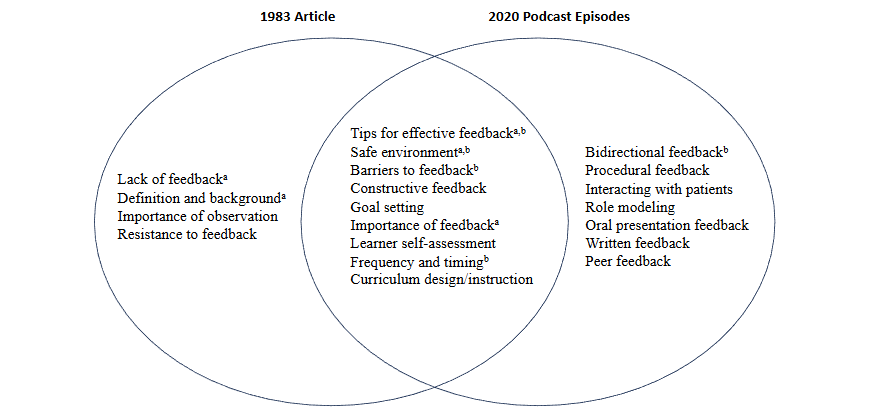
In Dr. Ende’s paper, the importance of feedback and lack of feedback were mentioned most, followed by tips for effective feedback, creating a safe learning environment, and definition and background on feedback. Although the importance of feedback was discussed in the podcast as well, it was only coded there 3 times as compared to 23 times in the Ende article. Lack of feedback was not discussed in the podcast, while it was the most common topic in the paper:
“Anxious about the impact of the information on the trainee … the well-intentioned teacher talks around the problem or uses such indirect statements as to obfuscate the message entirely. The student, fearing a negative evaluation, supports and reinforces the teacher’s avoidance. The result is that despite the best of intentions, nothing of any real value gets transmitted or received.”
In the podcast transcripts, tips for effective feedback, optimal frequency and timing, barriers to giving feedback, creating a safe learning environment, and bidirectional feedback were mentioned the most. Of these topics, bidirectional feedback was unique to the podcast data set and not mentioned in the article:
“Not only will you be providing them feedback, but you are also welcoming feedback from them. And I think that really helps them know that you’re not the only one giving feedback, and they’re not the only ones to improve.”
We also evaluated for feedback topics that came up frequently in both the article and podcast episodes. In Figure 1, common codes are listed in order of most to least overlap with effective feedback tips represented most often in both data sets. This tip came from the article:
“The information should deal with specifics, making use of real examples.”
A similar tip came from the podcast:
“Provide strategies for the learner to improve for next time. These strategies must be concrete, specific, and actionable.”
Discussion
Effective feedback is essential, as it brings insight to learners into their current level of clinical knowledge and skills. Additionally, the ability to give effective feedback is a critical skill for clinician educators to master as it allows their learners to make the necessary improvements that ultimately optimize patient care and outcomes. The importance of effective feedback was highlighted in Dr. Ende’s seminal paper in 1983 and continues to echo in the Teaching in Medicine podcast episodes in 2020. From our analysis, several themes became apparent about the evolving conversation on effective feedback in clinical medical education.
In the 1980s, the case for the importance of feedback was just being made. We may take this for granted in the 2020s, as most clinician-educators understand that this is an essential part of clinical education. The seminal 1983 paper defined feedback, discussed the lack of it, and advocated for observing and providing feedback to trainees. Resistance to feedback was also represented in the older data set but did not come up in more recent discussions. It seems that we are now in a place where feedback is commonplace and valued by all, but this was not always the case.
In the 2020s, the relationship between the giver and receiver of feedback has shifted. In the 1980s, feedback was delivered by educators to learners. Today, feedback is a bidirectional conversation in which educators and learners both seek to gain information that leads to improvement. Similarly, it is not only expected, but encouraged, for peers at various training levels to provide feedback to their peers. The nuances of providing feedback during clinical education are also an important part of the current conversation, including feedback following patient care experiences, during procedures, and in written and verbal forms.
Certain views on feedback have withstood the test of time. As educators, we have always been concerned with how to optimally give effective feedback and foster a psychologically safe learning environment. Difficult aspects such as barriers to providing effective feedback and how to give constructive feedback continue to challenge even the best of educators, suggesting that academic institutions may want to focus their faculty development efforts on these certain aspects/strategies of clinical feedback. Medical educators have an immeasurable impact on the next generation of healthcare professionals and efforts to support professional development are paramount.
There are limitations to this study, including analysis of only one historic article and one podcast series. We selected the Teaching in Medicine podcast given feasibility, permission to transcribe content, and access to interviews of clinician educators from multiple institutions. Future directions include in-depth interviews of clinician-educators to better understand the themes and further explore barriers to giving effective feedback and strategies to overcome them. Another future direction would be a scoping review comparing the evolution of approaches to feedback over time considering more resources from various time points. A strength of this study is the inclusion of multimedia resources and use of podcast interviews to provide a deeper understanding of educational practices. Future research should include a scoping review of print, audio, and video resources for a more thorough evaluation of the evolution of feedback.
At the 40th anniversary of Dr. Ende’s historical paper, there are aspects of the feedback dialogue that remain the same and others that have evolved over time. Feedback continues to be an important strategy to help healthcare providers improve clinically and professionally, although it is an evolving process. It will be interesting to see what the next 40 years have in store for this fascinating aspect of medical education as we continue to strive to improve the quality of clinical education.
Declaration of Interest
The authors have no conflicts of interest to declare.
The authors wish to thank Dr. Jack Ende for his seminal work in feedback.
References
- Ende J. Feedback in clinical medical education. JAMA. 1983;250(6):777-781.
- Ramani S, Krackov SK. Twelve tips for giving feedback effectively in the clinical environment. Medical Teacher. 2012;34:787-791.
- Burgess A, van Diggele C, Roberts C, Mellis C. Feedback in the clinical setting. BMC Medical Education. 2020;20(suppl 2),460.
- Orsini C, Rodrigues V, Tricio J, Rosel M. Common models and approaches for the clinical educator to plan effective feedback encounters. J Educ Eval Health Prof.2022;19:35.
- Soemantri D, Nurokhmanti H, Qomariyah N, Claramita M. The Practice of Feedback in Health Professions Education in the Hierarchical and Collectivistic Culture: a Scoping Review. Med Sci Educ. 2022;32(5):1219-1229.
- Fuentes-Cimma J, Sluijsmans D, Riquelme A, et al. Designing feedback processes in the workplace-based learning of undergraduate health professions education: a scoping review. BMC Medical Education. 2024;24:440.
- The Podcast Consumer 2024. Edison Research. Published May 16, 2024. Accessed November 5, 2024. https://www.edisonresearch.com/the-podcast-consumer-2024-by-edison-research/
- Purdy E, Thoma B, Bednarczyk J, Migneault D, Sherbino J. The use of free online educational resources by Canadian emergency medicine residents and program directors. CJEM. 2015;17(2):101-106.
- Tarchichi TR, Szymusiak J. Continuing medical education in the time of social distancing: The case for expanding podcast usage for continuing education. J Contin Educ Health Prof. 2021;41(1):70-74.
- Timme K. Teaching in Medicine Podcast. Accessed November 5, 2024. https://podcasters.spotify.com/pod/show/teachinginmedicine
- Kigler ME, Varpio L. Thematic analysis of qualitative data: AMEE Guide No. 131. Med Teach. 2020;42(8):846-854.
- Braun V, Clarke V. Using thematic analysis in psychology. Qual Res Psychol. 2006;3(2):77-101.
- Ajjawi R, Bearman M, Sheldrake M, et al. The influence of psychological safety on feedback conversations in general practice training. Med Educ. 2022;56(11):1096-1104.
- Chaou C-H, Monrouxe LV, Chang L-C, et al. Challenges of feedback provision in the workplace: A qualitative study of emergency medicine residents and teachers. Med Teach. 2017;39(11):1145-1153.
- Allsop S, McKinley RK, Douglass C, et al. Every doctor an educator? Med Teach. 2023;45(6):559-564.