






Exploring Biomedical Informatics and Mechanics Insights
The Biomedical Informatics and the Generalized Biomedical Mechanics: The new explorations of BMKI in these fields
Hanfei Bao1
- BMKI Lab, Retired Professor of Medical Informatics, Vancouver, Canada
OPEN ACCESS
PUBLISHED: 31 January 2025
CITATION: Bao, H., 2025. The Biomedical Informatics and the Generalized Biomedical Mechanics: The new explorations of BMKI in these fields. Medical Research Archives, [online] 13(1). https://doi.org/10.18103/mra.v13i1.6156
COPYRIGHT: © 2025 European Society of Medicine. This is an open-access article distributed under the terms of the Creative Commons Attribution License, which permits unrestricted use, distribution, and reproduction in any medium, provided the original author and source are credited.
DOI https://doi.org/10.18103/mra.v13i1.6156
ISSN: 2375-1924
Abstract
The paper discussed the promises and challenges in molecular biomedicines (MBMs) and their support discipline Biomedical Informatics (BMI) and investigated the possible underlying discipline the Generalized Biomedical Mechanics (GBMM) in order to seek for more understanding in MBMs. The latter is deemed to be the kingdom of phenomenology. Therefrom, a set of new concepts and principles such as the Structured Language Readable to Human and Machine, the philosophy-science interface, the semantic granule and pattern, the semi-closed or semi-isolated spaces, pan-cycle, the consuming-plus-absorbing law, the boundary principle of a ball-like cycle, the vibration-triggered pan-cycle, etc. were introduced. And also, the automatic semantic analysis and operation, the method of the expression of complex relation by ontology and the experimental project of the integration of the pan-cycle were described.
Keywords
general biology mechanics; ontology; Biomedical Informatics; Biomedicine Knowledge Integration (BMKI); the Structured Language Readable to Human and Machine (SLRHM); Pan-cycle; knowledge engineering; molecular biomedicines; automatic semantic operations and calculations; super-complex systems; non-linearity
1. Introduction
The investigation of the BMKI (Biomedicine Knowledge Integration) by the author is influenced by the philosophic view that concerns about the cognition issue “knowing more and understanding less (KMUL)” in the development of the molecular biomedicines (MBMs), which is guided by the reductionism philosophy. The rather chaotic pictures shown in the pandemic of COVID-19 strengthened this concern. As the author’s belief, beneath the understanding is the underlying mechanics. Those fundamental viewpoints above triggered the investigations of the Generalized Biomedical Mechanics (GBMM) in this paper.
The exploration of the GBMM is intended to discover the underlying mechanics or understandings beneath the massive phenomenal observations and discoveries of the MBMs, from the qualitative resources (QRs), usually expressed by the free-text, to the quantitative or data resources (QDRs), usually stored in data-bases. The explorations of the GBMM in the paper cover a list of so-called meta-science mechanics principles, including the principles about the dimension, the granulation and granule conversion, the semi-closed or semi-isolated spaces, the dimension paradox and harmony between the theoretical and real mechanics, the pan-cycles (its general form and the consuming-plus-absorbing law of free energy).
The explorations on the QRs leads to the study of the qualitative mechanics covering the Structured Language Readable to Human and Machine (SLRHM); the automatic semantics operations and computations; the conversion between the coarser granules and the finer granules and the developing of the relative programs; the investigation of a novel way to express the ternary or more compound relations by ontology. This paper studied also the theory of the pan-cycle which includes the role of the pan-cycle in the dimension paradox and harmony; the general form of pan-cycle; the vibration-triggered pan-cycle (VTPC). The project of Integration of Pan-cycles (IPCs) is an experimental one only currently and, given the fact that the pan-cycle is a key mechanism, the project is expected very much by the author to realize his dream of the integrated dynamic MBMs.
2. The promises and challenges in the molecular biomedicines
The MBMs have achieved greatly in the molecular area, such as the Human Genome Project (HGP), which made the sequences of the human genome clear, containing about 3*109 base pairs, and the great achievements in the Human Proteomics, etc. Such marvelous successes encourage us to expect the beautiful dreams in the MBMs. But we should realize clearly that those great successes did not provide us the critical understandings about their mechanics. The cancers and Alzheimer’s disease are still the stubborn diseases for the MBMs, not having been resolved as expected. And the rather chaotic pictures in the pandemic of COVID-19 also tell us that to reach that wonderful destination, we need more novel and theoretic insights into that MBMs, additional to the tremendous efforts of the phenomenal observations and measurements.
The MBMs are a huge grey box of knowledge (GBK), and a great deal of efforts of the researches and the massive publications (over 1.5 million each year scientific articles are published in the PubMed database) continuously add the new discoveries, which are usually partial and locally cleared phenomenal information or data, to the GBK, but the MBMs remain a GBK. The fact that the GBK growing bigger and bigger is not, always, a good thing. Knowing more will lead to doing more. Then the questions are raised: What is the moderate way? What is over treatment or over examination? These questions have no answers, especially when lacking “understanding”.
3. The promises and challenges in the Biomedical Informatics
The applications of the Bioinformatics (BMI, a combined name of the bioinformatics and medical informatics) has made the people’s eyes “fully occupied”. The recent reports in INTERNET said that the researchers at Stanford University set a record “for sequencing a human genome in 5 hours and 2 minutes”. In the BMI, the main successes include the fields: the Advances in Genomic Sequencing; AI and Machine Learning Applications; Single-Cell Genomics (about cell diversity in tissues, cancer biology, etc.); the integration of the various types of omics data (e.g. of the genomics, transcriptomics, proteomics, metabolomics); drug discovery, involving in the virtual screening and molecular docking studies, and others.
The highly developed information techniques are based on the emergence of the miraculous devices with the abilities of high-speedy and super-complex calculation and massive storage, and all sorts of data bases, programs and algorithms. Many extremely difficult methods of operations and calculations of information and data, which were unimaginable in old days, have been realized. Whereas the encouraging achievements have happened mainly in the large molecule fields and it is unimaginable that these great promises of BMI would be reached independent of the parallel advances at the higher organization levels such as the levels of the sub-cell, cell, cell society, organ, organ system, whole body and human society. An integration of the successes in both sides are inevitable. And many algorithms in the BMI, such as the sequence alignment, the genetic algorithm, the algorithm of simulated annealing, digital subtraction angiography, etc. belong to the physico-mathematics (PM), which are, in nature, the matter-to-matter or phenomenological analogy algorithms (PAAs). In one word, those PM algorithms lack “understanding”.
4. The exploration of mechanics theory of the MBMs
4.1 THE DIMENSION PARADOX BETWEEN THE THEORETICAL AND REAL SYSTEMS
The reference says the mechanics is “the area of physics concerned with the relationships between force, matter and motion among physical objects”. Theoretically, a set of dimensions determines a space. For instance, a Euclidean space is made up of the 3 dimensions, i.e. X, Y, Z axes. The ideal dimensions in a theoretical space may elongate infinitely. But in a physical or real world, all dimensions are material and limited in their sizes, e.g. the X, Y, Z axes, themselves, the volume, the temperature, the mass or weight, the concentration, etc. And an infiniteness of scale of a physical dimension usually unimaginable and implying a disaster or collapse of a physical system.
4.2 THE MBMS LACK THE FRAME OF MECHANICS
Except many those partial and less-connected mechanisms, the MBMs lack the frame of the systematic mechanics and its theories in a rigorous sense, and, essentially, they are the accumulations of the massive local observations of the phenomena.
4.3 WHAT IS THE SYSTEMIZED MECHANICS BENEATH THE COLORFUL MOTIONS
Let’s take the motion as the example. In a life system, there are massive motion forms at the different organizing levels. For examples, (i) at the whole-body level, the actions of our daily life, e.g. “going up stairs or down stairs”, “putting on more clothes when cold weather, and taking off when hot”, etc. (ii) at the anatomy-physiology systems level, we have the actions of the cardiovascular system, etc. (iii) at the cell level, there are “B lymphocyte produces antibody”, “the parietal cell secretes HCl”, etc. (iv) at large biological molecular level, we know “DNA stores instructions for making protein”, etc. (v) at general chemical molecule or ion level, we have the law “the concentration of hydrogen ions (H+) determines a Ph value”.
4.4 GBMM IS AT THE META-SCIENCE STAGE
The exploration of the BMKI was enlightened by the novel concept “the interface researches between philosophy and sciences” (or P-S level), raised by the late famous Chinese professor Xuemou Wu in his pioneering contribution . We will call the explorations at the P-S level as meta-science researches in the following text. As the author’s interpretation, the adventure at the P-S level is intended to find new scientific topics which are the efforts featured by both the universality of the philosophy and the concreteness of the sciences. Therefore, the expectation is those researches will go closer to the science and its methodology. And the great ambitions of the GBMM is to discover the seeds of the new sciences and that is why the novel principles raised by BMKI in this paper are thought belonging to the meta-sciences or meta-mechanics.
4.5 THE GENERAL FEATURES OF THE GBMM
Out of question, the MBMs are, like any systems in the world, based on and determined by the laws of classical or ideal mechanics, e.g. Newtonian mechanics in the physics and chemistry. And besides, as the super-organized and complicated systems, the GBMM of the MBMs involve much more sophisticated patterns or structured objects of the forces, motions, entities, etc. than those of the classical or ideal mechanics. Briefly, the GBMM would be charactered by the followings.
- Its force might be simple, complex, structured or compound at different organization levels (Ols);
- Its matter (or entity or substance) might be different at different OLs, life or non-life, static or dynamical, linear or nonlinear, the different semantic granules or patterns, in the quasi-zero-D, 1-D, 2-D, 3-D, multi-D spaces;
- The motion (or movement or action) in the GBMM might be (i) chemical reactions (substance generation or degeneration); (ii) the biological motions (DNA or cell duplication, human reproduction etc.), with different forms at different OLs; (iii) sophisticated regulations: activation or inactivation, strengthening or weakening; (iv) the diversity of motion shapes (procedures, cascades, pan-cycles, signal pathways etc.); (v) the complex space-dislocation (e.g. getting into or out a cell); (vi) the species evolution.
- Other organised dimensions include the homogenous, heterogenous, isolated or closed spaces, or the composite temporal and quantity dimensions.
5. The GBMM is a long scientific journey
As we known, the huge number of relations in the MBMs nowadays are the qualitative physical relations, like “DeficiencyOfVitaminC _causes_ Scurvy”, “Irbesartan _decreasses_ BloodPressure”, etc. and, in fact, which dominate the whole resources of the MBMs. It is impossible that the GBMM would be as rigorous or idealized as the theoretical mechanics, especially at the earliest stages of these efforts. We only expect to keep moving forward and closer to our destination. It would be an extremely long journey to close its dream destination. GBMM will face many challenges in the aspects: micro-and macro-level (from atom, through small molecule, large molecule, sub-cell, cell, tissue and organ, organ systems, to whole body), phenomenal and theoretical, qualitative and quantitative, static and dynamic, single and combination or super-combination. It is a beautiful dream to encourage us to trace the rigorous mechanics, rather than only to look for more and more information.
6. The semantics is a sort of qualitative mechanics
6.1 THE STRUCTURED LANGUAGE READABLE TO HUMAN AND MACHINE (SLRHM).
The BMKI has made much efforts to try to develop the formatted or structured language which is expected to express the knowledge of the MBMs and to be both machine-readable (and computable) and human-readable (and understandable). The language is called the Structured Language Readable to Human and Machine (SLRHM).
Given that fact, the resources of the knowledge bases (like ontology etc.) or data bases (like bases for genes and proteins etc.) are usually easy to be red by machine and the resources expressed by the free-text are ready to be red by human being, thus the resources by SLRHM are taken as a bridge between the traditional natural-text based biomedical resources and the ontology (or other knowledge- or data- bases). The author hopes also that SLRHM to be equipped with the functions of auto-composing or decomposing the knowledge expressions, and even auto-analyzing and auto-computing their semantics. This paper presented some relative primary works of program development and the examples for SLRHM resource, from the simplest binary relations to their composite form with more complex structure.
6.2 THE GRANULARITY CONVERSION IN SEMANTICAL COMPUTING
The granularity of an expression refers to how much or at which macro- or micro- levels the content of an object is detailed. A conversion from a coarser expression to a finer one (C-to-F conversion) means the process of turning an expression with coarser granularity (or less detailed) to one with finer (or more detailed) granularity. And the inverse conversion or F-to-C goes oppositely, i.e. from an expression with finer granularity to a form with coarser granularity or even a black box, with nothing detailed content inside being interested in. Let’s look at a simplest example. Suppose we have two expressions: 1. “Wood is combustible”; 2. “Dry wood is combustible in air.” Obviously, in the two expressions above, the (2) is more detailed than (1). The granularity is determined usually by the cognition needs, and, sometimes, by the knowledge limitations about the physical world, as well.
6.3 THE SLRHM EXPRESSION AND GRANULARITY COMPUTING
Let’s look at the process from a knowledge expression based on free text to a SLRHM one and the granularity changes, meanwhile. Here we have an original natural text expressed form: i. “RNA-PolymeraseII regulates positively the transcription of DNA synthesizes Precursors of mRNA”; ii. “RNA-PolymeraseII regulates positively the transcription of DNA synthesizes Precursors of snRNA”; iii. “RNA-PolymeraseII regulates positively the transcription of DNA synthesizes Precursors of microRNA”; iv. The (i), (ii), (iii) above are done by “the phosphorylation of CTD of larger subunit of RNA-PolymeraseII”. The SLRHM expression form for above (i),(ii),(iii),(iv) would be (RNA-PolymeraseII_regulatesPositively_(Transcription_of_(DNA_synthesizes_PrecursorsOfmRNA))_or_(Transcription_of_(DNA_synthesizes_PrecursorsOf-snRNA))_or_(Transcription_of_(DNA_synthesizes_PrecursorsOf-microRNA))) _byMeansOf_ (PhosphorylationOfCTD-OfLargerSubUnitOfRNA-PolymeraseII). Let’s call this expression the “expr-example-1”. This expression is able to be simplified to a form “G1 _byMeansOf_ G2”, G1 and G2 are two granules in the semantics of the expression, because only relationship “_byMeansOf_” has a space before and after. Each pair of (…) would be a semantic granule and then there are 8 granules in the whole structured and composite expression; And we may pay or not pay attentions to the inside contents, dependent of the semantics needs.
6.4 THE PROGRAM DEVELOPED FOR C-TO-F CONVERSION OF GRANULARITY BASED ON THE SLRHM
The automatic conversion from the coarser granularity into the finer one was done by a program developed by the author. Let’s have the knowledge expressed called “expr-example-2”, which is from the first part of the “expr-example-1”, as a target of the automatic conversion program: (RNA-PolymeraseII _regulatesPositively_ ((Transcription_of_(DNA_synthesizes_PrecursorsOfmRNA))_or_(Transcription_of_(DNA_synthesizes_PrecursorsOf-snRNA))_or_(Transcription_of_(DNA_synthesizes_PrecursorsOf-microRNA))), The format of above “expr-example-2” is a binary relation “E1 _regulatesPositively_ E2”. Though running a program, the output of step 1-1 is: Transcription _of_ (DNA_synthesizes_PrecursorsOfmRNA); And that of step 1-2 is: Transcription _of_ (DNA_synthesizes_PrecursorsOf-snRNA); And that of step 1-3 is: Transcription _of_ (DNA_synthesizes_PrecursorsOf-microRNA). That output of step 2-1 is: DNA _synthesizes_ PrecursorsOfmRNA; And that of step 2-2 is: DNA _synthesizes_ PrecursorsOf-snRNA; And that of step 2-3 is: DNA _synthesizes_ PrecursorsOf-microRNA. Finally at step 3, we achieved the much more detailed output set of the binary relations, which will be shown in Figure 6-1. For a complete hierarchical figure, some of most basic binary relations at this stage are completed in man-made way by the author, not automatically done by a program, because these relations are not included in the “expr-example-2”, right now. These relations are FinerConcept _includes_ DNA, FinerConcept _includes_ Transcription, Transcription _subsumes_ TranscriptionOf(DNA_synthesizes_PrecursorsOfmRNA), Transcription _subsumes_ TranscriptionOf(DNA_synthesizes_PrecursorsOf-snRNA), Transcription _subsumes_ TranscriptionOf(DNA_synthesizes_PrecursorsOf-microRNA), DNA _synthesizes_ PrecursorsOfmRNA, DNA _synthesizes_ PrecursorsOf-snRNA, DNA _synthesizes_ PrecursorsOf-microRNA.

7. The investigation of the mechanics in text-based resources
7.1 HOW TO EXPRESS MORE COMPLEX KNOWLEDGE—A NOVEL WAY TO EXPRESS THE TERNARY OR MORE COMPOUND RELATIONS BY ONTOLOGY
An Ontology is used to build a structured and machine readable and operatable knowledge base, mainly for the free-text resources. In OWL or Protage, the knowledge is, exclusively, expressed by the form of binary relations and has a common form like” A_relation_B”), rather than any ternary or more complicatedly compounded relations. Whereas the complicated or higher-ordered combinations of relations are ubiquitous in the biomedicines, through various relationships natured by substance, space, time or procedure, etc. Thus, there are the big challenges for ontology (and other similar type of data bases, as well) to express the biomedical knowledge in the sophisticated combinations.
When we develop an ontology for a particular biomedical field, such as HIV/AIDS, we are able to use so called the restrictions to define or describe a class, for example, we may give a class a restriction “_hasColour_ Red” as its feature. Those restrictions are called anonymous classes, perhaps, because of being expressed as statements rather than class names as we usually do. An anonymous class is able to be taken as one superclass of that very class on which we are working, due to the rule that any restrictions or features you give will be inherited to all the descendant classes. Thus a restriction is, in fact, a “single-feature-class”. The paper made an exploration to this topic. For simplicity, the author uses a formalized way to describe one of the most common seen compounded-relations or ternary relations: (A_rel1_B)_rel2_C. Here the classes A and B are linked by a relationship rel1, making a binary relation, and then the binary relation (A_rel1_B), as a whole, is linked further to C by rel2. Here is n real example of the ternary relation: “(p55FullNameGagPrecursorProtein_isCleavedInto_(MA_and_CA_and_SP1_and_NC_and_SP2_and_P6)) _isCatalzedBy_ Protease”. To express a ternary relation in ontology, the author would present a novel way to deal with the issue as the following.
In a class hierarchy, a new type of class called the Relation-natured Entities (REs) …\ConceptTransformedFromRelation (RE1) is created for the purpose to make a binary relation into an entity-like concept (a 2-to-1 transformation). The new class subsumes, further, “…\RelationNaturedEntity1From-p55” (RE2). Afterward, when describing a restriction for p55FullNameGagPrecursorProtein(EE0), linked by a physical relationship “isCleavedInto”(prel1), a new operational relationship “hasTransformationHereFromRelationToEntity”(orel1) is introduced to share the same subject “p55FullNameGagPrecursorProtein”. Thus, the class p55FullNameGagPrecursorProtein has two relations as its restrictions: one is a physical relation linked by “isCleavedInto”, another is operational relation linked by “hasTransformationHereFromRelationToEntity” with an operational entity as its object i.e. “RelationNaturedEntity1From-p55” (RE3). At last, “RelationNaturedEntity1From-p55” (RE3) is added by a restriction “_isCatalyzedBy(prel2) _ some PR-FullNameProteaseAlsoName-p10(EEx)”. Totally, the process has the following steps: 1. To create the Relation-natured Entity RE1; 2. To express “RE1_subsumes_RE2”; 3. To make EE0 have a restriction (_prel1_(EE1_and_EE2_and_…))_and_(_orel1_ RE3) to define the combination of the two; To make RE3 have a restriction (_prel2_EEx); 4. to reach the result of the ternary relation: (EE0_prel1_(EE1_and_EE2_and_…))_and_([]_prel2_ EEx), here ‘[]’ indicates “the front relation”.


8. The theory of the pan-cycle
8.1 THE SIGNIFICANCE OF PAN-CYCLE IN THE BIOLOGICAL EVOLUTION
The cycle is an amazing and unique motion. As the author described in his book, that a cycle exists in a quasi-zero-dimension space, where the driving dimension acts infinitely but never extends infinitely. The motion returns back to its starting point repeatedly. The pan-cycle is a such a magical mechanism which can avoid “the risk of infinity” or the exhaustion of the resource. A cycle is featured by both entity and event, the attributes of material help keeping and reserving the information having gotten in the biologic evolution and the attributes of motion help a species adapting new situation and getting new information. That explain its importance in the self-organization. Some scientists hold the belief that without cycles, there would be no self-organization, no lives, and no biological evolution, as well. The pan-cycle theory explored in this paper mainly discussed some features at the P-S interface and the ubiquity of pan-cycles in GBMM.
8.2 THE THEORY OF PAN-CYCLE AND MANFRED EIGEN’S HYPERCYCLE THEORY
Manfred Eigen presented Hypercycle Theory and some scientists deemed that hypercycle is the fundamental mechanism of the biologic evolution. The hypercycle is driven by a series of enzyme-catalyzed cycles. Those cycles connect each other to make the higher-ordered cycles. The pan-cycle theory pays its attention to the ubiquity of the cycle motions in the MBMs and, especially, to the theory, methodology and project of their integration. As we know, the enzyme can not change the thermodynamic second law, which says that a spontaneous reaction will follow the principle of minimum energy, releasing the free energy as it carries out. The law implies that a cycle motion would reduce its free energy continuously during a spontaneous course and never comes back to its starting point to finish a loop, if without supplementing its free energy at some steps of the cycle from the outside world.
Thus, we may conclude that the composition of “releasing and absorbing” the free energy is ever necessary for any cycle system.
8.3 THE GENERAL FORM OF PAN-CYCLE (GFPC)
In the following, we would discuss the formatted pan-cycle in order to realize the automatic operations on them, at last. A GFPC presented here would be 𝑌 = 𝐹(𝑥𝑖) 𝑎𝑛𝑑 𝑌𝑖 = 𝑌𝑖−𝑐𝑠𝑡, where i = 1, 2, 3, …, standing for all steps of the never stopped running of a cycle, cst is constant, representing the total steps a cycle-motion has; 𝑌𝑖 and 𝑥𝑖 are the state values of the dependent and independent variable, respectively. F is the dynamic function. For example, in a female hormone cycle discussed in this paper, 𝑌𝑖 is the hormone level, 𝑥𝑖 is the day of the menstrual cycle, and F is the physiologic function which determines the fluctuation of the female hormone.
8.4 AN EXAMPLE FOR THE DIMENSION PARADOX AND ITS HARMONIZATION
A dimension in the Euclidean space corresponds to a variable in a real system and its infiniteness of a variable (or dimension) usually reminds us a variable (or dimension) awkwardness (or paradox), because of the “risk of infinity”. Whereas as stated by the author in his book, the cycle or circle is a miraculous motion, where the driving dimensions are quasi-zero-consumed. To simply, we take the blood circulation system of the human body as an instance. Figure 8-1 is a diagram of the blood circulation system of the human body, which illustrates that the space, which, as well known, is one of the determining dimensions of a system, would be a constant and never be exhausted, because of a “dimension loop”.

8.5 THE BOUNDARY PRINCIPLE OF A BALL-LIKE CYCLE
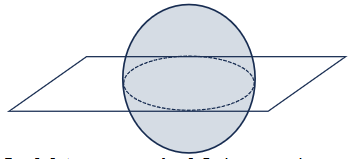
Any section made on a 3-D body, such as a cell, has a boundary cycle (see the cycle of the dashed line in Figure 8-2). Consequently, we might regard the boundary of a ball-like body as a 2-D cycle (the membrane) rather than a usual linear cycle. The ball-like space is a constructive mechanism for a closed or semi-closed room, facilitating the self-organization of the life systems being realized. The closed or semi-closed space (CSCS) refers to a 3-D object, which contains the basic mechanics factors (material and functional) and keeps those factors inside disconnected or semi-disconnected with outside environments. The existence of CSCS overcomes efficiently the huge chaos produced by the big mixture of those massive factors, assuming they share a single homogeneous space. That is to say the CSCS contributes to the highly organization or spatial diversity. Generally speaking, a boundary determines a CSCS and, theoretically, it is 1-D (or linear) one for a 2-D CSCS and 2-D (or membrane-like) one for a 3-D CSCS. An example of the linear boundary in a 2-D space is the boundary between two countries. The gravity force makes the surface of the earth into a 2-D space to guarantee the county boundaries functional. That explains why those species, which can overcome the gravity force like many birds, the boundary between the countries will lose its function for them. Many examples for the membrane-like boundaries could be listed in the human body, including cell membrane and blood vessel wall, skull, etc. which are quite familiar to us.
8.6 THE VIBRATION-TRIGGERED PAN-CYCLE (VTPC)
The VTPC means a determining dimension take a form of a vibration and is, therefore, called the vibration-triggered pan-cycle. The trigger point usually is a cycle or oscillation mechanism itself, where the strength or concentration of an activating factor (such as the electric potential) repeatedly reaches the activating threshold, making a motion occurring repeatedly. A typic example for the VTPC is the heart beating mechanism, which is a continuously repeated motion and controlled by an electrical signal. “This electrical signal is produced by a tiny structure known as the sinus node, located in the upper portion of the right atrium.” Each electrical impulse produced by the sinus node triggers one heartbeat and a correct conducting course, making the heart muscle contracting in a normal sequence.

9. The project of the integration of pan-cycles
9.1 THE OVERVIEW OF THE PROJECT OF PAN-CYCLE INTEGRATION (PCI)
The project is intended to integrate the observed ubiquitous pan-cycles in the human body. The ultimate goal of the project of PCI is an integrated virtual dynamic models of the human body made up by the pan-cycles and would be expected interact with the clinical practices and go closer and closer to the real dynamic body systems, from qualitative to quantitative, part by part. The project, right now, is at its very beginning and the experimental stage and this paper presents some examples of the pan-cycles integration for the human body, including the cycles at macro-level, and the menstrual cycle of female, at the molecule concentration level. Much efforts need to be done in the aspects of cell-signalling pathways and they would be discussed in the next publications.
9.2 THE DESCRIPTION OF THE PROJECT OF PCI
As an experimental work, the paper investigated about 35 biomedical cycles, including about 20 cycles at the macroscopical anatomy-physiology level and about 10 cycles at the molecular level, where some ones are quantitative. About the project, a network-like figure is made to show them visually.

9.3 THE CYCLE OF THE BLOOD LEVELS OF LH DURING THE MENSTRUATION
The blood levels of LH ordered by the days during the period of normal female menstrual cycle are shown, so, in nature, it is a state-description cycle. Table 9-1 shows the part of the order relations between the states about the reference range for LH in blood and day during the normal menstrual cycle and the data order in brackets lists hormone, day in normal menstrual cycle, value, blood level (of hormone), median, unit, respectively.
| LH | Day | Value | Blood Level | Median | Unit |
|---|---|---|---|---|---|
| -15 | 2.28 | BldLvl | Mdn | IU/L | |
| -8 | 4.96 | BldLvl | Mdn | IU/L | |
| -5 | 4.18 | BldLvl | Mdn | IU/L | |
| 12 | 3.42 | BldLvl | Mdn | IU/L | |
| 14 | 3.23 | BldLvl | Mdn | IU/L |
Figure 9-1 is a diagram showing the qualitative integration (logically and physically) at its experimental stage.
Discussion
The integration of the ontology involves two parts, the logical and physical. The logical part determined by the logical operators, such as “_subsumes” _ (the inverse is “_isA_”) is the logic integration. The work of this part includes the operation and computation of the “definition attribute set” (DAS) of class. As stated in reference, the class system evolves based on the DAS. It may be formalized as 𝐶i+1 = 𝐶i/(𝐷𝐴𝑆i+1 − 𝐷𝐴𝑆i), 𝑎𝑛𝑑 𝐷𝐴𝑆i ⊂ 𝐷𝐴𝑆i+1, where 𝐶i+1 and 𝐶i, are the son class and father class, respectively. The physical part is determined by the physical operators and its operations or calculations are also related to the physical attributes of the operators. Besides, this part needs to systemize its physical operator system. The integrations of the composite object would much more sophisticated.
References
- Rita González-Márquez, Luca Schmidt, Benjamin M. Schmidt, Philipp Berens, Dmitry Kobak: The landscape of biomedical research https://www.sciencedirect.com/science/article/pii/S266638992400076X
- 维基百科:生物資訊學, https://zh.wikipedia.org/zh-hk/%E7%94%9F%E7%89%A9%E4%BF%A1%E6%81%AF%E5%AD%A6
- 吴春艳,王靖飞,生物信息学及其主要数学算法 https://www.dtrends.com/Chinese/bioinfo_Harbin.pdf
- Benjamin Liu: Virtual Screening of Acetylcholinesterase-centered Inhibitors as Potential Therapies for Alzheimer’s Disease // European Journal of Biomedical and Life Sciences. 2024. №3. С. 46 – 74. URL: https://ppublishing.org/archive/publication/1209-virtual-screening-of-acetylcholinesterase-cen
- Kevin Doxzen:Record-breaking rapid DNA sequencing. It promises timely diagnosis for thousands of rare disease cases https://www.asbmb.org/asbmbtoday/science/022722/record-breaking-rapid-dna-sequencing
- Caroline Barranco: The Human Genome Project https://www.nature.com/articles/d42859-020-00101-9
- Hanfei Bao: (Book, In Chinese), ZheJiang University Press
- Wikipedia:Mechanics,https://www.google.ca/search?q=mechanics+definition&sca_esv=a276a5e6dcef4cbb&sca_upv=1&ei=-ZD7ZoaxLtan0PEP2ZWE6AY&start=10&sa=N&sstk=AagrsujKOxa2uGX7oyOAwvHORuXB4iJQX8Xm5ue7fdVI27VfysW_6iA7cJ1WDYan36mwcuYVSnViHwI19
- Hanfei Bao: The Theory of Biomedical Knowledge Integration(Ⅰ), Chinese Journal of Medical Treatment, 2(13): 1-6, 2003
- Hanfei Bao: The Theory of Biomedical Knowledge Integration(Ⅱ)—-What is underlying the domain concepts, Chinese Journal of Medical Treatment, 2(21): 1-6, 2003
- Hanfei Bao: The Theory of Biomedical Knowledge Integration (Ⅲ), Chinese Journal of Medical Treatment, Vol(3),No(7),2004
- Hanfei Bao: The Theory of Biomedical Knowledge Integration (Ⅳ), Medical Information, 18(6), 545-550, 2005
- Hanfei Bao: The Theory of Biomedical Knowledge Integration (Ⅴ)——The meta-dimensions and their combination of the General Linkage/Modifiers of SNOMED, Medical Information, 18(10): 1227-1232,2005
- Hanfei Bao: The Theory of Biomedical Knowledge Integration (Ⅵ), Medical Information, 19(2): 183-190,2006
- Hanfei Bao: The Theory of Biomedical Knowledge Integration (VII)—-The Non-Euclid Macro-Micro Transform Law, Medical Information, 19(11), 1899-1907, 2006
- Hanfei Bao: The Theory of Biomedical Knowledge Integration (VIII)——The Intrinsic Medical Informatics (IMI) and Meta-dimensions(MDs) of SNOMED, Medical Information, 21(7): 997-1002,2008
- Hanfei Bao: The Theory of Biomedical Knowledge Integration (IX) —-A venture in methodology for operations on the cognitive segment in HER, Medical Information, 21(7):1003-1010,2008
- 吴学谋:《从泛系观看世界》,中国人民大学出版社, 1990
- Hanfei Bao: The Generalized Biology Mechanics and the Molecule Biomedicines —-BMKI and SARS-CoV-2(I) https://www.researchgate.net/publication/371157215_The_Generalized_Biology_Mechanics_and_the_Molecule_Biomedicines_—-BMKI_and_SARS-CoV-2I#fullTextFileContent
- Hanfei Bao: he Automatic Semantic Operations and Calculations in the Molecular Biomedicines —-BMKI and SARS-CoV-2 (II) https://www.researchgate.net/publication/371157176_The_Automatic_Semantic_Operations_and_Calculations_in_the_Molecular_Biomedicines_—-BMKI_and_SARS-CoV-2_II
- Hanfei Bao: A Novel Way To Express The Complicated Knowledge On The Evolvements of The Biologic Factors Of HIV-1 In Ontology ——Discussion On HIV/AIDS Ontology(12) https://www.researchgate.net/publication/316560777_A_Novel_Way_To_Express_The_Complicated_Knowledge_On_The_Evolvements_of_The_Biologic_Factors_Of_HIV-1_In_Ontology_–Discussion_On_HIVAIDS_Ontology12
- Hanfei Bao: A Bridge Between Natural Language-And Ontology-based Biomedical Resources —-The Examples of Biomedical Knowledge Expressed by SLRHM I. The Structured Language Readable To Human And Machine (SLRHM) https://www.researchgate.net/publication/316598152_A_Bridge_Between_Natural_Language-And_Ontology-based_Biomedical_Resources_–The_Examples_of_Biomedical_Knowledge_Expressed_by_SLHMR_I_The_Structured_Language_Readable_To_Human_And_MachineSLHMR
- Protégé: A free, open-source ontology editor and framework for building intelligent systems https://protege.stanford.edu/
- Ilya Prigogine and Isabelle Stengers: < Order Out of Chaos: Man’s New Dialogue with Nature>, (in Chinese, translated by Qinghong Zeng, Xiaofeng Shen), Shanghai Translation Publishing House, 1988
- Manfred Eigen: Hypercycle theory, https://en.wikipedia.org/wiki/Hypercycle_(chemistry)
- 最小吉布斯自由能原理 https://baike.baidu.com/item/%E5%90%89%E5%B8%83%E6%96%AF%E8%87%AA%E7%94%B1%E8%83%BD/327614
- Principle of minimum energy https://en.wikipedia.org/wiki/Principle_of_minimum_energy
- Allison Soult:Gibbs Free Energy https://chem.libretexts.org/Bookshelves/Introductory_Chemistry/Chemistry_for_Allied_Health_(Soult)/11%3A_Properties_of_Reactions/11.05%3A_Spontaneous_Reactions_and_Free_Energy#:~:text=Spontaneous%20reactions%20release%20free%20energy,change%20and%20the%20entropy%20change.
- Richard N. Fogoros: The Heart’s Electrical System: Anatomy and Function Five components of electrical conduction make the heart beat https://www.verywellhealth.com/cardiac-electrical-system-how-the-heart-beats-1746299
- Jason S. Rawlings, Kristin M. Rosler, Douglas A. Harrison: The JAK/STAT signaling pathway https://journals.biologists.com/jcs/article/117/8/1281/28255/The-JAK-STAT-signaling-pathway
- ThermofisherScientific: JAK/STAT Pathway https://www.thermofisher.com/ca/en/home/life-science/antibodies/antibodies-learning-center/antibodies-resource-library/cell-signaling-pathways/jak-stat-pathway.html
- Lauren Dalton and Robin Young: Cell Signaling https://open.oregonstate.education/cellbiology/chapter/cell-signaling/
- NLM: General Principles of Cell Communication https://www.ncbi.nlm.nih.gov/books/NBK26813/
- Reto Stricker, Raphael Eberhart, Marie-Christine Chevailler, Frank A. Quinn, Paul Bischof and René Stricker: Establishment of detailed reference values for luteinizing hormone, follicle stimulating hormone, estradiol, and progesterone during different phases of the menstrual cycle on the Abbott ARCHITECTanalyzer https://www.researchgate.net/publication/7006350_Establishment_of_detailed_reference_values_for_luteinizing_hormone_follicle_stimulating_hormone_estradiol_and_progesterone_during_different_phases_of_the_menstrual_cycle_on_the_Abbott_ARCHITECTR_analyzer