






Femoral Head Insufficiency Fracture: A Case Study
Femoral Head Insufficiency Fracture after Overuse Injury; Case Report of a Rare Entity and Literature Review
Mohsin Usama M.D 1., Ahmed Al Ghaith M.D 1., Humaid Al Farid M.D 1., Wafa Al Baluki M.D. 1
- Department of Surgery, Orthopaedic division. Sultan Qaboos University Hospital. Muscat. Oman
OPEN ACCESS
PUBLISHED: 31 January 2024
CITATION Al Farli, H. 2023. Femoral Head Insufficiency Fracture after Overuse Injury; Case Report of a Rare Entity and Literature Review. Medical Research Archive, 1(1). https://doi.org/10.18143/mra.6148
COPYRIGHT: © 2025 European Society of Medicine. This is an open-access article distributed under the terms of the Creative Commons Attribution License, which permits unrestricted use, distribution, and reproduction in any medium, provided the original author and source are credited.
DOI: https://doi.org/10.18103/mra.v13i1.6148
ISSN 2375-1924
Abstract
Overuse injuries are a growing concern in youth participation in competitive sports, leading to physical load-related injuries. The skeletal maturity of young athletes plays a crucial role in their susceptibility to overuse injuries. The growth plate, a region of developing cartilage near the ends of long bones, is particularly vulnerable to stress during periods of rapid growth. Arnold et al. highlighted that the growth plate undergoes structural changes during maturation, which may weaken its anchoring points and make it more susceptible to injury. Additionally, the rate of bone mineralization may lag behind bone linear growth during pubescent growth spurts, contributing to the increased risk of injury.
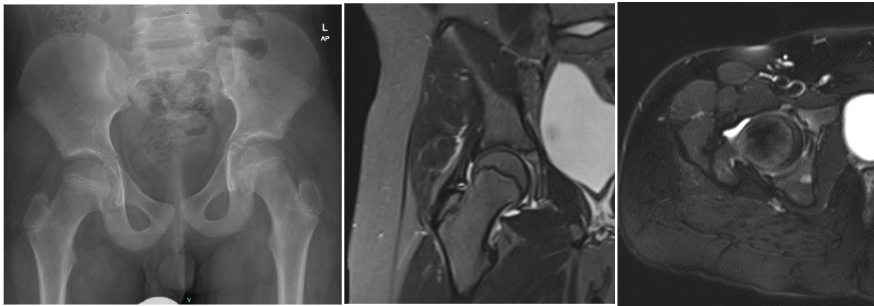
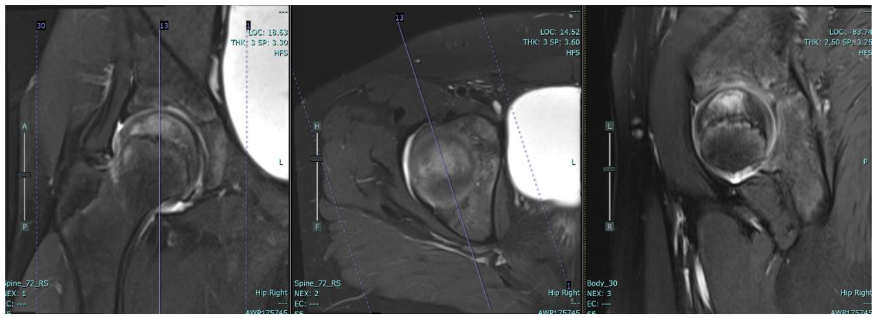
The location of overuse injuries can vary depending on the specific sport and the individual’s biomechanics. This case report discusses a rare instance of femoral head insufficiency fracture in a young gymnast, highlighting the need for awareness and early diagnosis in similar cases.
Keywords: femoral head insufficiency fracture, overuse injury, young athletes, growth plate, gymnastics
Introduction
Overuse injuries develop gradually over time without a specific traumatic event. They are more commonly reported as the cause of lower limb injuries in young athletes. The repetitive load associated with training sessions and competitions is challenging due to the mechanical stress placed on developing bones.
The growth plate, a region of developing cartilage near the ends of long bones, is particularly vulnerable to stress during periods of rapid growth. Arnold et al. highlighted that the growth plate undergoes structural changes during maturation, which may weaken its anchoring points and make it more susceptible to injury. Additionally, the rate of bone mineralization may lag behind linear growth during pubescent growth spurts, contributing to the increased risk of injury.
Discussion
In recent years, there has been a noticeable increase in youth participation in competitive sports, leading to physical load-related injuries and subsequent mechanical stress. The repetitive load can exceed the growth plate’s tolerance limit, resulting in changes in the immature skeleton. Post et al. showed increased overuse injuries among high school athletes in the U.S. The rate of overuse injuries reported in 2012-2013 was 1.64/10,000 athlete exposure, which increased to 6.67/10,000 athlete exposure based on the data collected from 2014-2015 through 2018-2019. Furthermore, Bell and colleagues identified the risk factor relative to overuse injuries, suggesting that young athletes are at a higher risk due to the ongoing development of their musculoskeletal system.
Diagnosing overuse injuries can be challenging, as they may mimic other conditions. Early recognition and intervention are critical to prevent long-term complications. In this case, the young gymnast presented with hip pain that was initially attributed to overtraining.

Conflict of Interest
All authors declare that they have no conflicts of interest.
Funding/sponsorship
No funding has been received to produce this work.
Patient/ Guardian Consent
A written consent obtained from the father to publish the case. No Clinical picture of the child is published.
References
1. Guerra MRA, Estelles JRD, Aboudiya YA, Paredes R, Posa JRP, Lentz F. Pediatric sports injuries: a review of the growth plate injury and subsequent mechanical stress. Acta Ortop Bras. 2016;24(4):204-207. doi:10.1177/0145561312461587.
2. DiFiori JP, Puffer JC, Aish B, Borer F. Wrist pain, distal radial physical injury, and ulnar variance in young gymnasts: Does a relationship exist? Am J Sports Med. 2002;30(6):879-885.
3. Arnold A, Thigpen CA, Beattie PF, Kissenbh M, Shanley E. Overuse physical injuries in youth athletes: Risk factors, prevention, and treatment strategies. J Athl Train. 2016;51(1): 52-63. doi:10.1177/191473181668467.
4. Staciokas C, Anson L, Levey Friedman H. et al. Pediatric sports injuries: A review. J Am Coll Surg. 2016;223(6): 915-925. doi:10.1177/0033343016642221.
5. Magrini D, Nussbaum ED, Rizzone KH, Brown NJ. Femoral neck bone stress injuries in pediatrics and adolescents: Diagnosis, etiology, and treatment. J Bone Joint Surg Am. 2021;103(2). doi:10.55275/JPOSNA-2021-0024.
6. Bencardino JT, Stone TL, Roberts CC, et al. ACR Appropriateness Criteria® Stress (fatigue/ insufficiency) fracture: excluding other vertebrae. J Am Coll Radiol. 2017;14(5): S293-S306.
7. Bernstein EL, Shay SH, Potter HG. Imaging of physical injury: Overuse. Sports Health. 2015;7(2): 142-153. doi:10.1177/1941738114568477.