





Fluorescent Mosquito Trap: Innovative Disease Control Solution
Fluorescent Mosquito Trap
Introduction
We have divided this paper into two main parts: the evolutionary journey of the trap and the experimental method to produce and validate its function.
About 1 decade ago, we published study showed that a boric-acid laced solution warmed at 37.5°C (the human body temperature); an artificial host could indeed kill 97% of a local female mosquito population.³ Later research comparing artificial hosts found that mosquitoes prefer the 42°C infrared footprint of birds first, 40°C infrared footprint of small mammals second, and 37.5°C of humans last.⁴
Mosquitoes do not “bite” in the traditional sense; rather, they slide their needle-like proboscises through microscopic openings on skin pores to draw blood. For they are known of inflicting the bite immediately right upon landing in such microscopic precision, we hypothesized that mosquitoes navigate toward skin pores by detecting water-vapor discharge. By enhancing the visibility of water vapor from a small, specific body of water, we can lure mosquitoes away from human hosts.
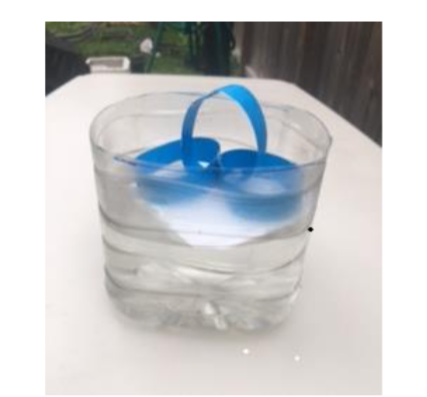
Early iterations of a blue mosquito trap were developed, and they were superior to thermal traps during the day but lost efficacy at night.⁵ ⁶ To address this limitation, we transitioned to fluorescence blue materials that utilize environmental UV light to emit blue photons. This creates a blue hue in daylight and a faint glow at night, assisting the keen vision of the insects. The final design utilizes 3 glow-in-the-dark blue wristbands on a thin flat float within a clear container of borax solution⁷, as shown in Figure 1.
FIGURE 1
Equipment and Methods
The objective of this experiment was to provide evidence of the trap’s efficacy. The study was conducted in a 1.5 m × 10 m alleyway to capture wild mosquitoes.
Equipment Setup
Figure 2 shows the equipment for the super trap system using a fluorescent blue trap as its daughter trap.
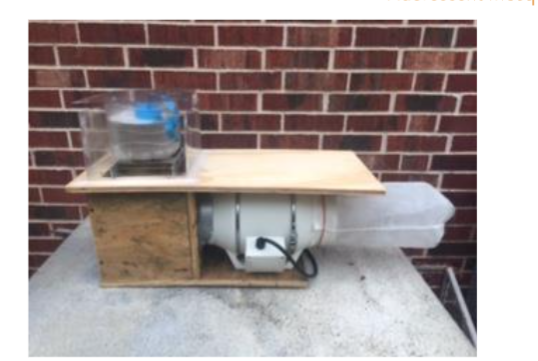
Figure 2
• Lure: The daughter trap was placed on a riser.
• Extraction: An intake mouth of a 6-inch inline duct fan was positioned to suck in mosquitoes attracted to the lure.
• Collection: A tube-like net was attached to the blowout end of the fan.
• Barriers: Transparent barriers and a cover plate were used to ensure the solution remained inaccessible to mosquitoes while remaining visible to the insects.
Procedure
The system was operated for 3 days. Fresh nets were exchanged at sunrise and sunset. Collected samples were placed in a freezer for 30 minutes then counted. A handheld camera was used to capture video evidence of mosquitoes choosing the trap over the camera operator as they were thrown onto the back end of the net.
Results
• YouTube video clip showing the result of the above mentioned procedure,
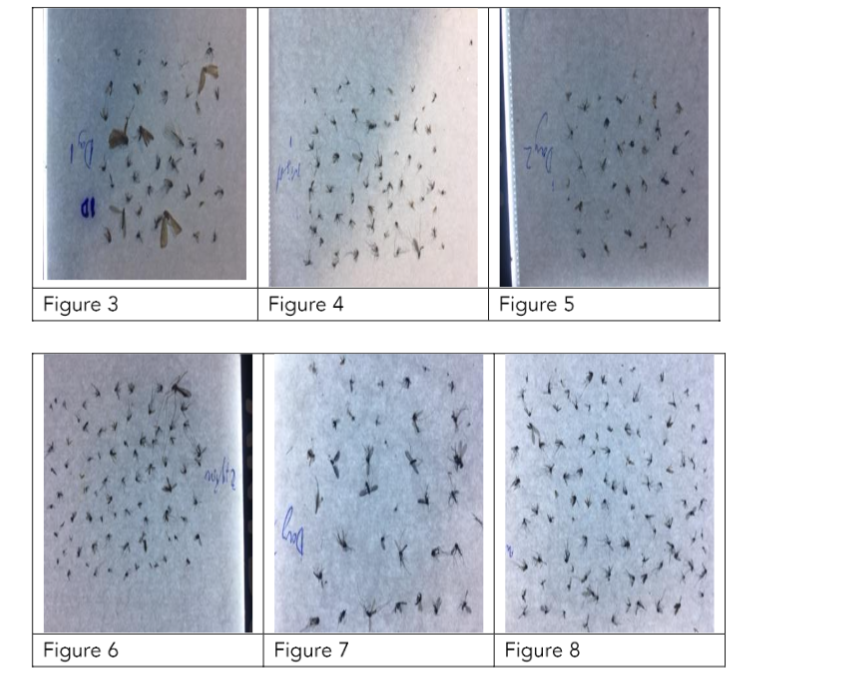
• For the full daytime operation from sunrise to sunset of Day 1, the system caught 39 mosquitoes, as shown in Figure 3.
• For the full nighttime operation from sunset to sunrise of Day 1, the system caught 54 mosquitoes, as shown in Figure 4.
• For the full daytime operation from sunrise to sunset of Day 2, the system caught 34 mosquitoes, as shown in Figure 5.
• For the full nighttime operation from sunset to sunrise of Day 2, the system caught 71 mosquitoes, as shown in Figure 6.
• For the full daytime operation from sunrise to sunset of Day 3, the system caught 34 mosquitoes, as shown in Figure 7.
• For the full nighttime operation from sunset to sunrise of Day 3, the system caught 105 mosquitoes, as shown in Figure 8.
Data Analysis
• Sex and maturity: Although some specimens were too small to identify the gender, all identifiable mosquitoes were females with empty stomachs meaning they were caught on their way to get a blood meal.
• Health impact: Because a single mosquito typically requires 3 to 4 bites to reach satiety, the removal of these insects reduces the local risk of disease transmission.
• Safety: Following the 3-day extraction, the experimental area was considered safe for human presence.
Discussion
The trap operates on visual principles; insects are attracted to water in the presence of fluorescent blue spectrum regardless of their point of origin, they get killed for consuming the solution.
• Effective radius: The trap is effective wherever the blue light is visible to the mosquitoes’ keen eyesight, going to the trap, they clear the place for human to come.
• Maintenance: The device is “set and forget,” requiring only occasional replenishment of evaporated water.
• Indoor use: Because the trap functions better during low-light conditions, it is suitable for indoor use.
• Safety of materials: The traps use borax as the killing agent, an inexpensive and safe consumer product in the United States. In many developing nations, borax is used as a food additive, ensuring it is safe for use around children and pets.
• Market availability: All materials required to build the trap are widely available on the market, ready for people to help themselves even mass deployments.
• Human preference: Evidence suggests that when a trap is placed 50 cm from a person, the insects consistently choose to go to the trap.
• As preventive measure: In term of mosquito-borne disease control, for the traps lure and kill only female, blood seeking mosquitoes, it belongs to the preventive side of the equation to helping people to avoid getting sick even though the public perhaps will welcome it as the mean addressing their immediate needs: to avoid seeing scary mosquitoes and to get more pleasures added to their welfares; doing so, they are indeed much needed helping hands in the fight against the spreading of the disease.
• Interllectual property: The intellectual property ownership of this work belongs to the Community and her members.
Conclusion
The Fluorescent Mosquito Trap is an innovative, cost-effective measure that works at all times in diverse environments. By intercepting female mosquitoes seeking a blood meal, the trap reduces the risk of malaria, Zika, and other viruses. Given its operation cost, the trap should be considered a primary tool for policy makers, philanthropies, and public-health officers in the global fight against mosquito-borne diseases.
Conflicts of Interest Statement:
The author declare that there are no conflicts of interest.
Funding Statement:
There was no funding of this research.
Acknowledgements:
None.
References
1. Mosquito-borne diseases control. Wikipedia. Accessed Month day, year.
https://en.wikipedia.org/wiki/Mosquito-borne_disease
2. Pfizer. Mosquito as deadly menace [Internet]. Available from https://www.pfizer.com
3. Tran P. Mosquito control, killing off the females. Open J Anim Sci. 2024;14:14-22.
doi:10.4236/ojas.2024.141002
4. Tran P. Mosquito control, alluring them away from humans. J Clin Images Rep. 2024;SRC/
JCIR-131. doi:doi.org/10.47363/JCIR/2024(3)124
5. Tran P. Female mosquitoes track to the hosts by the blue. Medical Research Archives. 2024;12(8). Accessed March 16, 2025. doi:https://doi.org/10.18103/mra.v12i8.5646
6. Tran, P. Malaria therapy, killing mosquitoes on their way to get infected blood meals. Medical Research Archives. 2025.;13(4) Accessed April 19, 2026.
doi: https://doi.org/10.18103/mra.v13i4.6407.
7. H. H. Schwardt, Borax as an Insecticide for Protecting Seed, Journal of Economic Entomology, Volume 23, Issue 2, 1 April 1930, Pages 401–404,
https://doi.org/10.1093/jee/23.2.401