

Forensic Protocols in Body Dismemberment Analysis
A Novel Protocol for the Forensic Investigation of Body Dismemberment: A Case Series and Report
Posa1, C. Trussardi2, M. Posa, V.1 Vener4, F. Sclavi5, M. Benzi6,
- F. Posa NeuroIntelligence – Institute for Ethical Criminological Research, 21100 Varese, Italy
- C. Trussardi NeuroIntelligence – Institute for Ethical Criminological Research, 21100 Varese, Italy
- M. Posa NeuroIntelligence – Institute for Ethical Criminological Research, 21100 Varese, Italy
- V. Vener NeuroIntelligence – Institute for Ethical Criminological Research, 21100 Varese, Italy
- F. Sclavi NeuroIntelligence – Institute for Ethical Criminological Research, 21100 Varese, Italy
- M. Benzi NeuroIntelligence – Institute for Ethical Criminological Research, 21100 Varese, Italy
OPEN ACCESS
PUBLISHED: Jul 25, 2025
CITATION:POSA, F. et al. A Novel Protocol for the Forensic Investigation of Body Dismemberment: A Case Series and Report. Medical Research Archives, [S.l.], v. 13, n. 7, july 2025. ISSN 2375-1924. Available at: <https://esmed.org/MRA/mra/article/view/6771>. Date accessed: 15 sep. 2025. doi: https://doi.org/10.18103/mra.v13i7.6771.
COPYRIGHT: © 2025 European Society of Medicine. This is an open-access article distributed under the terms of the Creative Commons Attribution License, which permits unrestricted use, distribution, and reproduction in any medium, provided the original author and source are credited.
DOI: https://doi.org/10.18103/mra.v13i7.6771.
ISSN 2375-1924
The phenomenon of “criminal dismemberment” has been highlighted by Holmes in 2017 to specifically refer to the act of homicide as it scarcely represents a significant indicator of underlying motives and psychological states of perpetrators, complicating investigative processes. To enrich the existing body of research on this subject, the present study aims to propose an innovative methodology based on a multifactorial behavior. This study seeks to address this gap by proposing an innovative, structured approach to the analysis of dismemberment cases. The methodology is structured into three key phases: 1. depth exploration of genetic and immunohistochemical evidence; 2. integration of psychological autopsy (PASIC, Psychological Autopsy of Suspects); and 3. forensic pathology.
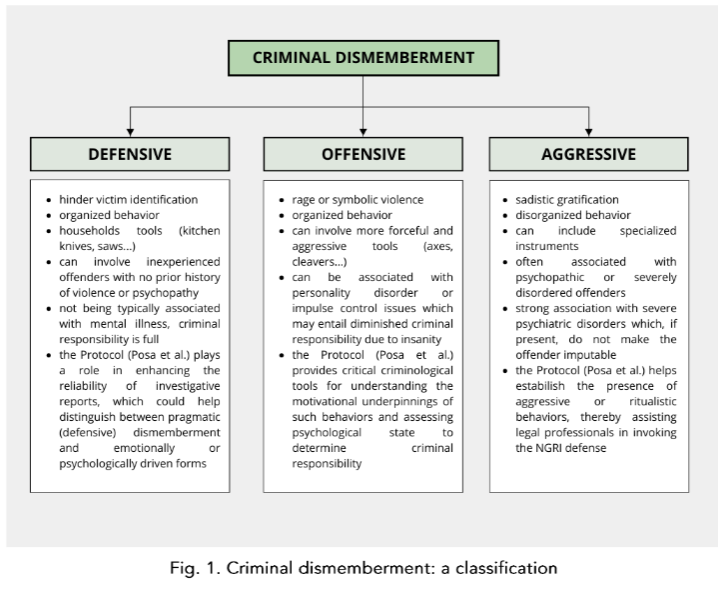
Case studies were conducted across academic, forensic, and national and international contexts, focusing on dismemberment cases. The study involved a comparative analysis of the different dismemberment modalities (defensive, offensive, and aggressive) within the context of the victims’ families.
Methods
In the second phase, pioneering a comprehensive and interdisciplinary approach to the forensic investigation of body dismemberment, the study methodology applied starting from the analysis of a series of twenty-two Italian cases pertaining to the period 1923–2022. Each case was subjected to a detailed forensic analysis combining traditional and innovative techniques, using the information available on the case.
This standardized procedure also incorporated the psychological autopsy approach based on the PASIC framework, which facilitated the reconstruction of individual psychological and pathological profiles. This analysis provided insights into the psychological factors and life circumstances that might have contributed to the act of dismemberment.
Results
Among the 22 Italian cases analyzed in this study, 18 were categorized as clear instances of defensive dismemberment, characterized by body fragmentation primarily aimed at concealment or obstruction of identification. These cases involved the use of bags, suitcases, rivers, or remote locations to dispose of remains, behavioral patterns consistent with previously established typologies in the literature. In one case, the dismemberment displayed features of offensive dismemberment, marked by potential sexual or sadistic motivations. However, the available evidence is insufficient to make a definitive conclusion regarding psychological intent or paraphilic elements. The remaining three cases could not be conclusively classified.
As for the U.S. victims, a total of eight cases were included, all involving biologically female individuals. The age was available in seven out of eight cases:
- The youngest victim was 14 years old
- The oldest was 80 years old
- The average age among those who reported ages was approximately 31 years
- Three victims (37.5%) were aged under 20
- Two victims (25%) were aged 31–40
In one U.S. case, the victim’s age was not publicly disclosed. All age information was derived from open-source or published data.
Anatomical Observation and Injury Pattern
This protocol integrates multifaceted methods that enhance the depth and accuracy of forensic assessments, aiming to elucidate the criminodynamics associated with dismemberment cases. Leveraging this structured methodology, investigators can achieve a more comprehensive understanding of victim identification and the circumstances surrounding the crime scene. Furthermore, the application of genetic and immunohistochemical analyses significantly bolsters the quality of evidence.
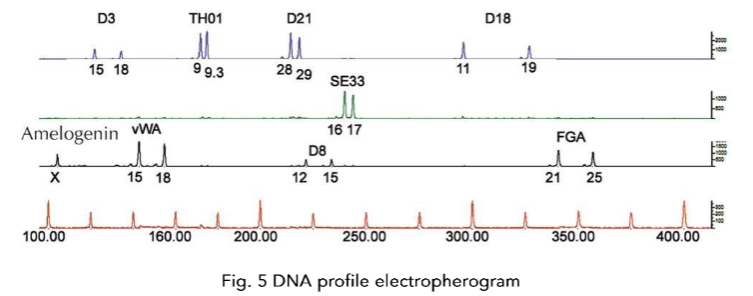
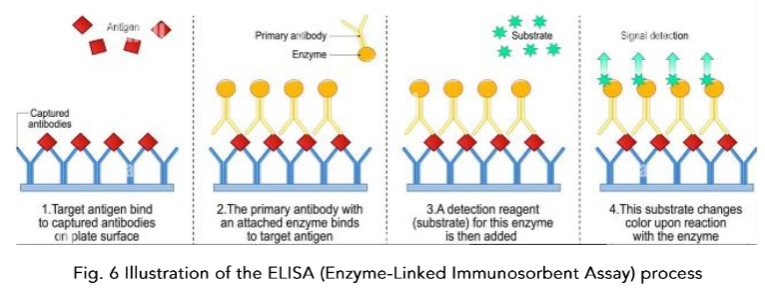
Genetic profiling is applicable in paternity testing, allowing for the identification of victims and suspects, including biological relatives. This method relies on the selective binding between an antibody and an antigen, coupled with a detection system (colorimetric, fluorescent, or electrochemical) that allows for the measurable identification of the target molecule. Various techniques are employed for immunochemical analyses; among these is the Enzyme-Linked Immunosorbent Assay (ELISA), an antibody sandwich technique used both qualitatively and quantitatively.
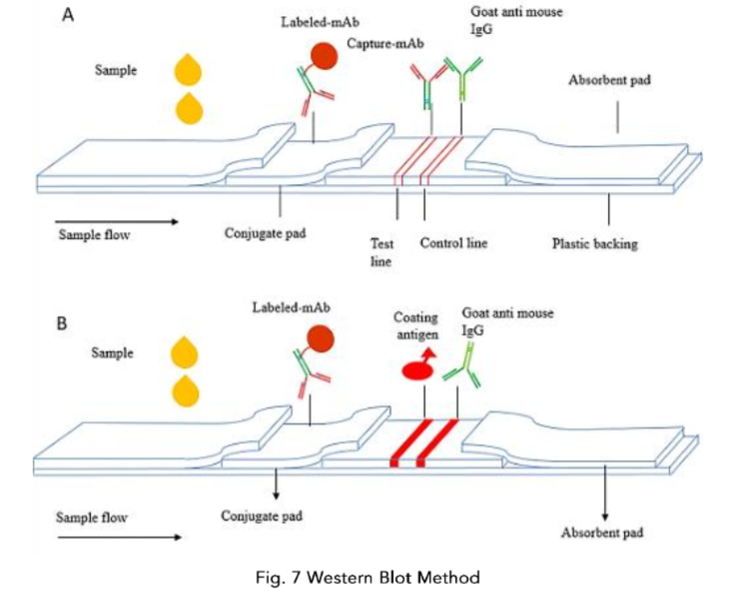
Another approach in forensic analysis is the Western Blot method. This test can be performed on samples from the victim or the individual, but it can also be used to identify specific proteins associated with dismemberment. This technique is particularly relevant for understanding the circumstances surrounding the act of dismemberment.
The Role of the Protocol in Judicial Police Activities
The legal aspects relevant to the present scientific study are derived from the utility that the Protocol may have in the context of criminal proceedings. This is particularly significant when considering that its application could contribute to enriching the scientific literature, which remains limited in terms of the phenomenological understanding of post-mortem dismemberment. A novel phenomenon in this field is primarily scholarly discourse in considering dismemberment as a therapeutic intervention.
In both civil law and common law systems, judicial activities are closely linked to the investigation of violent crimes. This study seeks to provide a comprehensive understanding of the circumstances surrounding dismemberment, revealing the demographic and behavioral patterns that could assist in the identification of offenders.
Conclusions
Recent studies on the phenomenon of post-mortem dismemberment, analyzing the demographic and behavioral patterns, have revealed that the integration of interdisciplinary approaches is necessary for understanding the complexities surrounding these crimes.
Ultimately, this study seeks not only to enrich scientific knowledge but also to promote methodological rigor in the investigation of such violent crimes.
Keywords
Forensic investigation, body dismemberment, psychological autopsy, criminodynamics, case series.
References
- Black SM, et al. Criminal Dismemberment: Forensic Analysis. CRC Press; 2017.
- Maiese A, Scoppitti M, Santoro A, et al. Corpse dismemberment: A case series. Solving the puzzle through an integrated multidisciplinary approach. J Forensic Leg Med 2020;74:102005. doi:10.1016/j.jflm.2020.102005
- Tidrick M, Brucato G, Petreca V, Burgess AW, Stone MH. The insanity defense in cases of homicide involving post-mortem dismemberment. Forensic Science International: Mind and Law 2021;10:303. doi:10.1016/j.fsimi.2021.100033
- Porta D, Amato A, Cappello A, et al. Dismemberment: A review of the literature and description of 3 cases. Annals of Forensic Medicine & Toxicology 2019;1:13-19.
- Kruth J, Bartsch M, Carignato G, Schmitt R, De Chiffre L, Weckenmann A. Computed tomography for dimensional metrology. CIRP Annals 2011;60(2):821-842. doi:10.1016/j.cirp.2011.05.006