





Fuzzy Expert System for MS Treatment Response Assessment
A based-rule fuzzy expert system to estimate the response to treatments in multiple sclerosis patients
Introduction
Multiple sclerosis (MS) is an autoimmune inflammatory disease of the central nervous system (CNS) that affects about 2.9 million people worldwide. The most common MS type is relapsing-remitting MS (RRMS), manifested by episodes of neurological dysfunction followed by partial, complete, or no remission¹. All the approved medications for MS have mainly anti-inflammatory effects. Current disease-modifying therapies are focused on delaying the disease progression, treating sensitive attacks, and improving symptoms². Although these therapies are effective mainly in the early phases of the disease, some MS patients do not respond or partially respond to the treatments³. Therefore, it is necessary to design new intelligent classification systems to support the decision of specialists in determining the degree of response to treatments in MS patients.
On one hand, machine learning (ML) is a subset of artificial intelligence (AI) that focuses on developing models to improve specific tasks by making predictions based on data. ML models are based on mathematical algorithms that find natural patterns in data⁴. ML is classified into two techniques: supervised learning, which trains a model with known input and output data to predict future outputs, and unsupervised learning, which identifies hidden patterns in the input data with unlabeled outputs⁵. Over the past decade, there has been an increase in the application of ML algorithms in several medical fields including radiology, cardiology, ophthalmology, oncology, and neurology⁶˒⁷˒⁸. Specifically, within the field of neurology, learning models based on genetic data can help to improve the diagnosis of some diseases, such as early MS⁹˒¹⁰˒¹¹, and to predict the possible response to some MS treatments, such as natalizumab and fingolimod¹²˒¹³.
Hierarchical clustering is an unsupervised ML algorithm that groups data into a tree of nested clusters. Some studies have applied unsupervised hierarchical and non-hierarchical clustering methods to classify the response to treatments in MS patients¹⁴˒¹⁵. Eshaghi et al.¹⁶ applied an unsupervised ML method to classify MS subtypes based on pathological features of brain MRI scans. Based on the earliest abnormalities, they defined MS subtypes as cortex-led, normal-appearing white matter-led, and lesion-led. Zellidou et al.¹⁷ presented a clustering-based method for detecting MS lesions, including anatomical information, brain geometry, and lesion features, while volume quantification is performed. The proposed methodology includes five steps: (i) image preprocessing, (ii) image segmentation utilizing the K-means clustering algorithm, (iii) post-processing for the elimination of false positives, (iv) delineation and visualization of the MS lesions, and (v) brain atrophy estimation. Maida et al.¹⁸ identified patterns of unmet needs among people with MS (PwMS) and their determinants. They performed an agglomerative hierarchical clustering algorithm to cluster PwMS according to their main unmet needs. Pairwise comparisons were used to evaluate demographics and clinical factors among clusters.
Chaves et al.¹⁹ implemented a high-content cell imaging (HCI) pipeline to profile the in vitro effects of natalizumab on VLA-4-stimulated leukocytes from MS patients prior to treatment. Unsupervised clustering of image data partially discriminated non-responder MS patients based on morphology, F-actin organization, and signaling-related features in CD8+ T cells. Liang et al.²⁰ subtyped MS patients using unsupervised ML on white matter (WM) fiber tracts and investigated the implications for cognitive function and disability outcomes. They utilized the automated fiber quantification (AFQ) method to extract 18 WM fiber tracts from the imaging data. Unsupervised ML techniques were applied to manage cluster analysis and identify distinct subtypes. Although unsupervised ML techniques, such as the K-means method, are relatively easy to implement they do not consider data outliers, they only use the distance between data points to cluster them.
On the other hand, the field of fuzzy expert systems has been one of the most active in different research areas such as diagnosing some diseases. An expert system is a computer program that emulates the reasoning process of a human expert. It can efficiently manage uncertain and imprecise information²¹. A fuzzy expert system incorporates fuzzy sets and fuzzy logic into its reasoning process and knowledge base. Fuzzy logic is another subset of AI. So far, some studies have applied fuzzy systems to analyze neurological diseases²². Ayangbekun & Jimoh²³ proposed a fuzzy inference system for diagnosing five brain diseases: Alzheimer’s, Creutzfeldt-Jakob, Huntington’s, MS, and Parkinson’s. Hosseini et al.²⁴ developed a clinical decision support system (CDSS), to help specialists diagnose MS with a relapsing-remitting phenotype. Hamedan et al.²⁵ developed a fuzzy logic-based expert system for diagnosing and predicting chronic kidney disease and evaluating its robustness against noisy data. Matinfar et al.²⁶ proposed an expert system for diagnosing MS, based on clinical symptoms and demographic characteristics. Chen & Gustienidna²⁷ proposed a Fuzzy Expert System to find out whether the patient has Parkinson’s or not based on the input value of each symptom displayed. Most previous studies have focused on neurological disease diagnosis, so we propose a fuzzy expert system for estimating the response to treatments in MS patients, using clinical information about some abnormalities derived from neurological examinations as input variables.
Methodology
DATA COLLECTION
The acquired dataset is the same as Muslim et al.²⁸, it includes general and clinical information of 60 patients evaluated at MS-Clinic, Baghdad Teaching Hospital, Baghdad, Iraq, between 2019 and 2020. The dataset consists of 46 females and 14 males with an average age of 33 years ranging from 15 to 56 years. All patients have confirmed MS disease by a neurologist at MS-Clinic. It includes general patient information such as age, gender, type of medicines (Gelenia, Tysabri, Avonex, Betaferon, Rebif), and clinical patient information such as expanded disability status scale (EDSS), Pyramidal, Cerebellar, Visual, Motor system, Coordination, Optic discs, etc. Some of them are described in Table 1. The dataset is publicly available on Mendeley Data repository.
FUZZY EXPERT SYSTEM
Expert systems are computer programs that emulate the reasoning process of a human expert. They typically manage uncertain and imprecise information. An expert system includes three elements: an inference engine, a knowledge base, and a global or working memory²⁹. The knowledge base contains the expert domain knowledge. The working memory is used to store information from the system user. The inference engine uses the domain knowledge with the acquired information about a problem to provide an expert solution.
A fuzzy expert system incorporates fuzzy sets and fuzzy logic into its reasoning process and knowledge representation scheme. Lotfi Zadeh originally proposed fuzzy sets theory to formalize qualitative concepts without precise boundaries³⁰. For example, no meaningful values represent the boundaries between low and normal, or normal and high. Rather, such linguistic terms are formalized by referring to fuzzy sets of numbers.
PROPOSED FUZZY EXPERT SYSTEM
The proposed fuzzy expert system is based on Takagi-Sugeno-Kang Fuzzy System (TSKFS) model³¹. It is designed through the Fuzzy Logic Designer App of MATLAB R2023a software. TSKFS accepts numeric values as input and maps them into linguistic terms such as high, medium, and low (fuzzification). Then, fuzzy rules based on expert knowledge evaluate the input linguistic terms onto similar ones describing the output (inference engine). Finally, the output linguistic terms are converted into an output numeric value (defuzzification)¹¹.
The fuzzifier is defined as the membership function μA(x) of the fuzzy set A. Some clinical information of the 60 MS patients treated with different drugs is entered into the fuzzifier. The input linguistic variables describing the clinical characteristics including EDSS, Pyramidal, Cerebellar, Visual, Motor system, Coordination, and Optic discs are defined as μA1(EDSS), μA2(pyramidal), μA3(cerebellar), μA4(visual), μA5(motor system), μA6(coordination), μA7(optic discs), and the output linguistic term μB(response to treatment). The sets of possible linguistic values are collections of different labels describing the EDSS, pyramidal, cerebellar, visual, motor system, coordination, and optic discs features as A1={‘high’, ‘medium’, ‘low’}, A2={‘normal’, ‘abnormal’}, A3={‘normal’, ‘abnormal’}, A4={‘normal’, ‘abnormal’}, A5={‘normal’, ‘abnormal’}, A6={‘normal’, ‘abnormal’}, A7={‘normal’, ‘abnormal’}, and the response to treatments B(y)={‘high’, ‘medium’, ‘low’}. The fuzzy sets Aₙ₋₁…₇ are defined on the input universes Xₙ and the output universe Yₙ, representing the range of possible values. The detailed description of the defined linguistic variables is presented in Table 2. For example, the graphics of the membership functions μA1(EDSS), and μA6(coordination) of the fuzzy sets A1 and A6 are displayed in Figures 1 and 2, respectively.
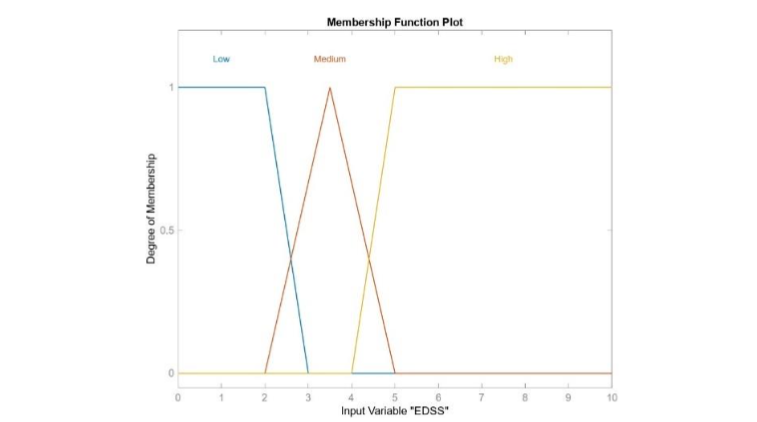
Figure 1: Set of linguistic values, three labels describing the EDSS input variable, corresponding to fuzzy set A1.
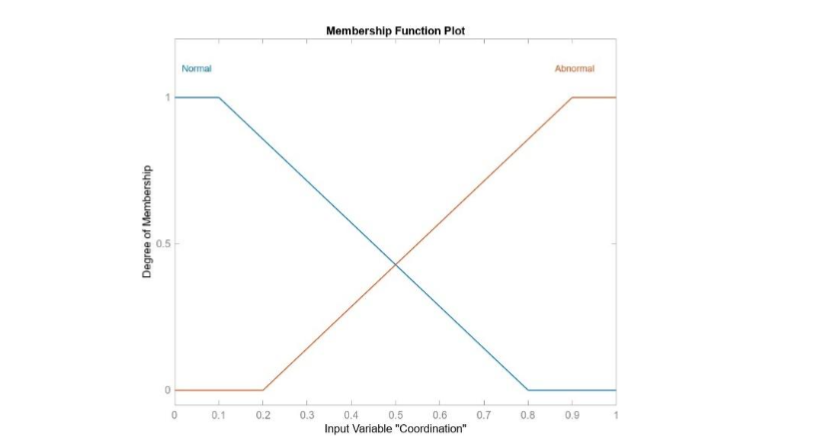
Figure 2: Set of linguistic values, two labels describing the coordination input variable, corresponding to fuzzy set A6.
At the approximate reasoning (inference engine), a typical fuzzy conditional rule might be,
IF input1 is High AND input2 is Low
THEN output is Zero. (1)
The fuzzy rules (knowledge base) are meant to decide the influence of the clinical characteristics on the response to MS treatments. Table 3 displays some of the 60 defined rules regarding the opinion of a neurology expert. In general, if a patient has 1 or 2 abnormalities is classified as “high” responder to treatment, 3 or 4 abnormalities as “medium” responder, and 5 or 6 abnormalities as “low” responder.
Each fuzzy conditional rule generates two values:
zᵢ – Rule output level, which is a constant value of the output values (Low-responder=0.3, Medium-responder=0.5, and High-responder=0.8), and wᵢ – Rule weight derived from the membership values as,
wᵢ = AndMethod(μA1(EDSS), μA2(pyramidal), μA3(cerebellar), μA4(visual), μA5(motor system), μA6(coordination), μA7(optic discs)) (2)
where AndMethod is the min operation.
The final output y₀ of the system is calculated by the wtaver (weighted average over all rule outputs) defuzzification method,
y0=∑i=1Nwiziwiy_0 = \frac{\sum_{i=1}^{N} w_i z_i}{w_i}y0=wi∑i=1Nwizi
where N is the number of rules.
Table 1: Treatment and clinical patient information (where 1.0=Abnormal and 0.0=Normal).
| Sample | Treatment | EDSS | Pyramidal | Cerebellar | Visual | Motor system | Coordination | Optic discs |
|---|---|---|---|---|---|---|---|---|
| 1 | Gelenia | 3.0 | 0.0 | 0.0 | 0.0 | 1.0 | 0.0 | 1.0 |
| 2 | Gelenia | 1.5 | 0.0 | 0.0 | 0.0 | 1.0 | 0.0 | 0.0 |
| 3 | Tysabri | 4.0 | 1.0 | 1.0 | 1.0 | 1.0 | 1.0 | 1.0 |
| … | … | … | … | … | … | … | … | … |
| 58 | Betaferon | 5.0 | 1.0 | 0.0 | 0.0 | 1.0 | 0.0 | 0.0 |
| 59 | Betaferon | 4.0 | 1.0 | 1.0 | 0.0 | 1.0 | 1.0 | 0.0 |
| 60 | Rebif | 4.0 | 0.0 | 1.0 | 1.0 | 0.0 | 1.0 | 1.0 |
Table 2: Linguistic variables description.
| Membership Function | Fuzzy Set | Universe of Discourse | Parameters and Type |
|---|---|---|---|
| μA1(EDSS) | A1 | [0 to 10] | Low: [-3 -0.5 2 3] Trapezoidal; Medium: [2 3.5 5] Triangular; High: [4 5 10.5 13] Trapezoidal |
| μA2(pyramidal) | A2 | [0 to 1] | Normal: [-0.3 -0.1 0.1 0.8] Trapezoidal; Abnormal: [0.2 0.9 1.1 1.3] Trapezoidal |
| μA3(cerebellar) | A3 | [0 to 1] | Normal: [-0.3 -0.1 0.1 0.8] Trapezoidal; Abnormal: [0.2 0.9 1.1 1.3] Trapezoidal |
| μA4(visual) | A4 | [0 to 1] | Normal: [-0.3 -0.1 0.1 0.8] Trapezoidal; Abnormal: [0.2 0.9 1.1 1.3] Trapezoidal |
| μA5(motor system) | A5 | [0 to 1] | Normal: [-0.3 -0.1 0.1 0.8] Trapezoidal; Abnormal: [0.2 0.9 1.1 1.3] Trapezoidal |
| μA6(coordination) | A6 | [0 to 1] | Normal: [-0.3 -0.1 0.1 0.8] Trapezoidal; Abnormal: [0.2 0.9 1.1 1.3] Trapezoidal |
| μA7(optic discs) | A7 | [0 to 1] | Normal: [-0.3 -0.1 0.1 0.8] Trapezoidal; Abnormal: [0.2 0.9 1.1 1.3] Trapezoidal |
| μB(response to treatment) | B(y) | [0 to 1] | Low: [0.3] Constant; Medium: [0.5] Constant; High: [0.8] Constant |
Table 3: Fuzzy conditional rules definition.
| # | Rule |
|---|---|
| 1 | IF EDSS is Medium AND Pyramidal is Normal AND Cerebellar is Normal AND Visual is Normal AND Motor system is Abnormal AND Coordination is Normal AND Optic discs is Abnormal then Response to treatment is High. |
| 2 | IF EDSS is Low AND Pyramidal is Normal AND Cerebellar is Normal AND Visual is Normal AND Motor system is Abnormal AND Coordination is Normal AND Optic discs is Normal then Response to treatment is High. |
| 3 | IF EDSS is Medium AND Pyramidal is Abnormal AND Cerebellar is Abnormal AND Visual is Abnormal AND Motor system is Abnormal AND Coordination is Abnormal AND Optic discs is Abnormal then Response to treatment is Low. |
| … | … |
| 57 | IF EDSS is High AND Pyramidal is Abnormal AND Cerebellar is Normal AND Visual is Normal AND Motor system is Abnormal AND Coordination is Normal AND Optic discs is Normal then Response to treatment is High. |
| 59 | IF EDSS is High AND Pyramidal is Abnormal AND Cerebellar is Abnormal AND Visual is Normal AND Motor system is Abnormal AND Coordination is Abnormal AND Optic discs is Normal then Response to treatment is Medium. |
| 60 | IF EDSS is High AND Pyramidal is Normal AND Cerebellar is Abnormal AND Visual is Abnormal AND Motor system is Normal AND Coordination is Abnormal AND Optic discs is Abnormal then Response to treatment is Medium. |
Results
In this paper, a fuzzy expert system based on TSKFS was implemented to estimate the response to treatment in MS patients. At fuzzification stage, the membership values were computed for each one of the input variables (clinical characteristics).
For example, the EDSS input value of the first sample is 3.0, so the corresponding membership values are:
- μLow(EDSS)=0.0
- μMed(EDSS)=0.66
- μHigh(EDSS)=0.0
as shown in Figure 3. The fuzzification results are displayed in Tables 4-10 for some samples.
Figure 3: Membership values for the EDSS=3 input variable (fuzzification). Medium label degree of membership = 0.66.
Table 4: Fuzzification results (EDSS).
| Sample | μLow(EDSS) | μMed(EDSS) | μHigh(EDSS) |
|---|---|---|---|
| 1 | 0.0 | 0.66 | 0.0 |
| 2 | 1.0 | 0.0 | 0.0 |
| 3 | 0.0 | 0.66 | 0.0 |
| … | … | … | … |
| 58 | 0.0 | 0.0 | 1.0 |
| 59 | 0.0 | 0.66 | 0.0 |
| 60 | 0.0 | 0.66 | 0.0 |
Table 5: Fuzzification results (Pyramidal).
| Sample | μNormal(Pyramidal) | μAbnormal(Pyramidal) |
|---|---|---|
| 1 | 1.0 | 0.0 |
| 2 | 1.0 | 0.0 |
| 3 | 0.0 | 1.0 |
| … | … | … |
| 58 | 0.0 | 1.0 |
| 59 | 0.0 | 1.0 |
| 60 | 1.0 | 0.0 |
Table 6: Fuzzification results (Cerebellar).
| Sample | μNormal(Cerebellar) | μAbnormal(Cerebellar) |
|---|---|---|
| 1 | 1.0 | 0.0 |
| 2 | 1.0 | 0.0 |
| 3 | 0.0 | 1.0 |
| … | … | … |
| 58 | 1.0 | 0.0 |
| 59 | 0.0 | 1.0 |
| 60 | 0.0 | 1.0 |
Table 7: Fuzzification results (Visual).
| Sample | μNorm(Visual) | μAbnorm(Visual) |
|---|---|---|
| 1 | 1.0 | 0.0 |
| 2 | 1.0 | 0.0 |
| 3 | 0.0 | 1.0 |
| … | … | … |
| 58 | 1.0 | 0.0 |
| 59 | 1.0 | 0.0 |
| 60 | 0.0 | 1.0 |
Table 8: Fuzzification results (Motor system).
| Sample | μNorm(Motor sys) | μAbnorm(Motor sys) |
|---|---|---|
| 1 | 0.0 | 1.0 |
| 2 | 0.0 | 1.0 |
| 3 | 0.0 | 1.0 |
| … | … | … |
| 58 | 0.0 | 1.0 |
| 59 | 0.0 | 1.0 |
| 60 | 1.0 | 0.0 |
Table 9: Fuzzification results (Coordination).
| Sample | μNorm(Coordination) | μAbnorm(Coordination) |
|---|---|---|
| 1 | 1.0 | 0.0 |
| 2 | 1.0 | 0.0 |
| 3 | 0.0 | 1.0 |
| … | … | … |
| 58 | 1.0 | 0.0 |
| 59 | 0.0 | 1.0 |
| 60 | 0.0 | 1.0 |
Table 10: Fuzzification results (Optic discs).
| Sample | μNorm(Op discs) | μAbnorm(Op discs) |
|---|---|---|
| 1 | 0.0 | 1.0 |
| 2 | 1.0 | 0.0 |
| 3 | 0.0 | 1.0 |
| … | … | … |
| 58 | 1.0 | 0.0 |
| 59 | 1.0 | 0.0 |
| 60 | 0.0 | 1.0 |
At the approximate reasoning stage, the membership values from fuzzification were evaluated by the inference rules (knowledge base). For example, with the input values of the first sample:
- EDSS=3
- Pyramidal=0.0
- Cerebellar=0.0
- Visual=0.0
- Motor system=1.0
- Coordination=0.0
- Optic discs=1.0
the inference engine calculations are shown in Table 11. In this case, only the first rule had a result different from zero.
Table 11: Inference results for the first sample.
| # | Rule | Inference engine |
|---|---|---|
| 1 | IF EDSS is Medium AND Pyramidal is Normal AND Cerebellar is Normal AND Visual is Normal AND Motor system is Abnormal AND Coordination is Normal AND Optic discs is Abnormal then Response to treatment is High. | min(0.66, 1.0, 1.0, 1.0, 0.0, 1.0, 0.0) = 0.66 |
The numerical outputs were calculated by Equation 3. For example, for the first sample, the numerical output was obtained as follows,
y0=0.8(0.66)0.66=0.8y_0 = \frac{0.8(0.66)}{0.66} = 0.8y0=0.660.8(0.66)=0.8
Finally, the estimation of the response to MS treatments is compared by three different methods:
- the opinion of a neurology expert,
- the proposed fuzzy expert system, and
- K-Means conventional clustering model.
The overall sample results are displayed in Table 12. 100% of the outputs were correctly labeled by the proposed system regarding the expert opinion, while 60% were correctly labeled by the K-Means clustering.
Table 12: Estimation of response to MS treatments.
The defuzzification numerical values less than 0.5 are considered as low responder (LR), those equal to 0.5 as medium responder (MR), and those greater than 0.5 as high responder (HR).
| Sample | Expert Opinion | Proposed System (Deffuzification) | K-Means Clustering |
|---|---|---|---|
| 1 | HR | 0.8→HR | HR |
| 2 | HR | 0.8→HR | HR |
| 3 | LR | 0.3→LR | LR |
| 4 | MR | 0.5→MR | LR |
| 5 | HR | 0.8→HR | HR |
| 6 | HR | 0.8→HR | LR |
| 7 | MR | 0.5→MR | LR |
| 8 | HR | 0.8→HR | HR |
| 9 | MR | 0.5→MR | LR |
| 10 | MR | 0.5→MR | MR |
| 11 | MR | 0.5→MR | MR |
| 12 | MR | 0.5→MR | LR |
| 13 | HR | 0.8→HR | LR |
| 14 | MR | 0.5→MR | MR |
| 15 | HR | 0.8→HR | HR |
| 16 | HR | 0.8→HR | HR |
| 17 | HR | 0.8→HR | HR |
| 18 | LR | 0.3→LR | LR |
| 19 | MR | 0.5→MR | MR |
| 20 | MR | 0.5→MR | MR |
| 21 | MR | 0.5→MR | LR |
| 22 | MR | 0.5→MR | LR |
| 23 | HR | 0.8→HR | HR |
| 24 | HR | 0.8→HR | HR |
| 25 | MR | 0.5→MR | LR |
| 26 | HR | 0.8→HR | HR |
| 27 | LR | 0.3→LR | MR |
| 28 | HR | 0.8→HR | HR |
| 29 | HR | 0.8→HR | HR |
| 30 | HR | 0.8→HR | HR |
| 31 | HR | 0.8→HR | LR |
| 32 | HR | 0.8→HR | HR |
| 33 | MR | 0.5→MR | MR |
| 34 | HR | 0.8→HR | HR |
| 35 | HR | 0.8→HR | LR |
| 36 | HR | 0.8→HR | MR |
| 37 | HR | 0.8→HR | HR |
| 38 | LR | 0.3→LR | LR |
| 39 | MR | 0.5→MR | MR |
| 40 | HR | 0.8→HR | HR |
| 41 | MR | 0.5→MR | MR |
| Sample | Expert Opinion | Proposed System (Deffuzification) | K-Means Clustering |
|---|---|---|---|
| 42 | HR | 0.8→HR | LR |
| 43 | HR | 0.8→HR | HR |
| 44 | LR | 0.3→LR | MR |
| 45 | HR | 0.8→HR | HR |
| 46 | MR | 0.5→MR | MR |
| 47 | HR | 0.8→HR | MR |
| 48 | HR | 0.8→HR | HR |
| 49 | HR | 0.8→HR | HR |
| 50 | HR | 0.8→HR | MR |
| 51 | HR | 0.8→HR | MR |
| 52 | MR | 0.5→MR | MR |
| 53 | HR | 0.8→HR | HR |
| 54 | LR | 0.3→LR | LR |
| 55 | HR | 0.8→HR | MR |
| 56 | HR | 0.8→HR | HR |
| 57 | HR | 0.8→HR | MR |
| 58 | HR | 0.8→HR | MR |
| 59 | MR | 0.5→MR | LR |
| 60 | MR | 0.5→MR | LR |
Discussion
Disease-modifying therapies help MS patients mainly to delay the disease progression. However, some patients do not respond or partially respond to the treatments. Hence, it was important to design a classification system able to determine the degree of response to treatments in MS patients.
The proposed method to assess whether a certain medication is suitable for an MS patient is based on fuzzy rules obtained in collaboration with a medical specialist and IA. The rules are fed by variables taken from a database with representative variables. AI allows the construction of a bridge between a series of variables that may or may not have a strong correlation with the disease. According to the calculations made by the fuzzy expert system, it is possible to estimate if a patient has a high, medium, or low response to the medication taken to treat MS.
AI is a powerful tool, and many research works incorporate it with good results. However, in the case of MS, much remains to be done. The results obtained in this paper lead to a promising path to determining a better treatment for MS patients if an unsupervised system is used. AI-based predictive systems reduce the risk of uncertainty and improve assertiveness, which increases precision and, therefore, confidence in decision-making regarding the most effective dose and combination of drugs against MS. Managing uncertain information is one of the challenges of medicine in decision-making. Everything indicates that using fuzzy logic to classify, prioritize, and understand the response to medications in MS is a reliable tool for choosing these. However, several difficulties must be overcome, such as having different databases where the representative variables used in the literature, including genetic analysis, are available since each country’s persons have different characteristics.
From a technical point of view, hierarchical and non-hierarchical clustering are the most used methods to diagnose MS¹⁴˒²⁰. While clustering methods are easy to implement, they rarely provide an efficient solution, due to many arbitrary decisions. A fuzzy expert system emulates expert reasoning with imprecise information about a problem to provide an efficient solution. So, the proposed fuzzy expert system achieved a high efficiency for estimating the degree of response to MS treatments compared to K-means clustering, as Table 12 shows. Also, the proposed system implementation could avoid inefficient therapies at the patient individual level.
Conflict of Interest Statement:
The authors have no conflicts of interest to declare.
Funding Statement:
The research received no external funding.
Acknowledgements:
I (Edgar Rafael Ponce de León Sánchez) would like to thank the Consejo Nacional de Humanidades, Ciencias y Tecnologías (CONAHCYT) for the scholarship number 003771 awarded to finance my PhD studies.
Authors Contact Email:
Edgar Rafael Ponce de León Sánchez
([email protected]),
Jorge Domingo Mendiola Santibañez
([email protected]),
Omar Arturo Dominguez Ramirez
([email protected]),
Martín Gallegos Duarte
([email protected]),
Ana Marcela Herrera Navarro
([email protected]),
Horacio Senties Madrid
([email protected]),
José Jonathan Franco Téllez
([email protected]).
References
1. Hauser, S. L., & Cree, B. A. (2020). Treatment of multiple sclerosis: a review. The American journal of medicine. 2020; 133(12):1380-1390.
2. Torkildsen, Ø., Myhr, K. M., Bø, L. Disease‐modifying treatments for multiple sclerosis–a review of approved medications. European journal of neurology. 2016; 23:18-27.
3. Cohan, S.L., Hendin, B.A., Reder, A.T., Smoot, K., Avila, R., Mendoza, J.P., Weinstock-Guttman, B. Interferons and multiple sclerosis: Lessons from 25 years of clinical and real-world experience with intramuscular interferon beta-1a (Avonex). CNS Drugs. 2021; 35:743-767.
4. Meskó B, Görög M. A short guide for medical professionals in the era of artificial intelligence. NPJ Digit Med. 2020; 3:126.
5. Law, M. T., Traboulsee, A. L., Li, D. K., Carruthers, R. L., Freedman, M. S., Ko-lind, S. H., and Tam, R. (2019). Machine learning in secondary progressive multiple sclerosis: an improved predictive model for short-term disability progression. Multiple Sclerosis Journal–Experimental, Translational and Clinical, 5(4):2055217319885983.
6. Afzal HMR, Luo S, Ramadan S, Lechner-Scott J. The emerging role of artificial intelligence in multiple sclerosis imaging. Multiple Scler J. 2022; 28:849–58.
7. Haug CJ, Drazen JM. Artificial intelligence and machine learning in clinical medicine, 2023. N Engl J Med. 2023; 388:1201–8.
8. Ponce de Leon-Sanchez, E. R., Mendiola-Santibañez, J. D., Dominguez-Ramirez, O. A., Herrera-Navarro, A. M., Vazquez-Cervantes, A., Jimenez-Hernandez, H., Senties-Madrid, H. (2024). Training Artificial Neural Networks to Detect Multiple Sclerosis Lesions Using Granulometric Data from Preprocessed Magnetic Resonance Images with Morphological Transformations. Technologies, 12(9), 145.
9. Casalino, G., Castellano, G., Consiglio, A., Nuzziello, N., and Vessio, G. (2021). MicroRNA expression classification for pediatric multiple sclerosis identification. Journal of Ambient Intelligence and Humanized Computing, 1–10.
10. Chen, X., Hou, H., Qiao, H., Fan, H., Zhao, T., and Dong, M. (2021). Identification of blood-derived candidate gene markers and a new 7-gene diagnostic model for multiple sclerosis. Biological Research, 54(1), 1–12.
11. Ponce de Leon-Sanchez, E. R., Dominguez-Ramirez, O. A., Herrera-Navarro, A. M., Rodriguez-Resendiz, J., Paredes-Orta, C., Mendiola-Santibañez, J. D. (2023). A deep learning approach for predicting multiple sclerosis. Micromachines, 14(4), 749.
12. Fagone, P., Mazzon, E., Mammana, S., Di Marco, R., Spinasanta, F., Basile, M. S., Petralia, M. C., Bramanti, P., Nicoletti, F., and Mangano, K. (2019). Identification of cd4+ t cell biomarkers for predicting the response of patients with relapsing-remitting multiple sclerosis to natalizumab treatment. Molecular medicine reports, 20(1):678–684.
13. Ebrahimkhani, S., Beadnall, H. N., Wang, C., Suter, C. M., Barnett, M. H., Buc-kland, M. E., and Vafaee, F. (2020). Serum exosome micrornas predict multiple sclerosis disease activity after fingolimod treatment. Molecular Neurobiology, 57:1245–1258.
14. Giordani, P., Ferraro, M. B., Martella, F., Giordani, P., Ferraro, M. B., Martella, F. (2020). Non-Hierarchical Clustering. An Introduction to Clustering with R, 75-109.
15. Vichi, M., Cavicchia, C., Groenen, P. J. (2022). Hierarchical means clustering. Journal of Classification, 39(3), 553-577.
16. Eshaghi, A., Young, A. L., Wijeratne, P. A., Prados, F., Arnold, D. L., Narayanan, S., Ciccarelli, O. (2021). Identifying multiple sclerosis subtypes using unsupervised machine learning and MRI data. Nature communications, 12(1), 2078.
17. Zelilidou, S. P., Tripoliti, E. E., Vlachos, K. I., Konitsiotis, S., & Fotiadis, D. I. (2021, October). Clustering based Segmentation of MR Images for the Delineation and Monitoring of Multiple Sclerosis Progression. In 2021 IEEE 21st International Conference on Bioinformatics and Bioengineering (BIBE) (pp. 1-4). IEEE.
18. Maida, E., Abbadessa, G., Cocco, E., Valentino, P., Lerede, A., Frau, J., … & Bonavita, S. (2024). Identifying definite patterns of unmet needs in patients with multiple sclerosis using unsupervised machine learning. Neurological Sciences, 1-13.
19. Chaves, B., e Silva, J. C. S., Nakaya, H., Almeida, M., Bucciarelli, F., Lacouture, C., … & Dupré, L. (2024). Morphological profiling of T cells predicts clinical response to VLA-4-targeting natalizumab therapy in patients with multiple sclerosis.
20. Liang, X., Yan, Z., & Li, Y. (2024). Exploring subtypes of multiple sclerosis through unsupervised machine learning of automated fiber quantification. Japanese Journal of Radiology, 1-9.
21. Saibene, A., Assale, M., & Giltri, M. (2021). Expert systems: Definitions, advantages and issues in medical field applications. Expert Systems with Applications, 177, 114900.
22. Ponce de Leon-Sanchez, E. R., Mendiola-Santibañez, J. D., Dominguez-Ramirez, O. A., Herrera-Navarro, A. M., Vazquez-Cervantes, A., Jimenez-Hernandez, H., Senties-Madrid, H. (2023). Fuzzy Logic System for Classifying Multiple Sclerosis Patients as High, Medium, or Low Responders to Interferon-Beta. Technologies, 11(4), 109.
23. Ayangbekun, O.; Jimoh~Ibrahim, A. Fuzzy logic application to brain diseases diagnosis. J. Emerg. Trends Comput. Inf. Sci. 2015; 6:144-148.
24. Hosseini, A.; Asadi, F.; Arani, L.A. Development of a knowledge-based clinical decision support system for multiple sclerosis diagnosis. J. Med. Life. 2020; 13:612.
25. Hamedan, F., Orooji, A., Sanadgol, H., & Sheikhtaheri, A. (2020). Clinical decision support system to predict chronic kidney disease: A fuzzy expert system approach. International journal of medical informatics, 138, 104134.
26. Matinfar, F.; Golpaygani, A.T. A fuzzy expert system for early diagnosis of multiple sclerosis. J. Biomed. Phys. Eng. 2022; 12:181.
27. Chen, J., & Gustientiedina, G. (2024). Implementation of Fuzzy Expert System to Detect Parkinson’s Disease Based on Mobile. Journal of Applied Business and Technology, 5(2), 72-81.
28. Muslim, A. M., Mashohor, S., Al Gawwam, G., Mahmud, R., binti Hanafi, M., Alnuaimi, O., Almutairi, A. D. Brain MRI dataset of multiple sclerosis with consensus manual lesion segmentation and patient meta information. Data in Brief. 2022; 42:108139.
29. Kandel, A. Fuzzy expert systems. CRC press. 1991.
30. Kandel, A., & Langholz, G. Fuzzy control systems. CRC press. 1993.
31. Prokopowicz, P., Czerniak, J., Mikołajewski, D., Apiecionek, Ł., Ślȩzak, D. Theory and applications of ordered fuzzy numbers: a tribute to Professor Witold Kosiński. Springer Nature. 2017.