

Hand and Wrist Issues in Orthopedic Surgeons: A Study
Hand and Wrist Issues in Orthopedic Surgeons – a Pilot Study
Paul Lizardi1, Sallie Yasins1, Madeline Rocks1, Ronald Wollstein2
- Department of Orthopaedic Surgery, New York University School of Medicine, NY, USA
- Department of Orthopaedic Surgery, UAB Heersink School of Medicine, Birmingham Alabama, USA
*Email: [email protected]
OPEN ACCESS
PUBLISHED: 31 January 2025
CITATION: Izard, P., Yassin, S., et al., 2024. Hand and Wrist Issues in Orthopedic Surgeons – a Pilot Study. Medical Research Archives, [online] 13(1).
https://doi.org/10.18103/mra.v13.i1.6185
COPYRIGHT © 2025 European Society of Medicine. This is an open-access article distributed under the terms of the Creative Commons Attribution License, which permits unrestricted use, distribution, and reproduction in any medium, provided the original author and source are credited.
DOI https://doi.org/10.18103/mra.v13.i1.6185
ISSN 2375-1924
ABSTRACT
Background/Aim:
Overload of the hand and wrist are inherent to any occupation that includes manual work and holds true for surgical specialties in medicine. This pilot study evaluated hand/wrist injuries/issues in a cohort of orthopaedic surgeons. Since orthopaedic surgery requires handling of tools and limbs that can be heavy, we hypothesized that there would be a significant amount of hand injuries/issues.
Methods:
A modification of the Standardized Nordic Questionnaire (anonymous survey) was distributed through Research Electronic Data Capture (REDCap). The questionnaire evaluates subject characteristics such as age and years in practice as well the existence of hand/wrist issues.
Results:
Hand injuries were common in orthopaedic surgeons (55%), and more common in female respondents (67%). A low BMI was associated with female gender (p=0.04) and prevalence of hand issues (p=0.01). There were no differences between light and heavy orthopaedic subspecialties in the number of injuries reported. Increased age and career length increased the likelihood of hand/wrist issues and issues were more common in the dominant hand (p=0.65). Ninety-eight percent of those experiencing pain did not report their issues to their employer.
Conclusions:
This pilot study supports small hand-size, female gender, and low BMI as predisposing to the development of hand injuries/conditions in surgery and is in tandem with the literature. Further study is needed but it is possible that adapting instruments to smaller-handed surgeons may help address some issues that exist today in surgery and orthopaedic surgery specifically.
Keywords: hand; hand size; orthopedic surgeons; problems; wrist.
Introduction
Hazards and overload of the hand and wrist are inherent to any occupation that includes manual work. While as surgeons, we treat many work-related hand and wrist conditions, we rarely evaluate those injuries and conditions that stem from our own occupation.
Though studies have evaluated certain aspects of surgery, few studies evaluate orthopaedic surgery and the relationship to hand and wrist conditions. Multiple studies have found hand and wrist issues in surgeons of various surgical specialties: A study evaluating musculoskeletal pain in gynecologists found that wrist/hand pain was prevalent (60.9%), while female surgeons were twice as likely to have pain as male surgeons¹. Another study evaluating musculoskeletal pain in pediatric surgeons focused on high body mass index (BMI) and poor physical condition²,³. In a study reviewing plastic surgeons, self-reported injury was found to be more prevalent in surgery than in other labor-intensive populations. The sampled surgeons appeared to be younger than the general surgery workforce, underscoring the need for a formal, multicenter assessment of occupational injury in surgeons⁴.
Specifically, laparoscopic and arthroscopic surgical equipment is not manufactured for ergonomic suitability and these have been shown to be a cause of musculoskeletal disorders in surgeons⁵. It has been demonstrated that laparoscopic instruments suffer from ergonomic inadequate handle designs and inefficient handle to tip force transmission, which lead to surgeon fatigue, discomfort, and hand paresthesia⁶. It is also possible that one of the risk factors during laparoscopic surgery, especially for neck/shoulder problems and visual disturbances includes beyond ergonomic factors, surgery factors such as the size of the incision and as surgeon-related factors⁷. Hand size has been found to be a significant determinant of difficulty using laparoscopic surgical instruments. Specifically, individuals using glove sizes 6.5 or smaller experience significantly more difficulty using common laparoscopic instruments, and in particular laparoscopic staplers⁸. Addressing these issues, Alaqeel et al. described guidelines from industry for orthopaedic surgery that include maintaining a neutral posture and joint alignment and working with the appropriate hand tools. They concluded that optimizing the occupational environment and utilizing well-established ergonomic principles from industry is both feasible and practical in the operating room to decrease the incidence of musculoskeletal injuries reported as 2/3rds of all surgeons during their career³.
A study by Yakkanti et al. found high rates of work-related injuries to the back and work/hand in orthopaedic surgeons. Eighty-five percent of these were carpal tunnel syndrome⁹. A better understanding of the causes of hand and wrist pain in orthopaedic surgeons is likely to improve the ability to prevent these from occurring, thus decreasing disability associated with multiple surgical professions.
We initiated a pilot survey, using a validated questionnaire, to investigate the prevalence of orthopaedic problems in our department. We hypothesized that a significant percentage of orthopaedic surgeons will have or have had hand problems related to their work and that we will find trends in work and/or subject characteristics that will enable a future more focused study to determine causes of work-related hand issues in orthopaedic surgery.
Methods
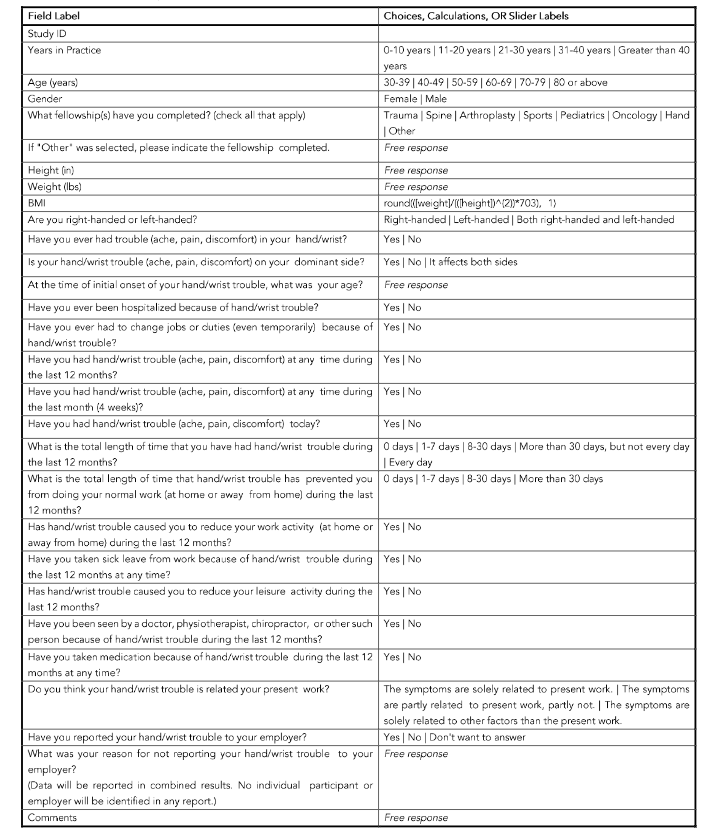
A modification of the Standardized Nordic Questionnaire (anonymous survey) was distributed through Research Electronic Data Capture (REDCap). (Figure 1) This questionnaire was distributed to all orthopaedic surgeons in our department as well as to various other groups including a pediatric orthopedic group and a forum for women in orthopaedics, via direct email. Since the number of female orthopaedic surgeons is so small, we specifically targeted a forum for women surgeons. Recipients were prompted twice to submit a response. Ninety-three responses were collected of which seven were excluded for incompleteness. The remaining 87 responses were used for analysis. Since this study is based on an anonymous survey, in discussion with our institutional review board (IRB) it was deemed unnecessary to obtain IRB approval or consent prior to performance.
To determine the factors that most influenced the risk of hand issues, several categories were created. The various subspecialties of orthopaedic surgery were grouped into the categories of “Heavy” (including general orthopedics, trauma, spine, arthroplasty, sports medicine, and oncology) and “Light” (including pediatric orthopaedics, hand surgery, foot & ankle surgery, and shoulder). For this study, “issues” were defined as any occurrence of hand pain. Severity was graded as mild (no impact on work or leisure), moderate (any amount of lost work or leisure), or severe (requiring hospitalization).
STATISTICAL ANALYSIS:
Univariate statistics were reported for all variables. Mean and standard deviation were calculated for continuous variables. Count and proportion were reported for categorical variables. To determine differences in hand outcomes between men and women, a chi-square test for independence was calculated.
All analyses were two-tailed and set at the 0.10 level. A higher alpha threshold of 0.10 was used for significance since this is a pilot study. By nature, pilot studies are small-scale, preliminary studies that are conducted to determine feasibility to conduct a robust research project. Therefore, due to the small sample size of this study and the novel nature of pilot studies, a higher alpha level was deliberately set to identify potential exposures to differences in hand outcomes between men and women. The aim is to indicate potential exposures that can be fully analyzed in future studies.
Results
Table 1 describes the population characteristics as well as the percentage of respondents with hand issues. Hand injuries were common in orthopaedic surgeons overall and more common among the 24 female-identifying respondents (67%). There were no statistically significant differences between light and heavy orthopaedic subspecialties in the number of injuries reported.
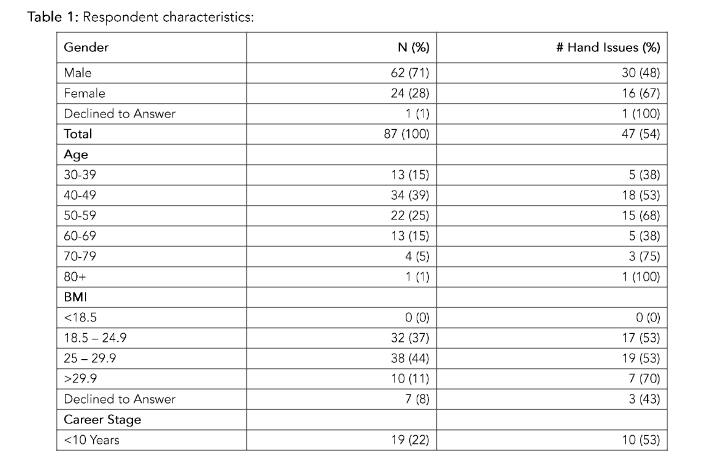
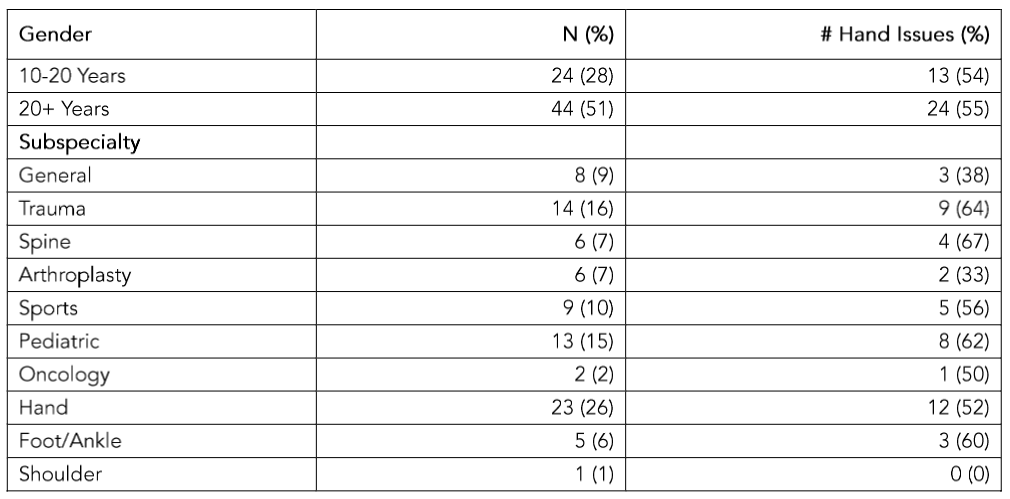
Increased age and increased career length trended towards an association with an increased likelihood of hand issues. Surgeons who were older or who were more advanced in their career were also more likely to report hand issues, p=0.56. The rates of problems experienced for early, mid, and late career surgeons were 53%, 54%, and 55%, respectively, and these issues were most often in the dominant hand p=0.65.
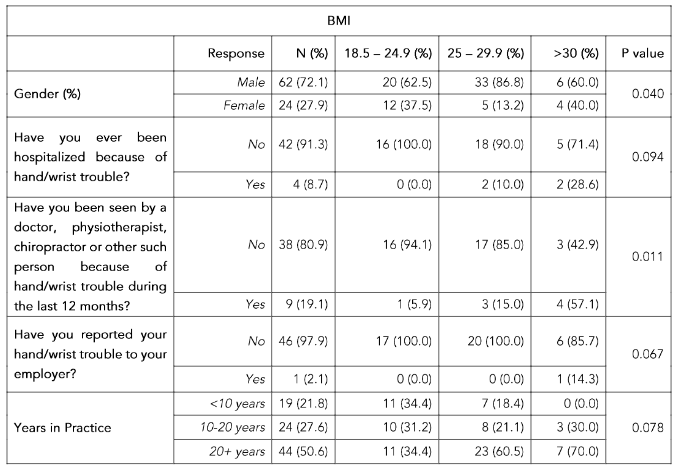
A low BMI was found to be significantly associated with female gender (p=0.04) and the prevalence of hand issues (p=0.01). Table 2
References
2. Akbiyik F, Uysal O, Firat T, Bek N. Evaluation of work-related musculoskeletal problems in pediatric surgeons. Pediatr Surg Int. Oct 2021;37(10):1333-1338. doi:10.1007/s00383-021-04928-9
3. Alaqeel M, Tanzer M. Improving ergonomics in the operating room for orthopaedic surgeons in order to reduce work-related musculoskeletal injuries. Ann Med Surg (Lond). Aug 2020;56:133-138. doi:10.1016/j.amsu.2020.06.020
4. Capone AC, Parikh PM, Gatti ME, Davidson BJ, Davison SP. Occupational injury in plastic surgeons. Plast Reconstr Surg. May 2010;125(5):15 55-1561. doi:10.1097/PRS.0b013e3181d62a94
5. Wyatt RW, Lin CC, Norheim EP, Przepiorski D, Navarro RA. Occupation-related Cervical Spine Disease in Orthopaedic Surgeons. J Am Acad Orthop Surg. Sep 1 2020;28(17):730-736. doi:10.5 435/JAAOS-D-19-00834
6. Berguer R. Surgical technology and the ergonomics of laparoscopic instruments. Surg Endosc. May 1998;12(5):458-62. doi:10.1007/s004649900705
7. Alhusuny A, Cook M, Khalil A, Xie Y, Johnston V. Neck/Shoulder Problems and Visual Disturbances Among Surgeons: A Scoping Review. J Surg Res. Mar 2020;247:413-428. doi:10.1016/j.jss.2019.09.064
8. Berguer R, Hreljac A. The relationship between hand size and difficulty using surgical instruments: a survey of 726 laparoscopic surgeons. Surg Endosc. Mar 2004;18(3):508-12. doi:10.1007/s00 464-003-8824-3
9. Yakkanti RR, Sedani AB, Syros A, Aiyer AA, D’Apuzzo MR, Hernandez VH. Prevalence and Spectrum of Occupational Injury Among Orthopaedic Surgeons: A Cross-Sectional Study. JB JS Open Access. Jan-Mar 2023;8(1)doi:10.2106/JBJS.OA.22.00083
10. Cruz-Montecinos C, Antunez-Riveros MA, Tapia C, et al. Gender differences on effects of forearm rotation on compressive stiffness of flexor carpi ulnaris during submaximal handgrip contractions. J Anat. Nov 2023;243(5):886-891. doi:10.1111/joa.13914
11. Pua YH, Tay L, Clark RA, et al. Associations of height, weight, and body mass index with handgrip strength: A Bayesian comparison in older adults. Clin Nutr ESPEN. Apr 2023;54:206-210. doi:10.10 16/j.clnesp.2023.01.028
12. Escobar-Molina R, Cuevas-Laguna M, Chirosa-Rios IJ, Merino-Fernandez M, Chirosa-Rios LJ, Franchini E. Analysis of grip specificity on force production in grapplers and its effect on bilateral deficit grip specificity and bilateral deficit in force production among grapplers. Front Sports Act Living. 2023;5:1190369. doi:10.3389/fspor.2023.1190369
13. Hislop J, Orth D, Tirosh O, Isaksson M, Hensman C, McCormick J. Does surgeon sex and anthropometry matter for tool usability in traditional laparoscopic surgery? A systematic review and meta-analysis. Surg Endosc. Sep 2023; 37(9):6640-6659. doi:10.1007/s00464-023-10228-1
14. Leal J, Clifford AL, Anastasio AT, Dymtruk M, Roach RP. Diversity Within the Field of Orthopedic Sports Medicine: A Systematic Review. JBJS Rev. Oct 1 2023;11(10)doi:e23.00134 10.2106/JBJS.RV W.23.00134
15. Mickle AM, Tanner JJ, Holmes U, 3rd, et al. Applying evidence-based cross-disciplinary concepts helps to explain the heterogeneity in pain, function, and biological measures in individuals with knee pain with/at risk of osteoarthritis. Pain Rep. Feb 2025;10(1):e1225. doi:10.1097/PR9.0000 000000001225
16. Zimmerman M, Nilsson P, Rydberg M, Dahlin L. Risk of hand and forearm conditions due to vibrating hand-held tools exposure: a retrospective cohort study from Sweden. BMJ Open. Jun 18 202 4;14(6):e080777. doi:10.1136/bmjopen-2023-080777
17. Ganhewa AD, Seth I, Wu R, et al. Exploring Age-Related Variations in Carpal Bone Volume: Implications for Clinical Practice and Anatomical Understanding. Hand (N Y). Apr 12 2024:15589447 241242830. doi:10.1177/15589447241242830
Most read articles by the same author(s)
- Ronit Wollstein, MD, Sarah Ewald, Esther Vögelin, A Tool to Measure Outcomes in the Hand and Wrist , Medical Research Archives: Vol 13 No 7 (2025): Vol.13, Issue 7, July 2025