





Impact of COVID-19 on Ballet Dancers’ Training and Injuries
Effects of COVID-19 Quarantine Restrictions on Training and Injury in Ballet Dancers
Jacquelyn Valenzuela-Moss, BS1, Selina Shah, MD2, Dana Sheng, MD3, Tracy Zaslow, MD4, Tishya A. L. Wren, PhD1, Bianca Edison, MD1
- Children’s Hospital Los Angeles and Keck School of Medicine of University of Southern California, Los Angeles, CA
- Selina Shah Dance and Sports Medicine, Walnut Creek, CA
- Dignity Health, Greater Sacramento, CA
- Cedars Sinai Kerlan-Jobe Institute, Los Angeles, CA
OPEN ACCESS
PUBLISHED: 31 January 2025
CITATION: Valenzuela-Moss, J., Shah, S., et al., 2025. Effects of COVID-19 Quarantine Restrictions on Training and Injury in Ballet Dancers. Medical Research Archives, [online] 13(1). https://doi.org/10.18103/mra.v13i1.6218
COPYRIGHT: © 2025 European Society of Medicine. This is an open-access article distributed under the terms of the Creative Commons Attribution License, which permits unrestricted use, distribution, and reproduction in any medium, provided the original author and source are credited.
DOI https://doi.org/10.18103/mra.v13i1.6218
ISSN 2375-1924
Abstract
Background: The COVID-19 pandemic dramatically interrupted worldwide athletics, as closures and limited access to sports facilities forced athletes to adapt to new and often challenging conditions. Many lost access to essential training spaces like gyms, tracks, and fields, which disrupted their routines. For ballet dancers, who rely heavily on studio space, mirrors, and specialized flooring, the restrictions were especially difficult.
Aims: This study examined pandemic effects on dance and training participation for California youth dancers, training environments during shutdown, and incidence of injury prior to, during the pandemic, and after returning to studios.
Methods: This cross-sectional study surveyed 17 dancers (all female, median age 13.7 years), comparing data surrounding the COVID-19 pandemic (before March 2020, during quarantine from March 2020 to January 2021, and when studios reopened for classes). Questions assessed rates of dance instruction, ability to replicate studio environments, injury, and self-rated readiness. Descriptive results are presented along with comparison of activities before and during the pandemic.
Results: Prior to COVID-19, dancers trained a median of 6 hours/wk. Dance training decreased significantly to 3 hours/wk at home during quarantine (p=0.01). 76% (13/17) of dancers reported COVID-19 interrupted training; 54% (7/13) reported 1-10 weeks of interruption, and 46% (6/13) reported a longer interruption. During quarantine, most (94%, 16/17) reported taking home virtual dance classes. Nearly half (8/17, 47%) of dancers had access to some equipment needed to adequately train, while 12% (2/17) felt they did not have proper access. Dance training floor surfaces varied (47% on hardwood floors at home, 24% on carpet). No participants trained on any version of sprung flooring while at home. Many dancers used chairs (65%) or a barre (53%) to train. Upon returning to studios, 4 injuries occurred (no active injuries right before/during quarantine), 100% involving the lower extremity and 75% affecting the foot.
Conclusions: COVID-19 proved challenging to dancers, limiting the ability to train at the level they had prior to imposed public health restrictions. Alternative options were utilized to continue dancing, including using hardwood floors and furniture at home. These alternatives could have increased risk, resulting in lower extremity injuries.
Keywords
COVID-19, ballet dancers, training, injury, quarantine
Introduction:
The COVID-19 pandemic had a dramatic impact on youth sports worldwide from March of 2020 through most of 2021.1-4 During this time, many sports organizations were forced to change the platforms by which they engaged with youth athletes or stopped activity altogether. With the future uncertain, some organizations took what they had presumed would be a short break. This proved to be far from that for many. For athletes, this break forced them to take time off or train on their own. Indoor sports, such as dance, were particularly affected, as indoor gatherings were widely regarded as having the highest risk of COVID-19 exposure. After weeks of suspended activity, many sports affiliations turned to resources and technology at hand to adapt to the pandemic restrictions by adjusting training for virtual instruction. Without proper preparation for such occurrences, this action was hurried for most compared to the weeks of planning that such a transition would normally require. Many dance studios pivoted to an online platform, offering live or pre-recorded classes so that their students could continue to practice at home. This source of activity provided dancers with some semblance of normalcy; however, many dancers still lacked the resources needed for proper performance as well as the social setting that athletes enjoy.
Teaching, learning, and practicing dance through a virtual platform required dance instructors and students to adapt to this new way of training. Access to the internet and virtual platforms were deemed necessary during this time, which was unfortunate for those who lacked the economic resources to obtain them.5 Equally crucial was access to safe practice spaces, which created disparities amongst certain dancers. Dancers were compelled to find areas in their home with enough space and suitable flooring to continue a modified version of their normal training and practice routine. Unfortunately, most dancers did not have available flooring at home similar to that of a dance studio and/or stage; nor were many likely to have a ballet barre already installed at home. Home and virtual practice during the pandemic also often correlated with a lack of one-on-one guidance for an extended period of time. The lack of availability of these resources left dancers ill-equipped to effectively practice, much less progress in their aesthetic sport during this time. By definition, detraining refers to partial or complete cessation of previously performed physical exertion for a period of time.6,7 Thus, a period of detraining arose for some dancers. With the stay-at-home orders in place, it is likely that many athletes were forced to cease all training or train at home for weeks to months over the course of the pandemic. Unfortunately, practicing at home without proper equipment or instruction over an extended period of time can be enough to impact skill and endurance levels.8-10
By June 15th, 2021, California re-opened with looser mask mandates and an eventual return to commonplace operations. With the anticipation of returning to competitive-level sports, some youth athletes resumed their activity of choice, a number with a reinvigorated enthusiasm, others with guarded anticipation. Taking into consideration the pause in training and the likelihood of long-term deconditioning resulting from the pandemic, it is important to evaluate the precautions that were taken (if any) as youth athletes began their return to practicing and performing at pre-pandemic levels. The purpose of this study was to evaluate how the pandemic affected dance and training participation, training environments during shutdown, and incidence of injury prior to, during, and after the pandemic while returning to studios for California youth dancers.
Methods:
RECRUITMENT AND ENROLLMENT
Institutional Review Board approval was obtained for this study as part of a larger research validation study to assess pointe readiness. All dancers were recruited from two dance studios: one located in Northern California and the other located in Southern California. Participating dance studios were selected before the start of the study by the principal investigators. Recruitment was initiated by distributing both paper and digital flyers to the dance studios and instructors. Interested dancers notified their dance instructor, who then provided their contact information to the research team. The research coordinator confirmed interest and met virtually with the families to review the consent and assent process. Signatures from families and participants were obtained through DocuSign. The identity of the signer was verified through DocuSign by asking each subject to provide their name and date of birth.
Dancers who met inclusion criteria within the selected dance studios were between the ages of 9-16 years, had a minimum of 4 years of ballet experience, and less than 3 months of experience dancing en pointe without injury. Dancers younger than 9, older than 16 or had transitioned to dancing en pointe for longer than 3 months were excluded.
SURVEY
Following enrollment, dancers were sent a link to a one-time survey using Research Electronic Data Capture (REDCap; Vanderbilt University, Nashville, TN) using the email provided to the research coordinator. Dancers from Northern California completed the survey in April 2021 and those from Southern California completed the survey in August 2021. The survey asked dancers about their training routine prior to, during, and after the COVID-19 pandemic; whether or not they had access to equipment and space to train properly during quarantine; the length of their training interruption; how they felt returning to the dance studio; and if they ever tested positive for the virus. The survey also asked dancers to report details of any recently acquired injuries. (Appendix A)
ANALYSIS
Descriptive analysis was used to report survey findings. Medians and frequencies/percentages were used to report continuous and categorical variables, respectively. Participation in dance training, aerobic training, strength training, and other types of workouts between the pre-pandemic and quarantine periods was compared using non-parametric Wilcoxon signed-rank tests.
Results:
A total of 17 dancers participated in this study. Nine were recruited from a Northern California studio and eight were recruited from a Southern California studio. All participants were females with a median age of 13.7 years (range, 11.0 – 16.8).
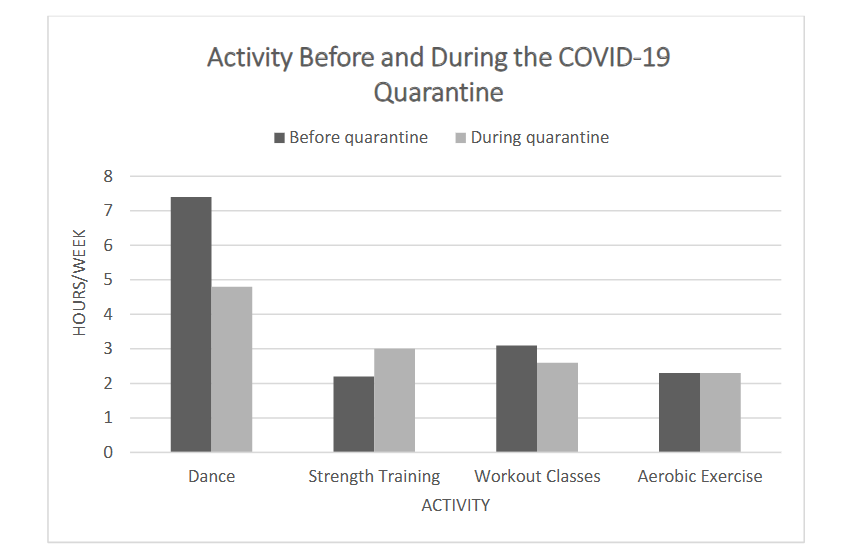
Prior to COVID-19, dancers reported training a median of 6 hours per week which decreased to 3 hours per week at home during quarantine (p=0.001). A significant proportion of the dancers surveyed (12/16, 75%) decreased training time during the pandemic, with only 2 of 16 (12.5%) increasing training time (p=0.01). This was accompanied by interruptions in training that ranged from 1 week to more than 6 months. To continue with dance training under stay-at-home guidelines, most participants (16/17, 94%,) reported following at-home virtual dance classes once they were available. The majority of dancers attended classes provided by their dance studio (14/16, 88%) which were guided by their regular dance instructor (13/17, 76%) or led by another studio instructor (5/17, 29%). Although more than half of dancers (6/11, 55%) reported performing their usual warm-up routine, there were a number of students (4/11, 36%) who reported a reduction in the time spent warming-up for practice.
The number of dancers who engaged in strength training increased to 76% (13/17) during the pandemic from only 29% (5/17) pre-pandemic. Nine dancers started strength training during the pandemic while only 1 dancer stopped (p=0.01). Despite the increases in strength training, participation in aerobic training did not change significantly (p=0.32) with the number of hours dedicated to aerobic training remaining at a median of two hours per week. Moreover, the number of dancers who attended additional exercise classes outside of dance decreased slightly from 41% (7/17) to 29% (5/17), (p=0.41).
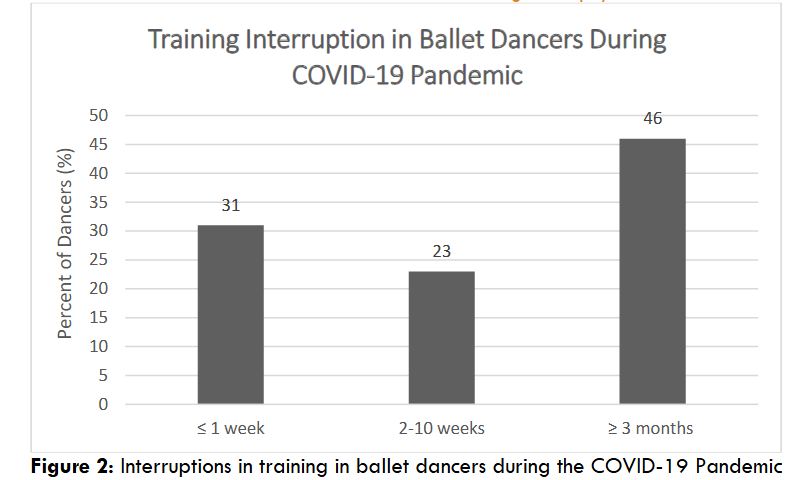
Within our cohort, 76% (13/17) of dancers reported an interruption in training due to the COVID-19 quarantine, with 54% (7/13) of participants reporting 1-10 weeks of interruption and 46% of the cohort (6/13) reporting a longer interruption. (Figure 2) Nearly half (47%, 8/17) of the dancers had access to some equipment needed to adequately train, while 12% (2/17) felt they did not have proper access. Training floor surfaces varied with 62% (10/16) on hardwood floors at home and 38% (6/16) on carpet. No participants trained on any version of sprung flooring while at home. Many dancers used chairs (11/17, 65%) or a barre (9/17, 53%) to train. Almost all dancers (94%, 16/17) received the COVID-19 vaccine and nearly half (47%, 8/17) reported being diagnosed with the virus at some point during the span of the pandemic.
Almost all dancers reported some level of nervousness (14/17, 82%) regarding their fitness, technique, timing, and performance level before returning to dance. Levels of preparedness were split between this cohort as 41% (7/17) reported a feeling of being moderately unprepared or minimally prepared and 59% (10/17) felt moderately or extremely prepared to return to pre-pandemic dance levels. Time taken to return to pre-pandemic caliber of dancing ranged from 1 day to 7 months. Only one dancer reported feeling they had not yet returned to their previous level of dancing. Upon returning to studios, 4 injuries occurred (no active injuries immediately before or during quarantine), with 100% involving the lower extremity, and 75% affecting the foot.
Discussion:
The results of our study demonstrate the ways in which the COVID-19 quarantine affected youth dancers. Almost all dancers who participated in this study attended virtual classes led by their dance studio once they became available; however, 61% of dancers experienced training interruptions longer than 6 weeks. The reasons for varying lengths of training interruption were not collected. Even after virtual classes were available, the number of hours dedicated to dance during quarantine was far from pre-pandemic levels. Before the stay-at-home order, 64.7% of dancers reported training 6 hours or more per week. This number reduced dramatically during the quarantine, with only 38% of dancers completing 6 or more hours of dance training per week. With such a considerable decrease in training, it could be assumed that these dancers went through a period of detraining and possible deconditioning. Periods of detraining can result in decreases in certain domains of performance including endurance, strength, power, speed, and flexibility.6,11,12 Despite the length of training interruption and time spent training at home, many dancers (80%) returned to pre-pandemic dancing levels within one month of returning to the dance studio.
Although dancers reported a decrease in training during the pandemic, many of the participating dancers found other ways to be active. Activities such as running, biking, swimming, walking, and martial arts were incorporated to maintain their cardiovascular fitness. However, the number of hours participating in these activities was minimal, averaging 2.3 hours per week with a range of 1-4 hours, which does not meet physical activity recommendations for youth.13 Unfortunately, when it comes to trained athletes, training at lower intensities for short periods of time is not enough to maintain athletic-level aerobic capacity.6 Although a break of one or two weeks does not have a significant effect on the aerobic capacity in athletes, longer term bouts of detraining can have a more detrimental effect. For example, a study performed by Font et al. investigated the effects of a 9-week home-based structured program on elite-level handball players during the COVID-19 quarantine.14 Investigators of this study found that despite the intentional effort to maintain neuromuscular and cardiovascular performance, the home program was insufficient to uphold pre-pandemic aerobic capacity levels. Studies conducted during this time demonstrate the deleterious physical effects that detraining has on athletes.6,14,15 With this in mind, a transition period of intentional and gradual re-training may be worth considering when athletes return to sport after a prolonged hiatus from competition-level training as a method of reacclimating the body and minimizing risks of injury.
Overall, 59% of dancers felt either moderately or extremely prepared to return to the studio when restrictions were lifted. Some dancers reported a very gradual return to the studios; however, some (33%) stated they began training at pre-pandemic levels immediately upon return. Despite variation in the time taken to return to prior levels of dance, almost all dancers (94%) admitted some difficulty with their return to the studio. With the likelihood of deconditioning and detraining occurring during the pandemic, it is recommended that athletes focus on strength training the muscles of the lower extremities and core as a starting point before returning to performing at pre-pandemic levels.10,16 During the pandemic, dancers within our cohort reported an increase in number of hours dedicated to strength training per week, which may have contributed to reduced risk of deconditioning or detraining. These dancers focused on both resistance bands and body-weight strength training. Those who recorded strength training hours all felt either moderately or extremely prepared to return to performing at their pre-pandemic dance levels upon return to the dance studios. Incorporation of flexibility and range-of-motion exercises are also highly recommended as a means of reducing risk of injury when returning to a sport after a prolonged pause in sport-specific exercise.16,17 Most protocols for returning to sport emphasize a gradual focus from strength training and general conditioning to agility and neuromuscular control.10,18-20 Lack of a premeditated or deliberate method of return may therefore put athletes at greater risk of injury.6,21 Notably, of the 25% of subjects who sustained new injuries after returning to the studio, 50% of those injured had sustained the injury within the first month of resuming dance training. All reported injuries occurred in the lower extremities of participating athletes. Similar studies have shown a greater incidence of lower extremity injuries in athletes returning to sports after the pandemic, especially among those who followed a primarily aerobic exercise routine over the span of the lockdown.14,22
A strength of our study was the ability to gather information regarding the experiences of youth athletes directly from the athletes themselves. Additionally, as California maintained some of the strictest social distancing mandates in the country, the results obtained from the surveys give insight to how extended restrictions affected dancers’ training routines individually and as a whole. This study was limited by a small sample size of 17 dancers. In addition, this study required retrospective reporting, which is subject to recall bias. Moreover, participating dancers were recruited from two studios in California, which may not necessarily represent the larger population of youth dancers or athletes. Nonetheless, this study highlights important trends and considerations regarding return to activity for performing arts athletes after prolonged periods of downtime.
Conclusions:
The COVID-19 pandemic was an unprecedented time of uncertainty for people across the world. Populations, including youth, relied on the resources, creativity, and resilience within themselves and those around them to continue participating in the activities they were passionate about. As the pandemic loomed on, the need for creative solutions became essential in keeping youth athletes active.23 Maintaining participation in dance and athletics in the midst of stay-at-home orders and social distancing mandates required the use of technological and financial resources which were not widely available to all families.24,25 Alternatives to in-person dance practice included participation in virtual exercise and dance classes, walking outdoors, and strength training. Despite the alternatives that were available, less than 50% of participating dancers felt they had access to the equipment they needed to adequately train for their sport. As a result, many dancers encountered difficulties as they attempted to return to dancing at their pre-pandemic levels. Ultimately, this study demonstrates that consistent, high-level training is essential for athletes in maintaining their skills and endurance. Fortunately, the pandemic has made virtual options for most services widely available and informed the public of the level of preparedness needed if similar events were to occur in the future.
Conflicts of interest statement
The authors have no conflicts of interest to declare. The authors have no disclosures to report.
References:
- McGuine T, Biese K, Hetzel S, et al. The Impact of COVID-19 Related School Closures and SPORT CANCELLATIONS on the Health of Adolescent Athletes. Orthopaedic Journal of Sports Medicine. 2021;9(7_suppl3):2325967121S00170. doi:10.1177/2325967121s00170
- Teare G, Taks M. Exploring the impact of the COVID-19 pandemic on youth sport and physical activity participation trends. Sustainability. 2021;13(4):1744.
- Pierce D, Stas J, Feller K, Knox W. COVID-19: Return to youth sports: Preparing sports venues and events for the return of youth sports. 2020;
- Drummond M, Elliott S, Drummond C, Prichard I. Youth sport and COVID-19: a potential generation lost. Emerald Open Research. 2023;1(2)
- Gingrasso S. Practical Resources for Dance Instructors! Choreographing Our Way Through COVID-19. Dance Education in Practice. 01 Sep 2020 2020;6(3)doi:10.1080/237348233.2020.1791565
- Alvurdu S, Baykal C, Akyildiz Z, et al. Impact of Prolonged Absence of Organized Training on Body Composition, Neuromuscular Performance, and Aerobic Capacity: A Study in Youth Male Soccer Players Exposed to COVID-19 Lockdown. International Journal of Environmental Research and Public Health. 2022;19(3):1148.
- Ünlü G. The Effects of COVID-19 İnduced Mobility Restrictions on Physical Fitness in Young Soccer Players at Different Maturity and Training Status. 2022;
- Jukic I, Milanović L, Svilar L, et al. SPORT PREPARATION SYSTEM IN TEAM SPORTS: SYNERGY OF EVIDENCE, PRACTICAL EXPERIENCES AND ARTISTIC EXPRESSION. 2018.
- Dayton JD, Ford K, Carroll SJ, Flynn PA, Kourtidou S, Holzer RJ. The Deconditioning Effect of the COVID-19 Pandemic on Unaffected Healthy Children. Pediatric Cardiology. 2021/03/01 2021;42(3):554-559. doi:10.1007/s00246-020-02513-w
- Kong H, Feng J, McClellan C, et al. Pediatric orthopedic injury prevention for team sports post COVID-19. Journal of Family Medicine and Primary Care. 2022;11(3):2249-4863 (Print). doi:10.4103/jfmpc.jfmpc_1632_21
- Joo CH. The effects of short-term detraining on exercise performance in soccer players. J Exerc Rehabil. 2016 February 23 2016;12(1):54-59. doi:10.12965/jer.160280
- Rodríguez-Fernández A, Sánchez-Sánchez J, Ramirez-Campillo R, Rodríguez-Marroyo JA, Villa Vicente JG, Nakamura FY. Effects of short-term in-season break detraining on repeated-sprint ability and intermittent endurance according to initial performance of soccer player. PLOS ONE. 2018 August 15 2018;13(8):e0201111. doi:10.1371/journal.pone.0201111
- CDC. Physical Activity Guidelines for School-Aged Children and Adolescents. Updated July 26, 2022. https://www.cdc.gov/healthyschools/physicalactivity/guidelines.htm
- Quintana-Cepedal M, Rodríguez MÁ, Crespo I, et al. Injury Characteristics among Young Adults during and Immediately after the COVID-19 Lockdown. International Journal of Environmental Research and Public Health. 2022;19(15):8982.
- Font R, Irurtia A, Gutierrez J, Salas S, Vila E, Carmona G. The effects of COVID-19 lockdown on jumping performance and aerobic capacity in elite handball players. Biology of sport. 2021 October 22 2021;38(4):753-759. doi:10.5114/biolsport.2021.109952
- Zago M, Lovecchio N, Galli M. Players at home: Physical activity and quality of life in 12–17 years-old football (soccer) players during the Covid-19 lockdown. International Journal of Sports Science & Coaching. 2022;17(3):626-636. doi:10.1177/17479541211041703
- Chiampas GT, Ibiebele AL. A sports practitioner’s perspective on the return to play during the early months of the COVID-19 pandemic: lessons learned and next steps. Sports Medicine. 2021;51(Suppl 1):89-96.
- Yanguas X, Dominguez D, Ferrer E, Florit D, Mourtabib Y, Rodas G. Returning to Sport during the Covid-19 pandemic: The sports physicians’ role. Apunts Sports Medicine. 2020;55(206):49.
- Mohr M, Nassis G, Brito J, et al. Return to elite football after the COVID-19 lockdown. Managing Sport and Leisure. 27, 172–180. 2020.
- Sarto F, Impellizzeri F, Spörri J, et al. Impact of potential physiological changes due to COVID-19 home confinement on athlete health protection in elite sports: a call for awareness in sports programming. Sports medicine. 2020;50:1417-1419.
- Kalinowski P, Myszkowski J, Marynowicz J. Effect of online training during the COVID-19 quarantine on the aerobic capacity of youth soccer players. International journal of environmental research and public health. 2021;18(12):6195.
- Batalha N, Sousa JP, Fernandes O, Dias E, Parraca JA, Villafaina S. Effects of an 11-Week Detraining, Imposed by the COVID-19 Confinement, on Handball Players’ Shoulder Rotator Isokinetic Profile, Shoulder Range of Motion, and Ball Release Velocity. Medicina. 2023;59(9):1548.
- Dorsch TE, Blazo JA, Arthur-Banning SG, et al. National trends in youth sport during the COVID-19 pandemic: Understanding American parents’ perceptions and perspectives. Journal of Sport Behavior. 2021;44(3):303-320.
- Fleming DJ, Dorsch TE, Serang S, et al. The association of families’ socioeconomic and demographic characteristics with parents’ perceived barriers to returning to youth sport following the COVID-19 pandemic. Psychology of Sport and Exercise. 2023;65:102348.
- Ng K, Cooper J, McHale F, Clifford J, Woods C. Barriers and facilitators to changes in adolescent physical activity during COVID-19. BMJ open sport & exercise medicine. 2020;6(1):e000919.
APPENDIX
Appendix A: COVID-19 Dance Survey
Demographic Information
What is your date of birth? MM/DD/YYYY
What is your gender? 1. Male 2. Female 3. Transgender, male-to-female 4. Transgender, female-to-male 5. Non-binary 6. Other 7. Prefer not to say
Please select the choices that apply to you (please mark all that apply): 1. Asian/Asian American 2. Black/African/African American 3. Latinx/Hispanic 4. Middle Eastern/North African 5. Native American/American Indian/Alaska Native 6. Native Hawaiian/Polynesian/Pacific Islander 7. White/Caucasian 8. Other 9. Prefer NOT to say
Please answer the following questions in this section based on your dance training PRIOR TO the coronavirus (COVID-19) pandemic.
How many days per week were you dancing? 0 1 2 3 4 5 6 7
How many hours per week did you dance? 1. 0 2. 1 3. 2 4. 3 5. 4 6. 5 7. 6 8. 7 9. 8 10. 9 11. 10 12. 11 13. 12 14. 13 15. 14 16. 15 17. >15
What aerobic/cross-training did you participate in prior to COVID-19? Aerobic training refers to any physical activity that has the ability to elevate your heart rate and maintain that level for a minimum of 20 consecutive minutes. 1. Running 2. Biking 3. Swimming 4. Elliptical 5. Other 6. None
If other, please specify: ___________________________________
Number of hours per week of aerobic training you participated in: 1. 0 2. 1 3. 2 4. 3 5. 4 6. 5 7. 6 8. 7 9. 8 10. 9 11. 10 12. 11 13. 12 14. 13 15. 14 16. 15 17. >15
What strength training did you participate in? (select all that apply) 1. Weight lifting 2. Resistance bands 3. Body weight exercises 4. None
Number of hours per week spent strength training: 1. 0 2. 1 3. 2 4. 3 5. 4 6. 5 7. 6 8. 7 9. 8 10. 9 11. 10 12. 11 13. 12 14. 13 15. 14 16. 15 17. >15
Workout classes prior to COVID-19: (check all that apply) 1. Spin 2. PBT (progressing ballet technique) 3. Pilates 4. Yoga 5. Crossfit 6. Other 7. None
If other, please specify: ______________________________________
Hours per week of workout classes 1. 0 2. 1 3. 2 4. 3 5. 4 6. 5 7. 6 8. 7 9. 8 10. 9 11. 10 12. 11 13. 12 14. 13 15. 14 16. 15 17. >15
During the pandemic, did you have any active injuries? 1. Yes 2. No
If you have active injuries, were you: 1. Out of dance entirely 2. Dancing modified (i.e. no jumps, lower extension, not full rehearsals, etc) 3. Dancing full but with an injury
What body region was injured? Check all affected body regions: 1. Head 2. Neck 3. Shoulder 4. Elbow 5. Wrist 6. Hand 7. Spine 8. Hip 9. Thigh 10. Knee 11. Lower leg 12. Ankle 13. Foot
Did you see a medical provider for this injury? 1. Yes 2. No
What was your diagnosis? _______________________________________
Please answer the following questions in this section based on your dance training DURING the coronavirus (COVID-19) pandemic.
Have you been vaccinated against COVID-19? 1. Yes 2. No
Choose what applies to you: 1. I received only some of the currently recommended doses 2. I received all of the currently recommended doses 3. I received all of the currently recommended doses with a booster
Have you been diagnosed with COVID-19 1. Yes 2. No
If yes, when were you diagnosed with COVID-19? DD/MM/YYYY
How many days were you ill and unable to exercise/train? _______self-reported number____________
Were you hospitalized? 1. Yes 2. No
If you were hospitalized, how many days were you hospitalized? _______self-reported number____________
Were you on a ventilator 1. Yes 2. No
If on a ventilator, for how many days? _______self-reported number____________
Did you have any interruption in your typical training due to the COVID-19 pandemic (not training or dancing at your usual level)? 1. Yes 2. No
How long was the interruption in your training? 1. 1 day 2. 2 days 3. 3 days 4. 4 days 5. 5 days 6. 6 days 7. 1 week 8. 2 weeks 9. 3 weeks 10. 4 weeks 11. 5 weeks 12. 6 weeks 13. 7 weeks 14. 8 weeks 15. 9 weeks 16. 10 weeks 17. 11 weeks 18. 12 weeks 19. 4 months 20. 5 months 21. 6 months 22. >6 months
What percent reduction did you experience in your training for your primary dance style (0% is no reduction or change in training at all, 100% is no training at all)? Self-reported number (0-100)
During the COVID-19 pandemic, have you taken classes in your home? 1. Yes 2. No
How many hours per week did you spend dancing at home? 1. 0 2. 1 3. 2 4. 3 5. 4 6. 5 7. 6 8. 7 9. 8 10. 9 11. 10 12. 11 13. 12 14. 13 15. 14 16. 15 17. >15
Was this exercise guided by (please check all that apply): 1. Yourself 2. An app 3. A video 4. Your regular dance teacher 5. A different dance teacher than your regular teacher 6. Your primary style of dance 7. Outside your primary style of dance
Were these classes offered by: 1. Your company/studio 2. Outside your company/studio
If you were practicing outside the studio, did your practice involve warm-up? 1. Yes 2. No
How did this compare to your usual studio practice warm-up? 1. Same as usual 2. More than usual 3. Less than usual
Did the dancing at home include jumping? 1. Yes 2. No
Did the dancing at home include pointe work? 1. Yes 2. No
Did the dancing at home include lifting a partner? 1. Yes 2. No
During this period of interrupted dancing, do you have access to the equipment you need to adequately train? 1. Yes 2. No 3. I have access to some 4. I have been trying to use substitutions at home to the best of my ability
What floor surface at home have you been training on? 1. Marly over home flooring 2. Marley over sprung floor 3. Sprung wooden floor 4. Home constructed sprung flooring 5. Other: eg hardwood, tile, cement, carpet
If other, please specify: ____________________________________
If dancing at home, did/do you use any of the following type of equipment at home? (please check all that apply) 1. Barre 2. Chair 3. Rail 4. Other 5. Nothing
If other, please specify: ______________________________________
If dancing at home, did/are you dancing: 1. Inside 2. Outside 3. Both
During this period of interrupted dancing, did you/are you doing any other forms of exercise? 1. Yes 2. No
Aerobic training: type 1. Run 2. Bike 3. Swim 4. Walk 5. Elliptical 6. Other 7. None
If other, please specify: ____________________________________
Hours per week of aerobic exercise 1. 0 2. 1 3. 2 4. 3 5. 4 6. 5 7. 6 8. 7 9. 8 10. 9 11. 10 12. 11 13. 12 14. 13 15. 14 16. 15 17. >15
Was this exercise guided by: 1. Yourself 2. An app 3. A video 4. Your regular dance teacher 5. A different dance teacher than your regular teacher
Strength training: type 1. Weight lifting 2. Resistance bands 3. Body weight exercise 4. None
Hours per week of strength exercise 1. 0 2. 1 3. 2 4. 3 5. 4 6. 5 7. 6 8. 7 9. 8 10. 9 11. 10 12. 11 13. 12 14. 13 15. 14 16. 15 17. >15
Was this guided by: 1. Yourself 2. An app 3. A video 4. Your regular dance teacher 5. A different dance teacher than your regular teacher
Other classes: type 1. Spin 2. PBT 3. Pilates 4. Yoga 5. Other 6. None
If other, please specify: _____________________________________
Hours per week of other classes: 1. 0 2. 1 3. 2 4. 3 5. 4 6. 5 7. 6 8. 7 9. 8 10. 9 11. 10 12. 11 13. 12 14. 13 15. 14 16. 15 17. >15
During interrupted dancing/dancing at home, have you sustained any injury from dancing outside the studio or at home? 1. Yes 2. No
If yes, were you: 1. Out of dance entirely 2. Dancing modified (i.e. no jumps, lower extension, not full rehearsals, etc.)
What body region was injured? Check all affected body regions: 1. Head 2. Neck 3. Shoulder 4. Elbow 5. Wrist 6. Hand 7. Spine 8. Hip 9. Thigh 10. Knee 11. Lower leg 12. Ankle 13. Foot
Did you see a medical provider for this injury? 1. Yes 2. No
What was your known diagnosis? ______self-reported diagnosis_____________
Have you returned to the dancing at the studio? 1. Yes 2. No
Before you returned to the dance studio and/or rehearsals, how prepared did you feel resuming your current fitness, technique, timing, and performance level? 1. Extremely unprepared 2. Moderately unprepared 3. Minimally prepared 4. Moderately prepared 5. Extremely prepared
Before you returned to the dance studio and/or rehearsals, how nervous did you feel resuming your current fitness, technique, timing, and performance level? 1. Not at all nervous 2. Slightly nervous 3. Minimally nervous 4. Extremely nervous
If you answered yes to an injury during COVID-19 interrupted dancing, what was the status of that injury when you returned to dancing in the studio/theater? 1. Not at all resolved 2. Slightly resolved 3. Minimally resolved 4. Moderately resolved 5. Completely resolved
How long did it take you to return to your prior level of dancing (as before the Pandemic)? 1. 1 day 2. 2 days 3. 3 days 4. 4 days 5. 5 days 6. 6 days 7. 1 week 8. 2 weeks 9. 3 weeks 10. 4 weeks 11. 5 weeks 12. 6 weeks 13. 7 weeks 14. 8 weeks 15. 9 weeks 16. 10 weeks 17. 11 weeks 18. 12 weeks 19. 4 months 20. 5 months 21. 6 months 22. 7 months 23. 8 months 24. 9 months 25. 10 months 26. 11 months 27. 1 year 28. Longer than 1 year 29. I do not feel I have returned
How difficult has it been to regain your prior level of dancing? 1. Not at all difficult 2. Slightly difficult 3. Minimally difficult 4. Moderately difficult 5. Extremely difficult
To return to your prior level of dance before the pandemic, how gradually did you build back up your dance training? Self-reported number (0-100) 0 = Not at all gradual, 100 = Extremely gradual
After you returned to dance training at the studio, did you develop any new injuries? 1. Yes 2. No
What body region did you injure? 1. Head 2. Neck 3. Shoulder 4. Elbow 5. Wrist 6. Hand 7. Spine 8. Hip 9. Thigh 10. Knee 11. Lower leg 12. Ankle 13. Foot
Did this new injury occur in: 1. The studio 2. In rehearsal 3. In performance
What movement were you performing when you were injured? ______Self-reported response_____________
If you sustained a new injury after returning to dance training at the studio, did you see a healthcare provider for this new injury? 1. Yes 2. No
What diagnosis were you given? ______Self-reported response_____________
After you returned to dancing in the studio/theatre, did you experience a recurrence of an old or ongoing (chronic) injury? 1. Yes 2. No
What body region did you reinjure? 1. Head 2. Neck 3. Shoulder 4. Elbow 5. Wrist 6. Hand 7. Spine 8. Hip 9. Thigh 10. Knee 11. Lower leg 12. Ankle 13. Foot
What diagnosis were you given for your prior injury? ______Self-reported response_____________
Did this new injury occur: 1. In the studio 2. In rehearsal 3. In performance
What movement were you performing when you were injured? ______Self-reported response_____________