

Impact of PPE on Dental Injuries in Gaelic Games
The Introduction of Compulsory Personal Protective Equipment in Gaelic Games: Impact on Dental Injuries
P Sexton¹, C Gordon², J A Twigg², T Barry¹, PJ Mc Cann¹
- Department of Oral and Maxillofacial Surgery, Galway University Hospitals, Galway, Ireland
- Department of Oral and Maxillofacial Surgery, Leeds Teaching Hospitals, Leeds, United Kingdom
OPEN ACCESS
PUBLISHED:31 January 2025
CITATION: Sexton, P., Gordon, C., et al., 2025. The Introduction of Compulsory Personal Protective Equipment in Gaelic Games: Impact on Dental Injuries. Medical Research Archives [online] 13(1).
https://doi.org/10.18103/mra.v13i1.6165
COPYRIGHT: © 2025 European Society of Medicine. This is an open- access article distributed under the terms of the Creative Commons Attribution License, which permits unrestricted use, distribution, and reproduction in any medium, provided the original author and source are credited.
DOI https://doi.org/10.18103/mra.v13i1.6165
ISSN 2375-1924
Abstract
Introduction: Gaelic football, Camogie, Hurling, Handball and Rounders collectively known as Gaelic games, are popular sports played in Ireland, with an increasing following worldwide. Information within the literature on longitudinal dental injury trends sustained whilst playing Gaelic games has been limited to date. The Gaelic Athletic Association (GAA), who govern the sports, have taken considerable steps to ensure players safety is maintained through various rule changes in the form of compulsory protective equipment wear and the availability of an injuries benefit insurance scheme. However, the impact of such legislative changes remains unexamined.
Aim: To evaluate the impact of the compulsory use of personal protective equipment (PPE) on the incidence of dental injuries in Gaelic games.
Method: A literature review was undertaken to explore the use of personal protective equipment in Gaelic Games and then a review of the open-access Gaelic Athletic Association Annual Reports from 2005-2019 were reviewed to obtain annual injury benefit fund claim data.
Results: A total of 4617 dental injuries were reported throughout 2005-2019. There was a statistically significant reduction in dental injuries following the introduction of mandatory PPE use in Gaelic games (p = 0.0053).
Conclusions: The incidence of dental injuries in Gaelic games is decreasing steadily since the mandatory introduction of helmets and mouthguards. Compulsory wearing of mouth guards in hurling and camogie will reduce dental injuries further. This rule change will certainly reduce injury benefit claims and prevent associated morbidity for players.
Keywords
Maxillofacial; Dental; Mouth-guard; Gaelic Athletic Association; Helmets; Contact Sports.
1. Introduction:
Gaelic football, Camogie, Hurling, Handball and Rounders collectively known as Gaelic games, are popular sports played in Ireland, with an increasing following worldwide. The governing body for Gaelic games, the Gaelic Athletic Association have continually sought to enhance the safety and wellbeing of its 500,000 plus members. In recent years, the GAA have taken considerable measures through the introduction of rule changes in the form of compulsory helmet wear, mouth guard use, stricter penalties for cynical fouls and the introduction of the GAA injury benefit fund schemes. However, while broadly supported by evidence from other contact sports, to date there has been no direct evaluation of the impact of such changes on dentoalveolar injuries during Gaelic games.
In January 2009, compulsory helmet wear was first introduced into the games of hurling and camogie. The rule stated that all players up to senior level were obliged to wear a helmet and faceguard during training and competitive play. In January 2010, senior players were then added to the ruling, which led to the compulsory wearing of helmets with faceguards for hurlers at all levels. Prior to this, helmet wear was optional and during this time injury to the facial region was commonplace. Hurling and camogie are fast paced games with frequent bodily contact and the potential for a “hurley stick” (similar to a hockey stick) or a hard ball (similar to a cricket ball) traveling at speeds up to 80km/h, to contact the face, which can lead to significant injury.
Mouth guards have been used in various sports as far back as the 1920s, when they were first introduced to the sport of boxing as a way of preventing dento-alveolar injury. In comparison, Gaelic football is a fast-paced game allowing players to both kick and handle the ball. Twisting, turning, tackling and the use of hands to grab the ball from an opponent leads to frequent bodily contact which includes hands and arms at face height. As players wear no other protective equipment such as padding or helmets, such contact can lead to a higher risk of injury.
Throughout the literature, researchers have discussed the different types of mouth guards available, from stock, boil and bite to custom-made. Evidence strongly suggests that custom mouthguards are the optimum type of mouthguard to reduce injury. Mouthguards have been consistently proven to reduce dental injury in those participating in contact sports. Mouthguards have been recommended by many stakeholders, such as the American and Irish Dental Associations, and the Oral Health Foundation. The Irish Dental Association (IDA) reported that Ireland had one of the highest rates of sport-related oral injuries in the EU, with one-third of all adult dental injuries being sports-related. Stewart et al., in 2011, found that 23.2% of paediatric emergency dental cases attending University College Cork Dental Hospital were caused by sports related injuries.
In response to increasing evidence on the value of mouthguards in reducing injury, major changes were introduced in April 2012 when the GAA held its Annual Congress. A ruling was announced stipulating the introduction of mandatory use of mouth guards in all Gaelic football matches and training sessions from January 1st 2013 (for all ages up to minor level) and at U21 and adult level from January 1st 2014.
Although it is widely accepted that participation in any sport carries with it some element of injury risk, dental injury at any age can result in potential lifelong morbidity and financial burden to a patient. Injury can lead to the loss of players from important games and cause deterioration in performance due to reduction in fitness from missed training.
2. Aim:
To evaluate the impact of compulsory use of personal protective equipment on the incidence of dental injuries in Gaelic games.
3. Methods:
A literature review was carried out to evaluate the level of reporting in the area of longitudinal dental injury trends in Gaelic games and the use of mouth guards and helmets in Gaelic Games sports. The search was performed using electronic databases “Scopus”, “PubMed”, “Science direct”, “Semantic scholar” and “Clinical key”. The keywords searched included “Gaelic game*”, “dental”, “mouth guard*” and “helmet”. The second part was the review of the open-access Gaelic Athletic Association Annual Reports. These reports are financial accounts produced every year highlighting injury insurance claim data. The period 2005-2019 was reviewed to obtain annual injury benefit fund claim data. Players were classified as youth (<18yrs) and senior (>18yrs). The following headings were noted: Eye, Ear, Facial, Head, Jaw, Nose, Teeth. Collectively these terms were classified as Oral and Maxillofacial injuries (OMFS). The study then sought to focus on the dental injuries sustained over the period. Data was assessed for normality using visual inspection of histograms and Q-Q plots. The difference between mean injury rates before and after the introduction of mandatory mouthguard and helmet wear was assessed using Welch’s T-test. The threshold for statistical significance was set at P = 0.05. Data was analysed using IBM SPSS statistics for Windows, version 27.
4. Results:
A review of the published literature showed limited reports of longitudinal dental injury trends in Gaelic games.
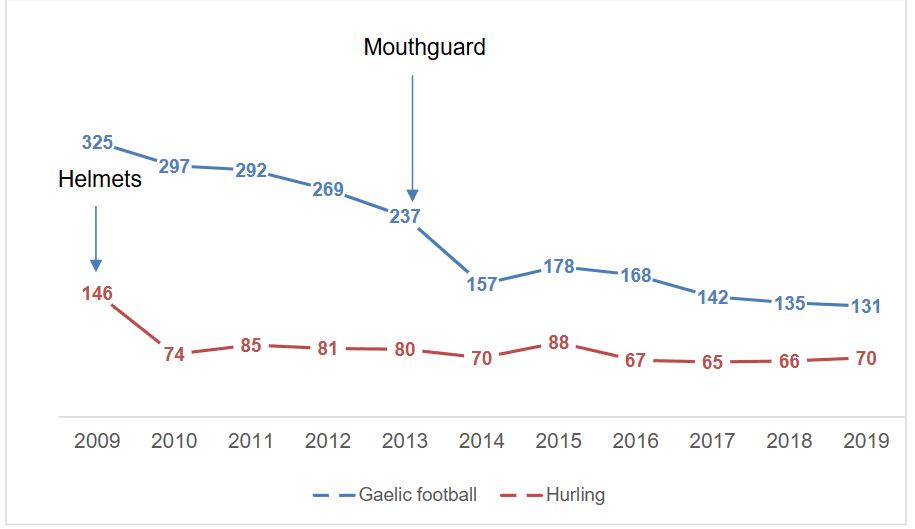
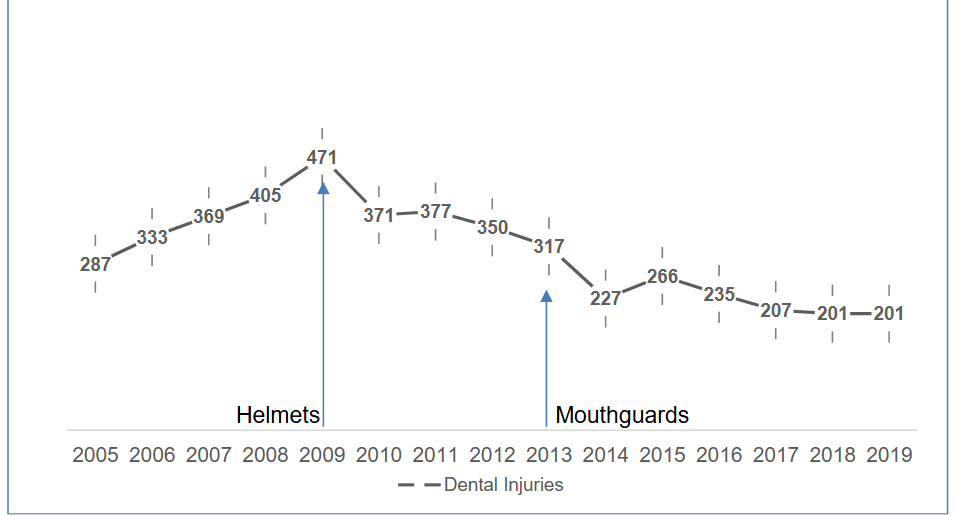
In the 15 years evaluated (2005-2019), a total of 99,858 bodily injuries occurred in Gaelic games, 7,540 (7.5%) were recorded as OMFS injuries. Within the OMFS injuries, 4617 were dental injuries resulting in an overall prevalence of (4.6%) of dental injuries in the sports of Gaelic games. Analysis of the data showed, a 57.4% reduction of dental injuries in Gaelic games from 2009 to 2019. Separately this showed a 59.7% reduction in Gaelic football and a 52.1% in hurling and camogie during the same period.
Analysis of the pre and post 2009-2010 periods showed a substantial reduction in the incidence of dental injuries with the introduction of helmets in hurling and camogie. The introduction of mandatory helmets led to a reduction and a visible plateau in dental hurling injuries, five years before the introduction of mouth guard use.
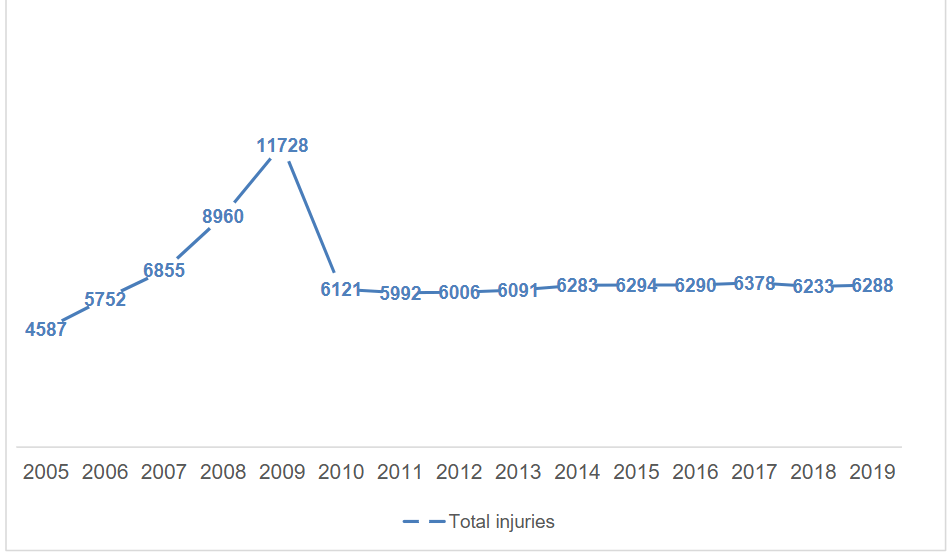
In the early years of the study period a worrying trend of increasing bodily injuries were recorded by the GAA, however this reduced and has now plateaued over time. Overall bodily injuries within the GAA have been relatively consistent since 2010, in contrast dental injuries, have been steadily declining.
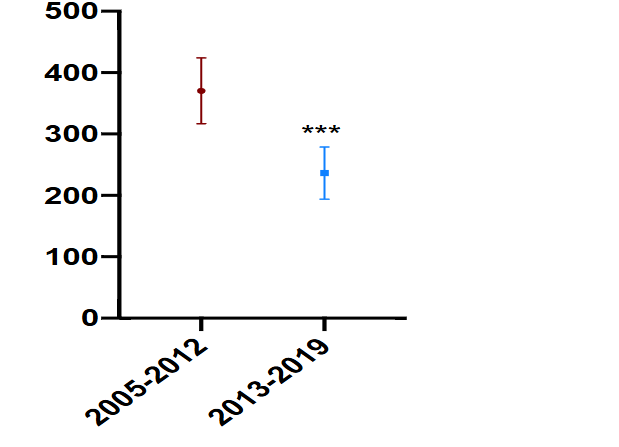
In Gaelic football, there was a statistically significant reduction (mean difference 28%, p=0.0053) in the mean incidence of dental injuries in the post-2013 period, corresponding with the introduction of mouth guards.
In total at all age levels Gaelic football players had 3 times the number of dental injuries versus those playing Hurling/Camogie.
| Player Level | Football Dental Injuries | Incidence Ratio | Hurling Dental Injuries |
|---|---|---|---|
| Minor players (U-18) | 675 | 3.2: 1 | 213 |
| Senior players | 2578 | 2.2: 1 | 1151 |
| Total Injuries | 3253 | 2.4: 1 | 1364 |
5. Discussion:
The incidence of dental injury is decreasing in Gaelic games. The introduction of the mandatory use of helmets in 2009 and mouthguards for Gaelic football players in 2013 as the timing of injury reduction corresponds to these interventions.
However, the incidence of dental injuries experienced by Gaelic football participants is still high at 4.6% and the number of reported dental injuries each year appears to have plateaued.
In comparison to other contact sports analysed in Welich et al’s recent systematic review and Meta-analysis, Gaelic sports had a lower prevalence of oro-facial injury (7.5%) and dental injury (4.6%). One must take into account however, that in this study a large volume of 99,858 injuries were recorded, in comparison to Welich et al’s meta-analysis of 4,933 players. Comparison with the Gaelic games, Gaelic football has 3 times the number of dental injuries compared to hurling/camogie. In the younger Gaelic football age groups (under 18 years old), the incidence is 3.2 times higher than hurling/camogie age group.
The study showed the number of dental injuries sustained in Gaelic football since the introduction of compulsory mouthguard wearing has decreased, but further reductions should be sought. The GAA have advised players that they are responsible for ensuring they wear a mouthguard during participation in Gaelic football and that they can be subsequently sent off should they fail to comply. They have adopted the phrase “No Mouthguard? No Game!” Any dental injuries sustained while not adhering to the mouthguard rules mean a player will not be covered under the GAA injury benefit scheme.
Dental injuries can be associated with lifelong morbidity and injury-claim expense thus it is important to reduce the incidence of such injuries. Dental injury represents a significant economic cost to both the individual affected and health services. The lifelong financial cost for a lone avulsed tooth is estimated to be in the region of 18,000 euro. The GAA injury benefit scheme covers dental costs up to 4,500 euro. This represents a considerable financial shortfall for the affected player or their family. Therefore, the use of mouthguards in Gaelic games has had a positive impact on player health and has reduced the risk of players suffering a large personal financial loss due to dental injury and represents a significant saving to the GAA by reducing injury claims.
To state non-compliance with helmet wear as a source of dental injury would be inaccurate. Helmets are a clearly visible piece of protective equipment and playing without wearing one is not possible, in comparison to mouth guards, which are hidden in the player’s mouth. Play without a mouth guard could easily go undetected. Players are not obliged to wear mouth guards in hurling or camogie however introduction of mouth guards could further reduce dental injuries in these sports.
5-1. CHALLENGES IN PROTECTIVE EQUIPMENT COMPLIANCE:
If personal protective equipment use is being promoted and players are complying with the rules, why might OMFS and dental injuries continue to occur?
5-2. EQUIPMENT DISSATISFACTION:
Anecdotally, observations have been made that player dissatisfaction with equipment can lead to non-compliance, with some reports of players placing the mouthguard in their sock during play. Players have complained that mouth guards make it hard to speak clearly and cause breathing difficulties. Coaches cite this as a reason for failing to encourage players to wear them during practices and competition. Helmets have also been known to be “modified by players for enhancement of vision with resultant injury.”
5-3. EQUIPMENT COST:
Although custom fit mouth guards have been proven to be superior, they are considerably more expensive. Custom mouthguards are manufactured using dental impressions. The custom guard is suitable in the adult dentition as this is stable, unlike the childhood dentition which undergoes frequent change, with loss of deciduous dentition and subsequent eruption of the permanent teeth. Parents with numerous children participating in Gaelic games would have large costs associated with purchasing multiple custom fit mouthguards. This in turn may lead them to purchase less effective, cheaper alternatives which may contribute to higher injury rates seen in younger players in football versus hurling. The GAA suggest that “Typically a custom-fitted mouthguard should cost between €50 and €75.” However, the cost of a custom fitted mouthguard from a dentist is likely to be higher with O’Malley et al suggesting that the average cost in 2011 was €109. To remedy this, different incentives have been trialed such as bulk purchase of mouthguards and tax incentive on the purchase of sports safety equipment. Helmet cost can range from €50 to €100 for a child or adult helmet. A helmet purchase is a more sustainable, long-term purchase as a head does not undergo as many growth changes as the developing dentition does. Helmets can also be passed onto younger siblings for further use.
5-4. INJURY EDUCATION:
Education about the importance of wearing a mouthguard remains a priority to reduce the number of dental injuries. Lack of awareness amongst players around long-term treatment implications and costs of dental injuries may be contributing to a lack of compliance with mouth guards. The GAA should consider further education at local level to stress the importance of compliance with the rules especially at senior inter county and club player level as these players need to set good examples to younger players. Perhaps educational talks at local level from dental practitioners would be another useful intervention.
5-5. PEER ACCEPTANCE:
Murphy et al. commented on the poor adherence to rules on personal protective equipment, especially during training sessions after the compulsory introduction of helmet wear in 2009. In the younger age groups, the use of safety equipment could be perceived as not being “cool” and lead to lack of peer acceptance should a player wear a mouth guard. However, with the introduction of a compulsory rule it removes that choice and in time, a mouth guard will be part of the accepted process of playing Gaelic football and resistance to wear should reduce.
6. Conclusions:
The reporting of dental injuries in the literature in Gaelic games to date has been somewhat restricted, possibly due to limited interest in the area. Effective injury prevention through the introduction of PPE has shown a significant improvement. A level of dental injury persists throughout the Gaelic games. One must ask whether adherence to the regulations is being followed at a local level and the introduction of mouth guard wear in hurling and camogie should serve to reduce dental injuries further in these sports.
7. Recommendations:
- Implementation of compulsory mouth guard use in Hurling and Camogie.
- Consideration of tax incentives or redistribution of injury benefit fund to reduce the cost of custom mouth guards.
- Further research into reasons for limited reporting and safety equipment dissatisfaction should be explored.
- The development of a national injury database, which will record in more detail the incidence and classification of dental injuries sustained.
- This will lead to more effective data recording, aid planning and decision making for future injury prevention such as possible harsher penalties for failure to comply with rules.
8. Conflicts of Interest:
The first author is a son in law to a member of the GAA board of directors. The director had no input into the study other than providing a contact to the injury benefit department. This research did not receive any specific grant from funding agencies in the public, commercial, or not-for-profit sectors.
9. Ethics Statement:
No ethics approval was required. No patient information was identifiable.
10. Acknowledgments:
GAA annual congress reports, GAA Injury Benefit Fund Department, Croke Park, Dublin.
References:
- Sexton, P, Courtney R, Mac Dhaibheid C, Barry T, McCann P. Dental injuries in Gaelic Games: A review of insurance injury claims of 2007–2015. British Journal of Oral and Maxillofacial Surgery 2017. 55. e142. 10.1016/j.bjoms.2017.08.165.
- Galic T, Kuncic D, Poklepovic Pericic T, et al. Knowledge and attitudes about sports-related dental injuries and mouthguard use in young athletes in four different contact sports-water polo, karate, taekwondo and handball. Dent Traumatol. 2018 Jun; 34(3):175-181. doi: 10.1111/edt.12394. Epub 2018 Apr 26. PMID: 29526055.
- Murphy C, Ahmed I, Mullarkey C, et al. Maxillofacial and dental injuries sustained in hurling. Ir Med J.2010 Jun; 103(6):174-6.
- Knapik JJ, Marshall SW, Lee RB, et al. Mouthguards in sport activities: history, physical properties and injury prevention effectiveness. Sports Med. 2007;37(2):117-44. doi: 10.2165/00007256-200737020-00003. PMID: 17241103.
- Dhillon BS, Sood N, Sood N, et al. Guarding the precious smile: incidence and prevention of injury in sports: a review. J Int Oral Health. 2014; 6(4):104-107.
- Young EJ, Macias CR, Stephens L. Common Dental Injury Management in Athletes. Sports Health. 2015;7(3):250-255. doi:10.1177/1941738113486077
- Newsome PR, Tran DC, Cooke MS. The role of the mouthguard in the prevention of sports-related dental injuries: a review. Int J Paediatr Dent. 2001 Nov;11(6):396-404. Doi: 10.1046/j.0960-7439.2001.00304.x. PMID: 11759098.
- Ilia E, Metcalfe K, Heffernan M. Prevalence of dental trauma and use of mouthguards in rugby union players. Aust Dent J. 2014 Dec; 59(4):473-81. doi: 10.1111/adj.12223. Epub 2014 Sep 27. PMID: 25160534.
- The Incidence of Orofacial Injuries in Sports: A Pilot Study in Illinois. Flanders RA, Bhat M. The Journal of the American Dental Association, Volume 126, Issue 4, 1995 491 – 496.
- Fernandes LM, Neto JCL, Lima TFR, et al. The use of mouthguards and prevalence of dento-alveolar trauma among athletes: A systematic review and meta-analysis. Dent Traumatol. 2019 Feb;35(1):54-72. doi: 10.1111/edt.12441. Epub 2018 Oct 16. PMID: 30222244.
- The importance of using mouthguards: Tips for keeping your smile safe, The Journal of the American Dental Association, Volume 135, Issue 7, 2004, Page 1061, ISSN 00028177
- Irish Dental Association Position Statement on The Prevention of Sports-Related Injuries January 2013
- Oral Health Foundation website. Available at www.dental health.org
- IDA survey ref Gaelic football is sport with most dental injuries for children, https://jida.ie/index.php/gaelic-football-is-sport-with-most-dental-injuries-for-children/
- Stewart C, Kinirons M, Delaney P. Clinical audit of children with permanent tooth injuries treated at a dental hospital in Ireland. Eur Arch Paediatr Dent. 2011 Feb;12(1):41-5. doi: 10.1007/BF03262778. PMID: 21299945.
- Warburton DER, Nicol CW, Bredin SSD. Health benefits of physical activity: the evidence. Can Med Assoc J 2006; 174(6):801-809.
- O’ Connor S, McCaffrey N, Whyte EF, et al. Epidemiology of injury in male adolescent Gaelic games. J Sci Med Sport. 2016 May; 19(5):384-8.
- Oliveira Werlich M, Honnef LR, Silva Bett JV, et al. Prevalence of dentofacial injuries in contact sports players: A systematic review and meta-analysis. Dent Traumatol. 2020 Oct; 36(5):477-488. doi: 10.1111/edt.12556. Epub 2020 Apr 16. PMID: 32176431.
- https://learning.gaa.ie/mouthguardshurlinghelmets Mouthguards & Hurling helmets | gaa.ie. Retrieved March 2021.
- Persic, R., Pohl, Y., Filippi, A. Dental squash injuries – a survey among players and coaches in Switzerland, Germany and France. Dental Traumatology 2006; 22 (5): 231-236.
- http://www.gaa.ie/mm/Document/MyGAA/ClubAdministrators/12/19/64/ClubManualInsuranceGAAInjuryBenefitFund_English.pdf
- Visser MF, Sexton PJ, Hawn KL. Enforcement of Mouthguard Use and Athlete Compliance in National Collegiate Athletic Association Men’s Collegiate Ice Hockey Competition J Athl Train. 2002 Apr-Jun; 37(2): 204–208. PMCID: PMC164346
- Lynch P, Rowan B. Eye injury and sport: sport-related eye injuries presenting to an eye casualty department throughout 1995. Ir Med J. 1997 Apr-May; 90(3):112-4.
- https://learning.gaa.ie/sites/default/files/GAA-Mouthguard-Information%202016.pdf
- O’Malley M, Evans D, Hewson, A, Owens J. Mouthguard use and dental injury in sport: a questionnaire study of national school children in the west of Ireland. Journal of the Irish Dental Association. 2012. 58. 205-11.
- Ferrari CH, Ferreria de Mederios JM. Dental trauma and level of information: mouthguard use in different contact sports. Dent Traumatol. 2002 Jun; 18(3):144-7. doi: 10.1034/j.1600-9657.2002.00017.x. PMID: 12154770.