

Impact of Public Pre-K on Academic Outcomes in Children
Large-Scale, Well-Implemented Public Pre-Kindergarten Linked to Better Academic Performance and School Health
Craig T. Ramey, PhD1, Gary J. Asmus, PhD2, Maria Stack Hankey PhD3, and Sharon Landeen Ramey, PhD4
- Craig T. Ramey, PhD Fralin Biomedical Research Institute at VTC, Virginia Tech; Roanoke, VA, USA 2 Riverside Circle Roanoke, Virginia, 24016
- Billy Ray Stokes, PhD Civitan International Research Center, University of Alabama at Birmingham, Birmingham, Alabama, USA
- Gary J. Asmus, PhD Cecil J. Picard Center for Child Development and Lifelong Learning, University of Louisiana, Lafayette, Louisiana, USA
- Maria Stack Hankey, PhD Fralin Biomedical Research Institute at VTC, Virginia Tech; Roanoke, VA, USA 2 Riverside Circle Roanoke, Virginia, 24016; New Affiliation: Carilion Clinic, Health Analytics Research Team, 213 S. Jefferson Street, Suite 1502, Roanoke, Virginia 24011, USA
- Sharon Landesman Ramey, PhD Fralin Biomedical Research Institute at VTC, Virginia Tech; Roanoke, VA, USA 2 Riverside Circle Roanoke, Virginia, 24016
OPEN ACCESS
PUBLISHED: 31 May 2025
CITATION:RAMEY, Craig T. et al. Large-Scale, Well-Implemented Public Pre-Kindergarten Linked to Better Academic Performance and School Health. Medical Research Archives, [S.l.], v. 13, n. 5, may 2025. ISSN 2375-1924. Available at: <https://esmed.org/MRA/mra/article/view/6534>.
COPYRIGHT: © 2025 European Society of Medicine. This is an open-access article distributed under the terms of the Creative Commons Attribution License, which permits unrestricted use, distribution, and reproduction in any medium, provided the original author and source are credited.
DOI: https://doi.org/10.18103/mra.v13i5.6534
ISSN 2375-1924
ABSTRACT
Large-scale PreK programs for children from low-income families are increasingly recognized for their potential to improve academic and health outcomes. This study examines the effects of a large-scale, state-wide pre-kindergarten (PPK) program on academic achievement and school health outcomes for children from low-income families. Findings indicate that children who participated in the PPK program performed significantly better in academic subjects than their peers who did not participate in pre-kindergarten (NPPK). The study highlights the importance of access to quality early education programs for enhancing the educational trajectories of children from disadvantaged backgrounds.
Keywords: Pre-K, academic achievement, low-income families, early education, school health
Introduction
Since the 1970s, justification for establishing many public pre-kindergarten programs has relied on citing the long-term results and estimates of economic returns-on-investment from rigorous multi-scale randomized control trials (RCTs) that offered multi-year early education programs to children from economically disadvantaged backgrounds (cf., Duncan & Magnuson, 2013; Heckman et al., 2007; Loewenstein, 2011). The most frequently cited longitudinal studies are the Perry Preschool Project4 (e.g., Lazar & Darlington, 1982; Heckman, Moon, Pinto, Savelyev, & Yavitz, 2010; Schweinhart, et al., 2005) conducted in Ypsilanti, MI and the Abecedarian Project conducted in Chapel Hill, NC (cf., Campbell & Ramey, 1994).
These effects occur for future cohorts that include children who enter pre-kindergarten at an earlier age and more heterogeneous groups than those previously studied. However, short-term gains are being associated with longer term benefits for students when they enter a wider range of public school settings? To our knowledge, this study provides a unique set of findings about public pre-k quality with a longitudinal, population-based comparative research design focused on the issue of program implementation and findings across increasingly larger statewide cohorts.
Methods
The study utilized the PPK program and the associated information system (SIS) from the state Board of Elementary and Secondary Education (BESE) and the state Department of Education (DOE). The PPK program was designed to serve children from low-income families who were eligible for free or reduced-price lunch. Children from higher income families were allowed to participate in the program if their families paid tuition (on a sliding scale) or if the LEA chose to cover the costs for all students. Although students from low-income families comprised the highest priority for admission, children from higher income families were included as space permitted. For the first four cohorts, a consistent mean of 85 percent of the admitted PPK children lived in low-income households.
Our rationale for including only children who attended kindergarten in the same schools that the PPK students attended (total N=6,868 schools), receiving free and reduced lunches, and having the designation of No Public Pre-K (NPPK), which eliminated students who had received 4-year old Head Start or who were enrolled in Special Education classrooms or any other publicly funded program for 4-year olds as a control.
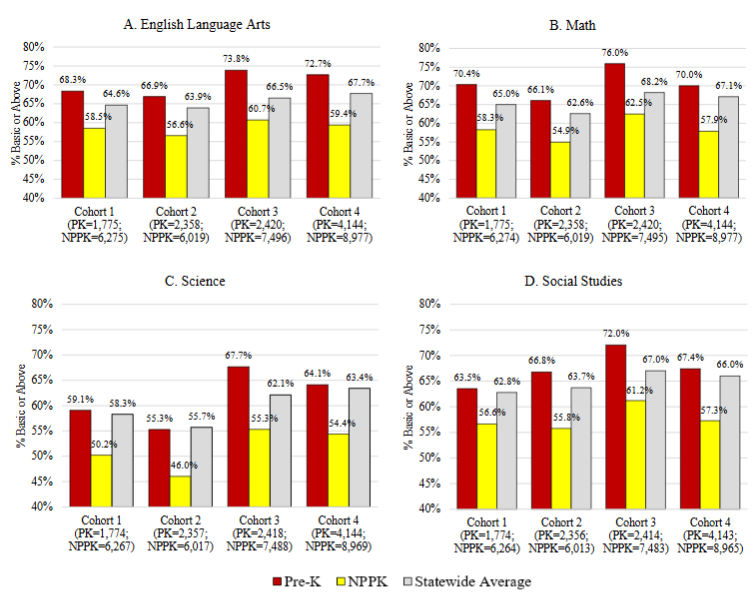
Data analysis was conducted using standardized test scores for each subject area (reading and math, Science, and Social Studies). We further describe the students’ achievement in terms of whether they met or exceeded the state’s threshold of “Basic or above” levels of competency for 3rd grade.
Results
DEMOGRAPHIC INFORMATION OF GROUPS
| Variable | Pre-K | NPPK |
|---|---|---|
| Gender | 50.1% Boys | 50.2% Boys |
| Race | Black: 30.1% | Black: 29.8% |
| Age on Kindergarten Entry | 5.0 years | 5.1 years |
For the academic achievement outcomes, we used a hierarchical linear model (HLM) to analyze the data. The results indicated significant differences between the PPK and NPPK students across all subjects.
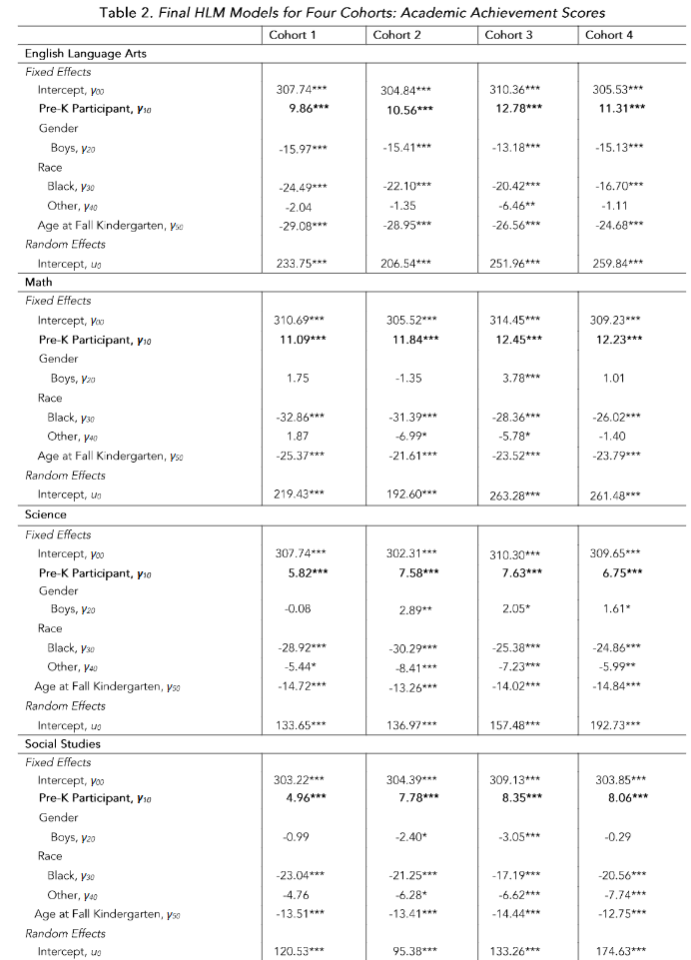
As shown in Table 3, the academic achievement scores for the four cohorts of Pre-K participants and NPPK comparison groups were significantly different, with PPK students consistently outperforming their peers.

Figure 1 illustrates the academic achievement of the PPK and NPPK groups across various subjects.
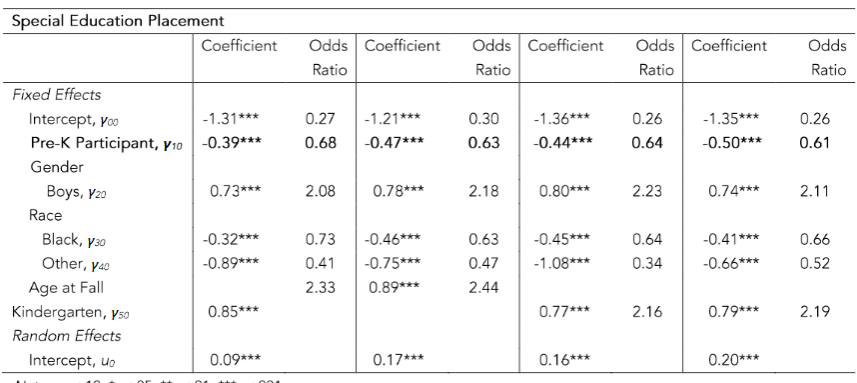
HLM RESULTS FOR GRADE RETENTION AND SPECIAL EDUCATION PLACEMENT
For both Grade Retention and Special Education Placement, we examined the percentage of students who were retained in the SIS database and compared the NPPK group to the PPK group.
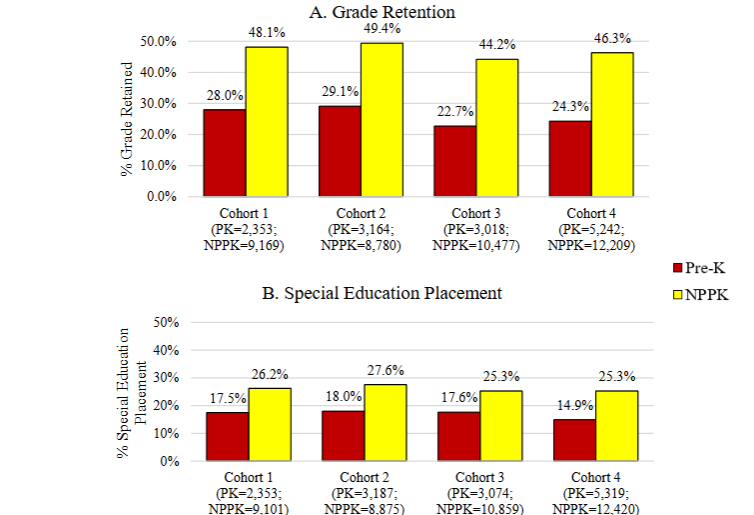
Figure 2 shows that special education placement for students in the PPK program is markedly lower for students in PPK compared to the NPPK group.
Discussion
These findings support the conclusion that children who participate in a high-quality pre-kindergarten program are less likely to be retained in grade and less likely to require special education services.
Limitations of the Study
We realize the importance of identifying several limitations inherent in this study. First, these results are based on the demographics of students and the state’s educational policies and practices.
Conclusion
Finally, we would like to establish an overarching goal in creating and sustaining children’s early educational experiences that will lead to improved outcomes in their academic and health trajectories.
References
References
2. Heckman JJ, Masterov DV. The productivity argument for investing in young children. Appl Econ Perspect Policy. 2007;29(3):446-493. doi: https://doi.org/10.1111/j.1467-9353.2007.00359.x.
3. Lowenstein AE. Early care and education as educational panacea: What do we really know about its effectiveness? Educ Policy. 2011;25(1):92-114. doi:10.1177/0895904810387790.
4. Lazar I, Darlington RB. Lasting effects of early education: A report from the Consortium for Longitudinal Studies. Monographs of the Society for Research in Child Development. 1982;47(2-3): 1-151. doi:10.2307/1165938.
5. Heckman JJ, Moon SH, Pinto R, Savelyev PA, Yavitz A. The rate of return to the HighScope Perry Preschool Program. J Public Econ. 2010;94(1):114-128. doi:https://doi.org/10.1016/j.jpubeco.2009.11.001.
6. Schweinhart LJ, Montie J, Xiang Z, Barnett WS, Belfield CR, Nores M. Lifetime effects: The High/Scope Perry Preschool Study through age 40. Ypsilanti, MI: High/Scope Press; 2005.
7. Ramey CT, Campbell FA, Burchinal M, Skinner ML, Gardner DM, Ramey SL. Persistent effects of early childhood education on high-risk children and their mothers. Appl Dev Sci. 2000;4(1):2-14. doi:10.1207/S1532480XADS0401_1.
8. Ramey CT, Sparling J, Ramey SL. Abecedarian: The ideas, the approach, and the findings. Los Altos, CA: Sociometrics Corporation.; 2012.
9. Ramey CT, Ramey SL. Early childhood education that promotes lifelong learning, health, and social well-being: The Abecedarian Project and its replications. Med Res Arch. 2023;11(11). doi:10.18103/mra.v11i11.4590.
10. Dodge KA, ed. The current state of scientific knowledge on pre-kindergarten effects. Durham, NC: Duke University; 2017.
11. Phillips DA, Lipsey MW, Dodge KA, et al. Puzzling it out: The current state of scientific knowledge on pre-kindergarten effects: A consensus statement. In: Dodge KA, ed. The current state of scientific knowledge on pre-kindergarten effects. Durham, NC: Duke University; 2017:19-30.
12. Durkin K, Lipsey MW, Farran DC, Wiesen SE. Effects of a statewide pre-kindergarten program on children’s achievement and behavior through sixth grade. Dev Psychol. 2022;58(3):470-484.
doi:10.1037/dev0001301.
13. Ramey CT, Ramey SL, Stokes BR. Research evidence about program dosage and student achievement: Effective public prekindergarten programs in Maryland and Louisiana. In: Pianta R, Howes C, eds. The Promise of Pre-K. Baltimore, MD: Brookes Publishing; 2009:79-105.
14. Open Science Collaboration. PSYCHOLOGY. Estimating the reproducibility of psychological science. Sci. 2015;349(6251):aac4716. doi:10.1126/science.aac4716.
15. Yoshikawa H, Aber JL, Beardslee WR. The effects of poverty on the mental, emotional, and behavioral health of children and youth: implications for prevention. Am Psychol. 2012;67(4):272-284. doi:10.1037/a0028015.
16. Harms T, Clifford RM, Cryer D. Early childhood environmental rating scale (Rev. Ed.). New York, NY: Teachers College Press; 2005.
17. Zill N, Resnick G, Kim K, O’Donnell K, Sorongon A. Head Start FACES 2000: A whole-child perspective on program performance. Washington, DC: Administration for Children Youth and Families, U.S. Department of Health and Human Services; 2003.
18. Developing Skills Checklist [Assessment Instrument]. Monterey, CA: CTB/McGraw-Hill; 1990.
19. United States Department of Agriculture, Food and Nutrition Services. (2016). Child nutrition programs: Income eligibility guidelines. Retrieved September 28, 2016, from
https://www.gpo.gov/fdsys/pkg/FR-2016-03-23/pdf/2016-06463.pdf
20. Hover HD, Dunbar SB, Frisbie DA. Iowa Tests of Basic Skills. . Rolling Meadows, IL: Riverside Publishing; 2001.
21. Raudenbush SW, Bryk AS. Hierarchical linear models: Applications and data analysis methods (2nd ed.). Thousand Oaks, CA: Sage; 2002.
22. Raudenbush SW, Bryk AS, Congdon R. Hierarchical Linear and Nonlinear Modeling (HLM) 7.01 for Windows. [computer program]. Skokie, IL: Scientific Software International, Inc.; 2013.
23. Snijders T, R. B. An introduction to basic and advanced multilevel modeling. Thousand Oaks, CA: Sage; 1990.
24. Donovan MS, Cross CT, eds. Minority students in special and gifted education. . Washington, DC: National Academy Press; 2002.
25. Grunewald R, Rolnick AJ. An early childhood investment with a high public return. The Regional Economist. 2010.
26. Gormley WT, Jr., Phillips D, Gayer T. The early years. Preschool programs can boost school readiness. Sci. 2008;320(5884):1723-1724. doi:10.1126/science.1156019.
27. Hill CJ, Gormley Jr WT, Adelstein S. Do the short-term effects of a high-quality preschool program persist? Early Child Res Q. 2015;32:60-79. doi:10.1016/j.ecresq.2014.12.005.
28. Barnett WS. Effectiveness of early educational intervention. Sci. 2011;333(6045):975-978. doi:10.1126/science.1204534.
29. Duncan GJ, Magnuson K. Investing in preschool programs. J Econ Perspect. 2013;27(2): 109–132. doi:10.1257/jep.27.2.109.
30. Bowman LJ. Grade retention: Is it a help or hindrance to student academic success? Prev Sch Fail. 2005;49(3):42-46. doi:10.3200/PSFL.49.3.42-46.