





Impact of Small Housing on Mental Health During COVID-19
The social housing, space that produces environmental stress in the case for confinement for Covid-19, in City Juárez, Chihuahua, Mexico
Leticia Peña-Barrera ¹
- Docente e Investigadora del Programa de Arquitectura, Instituto de Arquitectura, Diseño y Arte Universidad Autonoma de Ciudad Juarez, Mexico
OPEN ACCESS
PUBLISHED: 31 May 2025
CITATION: Peña-Barrera, L., 2025. The social housing, space that produces environmental stress in the case for confinement for Covid-19, in City Juárez, Chihuahua, Mexico. Medical Research Archives, [online] 1(35).
https://doi.org/10.18103/mra.v13i5.6395
COPYRIGHT: © 2025 European Society of Medicine. This is an open-access article distributed under the terms of the Creative Commons Attribution License, which permits unrestricted use, distribution, and reproduction in any medium, provided the original author and source are credited.
DOI https://doi.org/10.18103/mra.v13i5.6395
ISSN 2375-1924
Abstract
Social housing is the patrimony that thousands of families have acquired over time, with a Infonavit financing resources in recent decades in Mexico. These homes had an area of up to 90 square meters of construction in 1970, either single-family or condominium apartments. It is currently only 35 square meters or less. The impact on the decrease in space in homes has effects on the mental health of their residents, which was measured randomly during the Covid-19 lockdown. The methodology used are considered two study groups to identify situations that affected daily life, causing depression, fear, sadness, and anger, and were linked to the size of the space, household noise, lack of privacy, and problems of coexistence. The first group take assistance in the call center to Secretary of health for there have a depression, fear, sadness, and anger and intrafamilial violence. The second group they not had assistance. This article addresses the factors that generate environmental stress (depression, stress, anger, and sadness) in housing, due to prolonged confinement, limited space, and lack of isolation. In this sense, it is assumed that housing at a spatial determinant for socialization can trigger environments that produce stress and that hinder healthy coexistence in its residents. This research is a reflection on the changes that need to be made to improve social housing and ensure a stress-free environment to withstand prolonged confinement.
Keywords: limited space, environmental stress and situation of vulnerability.
Introduction
The social housing developed in the last twenty years is the result of public proposals regarding the constitutional right of every Mexican to access decent housing of the market’s vision. Funding from the National Institute of Workers’ Housing Fund (Infonavit) in Mexico, allows access to limited built-up space, housing options minimum that so “It is not just about the volume of housing production; it requires an improvement in society’s housing conditions”. Understanding how daily life is resolved unsocial housing and what effects can be identified on mental health, depression, sadness, fear, anguish and panic express situations of mental catharsis, breaking the environment that should be conducive for healthy coexistence. These contingency measures were due to the fact that SARS-COV-2 was a “highly contagious and previously unknown pathogen” that affected the respiratory system, causing complications and being fatal in some cases.
During the COVID-19 pandemic, several countries and cities resorted to border closures and home confinement for most of the population. A study of 44,672 cases determined that “all people, regardless of age, are susceptible” to infection, and identified that “the mortality rate is higher in older people and those with comorbidities”. The control mechanism used in different countries and cities was the closure of borders and confinement at home for most of the population, even if they did not present disease or symptoms. In a study of 44,672 cases, it was found that “all people without age limitation are susceptible” to contagion, identifying that “the mortality rate is higher in elderly people and those with some comorbidities”.
Confinement at home forced people, children and young people who study, to stay at home for a long time, living at the same time with daily activities and school commitments. The changes were very rapid and with few options outside the home to solve them. It is important to identify that the changes in the environment to which people are accustomed is not precisely those of the home, which means that the daily dynamics of coexistence and relations, in the use of spaces had to increase during most of the day, in condition of greater discomfort and with the increase of situations of friction and violence.
POVERTY AND SOCIAL VULNERABILITY
Some poverty records shown by CONEVAL in 2024 in Mexico, are linked to the social deprivations that exist:
- Lack of access to security for 50.2% of the inhabitants, 64.7 million people.
- Lack of access to health services, which impacts 39.1% of the population, 50.4 million people.
- The third is the educational lag for 19.4% of the inhabitants and 25.1 million people.
This outlook does not permit us to substantially reduce the problem, because the increase in insecurity, missing health care and education it’s an indicator of unfavorable for reducing environmental stress and violence. If a home doesn’t offer enough space and pleasant surroundings for the number of occupants it houses, it becomes a place triggering discomfort, stress, and mental health issues. This occurred during the COVID-19 lockdown, when in the house indoor mobility was limited for daily activities, such as cleaning, school, or work, making it a place with high levels of stress.
HABITABILITY AND CONFINEMENT IN SPACES
In studies related to environmental psychology, it has been established that in small environments, occupants face stressful situations that can lead to violence or discomfort. In this sense, this study considers habitability in the physical, psychosocial, and sociocultural aspects of space, which reflect people’s lifestyles. Therefore, it is necessary to consider other more flexible and/or adaptable forms, which other authors have proposed through the organization or modification of spaces. Habitability includes physical and non-physical aspects, “which allow a living being to inhabit and inhabit a place”, in which it incorporates cultural aspects and styles or ways of inhabiting by Saldarriaga.
The condition of well-being does not incorporate the personal dimension, of affective relationships, of the feeling of community, leading to existential emptiness. Therefore, this research explains the situations of sadness, fear and/or depression that affect the mental health of people in the groups considered when space cannot be personalized and which Monteys defines as “nuanced uses” refers to spaces of similar sizes without contrasting activities and a different function.
TRIGGERS OF VIOLENCE AND/OR DISCOMFORT
It is assumed that housing as a spatial determinant for socialization can trigger stress due to the lack of environments that facilitate healthy coexistence and thus increase areas of stress and violence in its residents. Therefore, identifying these stress-generating factors in the homes of people who requested telephone psychological care and comparing them with the group that did not require it contributes to understanding them. Housing for its inhabitants has become a means of oppression and despair, where violence and discomfort converge as factors of vulnerability to the mental health of those who live. As for the problems that were detected, they are depression, sadness, fear, anxiety and panic. The prolonged confinement of people in these homes encourages domestication, which limits their physical and mental potential, especially in young people and children just beginning their lives and education. Studies on environmental stress have shown that people’s diminished ability to adapt to adverse conditions in a given location leads to a “progressive deterioration in the quality of human life”.
As for the producers of environmental stress that could be established in the daily activities of the homes, they are the following:
- The agglomeration of people inside the house stays longer and generates concentration of the occupants in all spaces.
- Increase noise, either due to conversations or that in different rooms the television or radio remains of the day.
- Difficulty in maintaining the cleanliness of spaces, which makes it impossible to carry out tasks at pre-established times and times, which prolongs household chores for those who used to do so without restrictions.
- Loss of personal space, since school activities now occupy private spaces in bedrooms, or in their case it is difficult to concentrate in open spaces.
- Accumulation of bad odors, due to the lack of sufficient space for cleaning and the time spent on this activity is prolonged; due to the preparation of food or failures in the use of services (drainage, ventilation, among others).
All these aspects that were previously controlled when children and young people remained in school and the spouse working, now cannot be solved efficiently. Holahan mentions that Sheldon Cohen identified that “exposure to a producer of environmental stress can result in an overload in the individual’s capacity that prevents him from processing the information necessary to effectively perform the task or social activities”. The identified producers of environmental stress affect the daily activities of those who were in charge of the household. Different studies establish that the lack of control leads to an attitude of “learned helplessness”, where people are predisposed to offer answers without foreseeing the results and the “cognitive capacity” to resolve or control the factors that cause them is diminished.
Feelings of learned helplessness force individuals to decrease their “cognitive capacity” to solve problems, and when they are exposed to environmental stress for a prolonged period, they require “high levels of effort, energy and attention”. Holahan mentions that Sheldon Cohen identified that “exposure to an environmental stressor can result in an overload of an individual’s capacity, preventing them from processing the information necessary to effectively perform a task or social activity”. The level of demand that is placed on household chores may be considered less effort; but now you must connect with the teachers at school, dedicate time to study and homework with your children, tolerate complaints about the noise and patiently accept expressions of annoyance from other occupants. Undoubtedly, women are experiencing the increased workload at home that before. The “cognitive fatigue”, defined as the decrease in “the ability to process information” and with it the performance of complex tasks they imply greater concentration and control.
It is therefore understandable that the increase that 80% in telephone therapy applicants is from the confinement by Covid-19. The effects of discomfort identified in people are not exclusive to those who have requested psychological care, it is possible that permanent occupants who do not have a role in the activities of the house express some discomfort and stress. The environment analyzed in this article refers to the producers of stress that promote the situation of vulnerability for their occupants and that seeks to find a correlation between housing space and generator of discomfort or stress.
Methodology
A mixed methodology was used since they identify quantitative aspects of the problem of discomfort that originates in the housing environment and situations of perception of a qualitative nature, which arise from the opinion of the occupants. The study groups are residents of Ciudad Juárez, Chihuahua, Mexico. It is an exploratory study with 78 surveys, of which the first Group is 25 persons were applied to people who have used the telephone therapy system to reduce stress and mental health conditions. The second group, with 53 surveys are people in confinement in their homes, most of them young people (students), there by triggering stressful environments in their homes. The period of application of the questionnaire was between July 12 and August 10, 2020. The study is exploration and random, since it was not possible to control the social sector or the location of an area of the city, the spectrum is: Group 1, which receives therapy and group 2 (young people) who had been at home since March 18 in 2020 and taking distance courses. A questionnaire with closed and open opinion questions was applied using the Forms software, sent on WhatsApp or by email to the second group, and by telephone interview to the first group. The Group 1, case of people who receive therapy, it was done by telephone through the database available from the call center of the Ministry of Health. The people who attended responded at the beginning of the school vacations, and therefore 37.5% of the group was less broad. The Group 2, responded to a structured survey in which all participants are asked the same questions, the form and sequence is similar, is selection the azar. The respondents themselves answered virtually, with software Forms, managing to guarantee anonymity. The respondents had the option of not answering those questions that did not correspond to their situation. The answers were received online and by integrating the database the Excel and captured in SPSS version 19 statistical software. The results, the correlation of data is achieved with the triangulation between open opinions and the closes answers, is validated through applied statistics.
Results
The sample was randomly selected, indicating that gender was not predetermined, and therefore, there was a higher participation rate for women, with 65.4% compared to 29.5% for men. 5.1% did not respond, being the following:
- Group 1, persons with receiving therapy, of which 92% are women and 8% are men.
- Group 2 corresponds to students and adults who do not receive therapy, the 53% are women and 40% are men, with 7% of people not responded.
The age of the respondents is as follows:
- Group 1. Participants in this group are between 21 and 44 years old (48%) and between 41 and 55 years old (44%). 80% of the women are between 26 and 50 years old.
- Group 2. Respondents in this group are between 15 and 25 years old (64.1%). Young people between 26- and 35-years old account for 28.2%. 5.7% are over 46 years old. Regarding gender, 45.2% are women between 15 and 35 years old and 39.6% are men between 15 and 30 years old. The participants are primarily students.
HOUSING AND OCCUPANT COUNT
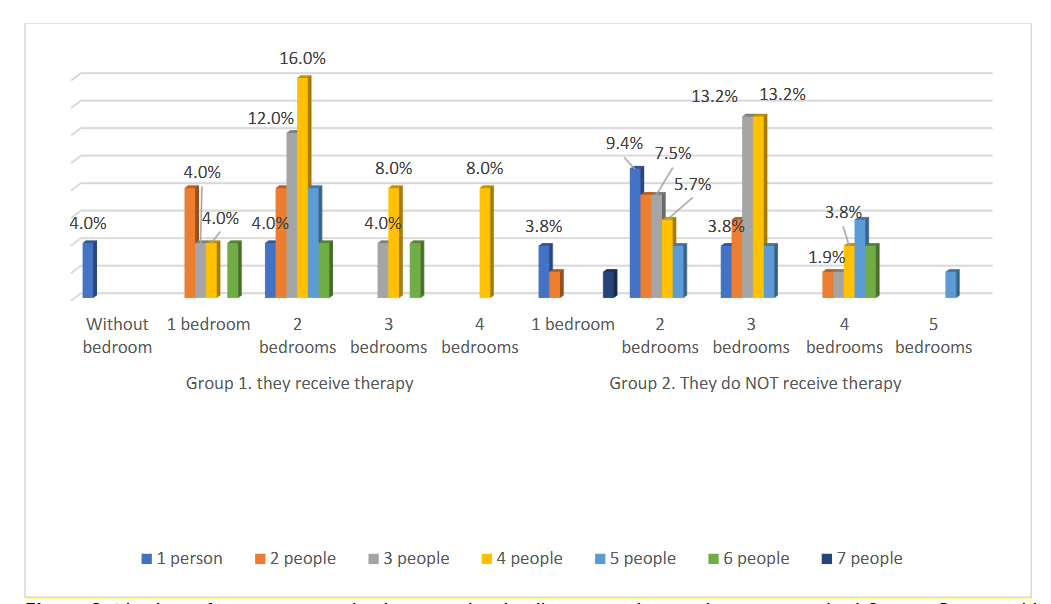
- Group 1 refers to 25 homes with 89 people living there; that is, an average of 3.56 inhabitants per home. It is also noted that 24% of the homes are overcrowded (see Figure 1).
- Group 2 consider 53 homes occupied by 170 people, an average of 3.2 occupants per home. Regarding overcrowding, only 2% report it (see Figure 1).
Stress conditions in Group 1 are greater due to overcrowding and lack of space for the number of occupants.
OVERCROWDING CONDITIONS IN HOMES
In both groups, 26% of households have a high concentration of people. The following can be identified:
- 23.8% of homes have only one bedroom, and in these cases, 14.4% are overcrowded because they are occupied by more than 4 to 6 people.
- 52.4% of homes have two bedrooms, and 9.6% are overcrowded because they are occupied by 5 or more people.
- 19% have three bedrooms.
- 4.8% have four bedrooms for very few occupants (see Figure 1).
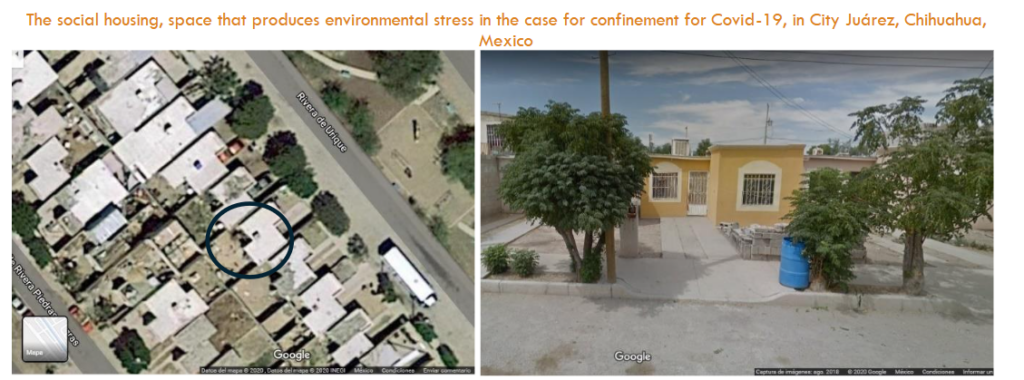
The Group 1, The 32% of the people who receive therapy live in the north-southwest zone, being 100% economic type (with 34 m² or 35 m² of construction, see figure 2 and 3). It is identified that 60% of the people who receive therapy live in the new sectors which were founded in 2001, specifically Riberas del Bravo, where more than 13,500 houses were built in nine stages. The Group 2, that 61.3% of the sector inhabits these subdivisions and 38.4% in a popular neighborhood. The inhabitants of the popular neighborhoods near the historic center (northwest), maintain other conditions of social consolidation. These were founded in 1940.
CHARACTERISTICS OF SPACE OR FACTORS SUCH AS PRODUCERS OF ENVIRONMENTAL STRESS
- Lack of communication, due to the increase in noise, whether from conversations or daily activity.
- Hygiene, difficulty in keeping space clean and tidy.
- Privacy, loss of personal space due to other uses that do not correspond to the routine of the home (school and work).
- Air pollution, with more occupied environments that present odors in food preparation, people’s cleanliness or failures in the use of services.
- Agglomeration, concentration of a large group within the home, all of whom interact together with different activities in the same space, such as work, school, cooking, cleaning, watching TV, among others.
People’s perception is that the size of the space in their homes generates stress, as follows:
- In Group 1, 60% have a negative opinion about the size of the space.
- In Group 2, 51.2% of those who do not receive therapy also have a negative opinion about the space their home offers.
MENTAL HEALTH SITUATION OF THE RESPONDENTS
In the groups studied, it is recorded that 89% report having a good quality of life and 91% good health; but they express having high or very high stress levels, by 50.6% of people. Women are more stressed than men. The social, economic and environmental problems that are linked to the space and environment of housing, making the following problems visible:
- In Group I, which receives therapy, 64% manifest depression, 32% sadness, fear 24%, the 8% anxiety and panic attacks the 4%, as well as despair, hysteria, stress and uncertainty the 4% for each.
- In Group 2, although they do not receive therapy, there is a gradual process tending to depression (11.3%), sadness (11.3%), fear (15%), anxiety (11.3%), uncertainty (1.9%) and stress (1.9%); in addition to other discomforts that were not identified.
In the groups studied, 29.5% consider that they are not affected by the situation of staying at home due to the Covid-19 contingency. However, 70.5% identify their condition of vulnerability by their mental health status. Another aspect is that 40% of people receiving therapy and 3.8% with not receiving therapy reported more than two mental health and mood disorders or discomfort. Considering the groups studied, greater vulnerability is seen in Group 2, which does not receive therapy and presents certain health problems that increase. Both groups studied have a similar proportion in those who manifest a single problem of mental distress such as depression, sadness or fear during this contingency period (60% and 52.8% of the total group, respectively).
- In Group 1, which receives therapy, a deterioration in mental health is observed during this lockdown, with more than one affected 40%.
- In Group 2, which does not receive therapy, there are people with mental illness that affects their cognitive ability to cope, and alternatives must be identified to reduce their discomfort.
Discussion
Fifty-nine percent of respondents identified problems with surveillance and street lighting, theft, crime, and insecurity, with the presence of criminals, violence, and drug dealing, and mentioned bad and uncommitted neighbors. This hinders the improvement of good neighborly ties that could diminish a negative atmosphere. This means that negative evaluations may increase more than positive ones after the pandemic. Mental health complaints, differentiated by sex and group studied, offer a picture of increased problems, starting with anxiety (13.2%), fear (5.7%), sadness (9.4%), and depression (8%) in women who do not receive Group 2 therapy. In the case of men, these are sadness (5.7%), fear (3.8%), and depression. This is higher in women because they are absorbing the demands of their homes and are primarily responsible for taking care of their homes, work, and children’s education during this pandemic. As Medellín mentions, it is necessary to identify “new uses of housing linked to work, education and other activities that must have the possibility of not eliminating activities already carried out in the home.” This is considered a priority to reduce stress in the home so that it is “a place that guarantees a dignified and quality of life” for all its occupants.
Two types of spaces can be defined: synchronous and asynchronous.
- Synchronous spaces help reduce stress when they are adapted so that people can perform several activities simultaneously without interfering with others. Each person has their own space in a flexible, multi-purpose environment with its own acoustics, helping them concentrate and reducing discomfort from noise, odors, or crowding.
- Asynchronous spaces are used at different times with different activities, organized or programmed can be completed at each time. It refers to the planning of activities and the arrangement of furniture arranged in a flexible manner and for multiple uses. Asynchronous spaces allow environments to be used both indoors and outdoors, mitigating depression and anxiety by changing locations and providing natural lighting, and avoiding monotony or degradation due to crowding, noise, or odors.
The mental health of home occupants is limited by the lack of options or alternatives offered by a small or limited space, as well as by the lack of innovation in flexible and multiple areas that promote constant change in the environment, making it pleasant and well-lit, and providing quality of life for its residents. The mental health status of people pos confinement is worrying, as the producers who have been proposed have no immediate solution, nor can they be controlled by them. This triggers future social, economic, and environmental problems linked to the spaces and surroundings of the home, highlighting the following problems. This is an initial factor that many families implemented during Covid-19, expanding, painting, and modifying their spaces, reducing their symptoms of depression, anxiety, fear, and/or sadness.
Conclusions
The environmental stress factors identified by housing residents are linked to deficiencies such as a lack of space, acoustics, hygiene, loss of privacy, or building materials to provide comfort and adaptability to the multiple activities required by daily life. The mental health problems identified as depression, sadness, irritability, fear, or negative thoughts are triggered in a environment when it is identified that it cannot be resolved favorably. Therefore, the measures of staying at home for a prolonged time due to the pandemic will have repercussions on social lifelong term. It is identified by the studies of experts in environmental psychology that the permanence in environments that produce stress in their occupants in a prolonged way and without the possibility, will have affected the people, their concern and interest in others, coexistence with others and minimal collaboration for the benefit of the family and the community. Therefore, they will have to develop with great effort other forms of coexistence of individual affective manifestation. The first factor is cognitive laziness, which makes people less capable of solving problems. It also includes an inability to empathize with others and a lack of interest in their environment, making them more individualistic and less cooperative to “progressive degradation of the quality of human life”.
Spaces can prevent mental illness when confined environments achieve privacy, hygiene, adequate communication, ventilation to prevent unpleasant odors, and natural lighting for greater visibility. Avoid concentrating more than two or three occupants per space. This could be possible if spaces are flexible, diverse, and adapted to the family. Having outdoor spaces with vegetation and good lighting is an alternative to reduce environmental stress, as it expands the functions of the interior space and connects activities with the surrounding environment. The mental health status of people pos confinement is worrying, as the producers who have been proposed have no immediate solution, nor can they be controlled by them. This triggers future social, economic, and environmental problems linked to the spaces and surroundings of the home, highlighting the following problems. A healthy housing model requires flexible spaces that can be used synchronously or asynchronously, facilitating simultaneous functions and reducing noise or feelings of oppression due to lack of space. This should be considered in housing policies to promote free space to environmental stress.
References
- Infonavit is a Financial from the National Institute of Workers’ Housing Fund, it’s for the social housing.
- It’s the opinion to Ball in 1998, registered for Kunz and Espinoza un 2017 page 684.
- It’s the opinion to Park, M.; Cocinero, A. R.; Lim, JT; Sun, Y.; Dickens, B. L. A systematic review of the epidemiology of Covid-19 based on current evidence. Journal of Clinical Medicine. 2020, Vol. 9. p. 967. Switzerland: Multidisciplinary Digital Publishing Institute (MPDI).et al, 2020: p. 968.
- It’s the opinion to Park, M.; Cocinero, A. R.; Lim, JT; Sun, Y.; Dickens, B. L. A systematic review of the epidemiology of Covid-19 based on current evidence. Journal of Clinical Medicine. 2020, Vol. 9. p. 967. Switzerland: Multidisciplinary Digital Publishing Institute (MPDI).et al, 2020: p. 968.
- It’s the opinion to Charles J. Holahan in the text Environmental Psychology, a General Approach. México: Editorial Limusa, published in 2005.
- Peña & Sandoval explain this in the text “Ciudad Juárez, deterioration and abandonment of housing.” In the journal Cities 113, Towards an evaluation of contemporary cities. No. 113, pp. 28-36. Mexico: National Network of Urban Research, published in 2019, quote from page 29.
- This is explained by Saldarriaga in the book “Habitability” published in Colombia in 1981 by Fondo Editorial Escala, quoted from the page 57.
- Monteys defines as “nuanced uses” in the text “The room beyond the living room” published in Mexico by Editorial Gustavo Gili in the year 2014 quote from page 16.
- The concept of “progressive degradation of the quality of human life” was proposed in 1970 by Dubos in the text “Reason Awke: Science for Man” published in the USA by University Press, which was cited by Edward Holahan in the book “Environmental Psychology” (2005: 190).
- Sheldon Cohen identified that “exposure to a producer of environmental stress can result in an overload in the individual’s capacity that prevents him from processing the information necessary to effectively perform a task or social activities”, in the research “Aftereffects of stress on human performance and social behavior: A review of research and theory”. In Psychological Bulletin. No. 88, pp. 82-108. USA: American Psychological Association. (2005: 215).
- Edward Holahan describes the decrease in the “cognitive capacity” to resolve or control the factors that cause them to be diminished. In Environmental Psychology (2005: 211).
- The “high levels of effort, energy, and attention” due to prolonged environmental stress, researched by Seagert in 1976 and published in Holahan, Environmental Psychology (2005: 191).
- The opinion of Sheldon Cohen in Holahan, 2005: 215.
- The decrease in “the ability to process information” and, with it, the performance of complex tasks are explained by Cohen in 1980 page 97, a quote taken from Environmental Psychology by Edward Holahan (2005: 15).
- The study groups are residents of Ciudad Juárez, Chihuahua, Mexico, who collaborate with the research through interviews and the application of a questionnaire that contributes to the results of this investigation.
- The application of random questions to ensure anonymity is proposed by Bennassar et al. in the research “Cluster Analysis of Health-Related Lifestyles in University Students”, published in the Journal Environmental Research and Public Health. Vol. 17, No. 5: 1776 by Multidisciplinary Digital Publishing Institute (MPDI) in 2020.
- According to Holahan, the problem of overcrowding interferes with quality of life due to the resulting noise and lack of space. In the case of overcrowding, according to Goux DM, Maurin E. (2005) relates it to mental health and infectious diseases in his text: The effect of overcrowded housing on children’s performance at school. Journal of Public Economics 2005;89(5):797–819.
- “The new uses of housing linked to work, education and other activities must have the possibility of not eliminating activities that were already in the home. It is a place that guarantees a dignified and quality life”, is the research of Medellín (2020: 2). Medellín Aranguren, Paola (2020) “It is urgent to transform housing to guarantee quality of life and well-being beyond the pandemic” Carlos Torres. In Featured News. Published on Monday, July 20, 2020. Colombia: IEU Universidad Nacional de Colombia.
- Durón and Peña mention that synchronous space “means that the activity must be carried out at the same time” (The emerging paradigms in post-COVID-19 architectural design in Ciudad Juarez: synchronous and asynchronous spaces, Chihuahua Hoy. Chihuahua Hoy, year 19, no. 19 -January- December 2021: 289).
- Asynchronous space involves adding acoustic mattresses, acrylic elements, screens, among others, and that according to Peña and Durón (2024: 224) “leads the designer to explore the diversity of uses and propose solutions,” which is raised in the chapter “Daily Life during the Covid-19 pandemic, limitations of living space for synchronous and asynchronous activities in Delicias, Chihuahua and Ciudad Juárez, Chihuahua, Mexico.” In the book Urban Heritage Fabrics in Mexico and Emerging Paradigms Post-Pandemic. Mexico. University of Guanajuato.
- According to Durón and Peña, flexible space “can easily be imagined with panels that move, furniture that folds, or curtains that unfold,” offering a versatile space for different uses. (2021: 294). Forqués (2016) is defined over time and by its uses (Flexibilidad de la Arquitectura. Mito. Revista Cultural).