





Influenza Vaccination in Immunocompromised Pediatric Patients

Influenza in Immunocompromised Pediatric Patients: Presentation, Risk Factors, Vaccine Strategies, and Areas of Future Study

Markus Buchfellner¹, Rawan Budair¹˒³, Hana Hakim¹˒⁴, Diego R. Hijano¹˒², Ramia Zakhour⁵*, Lisa Hiskey¹*

Affiliations: Department of Infectious Diseases, St. Jude Children’s Research Hospital, Memphis, TN, United States; Department of Pediatrics, University of Tennessee Health Science Center, Memphis, TN, United States; Department of Pediatrics, King Hussein Cancer Center, Amman, Jordan; Department of Pediatrics, Memphis, TN, United States.

  1. Department of Infectious Diseases, St. Jude Children’s Research Hospital, Memphis, TN, United States
  2. Department of Pediatrics, University of Tennessee Health Science Center, Memphis, TN, United States
  3. Department of Pediatrics, King Hussein Cancer Center, Amman, Jordan
  4. Infection Prevention and Control, St. Jude Children’s Research Hospital, Memphis, TN, United States
  5. Division of Infectious Diseases, Department of Pediatrics, McGovern Medical Center at UTHealth Houston, Children’s Memorial Hermann Hospital, Houston, TX


OPEN ACCESS

PUBLISHED: 30 June 2025

CITATION: Buchfellner M., et al., 2025. Influenza in Immunocompromised Pediatric Patients: Presentation, Risk factors, Vaccine Strategies, and Areas of Future Study. Medical Research Archives, [online] 13(6).
https://doi.org/10.18103/mra.v13i6.4640

COPYRIGHT: © 2025 European Society of Medicine. This is an open-access article distributed under the terms of the Creative Commons Attribution License, which permits unrestricted use, distribution, and reproduction in any medium, provided the original author and source are credited.

DOI https://doi.org/10.18103/mra.v13i6.4640

ISSN 2375-1924


Abstract

Influenza viruses are single-stranded, negative-sense RNA viruses classified within the family Orthomyxoviridae. There are three antigenically distinct species of influenza that infect humans: influenza A, B, and C. Influenza A and B cause most human infections and may cause clinically significant disease, whereas influenza C viruses are less common and typically cause mild respiratory illness. In the Northern hemisphere, influenza typically circulates between October and May, with peak activity in December and January.

Globally, the World Health Organization (WHO) estimates that influenza viruses cause up to 650,000 deaths per year due to respiratory disease alone. This number does not account for the additional morbidity associated with influenza in immunocompromised patients.

In this review, we discuss the presentation and risk factors for influenza in immunocompromised pediatric patients, the current vaccination strategies, and areas for future research.

Keywords

Influenza, immunocompromised, pediatric patients, vaccination, risk factors.

Introduction
Influenza viruses are single-stranded, negative-sense RNA viruses classified within the family Orthomyxoviridae. There are three antigenically distinct species of influenza that infect humans: influenza A, B, and C¹. Influenza A and B cause most human infections and may cause clinically significant disease, whereas influenza C viruses are less common and typically cause mild respiratory illness². In the Northern hemisphere, influenza typically circulates between October and May, with peak activity in December and January³.

Globally, the World Health Organization (WHO) estimates that influenza viruses cause up to 650,000 deaths per year due to respiratory disease alone. Notably, this number does not account for death from other diseases that may be influenza-related⁴. In the United States, the Centers for Disease Control and Prevention (CDC) estimated the burden for the 2023-2024 season to be 40 million influenza-related illnesses, 18 million medical visits, 470,000 hospitalizations, and 28,000 influenza-related deaths⁵.

Infection with influenza virus presents with a wide spectrum of clinical manifestations, ranging from asymptomatic infection to severe outcomes, including acute respiratory distress and death⁶. Immunocompromised patients are at an increased risk of severe respiratory illness and particularly vulnerable to influenza-associated complications that contribute to morbidity and mortality, i.e., myocarditis, exacerbation of pre-existing conditions, acute respiratory distress syndrome (ARDS), prolonged viral shedding, pneumonia and secondary bacterial pneumonia⁶–⁸.

For decades, extensive efforts, including advancements in public health strategies as well as antiviral and vaccine technologies, have been dedicated to preventing and treating influenza in children. Antiviral therapies available for use in treatment and prevention of influenza infection should be started as soon as possible, and these therapies have potential adverse effects. For prevention of influenza infection, vaccination is of greater focus due to several reasons: 1) widespread vaccination can achieve population-level protection by lowering influenza transmission rate, thus protecting immunocompromised children; 2) vaccines help mitigate the risk of influenza infection; 3) vaccines help reduce severity of illness and complications if children do contract influenza. Therefore, vaccination remains the standard for reducing the risk of infection and preventing severe disease in children, including immunocompromised hosts. Unfortunately, due to antigenic drift, new variants of the influenza virus frequently emerge, rendering antibodies developed against one strain largely ineffective against another³. Consequently, the WHO, European Center for Disease Prevention and Control, and CDC recommend updated annual influenza vaccination for all individuals to ensure optimal protection³,⁶,⁹.

Although vaccination remains the most important form of prevention against influenza-related diseases, there are limitations to vaccine efficacy in immunocompromised children. Underlying conditions, immunosuppression from chemotherapy, medications to reduce graft rejection, therapy for graft-versus-host-disease, or other immunomodulatory therapies may blunt the immune responses to vaccines. Immunity titers to the influenza vaccines are primarily studied in research settings, limiting their applicability for predicting vaccine responses in clinical practice. Unsurprisingly, pediatric patients undergoing cancer therapy or receiving hematopoietic cell transplant (HCT) or solid organ transplants (SOT) exhibit lower rates of seroconversion, seroprotection, or both after standard influenza vaccination, when compared to healthy controls¹⁰–¹⁴.

In this review, we will explore influenza treatment and vaccination strategies across immunocompromised pediatric populations, including SOT recipients, pediatric oncology patients, and HCT recipients. Notably, we will exam various strategies that have been studied with aims to enhance vaccine efficacy in these pediatric cohorts, including optimizing vaccination timing, comparing high-dose (HD) and standard-dose (SD) formulations, evaluating single-dose versus two-dose regimens, and utilizing adjuvanted influenza vaccines.

Influenza Disease and Vaccination in Pediatric Solid-Organ Transplant (SOT) Recipients

PRESENTATION AND RISK FACTORS

Pediatric SOT recipients are known to have more severe influenza disease and higher rates of influenza-associated complications¹⁵,¹⁶. A five-year prospective multicenter study estimated that the cumulative incidence of influenza-associated hospitalizations in pediatric SOT recipients at 1 year and 3 years post-transplant was 2.7% and 7.4%, respectively. Of those hospitalized, 12.4% required intensive care unit (ICU) admission, and 6.3% required mechanical ventilation. Influenza-associated mortality occurred in less than 1% of cases¹⁵. Risk factors associated with more severe disease included heart transplant, Black or Hispanic race, and age <1 year¹⁵.

A large cohort study of adult and pediatric SOT recipients evaluated the history, clinical presentation, and outcomes of laboratory-proven influenza virus infections. The most common presenting symptoms were cough (90%) and fever (70%), followed by rhinorrhea, sore throat, and gastrointestinal symptoms¹⁶. In this study, ICU admission occurred in 11% of all cases, and 12% of pediatric cases. A low initial influenza viral load was associated with less severe disease, and influenza vaccine and early initiation of antiviral therapy reduced the risk of lower respiratory tract disease and ICU admission. These findings highlight the importance of vaccination in preventing progression to severe disease in this patient population.

CURRENT VACCINATION RECOMMENDATIONS AND EVIDENCE

The current Infectious Diseases Society of America (IDSA), Advisory Committee on Immunization Practices (ACIP), and American Society of Transplantation (AST) guidelines for vaccination in SOT recipients recommend that all patients and all close contacts receive annual vaccination with the inactivated influenza vaccine¹⁶–¹⁸. As a rule, the influenza vaccine should be offered as early as possible once transplantation is considered to increase the likelihood of generating a more robust immune response.

Unlike children with malignancies or certain hematopoietic cell transplant (HCT) recipients, most pediatric SOT candidates do not undergo pre-transplant immunosuppression. As a result, they generally retain the ability to mount strong, protective immune responses. Thus, the ideal time to discuss and administer vaccines to SOT candidates is during pre-transplant evaluation¹⁸. During the pre-transplant visit, a comprehensive review of vaccine records ensures that SOT candidates are up-to-date with all age-appropriate vaccinations per local guidelines. This visit often provides ample time to discuss vaccine details, including the diseases they prevent. Given the increasing prevalence of vaccine hesitancy among pediatric patients and their families, these discussions are especially crucial¹⁹. Current guidelines suggest that the influenza vaccine should be delayed only in patients who are very unlikely to respond, such as those who have received anti-B cell antibodies for immune-mediated and oncologic conditions (e.g., rituximab)¹⁸.

After transplantation, the inactivated influenza vaccine is the only vaccine formulation recommended, as the live influenza vaccine is contraindicated in all immunocompromised hosts. Existing data on influenza vaccine safety in pediatric SOT recipients are limited to small cohort studies²⁰. Instead, most of the available knowledge on vaccine safety is derived from cohorts of adult SOT recipients. These studies compared vaccination 6 months pre- and post-transplant and showed that rates of adverse events (AEs) were similar between the two groups²¹,²².

The optimal timing of influenza vaccination after SOT is of particular interest in both adult and pediatric patients. There is no standardized or universally accepted approach to the optimal timing of influenza

vaccination. Transplant centers often consider the type and amount of immunosuppression when deciding on the timing of post-transplant vaccination²³. Most centers defer inactivated vaccine administration until at least 3–6 months post-transplant, provided the patient is clinically stable and receiving the anticipated level of immunosuppression. IDSA guidelines suggest that if the organ transplant occurs during the influenza season, vaccine should be offered as early as 1-month post-transplant with repeat vaccination 3–6 months later if community influenza activity remains high¹⁸. Additionally, for children under 9 years old receiving their first influenza vaccine, recommendations advise administering two doses one month apart¹⁸.

New strategies being studied to boost the immunogenic response to influenza vaccine in SOT recipients include administration of high-dose (HD) inactivated vaccine or adjuvanted vaccine, and adoption of a two-dose regimen. One review article suggested improved responses from HD compared to SD and from two doses compared to one dose, although they did not include many patients in the early post-transplant phase²⁴. A randomized controlled study TRANSGRIPE 1-2 with 499 adult SOT recipients showed that seroconversion and seroprotection rates were significantly higher in the two-dose group (with doses given 5 weeks apart) than in the control group (one dose), particularly for influenza A (H1N1)pdm, influenza A (H3N2), and influenza B²⁵. Recently, a large, randomized clinical trial in Europe, the STOP-FLU Trial, compared the safety and immunogenicity of SD versus HD versus adjuvant influenza vaccine in over 600 SOT recipients 3 months or more post-transplant. This study showed that both high-dose and MF59-adjuvanted vaccines significantly improved seroconversion rates at 28 days postvaccination when compared to the SD vaccine²⁶. When comparing HD to adjuvanted vaccines, the former resulted in higher rates of immune response than the latter (66% vs. 60%), although this difference was not statistically significant. Based on emerging evidence, the ACIP recommendations for the 2024-2025 influenza vaccine include both HD and adjuvanted vaccines as acceptable options for adult SOT recipients receiving immunosuppressive treatment³.

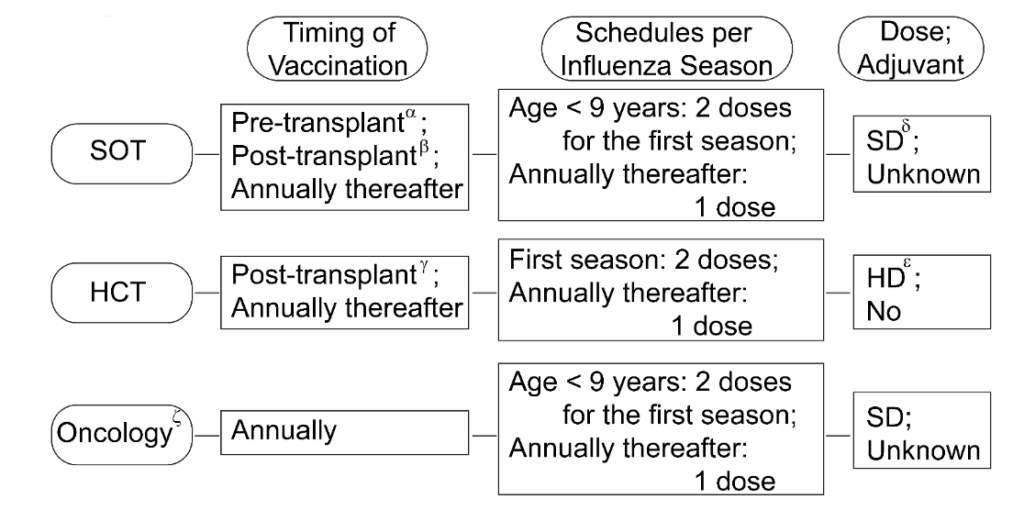
In pediatric SOT recipients, a small, prospective, randomized double-blind study showed that HD influenza vaccine administered at 6 months post-transplant appeared to be safe and led to a higher percentage of seroconversion and higher numerical titer compared to SD vaccine recipients¹¹. Although this strategy is promising, it has not been adopted across all pediatric SOT centers, and larger-scale clinical trials are needed to confirm these findings. Similarly, additional studies that evaluate the benefit of a two-dose regimen versus a single dose of influenza vaccine in pediatric SOT recipients are needed. Current approaches to improve immune responses to inactivated influenza vaccine in the pediatric SOT recipients are summarized in Figure 1.

Influenza Disease and Vaccination in Pediatric Oncology Patients

PRESENTATION AND RISK FACTORS

Due to the inherent immunosuppression associated with the underlying disease and chemotherapy treatment regimens, children receiving cancer therapy are at an especially high risk for morbidity and mortality related to influenza infection²⁷,²⁸. Thirty to seventy percent of pediatric oncology patients with influenza require hospitalization, and 10–20% require ICU admission, a phenomenon noted more frequently with the 2009 H1N1 strain²⁷–²⁹. In addition, bacterial co-infections complicating influenza have been reported in pediatric patients undergoing cancer treatment³⁰. A low lymphocyte count has been identified as a risk factor for influenza complications and serious illness, including lower respiratory tract infections (LRTIs)²⁸.

CURRENT VACCINATION RECOMMENDATIONS AND EVIDENCE

International guidelines recommend that children aged 6 months and older with cancer receive the inactivated influenza vaccine annually³,¹⁸. Exceptions

to this guidance are patients receiving high-intensity chemotherapy (such as treatment for acute myeloid leukemia) and treatment with anti-B cell agents (e.g., rituximab) within the past 6 months, as these patients are unlikely to respond to vaccination. Despite these recommendations, influenza vaccination rates among pediatric oncology patients are suboptimal, close to 60%²⁹.

Several factors, including the type of malignancy, immunosuppressive treatment regimen, and lymphocyte count, have been shown to impact the response to influenza vaccine in pediatric oncology patients³¹,³². Children with solid tumors who received inactivated trivalent influenza vaccine (TIV) displayed a significantly stronger immune response to each strain individually and to all three strains combined, when compared to those with hematological malignancies³³,³⁴. This difference is largely due to the direct negative effects of hematological cancers on the immune system, which are compounded by myelosuppressive therapies. In contrast, treatments for solid tumors are generally shorter and follow a cyclical pattern³⁴.

Approaches to enhance the immune response of pediatric oncology patients to influenza vaccination have been increasingly evaluated. Current recommendations suggest that pediatric oncology patients receive two doses of inactivated influenza vaccine 1 month apart²⁸,³⁵. However, one study that reviewed 498 pediatric patients receiving chemotherapy for acute leukemia during three consecutive influenza seasons showed that two doses of influenza vaccine in a single influenza season were not protective against laboratory-proven influenza or influenza-like infection³⁶. This study highlights that the currently available vaccination approaches may be ineffective in this patient population.

HD vaccination has also been explored in pediatric oncology patients. One small, randomized, open-label study enrolled participants aged 3–21 years (including 27 patients with leukemia and 17 with solid tumors) and compared two doses of HD to the SD influenza vaccine³⁷. Children who received the HD vaccine had significantly increased antibody titers to the B antigen in the leukemia group and to the H1 antigen in the solid tumor group compared to SD recipients, suggesting higher immunogenicity of the HD vaccine. However, there were no differences in seroconversion (defined as a ≥ 4-fold rise in titers) or seroprotection (defined as a post-vaccine titer ≥1:40) between the groups. The study also showed that immunogenicity was higher with two doses versus one dose of the vaccine³⁷. Current approaches to improve immune responses to inactivated influenza vaccine in the pediatric oncology patients are summarized in Figure 1.

Data are scarce regarding immune response to influenza vaccination in patients receiving newer therapies such as the monoclonal antibodies blinatumomab and inotuzumab ozogamicin. It is known that patients who receive rituximab within 6 months prior to vaccination have significantly impaired humoral responses to influenza vaccines²⁸. It is not known whether children receiving these newer B-cell chemotherapeutic agents would have similar outcomes.

Another population that has not been well studied is patients who have received chimeric antigen receptor T-cell therapy (CAR-T). Only one small study with an adult oncology cohort showed that the humoral response to the vaccine was limited both before and after CAR-T cell infusion³⁸. Immunogenicity of vaccination following receipt of immune checkpoint inhibitors (e.g., nivolumab, pembrolizumab, ipilimumab) appears to be preserved, although its safety is unclear³⁹.

Influenza Disease and Vaccination in Pediatric Hematopoietic Cell Transplant Recipients

PRESENTATION AND RISK FACTORS

Symptoms of influenza in the pediatric HCT population are similar to those in other populations, and most commonly include fever, congestion, cough, and myalgias. However, as opposed to

other immunocompromised children, it has been reported that up to 20% of HCT recipients may be afebrile on initial presentation. HCT recipients are also more likely to develop severe and uncommon presentations of influenza infection, such as encephalitis and myocarditis⁴⁰. These patients may also require longer hospitalization, demonstrate prolonged viral shedding, and have higher mortality rates⁴¹.

In general, the risk of developing severe influenza disease is much higher in allogeneic transplant recipients than in autologous transplant recipients⁴²,⁴³. Higher influenza viral loads, lymphopenia, and steroid use have been associated with disease progression¹⁶,⁴⁴.

An immunodeficiency scoring index (ISI), originally applied to respiratory syncytial virus (RSV), has also been applied to adult HCT recipients to identify patients with influenza infection who are at high risk for lower respiratory infection. This ISI includes absolute neutrophil count, absolute lymphocyte count, age, myeloablative conditioning regimen, graft-versus-host disease, corticosteroids, and recent or pre-engraftment allogeneic HCT. Patients are classified as low-, moderate-, or high-risk based on the number of risk factors present. Patients classified as high-risk (score of 7–12) had a significantly higher probability of progression to lower respiratory infection compared to low-risk patients (score of 0–2)⁴⁵.

In addition to the risks posed by influenza infection post-transplant, it is also known that pre-transplant respiratory virus infection, including influenza, is associated with worse prognosis and increased post-transplant mortality⁴⁶.

As mentioned above, in a prospective multicenter study examining influenza infection in adult SOT and HCT patients, influenza vaccination and early antiviral administration were associated with improved disease outcomes¹⁶. This study highlights the importance of influenza vaccination in this vulnerable population.

CURRENT VACCINATION RECOMMENDATIONS AND EVIDENCE

The current European Conference on Infections in Leukemia (ECIL) guidelines for vaccination of HCT recipients recommend administration of a seasonal inactivated influenza vaccine yearly starting 6 months post-transplant and as early as 3 months post-transplant in the setting of a community outbreak⁴². The consensus is that a second dose of vaccine administered 3–4 weeks after the first dose should be considered in the setting of an outbreak. Additionally, patients receiving treatment for graft-versus-host disease (GVHD) or with persistent low lymphocyte count may benefit from a second dose.

As noted in other populations, investigations are ongoing regarding the optimal timing of vaccination post-transplant, 1 versus 2 dose vaccine schedules, and the utility of HD or adjuvanted vaccines in HCT recipients.

The timing of vaccination has been addressed in multiple adult studies. A recent study by a group in Australia evaluated humoral and cellular responses to influenza vaccine in adult HCT recipients. It demonstrated that, in general, patients further away from transplant exhibit stronger vaccine-induced immune responses. This is a unique characteristic of the HCT population when compared to others. Since immune reconstitution is crucial to develop an effective response to all vaccines, patients further from transplant generate enhanced humoral immunity following vaccination⁴⁷.

Adult studies evaluating HD and adjuvanted influenza vaccine after HCT have shown some improvement in protective titers with HD compared to SD vaccine, although they failed to demonstrate the benefit of adjuvanted vaccine⁴⁸,⁴⁹. Specifically, in a recent large, multicenter, double-blinded study conducted in the pediatric population, two doses of influenza vaccine doses demonstrated superior efficacy over a single dose, and the HD vaccine generated a more robust immune response⁵⁰.

Another interesting point of investigation in HCT recipients is the utility of immune profiling to determine optimal vaccination strategies. One study analyzed 33 different cell populations and found a statistically significant association between higher absolute CD19+ and CD4+ numbers at baseline and increased vaccine immunogenicity at 28 to 42 days after two vaccine doses. Additionally, seven distinct cell subpopulations predicted responses to all three vaccine antigens 28 to 42 days after a 2-dose vaccine series, irrespective of vaccine dose⁵¹. In a follow-up study, a portion of the original study population received two doses of HD or SD vaccine in a consecutive year⁵². Repeat titers indicated a cumulative response to vaccination. Titers following HD vaccination were higher than SD, although not significantly. The results of this study highlight the importance of both the HD vaccine and two-dose regimen, at least in the first influenza season post-HCT. Current approaches to improve immune responses to inactivated influenza vaccine in the pediatric HCT recipients are summarized in Figure 1.

Consideration for Family Members of Immunocompromised Children

For all immunocompromised groups, seasonal influenza vaccines should be discussed with family members and caregivers. All eligible family members and close contacts should receive a yearly seasonal influenza vaccine⁵³. Vaccinating family members and close contacts for influenza is one of the most efficient ways to protect immunocompromised patients. Vaccination guidelines for SOT recipients recommend that healthcare workers and close contacts of all transplant recipients be fully immunized and receive influenza vaccines annually¹⁸. Live attenuated intranasal influenza vaccines are contraindicated in immunocompromised patients and their close contacts and caregivers, including oncology patients on active chemotherapy, SOT recipients, and HCT recipients early post-transplant and while receiving treatment for graft-versus-host disease (GVHD)⁴².

Conclusion

Influenza infection poses a serious risk to pediatric oncology patients and pediatric recipients of SOT and HCT. Initial symptoms of influenza infection in these patients are typically similar to those of immunocompetent patients, although it is important to remember that these patient populations are at increased risk of significant morbidity and mortality related to influenza infection.

The most effective means of reducing this morbidity and mortality is to prevent influenza infection. Research supports influenza vaccination of patients and their immediate contacts as an effective preventive measure, although the ideal timing, schedule, and dose of influenza vaccination in immunocompromised patients remains to be clarified. Future research is needed to determine the optimal timing of vaccination across patient populations, evaluate the safety and efficacy of vaccination in individuals undergoing specific chemotherapy regimens or CAR-T therapy, compare the benefits of high-dose (HD) versus standard-dose (SD) vaccination, and assess the feasibility of an individualized vaccine strategy informed by immune profiling.

 
This image has an empty alt attribute; its file name is image-83-1024x510.png


Figure 1. Summary of approaches to improve the response to influenza vaccine in pediatric oncology patients, solid-organ transplant recipients, and hematopoietic cell transplant recipients.

  • Pediatric recipients of solid organ transplants (SOT) are suggested to receive the inactivated influenza vaccine as soon as possible prior to the transplant.
    ‡ Pediatric recipients who already underwent SOT are recommended to administer the inactivated influenza vaccine 3 to 6 months after the transplant, with earlier administration at 1 month during peak season.
    † Pediatric recipients who already underwent hematopoietic cell transplant (HCT) are recommended to administer the inactivated influenza vaccine 6 months after the transplant, with earlier administration at 3 months during the influenza outbreak.
    § Ongoing research is comparing high-dose (HD) and standard-dose (SD) formulations of the inactivated vaccine. Preliminary data suggest that HD vaccine may elicit a stronger immune response; however, it has not been adopted as standard practice.

⁑ Evidence supports the benefit of a two-dose HD vaccine in the first influenza season post-transplant. Subsequently, a single-dose SD vaccine may be given annually thereafter.
ζ The vaccination strategy recommendations and corresponding humoral responses vary depending on the chemotherapy. Patients who receive rituximab within 6 months prior to vaccination have significantly impaired humoral responses to influenza vaccines. Safety in patients receiving immune checkpoint inhibitors is unclear.

Acknowledgements:

Author Contributions:

All listed co-authors made substantial and direct contribution to this manuscript, including conception, design, analysis, writing, and proofreading. We also thank Winston Gu for the overall proofreading and reformatting.

Conflicts of Interest Statement:

The authors report no conflicts of interest pertaining to this work.

Funding Statement:

This research did not receive any specific grant from funding agencies in the public, commercial, or not-for-profit sectors.


References


1. Hijano DR, Maron G, Hayden RT. Respiratory Viral Infections in Patients With Cancer or Undergoing Hematopoietic Cell Transplant. Front Microbiol 2018; 9: 3097.

2. Organization WH. Influenza (seasonal). 2025. https://www.who.int/news-room/fact-sheets/detail/influenza-(seasonal) (accessed 24 Mar 2025).

3. Grohskopf LA, Ferdinands JM, Blanton LH, Broder KR, Loehr J. Prevention and Control of Seasonal Influenza with Vaccines: Recommendations of the Advisory Committee on Immunization Practices – United States, 2024-25 Influenza Season. MMWR Recomm Rep 2024; 73(5): 1-25.

4. Organization WH. Burden of Disease. 2025. https://www.who.int/teams/global-influenza-programme/surveillance-and-monitoring/burden-of-disease (accessed 24 Mar 2025).

5. United States Centers for Disease Control and Prevention. Preliminary Estimated Flu Disease Burden 2023-2024 Flu Season. 2024.
https://www.cdc.gov/flu-burden/php/data-vis/2023-2024.html (accessed April 16 2025).

6. Organization WH. Vaccines against influenza: WHO position paper – May 2022. 19, 2022.

7. Caldera F, Mercer M, Samson SI, Pitt JM, Hayney MS. Influenza vaccination in immunocompromised populations: Strategies to improve immunogenicity. Vaccine 2021; 39 Suppl 1: A15-A23.

8. Prevention TCfDCa. People at Increased Risk for Flu Complications. 11 September 2024 2024. https://www.cdc.gov/flu/highrisk/index.htm.

9. European Centre for Disease Prevention and Control. Seasonal influenza vaccines. 2023.
https://www.ecdc.europa.eu/en/seasonal-influenza/prevention-and-control/seasonal-influenza-vaccines (accessed April 15 2025).

10. Dulek DE, de St Maurice A, Halasa NB. Vaccines in pediatric transplant recipients-Past, present, and future. Pediatr Transplant 2018; 22(7): e13282.

11. GiaQuinta S, Michaels MG, McCullers JA, et al. Randomized, double-blind comparison of standard-dose vs. high-dose trivalent inactivated influenza vaccine in pediatric solid organ transplant patients. Pediatr Transplant 2015; 19(2): 219-28.

12. Hakim H, Allison KJ, Van De Velde LA, Li Y, Flynn PM, McCullers JA. Immunogenicity and safety of inactivated monovalent 2009 H1N1 influenza A vaccine in immunocompromised children and young adults. Vaccine 2012; 30(5): 879-85.

13. Long CB, Ramos I, Rastogi D, et al. Humoral and cell-mediated immune responses to monovalent 2009 influenza A/H1N1 and seasonal trivalent influenza vaccines in high-risk children. J Pediatr 2012; 160(1): 74-81.

14. Ryan AL, Wadia UD, Jacoby P, et al. Immunogenicity of the inactivated influenza vaccine in children who have undergone allogeneic haematopoietic stem cell transplant. Bone Marrow Transplant 2020; 55(4): 773-9.

15. Haddadin Z, Spieker AJ, Amarin JZ, et al. Incidence of and risk factors for influenza-associated hospital encounters in pediatric solid organ transplant recipients. Am J Transplant 2023; 23(5): 659-65.

16. Kumar D, Ferreira VH, Blumberg E, et al. A 5-Year Prospective Multicenter Evaluation of Influenza Infection in Transplant Recipients. Clin Infect Dis 2018; 67(9): 1322-9.

17. Danziger-Isakov L, Kumar D, Practice AICo. Vaccination of solid organ transplant candidates and recipients: Guidelines from the American society of transplantation infectious diseases community of practice. Clin Transplant 2019; 33(9): e13563.

18. Rubin LG, Levin MJ, Ljungman P, et al. 2013 IDSA clinical practice guideline for vaccination of the immunocompromised host. Clin Infect Dis 2014; 58(3): e44-100.

19. Santibanez TA, Black CL, Zhou T, Srivastav A, Singleton JA. Parental hesitancy about COVID-19, influenza, HPV, and other childhood vaccines. Vaccine 2024; 42(25): 126139.

20. Camerino M, Jackson S, Chinnakotla S, Verghese P. Effects of the influenza vaccine on pediatric kidney transplant outcomes. Pediatr Transplant 2019; 23(2): e13354.

21. Harboe ZB, Modin D, Gustafsson F, et al. Effect of influenza vaccination in solid organ transplant recipients: A nationwide population-based cohort study. Am J Transplant 2022; 22(10): 2409-17.

22. Perez-Romero P, Bulnes-Ramos A, Torre-Cisneros J, et al. Influenza vaccination during the first 6 months after solid organ transplantation is efficacious and safe. Clin Microbiol Infect 2015; 21(11): 1040 e11-8.

23. Suresh S, Upton J, Green M, et al. Live vaccines after pediatric solid organ transplant: Proceedings of a consensus meeting, 2018. Pediatr Transplant 2019; 23(7): e13571.

24. Haddadin Z, Krueger K, Thomas LD, Overton ET, Ison M, Halasa N. Alternative strategies of posttransplant influenza vaccination in adult solid organ transplant recipients. Am J Transplant 2021; 21(3): 938-49.

25. Cordero E, Roca-Oporto C, Bulnes-Ramos A, et al. Two Doses of Inactivated Influenza Vaccine Improve Immune Response in Solid Organ Transplant Recipients: Results of TRANSGRIPE 1-2, a Randomized Controlled Clinical Trial. Clin Infect Dis 2017; 64(7): 829-38.

26. Mombelli M, Neofytos D, Huynh-Do U, et al. Immunogenicity of High-Dose Versus MF59-Adjuvanted Versus Standard Influenza Vaccine in Solid Organ Transplant Recipients: The Swiss/Spanish Trial in Solid Organ Transplantation on Prevention of Influenza (STOP-FLU Trial). Clin Infect Dis 2024; 78(1): 48-56.

27. Carr SB, Adderson EE, Hakim H, Xiong X, Yan X, Caniza M. Clinical and demographic characteristics of seasonal influenza in pediatric patients with cancer. Pediatr Infect Dis J 2012; 31(11): e202-7.

28. Furlong E, Kotecha RS. Lessons learnt from influenza vaccination in immunocompromised children undergoing treatment for cancer. Lancet Child Adolesc Health 2023; 7(3): 199-213.

29. Yarnall JN, Mertens A, Yee M, Orenstein E, Lai KW, Wasilewski-Masker K. Influenza Vaccination Receipt in Pediatric Patients With Cancer or Sickle Cell Disease. J Pediatr Hematol Oncol 2023; 45(2): e228-e35.

30. Tasian SK, Park JR, Martin ET, Englund JA. Influenza-associated morbidity in children with cancer. Pediatr Blood Cancer 2008; 50(5): 983-7.

31. Choi DK, Fuleihan RL, Walterhouse DO. Serologic response and clinical efficacy of influenza vaccination in children and young adults on chemotherapy for cancer. Pediatr Blood Cancer 2016; 63(11): 2011-8.

32. Mavinkurve-Groothuis AM, van der Flier M, Stelma F, van Leer-Buter C, Preijers FW, Hoogerbrugge PM. Absolute lymphocyte count predicts the response to new influenza virus H1N1 vaccination in pediatric cancer patients. Clin Vaccine Immunol 2013; 20(1): 118-21.

33. Kersun LS, Reilly A, Coffin SE, et al. A prospective study of chemotherapy immunologic effects and predictors of humoral influenza vaccine responses in a pediatric oncology cohort. Influenza Other Respir Viruses 2013; 7(6): 1158-67.

34. Kotecha RS, Wadia UD, Jacoby P, et al. Immunogenicity and clinical effectiveness of the trivalent inactivated influenza vaccine in immunocompromised children undergoing treatment for cancer. Cancer Med 2016; 5(2): 285-93.

35. Mikulska M, Cesaro S, de Lavallade H, et al. Vaccination of patients with haematological malignancies who did not have transplantations: guidelines from the 2017 European Conference on Infections in Leukaemia (ECIL 7). Lancet Infect Dis 2019; 19(6): e188-e99.

36. Sykes A, Gerhardt E, Tang L, Adderson EE. The Effectiveness of Trivalent Inactivated Influenza Vaccine in Children with Acute Leukemia. J Pediatr 2017; 191: 218-24 e1.

37. Hakim H, Allison KJ, Van de Velde LA, et al. Immunogenicity and safety of high-dose trivalent inactivated influenza vaccine compared to standard-dose vaccine in children and young adults with cancer or HIV infection. Vaccine 2016; 34(27): 3141-8.

38. Walti CS, Loes AN, Shuey K, et al. Humoral immunogenicity of the seasonal influenza vaccine before and after CAR-T-cell therapy: a prospective observational study. J Immunother Cancer 2021; 9(10).

39. Chong CR, Park VJ, Cohen B, Postow MA, Wolchok JD, Kamboj M. Safety of Inactivated Influenza Vaccine in Cancer Patients Receiving Immune Checkpoint Inhibitors. Clin Infect Dis 2020; 70(2): 193-9.

40. Engelhard D, Mohty B, de la Camara R, Cordonnier C, Ljungman P. European guidelines for prevention and management of influenza in hematopoietic stem cell transplantation and leukemia patients: summary of ECIL-4 (2011), on behalf of ECIL, a joint venture of EBMT, EORTC, ICHS, and ELN. Transpl Infect Dis 2013; 15(3): 219-32.

41. Renaud C, Campbell AP. Changing epidemiology of respiratory viral infections in hematopoietic cell transplant recipients and solid organ transplant recipients. Curr Opin Infect Dis 2011; 24(4): 333-43.

42. Cordonnier C, Einarsdottir S, Cesaro S, et al. Vaccination of haemopoietic stem cell transplant recipients: guidelines of the 2017 European Conference on Infections in Leukaemia (ECIL 7). Lancet Infect Dis 2019; 19(6): e200-e12.

43. Pinana JL, Perez A, Chorao P, et al. Respiratory virus infections after allogeneic stem cell transplantation: Current understanding, knowledge gaps, and recent advances. Transpl Infect Dis 2023; 25 Suppl 1: e14117.

44. Ogimi C, Xie H, Waghmare A, et al. Novel factors to predict respiratory viral disease progression in allogeneic hematopoietic cell transplant recipients. Bone Marrow Transplant 2022; 57(4): 649-57.

45. Kmeid J, Vanichanan J, Shah DP, et al. Outcomes of Influenza Infections in Hematopoietic Cell Transplant Recipients: Application of an Immunodeficiency Scoring Index. Biol Blood Marrow Transplant 2016; 22(3): 542-8.

46. Kim YJ, Waghmare A, Xie H, et al. Respiratory viruses in hematopoietic cell transplant candidates: impact of preexisting lower tract disease on outcomes. Blood Adv 2022; 6(18): 5307-16.

47. Zhang W, Rowntree LC, Muttucumaru R, et al. Robust immunity to influenza vaccination in haematopoietic stem cell transplant recipients following reconstitution of humoral and adaptive immunity. Clin Transl Immunology 2023; 12(6): e1456.

48. Halasa NB, Savani BN, Asokan I, et al. Randomized Double-Blind Study of the Safety and Immunogenicity of Standard-Dose Trivalent Inactivated Influenza Vaccine versus High-Dose Trivalent Inactivated Influenza Vaccine in Adult Hematopoietic Stem Cell Transplantation Patients. Biol Blood Marrow Transplant 2016; 22(3): 528-35.

49. Natori Y, Humar A, Lipton J, et al. A pilot randomized trial of adjuvanted influenza vaccine in adult allogeneic hematopoietic stem cell transplant recipients. Bone Marrow Transplant 2017; 52(7): 1016-21.

50. Schuster JE, Hamdan L, Dulek DE, et al. The Durability of Antibody Responses of Two Doses of High-Dose Relative to Two Doses of Standard-Dose Inactivated Influenza Vaccine in Pediatric Hematopoietic Cell Transplant Recipients: A Multi-Center Randomized Controlled Trial. Clin Infect Dis 2024; 78(1): 217-26.

51. Amarin JZ, Dulek DE, Simmons J, et al. Immunophenotypic predictors of influenza vaccine immunogenicity in pediatric hematopoietic cell transplant recipients. Blood Adv 2024; 8(8): 1880-92.

52. Bahakel H, Spieker AJ, Hayek H, et al. Immunogenicity and Reactogenicity of High- or Standard-Dose Influenza Vaccine in a Second Consecutive Influenza Season. J Infect Dis 2025; 231(1): e123-e31.

53. Sung L, Heurter H, Zokvic KM, et al. Practical vaccination guidelines for children with cancer. Paediatr Child Health 2001; 6(6): 379-83.


Interested in publishing your own research?
ESMED members can publish their research for free in our peer-reviewed journal.
Learn About Membership

Call for papers

Have a manuscript to publish in the society's journal?