

Integrating Behavioral Science in Culinary Education
Integrating Behavioral Science Into Puerto Rico Culinary Education: A Theory-Driven Curriculum Model for Behavior Change
Dr. Christian Rivera Medina1, PhD, RD, LND, CCE, CCC
- José A. “Tony” Santana International School of Hospitality and Culinary Arts Universidad Ana G. Méndez, Puerto Rico
OPEN ACCESS
PUBLISHED: 28 February 2026
CITATION: Medina, CR, 2026. Integrating Behavioral Science Into Puerto Rico Culinary Education: A Theory-Driven Curriculum Model for Behavior Change. Medical Research Archives, [online] 14(2).
https://doi.org/10.18103/mra.v14i2.7225
COPYRIGHT:© 2026 European Society of Medicine. This is an open-access article distributed under the terms of the Creative Commons Attribution License, which permits unrestricted use, distribution, and reproduction in any medium, provided the original author and source are credited.
DOI https://doi.org/10.18103/mra.v14i2.7225
ISSN 2375-1924
ABSTRACT
Background: Culinary education occupies a strategic position at the intersection of gastronomy, nutrition, and public health. In Puerto Rico, post-secondary culinary programs prepare professionals who influence food environments, dietary behaviors, and cultural food practices. Despite strong technical training, evidence suggests that culinary students often exhibit suboptimal eating habits and limited translation of nutrition knowledge into sustained healthy behaviors.
Purpose: This conceptual manuscript proposes a theory-driven curriculum reform model that integrates behavioral science and nutrition into culinary education, grounded in established behavior change frameworks.
Methods: A narrative and conceptual synthesis was conducted using peer-reviewed research on eating behaviors among culinary students, reviews of experiential learning and behavioral mediators, and curricular mapping of associate-degree culinary programs in Puerto Rico.
Results: Three curricular pillars emerged: integrative capability, supportive opportunity, and reflective motivation. Mapping revealed strong technical instruction but limited integration of behavioral determinants. A theory-driven framework is proposed to embed nutrition literacy, sustainability, and behavior change strategies across culinary coursework.
Conclusions: Integrating behavioral science into culinary curricula may enhance the translation of culinary competence into sustained healthy and sustainable food behaviors. The proposed model offers a scalable framework aligned with public health and preventive medicine goals.
Keywords: culinary education; nutrition education; COM-B; behavioral science; curriculum design; Puerto Rico; public health.
Introduction
Diet-related noncommunicable diseases (NCDs) remain a leading contributor to morbidity and mortality globally and represent a critical public health challenge in Puerto Rico. Dietary behaviors are shaped not only by nutrition knowledge but also by food environments, cultural norms, economic constraints, and behavioral determinants. Culinary professionals occupy a strategic position within this nexus, as they directly influence food preparation practices, menu design, portioning, and the symbolic communication of health and culture through cuisine.
In Puerto Rico, university-based culinary programs have expanded rapidly, reflecting workforce demand and the cultural centrality of food. These programs produce graduates who shape institutional, commercial, and community food environments. However, emerging evidence suggests a persistent disconnect between culinary training, nutrition knowledge, and sustained healthy eating behaviors among students and professionals trained in food-related disciplines.
Empirical studies indicate that students enrolled in culinary and nutrition-related academic programs frequently demonstrate suboptimal dietary behaviors despite moderate to high levels of nutrition knowledge. This pattern has been observed in Puerto Rican university populations and internationally, suggesting that knowledge acquisition alone is insufficient to produce durable dietary behavior change. Structural barriers such as cost, time availability, food access, and sociocultural food norms further mediate the relationship between education and behavior.
Behavioral science offers empirically grounded frameworks capable of addressing these gaps. Models such as the Capability–Opportunity–Motivation–Behavior (COM-B) framework, Social Cognitive Theory, and the Theory of Planned Behavior emphasize that behavior emerges from the interaction of skills and knowledge, environmental opportunities, and motivational processes. These models are widely applied in public health and preventive medicine yet remain underutilized within formal culinary education.
The purpose of this manuscript is to propose a theory-driven curricular model that integrates behavioral science and nutrition into undergraduate culinary education in Puerto Rico. This paper is conceptual and educational in nature and focuses on curriculum design as an upstream, preventive strategy for improving food-related behaviors. Specifically, the manuscript aims to map behavioral science frameworks onto culinary learning objectives, identify gaps in existing culinary curricula related to behavioral determinants of eating, and propose a structured curriculum model aligned with public health and preventive medicine goals.
Theoretical Framework
COM-B Model
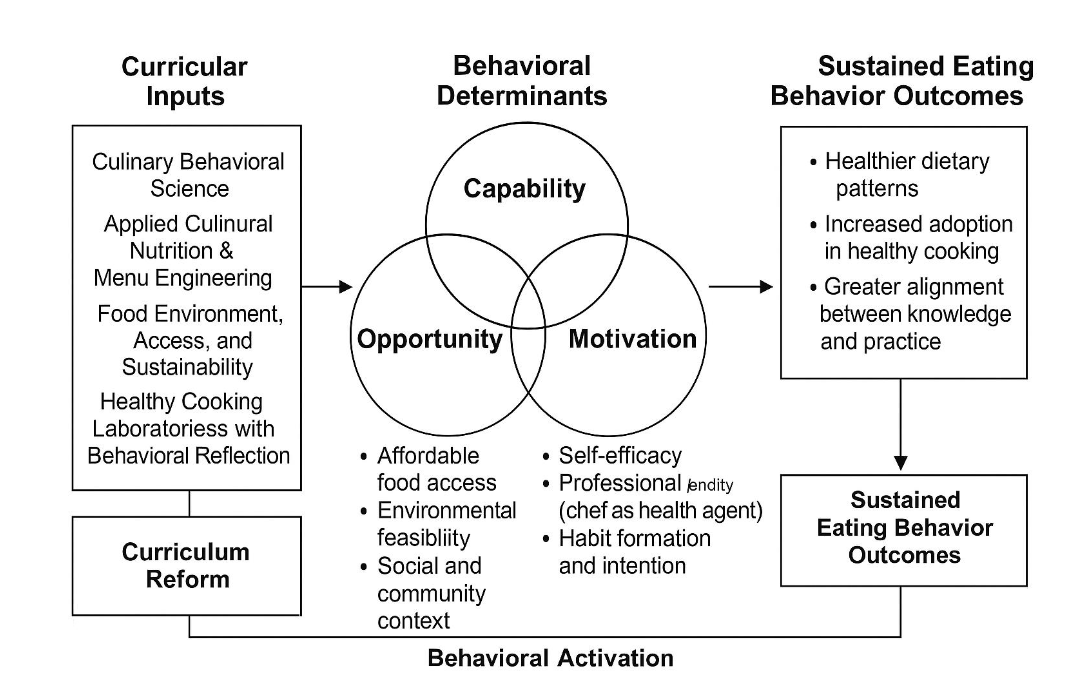
The COM-B model posits that behavior emerges from the interaction of Capability (knowledge and skills), Opportunity (physical and social environment), and Motivation (reflective and automatic processes). Culinary education traditionally emphasizes capability through technical skill development but often neglects opportunity and motivation.
SOCIAL COGNITIVE THEORY
Social Cognitive Theory highlights key determinants of behavior such as perceived self-efficacy, observational learning, and reinforcement within a dynamic interaction of personal, behavioral, and environmental factors. Culinary laboratories provide ideal environments for mastery experiences; however, without explicit reflection and feedback, gains may remain task-specific rather than behavior-generalizable.
THEORY OF PLANNED BEHAVIOR
Although first conceptualized by Ajzen, recent syntheses affirm that attitudes, subjective norms, and perceived behavioral control remain the principal determinants of intention and behavior within the Theory of Planned Behavior. Culinary education may therefore operate as a contextual intervention by reshaping normative expectations and perceived agency related to healthy, sustainable, and economically viable food practices.
Methods
This manuscript represents a conceptual and theory-driven curriculum model rather than an intervention study. A narrative and conceptual synthesis approach was employed, integrating empirical evidence on eating behaviors among culinary and nutrition students, narrative reviews of experiential learning and behavioral mediators, and curricular mapping of associate-degree culinary programs in Puerto Rico. Courses were mapped to COM-B domains and Bloom’s learning domains (cognitive, psychomotor, affective) to identify integration opportunities and gaps.
Sources included:
- Empirical findings from a cross-sectional study of Puerto Rican university students enrolled in nutrition and culinary programs.
- A narrative review examining experiential learning, behavioral mediators, and structural barriers in culinary education.
- Curricular sequences from three associate-degree culinary programs: Universidad Ana G. Méndez, Universidad Interamericana de Puerto Rico, National University College.
Results
CURRICULAR MAPPING FINDINGS
Across all three programs, strong emphasis was observed in culinary technique, food safety, and operations management. However, behavioral-science constructs—such as motivation, habit formation, and environmental constraints—were rarely explicit.
EMERGENT CURRICULAR PILLARS
- Integrative Capability: Embedding nutrition literacy, nutrient retention, and menu engineering within technical courses.
- Supportive Opportunity: Addressing cost, access, sustainability, and procurement within management and purchasing courses.
- Reflective Motivation: Incorporating identity formation, reflection, and behavior-change planning in laboratories and practicums.
To address the persistent gap between culinary education and dietary behavior observed across institutions, targeted curricular innovations are warranted. A growing body of evidence indicates that nutrition knowledge and culinary skill acquisition alone are insufficient to produce sustained dietary behavior change, underscoring the need for educational approaches that explicitly engage the behavioral determinants of eating. Courses that integrate behavioral science, applied culinary skills, food environments, and community engagement may be conceptualized as strengthening capability, opportunity, and motivation for health-promoting food practices, consistent with COM-B–informed behavior change mechanisms.
Furthermore, the integration of behavior-change theory, reflective laboratory experiences, and real-world food system exposure has been shown to enhance self-efficacy, professional responsibility, and contextual feasibility, providing a viable pathway for translating culinary competence into sustained healthy and sustainable dietary behaviors.
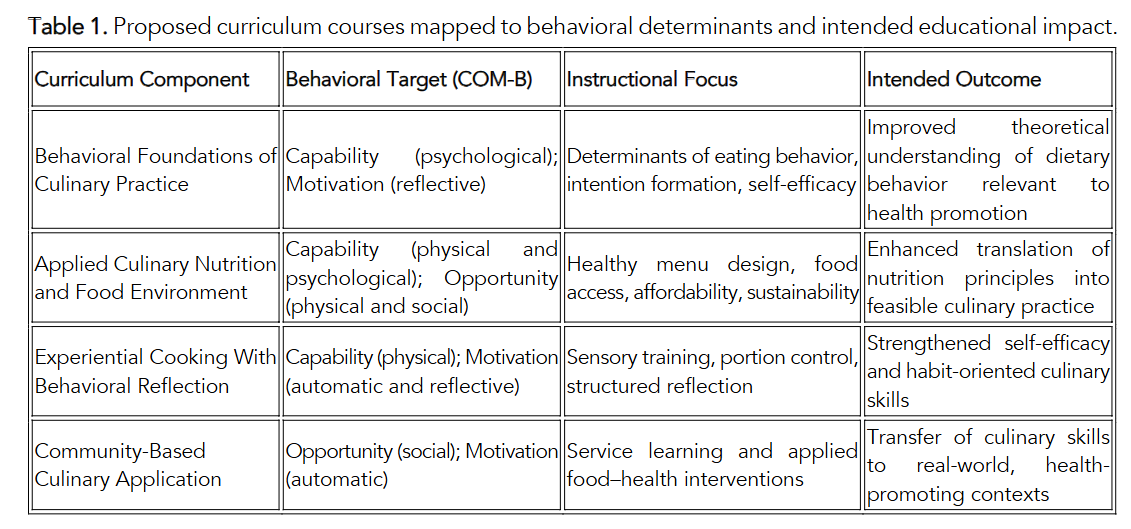
Collectively, the proposed curricular courses address the full spectrum of behavioral determinants articulated within the COM-B framework. By enhancing behavioral capability, expanding environmental opportunity, and strengthening motivational processes, these courses move beyond traditional knowledge-based instruction to engage the complex, multifactorial drivers of eating behavior. This integrated, theory-driven approach increases the likelihood that culinary students will translate technical competence and nutrition knowledge into sustained healthy and sustainable dietary practices.
Discussion
The integration of behavioral science frameworks across Puerto Rican culinary curricula highlights the limitations of traditional, skill-focused culinary education in addressing contemporary public health challenges. While culinary programs excel at developing technical competence, behavioral capability alone is insufficient to ensure sustained healthy or sustainable dietary practices. Without explicitly addressing motivation and environmental opportunity, the preventive health potential of culinary education remains underutilized.
The proposed COM-B–informed curriculum model reframes culinary education as an upstream intervention within the prevention continuum. Culinary professionals function as intermediaries between dietary guidelines, food systems, and lived eating experiences, positioning them as influential actors in shaping food environments that affect population health. From a medical and public health perspective, this approach aligns with calls to address diet-related NCDs through environmental and behavioral determinants rather than relying solely on individual-level counseling or downstream clinical interventions.
Curricular mapping revealed that nutrition-focused coursework represents a small proportion of total credit requirements, and none of the reviewed programs explicitly address behavioral modification or theory-driven behavior change strategies. These findings parallel empirical evidence indicating that even among students trained in food and health-related disciplines, dietary behaviors are shaped more strongly by contextual and motivational factors than by formal nutrition education alone.
Recent literature further supports the necessity of integrating behavioral, motivational, and environmental components into culinary education. Studies demonstrate that improvements in culinary knowledge and confidence do not reliably translate into personal or professional practice without structured behavioral reinforcement. Evidence also suggests that cooking skills are not independently associated with improved diet quality unless supported by enabling environments and motivational drivers. These findings align closely with the COM-B framework and reinforce the theoretical coherence of the proposed model.
Although conceptual in nature, this framework offers a structured foundation for future empirical testing, curriculum evaluation, and policy discussion. Future research should pilot the model using longitudinal designs, assessing outcomes such as diet quality, self-efficacy, professional practice patterns, and downstream impacts on food environments and population health. Limitations include the absence of intervention testing and restriction to associate-degree programs; however, the consistency of identified gaps supports the relevance and transferability of the model.
Conclusion
A theory-driven integration of behavioral science into culinary education represents a critical pathway for aligning culinary training with contemporary public-health priorities. Embedding COM-B principles across culinary curricula moves programs beyond technical skill acquisition toward the deliberate cultivation of behavioral capability, motivation, and environmental opportunity. Within the Puerto Rico context—where food systems, culture, and health inequities intersect—this approach positions culinary graduates not only as skilled practitioners, but as agents of change capable of shaping healthier, more sustainable, and culturally responsive food environments. Institutionalizing behavior-change frameworks within culinary education therefore offers a scalable strategy to strengthen workforce preparedness, enhance population-level dietary outcomes, and reinforce the role of culinary professionals as leaders in public-health–oriented food systems.
Conflict of Interest Statement:
None.
Funding Statement:
None.
Acknowledgements:
None.
References:
- World Health Organization. Diet, Nutrition and the Prevention of Chronic Diseases. Geneva, Switzerland: World Health Organization; 2023.
- Pan American Health Organization. Diet-Related Noncommunicable Diseases in the Caribbean: Policy Approaches. Washington, DC: PAHO; 2022.
- Rivera Medina C, et al. Eating habits associated with nutrition-related knowledge among university students. Nutrients. 2020;12(5):1408. doi:10.3390/nu12051408
- Antwi J, Olawuyi Y, Ifafore M, Opara I. Nutrition knowledge among students in a historically Black college and university is inadequate and associated with residence. J Nutr Educ Behav. 2025;57(3):225-231. doi:10.1016/j.jneb.2024.10.013
- Rivera Medina C. Integrating nutrition education in culinary curricula. J Food Sci Nutr Res. 2025;8:115-118. doi:10.26502/jfsnr.2642-110000182
- World Health Organization. Global Action Plan for the Prevention and Control of Noncommunicable Diseases 2013–2030. Geneva, Switzerland: WHO; 2023.
- Centers for Disease Control and Prevention. Strategies to Prevent Obesity and Diet-Related Chronic Disease. Atlanta, GA: CDC; 2022.
- Cho J, Bonn MA, Brymer RA. Culinary students’ perceptions of healthy cooking and professional responsibility. J Culin Sci Technol. 2022;20(5):385-401. doi:10.1080/15428052.2021.1904739
- Franchini C, Rosi A, Scazzina F, et al. Promoting nutrition and food sustainability knowledge in apprentice chefs. Nutrients. 2024;16(4):537. doi:10.3390/nu16040537
- Arun DR, Srivastava DS, Sireesha R, Thilagaraj A. Examining varied culinary practices and nutritional patterns among student populations. South East Eur J Public Health. 2024:392-400. doi:10.70135/seejph.vi.1189
- Pan American Health Organization. Ultra-Processed Foods and Public Health in the Caribbean. Washington, DC: PAHO; 2021.
- O’Leary M, Mooney E, McCloat A. Relationship between nutrition knowledge and dietary intake. Dietetics. 2025;4(2):16. doi:10.3390/dietetics4020016
- Ajzen I. The theory of planned behavior. Organ Behav Hum Decis Process. 1991;50(2):179-211.
- Bosnjak M, Ajzen I, Schmidt P. The theory of planned behavior: selected recent advances and applications. Front Psychol. 2020;11:589294. doi:10.3389/fpsyg.2020.589294
- Islam KF, et al. Social cognitive theory-based health promotion in primary care practice. Heliyon. 2023;9(4):e14889. doi:10.1016/j.heliyon.2023.e14889
- Michie S, van Stralen MM, West R. The behaviour change wheel: a method for designing behaviour change interventions. Implement Sci. 2011;6:42. doi:10.1186/1748-5908-6-42
- Keyworth C, Epton T, Goldthorpe J, Calam R, Armitage CJ. Theory-informed digital health intervention using the behaviour change wheel. J Med Internet Res. 2019;21(6):e11223. doi:10.2196/11223
- Bandura A. Social cognitive theory for personal and social change by enabling media. In: Singhal A, Cody MJ, Rogers EM, Sabido M, eds. Entertainment-Education and Social Change. New York, NY: Routledge; 2003:97-118.
- Ajzen I. Consumer attitudes and behavior change: role of intention. Annu Rev Psychol. 2021;72:357-384. doi:10.1146/annurev-psych-010419-050609
- Wolfson JA, Bleich SN. Is cooking at home associated with better diet quality? Public Health Nutr. 2021;24(3):565-575. doi:10.1017/S136898002000367X
- Vieux F, et al. Sustainable diets: concepts, metrics, and future directions. Curr Opin Food Sci. 2023;49:100957. doi:10.1016/j.cofs.2022.100957
- Ray ME. Bloom’s taxonomy in health professions education: Associations with exam scores, clinical reasoning, and instructional effectiveness. Clin Pharmacol Ther. 2025; (scoping review on Bloom’s taxonomy in health education). doi:10.1016/j.cptl.2025.102444.
- Universidad Ana G. Méndez. Grado Asociado en Ciencias en Artes Culinarias. https://documento.uagm.edu/academia/secuenciales/AS_Ciencias_Artes_Culinarias.pdf. Accessed January 31, 2026.
- Universidad Interamericana de Puerto Rico, Recinto de Barranquitas. Grado de Asociado en Artes en Artes Culinarias y Ciencias de la Gastronomía. https://www.br.inter.edu/wp-content/uploads/secuenciales/adm-emp/regular/asociado-artes-culinarias.pdf. Accessed January 31, 2026.
- NUC University – División Técnica IBC. Grado Asociado en Cocina Local e Internacional. https://tecnicos.nuc.edu/cursos/grados-asociados/ga-cocina-local-e-internacional/. Accessed January 31, 2026.
- Krenek AM, Mobley AR, Andrade J, et al. Behavioral frameworks and translational applications of culinary medicine and culinary nutrition. J Nutr Educ Behav. 2024. doi:10.1016/j.jneb.2024.07.001.
- Bertoldo J, Hsu R, Reid T, Righter A, Wolfson JA. Attitudes and beliefs about how chefs can promote nutrition and sustainable food systems among students at a US culinary school. Public Health Nutr. 2022;25(2):498-510. doi:10.1017/S1368980021003578
- Asher RC, Shrewsbury VA, Bucher T, Collins CE. Culinary medicine and culinary nutrition education for individuals with the capacity to influence health-related behaviour change: a scoping review. J Hum Nutr Diet. 2022;35(2):388-395. doi:10.1111/jhn.12944.
- Silva P, Araújo R, Lopes F, Ray S. Nutrition and Food Literacy: Framing the Challenges to Health Communication. Nutrients. 2023;15(22):4708. Published 2023 Nov 7. doi:10.3390/nu15224708
- Lavelle F, McGowan L, Hollywood L, et al. Diet quality is more strongly related to food skills than cooking skills confidence: results from a national cross-sectional survey. Public Health Nutr. 2020;23(10):1769-1777.
- Timlin D, Elliott ES, Steptoe A. Using the COM-B model to identify barriers and facilitators towards adoption of a diet associated with cognitive function. Public Health Nutr. 2021;24(11):1-14.