


Latent Autoimmune Diabetes in Systemic Lupus Erythematosus
A case of latent autoimmune diabetes of adult with systemic lupus erythematosus
Subhashchandra Daga
- The Primary Health Centre, Kamshet, 410405 (India).
OPEN ACCESS
PUBLISHED: 31 December 2024
CITATION: Daga S., 2024. A case of latent autoimmune diabetes of adult with systemic lupus erythematosus. Medical Research Archives, [online] 12(12).
https://doi.org/10.18103/mra.v12i12.5947
COPYRIGHT: © 2024 European Society of Medicine. This is an open-access article distributed under the terms of the Creative Commons Attribution License, which permits unrestricted use, distribution, and reproduction in any medium, provided the original author and source are credited.
DOI https://doi.org/10.18103/mra.v12i12.5947
ISSN 2375-1924
ABSTRACT
Systemic lupus erythematosus and latent diabetes mellitus are chronic systemic disorders that affect any part of the body. Both have autoimmune origins. However, their coexistence is rare. A fifty-five-year-old woman of average build presented with skin rashes at Kamshet Primary Health Centre. Her blood test was positive for antinuclear antibodies, and she was treated with hydroxychloroquine. The patient also had increased urination and blurring of vision. Her fasting blood sugar was 260 mg/dl; her HbA1c was high, 12.2%, and her C-peptide level was low (1.67 ng/ml). Singly and in combination, oral antidiabetic drugs made no difference to blood sugar levels, but the insulin response was prompt. We report a case that had features of both type 1 and type 2 diabetes along with systemic lupus erythematosus.
Introduction
Neither Latent autoimmune diabetes of adults (LADA) nor systemic lupus erythematosus (SLE) is uncommon; however, their coexistence is rare. LADA is an autoimmune disorder in which the autoantibodies damage the islet cells of the pancreas. The World Health Organization (WHO) considers LADA one of the hybrid forms of diabetes. The WHO renames it as the slowly evolving immune-mediated diabetes in adults but more often has features of the metabolic syndrome, a single GAD autoantibody, and retains greater β-cell function¹. LADA is believed to be a form of type 1 diabetes that develops much more slowly and presents in adulthood. It has features of both type 1 and type 2 diabetes; hence, it’s sometimes called type 1.5 diabetes. In Japan, the synonym is Slowly Progressive Insulin-dependent Type 1 Diabetes Mellitus. Lean people diagnosed with type 2 diabetes who are physically active may have LADA.
SLE is a complex disease currently defined using a variety of case definitions. The gold standard case definition is diagnosed by expert clinical assessment, usually by a rheumatologist, which is impractical for a low-resource setting². Diverse clinical features and the disease’s relapsing and remitting course pose challenges in diagnosing SLE and conducting epidemiological studies³,⁴. The global SLE prevalence was estimated to be 43.7 (15.87 to 108.92) per 100,000 persons. People in high-income regions were likelier to suffer from SLE than those in lower-income communities⁵. Compounded by poor access to healthcare and limited understanding of SLE among primary care physicians, there is a paucity of SLE epidemiological studies in low-resource countries⁶.
CASE REPORT
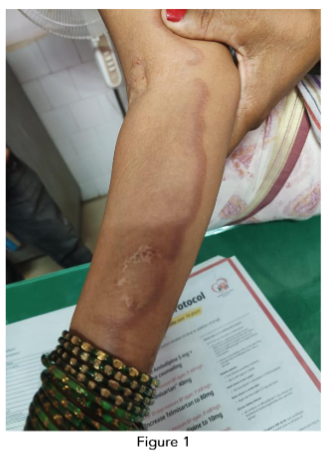
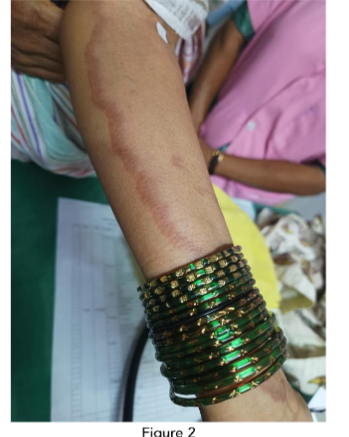
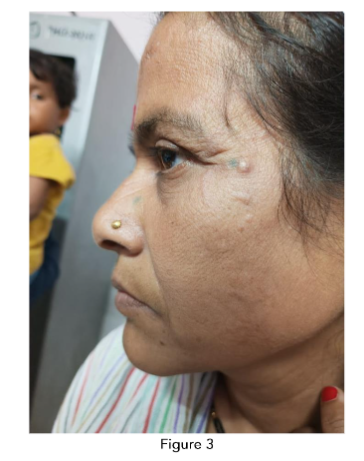
A fifty-five-year-old woman presented to the Primary Health Centre (PHC), Kamshet, with a non-itchy and linear lesion on the arm and abdomen for eight months (Figures 1 and 2). This rash was preceded by a fever that responded to a short course of treatment. The clinical examination also revealed a scaly lesion in the “butterfly area” over the face (Figure 3). She had no history of red urine. Her blood pressure was 126/84 mm Hg, and complete blood counts were normal. Blood urea, serum creatinine, liver function tests, and thyroid profile were within normal limits. The antinuclear antibody test was positive (1 in 100), and ESR and CRP were not raised. Systemic lupus erythematosus (SLE) was diagnosed and treated with hydroxychloroquine. Steroids were not administered.
On direct questioning, she admitted increased urination and blurred vision. There was no weight loss. Her BMI was 21.8. There is a strong family history of diabetes. Her two brothers have type II diabetes. Her fasting blood sugar level was 260 mg/dl, Hb A1c was 12.2%, and the C-peptide level was low (1.67 ng/ml). The anti-insulin antibody test was negative (2.5 U/ml). IA2-Insulin (3.35 U/ml) and GAD-65 Antibody Type I (1.3 IU/ml) were also negative. She did not respond to oral antidiabetic treatment, singly or in combination, despite adherence, but responded promptly to insulin therapy, 20 units twice a day. Her post-meal plasma glucose was 120 mg/dl. Metformin and pioglitazone were continued.
Discussion
Observational studies suggest a relationship between type-1 diabetes mellitus (T1DM) and systemic lupus erythematosus (SLE). Type 1 diabetes mellitus (T1DM) is an organ-specific autoimmune disorder, and SLE is an autoimmune disorder involving multiple systems. The pathogenesis of the B-cell-mediated autoimmune response in T1DM and the T-cell-mediated cytotoxic response in SLE is similar⁷. Autoantibodies detected in T1DM have also been found in presymptomatic SLE⁸. Mendelian Randomization analysis suggested a causal relationship between T1DM, 25-OHD levels, and SLE. T1DM and 25-OHD levels are associated with SLE and have causal associations with the risk of SLE. 25-OHD levels could mediate the causality of T1DM and SLE⁹. However, the studies on the association between SLE and diabetes have yielded conflicting results. There was no increased risk of DM in patients with SLE compared with controls¹⁰. Patients with newly diagnosed SLE had a 22% increased risk of developing type 2 diabetes during the 3-year follow-up period compared with matched controls¹¹. Hemminki used data from three Swedish health databases to estimate the risk of subsequent type 2 diabetes in patients with autoimmune diseases. The study included 12,206 patients with SLE and found that patients with SLE had a higher risk of type 2 diabetes¹². As against this, a nationwide population-based study that used data from the UK, which included 1,605 patients with SLE, found no increased risk of developing diabetes¹³. The gene PTPN 1858T variant is a common link to type 1 diabetes, rheumatoid arthritis, systemic lupus erythematosus (SLE), and other autoimmune disorders, supporting the hypothesis that several autoimmune diseases may share specific genes or susceptibility pathways¹⁴.
An association between type B insulin resistance syndrome (TBIRS) and SLE has been described. Almost all these patients with TBIRS had antibodies against insulin receptors, and they required insulin in high doses ranging from 450 to 25,000 IU daily¹⁵. As against TBIRS cases, our patient did not have antibodies against insulin and responded to a small insulin dose.
In summary, our patient with a normal BMI presented later than type 1 diabetes commonly presents. Her C-peptide levels were low, and she did not respond to oral antidiabetic drugs. She did not have islet cell antibodies but was diagnosed with SLE and promptly responded to small doses of insulin.
Competing interest:
None
Funding Statement:
None.
Acknowledgements:
The author thanks Dr. Mohan Swaminathan for his help.
Corresponding author
Subhashchandra Daga
The Primary Health Centre, Kamshet, 410405 (India).
Mobile no. 0091-9960522259
Email: [email protected]
ORCID: 0000 0001 5840 3804
References
1. Classification of diabetes mellitus. World Health Organization 2019. ISBN 978-92-4-15170-2.
2. Lim SS, Bayakly AR, Helmick CG, Gordon C, Easley KA, Drenkard C. The incidence and prevalence of systemic lupus erythematosus, 2002-2004: The Georgia Lupus Registry. Arthritis Rheumatol. 2014 Feb;66(2):357-68.
3. Carter EE, Barr SG, Clarke AE. The global burden of SLE: prevalence, health disparities, and socioeconomic impact. Nat Rev Rheumatol 2016; 12:605-20.
4. Barber MRW, Drenkard C, Falasinnu T, et al. Global epidemiology of systemic lupus erythematosus. Nat Rev Rheumatol 2021; 17: 515-32.
5. Tian J, Zhang D, Yao X, et al. Global epidemiology of systemic lupus erythematosus: a comprehensive systematic analysis and modelling study. Annals of the Rheumatic Diseases 2023;82:351-356.
6. Malaviya AN, Singh RR, Singh YN, Kapoor SK, Kumar A. Prevalence of Systemic Lupus Erythematosus in India. Lupus. 1993;2(2):115-118.
7. Katsarou A, Gudbjörnsdottir S, Rawshani A, et al. Type 1 diabetes mellitus. Nat Rev Dis Primers. 2017;3:17016.
8. Cortes S, Chambers S, Jerónimo A, Isenberg D. Diabetes mellitus complicating systemic lupus erythematosus—analysis of the UCL lupus cohort and literature review. Lupus. 2008;17(11):977–980.
9. Su K, Jia Z, Wu Y, Sun Y, Gao Q, Jiang Z, Jiang J. A network causal relationship between type-1 diabetes mellitus, 25-hydroxyvitamin D level, and systemic lupus erythematosus: Mendelian randomization study. PLoS One. 2023 May 17;18(5).
10. Etchegaray-Morales I, Mendoza-Pinto C, Munguía-Realpozo P, Solis-Poblano JC, Méndez-Martínez S, Ayón-Aguilar J, Abud-Mendoza C, García-Carrasco M, Cervera R. Risk of diabetes mellitus in systemic lupus erythematosus: systematic review and meta-analysis. Rheumatology (Oxford). 2024 Aug 1;63(8):2047-2055.
11. Lin YJ, Chien CC, Ho CH, Chen HA, Chen CY. Increased risk of type 2 diabetes in patients with systemic lupus erythematosus: A nationwide cohort study in Taiwan. Medicine (Baltimore). 2022 Dec 23;101(51).
12. Hemminki K, Liu X, Försti A, et al. Subsequent type 2 diabetes in patients with autoimmune disease. Sci Rep. 2015; 5:13871.
13. Kuo CF, Chou IJ, Rees F, et al. Temporal relationships between systemic lupus erythematosus and comorbidities. Rheumatology (Oxford). 2019; 58:840–8.
14. Tizaoui K, Terrazzino S, Cargnin S, et al. Seminars in arthritis and rheumatism. 2021; 51:513-22.
15. Alvarez-Payares JC, Ribero D, Rodríguez L, Builes CE, Prieto C, Arango C, Gamboa JG, Alvarez-Payares C. Late Systemic Lupus Erythematosus-Associated Insulin Resistance Syndrome: A Rare Cause of De Novo Diabetes Mellitus. Case Rep Med. 2022 Oct 14; 2022:4655804.
Most read articles by the same author(s)
- Subhashchandra Daga, M.D. (Pediatrics), A child with Epileptic and nonepileptic Head Drops , Medical Research Archives: Vol 12 No 7 (2024): Vol 12 No 7 (2024): July issue
- Subhashchandra Daga, Oral theophylline as a preventer and oral salbutamol as a reliever in childhood asthma: An option when resources are scarce , Medical Research Archives: Vol 13 No 2 (2025): Vol.13 issue 2 February 2025