

Lifecycle Radiation Protection: Ensuring Future Generations
Protection of entire lifecycle from radiation is needed to ensure future human generations
Mary Olson1
- Generational Radiation Impact Project, Asheville NC USA
Correspondence to Mary Olson [email protected]
OPEN ACCESS
PUBLISHED: 31 December 2025
CITATION: Olson, M., Protection of entire lifecycle from radiation is needed to ensure future human generations. [Online] 13(12). https://doi.org/10.18103/mra.v13i12.7137
COPYRIGHT: © 2025 European Society of Medicine. This is an open-access article distributed under the terms of the Creative Commons Attribution License, which permits unrestricted use, distribution, and reproduction in any medium, provided the original author and source are credited.
DOI https://doi.org/10.18103/mra.v13i12.7137
ISSN 2375-1924
ABSTRACT
This editorial is offered to those who are interested in science-based radiation protection. A long historical frame is offered for the advent and application of fission and the resulting wide exposure of communities to ionizing radiation. Findings are reviewed: disproportionate harm to female bodies compared to male bodies, and that the difference in outcome is strongly tied to exposures in early childhood is the occasion to invoke our lifecycle as the appropriate focus for radiation protection. are not uniform across our lifecycle, make a case for adopting a new Reference Individual as an efficient means to better protect our lifecycle. To protect our future, the entire lifecycle must be protected, and so the new Reference is best if both a child, and female, in order to be maximally protective. Centering protection on life stage of greatest harm is insufficient unless the model is applied universally, not only to girls. The frame of Reference Girl is also offered as a means to engage, and incorporate, new findings lth. These views point to work that is to be done, and the author commends the rising generations in research settings step up to meet these opportunities.
Keywords: Early childhood exposure; Female radio sensitivity; Ionizing radiation; Lifecycle vulnerability; Public health policy; Radiation protection; Radiation safety standards; Reference Individual.
INTRODUCTION
PHYSICAL HISTORY
Uranium is found on every continent, and in the seas. Many ancient knowledge archives recognize the danger associated with uranium and its decay progeny radiation exposure, and produced cancer, infertility, pregnancy disruptions, and likely other human and environmental maladies. Human uranium extraction, accelerating in the 20th century, to this day, has increased these exposures and outcomes. In the rush to feed fission both military and civilian, human loss has also accelerated. Ancient radiation is not comparable to the new chapter in the story of radioactivity that began in Chicago, Illinois, in December 1942. Splitting the nuclei of Uanium-235 released energy and heat and also massive quantities of fission products the fragments of the original uranium, post-fission. These new atoms, not found in nature, are naturally smaller than the atom that they sprang from, and are, in aggregate, several million times more radioactive than the original uranium. In both nuclear weapons and nuclear power generation, these radionuclides are seen as waste. Nuclear weapons detonations from 1945 1963 in our atmosphere led to contamination of every continent and the seas with these new-to-Earth elements in industrial quantities as fallout drifted, or rained back down to the ground, or any other surface.
APPLIED HISTORY
The discovery of radioactivity by Europeans was when society was industrializing and almost immediately led to applications in both the military and in medicine. Marie and Pierre Curie shared concentrated radium with a doctor that was applied to a tumor, and elixirs featuring natural spring waters that were radioactive were popularized for alleged health benefits. The use of radium and strontium to create illuminated watches contributing to the use of airplanes as part of the war machine of WWI, and tragically cost the lives of not only the victims of war, but also the many women who applied radioactive paint to the cockpit dials and the watch hands. The young women famously used their lips to shape their paint brush tips but then suffered from internal disfigurement and many died. identified radioactivity as both beneficial and hazardous. It is level of archetype: nuclear and radiation were seen both as a global panacea to solve poverty, hunger, and also as the bringer of global destruction. This binary pair (yin and yang, good and bad, are also binary pairs) is typified historically by the super-secret U.S. Manhattan Project that built the first nuclear weapons, and the subsequent founding of the Atoms for Peace programs centered in the United Nations. This dichotomy sewn into the fabric of nuclear history has helped to feed the idea that radiation is either always beneficial or always hazardous. This type of either-or-thinking does not serve us and needs to be left behind. Few things are limited to two options. Today many factors are seen as part of a continuum, a spectrum of variability. The highlight of binary thinking is offered here as a frame for reconsidering radiation regulation, which is inextricably linked to this historical frame.
Fission is unsafe for living things. Temperatures and radioactivity of uncontrolled fission approach levels comparable to the sun. Massive new radioactivity generated, including pesky elements like plutonium that are formed inside a nuclear reactor, in its fuel rods during fission of uranium. It is impossible to operate any nuclear site, particularly nuclear reactors, without ongoing, routine releases of radioactivity to air, water, and solid wastes that will end up in the ground. Non-routine reactor events have, with few exceptions, led to fallout on the scale of nuclear weapons detonations: Windscale, Santa Suzanna, Three Mile Island, Chornobyl, Fukushima Daiichi. All events with a beginning, but no end in the human timescale.
SELECTED REGULATORY HISTORY
At the same time, the energy of fission is impressive. Harnessing fission for something besides a warhead would be beneficial. In order to allow corporations and government agencies to conduct this inherently dangerous process, expose workers, and also the public, to radioactivity at all the industrial processes required to conduct fission, governments created regulations. There were many presumptions rolled into what was essentially a creative process ostensibly designed to limit harm while maximizing benefit. It made sense during both the Manhattan Project and the first nuclear arms race that the large numbers of male workers were the focus of regulation. The creation of the Reference Man was in direct alignment with the need to protect hundreds of thousand of Cold War workers. There was not however a course-correction when this early formulation for workers was applied to the general public including pregnant women, infants and elders who are not reflected in the Reference Man model. This is an example of an initial misapprehension some of which have been corrected, but many of which remain to this day, and are rarely challenged.
Another shortcoming of early regulation was that sought to limit radiation impacts, then measured only as cancer or fatal cancer, to a level society would find acceptable. In general, trust in the mid-twentieth century was centered on the idea that if the government conducted or permitted corporations to perform hazardous activities that could result in death of members of the public, the activities would be limited by protection standards that govern the corporate license. In general, the social discussions of the era centered on a risk level of 1 in a million people per year. In a global population over 8 billion, with thousands of licensed nuclear sites in industrial nations and extraction sites in the Global South, that ostensibly low relative rate of risk translates to a lot of people but, that is rarely added to the discussion, since a goal of government regulation is to create public acceptance of the licensed activity. invoked, and this is where secrecy helped to dodge the fact that it was not only fallout from nuclear weapons tests that caused a much higher risk of cancer and to those most impacted, but nuclear reactors also would not deliver protection of the people.
The US Nuclear Regulatory Commission (NRC), stipulating external radiation exposure only, published a fatal cancer rate from the level of exposure permitted by its own (historical) licensing rate from this exposure level is 1 fatal cancer in every 268 exposed each year for 70 years. This fatal cancer outcome was evaluated using the Reference Man and published in 1990. While cancer rates overall are raging the fact that a licensing agency would tolerate a deathrate of 1 in 286 exposed is staggering. It is ever more so because at that time, there was a presumption that radiation impacted every body in the same ways. nuclear regulators in the U.S. Today we know that is wrong.
DISPROPORTIONATE HARM
The exposure of children creates greater bodily harm than exposure of adults. The exposure of female bodies is more harmful than the exposure of male bodies. These two findings, take together reveal that age and biological sex are compounding factors, resulting in a significantly greater impact to one post-birth life-stage than all the others. Little girls exposed to radiation suffer seven times more cancer (incidence) than when compared to the rate of cancer incidence in young adult males (at the age of Reference Man). This comparison is offered to illustrate that the most-harmed is strikingly different than the point of measurement of dose/response.
The dataset from the Lifespan Study of A-bomb survivors was used by the authors of the watershed 2006 National Academy report, Biological Effects of Ionizing Radiation (BEIR VII), to create a scenario in which a single (fixed) exposure level is posited, impacting a population including ages of newborn to octogenarian. The scenario allows high contrast on biological sex and age, and how these are compounding factors. Ages in the scenario are the life stage when exposed to a single 0.1 Gy of gamma/neutron radiation. The cancer incidence is totaled across the subsequent 60 years, post-exposure. The age of cancer onset is not included in the scenario.
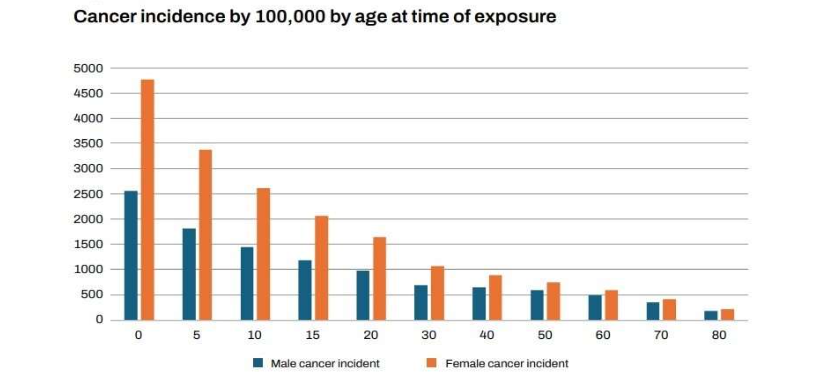
It is easy to see that both biological sex and age at the time of exposure are factors in radiation to females compared to males is greatest in young children however females are harmed more in every age group than are males. This author encountered these insights nearly 15 and subsequent peer-reviewed publication of the same material in and This work found an audience among those who have decided that the benefits of nuclear weapons certainly do not outweigh the harm to public and environmental health due to radioactive pollution from extraction, production, testing and risk of nuclear destruction. The finding that radiation is more harmful to women and girls compared to boys and men became part of the qualification for the General Assembly at the United Nations to claim jurisdiction for the new Treaty on the Prohibition of Nuclear Weapons under the Humanitarian legal code. In 2024 the UN Institute on Disarmament invited follow-up work and Dr Amanda Nichols co-authored the major update, Gender and Ionizing Radiation: Towards a New Research Agenda Addressing Disproportionate Harm. The report includes an additional peer-reviewed papers bearing data showing greater harm to female bodies compared to males.
FAILURE TO PROTECT OUR LIFECYCLE
This finding that radiation is not uniform, not indiscriminate, must certainly be part of addressing the misapprehension that there is a single impact from radiation exposures to the human body. The human body is not one soma it is a lifecycle. If one takes the poorly drawn 1990 risk assessment by the US NRC cited above, it shows an unacceptably high lifetime risk of fatal cancer. Worse yet, the regulator centers on a disproportionately radiation-resistant part of our lifecycle. One can truly say that public health is not protected unless ALL parts of our lifecycle are protected. Unprotected children result in more disease in adults and both male and female health across the lifecycle are needed for our species to survive.
POSSIBLE SOLUTIONS
It is not particularly viable to propose separate regulations for different life phases. A much easier solution is to retire Reference Man (U.S.) or any other adult Reference Individual. When the most impacted portion of the lifecycle is the basis of protection then every other part is better protected. It is time to adopt Reference Girl not for girls as a new universal reference individual. This way children, particularly girls, will be protected for the first time and every other part of the lifecycle will be protected better than ever before. What of pre-birth? Bravo! A vital question, particularly since the reproductive cells are present and can be exposed during any life stage.
HUMAN LIFECYCLE
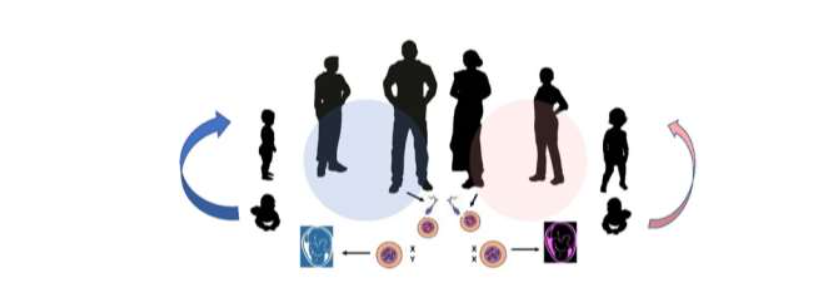
Lifecycle Exposure to ionizing radiation at any life stage may produce outcomes across all life stages. Primary reproductive cells are present in the fetus and throughout the somatic cycle, therefore intergenerational outcomes are possible from any exposure, though risks are highest during pregnancy. Current radiation standards for protection of the public are silent on pregnancy.
HUMAN LIFECYCLE
Primary reproductive cells: Ova (XX) Sperm (XY) / Spermatogonia In utero developmental phases: Zygote, Embryo, Fetus which is somatically either female XX, or male, XY or intersex Post-Birth Life Stages: Infant, Child, Pubescent, Adult, Elder
The data-set available to me for my work on disproportionate harm from radiation did not include life stages prior to birth. Nonetheless, here is a contemporary presumption: if radiation harms an embryo or fetus, it generally produces catastrophic damage and results in unviability. Wouldn’t it be better to call that a hypothesis, and test it? Dr Alice Stewart who first identified harm to pregnancy from x-rays in 1958 while looking for the cause of a large increase in childhood leukemias in the UK, subsequently characterized childhood cancers as post-birth defects. Similarly, Dr Alfred Korblein finds a correlation between excess infant deaths and exposure during pregnancy to atmospheric nuclear weapons test fallout. Korblein posits that reduced immune function of the mother during pregnancy may be the cause. Comprehensive study of intergenerational impacts of radiation exposure is currently hard to find. We ignore it at our own peril.
One final thought: the 1974 definition of Reference Man, penned by the International Commission for Radiological Protection excludes significant exposure to contaminated air, food and water in also exclude internal radionuclides from most restrictions of public exposure. New study has found hot particles capable of being inhaled or consumed in nuclear reactor communities. The finding is that insoluble hot particles can lodge in the body and result in non-trivial cumulative exposures, particularly from alpha emissions. While preliminary, these studies are pointing to the need for a Reference Individual who reflects the reality of radioactive pollution in our air, food, and water resulting in internal exposures from internal emitters. In order to protect real-world communities impacted by industrial nuclear activities, it is time for the Reference standing for them to also include internal exposure. Reference Girl is the opportunity to take on this new challenge. technologies and evaluate the true humanitarian impacts from radiation exposures to infants, women, pregnant or not, girls, men, and boys and base the limits on those most harmed? Otherwise, we are caught in the false dichotomy that permits the magical thinking that radiation exposure is ever completely safe for our children.
CONCLUSION
I chose to write this column for the European Medical Society since creating a new Reference Girl is beyond the scope of my own skillset but, I know she is needed. Currently the trend here in the USA is to relax long-time radiation protection levels, not pursue more comprehensive revisions based on new scientific evidence. There is no patent or copyright on these ideas. Please support your best and brightest in pursuing these ideas.
Conflict of Interest:
The authors have no conflicts of interest to declare.
Funding Statement:
No financial disclosure.
References:
- Energy, US Department of. CP-1 goes critical, in the Manhattan Project, an interactive history. Posted by the US Office of Science and Technology (no posting date given). Accessed on November 14, 2025. https://www.osti.gov/opennet/manhattan-project-history/Events/1942-1944_pu/cp-1_critical.htm.
- Fission product yields. International Atomic Energy Agency, Physics Section and Nuclear Data Sections. No posting date. Accessed on November 14, 2025. https://www.inds.iaea.org/wimsd/fpyield.htm#:~:text=Fission%20product%20yields%20for%20U%2D235%2C%2U%2D236%2C%20U%2D237%2C%20U%2D238
- -Curie to the development of modern oncology. Anal Bioanal Chem. 2011 Feb 18;400(6):1583-1586. doi:10.1007/s00216-011-4712-1.
- Moore, Kate. The Radium Girls: The Dark Story of. Source Books. 2017.
- Energy, US Department of. The Manhattan Project, an interactive history. Posted by the US Office of Science and Technology (no posting date given). Accessed on November 14, 2025. https://www.osti.gov/opennet/manhattan-project-history/index.htm.
- nuclear energy in a postwar America. Published Apr 7, 2020. Accessed November 14, 2025. https://thebulletin.org/virtual-tour/atoms-for-peace-cancer-research-and-nuclear-energy-in-a-postwar-america/
- Garland, J.A., Wakeford, R. Atmospheric emissions from the Windscale accident of October 1957. Atmospheric Environment. Volume 41, Issue 18, June 2007, Pages 3904-3920. https://doi.org/10.1016/j.atmosenv.2006.12.049.
- Gap, The Committee to Bridge the. Santa Susana Field Laboratory, The Partial Nuclear Meltdown in July 1959. Publication date not listed. Accessed November 14, 2025. https://www.committeetobridgethegap.org/the-santa-susana-field-laboratory/#:~:text=The%20Partial%20Nuclear%20Meltdown%20in%20July%201959.
- Alert, Three Mile Island. Legal History of Three Mile Island. Date of publication missing. Accessed on November 14, 2025. https://www.tmia.com/old-website/history/tmilegalhistory.html.
- Fairlie, Ian. Independent Report on Health Effects 30 Years After Chernobyl: TORCH Updated. 2016. Posted by the World Health Association (no date given). Accessed November, 14 2025. https://co-cher.iarc.who.int/description-of-work/abstracts/fairlie-i-abstract-v2.pdf
- Lochbaum, D. Lyman, E. Stranahan, S. Fukushima: The Story of a Nuclear Disaster. The New Press, 2015.
- Commission, US Nuclear Regulatory. Reference Man. Posted March 09, 2021. Accessed November 14, 2025. https://www.nrc.gov/reading-rm/basic-ref/glossary/reference-man
- Olson, M. Personal participation in focus group on acceptable risk conducted by Andrew Armstrong, November, 1962 in Mount Carroll, IL.
- Fernandez, T. Radiation Exposure Compensation Act (RECA) Program. Date of publication missing. Accessed on November 14, 2025. https://fernandez.house.gov/services/reca.htm
- The definition of Reference Man was developed by the International Commission for Radiological as being between 20-30 years of age, weighing 70 kg, is 170 cm in height, and lives in a climate with an average temperature of from 10o to 20o C. He is a Caucasian and is a Western European or North Task Group on Reference Man. [ICRP Publication] No. 23. Oxford: Pergamon Press, 1975. Adopted October 1974. Page 4.
- US NRC Policy Statement. 1990 (3 July). Below Regulatory Concern, Federal Register, Vol 55, No. 128: 27522-27537. https://archives.federalregister.gov/issue_slice/1990/7/3/27519-27535.pdf#page=4.
- Makhijani, A. Smith, B. Thorne, M. Science for the Vulnerable: Setting Radiation and Multiple Exposure Standards. Posted on October, 2006. Last modified March, 2015. Accessed November 14, 2025. https://ieer.org/resource/depleted-uranium/science-vulnerable-setting-radiation/.
- Nichols, A. Olson, M. 2024. Gender and Ionizing Radiation Towards a New Research Agenda Addressing Disproportionate Harm. United Nations Institute for Disarmament Research. Posted November, 2024. Accessed November 14, 2025. https://unidir.org/wp-content/uploads/2024/11/Gender_and_ionizing_radiation_web.pdf.
- Interdisciplinary Science Reviews 44, no. 2 (2019): 131-139, https://doi.org/10.1080/03080188.2019.1603864.
- NAS-NRC. Health Risks from Exposure to Low Levels of Ionizing Radiation: BEIR VII Phase 2. Committee to Assess Health Risks from Exposure to Low Levels of Ionizing Radiation, Board on Radiation Effects Research, National Research Council of the National Academies. National Academies Press. 2006. Pp 311.
- Posted 2011. Accessed November 14, 2025. https://www.nirs.org/wp-content/uploads/radiation/radhealth/radiationwomen.pdf.
- posted 7 July 2017. Accessed on November 15, 2025: 1, https://documents.un.org/doc/undoc/gen/n17/209/73/pdf/n1720973.pdf.
- US Federal Code of Regulations. 2025 [1991]. chp. 10, part 20 (10cfr20). Accessed November 14, 2025. https://www.ecfr.gov/current/title-10/chapter-I/part-20.
- Stewart, A. Webb, J. Hewitt, D. A survey of childhood malignancies. Br Med J 1958; 1 doi: https://doi.org/10.1136/bmj.1.5086.1495 (Published 28 June 1958)
- Körblein, A. Statistical modeling of trends in infant mortality after atmospheric nuclear weapons testing. May 18, 2023 https://doi.org/10.1371/journal.pone.0284482.
- Kaltofen, M. Vieira, C. Garshick, E. et al. Soil and Indoor Radionuclides Related to the Plymouth Pilgrim Nuclear Power Plant Area. ENVIRONMENTAL ENGINEERING SCIENCE Volume 00, Number 00, 2025. DOI: https://doi.org/10.1177/15579018251371131.
- Kaltofen, M., and P. Plato. Absorbed Dose Rates and Biological Consequences of Discrete Alpha-emitting Particles Embedded in Tissue. Applied Radiation and Isotopes. 2024. 210: 111355. https://doi.org/10.1016/j.apradiso.2024.111355.