

Locomotor Experience Before Walking: Crawling to Steps
Everyday Locomotor Experience Prior to Walking: A Longitudinal Case Series of Crawling, Cruising, and Falls
Do Kyeong Lee¹, Juliet Leyva¹, Beverly Ulrich²
- Department of Kinesiology,California State University, Fullerton, USA
- School of Kinesiology, University of Michigan, USA
OPEN ACCESS
PUBLISHED: 30 November 2025
CITATION: Lee, D., K., Leyva, J., Ulrich, B., Everyday Locomotor Experience Prior to Walking: A Longitudinal Case Series of Crawling, Cruising, and Falls. [online] 13(11). https://doi.org/10.18103/mra.v13i11.7110
COPYRIGHT: © 2025 European Society of Medicine. This is an open-access article distributed under the terms of the Creative Commons Attribution License, which permits unrestricted use, distribution, and reproduction in any medium, provided the original author and source are credited.
DOI https://doi.org/10.18103/mra.v13i11.7110
ISSN 2375-1924
ABSTRACT
Purpose: Many studies examine improvements in walking after its emergence, but far less is known about the practice that precedes walking. We documented developmental trajectories of crawling and cruising in 10 infants prior to walking onset.
Methods: Using a naturalistic, home-based longitudinal design, we video-recorded one hour of spontaneous motor activity monthly from the point infants could cruise sideways continuously for six feet until walking began.
Results: On average, infants practiced for ~4 months between the onset of cruising and independent walking. Over this period, time spent cruising increased as crawling decreased; unintentional falls during cruising rose to a peak approximately three months before walking onset and then declined rapidly, whereas falls during crawling were rare.
Conclusions: These patterns indicate that infants accrue several months of upright practice in everyday settings, including exposure to and recovery from falls, before achieving independent walking. Findings suggest that interventions for infants with motor delays should emphasize high-repetition, functionally relevant practice, incorporate safe opportunities for failure and recovery, and use goal-directed tasks that elicit progressively advanced motor control.
Keywords: Infants, Motor learning, Locomotion
Introduction
Walking is the most studied of all functional motor skills, from basic to clinical science perspectives, and across the developmental spectrum from toddlerhood to late adulthood. Considerable attention has been devoted to the emergence of expertise in new walkers, in which inter- and intralimb phasing becomes more stable, foot widths narrow, gait speed increases, and muscle-activation patterns transition from highly variable to increasingly rhythmic¹–⁸. Adolph and colleagues⁵ astounded by reporting that new walkers produce an average of 9,000 steps per day as they practice their walking skills as they progress to becoming experts. These data reflect the enormous amount of repeated effort that goes into “mastering” this skill. Equally important—but far less studied—is the practice that goes into acquiring the skill in the first place, as little empirical work has examined what infants are actually doing. What about the practice that goes into “getting the skill” in the first place?
Crawling and cruising are listed on standard motor-milestone inventories and typically precede independent walking, with earlier average onset ages. Although their surface kinematics differ—crawling is a prone, quadrupedal pattern, whereas cruising and walking are upright, bipedal patterns—these skills rely on overlapping capacities, including coordinated arm–leg action, trunk strength, and balance control to manage frequent disequilibrium. Accordingly, crawling and cruising are widely regarded as functional precursors to walking. Research on crawling shows infants adopt diverse movement strategies “in prone,” beyond the familiar hands-and-knees crawl⁹,¹⁰. Adolph et al. (1998) documented four classes of patterns—army crawl, inchworm, classic hands-and-knees, and hands-and-feet—with some infants switching between them. Although fewer studies address cruising, evidence shows steady gains in efficiency and control. For forward-facing cruising, HaehI et al.¹¹ reported improved thorax–pelvis coordination; by week onset, infants moved rapidly with minimal errors, while trunk control remained variable but sufficient for “letting go.” Similarly, longitudinal studies of sideways cruising reveal progression from single-limb to overlapping moves, culminating in near-simultaneous multi-limb initiations¹². Together, these findings illustrate the bit-by-bit control refinements that pave the way to independent walking.
The link between crawling/cruising and the emergence of independent walking remains poorly understood. Most prior works were laboratory-based and cross-sectional, focusing on simple between-group comparisons (e.g., distance traveled, step counts, or fall rates for crawlers vs. walkers)⁵,¹³. Such designs do not capture the longitudinal practice that occurs during the transition—particularly the role of cruising—nor therefore how experience in earlier locomotor modes supports walking onset.
What do infants do in the months leading up to practicing independent walking? How do infants decide when to switch modes? And how do they choose between crawling and walking once both are available? In this study, our primary aim was to document the naturally occurring developmental trajectories of locomotor practice among healthy infants in the months leading up to and including the onset of walking. We further examined the costs of mastering a new skill by measuring the frequency of falls. We hypothesized that as infants transition from cruising to walking, overall locomotion increases, crawling gives way to cruising, fall rates are lowest in crawling and highest in walking, and independent walking begins after cruising falls stabilize. Addressing these questions is critical for understanding the emergence of walking, a major life skill, and may also inform strategies for supporting infants with developmental delays.
Methods
Participants
Ten typically developing infants participated (mean age at first test = 10 months, 18 days; mean height = 77.3 cm; mean weight = 9.24 kg). The first test
The onset of the ability to cruise independently for 6 feet occurred for each infant at the onset of the ability to cruise independently for 6 feet. Participants were recruited through local daycare centers, community activity centers, libraries, and word-of-mouth, and data were collected between 2012 and 2013. Procedures were approved by the University of Michigan Institutional Review Board.
Data Collection — home visit
Caregivers were instructed to reach out to the data collection team to volunteer, and correspondence took place via phone and email until their infant could cruise sideways independently for six feet. Once this was completed, the first observation was scheduled and took place in their home. We conducted monthly observations until an infant took three independent steps, as defined by the Bayley Scales of Infant Development¹⁴. We then classified that infant as walking independently.
During the first visit, we explained to caregivers all procedures of the study and obtained consent to participate. The researcher visited the infant’s home when the infant was fully awake, not during mealtime, as reported by the caregiver. At the start of each visit’s data collection, the caregiver placed the infant in their naturalistic play setting at their home. There was no interaction between the infant and the researchers; caregivers were encouraged to maintain naturalistic interactions throughout the 60-minute video collection. A Canon handheld camcorder was used to collect the video footage, and was moved as necessary to keep the infant in the frame of the camera. During the visit, researchers made the effort to stay out of sight of the participant; this was done to keep the setting as naturalistic as possible. Infants were allowed to travel freely throughout the house as mandated by the caregiver, provided boundaries. Caregivers were also given the option to go about their typical behavioral patterns (completing chores, playing with the infant, relaxing). After filming, infant length and weight were measured to compute the Ponderal Index (PI; weight-for-length).
Data Reduction
After each visit, videos were uploaded and digitized, then coded in OpenSHAPA (v1.09). Customized scripts identified three locomotor patterns—cruising, crawling, and walking—using operational definitions guided by the BSID-II gross-motor constructs¹⁴. For each bout, onset was the first frame meeting the definition of the target locomotion, and offset was the last frame before a transition, from which duration and bout counts were derived. The number of steps was also counted during cruising and during independent walking. The number of falls during cruising, crawling, and walking was recorded. Only accidental falls, not playful ones, were included.
Results
Participant Characteristics
Table 1 reports individual onset ages from cruising (first successful 6-ft cruise) to walking, along with the number of independent steps at walk onset (WO). Testing began once infants could cruise sideways 6 ft. On average, cruising 6-ft occurred at 10 mo 18 d (range: 8 mo 8 d–13 mo 6 d) with a mean Ponderal Index (PI; weight-for-length) of 25.87 kg·m⁻³. Walking occurred at a mean age of 13 mo (range: 10 mo 18 d–15 mo 7 d), when PI averaged 24.73 kg·m⁻³. The mean interval between these milestones was 4 mo 14 d (range: 25 d–4 mo 2 d), accompanied by an average 1.05 kg·m⁻³ decline in PI.
Table 1: Individual Infants’ Characteristics
| Age at Cruise Onset (Months [Days]) | Age at Cruise 6 Feet (Months [Days]) | Age at WO (Months [Days]) | Time Lapsed Between Cruise 6 Feet & WO (Months [Days]) | Independent Steps Taken at WO | PI at Cruise onset | PI at WO |
|---|---|---|---|---|---|---|
| 1 (21) to 15 (7) | 2 (6) to 4 (2) | 20.73 to 30.28 | 22.33 to 26.94 | |||
| 2 (6) to 8 (22) | 2 (6) to 4 (2) | 20.73 to 30.28 | 22.33 to 26.94 | |||
| 3 (8) to 8 (22) | 2 (6) to 4 (2) | 20.73 to 30.28 | 22.33 to 26.94 | |||
| 4 (8) to 11 (25) | 2 (6) to 4 (2) | 20.73 to 30.28 | 22.33 to 26.94 | |||
| 5 (8) to 11 (25) | 2 (6) to 4 (2) | 20.73 to 30.28 | 22.33 to 26.94 | |||
| 6 (8) to 11 (25) | 2 (6) to 4 (2) | 20.73 to 30.28 | 22.33 to 26.94 | |||
| 7 (10) to 11 (25) | 2 (6) to 4 (2) | 20.73 to 30.28 | 22.33 to 26.94 | |||
| 8 (10) to 11 (25) | 2 (6) to 4 (2) | 20.73 to 30.28 | 22.33 to 26.94 | |||
| 9 (10) to 11 (25) | 2 (6) to 4 (2) | 20.73 to 30.28 | 22.33 to 26.94 | |||
| 10 (10) to 11 (25) | 2 (6) to 4 (2) | 20.73 to 30.28 | 22.33 to 26.94 |
Developmental Trajectories of Locomotion Prior to the Onset of the Walking Milestone
Figure 1a shows monthly group means from the first 6-ft cruise to walk onset (WO) for time spent crawling, cruising, and total locomotion. WO served as the anchor; earlier sessions are labeled W–1 (one month before WO), W–2, etc. Over the course of several months, total locomotion time increased steadily. Crawling time declined, cruising time rose, and the two curves crossed around W–1. At WO, both crawling and cruising decreased.
Figure 1: Longitudinal patterns of locomotor activity and fall rates during the transition to walking.
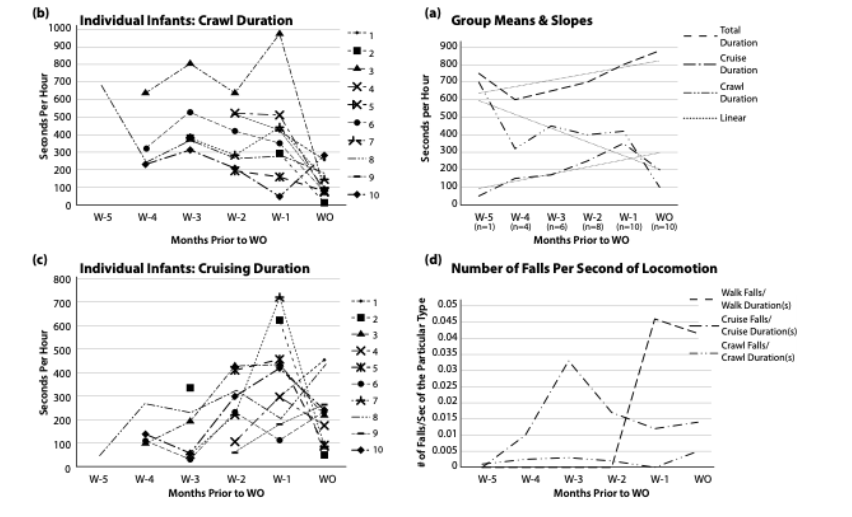
Longitudinal trajectories of crawling (a) and cruising duration (b) over months to and at WO. (c) Mean unintentional fall rate (falls/s) for each locomotor pattern.(a) Group means and regressions for cruising, crawling, and total locomotion by months relative to walk onset (WO); total = cruising, crawling, and walking. Individual trajectories of crawling (b) and cruising duration (c) (per hour) across months to and at WO. (d) Mean unintentional fall rate (falls/s) for each locomotor pattern.
Figure 1b and 1bc plot each individual infant’s time spent in crawling per month (1b) and time spent in cruising (1c). Although these monthly snapshots of infants’ locomotor practice showed variability from month to month and among individuals, their individual trajectories, nevertheless, tended to follow the group mean trajectory plotted in Figure 1a.While individual infants displayed similar developmental trajectories for increase/decrease over months for time spent cruising and crawling, they also showed individual differences in how much they used their new walking skill during their WO month. Overall, infants performed an average of 876.6 independent steps during the 60 minutes of videotaping at WO (Table 1). Infant 6, took the most independent walking steps, 2210, and also shifted from cruising 6 feet to WO in just 2.5 months, one of the quickest of our participants. The fewest walking steps were performed by infant 9, who produced 0 steps during the videotaped session but walked during the Bayley Scale testing. This child also moved quite rapidly between cruise 6 feet and WO but was also one of the oldest of our participants when she achieved WO. Infant 8 needed 5 months between cruising 6 feet and walk onset, the longest time of all 10 infants, was one of our older infants at WO, but still took only 14 walking steps during this test session.
Falls–Developmental Trajectory
Figure 1d shows the mean rate of falls (falls per second) within bouts of crawling, cruising, and walking. Fall rates during crawling were consistently low across months. During cruising, the rate rose to a peak at W–3 (0.033 per second) and then declined as WO approached. At W–1, while falls from crawling and cruising continued to decrease, falls associated with walking steps increased markedly—reflecting the moment when infants let go and learn how “not to fall.” With the onset of independent walking, the fall rate againincreased sharply to 0.0415 per second, far above the cruising peak. This pattern indicates that the shift from multi-point support (hands and knees or hands-on-furniture) to bipedal support imposes substantially greater control demands. Notably, infants initiated independent steps after cruising fall rates had stabilized at a low level.
Discussion
Our results show how independent walking emerges by tracking day-to-day practice in precursor milestones within infants’ everyday environments. Focusing on crawling and cruising as functional foundations, we charted developmental trajectories of exploration and practice—highlighting how skills change, not just that they improve—revealing the processes by which infants build the control and coordination needed for walking.
Our infants spent, on average, four months of cruising practice after reaching the criterion of cruising six feet before taking their first independent walking steps. When we include the interval from infants’ initial cruising steps based on parental recall, the mean cruising experience rises to eight months. Although Adolph et al. used slightly different onset criteria—3 ft of independent cruising and 10 ft of independent walking—compared with ours (6 ft of cruising and three independent steps), our estimates align with Adolph et al.¹⁵, who reported cruising experience ranging from 0.20 to 8.91 months (M = 2.74). Crawling, of course, emerged months earlier, and infants continued to use this skill as they acquired and practiced the cruising skill. Once walking onset was achieved, toddlers produced independent upright steps frequently, though research shows that refinement continues for months.¹,³,⁴,⁶,¹⁶ In the first session in which we observed independent steps, toddlers averaged 876 steps during the hour of free play. Thus, these patterns suggest that an early challenge in learning to walk is the transition from supported to unsupported stepping, a process that often unfolds over several months of cruising practice.
Across the observation period, infants engaged in locomotion for approximately 10–15 minutes per hour, using a mixture of crawling, cruising, or walking. These values align with Hoch et al.¹³, who reported that 10- and 13-month-old infants—predominantly crawlers with emerging cruising and little to no independent walking—locomoted for about 9–11.4 minutes per hour across crawl, cruise, knee-walking, and walking steps. Mirroring that locomotor status in our cohort (WO–5 to WO–1 months), we provide a fine-grained, longitudinal breakdown by locomotor type: in the months preceding walking onset, cruising increased while crawling decreased, yet cruising never surpassed crawling as the dominant mode. By WO–1 month, the two modes were approximately at parity; with the achievement of independent walking, walking increased and crawling declined sharply, indicating rapid reallocation of practice input to upright, independent walking. This general pattern was true for individual infants as well, although month-to-month variability was more obvious at this level. Together, this pattern indicates that infants systematically reallocate locomotor practice toward emerging skills—shifting from crawling to cruising before WO, then rapidly concentrating on independent walking at WO.
As practice concentrates on unsupported walking, infants’ balance demands increase, and with them the likelihood of falls—events that are not errors but essential experiences for tuning locomotor control. Previous studies have reported that crawlers fall at rates of approximately 8.8–17.4 falls per hour, whereas novice walkers average about 31.4 falls per hour.⁵,¹³ Falling continues well beyond the onset of walking; longitudinal observations show that early walkers experience frequent, mostly non-injurious falls that decline steadily over the first several months of walking experience¹⁷. Notably, most falls do not interrupt exploration—infants typically recover quickly and resume play.
Our longitudinal data extend prior findings into the pre-walking period, showing that fall frequency is patterned by locomotor skill status, rising during cruising and peaking with early independent walking. Walking-related fall rates rose sharply during the month(s) preceding walking onset, exceeding rates observed for other locomotor modes and earlier months. Specifically, cruising-related falls peaked around WO–3 (three months before WO) and then declined steadily, reaching a minimum in the month immediately before WO. As cruising falls decreased, falls during walking increased over the final two months prior to WO, indicating that infants’ falls shift toward the most advanced locomotor form in use. At their peak, walking-related falls were approximately twice those associated with other modes. Collectively, these patterns suggest that independent walking imposes greater postural control and environmental adaptation demands, producing a transient surge in falls as infants reorganize control for upright, independent locomotion.
One point that warrants attention is that our walking-related fall rates are substantially higher than those reported previously. At the month of walking onset, our toddlers averaged ~166 falls per walking hour, compared with about 32 falls per hour for novice walkers reported by Adolph and colleagues⁵. Moreover, even when considering time in motion within each locomotor mode, our walk-related fall rates remained higher than crawl- or cruise-related fall rates, whereas Adolph’s estimates did not differ by locomotor type. This divergence likely reflects contextual and methodological differences: prior studies⁵,¹³,¹⁷ aggregated falls across the entire observation irrespective of locomotor mode, whereas we quantified falls separately within mode (e.g., cruising vs. walking). In addition, our observations were longitudinal and home-based, while earlier work was largely laboratory-based and cross-sectional; infants may behave more cautiously in novel lab settings, whereas familiar home environments permit more risk-taking and easier recovery, yielding higher observed fall frequencies.
As infants transition to more advanced motor skills, researchers have long posited that practicing demanding skills increases energy expenditure. Prior work using ankle-worn accelerometers shows that more active infants exhibit lower body-fat percentages than less active peers¹⁸. In our sample, the Ponderal Index (weight/length³) declined from the onset of cruising to the onset of walking, indicating that toddlers became slimmer during this transition. This pattern is consistent with the view that the practice of more challenging skills carries higher energetic costs. Together, these findings suggest that the emergence of independent walking is accompanied by measurable shifts in body proportionality, likely reflecting increased energy demands of upright locomotion.
This study is limited by a modest sample and the absence of direct biomechanical measures; our analyses are descriptive. Even so, a naturalistic, home-based longitudinal design revealed a sequential redistribution of locomotor practice—from crawling to cruising, then rapidly to unsupported walking at WO—accompanied by a transient surge in walking-related falls. Mode-specific rates showed that falls are patterned by skill status and likely reflect the heightened balance and control demands of newly independent walking rather than error per se. These findings refine accounts of how walking emerges by pinpointing the critical transition from supported to unsupported stepping and the months of cruising that typically precede it. Future work should pair in-home kinematics/sensors with observational coding to parse mechanisms of balance control and to test how environmental supports shape the timing and cost of this transition.
Conclusion
Our longitudinal data extend prior findings into the pre-walking period, showing that fall frequency is patterned by locomotor skill status, rising during cruising and peaking with early independent walking. Walking-related fall rates rose sharply during the months preceding walking onset, exceeding rates observed for other locomotor modes and earlier months.
Conflict of Interest
The authors have no conflicts of interest to declare.
References
1. Adolph KE, Vereijken B, Shrout PE. What changes in infant walking and why. Child Development. 2003;74(2):475-497.
2. Chang CL, Kubo M, Ulrich BD. Emergence of neuromuscular patterns during walking in toddlers with typical development and with Down syndrome. Human movement science. 2009;28(2):283-296.
3. Clark JE, Whitall J, Phillips SJ. Human interlimb coordination: the first 6 months of independent walking. Developmental psychobiology. 1988;21(5):445-456.
4. Bril B, Brenière Y. Chapter 13 Posture and Independent Locomotion in Early Childhood: Learning to Walk or Learning Dynamic Postural Control? In: Savelsbergh GJP, ed. Advances in Psychology. Vol 97. North-Holland; 1993:337-358.
5. Adolph KE, Cole WG, Komati M, et al. How do you learn to walk? Thousands of steps and dozens of falls per day. Psychological Science. 2012;23(11):1387-1394.
6. Black D, Chang CL, Kubo M, Holt K, Ulrich B. Developmental trajectory of dynamic resource utilization during walking: toddlers with and without Down syndrome. Human movement science. 2009;28(1):141-154.
7. Holt KG, Saltzman E, Ho CL, Ulrich BD. Scaling of dynamics in the earliest stages of walking. Phys Ther. 2007;87(11):1458-1467.
8. Clark JE, Phillips SJ. A Longitudinal Study of Intralimb Coordination in the First Year of Independent Walking: A Dynamical Systems Analysis. Child development. 1993;64(4):1143-1157.
9. Adolph KE, Vereijken B, Denny MA. Learning to crawl. Child Dev. 1998;69(5):1299-1312.
10. Gesell A. The ontogenesis of infant behavior. In: Manual of child psychology. Hoboken, NJ, US: John Wiley & Sons, Inc.; 1946:295-331.
11. Haehl V, Vardaxis V, Ulrich B. Learning to cruise: Bernstein’s theory applied to skill acquisition during infancy. Human movement science. 2000;19(5):685-715.
12. Vereijken B, Adolph KE. Transitions in the development of locomotion. In: G.J.P. Savelsbergh HLJvdM, P.C.L. van Geert, ed. Non-linear analyses of develpmental processess. Amsterdam: Elsevier; 1999:137-149.
13. Hoch JE, Rachwani J, Adolph KE. Where Infants Go: Real-Time Dynamics of Locomotor Exploration in Crawling and Walking Infants. Child Dev. 2020;91(3):1001-1020.
14. Bayley N. Bayley Scales of Infant Development—Second Edition (BSID-II). San Antonio, TX: The Psychological Corporation.; 1993.
15. Adolph KE, Berger SE, Leo AJ. Developmental continuity? Crawling, cruising, and walking. Dev Sci. 2011;14(2):306-318.
16. Hallemans A, De Clercq D, Aerts P. Changes in 3D joint dynamics during the first 5 months after the onset of independent walking: a longitudinal follow-up study. Gait Posture. 2006;24(3):270-279.
17. Han D, Adolph KE. The impact of errors in infant development: Falling like a baby. Dev Sci. 2021;24(5):e13069.
18. Benjamin-Neelon SE, Bai J, Østbye T, Neelon B, Pate RR, Crainiceanu C. Physical Activity and Adiposity in a Racially Diverse Cohort of US Infants. Obesity. 2020;28(3):631-637.