

Mass Media Campaigns and Organ Donation Rates in Chile
Mass media campaigns sensitize but fail to increase actual organ donation rate
Eng. Francisca González Cohens, MPH1, Eng. Felipe Vera Cid, MBE2 ,Fernando González Fuenzalida, MD3
- Web Intelligence Centre, Department of Industrial Engineering, School of Mathematics and Physics Sciences, Universidad de Chile, Santiago, Chile
- Web Intelligence Centre, Facultad de Ciencias Físicas y Matemáticas, Universidad de Chile
- Facultad de Medicina, Universidad de Chile, Nephrology Service, Hospital del Salvador
OPEN ACCESS
PUBLISHED: 30 November 2024
CITATION: Cohens, FG., Cid, FV., et al., 2024. Mass media campaigns sensitize but fail to increase actual organ donation rate. Medical Research Archives, [online] 12(11). https://doi.org/10.18103/mra.v12i11.5885
COPYRIGHT: © 2025 European Society of Medicine. This is an open-access article distributed under the terms of the Creative Commons Attribution License, which permits unrestricted use, distribution, and reproduction in any medium, provided the original author and source are credited.
DOI: https://doi.org/10.18103/mra.v12i11.5886
ISSN 2375-1924
ABSTRACT
Background: Media campaigns aimed at increasing non-living organ donors for transplantation have demonstrated increasing intention to donate in their target population, but their effectiveness for increasing donation rates is not clear. The largest broadcasting corporation in Chile conducted a one-year national mass media campaign (2016-2017) intended to decrease familial refusal to donation. It included prime time TV coverages, advertising with well-known personalities, web, radio, and social media content. In 2016 Chile reached an organ donation rate of 7.9 donors per million population (pmp) and 50% familial refusal; and in 2017, 10 pmp, and 46% familial refusal.
Methods: We used a quasi-experimental design of interrupted time series to analyze the effect of the campaign over organ donation figures, between 2016 and 2017 and between the year before and during the campaign, using ANOVA.
Results: For familial refusal we found no statistically significant difference between 2016-17, yearly (p=0,16), per semester (p=0,28), nor quarterly (p=0,54). Same happened when comparing the period of the campaign (year p=0,17, semester p=0,62, quarter p=0,39). Nonetheless, we found significant differences in organ donors for both yearly periods (p<0,01; p=0,01). Semiannually, we found significant differences just comparing calendar years (p=0,048), but not campaign years (p=0,09). We found no significant differences in the quarterly analyses (p=0,16; p=0,15).
Conclusions: Even though familial refusal did not change, organ donors increased. This, because more potential donors reached the donation request stage of the procurement process, which may have been due to more detection and referral, or better care of patients. Both things are healthcare professionals’ (HCP) responsibility, so maybe the campaign sensitized these professionals, but not its target population. Considering that the campaign had a cost of USD$ 10-20 million, media campaigns are attractive in the short run, but they are unsustainable and ineffective in the long run. Looking for other interventions, like those targeting healthcare professionals should be explored.
Keywords:
Organ donation, mass media campaign, Familial refusal to donation
INTRODUCTION
Organ transplantation, specifically kidney and liver transplantation, is widely regarded as the best treatment for end stage organ disease. Nonetheless, the number of people waiting for an organ transplant greatly exceeds the number of available organ donors, which is a limitation for accessing an organ transplant. Some consequences are growing waiting lists all over the world, and a high probability of dying while waiting for a suitable organ. These are characteristics of an imperfect market; where demand exceeds supply, so there is always an unmet demand proportion. The problem lies in the fact that this unmet demand involves human lives.
The “never ending question” to this problem has always been “how to increase supply”. More modern approaches are focusing on harvesting artificial organs, or harvesting organs from other species, such as genetically modified pigs, which is called xenotransplantation. But as such innovations are still too expensive to be implemented, more traditional approaches must be considered under the question “how to increase the number of organ donors”.
The most typical ways different countries have targeted this question is by sensitizing the population towards the willingness of becoming an organ donor. Some of the paths taken have been trying to educate the population regarding organ donation, appeal to generosity, improve or change the legal framework, or use communication campaigns for encouraging organ donation and improving the trust in the procurement and allocation systems.
It is common to find experts arguing that educating the population should be effective for improving their attitude towards donation, or even for increasing effective donation rates. Indeed, there have been experiences demonstrating that mass media campaigns are effective at increasing intention to donate in their target population, but their effectiveness for increasing donation rates is not as clear.
Even more, some experts had suggested that the problem may arise from an inadequate narrative explaining the connection between procurement and transplantation activities, and that social media could be used to address this narrative. However, the actual empirical results contradict this hypothesis. One possible explanation could be that the messages that are typically more salient for these types of campaigns, are not the most effective for increasing awareness and intention to donate, which makes this approach even harder to target effectively. Nonetheless, and despite that evidence, there are still some Chilean experts convinced that massive campaigns to encourage organ donation broadcasted on TV, radio, newspapers, and social media, could be efficient and the clue to success.
In Chile, the national organ donation rate has been historically low – less than 10 donors per million population (pmp) – which has been frequently explained by high rates of familial refusal towards donation – which approaches 50% -, and less frequently by low number of possible organ donors entering procurement follow-up process inside hospitals.
Between 2016 and 2017 a private mass media company in Chile designed, financed, and implemented a national campaign aimed at sensitizing the population towards donation, increasing intention to donate, decreasing familial refusal, and thus increasing organ donation rates. This was a natural experiment to study the effect of such a campaign in a country with low organ donation rates.
Our aim is to study the effect of this campaign and complement a previous article that explained organ donation rates observed the year of the campaign using incomplete information. In this manuscript, we obtained all the data and analyzed the actual monthly organ donation rate, possible organ donor identification rate, and familial refusal rate in order to deeply understand the effect of the massive mass media campaign on organ donation figures.
METHODS
In October 2016, the leading national TV station (with an annual TV rating of 34% in comparison to 2.5 – 21.8% from competitors, and a national daily average of TV consumption of 3.75 hours) began a year-long mass media campaign aimed at reducing familial refusal rates and increasing organ donation rates using five main communicational tools:
- In-depth coverage, promos, and live reporting with well-known local TV personalities, all broadcast in prime-time TV.
- Creation of an online registry to document individuals’ will to donate their organs in case of brain death, an initiative that was also led by well-known local TV celebrities.
- A dedicated web site to repeat the TV promos and live broadcasts mentioned above, promoted by social media (Instagram, Facebook, and Twitter).
- Radio advertising and short communications.
- Alliances with major enterprises in the country to promote organ donation within the company and to register their employees in the registry.
This TV station is part of a very large private communication holding in Chile, and its target population are the middle and lower social classes, which are also users of the public health insurance, where most organ donors come from. Specifically, this campaign targeted the general population with the objectives of encouraging families to talk about organ donation, sign a consent to become an organ donor, and decrease the familial refusal rate towards donation. In total, the campaign enrolled more than 200,000 people by “signing” an online form with their willingness to become an organ donor.
During 2016, the year where the campaign was implemented, Chile reached 7.9 donors pmp and 51% of familial refusal rate. The year after the campaign, 2017, those respective figures improved to 10 donors pmp and 46% of familial refusal rate. This improvement prompted the TV station and, surprisingly, the national health authorities to attribute such results to the mass media campaign.
In order to evaluate these claims we used a quasi-experimental design with an interrupted time series model. We took the monthly national figures of the number of actual organ donors, the number of potential organ donors, and the corresponding familial refusal rates from the National Procurement and Transplantation Coordination, the official bureau that organizes and coordinates all procurement and transplantation activities in Chile.
We analyzed those time series to see whether the TV campaign met its objectives to sensitize the population in order to decrease refusal to donate or not. For that purpose, we compared the data in two ways:
- Comparing the year before the campaign started with the year while the campaign was on air.
- Comparing 2016 and 2017 as a whole: since the campaign ran through most of 2017 and only through a fraction of 2016, comparing the national figures is of interest to assess the impact of the campaign.
Statistical analyses (Shapiro-Wilk and ANOVA tests) were carried out using Stata 13.
RESULTS
We started by visually analyzing the data.
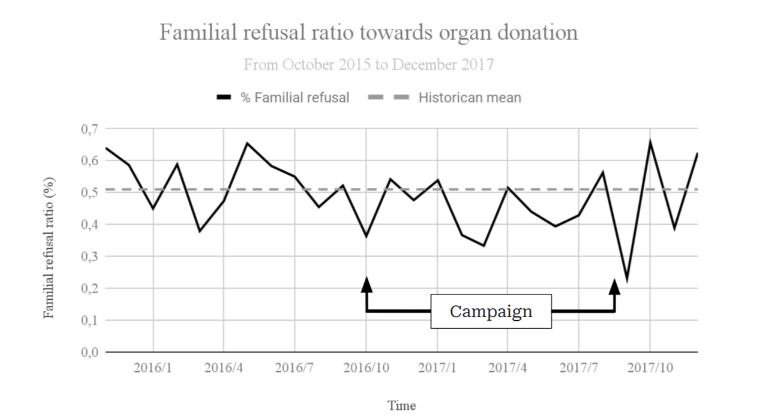
shows monthly figures of familial refusal ratio for the studied period, highlighting the duration of the campaign. We observe a large variation between observations and apparent lower observations during the campaign.
When comparing familial refusal rates between 2016 and 2017, we found no statistically significant differences between years (52% vs 45%; p=0,16), semesters (52% vs 48% vs 41% and 48%; p=0,28), nor quarters (48% vs 59% vs 44% vs 52% vs 40% vs 42% vs 47% vs 50%; p=0,54). When doing so between the 12-month period before and after the campaign, we found no significant differences either (years p=0,17, semesters p=0,62, quarters p=0,39).
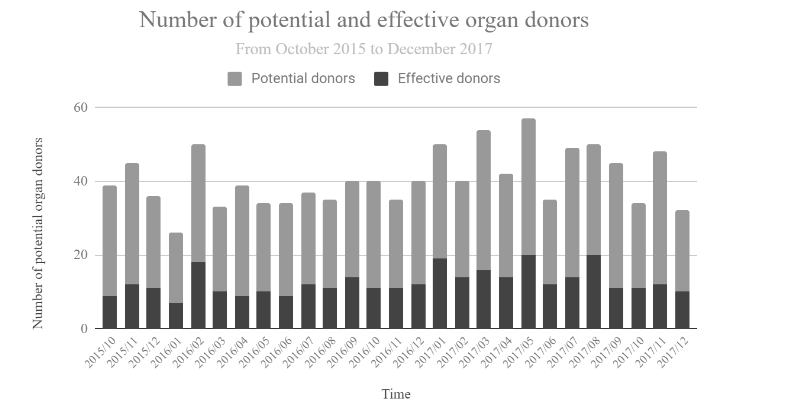
Nevertheless, when we compared number of organ donors for both type of periods, we did find significant differences between 2016 and 2017 for the year-long period (10.67 vs 14.67 in mean) and for the semester-long periods (10.67 vs 10.67 vs 14.33 vs 15.0; p=0,048;), as well as for the year-long period before and after the campaign (p<0,01; p=0,01). But we found no differences between the semester-long periods before and after the campaign (p=0,09), nor in quarter-long periods for both comparisons (10.0 vs 11.33 vs 9.33 vs 12.0 vs 12.0 vs 16.67 vs 15.33 vs 14.67; p=0,16; p=0,15).
In terms of potential organ donors, shown as gray columns in
DISCUSSION
There are plenty of very good examples on the effectiveness of advertisement and marketing campaigns in communications, sociology, and economic spheres. The success of these examples has become a strong incentive to replicate their formula to incentivize organ donation, and thus improve organ donation rates, particularly in countries with lower rates, as the Chilean case.
Indeed, the analyzed campaign was very successful, winning two journalism awards as the “best advertising campaign of the year”, and was recognised for its quality by advertising and marketing peers. The campaign focused on sensitizing the public towards organ donation through the promotion of conversation between family members about their willingness to become an organ donor. But the conversion of willingness to donate to actual donation is not direct, and our results show that. If we consider that the aim of the campaign was to increase organ donation by lowering familial refusal to donation (as it promoted families to know each other’s will), our findings show that the campaign did not reach its objectives. Our results show that the campaign was unable to modify the overall numbers of familial refusal, so the observed change in organ donation rate may be explained by other factors. This fact was not noticed by the TV station, which even considered repeating the campaign during 2018 “due to its success”.
Nonetheless, the real numbers “worsened” that year.
When we observe changes in organ donation rates, they must come from two big sources. Whether a change in familial refusal, or a change in the number of potential donors that reach the stage of the procurement process of organ donation communication with the family. An interesting finding of this study is that both the number of potential and actual donors increased during the campaign (for both types of periods studied). Suggesting that an increase in potential donors, and not a decrease in familial refusal, explains the raise in organ donation. Which may come from either a boost in identification and referral of potential organ donors, an improvement in their management and maintenance, or both. Or in other words, the procurement process may have been more effective during the time when the mass media campaign was on air. A hypothesis to this phenomenon could be that the campaign effectively and specifically sensitized healthcare workers and hospital staff, making them more aware of how they contribute to the procurement process. But to be fair, there are other possible explanations, such as the effect of a new policy implemented that same year, that established an indicator of potential organ donor referral on the Balance Scorecard of all hospitals.
People and experts believe that the press has a major role in encouraging organ donation and maintaining public confidence in the procurement system. But every mass media campaign, especially niche campaigns such as one to promote organ donation, must compete with retail, sports, and several other products for the attention of “consumers” or the campaign’s target audience. In that sense, the efficacy of mass media campaigns is correlated to their costs, the higher the cost, the larger the chance it will reach its target population. The cost of a nationally covered campaign is very high, meaning that the incremental cost of obtaining a single additional donor is also high, questioning the affordability of the method. For example, the cost of this campaign was estimated by its executive producer to have been US$10-20 million. If we are optimistic and consider that every extra donor during the period of the campaign was a consequence of it, the marginal cost of every incremental organ donor had an approximated cost of US$400,000-500,000, equivalent to the annual budget of the National Procurement and Transplant Coordination in those years. To provide another contrast, in Chile the cost of any incremental donor due to traditional efforts is calculated to be US$140,000 the first year (logarithmically decreasing the following years).
The high costs of the mass media campaign are not expected to decrease. Moreover, marketing experience shows that in general, advertising prices increase while consumers’ attention diverges, making it harder to reach the target population through traditional means.
CONCLUSION
In conclusion, even though mass media campaigns aimed at increasing organ donation can be attractive in the short term, they are unaffordable and ineffective in the long run. In order to increase organ donation rates, it is imperative to search for innovative strategies that target the other part of the equation: potential donors. Since trying to reduce familial refusal rate is not an effective nor affordable alternative, and that the only possible effect of the campaign was sensitizing healthcare workers, we consider that targeting those healthcare workers is the real clue to success. There are several ways to do so, like providing incentives or education. But an attractive strategy to explore could be using high standard tools like those derived from information technologies, because they have the potential of educating and incentivizing healthcare workers in organ donation, at the same time they make the procurement process more efficient.
Conflicts of interest statement
All authors declare that there is no conflict of interest regarding the publication of this manuscript.
Funding statement
This research did not receive any specific grant from funding agencies in the public, commercial, or not-for-profit sectors.
Acknowledgments
We acknowledge Daniel Andres Gonzalez for revising English spelling and translating some sections of the manuscript from Spanish to English.
Author Contributions
Francisca González Cohens: Analyzed data and interpreted results. Designed the study and reviewed and approved manuscript.
Felipe Vera Cid: Interpreted results. Designed the study and reviewed and approved manuscript.
Fernando González Fuenzalida: Interpreted results and wrote manuscript. Designed the study and reviewed and approved manuscript.
REFERENCES
- Rana A, Gruessner A, Agopian VG, et al. Survival benefit of solid-organ transplant in the United States. JAMA Surg. 2015;150(3):252-259. doi:10.1001/jamasurg.2014.2038
- Abouna GM. Organ shortage crisis: problems and possible solutions. Transplant Proc. 2008;40(1):34-38. doi:10.1016/j.transproceed.2007.11.067
- Paik HC, Haam SJ, Lee DY, et al. The Fate of Patients on the Waiting List for Lung Transplantation in Korea. Transplant Proc. 2012;44(4):865-869. doi:10.1016/j.transproceed.2011.12.059
- Breyer F, Kliemt H. The Shortage of Human Organs: Causes, Consequences and Remedies. Anal Krit. 2007;29(2):188-205. doi:10.1515/auk-2007-0205
- Lewis A, Koukoura A, Tsianos GI, Gargavanis AA, Nielsen AA, Vassiliadis E. Organ donation in the US and Europe: The supply vs demand imbalance. Transplant Rev. 2021;35(2):100585. doi:10.1016/j.trre.2020.100585
- Groth T, Stegmayr BG, Ash SR, et al. Wearable and implantable artificial kidney devices for end-stage kidney disease treatment: Current status and review. Artif Organs. 2023;47(4):649-666. doi:10.1111/aor.14396
- Ekser B, Ezzelarab M, Hara H, et al. Clinical xenotransplantation: the next medical revolution? Lancet Lond Engl. 2012;379(9816):672-683. doi:10.1016/S0140-6736(11)61091-X
- Gonzalez FM, Gonzalez F del R. Is the near coming xenotransplantation era relieving us from needing to look for more non-living organ donors? World J Transplant. 2022;12(12):388-393. doi:10.5500/wjt.v12.i12.388
- González Cohens F, Vera Cid F, Alcayaga Droguett R, González Fuenzalida F. Análisis crítico de la baja tasa de donación de órganos en Chile. Rev Med Chile. 2020;148(2):267-276. doi:10.4067/s0034-98872020000200242
- Feeley TH, Moon SI. Promoting organ donation through public education campaigns: a random-effects meta analysis. Wash DC Div Transplant Health Resour Serv Adm Health Hum Serv Retrieved Httpswww Organdonor Govsitesdefaultfilesabout-Dotfilesmetaanalysisfinalmanuscript Pdf. Published online 2011.
- Frates J, Bohrer GG, Thomas D. Promoting organ donation to Hispanics: the role of the media and medicine. J Health Commun. 2006;11(7):683-698. doi:10.1080/10810730600934542
- Alvaro EM, Siegel JT, Crano WD, Dominick A. A Mass Mediated Intervention on Hispanic Live Kidney Donation. J Health Commun. 2010;15(4):374-387. doi:10.1080/10810731003753133
- Salim A, Berry C, Ley EJ, Schulman D, Navarro S, Chan LS. Utilizing the media to help increase organ donation in the Hispanic American population. Clin Transplant. 2011;25(6):E622-628. doi:10.1111/j.1399-0012.2011.01505.x
- Salim A, Malinoski D, Schulman D, Desai C, Navarro S, Ley EJ. The Combination of an Online Organ and Tissue Registry With a Public Education Campaign Can Increase the Number of Organs Available for Transplantation. J Trauma. 2010;69(2):451-454. doi:10.1097/TA.0b013e3181e7847a
- Bellini MI, Parisotto C, Dor FJMF, Kessaris N. Social media use among transplant professionals in europe: A cross-sectional study from the european society of organ transplantation. Published online 2020. doi:10.6002/ect.2019.0078
- A A, A U, C Ş. Mass media, online social network, and organ donation: old mistakes and new perspectives. Transplant Proc. 2015;47(4). doi:10.1016/j.transproceed.2014.09.182
- Jiang X, Jiang W, Cai J, et al. Characterizing Media Content and Effects of Organ Donation on a Social Media Platform: Content Analysis. J Med Internet Res. 2019;21(3):e13058. doi:10.2196/13058
- González Fuenzalida F, González Cohens F. El sinsabor que deja el mejor año en la donación de órganos para trasplante en Chile. Rev Med Chile. 2018;146(5):547-554. doi:10.4067/s0034-98872018000500547
- Consejo Nacional de Televisión. Informe Estadístico Oferta y Consumo De TV Abierta1er Semestre 2017. Consejo Nacional de Televisión; 2017:67. Accessed July 3, 2020. https://www.cntv.cl/cntv/site/artic/20180104/asocfile/20180104124404/oferta_y_consumo_semes tre_1_2017.pdf
- Meganoticias. “Cumple Mi Deseo” supera los 200 mil inscritos que han manifestado su voluntad de ser donantes de órganos. meganoticias.cl. October 25, 2017. Accessed July 15, 2020. https://www.meganoticias.cl/tendencias/208457-cumple-mi-deseo-supera-los-200-mil-inscritos-que-han-manifestado-su-voluntad-de-ser-donantes-de-organos.html
- Ministerio de Salud. Yo Dono Vida – Estadísticas. Ministerio de Salud – Estadísticas. Accessed March 26, 2019. https://yodonovida.minsal.cl/estadisticas/estadisticas.html
- Meganoticias. Número de donantes y trasplantes de órganos aumentó durante 2017. meganoticias.cl. January 4, 2018. Accessed July 15, 2020. https://www.meganoticias.cl/nacional/213354-numero-de-donantes-y-trasplantes-de-organos-aumento-durante-2017.html
- Autoridades de Salud destacan cifra récord de donación y trasplante de órganos durante 2017. Ministerio de Salud – Gobierno de Chile. Accessed July 15, 2020. https://www.minsal.cl/autoridades-de-salud-destacan-cifra-record-de-donacion-y-trasplante-de-organos-durante-2017/
- Madden S, Lucey MR, Neuberger J. Does publicity affect organ donation? Transpl Int. n/a(n/a). doi:10.1111/tri.13655
- Local & National TV Advertising Costs & How to Advertise 2019. Fit Small Business. May 20, 2019. Accessed July 15, 2020. https://fitsmallbusiness.com/tv-advertising/
- Atal R, Domínguez J, Harrison R, Larraín L. Cost-effectiveness of policies Aimed at Increasing Organ Donation, the Case of Chile. Doc Trab Inst Econ PUC. 2010;(383):1.
- Teixeira TS. The Rising Cost of Consumer Attention: Why You Should Care, and What You Can Do about It. Published online January 17, 2014. Accessed July 15, 2020. https://www.hbs.edu/faculty/Pages/item.aspx?num=46132