


Neuroplasticity and Recovery in M1 Lesioned Monkeys
Behavioral and Connectional Neuroplasticity in M1 Lesion Adult Macaque Monkeys
Anne-Dominique Gindrat Ph.D. 1, Alexander Felix Wyss Ph.D. 1, Cindy Leuthard MSc. 1, Eric M. Rouiller Ph.D. 1, Mélanie Kaeser Ph.D. 1
- Department of Neurosciences, Section of Medicine, Faculty of Sciences and Medicine, Fribourg Center of Cognition, University of Fribourg, Chemin du Musée 5, CH-1700 Fribourg, Switzerland.
OPEN ACCESS
PUBLISHED: 31 October 2025
CITATION: Gindrat, AD., Wyss, AF., et al., 2025. Behavioral and Connectional Neuroplasticity in M1 Lesion Adult Macaque Monkeys. Medical Research Archives, [online] 13(10). https://doi.org/10.18103/mra.v13i10.7003
COPYRIGHT: © 2025 European Society of Medicine. This is an open-access article distributed under the terms of the Creative Commons Attribution License, which permits unrestricted use, distribution, and reproduction in any medium, provided the original author and source are credited.
DOI: https://doi.org/10.18103/mra.v13i10.7003
ISSN 2375-1924
ABSTRACT
Previous studies have shown that permanent lesions of the hand area of primary motor cortex (M1) in adult macaque monkeys induced a temporary loss of manual dexterity, followed by incomplete, spontaneous functional recovery. Notably, a treatment with anti-Nogo-A antibody or autologous cellular therapy both enhanced the recovery compared to untreated monkeys. An indicator of this improvement in functional recovery is the increased number of small food pellets retrieved from vertical and horizontal slots in a reach-and-grasp task (“modified Brinkman Board” task) which requires the opposition of the thumb and index finger (precision grip) under visual guidance. The horizontal slots proved more challenging than the vertical ones and offered a better discrimination between treated and untreated monkeys. We hypothesized that further increasing the difficulty of the behavioral readout would better discriminate between the 2 subgroups. Therefore, we developed a novel manual dexterity task performed without visual guidance (“Brinkman Box task without vision”). In this task, the tested hand was inserted into a “blind” box to grasp pellets from hidden slots, relying on motor exploration based on palpation, and executing precision grip without visual guidance. This more challenging blind task required intensive and long training, and additional positive reinforcement. Nevertheless, a successful and stable performance level was achieved in 10 pilot adult macaques which were subsequently subjected to a unilateral permanent lesion of M1. Of these, four monkeys were left untreated (“control”), whereas 4 received the anti-Nogo-A antibody treatment and 2 were treated with cellular therapy. Immediately post-lesion, the ability to retrieving pellets with the contralesional hand dropped to zero in all monkeys, followed after a few weeks by partial functional recovery, ultimately reaching a plateau of restored manual dexterity. The “treated” monkeys outperformed the control group, corroborating previous behavioral findings from visually guided tests. The greatest discrimination between the 2 subgroups was obtained by combining the results derived from both visually guided and blind tasks. Potential mechanisms underlying functional recovery are discussed in the context of functional and connectional neuroplasticity with emphasis on the involvement of the adjacent intact premotor cortex, in particular with adaptation of its efferent and afferent projections.
Keywords
motor cortex lesion; blind tactile exploration; anti-Nogo-A antibody treatment; autologous cellular therapy; functional recovery; manual dexterity; non-human primate
INTRODUCTION
Primates (humans and monkeys) have a distinctive motor ability to precisely and independently control finger movements. This skill underlies their remarkable manual dexterity, as demonstrated by tasks such as manipulating small objects or playing instruments like the piano or violin. The precise motor control of fingers originates mostly from the multiple “motor” cortical areas, located in the frontal and parietal lobes 1-13. These multiple motor cortical areas send corticospinal projections to the cervical and upper thoracic segments of the spinal cord, where motoneurons controlling hand muscles are located 2,14-21. The direct, monosynaptic connection between the corticospinal neurons in motor cortical areas and the cervical/thoracic motoneurons – the corticomotoneuronal (CM) projection system 5,6,8,9,17,22-24; but see 25,26 – is of special importance for manual dexterity. Studies involving reversible inactivation in macaques have shown that different motor cortical areas play distinct roles in contributing to manual dexterity 27-34: inactivation of the primary motor cortex (M1 or F1), the anterior intraparietal area (AIP) and the rostral part of the ventral premotor cortex (PMv-r or F5) had dramatic effect on manual dexterity, whereas less impact was observed after inactivation of the dorsal premotor cortex (PMd-c or F2) or the supplementary motor area (SMA-proper or F3). Moreover, the influence of M1 onto spinal motoneurons is stronger than that from PM or SMA 35-38. The M1 region in macaques, subdivided into an “old” M1 and a “new” M1 6, plays a crucial role in controlling manual dexterity. The CM projection system originating from M1 is located mostly in the “new” M1, in the rostral bank of the central sulcus 6.
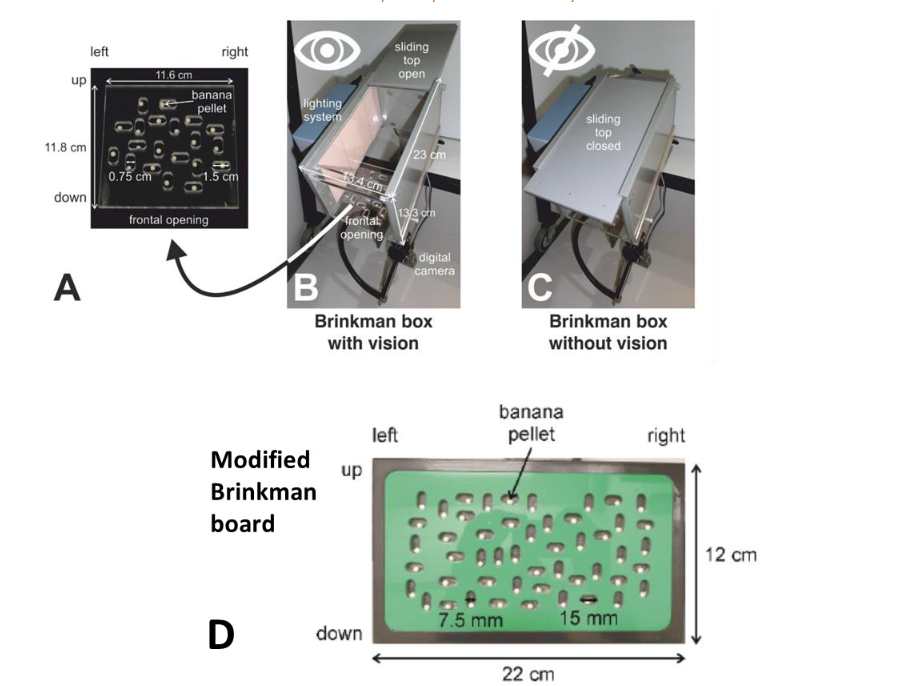
The proximity of macaques with humans regarding manual dexterity makes them suitable animal models to experimentally investigate fundamental properties of motor hand control, but also pathological movement issues, such as the impact of motor cortical lesion on motor performance, the plastic mechanisms underlying often incomplete spontaneous functional recovery of motor control, or the putative potential of various therapies aimed at enhancing the spontaneous recovery. To these aims, several behavioral tests were developed over many decades to quantitatively assess the manual dexterity performance of macaques. A commonly used test is the Klüver board task 39, with its different versions proposed later by several authors 22,40-47. Another commonly used manual test was initially developed by Brinkman and Kyupers 48,49, known as the Brinkman board task, and refined later by Brinkman 50. Other manual dexterity tasks were proposed 51-54. In our laboratory, we developed it toward a visually guided reach and grasp task, the “modified Brinkman Board” task (Fig. 1D) 28-30,33,55-75. The modified Brinkman Board task includes two levels of prehension difficulties, represented by the precision grip synergies (full opposition of thumb and index finger associated with fingers flexion 76-79) needed to successfully retrieve pellets from either vertical slots or horizontal slots (Fig. 1D). Retrieving pellets from the horizontal slots is more challenging than from the vertical ones, as the former required, in addition, a radial or an ulnar deviation of the wrist 64. Following a permanent lesion of M1 or of the cervical cord, or in case of Parkinson’s disease (PD) symptoms, the horizontal slots’ manual dexterity recovery curve was more discriminative than the vertical slots’ one for assessing the potential benefit of a treatment, either by neutralizing a nerve growth inhibiting factor (anti-Nogo-A 59,60,68) or by applying an autologous cellular therapy (ANCE 62,74,75,80).
The present study aimed to develop a more challenging manual dexterity task able to better distinguish between a “control” group and a “treated” group when evaluating a therapeutic strategy. It was important to balance this by ensuring the task difficulty did not become counterproductive, potentially leading to a loss of motivation of the animals. We propose here an enhanced version of the “modified Brinkman Board” task, called the “Brinkman Box without vision” task (Fig. 1A-C), with two additional levels of difficulty compared to the “modified Brinkman Board” task: Firstly, the space for the monkey’s hand to perform the precision grip for grasping is restricted, limiting the motor degrees of freedom. Secondly, and more importantly, the monkey has to perform the manual dexterity task without visual guidance, a condition applied to macaques only in a very few previous studies 10,81-83. Our monkeys were trained to insert either their left or right hand into a box (Fig. 1C) to detect slots containing food pellets. In each daily behavioral session, the “Brinkman Box without vision” task was executed separately with each individual hand in two consecutive distinct series of trials see 58. Instead of visual guidance, the monkeys relied on palpation and haptic exploration to grasp and retrieve the pellets. Haptic exploration, which involves touch and proprioception, requires highly sophisticated sensorimotor neural processing when combined with precise motor control see 84 for review. We hypothesized that the “Brinkman Box without vision” task, despite its increased difficulty, would more effectively distinguish individual performance than a precision grip task performed with visual guidance.
MATERIAL AND METHODS
SUBJECTS
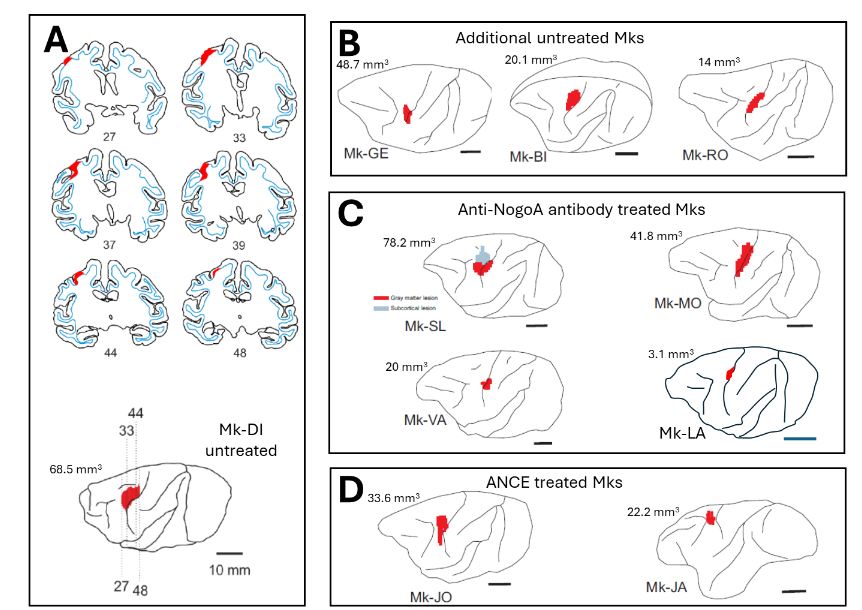
The present study involved a cohort of ten adult macaque monkeys (Macaca fascicularis, Table 1) with a unilateral permanent lesion of the hand area in M1 opposite the dominant hand (Fig. 2). Dominance was determined pre-lesion using the best score based on the “modified Brinkman Board” task 66. Among them, four monkeys did not receive any treatment, serving as control subjects to assess the spontaneous recovery of manual dexterity. Six monkeys were subjected to a specific treatment aimed at enhancing functional recovery: Four monkeys were treated with an anti-Nogo-A antibody immediately post-lesion for one month 68, while two monkeys received an autologous cellular therapy starting a few weeks after the lesion 62. Details on monkeys’ sex, age, weight, lesion procedure, lesion volumes, as well as previously published post-lesion recovery performance assessed with the “modified Brinkman Board” task (i.e. with visual guidance, Fig. 1D) are available in Table 1. Unilateral lesions were performed by intracortical infusion of ibotenic acid 56,61,62,68,69 (Table 1 provides the numbers of infusion sites and the volumes of ibotenic acid injected in each monkey) and were mostly restricted to the hand representation of M1. The experimental conditions were designed in accordance with ethical and legal guidelines, as previously reported in detail earlier 61-64,68,69. Animals were housed in small groups of 2-5 monkeys in 45 m3 rooms within the animal facility (www.unifr.ch/spccr/about/housing). The monkeys had free access to water at all times in the animal facility and were not food restricted. The food rewards (banana pellets, about 4 mm diameter, Bio-Serv, US and Canada, www.bio-serv.com) received during the daily behavioral session (about 45-60 minutes duration) represented the first access to food on that day, completed later during the day by additional cereals, fruits, and vegetables. Monkeys’ weight was checked every day and remained stable throughout the study (typically 2-3 years). The experimental protocol was approved by the official cantonal (FR) and federal (Swiss) veterinary authorities, covered by the authorization numbers FR 24/95/1; FR 44/92/3; FR 157/01, FR 157/03, FR 157/04, FR 156/04, FR 156/06, FR 157e/06; FR 166-03; FR 166-05; FR 166e-05; FR 185-08; FR 17-09; FR 18-10.
BEHAVIORAL TASKS
After the monkeys acclimated to a primate chair over several weeks, they underwent extensive training on two tests for several months (typically 6-12 months), namely the “modified Brinkman Board” task (Fig. 1D) and the “Brinkman Box” task (with and without visual guidance in the latter case: Fig. 1B and 1C, respectively) 58. Three monkeys (Mk-DI, Mk-JA, and Mk-JO) were also trained in two additional tasks not reported here (reach and grasp drawer task; rotating Brinkman Board task). The characteristics of the learning phase of most of the ten monkeys for the “modified Brinkman Board” task pre-lesion have been previously reported 58,64. The M1 lesions were then performed when the behavioral performance was stable over several weeks.
The “modified Brinkman Board” task (Fig. 1D) and the “Brinkman Box” task with visual guidance (Fig. 1B) represented a fairly straightforward task. In contrast, the “Brinkman Box without vision” task (Fig. 1C; Video 1) was much more challenging for the monkeys and impacted their motivation. As a consequence, it was necessary to reinforce motivation in two ways: (i) the monkeys performed the “Brinkman Box” task daily first with vision, and then without; (ii) In the “Brinkman Box without vision” task, additional food pellets were episodically given in parallel by the experimenter (see Video 1). For both the “modified Brinkman Board” and “Brinkman Box without vision” tasks, based on videos captures using a digital camera, the behavioral performance was quantified for the hand opposite the M1 lesion during a pre-lesion period and a long post-lesion period. This evaluation aimed to assess spontaneous and/or treatment-enhanced functional recovery, reaching a single plateau (Fig. 3; Table 1) or 2 plateaus (Table 1; see e.g. 62,68,75). The behavioral protocol was pursued during a few weeks after the single or both plateaus of recovery were reached.
At the end of the overall experimental protocol, as previously reported in detail e.g. 68,69,71, the monkeys were euthanized under deep anesthesia to proceed with histology of the brain and spinal cord. The methods to delineate the lesion position and extent on histological sections stained for the neurofilament SMI-32 were described in earlier publications, as well as the procedure for estimating the lesion volume 61,68,69,71. Similarly, comprehensive descriptions of the methods concerning the two treatments — anti-Nogo-A antibody and ANCE — have been extensively documented in prior studies 59,60,62,68,74,75,80,85-87.
RESULTS
1. MONKEYS’ GROUPS, PROPERTIES AND HISTORICAL CONTEXT
The location and the extent of the M1 lesion “projected on the hemisphere’s surface” for each monkey are presented in Figure 2. Precise data regarding the M1 lesions are also provided in Table 1, including volumes of ibotenic acid injected, volumes of the lesion in the gray matter (M1/S1) and subcortically in the white matter. Note that Mk-LA, the first one lesioned in the series of these 10 animals, exhibits a tiny lesion extent (3.1 mm3), far smaller than the other monkeys, consistent with the low number of ICMS sites where ibotenic acid was infused (Table 1).
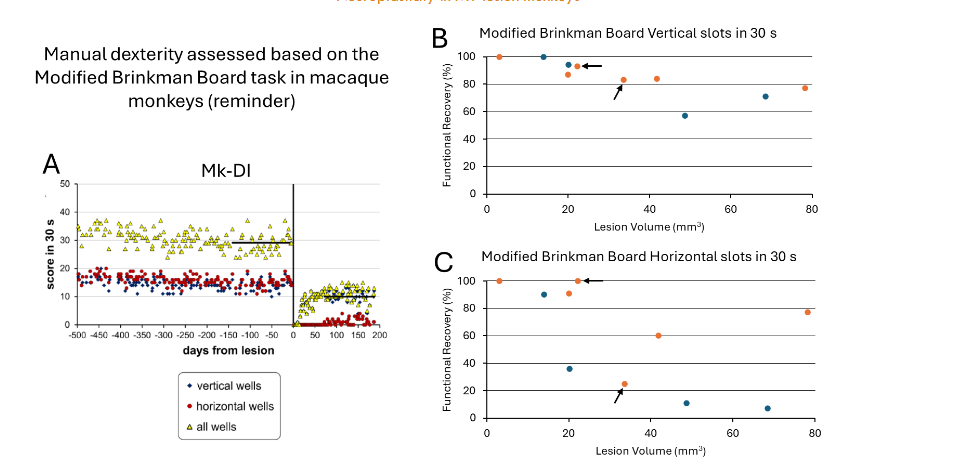
In the last 2-3 decades, the manual dexterity investigations in our laboratory were mostly based on our standard “modified Brinkman Board” task (see Introduction and Fig. 1D). A typical illustration is provided here for Mk-DI (not published earlier), showing the dramatic impact of a unilateral M1 lesion on the opposite hand’s manual dexterity, followed by a progressive, spontaneous functional recovery (Fig. 3A). The score (ordinate) corresponds to the number of pellets successfully retrieved with the contralesional hand during the first 30 seconds of the daily test. The observed functional recovery was mostly due to retrieval of the pellets from the vertical slots, whereas the recovered capacity to grasp pellets from horizontal slots was minimal post-lesion (see also Table 1). In Figure 3A, “all wells” represent a total score, cumulating the vertical and horizontal slots. The percentages of functional recovery derived from the “modified Brinkman Board” task are listed in Table 1 and represented graphically in Figures 3B and 3C, separately for the 2 slots’ orientations and for all 10 monkeys (control monkeys in blue and treated monkeys in brown). The functional recovery observed in the vertical slots was not so much different between the control and the treated monkeys (Fig. 3B). In contrast, a larger difference between the two subgroups emerged when recovery in the horizontal slots was assessed (Fig. 3C).
2. “BRINKMAN BOX WITHOUT VISUAL GUIDANCE”: QUANTITATIVE DATA
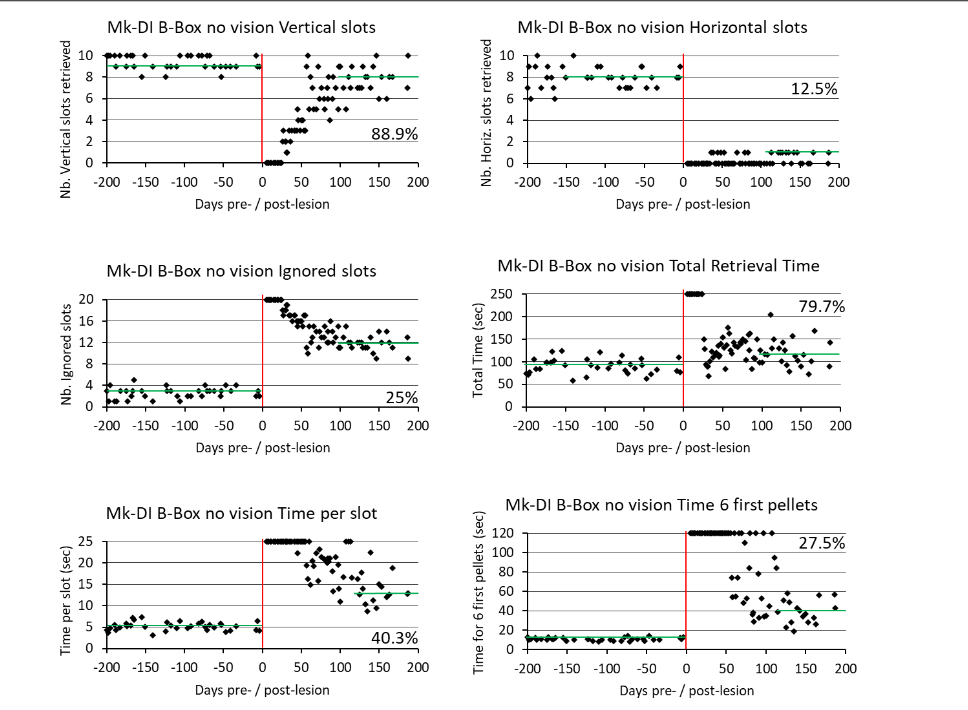
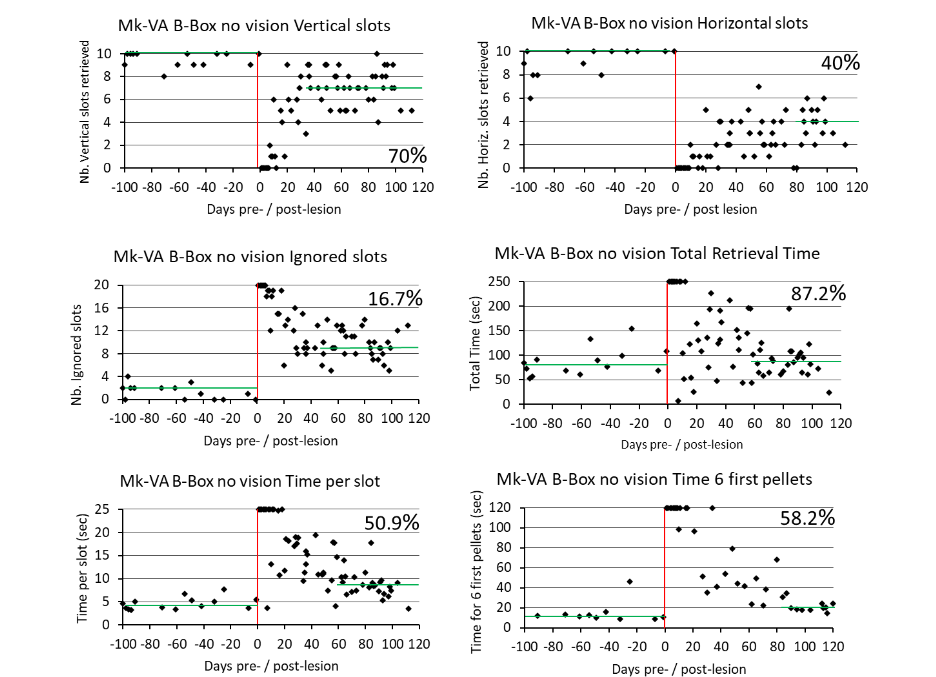
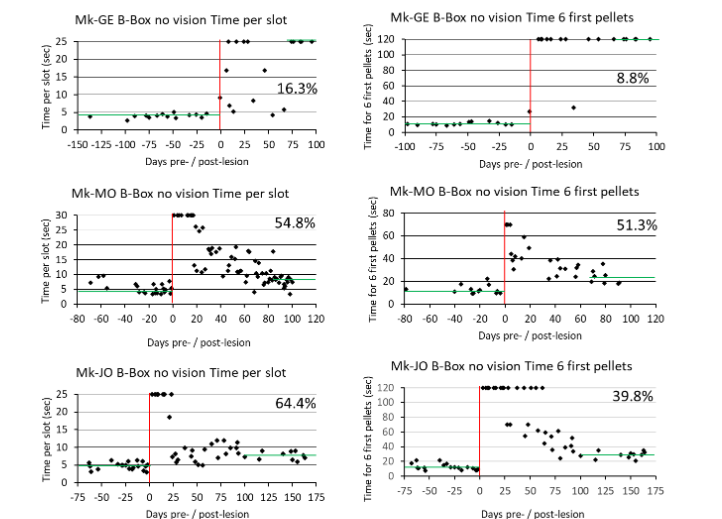
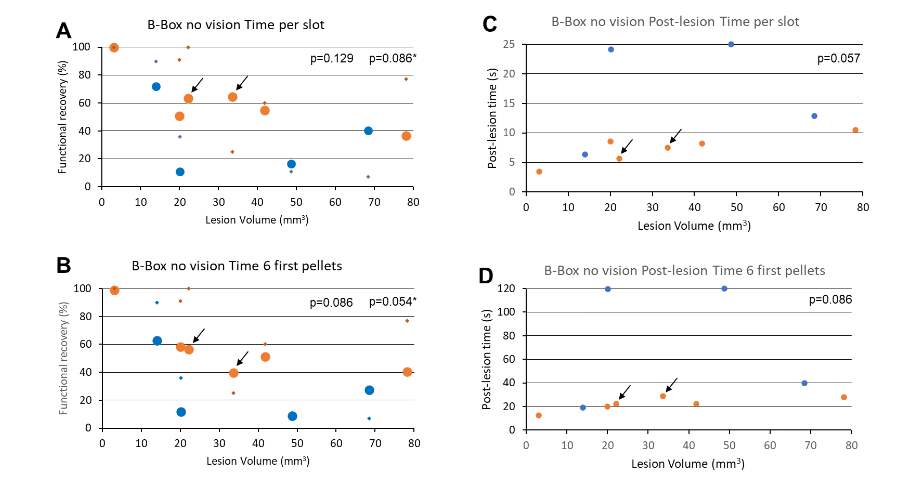
The main goal of this study was to evaluate the potential benefit of using the more challenging “Brinkman Box without vision” task to discriminate between control and treated monkeys (Fig. 1C; Video 1). This task is particularly relevant as it is executed without visual guidance. Typical results from the “Brinkman Box without vision” task are illustrated extensively in Figures 4 and 5 for one control animal (Mk-DI) and one treated animal (Mk-VA), respectively. While the number of slots successively retrieved is informational (top rows of Figs. 4 and 5), this score may be biased because there was no time constraint to perform the task. In other words, different monkeys may have spent different amounts of time windows to complete the task, and some, potentially discouraged by the task difficulty, may have stopped prematurely at various time points sooner than others. In such cases, some slots were ignored (left graph in the middle row of Figs. 4 and 5). Due to the difficulty of the task, there was also variability in performance from one daily session to the next, even within the same monkey (Figs. 4 and 5). A more informative parameter is the total time spent by the monkey on each daily session to complete the task, or until the monkey gives up (right graph in the middle row of Figs. 4 and 5). Another metric is the average “time per slot”, representing the mean time necessary to retrieve a single pellet, irrespective of the slot’s orientation (left bottom graph). An additional metric, similar to the one used in the “modified Brinkman Board” task, consists of quantifying the performance in a limited “time window” (30 seconds). For the “Brinkman Box without vision” task, we measured the time needed to successfully retrieve the first 6 pellets without visual guidance, irrespective of the slot’s orientation (“time for first 6 pellets”). This parameter and the “time per slot” were used for further quantitative analysis. These 2 relevant parameters are illustrated for Mk-DI and Mk-VA in the bottom row of Figures 4 and 5, as well as for 3 additional monkeys in Figure 6 (Mk-GE, Mk-MO, and Mk-JO). Interestingly, the % of functional recovery for the “time per slot” and “time for 6 first pellets” falls more or less midway in the very large range observed for the other 4 parameters (number of pellets retrieved from vertical slots, number of pellets retrieved from horizontal slots, number of slots ignored, total retrieval time). This suggests that the “time per slot” and “time for first 6 pellets” are indeed more representative of the overall actual performance of each monkey (see scores for each animal in Table 1). The functional recovery using these two metrics ranged from 8.8% to 100% post-lesion (Figs. 4, 5, 6; Table 1). Overall, the two control monkeys with substantial M1 lesions (Mk-DI and Mk-GE) exhibited limited functional recovery in the two relevant parameters (Figs. 4 and 6; Table 1). Mk-GE showed a lower recovery than Mk-DI, but Mk-DI was especially impaired for retrieving pellets from horizontal slots (Fig. 4). In contrast, the two treated monkeys with large M1 lesion (Mk-SL and Mk-MO) showed both a better functional recovery for the “time for first 6 pellets” (Fig. 6 and Table 1), and Mk-MO also a better recovery for the median “time per slot”. Contrary to the control monkeys, Mk-SL had a large subcortical lesion in the white matter, in addition to the M1 lesion in the gray matter (Table 1).
DATA ANALYSIS
The analysis of the motor behavior was based on video sequences (25 frames / sec) which captured the daily sessions of the monkeys performing the “Brinkman Box” task without visual guidance (see video 1). Six parameters were derived and computed, as illustrated in Figures 4 and 5. For each parameter, a median pre-lesion value was defined, as well as a post-lesion median value determined once a plateau in functional recovery was reached. By comparing these 2 median values (pre- and post-lesion), the percentage of functional recovery was calculated. For example, in the case of a score metric such as the number of pellets retrieved, where the pre-lesion value exceeded the post-lesion value, the post-lesion median value was divided by the pre-lesion median value and then multiplied by 100. Conversely, when the post-lesion value was higher (e.g., an increased time interval indicating a loss of dexterity after the lesion), the pre-lesion median value was divided by the post-lesion median value and then multiplied by 100. The resulting functional recovery percentages, ranging from 0% (indicating a total loss of manual dexterity) to 100% (indicating full recovery), are detailed in Table 1. A similar percentage of functional recovery was established for the “modified Brinkman Board” task based on pre-lesion and post lesion median values (Fig. 3A).
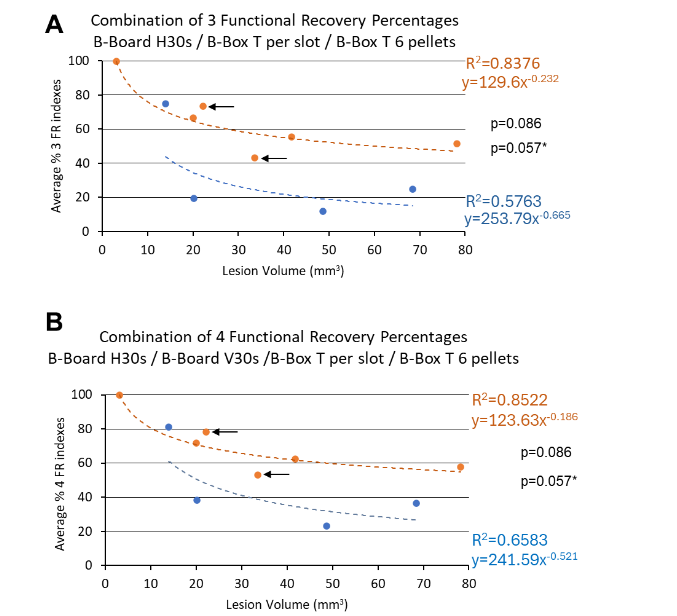
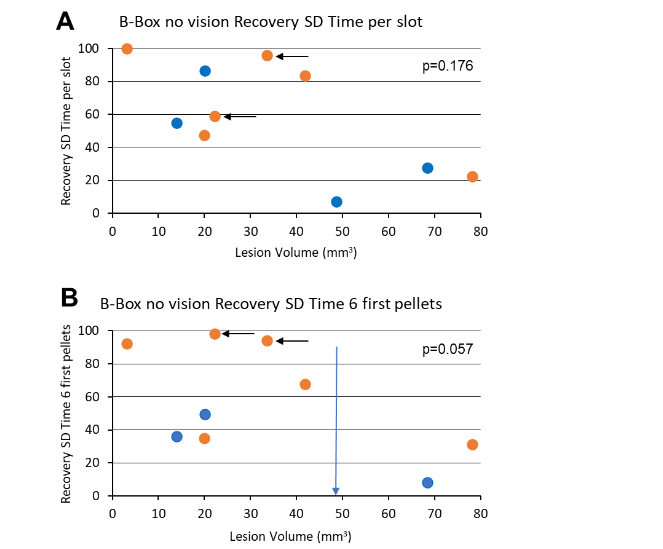
In spite of limited number of monkeys included in the present study, due to the difficulty to train the animals for such a challenging task (“Brinkman Box without vision”), statistical comparisons were tentatively conducted to compare the 2 subpopulations of monkeys, the 4 untreated monkeys versus the 6 treated monkeys (see Table 1). The approach was a non-parametric unpaired Mann and Whitney test (using the on-line calculator “www.Statistics Kingdom.com”), applied to the data displayed in the form of graphs in Figures 7, 8 and 9. For each graph, a standard univariate Mann and Whitney test was applied on the behavioral values. In addition, in graphs exhibiting an inverse correlation between the behavioral metrics in ordinate and the M1 lesion volume in abscissa, a graphical bivariate Mann and Whitney test was applied as well, as previously reported 60.
RESULTS
1. MONKEYS’ GROUPS, PROPERTIES AND HISTORICAL CONTEXT
The location and the extent of the M1 lesion “projected on the hemisphere’s surface” for each monkey are presented in Figure 2. Precise data regarding the M1 lesions are also provided in Table 1, including volumes of ibotenic acid injected, volumes of the lesion in the gray matter (M1/S1) and subcortically in the white matter. Note that Mk-LA, the first one lesioned in the series of these 10 animals, exhibits a tiny lesion extent (3.1 mm3), far smaller than the other monkeys, consistent with the low number of ICMS sites where ibotenic acid was infused (Table 1).
In the last 2-3 decades, the manual dexterity investigations in our laboratory were mostly based on our standard “modified Brinkman Board” task (see Introduction and Fig. 1D). A typical illustration is provided here for Mk-DI (not published earlier), showing the dramatic impact of a unilateral M1 lesion on the opposite hand’s manual dexterity, followed by a progressive, spontaneous functional recovery (Fig. 3A). The score (ordinate) corresponds to the number of pellets successfully retrieved with the contralesional hand during the first 30 seconds of the daily test. The observed functional recovery was mostly due to retrieval of the pellets from the vertical slots, whereas the recovered capacity to grasp pellets from horizontal slots was minimal post-lesion (see also Table 1). In Figure 3A, “all wells” represent a total score, cumulating the vertical and horizontal slots. The percentages of functional recovery derived from the “modified Brinkman Board” task are listed in Table 1 and represented graphically in Figures 3B and 3C, separately for the 2 slots’ orientations and for all 10 monkeys (control monkeys in blue and treated monkeys in brown). The functional recovery observed in the vertical slots was not so much different between the control and the treated monkeys (Fig. 3B). In contrast, a larger difference between the two subgroups emerged when recovery in the horizontal slots was assessed (Fig. 3C).
3. “BRINKMAN BOX WITHOUT VISUAL GUIDANCE” TASK: SEMI-QUANTITATIVE SOMATOSENSORY DATA
Besides the strong motor deficits resulting from the M1 lesion observed in the “Brinkman Box without vision” task (Figs. 4-8), some subtle post-lesion somatosensory-related deficits of the contralesional hand were observed. Several monkeys performed a precision grip motor sequence but failed to grasp the pellet. They withdrew then their hand from the slot and from the hidden box, brought it to or near the mouth, and supinated their hand to visually inspect the empty palm. Only at that time they realized that they actually did not retrieve any pellet. This erroneous behavior – referred to as somatosensory-related error – was frequently observed in Mk-VA in the first 50 days after the lesion (1-19 events per daily session), followed by 1-4 events in the daily sessions at days 50-120 post-lesion; later (120-200 days post-lesion), such events became rare. Somatosensory-related errors were also fairly frequent in Mk-GE, with an occurrence of 1-10 events per daily session until post-lesion day 120. Such events were more rarely observed in Mk-JA and Mk-JO (7 and 3 events during the whole post-lesion phase, respectively). Mk-DI, in spite of a fairly large M1 lesion, also showed this misbehavior very infrequently, and it was not specifically restricted to the contralesional hand. These somatosensory-related errors seem to be linked neither to the volume of the lesion nor to a lesion spread into the postcentral gyrus in addition to M1 (Table 1).
4. SURVEY OF CONNECTIONAL ADAPTATIONS OF PM IN RESPONSE TO THE M1 LESION
Previous reports from our laboratory provided evidence that, following a unilateral lesion of M1, a significant part of the functional recovery of manual dexterity was dependent, among other mechanisms, on a vicarious role taken by the ipsilesional premotor cortex (PM), as demonstrated by reversible inactivation experiments 56,67. This observation prompted the injection of the tract tracer BDA (biotinylated dextran amine) in PM in several monkeys of our laboratory collection, either intact or subjected to M1 lesion, including among others a few monkeys of the present study. The raw BDA tracing data after injection in PM were reported earlier 88-95. These data are not presented here again, and only a survey of the adaptations of connectivity involving PM after M1 lesion is summarized here, as a complement of the behavioral data reported above.
The precise location and extent of the BDA injection sites were illustrated previously 89,90-92,96,97. Based on unilateral BDA injections in PM in 3 groups of monkeys, it was possible to compare the density of input/output projections reaching or leaving PM, between intact monkeys, untreated (control) M1 lesioned monkeys and M1-lesioned monkeys subjected to anti-Nogo-A antibody treatment. In the 2 groups with unilateral M1 lesion, BDA was injected in the ipsilesional PM.
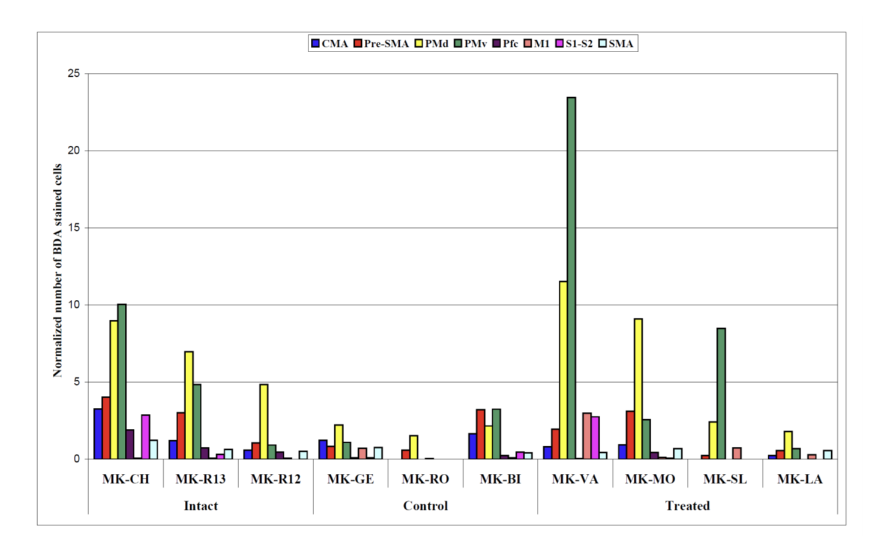
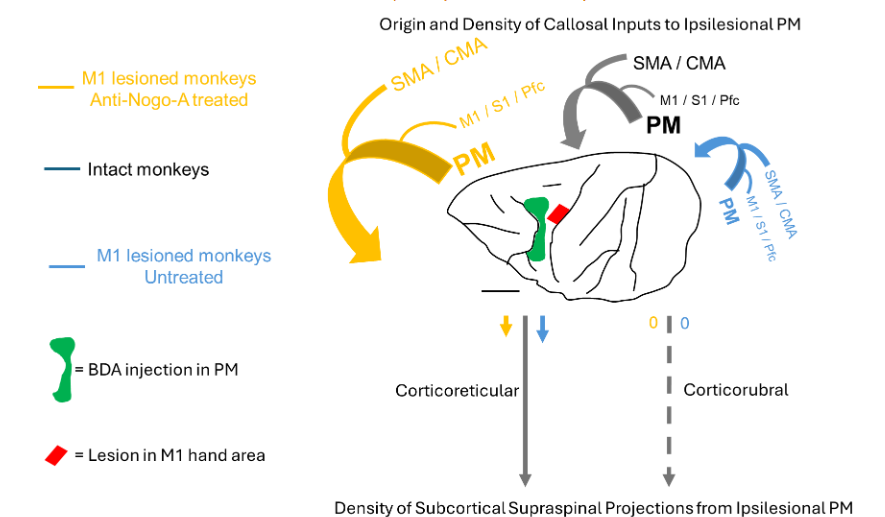
As reported earlier 89, the distribution of retrogradely labelled neurons in the opposite (intact) hemisphere was established, spread between PM (PMd and PMv), SMA (pre-SMA and SMA proper), cingulate motor areas (CMA), M1, somatosensory cortex (S1 and S2) and prefrontal cortex (Pfc; Fig. 10). These areas represent the origin of the callosal projections to the ipsilesional PM. To minimize possible bias due to different properties of BDA injections, the number of BDA stained cells (ordinate) is normalized in each monkey based on the corresponding volume of the core of the BDA injection site, as previously reported 89. In line with previous reports from our laboratory 88,94, note that the dominant callosal projection to PM originates from its homotypic counterpart in the opposite hemisphere (PM). As compared to three intact monkeys (Mk-CH, Mk-R12 and Mk-R13), the M1 lesion in untreated monkeys (n=3; included in the present behavioral data) induced a slight reduction of the density of callosal inputs to the ipsilesional PM, especially the homotypic contingent from the opposite PM (Fig. 10). In contrast, the density of the callosal inputs to the ipsilesional PM in the M1-lesioned anti-Nogo-A antibody-treated monkeys (n=4, also included in the present behavioral data), showed an increase in comparison to the intact monkeys and even more compared to the untreated M1-lesioned monkeys (Fig. 10). We summarized the re-organization of callosal projections to the ipsilesional PM in the 3 subgroups of monkeys in Figure 11. As reported earlier, the corticoreticular and the corticorubral projections from the ipsilesional PM after M1 lesion were dramatically downregulated by about 90% to 100%, respectively, for both the untreated M1 lesioned monkeys and the anti-Nogo-A antibody-treated M1 lesioned monkeys 92,95,97.
DISCUSSION
Pros and Cons of the “Brinkman Box without vision” task
The originality of the present study was to demonstrate the feasibility of successfully training adult macaques to perform a complex manual dexterity task (precision grip), even without visual guidance (“Brinkman Box without vision” task). A long training period was though required. Furthermore, it was crucial to pair this daily with the same task performed with visual guidance (“Brinkman Box with vision” task: Fig. 1B). The latter task, introduced during the training phase, allowed the monkey to progressively overcome a natural reluctance to insert its hand into the invisible space represented by the “Brinkman Box without vision” (Fig. 1C). The “Brinkman Box with vision” task yielded functional recovery data 89 (for Mk-GE, Mk-BI, Mk-RO, Mk-MO, Mk-VA, Mk-SL) largely comparable to those derived from the “modified Brinkman Board” task (Table 1), as expected for 2 rather comparable motor performances, executed both under visual guidance. As a consequence, the “Brinkman Box with vision” task was not analyzed in depth here, as it was used mainly as an introduction and support to the more relevant “Brinkman Box without vision” task.
Although introducing the latter task into the training program for the 10 monkeys added some complexity and increased the duration of the initial training, it proved to be feasible, even without water and/or food restriction. A challenge in animal pre-clinical studies, particularly those that are long-lasting and involve non-human primates, as well as in clinical trials on human subjects, is the need to develop and refine potentially relevant behavioral or critical parameters in advance, without the assurance that they effectively address the hypothesis of the trial. In our previous pre-clinical studies (see introduction) related to spinal cord injury (SCI) or motor cortex injury (MCI), the “modified Brinkman Board” task was developed without being sure that this task would be informative in discriminating between different amounts of M1 lesion and different treatments. A few pilot monkeys subjected to SCI and MCI 55-57 provided evidence that scores of successful grasping of pellets reflecting manual dexterity had to be established within a restricted time window (e.g., the first 30 or 45 seconds of the daily sessions). It also appeared that, fortunately, the test comprised 2 levels of difficulty, the vertically and the horizontally oriented slots. The latter, more challenging, yielded more significant data when comparing for instance the “impaired” hand versus the “normal” hand 55: their Fig. 2 or a therapy treated group versus a control group (Fig. 3). Pilot trials with a limited number of non-human primates are essential for the choice and refinement of pertinent variables, for instance in behavioral tasks, before launching larger size trials. This study can therefore be regarded as a pilot study, providing support for an inclusion of non-visually guided motor tasks in addition to visually guided ones in pre-clinical trials involving non-human primates. This approach is particularly relevant in the context of SCI, MCI and Parkinson disease. A single monkey can show significant variability in performance depending on the behavioral task undertaken. This is evident when comparing the “modified Brinkman Board“ task versus the “Brinkman Box without vision” task (see Figure 7). As demonstrated in this study, using multiple behavioral tests and parameters can help minimize intraindividual variability, for instance by combining several parameters, as proposed in Figure 8A. In sum, our data support the hypothesis that adding the “Brinkman Box without vision” task can help better discriminate individual manual dexterity performance than relying only on a precision grip task performed with visual guidance, and thus represents a valuable complement to other behavioral tests executed with visual guidance. In addition, the present “Brinkman Box without vision” task may offer the possibility to better discriminate motor dysfunction from sensory deficit, affecting in particular proprioception and touch which are especially involved in this task based on exploration by palpation. As illustrated in the attached video sequence, the monkeys needed extra positive reinforcements to comply with the difficulty of the blind task, in the form of additional reward pellets episodically delivered by the experimenter. A technical improvement can be envisaged via the delivery of drops of diluted fruit juice to the monkey’s mouth, time-locked with successful retrieval of pellets. Nevertheless, the implementation of the blind “Brinkman Box without vision” task represented a major investment during the initial motor training, delaying considerably in these animals the pre-lesion phase of the M1 lesion project. One cannot exclude that a few monkeys may not be successful, in spite of intense training.
Mechanism underlying the “blind” motor task
One may argue that a motor task performed without visual feedback relies more on spatial memory than on true motor exploration by palpation, which would challenge the relevance of the present “Brinkman Box without vision” task to highlight somatosensory impairments to go with motor deficits after an M1 lesion. The present data allow to rule out this possibility. Namely, none of the monkeys that performed here in the “Brinkman Box without vision” task, exhibited a motor strategy or “motor habits” 63 for picking up pellets with either hand. In contrast, it was usually present when visual feedback accompanied the behavioral test, like in the “modified Brinkman Board” task 63,70. This contrasted observation indicates that the animals usually performed the “blind” task primarily based on tactile exploration and not on spatial memory.
When behavioral tasks are performed under full visual control, as it is the case in most studies in non-human primates so far, active touch still plays an important role, meaning that motor and non-visual sensory contributions are intermingled. Nevertheless, there are surprisingly very few reports about behavioral tasks assessing the precision grip both with and without visual control in the same subjects. Our results demonstrate the relevance to combine visually guided tasks (here the “modified Brinkman Board” task) with tasks performed without vision (here the “Brinkman Box task without vision”). Using only a visually-guided task would have made it very difficult to detect some subtle adverse effects of the M1 lesion, such as the “sensorimotor-related errors”.
Somatosensory-related errors resulting from M1 lesion
Post-lesion contralesional deficits in manual dexterity were also characterized by very subtle somatosensory-related impairments (see results), most probably linked to the absence of visual feedback because these misbehaviors were mostly observed in the “Brinkman Box without vision” task. The “somatosensory-related error”, where a monkey visually inspects its empty hand to actually realize that no pellet was collected, seems to be very similar to the sensory errors previously observed by Nudo and collaborators in squirrel monkeys after a lesion affecting specifically the caudal part of M1 100,101. However, it is noteworthy that in the latter case, visual guidance was available. The observed “somatosensory-related errors” shows similarities to a deficit following complete S1 ablation, namely strong tactile deficits, where rhesus monkeys can open a box and reach for the food morsel inside, but then inadvertently closed their hand without grasping the reward and brought the empty hand to their mouth 102-104. Tactile deficits resulting from a lesion of the hand representation of S1 in monkeys can be partially compensated by visual guidance 41.
Interestingly, the “somatosensory-related errors” described here are reminiscent of deficits of integrative sensitivity and astereognosis reported in human patients following a lesion of the parietal cortex 105. This might align with our data, given the strong interconnectivity between the frontal and parietal areas 13,106,107. Moreover, similar deficits in object recognition by touch were reproduced by locally anaesthetizing the fingertips of human subjects who were then asked to perform object manipulation in the absence of visual feedback, such as picking up small objects from a dish 108. The resulting astereognosis demonstrated the critical role of tactile inputs from the fingertips for object manipulation. Our data suggest that tactile perception may be altered after a dominant motor cortical lesion and therefore further confirm the key role of M1 in somatosensory processing during the execution of a motor task 109. M1 should therefore not be considered as a purely motor structure, as M1 processes cutaneous, muscle and joint afferents as well, due to its strong connections with the somatosensory cortex and the direct connections with the periphery through the thalamus 110-112. Consequently, deficits after M1 lesion are a combination of sensory and motor impairments, rather than being exclusively motor-related. The nearly complete absence of “somatosensory- related errors” under visual control suggests that monkeys were usually able to compensate, at least partly, the tactile impairment when visual guidance was involved, in line with previous reports in humans e.g. 113, described as a “visual enhancement of touch” and exemplified in mirror therapy. M1 and S1 closely work together, forming in common an integrated “sensorimotor” cortex, rather than being two completely separated entities 111,114.
Post-lesion deficits: comparison with previous studies
In the absence of previous reports involving monkeys performing a motor “blind” task comparable to the “Brinkman Box without vision” task presented here, we can only indirectly compare our results to those of previously reported visually guided motor tasks. The severe post-lesion deficits of manual dexterity in the contralesional hand described here (Figs. 4-8) are in general accordance with previous reports of lesions of the M1 hand representation in non-human primates performed either in our laboratory 55,56,62,67-69,75, or in others 43-47,51,53,101,115-134. A permanent focal lesion of the hand representation of M1 in monkeys resulted in a strong deficit in manual dexterity of the contralesional hand. This was characterized initially by a complete loss of finger movements, followed by a spontaneous and gradual functional recovery. In most cases, although some relatively independent finger movements were restored, allowing to perform some precision grip, the ability to perform fine fractionated finger movements, as well as the ability to perform wrist deviations, remained permanently altered (to a variable extent) 33,45,55,56,67,68,115,116,118,127,135. Changes in precision grip strategies were observed as well over the post-lesion time 47. Our findings align with previous studies regarding the overall timeline of manual dexterity loss and subsequent functional recovery, as well as the incompleteness of recovery. Irrespective of the motor tasks, many studies reported a large inter-individual variability in the different behavioral metrics, affected at various degrees by the M1 lesion. This is also true for our current task without visual feedback. This large variability results partly from the different extent and precise location of the M1 lesion among monkeys, as well as different degrees to which the lesion extends to somatosensory areas and/or the subcortical white matter (Table 1; see also 124). This variability may also reflect a wide range of restitution and/or substitution strategies underlying the functional recovery (see below).
Mechanisms underlying functional recovery
While the neural mechanisms underlying functional recovery of manual dexterity after a M1 lesion are still not fully understood, the recruitment of adjacent and remote areas (such as PM or SMA) in the same hemisphere or in the intact hemisphere highly depends on the extent of the M1 lesion, as well as the timing of the lesion, for example whether it occurs during the neonatal period or in adulthood 33,46,55,56,67,69,115-119,121,123,125,128,129,134,136-149. Regarding the involvement of contralesional cortical areas 137, possible recruitment of the intact hemisphere was reported 129,143,144,147,150-153, especially in the case of large lesions 139. In our study, while the M1 lesion was fairly extensive and covered most of the hand representation in M1, it was largely restricted to M1 (except a small spread to S1; see Table 1). Other studies in macaques reported larger M1 lesions associated to an injury of the lateral premotor cortex 124-128,129,143,144 and, for some of them, to the parietal lobe. The mechanisms of recovery may differ depending on the precise lesional territories involved 143,144. When the lesion involves M1 and PM, an upregulation of the corticospinal projection originating from the contralesional M1 is usually observed, which is suppressed when the M1 and PM lesion is associated to a parietal lesion. In our M1 lesion model, the contralesional M1 did not seem to contribute to the functional recovery of manual dexterity, at least on the long-term (once the plateau of recovery is well established 56,69). However, a contribution of the contralesional M1 is not excluded at an earlier stage of functional recovery. When translated to the clinical context, the M1 lesion in our model corresponds to a very focal lesion, where the implication of the contralesional hemisphere is unlikely or very minimal. A contribution of the contralesional hemisphere to the functional recovery is more likely expected when an extended lesion affects not only M1, but also other non-primary motor areas, such as PM or SMA, and even the parietal cortex, as observed in stroke patients.
After lesion mostly restricted to M1 and sparing PM, there is evidence that the latter area significantly contributes to the functional recovery 56,67,118,119,121,134,140,141,146,148,154. Following very small lesion in the M1 hand area, functional recovery is supported by a reorganization of the territory adjacent to the lesion in M1 43,115-117, a mechanism observed also after neonatal lesion of M1 55. Effective rehabilitative training, carefully balanced to avoid being contraproductive, is essential to promote functional recovery e.g. 43,44,47,119,120,122. Plastic changes mediating functional reorganization in motor cortical areas are dynamic over time: A study in macaques revealed that after an M1 hand lesion, the early post-recovery period involved the activation of ipsilesional PMv, whereas the functional recovery during the later post-recovery period was mediated primarily by the peri-lesional intact portion of M1 123. In our 2 treated subgroups of monkeys (anti-Nogo-A and ANCE), a large and diverse palette of mechanisms are likely to play a role in the therapy-enhanced functional recovery 62,68,75,131,133,134,145,148,155-167.
Adaptative plasticity of connections (mainly of PM) following M1 lesion
As mentioned above, in case of M1 lesion, PM contributes to the functional recovery, whether spontaneous or therapy-enhanced. This contribution may be in part facilitated by the re-wiring of PM afferent and efferent projections. Indeed, after M1 lesion, projections from the ipsilesional PM (PMv) exhibited sprouting and trajectory redirections of axons in the vicinity of the injury, as well as establishment of novel reciprocal connections with distant areas 1 and 2 of S1 140. Such neuroanatomical reorganization was also observed following M1 lesion, in the form of denser projections from the ipsilesional PMv to deep cerebellar nuclei 146, a post-lesion neuroanatomical reorganization identified as functional. As reported earlier 89, after M1 lesion we observed stronger callosal inputs to the ipsilesional PM in monkeys subjected to anti-Nogo-A antibody treatment compared to both untreated monkeys and intact monkeys (see Figure 11). This contrasts with the massive downregulation of the corticoreticular and corticorubral projections from PM observed in M1 lesioned monkeys, regardless of treatment, compared to intact monkeys (Fig. 11; see also 92,95,97). The downregulation of corticoreticular projection may look contradictory to the post-lesion upregulation reported for the projection originating from the contralesional SMA 168. However, the lesion sizes are quite different between both studies, mostly restricted to M1 in our monkeys, while the lesion also involved PM and, for some monkeys, also part of the parietal cortex in Darling et al. 168. Significant variations in the extent of the cortical lesions involving M1 can lead to distinct patterns of neuroanatomical reorganization. The strong downregulation of corticoreticular and corticorubral projections from PM in M1 lesioned monkeys (Fig. 11) represents a connectional adaptation providing more independence from PM to the reticular nuclei and red nucleus. These two subcortical structures are known for their capability to exert motor control in manual dexterity 169-173. In M1 lesioned monkeys, the red nucleus and the reticular nuclei may partially compensate for M1, via their rubrospinal and reticulospinal projections, with a reduced influence/input from PM. Nevertheless, following lesion in M1 and neighboring areas, an important adaptation is a neuroanatomical reorganization of corticospinal projections from intact motor cortical areas 129,143,144. The corticospinal projection from PM in our own material has not been analyzed yet and will be the topic of a future investigation in itself.
Conclusion
The “Brinkman Box without vision” task presented here, assessed in a group of 10 macaques with M1 lesion (4 untreated and 6 treated), is a relevant behavioral approach to quantitatively evaluate manual dexterity. This task effectively complements visually-guided motor tasks. Combining a blind and a visually-guided test and averaging their respective functional recovery percentages provides a valuable discriminative approach for assessing potential benefits of a therapy in a pre-clinical trial. Following unilateral M1 lesion, our pilot pre-clinical study supports the fact that anti-Nogo-A antibody treatment and autologous cellular therapy promote functional recovery of manual dexterity. Since humans are typically less hesitant than monkeys to insert their hand in a hidden box, manual dexterity tests without visual guidance, such as the current “Brinkman Box without vision” task, are promising candidates for expanding behavioral assessments in clinical trials involving human subjects. However, due to the difficulty of the blind task, it may be wise to introduce such a test not at early stages of a rehabilitation program following a stroke for instance, but later when the patient has recovered a sufficient level of motor control, preventing a counterproductive effect (discouragement) resulting from overestimating the patient’s sensorimotor capacity. In any case, future pilot experiments in human subjects are needed in order to test the relevance and feasibility of blind motor tasks in the clinics.
ACKNOWLEDGEMENTS
The authors thank former collaborators who contributed to the collection of previously published data, which have been re-evaluated here: A. Hamadjida, S. Bashir, A. Belhaj-Saif, J.F. Brunet, J. Bloch, M. Fregosi, S. Borgognon, J. Cottet, S. Badoud, A. Contestabile, M. Schwab.
The authors thank the excellent technical assistance of Mrs Christine Roulin (histology and behavior), Mrs Véronique Moret (behavior, illustration with video sequences), Mr. Laurent Bossy and Mr. Jacques Maillard (animal care taking), Mr. André Gaillard (mechanics), Mr. Bernard Aebischer and Mr. Andrea Francovich (electronics), and Mr. Laurent Monney (informatics).
This work was supported by: Swiss National Science Foundation, Grants No 31- 61857.00, 310000-110005, 31003A-132465, 310030B-149643 (to EMR), the National Centre of Competence in Research (NCCR) on “Neural plasticity and repair”; The Novartis Foundation; The Christopher Reeves Foundation (Springfield, NJ, USA); The Swiss Primate Competence Centre for Research (SPCCR).
Conflict of interest: the anti-Nogo-A antibody was provided by Novartis AG.
Authors’ contribution EMR designed the study and drafted the manuscript (including the Figures), which was refined and approved by all authors. ADG, AFW, CL and MK performed the behavioral experiments. All authors analyzed the behavioral data.
Data availability The raw data are accessible on request via the corresponding author.
REFERENCES
- Dum RP, Strick PL. 1991. The origin of corticospinal projections from the premotor areas in the frontal lobe. J Neurosci. 1991;11:667-689.
- Dum RP, Strick PL. Spinal cord terminations of the medial wall motor areas in macaque monkeys. J Neurosci. 1996;16:6513-6525.
- Dum R, Strick P. Motor areas in the frontal lobe of the primate. Physiology & Behavior 2002;77:677–682.
- Luppino G, Rizzolatti G. The Organization of the Frontal Motor Cortex. News in physiological sciences : an international journal of physiology produced jointly by the International Union of Physiological Sciences and the American Physiological Society 2000;15:219-224.
- Rathelot JA, Strick PL. Muscle representation in the macaque motor cortex: An anatomical perspective. Proc Natl Acad Sci USA. 2006;103:8257-8262.
- Rathelot JA, Strick PL. Subdivisions of primary motor cortex based on cortico-motoneuronal cells. Proc Natl Acad Sci USA. 2009;106:918-923.
- Raos V, Umilta´ MA, Murata A, Fogassi L, Gallese V. Functional Properties of Grasping-Related Neurons in the Ventral Premotor Area F5 of the Macaque Monkey. J Neurophysiol. 2006;95:709-729.
- Lemon RN. Descending pathways in motor control. Annu Rev Neurosci. 2008;31:195–218.
- Lemon R. Recent advances in our understanding of the primate corticospinal system. F1000Research. 2019;8:274 (https://doi.org/10.12688/f1000research.17445.1).
- Nelissen K, Vanduffel W. Grasping-Related Functional Magnetic Resonance Imaging Brain Responses in the Macaque Monkey. J Neurosci. 2011;31:8220-8229.
- Rathelot JA, Dum RP, Strick PL. Posterior parietal cortex contains a command apparatus for hand movements. Proc Natl Acad Sci USA. 2017;114:4255-4260.
- Gardner EP, Putrino DF, Chen (Van Daele) J. Neural representation in M1 and S1 cortex of bilateral hand actions during prehension. J Neurophysiol. 2022;127:1007-1025.
- Bufacchi RJ, Battaglia-Mayer A, Iannetti GD, Caminiti R. Cortico-spinal modularity in the parieto-frontal system: A new perspective on action control. Prog Neurobiol. 2023;231:102537.
- Jenny AB, Inukai J. Principles of motor organization of the monkey cervical spinal cord. J Neurosci. 1983;3:567–575.
- He S-Q, Dum RP, Strick PL. Topographic organization of corticospinal projections from the frontal lobe: Motor areas on the lateral surface of the hemisphere. J Neurosci. 1993;13:952-980.
- He SQ, Dum RP, Strick PL. Topographic organization of corticospinal projections from the frontal lobe: motor areas on the medial surface of the hemisphere. J Neurosci. 1995;15:3284-3306.
- Rouiller EM, Moret V, Tanné J, Boussaoud D. Evidence for direct connections between the hand region of the supplementary motor area and cervical motoneurons in the macaque monkey. Eur J Neurosci. 1996;8:1055-1059.
- Borra E, Belmalih A, Gerbella M, et al. Projections of the hand field of the macaque ventral premotor area F5 to the brainstem and spinal cord. J Comp Neurol. 2010;518:2570-2591.
- Morecraft RJ, Ge J, Stilwell-Morecraft KS, McNeal DW, Pizzimenti MA, Darling WG. Terminal Distribution of the Corticospinal Projection from the Hand/Arm Region of the Primary Motor Cortex to the Cervical Enlargement in Rhesus Monkey. J Comp Neurol. 2013;521:4205-4235.
- Morecraft RJ, Ge J, Stilwell-Morecraft KS, Rotella DL, Pizzimenti MA, Darling WG. Terminal organization of the corticospinal projection from the lateral premotor cortex to the cervical enlargement (C5 – T1) in rhesus monkey. J Comp Neurol. 2019;527:2761-2789.
- Morecraft RJ, Ge J, Stilwell-Morecraft KS, Lemon RN, Ganguly K, Darling WG. Terminal Organization of the Corticospinal Projection from the Arm/hand Region of the Rostral Primary Motor Cortex (M1r or Old M1) to the Cervical Enlargement (C5-T1) in Rhesus Monkey. J Comp Neurol. 2023; 531:1996-2018.
- Lawrence DG, Kuypers HGJM. The functional organization of the motor system. I. The effects of bilateral pyramidal lesions. Brain. 1968;91:1-14.
- Lawrence DG, Hopkins DA. The development of motor control in the rhesus monkey: evidence concerning the role of corticomotoneuronal connections. Brain 1976;99:235–254.
- Courtine G, Bunge MB, Fawcett JW, et al. Can experiments in nonhuman primates expedite the translation of treatments for spinal cord injury in humans? Nat Med. 2007;13:561-566.
- Kinoshita M, Matsui R, Kato S, et al. Genetic dissection of the circuit for hand dexterity in primates. Nature. 2012;487:235-238.
- Yoshida Y, Isa T. Neural and genetic basis of dexterous hand movements. Curr Opin Neurobiol. 2018;52:25-32.
- Gallese V, Murata A, Kaseda M, Niki N, Sakata H. Deficit of hand preshaping after muscimol injection in monkey parietal cortex. Neuroreport 1994;5:1525-1529.
- Rouiller EM, Yu X.Y., Tempini A. (1997) Effect of inactivation of M1 and SMA on precision grip performance in monkeys. In: Perspectives of motor Behavior and its Neural Basis. Eds M.C. Hepp-Reymond and G. Marini, Karger (Basel). 1997.pp. 34-43.
- Kermadi I, Liu Y, Tempini A, Rouiller EM. Effects of reversible inactivation of the supplementary motor area (SMA) on unimanual grasp and bimanual pull and grasp performance in monkeys. Somatosens Mot Res. 1997;14:268-280.
- Wiesendanger M, Kazennikov O, Perrig S, Rouiller EM, Kermadi I. Reaching, grasping, and bimanual coordination with special reference to the posterior parietal cortex. In: Parietal lobe contributions to orientation in 3D space. Eds P. Thier and H.O. Karnath, Springer Verlag (Berlin). 1997. pp. 271-288.
- Brochier T, Boudreau MJ, Paré M, Smith AM. The effects of muscimol inactivation of small regions of motor and somatosensory cortex on independent finger movements and force control in the precision grip. Exp Brain Res. 1999;128:31-40.
- Fogassi L, Gallese V, Buccino G, Craighero L, Fadiga L, Rizzolatti G. Cortical mechanism for the visual guidance of hand grasping movements in the monkey: A reversible inactivation study. Brain. 2001;124:571-586.
- Rouiller EM, Olivier E. Functional recovery after lesions of the primary motor cortex. Prog Brain Res. 2004;143:467-475.
- Roux, Kaeser M, Savidan J, Fregosi M, Rouiller EM, Schmidlin E. (2019) Assessment of the effect of continuous theta burst stimulation of the motor cortex on manual dexterity in non-human primates in a direct comparison with invasive intracortical pharmacological inactivation. Europ J Neurosci. 2019; doi: 10.1111/ejn.14517, p. 1-15.
- Maier MA, Armand J, Kirkwood PA, Yang HW, Davis JN, Lemon RN. Differences in the corticospinal projection from primary motor cortex and supplementary motor area to macaque upper limb motoneurons: An anatomical and electrophysiological study. Cereb Cortex. 2002;12:281-296.
- Schmidlin E, Brochier T, Maier MA, Kirkwood PA, Lemon RN. Pronounced reduction of digit motor responses evoked from macaque ventral premotor cortex after reversible inactivation of the primary motor cortex hand area. J Neurosci. 2008;28:5772-5783.
- Boudrias MH, McPherson RL, Frost SB, Cheney PD. Output Properties and Organization of the Forelimb Representation of Motor Areas on the Lateral Aspect of the Hemisphere in Rhesus Macaques. Cereb Cortex. 2010;20:169-86.
- Boudrias MH, Lee SP, Svojanovsky S, Cheney PD. Forelimb muscle representations and output properties of motor areas in the mesial wall of rhesus macaques. Cereb Cortex. 2010;20:704-719.
- Klüver H. An auto-multi-stimulation reaction board for use with sub-human primates. J Psychol. 1935;1:123-127.
- Cole J. Three tests for the study of motor and sensory abilities in monkeys. J. Comp. Physiol. Psychol. 1952;45:226.
- Cole J, Glees P. Effects of small lesions in sensory cortex in trained monkeys. J Neurophysiol. 1954;17:1-13.
- Nudo RJ, Jenkins WM, Merzenich MM, Prejean T, Gedela R. Neurophysiological correlates of hand preference in primary motor cortex of squirrel monkeys. J Neurosci. 1992;12:2918-2947.
- Nudo R., Plautz EJ, Milliken GW. Adaptive Plasticity in Primate Motor Cortex as a consequence of Behavioral Experience and Neuronal Injury. Seminars in Neuroscience. 1997; 9:13-23.
- Plautz EJ, Barbay S, Frost SB, et al. Post-infarct cortical plasticity and behavioral recovery using concurrent cortical stimulation and rehabilitative training: a feasibility study in primates. Neurol Res. 2003;25:801-810.
- Pizzimenti MA, Darling WG, Rotella DL, et al. Measurement of reaching kinematics and prehensile dexterity in nonhuman primates. J Neurophysiol. 2007;98:1015-1029.
- Eisner-Janowicz I, Barbay S, Hoover E, et al. Early and late changes in the distal forelimb representation of the supplementary motor area after injury to frontal motor areas in the squirrel monkey. J Neurophysiol. 2008;100:1498-1512.
- Murata Y, Higo N, Oishi T, et al. Effects of Motor Training on the Recovery of Manual Dexterity After Primary Motor Cortex Lesion in Macaque Monkeys. J. Neurophysiol. 2008;99:773-786.
- Brinkman J, Kuypers HG. Splitbrain Monkeys: Cerebral Control of Ipsilateral and Contralateral Arm, Hand, and Finger Movements. Science. 1972;176:536-539.
- Brinkman J, Kuypers HG. Cerebral control of contralateral and ipsilateral arm, hand and finger movements in the split-brain rhesus monkey. Brain. 1973;96:653-674.
- LeFriec A, Desmoulin F, Demain B, et al