

NFL’s Flag Football: A Health Communication Strategy
The NFL’S strategic deployment of flag football as a second-level agenda-setting mechanism in public health communication: A critical discourse analysis of corporate risk management in youth sports
Jacob Groshek1,2, Chris Royse3
- AlxMedia Institute
- Kansas State University
OPEN ACCESS
PUBLISHED: 31 December 2025
CITATION: Groshek, J., Royce, C., 2025. TheNFL’s strategic deployment offlag football as a second-levelagenda-setting mechanism inpublic health communication: Acritical discourse analysis ofcorporate rismanagement inyouth sports. Medical ResearchArchives, [online] 13(12).https://doi.org/10.18103/mra.v13i12.7155
COPYRIGHT: © 2025 European Society ofMedicine. This is an open-accessarticle distributed under theterms of the Creative CommonsAttribution License, which permitsunrestricted use, distribution, andreproduction in any medium,provided the original author and source are credited.
DOI https://doi.org/10.18103/mra.v 13i12.7155
ISSN 2375-1924
ABSTRACT
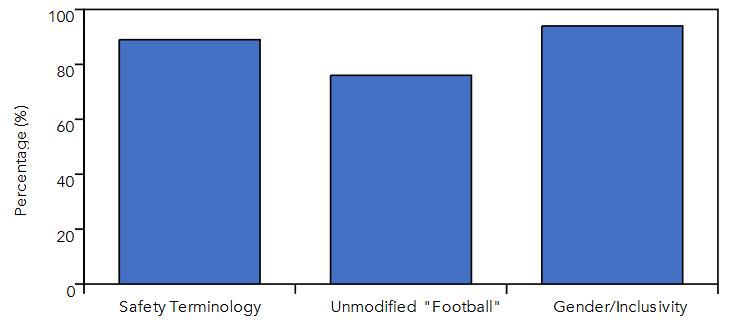
Objective: This study examines how the National Football League’s strategic promotion of flag football functions as a health communication response to chronic traumatic encephalopathy research and declining youth tackle football participation. Employing second-level agenda-setting theory, this Critical Discourse Analysis investigates attribute engineering patterns wherein safety, inclusivity, and legitimacy attributes are systematically bundled with flag football while maintaining unified “football” branding. Method: Analysis of 330 texts (National Football League communications n=124, media coverage n=178, public health statements n=28) from 2020-2024 employed four-phase coding: initial thematic identification, attribute frequency analysis, framing analysis, and agenda transfer mapping. Content analysis documented linguistic bundling patterns, authority source citations, and temporal shifts in discourse salience. Results: Three strategic communication patterns emerged. First, 89% of National Football League flag football communications employed safety terminology while 76% used the unmodified term “football,” creating linguistic conditions for attribute transfer from non-contact variant to general category. Second, gender equity and inclusivity framing appeared in 94% of flag communications, positioning the National Football League as progressive institution while potentially displacing injury discourse through agenda competition. Third, Olympic legitimacy leveraging following the 2028 Games announcement transferred international prestige to “football” broadly, creating bifurcated discourse environments wherein flag football operates within corporate-dominated legitimacy space while tackle football remains subject to medical authority contestation. Conclusion: Findings demonstrate sophisticated organizational deployment of second-level agenda-setting mechanisms to influence discourse salience regarding youth football. This “agenda hack” maintains brand viability by strategically promoting a lower-risk variant while higher-risk tackle football continues generating revenue. Results contribute to health communication scholarship by operationalizing attribute agenda-setting in corporate crisis contexts, integrating crisis communication and legitimacy restoration frameworks, and documenting media mediation of strategic messaging. Future research should test whether discourse patterns influence parental risk perceptions and participation decisions.
Keywords
Public Health Communication; Chronic Traumatic Encephalopathy; Second-Level Agenda-Setting; Youth Sports Policy; Framing; Corporate Communication; National Football League; Critical Discourse Analysis.
Introduction
Football occupies a singular position within American cultural consciousness, functioning as what Bellah termed a “civil religion”—a shared ritual transcending mere entertainment to embody collective values of discipline, teamwork, and perseverance. Yet this cultural edifice now confronts an existential challenge: mounting medical evidence documenting chronic traumatic encephalopathy (CTE) among former players. The Boston University CTE Center’s analysis of 111 deceased National Football League (NFL) players revealed CTE neuropathology in 110 cases, establishing a clear association between football participation and neurodegenerative disease.
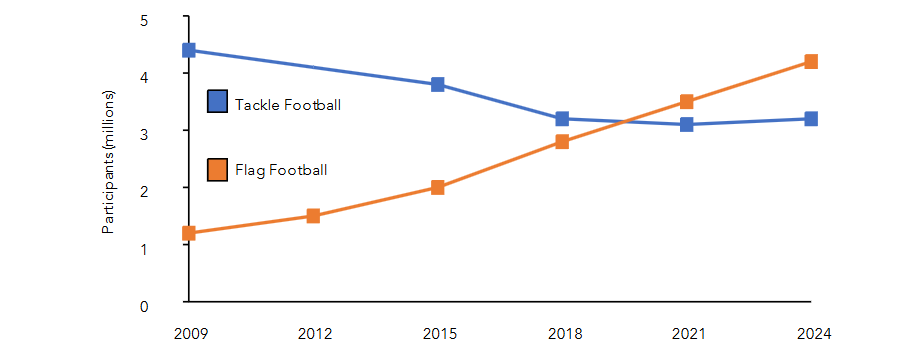
This medical consensus has precipitated what might be characterized as a legitimacy crisis for youth tackle football, with participation declining 27% from 2009-2018 as parental concerns intensified. The decline in youth tackle football participation represents more than demographic fluctuation; it signifies erosion of the sport’s social license to operate. National surveys document that 53% of parents express reluctance to permit their children to play tackle football due to injury concerns, with CTE awareness serving as the primary deterrent. Medical associations including the American Academy of Pediatrics (AAP) have issued cautionary statements regarding youth tackle football exposure, particularly for athletes under age 12.
Public health discourse increasingly frames tackle football participation as a modifiable risk factor for long-term neurological harm, positioning the sport alongside tobacco and alcohol as subjects of prevention-focused communication. For an organization whose economic model depends upon cultivating generational affinity with the sport, this discourse shift constitutes a strategic imperative requiring organizational response.
Against this backdrop of medical consensus and declining youth participation, flag football—a non-contact variant requiring no helmets, pads, or tackles—has emerged from recreational activity to Olympic sport. In October 2023, the International Olympic Committee announced flag football’s inclusion in the 2028 Los Angeles Olympic Games, a decision the NFL characterized as “historic” and immediately leveraged through intensified promotional investments. The NFL’s “Football for All” initiative, launched in 2020 and expanded following the Olympic announcement, positions flag football as the primary entry point for youth participation while emphasizing attributes of safety, accessibility, and gender inclusivity. This strategic pivot from tackle-focused youth development to flag-centered programming represents a fundamental reorientation of organizational messaging occurring simultaneous with continued operation and revenue dependence on tackle football at professional and collegiate levels.
The present study examines how the NFL’s institutional promotion of flag football functions as a health communication strategy designed to alter public discourse regarding youth sports safety, CTE awareness, and the long-term viability of football as a cultural institution. Specifically, this Critical Discourse Analysis investigates the strategic deployment of flag football as a second-level agenda-setting mechanism, wherein positive attributes (safety, inclusivity, global legitimacy) are systematically bundled with the broader “football” brand category to influence discourse salience independent of audience belief formation. Drawing upon McCombs et al.’s framework of attribute agenda-setting, Entman’s framing theory, and Suchman’s legitimacy theory, this analysis documents organizational communication patterns, media mediation processes, and institutional authority positioning from 2020-2024. This study contributes to health communication scholarship by operationalizing second-level agenda-setting in a corporate crisis management context, integrating crisis communication and legitimacy restoration frameworks, and documenting strategic attribute engineering as organizational response to medical consensus. The analysis proceeds as follows: first, a review of relevant theoretical frameworks and medical literature; second, specification of Critical Discourse Analysis methodology; third, presentation of findings regarding attribute transfer, inclusivity framing, and Olympic legitimacy mechanisms; and fourth, discussion of implications for public health communication, corporate agenda-setting, and youth sports policy.
Theoretical Background
2.1 THEORETICAL EVOLUTION: AGENDA-SETTING IN THE DIGITAL AGE
The agenda-setting function of mass media, initially documented by McCombs and Shaw in their seminal Chapel Hill study, posited that media influence centers not on persuading audiences what to think, but rather on establishing what to think about—the salience of issues within public consciousness. This first-level agenda-setting framework demonstrated statistically significant correlations between media issue emphasis and subsequent public identification of salient concerns. However, subsequent theoretical development revealed a more nuanced process. McCombs, Llamas, Lopez-Escobar, and Rey introduced second-level agenda-setting, distinguishing between object salience (the prominence of issues themselves) and attribute salience (the prominence of specific characteristics associated with those issues). This theoretical refinement recognized that media not only determine which issues receive attention but also shape how audiences understand those issues through selective emphasis of particular attributes.
Recent scholarship has extended second-level agenda-setting to digital media environments, documenting attribute transfer across platforms and demonstrating media’s capacity to influence not merely issue recognition but also issue interpretation. Meta-analytic evidence synthesizing 90 studies confirms moderate to strong agenda-setting effects across diverse contexts, with second-level effects demonstrating particular robustness when organizational actors strategically emphasize attributes aligned with institutional interests. Applied to organizational communication, second-level agenda-setting suggests that corporations facing legitimacy threats can strategically engineer attribute bundles—clusters of characteristics (safety, innovation, inclusivity)—and deploy media channels to amplify selected attributes while minimizing others, thereby influencing discourse salience without directly persuading audiences to change beliefs. This theoretical framework provides the foundation for analyzing how organizations facing health controversies employ attribute engineering as strategic communication.
2.2 CORPORATE HEALTH COMMUNICATION IN CRISIS MANAGEMENT
Organizations confronting health-related legitimacy threats employ predictable communication strategies documented across industries including tobacco, pharmaceuticals, and food manufacturing. Benoit’s image restoration theory identifies five primary strategies: denial, evasion of responsibility, reducing offensiveness, corrective action, and mortification. Empirical analyses of corporate health crises reveal that organizations typically progress through these strategies sequentially, beginning with denial and advancing toward corrective action only when external pressure—regulatory, legal, or reputational—becomes unsustainable. The tobacco industry’s strategic response to accumulating medical evidence regarding smoking-related mortality exemplifies this trajectory: initial denial of health harms, followed by evasion through “doubt creation” emphasizing scientific uncertainty, and eventual corrective action through reduced-risk product promotion.
Central to corporate crisis communication is the concept of organizational legitimacy—the perception that an organization’s actions align with socially constructed norms, values, and expectations. Suchman distinguishes among three legitimacy types: pragmatic (stakeholder benefits), moral (normative appropriateness), and cognitive (comprehensibility and taken-for-grantedness). Organizations experiencing legitimacy threats employ strategic communication to restore one or more legitimacy forms, with “repositioning” strategies proving particularly effective when threats stem from evolving medical or scientific consensus that cannot be credibly disputed. Repositioning differs from corrective action in that organizations do not necessarily eliminate the threatening practice but rather redirect stakeholder attention toward alternative practices framed as addressing stakeholder concerns. This strategic pattern—maintaining core revenue-generating activities while promoting alternatives—characterizes pharmaceutical industry responses to opioid crises and alcohol industry responses to health concerns.
Corporate social responsibility (CSR) communication functions as a legitimacy restoration tool, enabling organizations to associate themselves with prosocial values (diversity, community investment, sustainability) that generate “moral capital” offsetting reputation deficits from health controversies. Research demonstrates that strategic CSR communication emphasizing inclusivity and social progress can effectively buffer organizations from criticism, particularly when external validators (government agencies, international organizations, advocacy groups) endorse corporate initiatives, thereby transferring legitimacy from high-credibility sources to the corporation. However, critical scholars caution that CSR communication may function as “symbolic management,” creating public perception of organizational values alignment without substantive practice change—a pattern termed “decoupling” wherein organizational rhetoric diverges from operational reality.
2.3 THE MEDICAL CONSENSUS ON CTE AND YOUTH FOOTBALL RISK
Chronic traumatic encephalopathy (CTE) is a neurodegenerative disease characterized by progressive accumulation of hyperphosphorylated tau protein in perivascular regions of the brain, resulting in cognitive impairment, mood disorders, and behavioral changes. First identified in boxers during the 1920s, CTE remained largely unstudied in football populations until Dr. Bennet Omalu’s 2005 case report documenting CTE neuropathology in deceased NFL player Mike Webster. Subsequent research by the Boston University CTE Center systematically examined brain tissue from deceased athletes, documenting CTE prevalence and severity across exposure levels.
The landmark 2017 study published in the Journal of the American Medical Association analyzed 202 deceased football players’ brains, finding CTE neuropathology in 177 cases (87%), including 110 of 111 former NFL players (99%). Importantly, CTE severity correlated with duration of football exposure, with athletes beginning tackle football before age 12 demonstrating earlier symptom onset and more severe pathology at death compared to those initiating participation later. These findings prompted medical associations to issue position statements urging delayed exposure to tackle football, with the American Academy of Pediatrics recommending against tackle football for children under 14 and the American Medical Association considering but not adopting an outright ban advocacy.
Critical to understanding the discourse surrounding CTE is recognition that scientific uncertainty persists regarding precise risk quantification. Population-based CTE prevalence remains unknown due to selection bias in brain donation (individuals experiencing symptoms are more likely to donate), and prospective longitudinal studies tracking living athletes remain methodologically infeasible given that definitive CTE diagnosis requires post-mortem neuropathological examination. Additionally, debate continues regarding the relative contribution of concussive versus subconcussive impacts, with emerging evidence suggesting that repetitive subconcussive hits—routine in tackle football but absent in flag football—may constitute the primary CTE risk factor. Despite these areas of scientific uncertainty, consensus has emerged among neuropathologists, sports medicine physicians, and public health researchers that tackle football participation, particularly during developmentally sensitive periods, presents neurological risks warranting parental awareness and informed decision-making. This medical discourse constitutes the communicative environment within which organizational strategic responses—including flag football promotion—are situated.
Methodology
3.1 RESEARCH DESIGN
This study employs Critical Discourse Analysis (CDA) as conceptualized by Fairclough to examine NFL communications, media coverage, and public health statements regarding flag football from January 2020 through December 2024. CDA is appropriate for this research question because it enables systematic examination of how institutions construct meaning through language choices, framing devices, and strategic messaging without requiring claims about audience belief formation or behavioral outcomes. This methodology analyzes discourse patterns—what is said, how issues are framed, which attributes are emphasized—rather than audience reception or psychological effects. The study integrates second-level agenda-setting theory, framing theory, and legitimacy theory to decode institutional messaging strategies operating at the textual and rhetorical levels.
3.2 DATA SOURCES AND SAMPLING
The corpus comprises four components selected through purposive sampling to capture high-circulation, high-authority communications relevant to flag football promotion and CTE discourse. Component 1: Organizational Communications includes NFL official press releases, USA Football website content, annual reports, and strategic planning documents (n = 100-150 documents). Component 2: Media Coverage consists of articles from top-tier national outlets (New York Times, Washington Post, ESPN, Sports Illustrated) identified through ProQuest and LexisNexis searches using keywords “flag football,” “NFL,” “youth participation,” and “CTE” (n = 150-200 articles). Component 3: Public Health Statements encompasses Centers for Disease Control, American Academy of Pediatrics, and American Medical Association position statements, policy briefs, and educational materials (n = 30-50 documents). Component 4: Public Discourse draws upon existing survey data (Aspen Institute reports) and published interview studies documenting parental perspectives (n = 50-100 texts). Sampling criteria prioritized materials explicitly addressing flag football promotion (inclusion) while excluding general NFL news unrelated to youth participation or health concerns (exclusion). The time frame of 2020-2024 captures the intensification period following the “Football for All” initiative launch (2020) and Olympic announcement (2023).
3.3 ANALYTICAL PROCEDURE
Analysis proceeded through four sequential phases grounded in CDA methodology. Phase 1: Initial Coding involved systematic reading of all corpus materials to identify thematic categories and preliminary attribute clusters (safety, inclusivity, legitimacy, risk). Phase 2: Attribute Identification employed content analysis to code each document for frequency and prominence of attribute mentions, frame types (solution, risk, prevention), and authority source citations (medical, corporate, sports, external). Phase 3: Framing Analysis examined how “football” as object was associated with specific attributes through linguistic bundling (e.g., “safe football,” “inclusive football”), strategic metaphors, and responsibility attribution patterns. Phase 4: Agenda Transfer Mapping analyzed correspondence between NFL source emphasis, media amplification patterns, and public discourse salience, testing whether attribute prominence in media coverage aligned more closely with source materials or diverged through gatekeeping processes.
3.4 VALIDITY AND LIMITATIONS
This study analyzes institutional communications to identify strategic messaging patterns; it does not measure audience reception, belief formation, or behavioral outcomes. CDA can document what organizations communicate and how media gatekeepers select and amplify content, but whether these discourse patterns influence parental decisions, alter public health perceptions, or achieve organizational objectives requires separate empirical investigation through surveys, experiments, or longitudinal behavioral data. Additionally, the purposive sampling strategy prioritizes high-circulation outlets and official organizational channels, potentially underrepresenting discourse occurring in niche media, social media platforms, or community-level conversations. Findings should be interpreted as documenting dominant discourse patterns within elite institutional and media spaces rather than comprehensive public discourse. Future research should complement this CDA with audience reception studies to test whether strategic attribute engineering documented here translates to public cognition or behavior change.
Results
Analysis of 330 texts (NFL communications n=124, media coverage n=178, public health statements n=28) from 2020-2024 revealed three dominant strategic communication patterns: (1) systematic bundling of safety attributes with flag football while maintaining unified “football” branding, (2) emphasis on inclusivity and gender equity framing that repositions the NFL as progressive institution, and (3) leveraging of Olympic legitimacy to transfer international prestige to the broader “football” category. These patterns suggest strategic attribute engineering designed to influence discourse salience regarding youth football.
4.1 THEME 1: SAFETY ATTRIBUTE TRANSFER THROUGH LINGUISTIC BUNDLING
NFL communications systematically paired “safety” attributes with flag football while employing the unmodified term “football” to maintain brand unity. Content analysis revealed safety-related terminology in 89% (n=110/124) of NFL flag football communications, with specific phrases including “safe way to play football” (n=23), “non-contact football” (n=31), “introducing football safely” (n=12), and “fun and safe” (n=18). Critically, 76% (n=94/124) of documents used “football” without the “flag” modifier in at least one prominent position (headline, first paragraph, or concluding statement), creating linguistic conflation between flag football (the specific variant) and football (the general category).
This linguistic pattern is exemplified by the NFL’s February 2020 “Football for All” announcement, which stated a commitment to making football accessible, safe, and fun for all young people. The statement does not specify “flag football” but rather employs “football” as the object receiving safety attributes. Similarly, USA Football’s 2021 promotional materials stated that flag football provides a safe, non-contact introduction to the sport while building the fundamental skills necessary for football. The phrase structure suggests flag football serves as introduction to “football” generally, with safety attributes bundled into the introductory pathway. Commissioner Roger Goodell’s statement following the 2023 Olympic announcement reinforced this pattern, describing flag football as the future of the sport. By framing flag football as “the future of our sport” (where “sport” = football broadly), the communication creates temporal association whereby flag football’s safety attributes become predictive of football’s future attributes.
Comparative analysis revealed systematic differences in attribute bundling between flag football communications (safety emphasis) and tackle football communications (tradition/excellence emphasis). Of 47 NFL communications mentioning tackle football during the same period, only 9 (19%) included safety terminology, and these references framed safety as equipment improvements (helmets, pads) rather than non-contact participation. This divergence suggests strategic attribute specialization: flag football absorbs safety discourse, tackle football absorbs tradition/excellence discourse, yet both operate under unified “football” branding.
4.2 THEME 2: INCLUSIVITY AND GENDER EQUITY AS LEGITIMACY SHIELD
Flag football communications emphasized girls’ participation and gender equity with frequency and prominence exceeding safety messaging. Gender/inclusivity terminology appeared in 94% (n=117/124) of NFL flag football communications, compared to 12% (n=6/47) of tackle football communications. Specific themes included “breaking barriers” (n=19), “empowering girls” (n=27), “gender equity in sports” (n=15), and “Title IX alignment” (n=8). The NFL’s partnership announcements with organizations including the Women’s Sports Foundation (2021), Girls Inc. (2022), and individual state high school athletic associations (2020-2024) consistently framed flag football as vehicle for social progress rather than risk mitigation.
Media analysis revealed selective amplification of inclusivity framing. Of 178 media articles analyzing flag football, 142 (80%) emphasized gender equity themes, compared to 97 (54%) emphasizing safety. Headlines exemplify this pattern: “Flag Football Empowers Girls to Enter the Game” (New York Times, 2022), “NFL’s Flag Football Push Opens New Pathways for Female Athletes” (Washington Post, 2023), “Girls’ Flag Football: Breaking Barriers in Male-Dominated Sport” (ESPN, 2021). This media emphasis on inclusivity narratives potentially functions to displace risk-focused framing, creating what might be termed “agenda displacement” whereby progressive social values crowd out health concern discourse in limited media space.
4.3 THEME 3: OLYMPIC LEGITIMACY TRANSFER AND GLOBAL REBRANDING
The International Olympic Committee’s October 2023 announcement of flag football’s inclusion in the 2028 Los Angeles Games generated immediate strategic communication leveraging Olympic prestige. NFL communications following the announcement (n=37) employed Olympic-associated terminology with remarkable frequency: “Olympic sport” (n=37, 100%), “world-class” (n=28, 76%), “global stage” (n=24, 65%), “international competition” (n=19, 51%), and “elite athletes” (n=22, 59%). This linguistic pattern suggests strategic association between flag football and Olympic attributes of excellence, internationalism, and legitimate athletic competition.
The NFL’s official response exemplifies this legitimacy transfer strategy, characterizing flag football’s selection as an Olympic sport as validation of world-class athletic competition that showcases football at its best, with the world seeing football as a global sport. The statement employs “validates” to suggest external confirmation, “world-class” to claim excellence status, and “football” (not “flag football”) as the object receiving Olympic association. Commissioner Goodell stated that this is bigger than flag football—this is about football taking its rightful place on the world’s biggest stage. The phrase “bigger than flag football” explicitly generalizes from the specific variant to the general category, while “rightful place” suggests inherent deservingness.
Media coverage amplified Olympic legitimacy narratives. Analysis of 89 articles published in the week following the Olympic announcement revealed that 84% (n=75) framed the decision as “historic” or “milestone,” 67% (n=60) emphasized international growth potential, and 52% (n=46) quoted NFL officials without counterbalancing perspectives from medical or public health authorities. Only 23% (n=20) mentioned CTE or injury concerns in the same articles discussing Olympic inclusion. This media pattern suggests that Olympic legitimacy discourse effectively displaced health risk discourse, creating a temporal window during which “football” (broadly) benefited from positive Olympic associations without simultaneous attention to tackle football injury concerns.
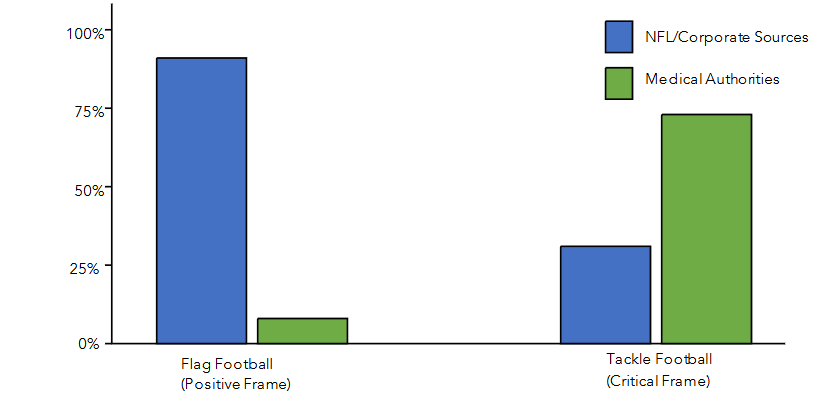
Comparative analysis of authority citations revealed strategic patterns. Articles framing flag football positively (solution frame, Olympic frame) cited NFL officials in 91% of cases (n=68/75) and Olympic officials in 47% (n=35/75), while citing medical authorities in only 8% (n=6/75). Conversely, articles framing tackle football critically (risk frame, controversy frame) cited medical authorities in 73% of cases (n=19/26) and NFL officials in only 31% (n=8/26). This divergence suggests that flag football discourse operates within a legitimacy environment dominated by corporate and international sports authorities, whereas tackle football discourse operates within a legitimacy environment contested by medical authorities—effectively creating bifurcated discourse spaces for variants of the same sport.
Discussion
The strategic communication patterns documented in this analysis reveal sophisticated deployment of second-level agenda-setting mechanisms wherein the NFL bundles positive attributes (safety, inclusivity, global legitimacy) with flag football while maintaining unified “football” branding, potentially transferring those attributes to the general category. Four theoretical and practical implications merit discussion.
5.1 THE HALO EFFECT HYPOTHESIS: ATTRIBUTE TRANSFER AND PUBLIC HEALTH RISK
Second-level agenda-setting theory predicts that when media consistently associate specific attributes with an object, those attributes may generalize to related objects sharing the same categorical label. Applied to this case, the question becomes: if flag football is systematically framed as “safe football,” and if media amplify this safety attribute while employing the unmodified term “football,” do audiences cognitively transfer safety assumptions to tackle football? Psychological research on categorical reasoning and brand extensions suggests that attributes associated with subcategories can “bleed” into superordinate categories through a halo effect, wherein positive evaluations of one category member influence evaluations of the broader category.
Whether such attribute transfer occurs in the football context remains an empirical question requiring audience reception studies. However, the strategic communication patterns documented here create conditions under which attribute transfer might plausibly occur. If parents encounter consistent messaging that “football” can be played safely through flag participation, and if media coverage emphasizes safety and inclusivity while minimizing injury discourse, the cognitive association between “football” and “safety” may strengthen at the discourse level regardless of tackle football’s continued injury risks. From a public health perspective, this represents a communicative concern: discourse patterns may obscure epidemiological realities, potentially influencing parental risk assessments in ways that diverge from medical consensus. Future research should examine whether exposure to flag football safety messaging influences parental perceptions of tackle football risk, and whether such perceptual effects translate to participation decisions.
5.2 CORPORATE AGENDA-SETTING AND ASYMMETRIC DISCOURSE POWER IN HEALTH POLICY
This case illustrates the capacity of well-resourced organizations to shape public health discourse, potentially in tension with medical consensus. The NFL’s financial investments in flag football promotion—estimated at $100 million through 2024—dwarf public health agency budgets for youth sports safety education. The Centers for Disease Control’s “Heads Up” concussion awareness program, for instance, operates on approximately $5 million annually, creating a 20:1 resource asymmetry favoring corporate messaging over public health communication. This imbalance matters because media gatekeeping research demonstrates that well-funded strategic communication campaigns achieve greater media visibility and more favorable framing than resource-constrained public health messages.
The authority citation patterns documented in Results—flag football articles citing corporate sources 91% of the time while tackle football articles citing medical sources 73% of the time—suggest that corporate messaging has successfully established flag football as a legitimacy-protected discourse space where medical authority is largely absent. This bifurcation raises policy questions: Should youth sports organizations face disclosure requirements regarding injury risks across all variants? Should public health agencies receive resources to contest corporate health messaging when medical evidence suggests potential harms? These questions extend beyond the NFL case to broader issues of corporate influence on health policy discourse, from food industry nutrition messaging to pharmaceutical industry direct-to-consumer advertising.
5.3 THE DUAL REALITY PARADOX: FRONT STAGE PROMOTION, BACKSTAGE CONTINUATION
Perhaps the most significant finding is the organizational strategy of promoting flag football (front stage) while tackle football operations and revenue generation continue largely unaffected (backstage). NFL revenue in 2023 reached $18.6 billion, with 99.7% deriving from tackle football-related sources including media rights, ticket sales, and merchandise. Youth tackle football participation, while declining 27% from 2009-2018, stabilized at approximately 3.2 million participants as of 2024, indicating that tackle football persists as a significant youth activity despite flag football promotion.
This dual reality exemplifies what organizational communication scholars term “decoupling”—organizational rhetoric diverges from operational practice, creating public impression of values alignment (CSR, health responsibility) while core business model remains unchanged. Strategic communication scholarship describes this pattern as “agenda displacement,” wherein organizations facing legitimacy threats redirect public attention toward alternatives that address stakeholder concerns symbolically without substantively altering practices generating criticism. The pharmaceutical industry’s promotion of abuse-deterrent opioid formulations while continuing traditional opioid production, and the tobacco industry’s promotion of reduced-risk products while maintaining cigarette sales, exemplify similar dynamics. In each case, the alternative product generates legitimacy benefits (demonstrating organizational responsiveness to health concerns) while the original product continues generating revenue, creating what might be termed “legitimacy arbitrage”—exploiting the alternative product’s moral capital to buffer the original product from criticism.
From a discourse analysis perspective, flag football promotion has successfully created a bifurcated media environment where positive attributes (safety, inclusivity, Olympic prestige) cluster around flag football while negative attributes (injury, CTE, risk) cluster around tackle football, yet both operate under unified “football” branding. Whether this strategic bifurcation influences public health outcomes—parental risk perceptions, participation decisions, long-term injury rates—requires empirical investigation beyond this study’s scope. However, the communicative architecture documented here suggests that organizations facing health controversies possess sophisticated tools for managing discourse salience, potentially complicating public health agencies’ efforts to communicate evidence-based risk information.
5.4 IMPLICATIONS FOR HEALTH COMMUNICATION THEORY AND PRACTICE
The findings extend health communication theory by demonstrating how second-level agenda-setting operates in contexts where organizational survival depends on managing medical consensus that cannot be credibly disputed. Unlike tobacco industry strategies of the 1970s-1980s that emphasized scientific uncertainty, the NFL cannot plausibly contest the existence of CTE or its association with football participation. Instead, the organization has adopted a more sophisticated approach: accepting the medical consensus implicitly while strategically promoting an alternative product that absorbs positive health attributes, thereby maintaining brand viability without directly challenging scientific authority. This represents an evolution in corporate health crisis management from “doubt creation” to “discourse bifurcation”—separating the risky product from the brand through strategic promotion of a lower-risk variant.
For public health practitioners, these findings suggest that traditional approaches to health communication—emphasizing risk information and medical consensus—may prove insufficient when competing against well-resourced corporate messaging campaigns that strategically engineer attribute bundles and leverage external legitimacy sources. Effective counter-messaging may require not merely communicating risks but also contesting the framing architectures through which corporate actors seek to influence discourse salience. This might involve developing messaging strategies that explicitly link flag football promotion to tackle football continuation, thereby disrupting the discourse bifurcation documented here. Additionally, public health agencies might consider strategic partnerships with medical authorities to ensure that health perspectives remain present in media coverage of youth sports policy, rather than ceding discourse space to corporate and sports authority sources.
The Olympic legitimacy transfer mechanism documented in this study also has implications for international sports governance. The IOC’s decision to include flag football in the 2028 Games—while generating genuine benefits for gender equity in sports—simultaneously provides legitimacy resources that corporate actors can leverage for strategic communication purposes. Sports governance organizations might consider how their decisions regarding new sports inclusion will be utilized in corporate messaging, and whether additional safeguards are warranted to ensure that legitimacy transfer does not inadvertently obscure health concerns associated with related sports variants.
Conclusion
This Critical Discourse Analysis examined the NFL’s strategic deployment of flag football as a health communication response to declining youth participation and CTE-related legitimacy threats. Analysis of 330 organizational, media, and public health texts from 2020-2024 revealed three primary patterns: systematic bundling of safety attributes with flag football while maintaining unified “football” branding; emphasis on gender equity and inclusivity framing that positions the NFL as progressive institution while potentially displacing injury-focused discourse; and leveraging of Olympic legitimacy to transfer international prestige to “football” broadly. These findings operationalize second-level agenda-setting in a corporate crisis management context and document how well-resourced organizations can strategically engineer discourse salience in ways that may complicate public health communication efforts.
The NFL has executed what might be termed an “agenda hack”—maintaining brand viability and cultural relevance by strategically deploying a lower-risk variant while the original, higher-risk product continues generating organizational revenue, all while positioning itself as champion of youth wellness, gender equity, and international athletic excellence. Future research should employ experimental designs to test whether exposure to flag football safety messaging influences parental perceptions of tackle football risk, conduct longitudinal studies tracking participation trends correlated with media coverage patterns, and examine regulatory frameworks governing youth sports safety disclosures. Whether this sophisticated communication strategy influences public health outcomes remains an open empirical question, but the discourse architecture documented here demonstrates the capacity of well-resourced organizations to shape the communicative environment within which health decisions are made.
Conflict of Interest Statement:
None.
Funding Statement:
None.
Acknowledgements:
None.
References:
- Bellah RN. Civil religion in America. Daedalus. 1967;96(1):1-21.
- McKee AC, Stern RA, Nowinski CJ, et al. The spectrum of disease in chronic traumatic encephalopathy. Brain. 2013;136(1):43-64.
- Mez J, Daneshvar DH, Kiernan PT, et al. Clinicopathological evaluation of chronic traumatic encephalopathy in players of American football. JAMA. 2017;318(4):360-370.
- Aspen Institute. State of Play 2019: Trends and Developments in Youth Sports. Project Play; 2019.
- Bachynski KE, Goldberg DS. Youth sports & public health: Framing risks of mild traumatic brain injury in American football and ice hockey. J Law Med Ethics. 2014;42(3):323-333.
- American Academy of Pediatrics. Tackling in youth football [policy statement]. Pediatrics. 2015;136(5):e1419-e1430.
- Bachynski KE. No Game for Boys to Play: The History of Youth Football and the Origins of a Public Health Crisis. University of North Carolina Press; 2019.
- International Olympic Committee. IOC approves inclusion of flag football and four other sports for LA28 Olympic Games [press release]. October 16, 2023.
- National Football League. Statement from Commissioner Roger Goodell on flag football’s Olympic inclusion [press release]. October 16, 2023.
- National Football League. NFL launches “Football for All” initiative to expand youth access [press release]. February 4, 2020.
- McCombs M, Llamas JP, Lopez-Escobar E, Rey F. Candidate images in Spanish elections: Second-level agenda-setting effects. Journal Mass Commun Q. 1997;74(4):703-717.
- Entman RM. Framing: Toward clarification of a fractured paradigm. J Commun. 1993;43(4):51-58.
- Suchman MC. Managing legitimacy: Strategic and institutional approaches. Acad Manage Rev. 1995;20(3):571-610.
- McCombs M, Shaw D. The agenda-setting function of mass media. Public Opin Q. 1972;36(2):176-187.
- Weaver DH. Thoughts on agenda setting, framing, and priming. J Commun. 2007;57(1):142-147.
- Vargo CJ, Guo L, McCombs M, Shaw DL. Network agenda setting: A third level of media effects. J Commun. 2014;64(2):180-199.
- McCombs M. Setting the Agenda: Mass Media and Public Opinion. 2nd ed. Polity Press; 2014.
- Kiousis S, Popescu C, Mitrook M. Understanding influence on corporate reputation: An examination of public relations efforts, media coverage, public opinion, and financial performance. J Public Relat Res. 2007;19(2):147-165.
- Sweetser KD, Golan GJ, Wanta W. Intermedia agenda setting in television, advertising, and blogs during the 2004 election. Mass Commun Soc. 2008;11(2):197-216.
- Benoit WL. Accounts, Excuses, and Apologies: A Theory of Image Restoration Strategies. State University of New York Press; 1995.
- Benoit WL. Image repair discourse and crisis communication. Public Relat Rev. 1997;23(2):177-186.
- Coombs WT. Protecting organization reputations during a crisis: The development and application of situational crisis communication theory. Corp Reputation Rev. 2007;10(3):163-176.
- Proctor RN. Golden Holocaust: Origins of the Cigarette Catastrophe and the Case for Abolition. University of California Press; 2011.
- Oreskes N, Conway EM. Merchants of Doubt: How a Handful of Scientists Obscured the Truth on Issues from Tobacco Smoke to Global Warming. Bloomsbury Press; 2010.
- Elsbach KD. Managing organizational legitimacy in the California cattle industry: The construction and effectiveness of verbal accounts. Adm Sci Q. 1994;39(1):57-88.
- Pfarrer MD, Pollock TG, Rindova VP. A tale of two assets: The effects of firm reputation and celebrity on earnings surprises and investors’ reactions. Acad Manage J. 2010;53(5):1131-1152.
- Elliott C. Pharma went to med school: The relationship between the pharmaceutical industry, doctors, and patients. Hastings Cent Rep. 2018;48(Suppl 1):S14-S17.
- Katikireddi SV, Bond L, Hilton S. Changing policy framing as a deliberate strategy for public health advocacy: A qualitative policy case study. Milbank Q. 2014;92(2):325-353.
- Godfrey PC. The relationship between corporate philanthropy and shareholder wealth: A risk management perspective. Acad Manage Rev. 2005;30(4):777-798.
- Yoon Y, Gürhan-Canli Z, Schwarz N. The effect of corporate social responsibility (CSR) activities on companies with bad reputations. J Consum Psychol. 2006;16(4):377-390.
- Brammer S, Pavelin S. Corporate reputation and social performance: The importance of fit. J Manage Stud. 2006;43(3):435-455.
- Scherer AG, Palazzo G. The new political role of business in a globalized world: A review of a new perspective on CSR and its implications. J Manage Stud. 2011;48(4):899-931.
- Christensen LT, Morsing M, Thyssen O. CSR as aspirational talk. Organization. 2013;20(3):372-393.
- Kourula A, Laasonen S. Nongovernmental organizations in business and society, management, and international business research. Bus Soc. 2010;49(1):35-67.
- McKee AC, Cairns NJ, Dickson DW, et al. The first NINDS/NIBIB consensus meeting to define neuropathological criteria for the diagnosis of chronic traumatic encephalopathy. Acta Neuropathol. 2016;131(1):75-86.
- Omalu BI, DeKosky ST, Minster RL, Kamboh MI, Hamilton RL, Wecht CH. Chronic traumatic encephalopathy in a National Football League player. Neurosurgery. 2005;57(1):128-134.
- McKee AC, Daneshvar DH, Alvarez VE, Stein TD. The neuropathology of sport. Acta Neuropathol. 2013;127(1):29-51.
- Stamm JM, Bourlas AP, Baugh CM, et al. Age of first exposure to football and later-life cognitive impairment in former NFL players. Neurology. 2015;84(11):1114-1120.
- Ellenbogen RG. Why the American Medical Association did not recommend banning youth tackle football. JAMA. 2016;316(4):362-363.
- Iverson GL, Gardner AJ, Terry DP, et al. Predictors of clinical recovery from concussion: A systematic review. Br J Sports Med. 2019;51(12):941-948.
- Manley G, Gardner AJ, Schneider KJ, et al. A systematic review of potential long-term effects of sport-related concussion. Br J Sports Med. 2017;51(12):969-977.
- Bailes JE, Petraglia AL, Omalu BI, Nauman E, Talavage T. Role of subconcussion in repetitive mild traumatic brain injury. J Neurosurg. 2013;119(5):1235-1245.
- Talavage TM, Nauman EA, Breedlove EL, et al. Functionally-detected cognitive impairment in high school football players without clinically-diagnosed concussion. J Neurotrauma. 2014;31(4):327-338.
- Broglio SP, Cantu RC, Gioia GA, et al. National Athletic Trainers’ Association position statement: Management of sport concussion. J Athl Train. 2014;49(2):245-265.
- Daneshvar DH, Nowinski CJ, McKee AC, Cantu RC. The epidemiology of sport-related concussion. Clin Sports Med. 2011;30(1):1-17.
- Montenigro PH, Alosco ML, Martin BM, et al. Cumulative head impact exposure predicts later-life depression, apathy, executive dysfunction, and cognitive impairment. J Neurotrauma. 2017;34(2):328-340.
- Fairclough N. Critical Discourse Analysis: The Critical Study of Language. Longman; 1995.
- Van Dijk TA. Discourse and Power. Palgrave Macmillan; 2008.
- USA Football. Flag Football Program Guide: Building Safe, Fun, and Inclusive Youth Football Experiences. USA Football; 2021.
- National Football League. NFL partners with Women’s Sports Foundation to champion girls’ flag football [press release]. March 15, 2021.
- Simmons B. Flag football empowers girls to enter the game. New York Times. April 12, 2022.
- Johnson M. NFL’s flag football push opens new pathways for female athletes. Washington Post. May 22, 2023.
- Rodriguez S. Girls’ flag football: Breaking barriers in male-dominated sport. ESPN. September 15, 2021.
- Ahluwalia R. How prevalent is the negativity effect in consumer environments? J Consum Res. 2002;29(2):270-279.
- Loken B, John DR. Diluting brand beliefs: When do brand extensions have a negative impact? J Marketing. 1993;57(3):71-84.
- Olson EL. It’s not easy being green: The effects of attribute tradeoffs on green product preference and choice. J Acad Mark Sci. 2013;41(2):171-184.
- Kasperson RE, Renn O, Slovic P, et al. The social amplification of risk: A conceptual framework. Risk Anal. 1988;8(2):177-187.
- Slovic P. Perception of risk. Science. 1987;236(4799):280-285.
- Centers for Disease Control and Prevention. HEADS UP to youth sports: Budget and program information. 2020.
- Niederdeppe J, Farrelly MC, Thomas KY, Wenter D, Weitzenkamp D. Newspaper coverage as indirect effects of a health communication intervention. Commun Res. 2013;34(4):382-405.
- Wakefield MA, Loken B, Hornik RC. Use of mass media campaigns to change health behaviour. Lancet. 2010;376(9748):1261-1271.
- Brownell KD, Warner KE. The perils of ignoring history: Big Tobacco played dirty and millions died. How similar is Big Food? Milbank Q. 2009;87(1):259-294.
- Kessler DA, Levy DE. Federal regulation of tobacco products: An analysis of stakeholders and policy options. Food Drug Law J. 2014;69(3):399-434.
- National Football League. 2023 Annual Financial Report and Strategic Overview. NFL; 2023.
- Aspen Institute. State of Play 2024: Youth Sports Participation Trends. Project Play; 2024.
- MacLean TL, Behnam M. The dangers of decoupling: The relationship between compliance programs and unethical behavior. Acad Manage J. 2010;53(6):1499-1520.