

Obstetric Complications in Women with Hepatitis A
PREDICTION OF OBSTETRIC COMPLICATIONS IN WOMEN WITH NEWLY DETECTED HEPATITIS A REPLICATIVE ACTIVITY
Mitsoda Roman1, Mitsoda Kateryna-Mariya2
- Mitsoda Roman Dr. of Medical Sciences, Professor, State Higher Educational Institution, “Uzhhorod National University”, Uzhhorod, Ukraine
- Mitsoda Kateryna-Mariya Doctor in pre-certification training, Vranov nad Toplou, Slovakia, Vranov Hospital
OPEN ACCESS
PUBLISHED: 28 Febuary 2025
CITATION: ROMAN, Mitsoda; KATERYNA-MARIYA, Mitsoda. PREDICTION OF OBSTETRIC COMPLICATIONS IN WOMEN WITH NEWLY DETECTED HEPATITIS A REPLICATIVE ACTIVITY. Medical Research Archives. Available at: <https://esmed.org/MRA/mra/article/view/6299>.
COPYRIGHT: © 2025 European Society of Medicine. This is an open-access article distributed under the terms of the Creative Commons Attribution License, which permits unrestricted use, distribution, and reproduction in any medium, provided the original author and source are credited.
ISSN 2375-1924
ABSTRACT
Prediction of obstetric complications in women with newly detected hepatitis A replicative activity. Mitsoida R. Mitsoida K.-M.
A survey of 500 women who suffered from acute hepatitis A during pregnancy and their obstetric activity revealed a positive relationship. The aim of this study was to analyze the impact of newly detected hepatitis A replicative activity on obstetric complications.
Keywords
hepatitis, pregnancy, obstetric complications, risk factors
Introduction
Despite advancements in medical science and the conclusion of numerous studies aimed at controlling infectious diseases, viral hepatitis remains a major contributor to elevated rates of illness and mortality. Hepatitis B (HBV) and hepatitis A (HAV) is an infection, which is also vaccine-preventable, but there are 14 million new cases globally that occur annually. The Hepatitis A vaccine (HAV) is recommended for those at an increased risk of hepatitis A, including pregnant women who fall into the at-risk category. The incidence of newly diagnosed HAV infections is generally higher in low-income countries. In contrast, the rapid spread of the disease in low-income countries is often driven by poor sanitation and malnutrition.
Hepatitis A is a viral infection that can affect the liver and cause significant morbidity. Studies exploring the effects of hepatitis A on pregnancy have shown that it can lead to various obstetric complications, including premature birth, low birth weight, and increased maternal morbidity.
The Aim
The aim of the study was to analyze the relationship between newly detected hepatitis A replicative activity and obstetric complications in pregnant women.
Materials and Methods
In this study, the significance level p<0.05 was established for each of the indicators examined, compared with the possible value of the others (p<0.45). From 21 to 25 years old – 44% and 40% (p=0.71); 26-30 years old – 17% and 24% (p=0.99); 31-35 years old – 16% and 18% (p=0.29).
Statistical processing of the observational results was carried out using the Statgraphics and Excel software. To calculate the prognostic significance of the signs, the Student’s criterion in the modification of N.M. Amosov and co-authors (1972) were used. This relatively simple approach assumes statistical independence of signs to describe the outcomes and risks.
The objective of the analysis was to compare the frequency of an unfavorable result in patients with the investigated hepatitis (P1) in the average personal risk of the obstetric complications (P2) in the pregnant women with newly detected hepatitis A replicative activity.
Results
All pregnant women with newly detected hepatitis A were divided into two groups:
- with obstetric complications in childbirth;
- without obstetric complications or positive changes during the labor.
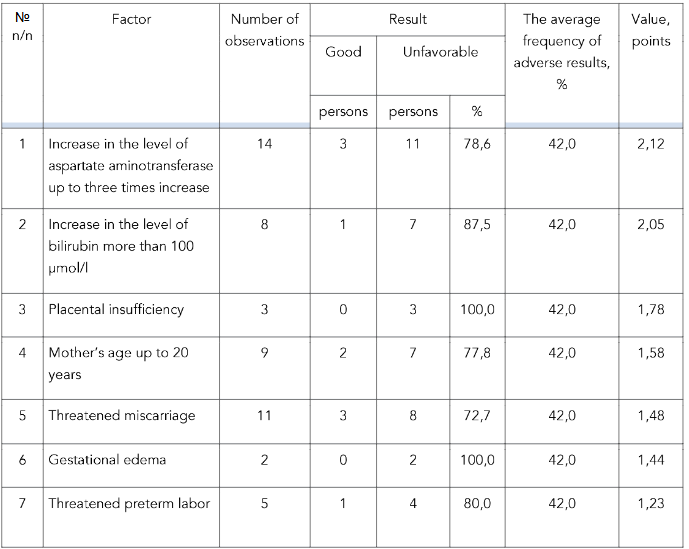
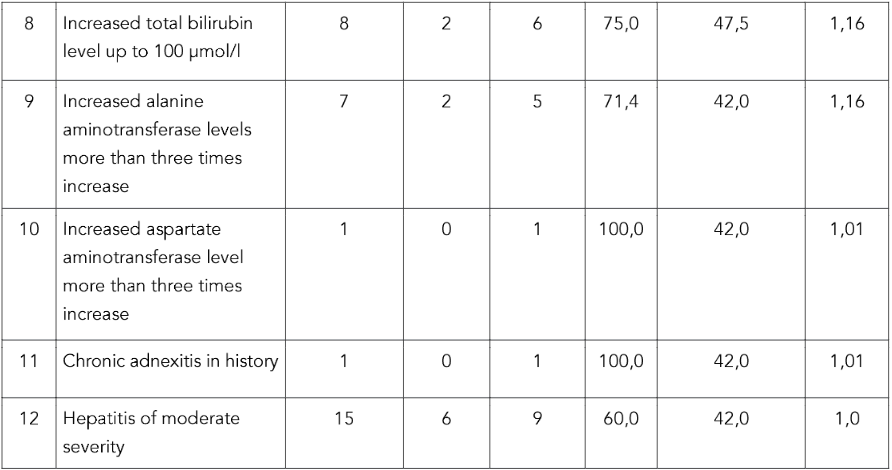
Table 1. Prognostic significance of factors determining obstetric complications in women with newly detected hepatitis A replicative activity.
Table 1 shows factors with positive values only, i.e. those that worsen the prognosis. The relatively small number of patients with newly detected replicative activity of the hepatitis A pathogen were divided into two groups:
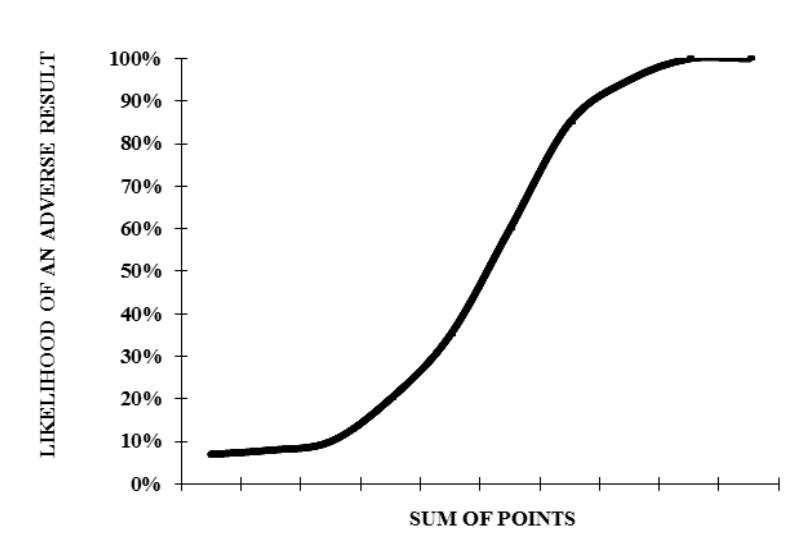
Based on the data from the risk map, it was established that the severity of the disease, the occurrence of which is mainly due to the severity of viral hepatitis.
Discussion
The results of the study indicate that acute viral hepatitis A during pregnancy has been studied sufficiently, since it is believed that the impact of hepatitis A on the course of pregnancy, childbirth, the postpartum period and the early neonatal period of their newborns.
The analysis of the gestational process in women who suffered from acute viral hepatitis A during pregnancy showed a significant number of obstetric complications consistent with the literature and mainly characterized by the severity of hepatitis (increased alanine and aspartate levels, total bilirubin level, and maternal syndrome) and Erb’s palsy.
Therefore, it can be concluded that the probability of obstetric complications in women with newly detected hepatitis A replicative activity is significantly higher than in women without this condition.
Conflict of Interest:
None
Acknowledgements:
None
References
- Shapiro M, Hatzis H, Sharma H. Infectious hepatitis in pregnancy. Clinical Obstetrics & Gynecology. 2006; 53(1):129-134. doi:10.1097/01.grf.0000190000.00001.9a
- Hamburg-Shields E, Prasad M. Infectious hepatitis in pregnancy. Clinical Obstetrics & Gynecology. 2019; 63(1):175-192. doi:10.1097/01.grf.0000000000000512
- Domingue-Godoy J, 2020 GD, Franco RA, Njie B, Tita ATN. Treatment and prevention of viral hepatitis in pregnancy. American Journal of Obstetrics and Gynecology. 2021; 226(3):335-346. doi:10.1016/j.ajog.2021.02.007
- Sato MT, Alpern F, Buzin C, H. Infectious hepatitis in pregnancy: A, C and D in pregnancy. Gastroenterology. 2006; 130(4):1129-1141. doi:10.1016/j.gastro.2005.11.020