





Opportunities for Pediatric Oral Health Education
A Pilot Study to Observe Potential Opportunities for Oral Health Education in a Pediatric Dental Clinic
Valerie A. Ubbes, PhD, RMCHES1
- Professor Emerita, Miami University, Department of Kinesiology, Nutrition, and Health, Oxford, OH, USA
OPEN ACCESS
PUBLISHED: 31 March 2026
CITATION: Ubbes, VA., 2026. A Pilot Study to Observe Potential Opportunities for Oral Health Education in a Pediatric Dental Clinic. Medical Research Archives, [online] 14(3).
https://doi.org/10.18103/mra.v14i3.7291
COPYRIGHT: © 2026 European Society of Medicine. This is an open-access article distributed under the terms of the Creative Commons Attribution License, which permits unrestricted use, distribution, and reproduction in any medium, provided the original author and source are credited.
DOI https://doi.org/10.18103/mra.v14i3.7291
ISSN 2375-1924
ABSTRACT
Background: This research outlines the rationale and purpose for including oral health education in the waiting rooms of dental clinics. Aims: We quantified the activities of children and their parents in a dental waiting room prior to their dental checkup and explored if a child-centric educational video about oral health habits would catch the attention of children while engaged in waiting room activities.
Methods: A pilot study using an observational research design was employed. Descriptive data were computed for 16 families at a dental clinic.
Results: Results showed that children and their families participated in a variety of activities while in the waiting room before the dental checkup. Over the 5 hours of observation (i.e., 300 minutes), there were 13 minutes of transitional time for the 16 families which also translated to down time for the researchers. The majority of time spent in the waiting room was for viewing the oral health literacy content on the television screen (117 minutes), followed in descending order by physical movement and play with toys (100 minutes), digital technologies (39 minutes), and reading and writing with print-based materials (31 minutes).
Conclusion: Observations of a pediatric dental clinic provided important insights into the human interactions, activities, and affordances available to children and their parents. The clinic environment included the objects and technologies that were used by children in the waiting room, including the implementation and viewing of four Electronic Texts for Health Literacy© on a television screen that was made available for the first time in the dental clinic. The pilot study provided a foundational step in quantifying the interactive climate established by children and their parents when selecting activities in the waiting room prior to visiting with the dentist and dental hygienist. Implications for health literacy are discussed and the value of providing families with educational messages about oral health hygiene in the waiting room where they may not exist currently. This explicit change will fulfill the global call to action for dentists to offer more oral health education in their clinics for children and their parents.
Keywords
oral health education, pediatric dental clinic, health literacy, child-centric educational video, waiting room activities
Introduction
The Oral Health Workgroup of the World Federation of Public Health Associations made a call to action to dentists in 2024 to include more oral health education in their clinical practice for children, youth, and their families. Dentists were also called to collaborate more with oral health education in school systems. School-based oral health education aims “to improve oral health knowledge and behavior to promote oral health”. Oral health education should be promoted in places where children spend most of their time. Oral health education is conceptualized as the planned learning events that support skill development in oral health hygiene, fresh food and beverages choices, and dental checkups every six months. Oral health education is important because children are lacking in their oral hygiene and dental care, so they need multiple places where they are reminded about the importance of caring for their mouth, teeth, and gums.
The Brush Day & Night tooth brushing program promoted by the World Dental Federation focuses on a 21-day school program to empower children to teach other children to brush day and night. Launched in 2005, the Brush Day & Night program has reached over 136 million people in 40 countries to promote oral health in schools and communities. In the United States, the data surveillance initiative published as Healthy People 2030 indicated that only 45.5 percent of children, adolescents, and adults used the oral health care system for their dental checkups. This data indicates that health disparities continue to exist even though more national campaigns have urged people to understand the chronic disease evidence that oral health is an essential part of one’s general health. Oral health is designated as a Leading Health Indicator (LHI), which is a small subset of high-priority Healthy People 2030 objectives that are selected to drive action toward reducing the major causes of death and disease in the United States. A major reason that oral health and the other 22 LHIs are highlighted is to help organizations, communities, and states to focus their resources and efforts on improving the health and well-being of all people.
In the case of oral health, greater disparities exist between individuals with less than a high school education than with individuals with four-year college degrees. Therefore, educational programs about oral health need to start early and continue consistently across the lifespan because education is an important social determinant of health. Another LHI shows that the proportion of 4th graders with reading skills at or above the proficiency level has fallen behind and currently shows only 31.3 percent of 4th graders reading at their grade level.
Recent initiatives include finding educational ways to merge pediatric medical care with dental care through literature-based dentistry, so children gain increased access to oral health education, and learning how to reduce the burden of oral diseases through preventive nutrition strategies. Other research has shown that barriers to health care and health education are real because students who are more likely to miss school due to illness and injury are those children not receiving adequate dental, medical, and mental health support. This same research suggests that improving access to health care through reciprocal initiatives in school and community settings can help to reduce chronic school absenteeism, including data that shows that 34.4 million school hours are lost annually because of acute dental problems and unplanned dental visits.
Nevertheless, inequities still exist for children and their families, who need access to dental health services, consistent oral health promotion messaging, and valid and reliable health information about brushing, flossing, rinsing, and visiting their dentist for six-month checkups. Using the Whole School, Whole Community, and Whole Child (WSCC) model, administrators have the potential to support children in academic classrooms and school-based health clinics through health education and health services, respectively, which are two of the ten WSCC components. The Association of State and Territorial Dental Directors (ASTDD) fully supports the use of the WSCC model as a framework for integrating oral health into school health education curricula. The ASTDD reported that 69 percent of U.S. states offered oral health literacy and oral health education programs in schools with 61 percent of programs provided to elementary school children and 29 percent to adolescents. Details on these services were not described to ensure they focused on the implementation of educational curricula at the classroom level instead of school-based dental sealant programs and community water fluoridation – two needed and proven prevention strategies that fall under the health services component and not the health education component of the WSCC model. Oral health data for My Water’s Fluoride and School Dental Sealant Programs are also available on the CDC website.
Since 2016 when the last School Health Policies and Practices Study was conducted by the U.S. Centers for Disease Control and Prevention, elementary schools have reduced from the previous 57.7 percent of school districts that had adopted a policy stating that oral health would be taught. Schools have not designated adequate time allocations for oral health education in the academic curriculum with some exceptions. Two school districts have fostered some creative ways for increasing health education in the academic curriculum by inviting dietitians into classrooms to discuss oral health literacy and nutrition and by teaching an oral health literacy curriculum in a digital classroom when schools opened up after the COVID-19 pandemic. In 2024, the National Academies of Sciences, Engineering, and Medicine, convened a workshop on Whole-Person Oral Health Education, which shows promise for persons with disabilities, including the importance of interprofessional education and collaborative practices aimed at whole-person oral health care.
Dentists are important contributors to school-based oral health education whether they are working in partnership with interprofessional teams from dental schools, underserved elementary schools, or children’s hospitals. Dentists working in school-based health centers (SBHC) are important contributors to the health services component of the WSCC model with 37% SBHC (n=561) providing oral health care. School-based health centers may be able to access funding to provide children with affordances like toothbrushes, toothpaste, and floss like many private dental clinics currently provide, but not all schools have school-based health centers or are champions for oral health.
The purpose of this pilot study was to quantify the current activities of children and their parents in the dental waiting room prior to their dental checkup and to explore if a child-centric educational video about oral health habits would catch the attention of children while engaged in waiting room activities. This will help dentists to be able to answer the global call to action for increasing health promotion messaging and skill-based health education in dental clinic waiting rooms.
Methods
This research was reviewed and approved by the Research Ethics Office at the referent university. The Research Compliance Office assigned project number 01468e to “A Pilot Study in Dental Environments for Health Literacy” and granted the study an exemption certificate.
PARTICIPANTS
Thirteen girls and three boys accompanied by their parents (n=16) were observed in the waiting room of a pediatric clinic prior to their dental checkup. Children who had an appointment for a dental checkup were the subjects of this study.
RESEARCH DESIGN
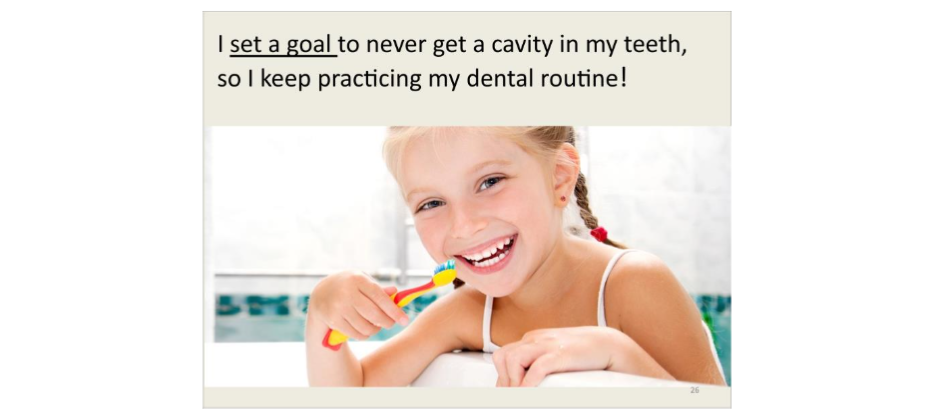
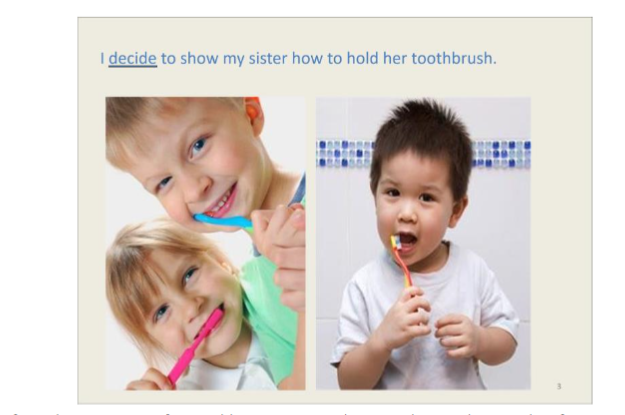
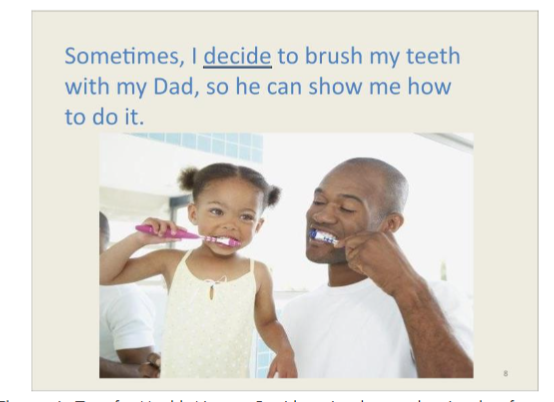
Researchers employed an observational design to evaluate the number of times that children and their parents interacted with objects and with each other in the waiting room of the dental clinic. Researchers also quantified child engagement with a video that showed four continuous Electronic Texts for Health Literacy© projected onto a television screen without sound. This necessitated the waiting room participants to be able to observe and read the screen for the health-related messages about oral health. Each visual textual story was written with simple sentences using skill-based words (e.g., making decisions, setting goals) and realistic action-oriented photographs depicting oral health hygiene and dental practices.
SETTING
The pilot study took place in a small waiting room at a pediatric dental clinic in a midwestern town with a university. The dental clinic served the broader community with 13% of families living below the poverty line and 3 to 11% of families receiving federal assistance. Observations of child-parent interactions and a visual inventory of waiting room objects were made during two subsequent Tuesday mornings for a total of five hours. A census of objects included toys, puzzles, print material, technology, and office furniture. Children could freely access these objects prior to their dental checkup.
PROCEDURES
Researchers (n = 2) did not have prior knowledge about the patients in the dental clinic or prior information about the pediatric dentist and staff. The researchers were quiet visitors in the dental clinic with the aim of observing children and their parents with discretion and anonymity. Researchers sat in the waiting room during four transitional phases: Phase 1. Family check-in at the dental office window; Phase 2. Free time for the family in the waiting room; Phase 3. Dental checkup with the dentist and dental hygienist; and Phase 4. Family departure from the clinic.
The researchers observed 16 families directly during Phases 1, 2, and 4. During Phase 2, researchers observed families then discretely completed the Dental Waiting Room Observation Form. Researchers were asked to be unobtrusive and even nonchalant when parents gazed in their direction. If a child approached or talked to the researchers, they were instructed to respond to the child but not initiate more interactions with the child. The researchers were asked not to sit near each other and not to talk verbally or nonverbally with each other during their time in the waiting room. Phase 3 was not observed by the researchers once the family left the waiting room to complete the dental checkup. However, when the family returned to the waiting room during Phase 4, a postcard was given to them at the front desk by the clinic receptionist prior to the family departing the clinic. The postcard indicated that two undergraduate students had been observing “television viewing activities in the waiting room”. The postcard contained contact information for communicating with the principal investigator (PI) in case there were any issues or concerns – or the need to ask the PI a question.
OBSERVATIONAL VARIABLES
The targeted behavior to be observed was child play in the waiting room. Researcher observed interactions with any object serving as a toy, reading material, or plaything that was already in the dental waiting room upon entering the space. Researchers monitored and tallied any glances that children or parents made toward the television screen which showed a visual textual story of children practicing oral health habits. Looking at the television screen was defined as making eye contact with the visual story. Verbal interactions with a peer or a parent about the oral health photo story was coded on the observation form. The photo story, cowritten by the researcher and two undergraduate health education students, consisted of 12 total slides with each slide showing a child-centric photograph and a skill-based sentence that was typed in a 20-point font. Four different stories were pooled together into one video separated by four title pages with a 22-point font. The video was shown on the television screen in the waiting room in a repeating loop from a computer in the clinic office. There was no volume or sound on the iMovie. The electronic texts showed a written script and photographs of children interacting with their peers and/or parents while doing oral health hygiene and dental behaviors.
Upon entering the waiting room, the researchers sat quietly in a chair to observe children who were waiting for their dental check-up. Research observations started immediately when the first family entered the clinic. The mean length of observation for each family dyad or triad was 10.8 minutes (range 10 to 12 minutes). To maintain the naturalistic environment of the dental clinic, researchers used checkmarks to indicate certain actions of the children which were listed on the Dental Waiting Room Observation Form. The researchers did not interact with any child or parent while making observations in the waiting room. No direct or formal interactions were expected, planned, or encouraged with the children and their families.
RELIABILITY
All of the research observations were guided by a procedural checklist adapted from the Implementation of Social Stories outlined by Gray and Agoratus. Inter-observer reliability was measured. The principal investigator provided reliability training to both research assistants by demonstrating the use of the procedural checklist. Reliability was determined a priori with a standard to be above 80%. Inter-observer reliability was assessed for the two observation sessions that were scheduled one week apart. Reliability was calculated by dividing agreements by the total number of agreements and disagreements and multiplying the sum by 100. Inter-observer reliability was 100% for week 1 and 96% (range 90-100) for week 2 observations.
INSTRUMENTATION
The four electronic texts spooled into one video were aligned to the second edition of the National Health Education Standards (NHES) for preK to grade 5. We also included an electronic text aligned to the curriculum standards for grades 6 to 12 for any parents who may not be strong readers. The names of the four electronic texts included Daily Decisions for My Teeth; My Dental Routine; Teeth to Treasure; and My Six-Month Checkup at the Dentist. Three of the four Electronic Texts for Health Literacy© were focused on skill-based curriculum standards which included the ability to use decision making (NHES 5) and goal setting (NHES 6) to enhance health and the ability to practice health-enhancing behaviors that avoid or reduce health risks (NHES 7).
DATA ANALYSIS
Observational data were collected and tallied as descriptive research. Data were aggregated on the Dental Waiting Room Observation Form via frequency marks then tallied later after leaving the dental office. No descriptive data were associated with individuals or families with one exception. Researchers described clothing that children wore by colors and type of clothing in case there was more than one family in the waiting room at a time. This enabled researchers to attribute behaviors appropriately on the frequency chart for the duration of their observations.
Results
Over the five hours of observation (i.e., 300 minutes), there were 13 minutes of transitional time for the families in the waiting room, which also translated to down time for the researchers. Results showed that children (n=16) read literature in the waiting room for 14 minutes which included 7 minutes talking about what they read with their parents or siblings. Children wrote for 10 minutes using materials provided in the waiting room or wrote on personal materials such as school work. Children also used digital technologies such as a tablet for 3 minutes; a music device for 1 minute; and a phone for 24 minutes with 11 additional minutes talking on the phone. Children were observed moving for 100 minutes of whole-body physical activity which included 10 minutes of play using only their lower-body (e.g., standing or walking) and 10 minutes of play using only their upper-body (e.g., puzzles). Children viewed some portions of the Electronic Texts for Health Literacy© on the television screen for a total of 117 minutes. Interactions with parents about the digital content occurred for 31 additional minutes that children were observed. In short, the cumulative time that 16 families spent in the waiting room over the five observational hours included the viewing of the oral health literacy content on the television screen (117 minutes), followed in descending order by physical movement and play with toys (100 minutes), digital technologies (39 minutes), reading and writing with print-based materials (31 minutes), and transitions (13 minutes).
Discussion
This pilot study was designed to investigate the observations of child-parent interactions in a dental clinic and the number and type of objects and technologies with which children interacted in the dental waiting room. The intent in observing these interactions was to determine if children would be interested in a newly installed video that portrayed children practicing oral health hygiene habits and going to the dentist for a six-month checkup. There was no audio component with the video to ensure that children would have a visual-only experience versus a bimodal experience of watching and hearing the video. The exploratory nature of the pilot study did not logically permit volume or sound on the television screen since we wanted to see if children would be hooked by the child-centric photographs and the lexicon of dental words as a visual nudge. We also wanted to reduce interferences in hearing child-parent interactions during the waiting room observations. Some children did not glance at the screen, but we also did not expect children to ignore the television screen while playing in the waiting room.
This pilot study is similar to a study by O’Malley and colleagues who used an audio storybook in two formats (e.g., a hard copy book and digital video disk) to deliver oral health promotion messages to parents and children, which included how to brush teeth (n= 13, 54.2%), the importance of oral health hygiene (n= 5, 20.8%), how to not be afraid of the dentist when visiting the dentist regularly (n= 4, 16.7%), and ways to limit sugar in the diet (n=2, 8.3%). Although we didn’t test for an effect from a specific intervention on children in the waiting room, we explored the conditions for implementing an oral health video for the first time to determine if the dental practice could offer a supportive learning environment for families in the future.
Research has shown that children “learn through modelling the behaviors of others, whether real or virtual”. Therefore, this pilot study afforded us an opportunity to implement a video containing four Electronic Texts for Health Literacy© which focused on children learning about social norms for oral health through the virtual modelling of others. Follow-up interactions with the dentist and dental hygienist could be educational opportunities for children to discuss what they may have learned in the waiting room from a video recording. Any conversations that children have with parents or health care providers about their oral health could potentially increase learning in real time about their functional health knowledge and behaviors, and possibly their oral health literacy skills. Abu-Rabia and Yaari suggested that environmental conditions explain from 25% to 40% of the variance in learning achievement for grades 1 through 3 with a correlation of .35 found between the learning environment and learning achievement. Based on this finding, we hypothesized that access to oral health promotion materials that were highly visual in words and pictures could prime or mediate the verbal interaction that could take place once the child was called back for their checkup with the dental hygienist and dentist. Understanding the waiting room activities and behaviors of the children (and their parents) was the main focus of the current study so we could continue to build on and modify the design of the oral health literacy materials. We plan to design an experimental study to see the extent to which educational materials offered prior to the checkup could have an impact on the oral health knowledge and behaviors of children from the beginning to the end of their office visit.
In the future, the use of a 30-item word recognition test called the Rapid Estimate of Adult Literacy in Dentistry (REALD-30) may be helpful to determine parental health literacy and oral health knowledge since both are important predictors of oral health status. Van, Lee, Baker, and Divaris conducted structured interviews from a low-income population of female caregivers and their children to investigate the impact of oral health literacy on oral health outcomes in early childhood. Lower literacy levels of the caregivers were associated with worse oral health status of the children. Caregivers who scored the lowest literacy scores (0 low to 30 high) on the REALD-30 also reported lack of daily tooth brushing and putting their infant to bed with a bottle. A word recognition test like the REALD-30 is important in assessing oral health vocabulary about dental hygiene and dental care since parents will be using and modeling this language (or not) in home situations. Parental health literacy and oral health knowledge have been studied as important predictors of functional health literacy of children. For example, researchers found that REALD-30 scores correlated well with functional health literacy and reading comprehension. This is important because dental hygienists and dentists have limited time to offer health-promoting messages in a clinical practice, so access to high quality picture books and electronic (digital) curricula can increase oral health education and oral health literacy for children. A shift to literature-based dentistry can also build children’s familiarity with dental professionals and clinical environments before, during, and after their dental checkup. Because health care environments are “textually-mediated” social worlds where consent forms and information leaflets are two of the many text types used in health care interactions, we envision the development of question prompts that dentists and dental hygienists could use during their brief chats with children to continue the learning that patients may have experienced by watching a video or reading a high-quality book about dentistry in the waiting room.
Although this pilot study provides preliminary findings with little to no applicability to other dental clinics, there were several benefits for the children and their families who participated. First, children were exposed to an educational video showing peers of a similar age brushing, flossing, and taking care of their teeth via realistic photographs. Any other children who visited the dental clinic outside the research time interval were not exposed to the educational messaging. Second, children were free to interact with several play items in the waiting room without interruptions or constraints, and they were able to engage in oral communication with their parents and other children. This is why we showed the video without sound. By keeping conditions for a naturalistic pilot study, we were better able to track if children interacted with parents. Studies show that children will benefit from learning oral health vocabulary and knowledge when the learning environment is supportive and when there is an availability of reading materials. Besides important conversations about oral health with their parents, the clinic should provide toys such as large toothbrush props and toys to help children initiate and act like a dentist or dental hygienist in the waiting room. This could also be helpful for building background information for their dental cleanings and daily oral hygiene practices.
Conclusion
Observations of a pediatric dental clinic provided important insights into the human interactions, activities, and affordances available to children and their parents in the waiting room. Based on total observations in minutes, children chose to view an oral health video on a television screen more often than physical movement and play with toys, digital technologies, and print-based literacy materials. This pilot study provided a foundational step in quantifying the interactive climate established by children and their parents when selecting activities in the waiting room prior to visiting with the dentist and dental hygienist. Implications for health literacy were discussed, including the value of providing children and their families with educational messages in the waiting room about oral health hygiene where they may not currently exist. This explicit improvement will fulfill the global call to action for dentists to offer more oral health education in their clinics for children and their parents.
Conflict of Interest Statement:
The author has no conflicts of interest to declare.
Funding Statement:
The Principal Investigator (PI) received $500 to conduct the pilot study through the Center for Human Development, Learning, & Technology in the College of Education, Health, & Society at Miami University, Oxford, Ohio.
Acknowledgements:
Several undergraduate students enrolled in an independent study with the PI to participate in various aspects of the pilot study. Ellen Justus and Megan Rigot served as research observers at the dental clinic. Brooke Bogdan assisted with data reduction. Ellen Justus revised the data collection form. The visual textual stories on dental hygiene and dental checkups were written by Valerie Ubbes, Ellen Justus, and Tulsi Patel using an early prototype of an Electronic Text for Health Literacy© developed by the lead author. The electronic texts that were spooled together and used in the current pilot study are available by writing the PI at [email protected]. Additional examples of Electronic Texts for Health Literacy© on many health topics can be accessed at https://dlp.lib.miamioh.edu/healthliteracy/
References:
- Wordley V, Vasthare R, Lee H. Oral health for all schools: a call to integrate oral health in school systems. Journal of School Health. 2024;94:1105-1106. doi:10.1111/josh.13450
- Kim S, Kim SY. Effectiveness of school-based oral health education for children and adolescents in low-and middle-income countries: A systematic review and meta-analysis. 2024. Asia Pacific Journal of Public Health. doi:10.1177/10105395241240959
- FDI World Dental Federation. Study protocol seeks to measure the impact of the Brush Day & Night 21-Day Toothbrushing Programme in Schools. 4/14/2020. https://www.fdiworlddental.org/study-protocol-seeks-measure-impact-brush-day-night-21-day-toothbrushing-programme-schools.
- Office of Disease Prevention and Health Promotion. (n.d.). Oral health care. Healthy People 2030. U.S. Department of Health and Human Services. https://odphp.health.gov/healthypeople/objectives-and-data/browse-objectives/health-care/increase-use-oral-health-care-system-oh-08/infographic
- National Institutes of Health. Oral Health in America: Advances and Challenges. US Department of Health and Human Services, Bethesda 2021.
- Office of Disease Prevention and Health Promotion. Fourth grader reading skills. Healthy People 2030. U.S. Department of Health and Human Services. https://odphp.health.gov/healthypeople/objectives-and-data/browse-objectives/schools/increase-proportion-4th-graders-reading-skills-or-above-proficient-level-ah-05/infographic
- Ubbes VA, Miner, M, Karthikeyan M. Moving toward literature-based dentistry to boost oral health literacy of children: Interprofessional partnerships between dentists, doctors, and librarians. In Naomi Lesley & Sarah L. Hardstaff (Eds.) Health Care in Children’s Media. 2025: 162-195, Jackson MS: University Press of Mississippi. ISBN 978-1-4968-5786-6.
- Aida J. Oral health and nutrition: Epidemiology, clinical, and social aspects. Journal of Nutrition Science and Vitaminology. 2022;68:S26-S27.
- Ubbes VA, Bailey A. Management of chronic diseases through oral health and nutrition strategies. Archives of Clinical and Biomedical Research. 2026;10:49-59. doi:10.26502/acbr.50170508
- Castillo W, Singer J. Missing care, missing class: analyzing the overlooked relationship between unmet healthcare needs and absenteeism. Journal of School Health. 2026;96(1):e70082, doi:10.1111/josh.70082
- Kelekar U, Naavaal S. Hours lost to planned and unplanned dental visits among US adults. Prevention of Chronic Disease. 2018;15:E04. doi:10.5888/pcd15.170225
- Lewallen TC, Hunt H, Potts-Datema W, Zaza S, Giles W. The Whole School, Whole Community, Whole Child Model: a new approach for improving educational attainment and healthy development for students. Journal of School Health. 2015. 85(11):729-739. doi:17461561
- Association of State and Territorial Dental Directors (ASTDD). Dental Public Health Policy Committee and School and Adolescent Oral Health Committee. Integrating Oral Health into School Health Education Curricula Using the Whole School, Whole Community, and Whole Child School Health Model Policy Statement. [Monograph on the Internet]. ASTDD, Reno, NV. 15 pp. Available from http://www.astdd.org
- U.S. Centers for Disease Control and Prevention. Oral health data systems. 2026. https://www.cdc.gov/oral-health-data-systems/index.html
- Ubbes VA, Whitesel S. Use of an eBook for Oral Health Literacy© curriculum to elicit functional health knowledge, decision making, and goal setting among school-aged children. International Electronic Journal of Elementary Education. 2022; 15(2):145-159. doi:10.26822/iejee.2023.286
- Ubbes VA, Miranda MA, O’Connell M. Oral health knowledge, reading comprehension, and behavior change after implementing the eBook for Oral Health Literacy© curriculum with 3rd graders during COVID-19: Implication for school health education. International Electronic Journal of Elementary Education. 2025;17(5):642-61. doi:10.26822/iejee.2025.405
- National Academies of Sciences, Engineering, and Medicine. 2024. Whole-Person Oral Health Education: Proceedings of a Workshop. Washington, DC: The National Academies Press. doi:10.17226/27761
- Ogenchuk M, Spurr S, Bally J. Caring for kids where they live: interprofessional collaboration in teaching and learning in school settings. Nurse Education in Practice. 2014;14(3):293-298. doi:10.1016/j.nepr.2013.11.003
- Ma S, Serban N, Dehghanian A, Tomar SL. The impact of dentists’ availability in delivering dental care in Florida elementary schools. Journal of Public Health Dentistry. 2023;83(1):60-68. doi:10.1111/jphd.12551
- Hammersmith KJ, Baer AC, Irwin MK, Townsend JA. Overview and preliminary outcomes of a children’s hospital sponsored, training program affiliated, school based dental clinic. Journal of School Health. 2026;96 (4):e70127. doi:10.1111/josh.70127
- Soleimanpour S, Cushing K, Christensen J, Ng S, Yang J, Saphir M, Geierstanger S, Even M, Brey L. Findings from the 2022 National Census of School-Based Health Centers. Washington, DC: School-Based Health Alliance.
- Gray CA. (2000). The new social story book™, revised and expanded 10th anniversary edition: Over 150 social stories that teach everyday social skills to children with autism or Asperger’s syndrome and their peers. Arlington, TX: Future Horizons.
- Agoratus L. The new social story book: illustrated edition. The Exceptional Parent. 2001;31(6):88.
- Joint Committee on National Health Education Standards. The National Health Education Standards: Achieving Excellence (2nd edition). 2007; The American Cancer Society.
- O’Malley L, Burnside G, Coffey M, Adair P, Robinson L, Pine C. An evaluation of a storybook targeting parental attitudes, intention and self-efficacy to change their child’s oral health behavior. Health Psychology. 2017; 36:152-159.
- Farrow C, Belcher E, Coulthard H, Thomas JM, Lumsden J, Hakobyan L, Haycraft E. Using repeated visual exposure, rewards and modelling in a mobile application to increase vegetable acceptance in children. Appetite. 2019; 141:104327.
- Abu-Rabia S, Yaari, I. Parent’s attitudes and behavior, the learning environment and their influence on children’s early reading achievement. Open Journal of Modern Linguistics. 2012;2(4):170-179.
- Vann WF Jr, Lee JY, Baker D, Divaris K. Oral health literacy among female caregivers: impact on oral health outcomes in early childhood. Journal of Dental Research. 2010;89(12):1395-1400. doi:10.1177/0022034510379601
- Lee JY, Rozier RG, Lee SYD, Bender D, Ruiz RE. Development of a word recognition instrument to test health literacy in dentistry: The REALD-30 – A brief communication. Journal of Public Health Dentistry. 2007;67(2):94-98. doi:10.1111/j.1752-7325.2007.00021.x
- Papen U. Literacy, learning, and health: A social practices view of health literacy. Literacy and Numeracy Studies. 2009;16(2):19-34.