


Perception of Time After Loss: Insights for Clinicians
Perception of time perspective in the first year after the loss of a loved one
Larysa Rybyk1*, Volodymyr Medvedev2
- Head of the International Association of Psychologists for Grief and Bereavement.
- Professor of the Department of Legal Psychology, National Academy of Internal Affairs, Doctor of Psychological Sciences.
*Email: [email protected]
OPEN ACCESS
PUBLISHED: 31 February 2025
CITATION: Rybyk, L., Medvedev, V., 2025. Perception of time perspective in the first year after the loss of a loved one. Medical Research Archives, [online] 13(2). https://doi.org/10.18103/mra.v13i2.6359
COPYRIGHT: © 2025 European Society of Medicine. This is an open-access article distributed under the terms of the Creative Commons Attribution License, which permits unrestricted use, distribution, and reproduction in any medium, provided the original author and source are credited.
DOI: https://doi.org/10.18103/mra.v13i2.6359
ISSN: 2375-1924
ABSTRACT
Background: This study examines the perception of time perspective in individuals who have experienced the loss of a loved one due to military conflict. It explores the disruption of subjective time perception and its psychological implications in the grieving process. The study distinguishes between expected deaths due to illness and sudden losses caused by military actions or other external factors. It further analyses the impact of time Perspective Theory.
Methods: A study was conducted in 2024 among Ukrainians, involving 64 participants; 63 were women, and one was a man, aged between 22 and 64 years. Statistical methods, including ANOVA, descriptive statistics and comparative analysis, were applied using Jamovi software to determine significant differences in time perception across groups.
Results: Respondents grieving for up to six months showed strong future focus (M=3.74), reflecting emotional ties to shared plans. Those in the 6-12 month period exhibited deep distress with negative past perception but retained positive memories. In the 1-5 year group, both negative and positive past factors (M=3.16) and high future orientation (M=3.48) suggested reminiscence or escapism. After five years, respondents had a balanced time perception with reduced fatalism. Loss type also influenced grief: the highest negative past perception was among those who lost loved ones to suicide (M=3.57) or drugs (M=3.70), while battlefield losses correlated with strong future focus (M=3.59) and the lowest fatalistic present scores (M=2.52).
Conclusion: This pilot study examined the perception of time perspective among individuals who experienced the sudden loss of a loved one during military conflict, identifying significant differences based on the duration and type of loss, with findings suggesting that adaptation over time leads to a more balanced perception of the past, present, and future. Future research should explore how age, family relationships, and attachment to the deceased influence mourners’ time perspective in both short- and long-term contexts.
Keywords: time perspective, military losses, loss of a loved one, grief experience, perception of time perspective, time perspective theory, losses in wartime conditions.
THE EUROPEAN SOCIETY OF MEDICINE
Medical Research Archives, Volume 13 Issue 2
RESEARCH ARTICLE
Introduction
Death is an inherent part of life, and sooner or later, everyone faces loss. The loss of a loved one can happen naturally, allowing for preparation and farewell, but it can also be violent and sudden, especially in times of war. The psychological effects of grief have been extensively studied, revealing significant impacts on emotional, cognitive, and behavioural functioning. Loss creates a new psychological reality where the object of affection no longer exists. Communication ceases, shared future plans vanish, leaving only memories, and the bereaved must adapt to a new life without their loved ones. Loss during war further exacerbates this impact by destroying the sense of security that is typically reinforced by stable attachment relationships. However, having sufficient family and social support allows individuals to adapt to new circumstances and reorganize their lives based on fundamental conditions that restore a sense of security and provide hope for the future.
Adaptation is based on experiences, while the present creates the context in which these experiences are applied. If the current living conditions allow for the restoration of security, the formation of new social connections, or the transformation of existing ones, individuals gradually adapt, changing their identity, forming new social roles, and shaping their future. Pain and suffering associated with the multiple losses of war such as the loss of security, the familiar way of life, loved ones, and forced displacement often lead to disruptions in time perception, affecting the sense of the past, present, and future. The past can be perceived as a source of painful memories, the present as chaotic and meaningless, and the future as uncertain and unpredictable. The Time Perspective Framework suggests that temporal frames influence an individual’s actions, judgments, and decisions. Time perspective has been linked with psychosocial outcomes of trauma and loss, such as posttraumatic stress disorder.
Furthermore, the concept of mental time travel, which involves the ability to mentally project oneself into the past or future, is closely linked to episodic memory and future planning. Neuroimaging studies have shown that remembering experiences and imagining future ones activate similar brain regions, suggesting a shared neural basis for these processes. These studies highlight the complex relationship between trauma, mental health, and time perception, highlighting the need for further research in this area. At the same time, resilience, as a general trait, enables individuals to accept various life situations and take responsibility for their lives. In the case of losing a loved one, resilience manifests as the ability to live through grief, face pain, accept fate, and move forward. This is what Maddi calls existential courage. It is resilience that allows individuals to interact with the world, avoiding a fatalistic stance. No one chooses such a fate, shattering the perception of the world as predictable and disrupting the future. Thus, existential courage provides the stability needed to move forward.
Additionally, experiencing the loss of a loved one confronts individuals with death and the realization of their own mortality, which influences their attitudes toward life. For Ukrainians, the daily threat of war shapes a new attitude toward death. War has significantly influenced the perception of death, making it more ambivalent with a certain shift toward a positive attitude. This suggests that the constant threat of war is shaping a new perspective on death among Ukrainians. The fear of death correlates with time perception, manifesting in adaptive, defensive, or maladaptive views on death. This aspect of future perception through the lens of death anxiety has been previously studied among those who were in concentration camps during World War II. They did not choose their fate to live during war, but they could choose whether to live in the present, immerse themselves in memories when everything was fine and their loved ones were alive and near, or dwell on the terrible moment in the past when the war began. Some may have escaped into hopes of imminent rescue in the future, experiencing daily despair.
Subjective time perception is the foundation of human existence, providing a sense of continuity between the past, present, and future. This perception can be disrupted by difficult life events, which Chandler defines as “changes,” while other researchers refer to them as “interruptions” of continuity. Personality resilience is a key aspect of personal development and self-realization. The ability to emotionally process important events, analyze them, and integrate them into autobiographical memory involves active cognitive work. This process enables individuals to incorporate their experiences into a cohesive life narrative, maintaining a connection between the past and the present. As a result, a unique personality is formed—one that not only acknowledges its own identity but is also ready to take responsibility for experiences, current choices, and future aspirations.
Philip Zimbardo’s Time Perspective Theory provides an essential framework for studying changes in time perception. A balanced temporal perspective involves a harmonious combination of positive aspects of the past, present, and future. However, in the context of war, when tomorrow may not come and the present is filled with fear, the study is based on two hypotheses:
- We assumed that the perception of time perspective changes over time after the loss.
- We assumed that there are differences in the perception of time perspective depending on the type of loss.
The Aim
The aim of this pilot study is to analyse the impact of types of loss of a loved one on the perception of temporal perspective from the prolonged perspective.
Materials and Methods
A study was conducted in 2024 among Ukrainians, involving 64 participants who sought assistance from our organization. These individuals experienced various types of loss, including combat-related deaths, illness-related deaths, disappearances, sudden deaths, suicides, and fatalities due to substance use. We selected participants currently residing in Ukraine, as those who fled abroad, even temporarily, often experience the additional psychological burden of displacement and adaptation to a new country. This, in turn, influences their perception of psychological time. Among the participants, 63 were women, and one was a man, aged between 22 and 64 years.
In the demographic questionnaire, we included a question about the type of loss, dividing it into the following groups:
- Killed in battle: This includes military personnel and medical workers who were directly killed on the battlefield.
- Death due to a severe illness: This category includes individuals who had long-term, life-limiting illnesses.
- Missing in action: This includes military personnel who went missing in battle and civilians who disappeared during the occupation.
- Tragic accident/sudden death: This category includes individuals who died suddenly due to causes such as heart attacks or car accidents.
- Suicide: Individuals who took their own lives.
- Killed as a result of military actions: Those who died during bombings of civilian areas.
- Death from drug use: This category includes those who died from drug-related causes.
Additionally, we recorded the period since the loss:
- Less than 6 months ago
- 6-12 months ago
- 1-5 years ago
- 5-10 years ago
- More than 10 years ago
To analyze the impact of loss on time perception, we utilized the Ukrainian adaptation of Zimbardo’s Time Perspective Questionnaire (ZTPI). This instrument diagnoses an individual’s subjective perception of past, present, and future time perception, in which past, present, and future are imbued with personal meaning. Individuals tend to focus on one temporal dimension more than others, shaping their orientation toward either the past, present, or future. The questionnaire consists of 56 items, with responses classified on a 5-point Likert scale. The study measured five factors:
- Negative past
- Positive past
- Hedonistic present
- Fatalistic present
- Future orientation
Statistical methods, including ANOVA, descriptive statistics and comparative analysis, were applied using Jamovi software to determine significant differences in time perception across groups.
Results
PARTICIPANT CHARACTERISTICS
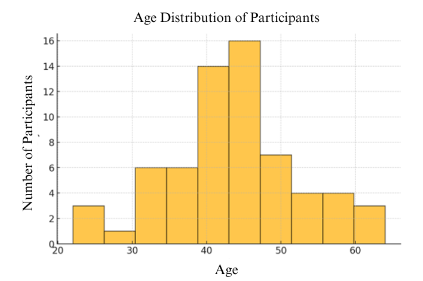
The participants were Ukrainian-speaking, predominantly women (98.4%), aged between 22 and 64 years. The average age of the survey participants was 43.3 years. Among them, 63 women had an average age of 43.3 years, and one male participant was 42 years old. The age distribution of participants is presented in Figure 1.
The majority of participants have a higher education degree, making it the most common education level among respondents (57 individuals). Other education categories are represented by a smaller number of participants but are still present: 5 individuals completed college, 1 person finished secondary school, and 1 person completed postgraduate studies.
The most common type of loss reported was the loss of a spouse/partner, with 23.4% of respondents indicating this category. The types of relationship are presented in Figure 2.
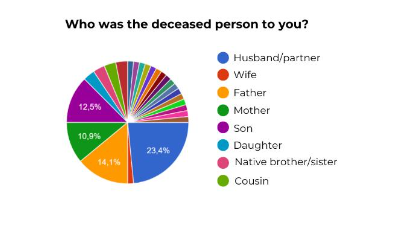
The second most common category was parental loss, with 14.1% experiencing the loss of a father and 10.9% the loss of a mother. The third-largest category was child loss, with 12.5% reporting the loss of a son and 3.1% the loss of a daughter. For the question ‘Who was the deceased person to you?’, we offered 7 options, but it was important for the participants to specify exactly who they lost, and in the additional ‘other’ field, we received the following answers: besides family and relative, the answers included a close friend, a family friend, a mate, a neighbor, a fellow soldier, a company commander.
DESCRIPTIVE STATISTICS OF GROUPS BY TIME OF LOSS
For the group of respondents experiencing loss for a period of up to 6 months, there is a prevalence of the future factor (M=3.74), which indicates the presence of goals and plans for the future (this may also suggest that the plans for the future are connected to the loved one, and the mourners are not yet ready to abandon their shared plans). The results are presented in Table 1.
| Time of loss | Negative past | Hedonistic present | Future | Positive past | Fatalistic present |
|---|---|---|---|---|---|
| < 6 months ago | 3.12 | 2.91 | 3.74 | 3.23 | 2.79 |
| 6-12 months ago | 3.62 | 2.87 | 3.39 | 3.26 | 2.91 |
| 1-5 years ago | 3.16 | 2.83 | 3.48 | 3.16 | 2.81 |
| 5-10 years ago | 3.37 | 3.04 | 3.36 | 3.37 | 2.98 |
| > 10 years ago | 3.30 | 3.13 | 3.31 | 3.08 | 2.48 |
Standard deviation < 6 months ago: 0.579, 0.278, 0.362, 0.321, 0.381; 6-12 months ago: 0.603, 0.313, 0.343, 0.294, 0.494; 1-5 years ago: 0.582, 0.428, 0.525, 0.534, 0.552; 5-10 years ago: 0.375, 0.403, 0.240, 0.269, 0.656; > 10 years ago: 0.412, 0.443, 0.322, 0.532, 0.750.
For the group of respondents experiencing loss for a period of 6 to 12 months, the data indicates a predominance of the negative past factor, signifying the presence of traumatic experiences and corresponding severe emotional distress. However, there is also an above-average level for the future and positive past factors, which indicates not only the existence of traumatic memories regarding the past but also sentimental (positive past) memories and efforts to achieve goals in the future (future). At the same time, the lowest scores were observed for the second factor hedonistic present (M=2.87), which shows the level of enjoyment of the moment and a risky attitude toward life, and the fatalistic present factor (M=2.91), which corresponds to the level of helplessness in everyday life. Thus, respondents in this group exhibit a sufficient value orientation toward their lives, without excessive risk to themselves (hedonistic present), and a sufficient level of confidence in their own abilities to avoid feeling helpless (fatalistic present).
For the group of respondents experiencing loss for a period of 1 to 5 years, there is a nearly identical value for the hedonistic present factor (M=2.83) and the fatalistic present factor (M=2.81). These scores are above the average level, indicating an adequate perception of the present. However, with completely identical and quite high scores for the negative and positive past factors (M=3.16) and the highest factor among all groups of respondents regarding the perception of the future (M=3.48), this may suggest an escape from reality into memories or dreams.
For the group of respondents experiencing loss for a period of 5 to 10 years, as well as for the group with more than 10 years of loss, there is a harmonious perception of the past, future, and hedonistic present, accompanied by a lower perception of the fatalistic present.
DESCRIPTIVE STATISTICS OF GROUPS BY TYPE OF LOSS
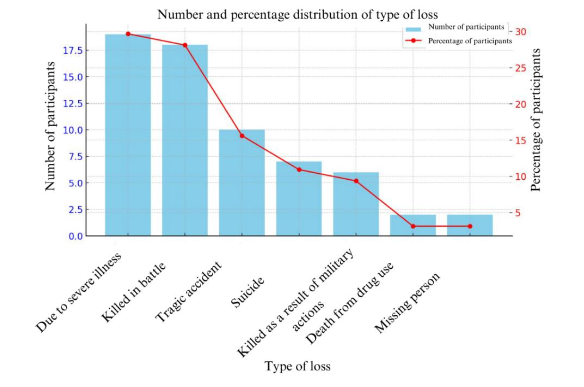
Most Common Causes of Loss: The largest proportion of losses is associated with severe illness (29.7%) and battlefield casualties (28.1%). Tragic accidents account for 15.6% of all losses. Suicides constitute 10.9%, while civilian losses due to military actions make up 9.4%. The nature of loss significantly affects respondents’ psychological states (The results are presented in Figure 3 and Table 2).
| Type of loss | Negative past | Hedonistic present | Future | Positive past | Fatalistic present |
|---|---|---|---|---|---|
| Died on the battlefield | 3.05 | 2.77 | 3.59 | 3.11 | 2.52 |
| Due to a serious illness | 3.19 | 3.02 | 3.40 | 3.15 | 2.88 |
| Missing | 2.55 | 3.20 | 3.50 | 3.44 | 2.67 |
| Tragic accident | 3.30 | 2.97 | 3.58 | 3.49 | 3.01 |
| Suicide | 3.57 | 2.78 | 3.30 | 3.08 | 2.65 |
| Civilians who died during shelling | 3.57 | 2.84 | 3.64 | 3.28 | 3.15 |
| Death from drugs | 3.70 | 3.33 | 3.04 | 2.83 | 2.78 |
Loss on the Battlefield: The lowest “Fatalistic Present” (M=2.52) and a high “Future” score (M=3.59) suggest that despite the loss, respondents remain resilient and forward-looking. Loss Due to Illness: “Hedonistic Present” (M=3.02) is relatively high, indicating that individuals may cope by focusing on present enjoyment. “Fatalistic Present” (M=2.88) remains low, suggesting an ability to adapt. Missing Persons: The lowest “Negative Past” score (M=2.55) may indicate uncertainty rather than closure, leading to a different emotional experience compared to death. “Hedonistic Present” (M=3.20) is the highest among all groups, suggesting that some may adopt a present-focused mindset as a coping mechanism. Tragic Accidents & Suicide: The “Negative Past” is highest for these groups (M=3.30 for accidents, M=3.57 for suicide), reflecting severe trauma. “Hedonistic Present” (M=2.97 for accidents, M=2.78 for suicide) remains relatively low, suggesting that these individuals may struggle to engage in present-focused activities. Civilians Dying in Shelling: A high “Negative Past” score (M=3.57) reflects deep trauma. “Fatalistic Present” (M=3.15) is the highest among all groups, suggesting increased feelings of helplessness. Death from Drugs: The highest “Negative Past” (M=3.70) suggests a strong sense of regret or unresolved emotions. A relatively high “Hedonistic Present” (M=3.33) may indicate attempts to cope through present-focused behaviors.
Discussion
The interviews showed a sufficiently balanced system of time perception. This finding aligns with previous research on temporal perspectives and their psychological impact on individuals experiencing traumatic events. The perception of time plays a crucial role in coping mechanisms and emotional well-being on war-affected populations, where a sense of helplessness and resignation often emerges as a coping mechanism from drug use. This corresponds with studies indicating that traumatic loss, particularly due to stigmatized causes such as substance abuse, intensifies feelings of shame and social isolation. Death from drugs is a stigmatized death. In Ukraine, as in many other countries worldwide, drug addiction receives attention in the medical field as a dependency disease, as well as in the social sphere, since it is a problem of social interaction. However, military actions have their own impact on the formation of drug addiction and the grieving process in families of those who have died from the use of psychoactive substances. In the near future, we anticipate changes in the psychological state of these families. However, now we have soldiers who died from drug use, and this is a different story. There is no long-term struggle with substances to relieve pain, to fight fear, or an attempt to sleep in hell because the front line is always hell, and yet, rest is needed. The psychological implications of substance use in combat zones have been studied extensively, revealing how soldiers resort to substances to manage extreme stress and trauma. In the near future, we anticipate changes in the psychological state of these families.
Regarding the first category, which concerns the loss of our soldiers in battle, there are high levels of grief. Research on collective memory and national identity suggests that while grief over fallen soldiers is profound, it is often intertwined with narratives of heroism and sacrifice. There is no difficulty for loved ones to recognize the bodies, and this is an additional factor of trauma during the loss. However, there is also honor for the heroes and positive memories of peaceful life in the past. Studies on post-traumatic growth show that families often find solace in collective recognition and commemoration of their loved ones.
We have separated tragic accident/sudden death and civilian deaths as a result of military actions. In the first case, it includes road traffic accidents, sudden cardiac death, etc. In the second category, it refers to those who died after city bombings and during occupation. The psychological aftermath of sudden deaths often involves heightened shock and prolonged grief, as there is no time for psychological preparation. In contrast, the loss of civilians due to military actions contributes to collective trauma, influencing the broader.
The second category reflects the results of families whose loved ones were seriously ill. During the care process, these people learned to appreciate life, to find joy in small things, and to honor the last moments. Studies on anticipatory grief highlight how caregivers of terminally ill individuals develop resilience and a deeper appreciation for life despite their suffering. This aligns with findings on meaning-making in bereavement, where individuals reconstruct their narratives to find purpose in loss.
Pay attention to the third category. These are the results of those whose loved ones went missing. We had another study on reactions to ambiguous loss, and we were struck by the level of hope. Ambiguous loss, a concept introduced by Pauline Boss (1999), refers to the unique psychological distress experienced when a loved one is missing, leaving families in a state of unresolved grief. As we can see from these results, there is only a positive past, plans for the future, and a positive perception of the present. In reality, there are many stories of miraculous rescues, and every woman is waiting for the return of her son, husband, or father. Hope in these cases functions as both a psychological coping mechanism and a means of sustaining resilience.
The fifth category is death by suicide. We also expect changes here in the near future, as the suicide rate is rising daily. These are men who could not withstand the horrors of war. Suicide rates among veterans and active-duty soldiers have been extensively studied, with findings indicating that combat exposure, PTSD, and moral injury significantly increase the risk. The unique aspect of soldiers is that there are businessmen, programmers, singers, dancers, drivers, doctors… Men from various professions went to defend the country, but they were not prepared. Research on civilian-to-soldier transitions has shown that those without prior military training face greater psychological challenges and a higher risk of trauma.
What is shown in movies cannot be compared to reality. Additionally, there are suicides among psychologists. The mental health burden on professionals providing psychological support in war zones is a growing concern, with studies highlighting burnout and secondary trauma as key risk factors. We have all become crisis and military university. So sometimes psychologists also cannot handle it. The concept of vicarious trauma explains how continuous exposure to traumatic narratives affects mental health professionals, sometimes leading to depression and suicidal ideation.
In our religion, suicide is a sin, and priests do not perform memorial services, but during the war, the situation has changed. Religious perspectives on suicide are evolving, particularly in conflict zones, where societal attitudes shift to acknowledge the complexities of war-related psychological suffering. These people are victims of war.
Conclusions
This pilot study was conducted to assess the perception of time perspective among individuals who have experienced the sudden loss of a loved one during the active phase of a military conflict. It is intended to be the first step in studying the psychological state of mourners experiencing so-called “military” losses in a prolonged perspective. As a result of the survey conducted within the framework of this study, several subgroups were identified based on the duration of loss, with significant differences in their perception of time perspective.
It is expected that over time, the subjective perception of time will be characterized by a more harmonious combination of indicators of the past, present, and future, which is associated with gradual adaptation to life after the loss. Additionally, the results of the survey among respondents regarding the type of loss and its connection to military actions suggest that the manner in which the loss occurred directly influences the level of perception of the past, present, and future, particularly in the short term.
Particular attention and further research are needed on the question of the interrelation of time perspective perception among respondents of different ages who are experiencing loss. Future studies should also focus on how the type of family relationships and the level of attachment to the deceased individual affect how mourners perceive their own past, present, and future in both the short-term and long-term perspectives.
Competing Interests:
The authors declare that they have no competing interests.
Funding Statement:
The authors acknowledge that they received no funding in support for this research.
Acknowledgements:
International Renaissance Foundation for the systematic support of the activities of the International Association of Psychologists for Grief and Bereavement.
References:
- Meier EA, Gallegos JV, Thomas LP, Depp CA, Irwin SA, Jeste DV. Defining a good death (successful dying): Literature Review and a call for research and public dialogue. The American Journal of Geriatric Psychiatry. 2016;24(4):261-271. doi:10.1016/j.jagp.2016.01.135
- Kristensen P, Weisæth L, Heir T. Bereavement and mental health after sudden and violent losses: A Review. Psychiatry: Interpersonal and Biological Processes. 2012;75(1):76-97. doi:10.1521/psyc.2012.75.1.76
- Charlson F, van Ommeren M, Flaxman A, Cornett J, Whiteford H, Saxena S. New who prevalence estimates of mental disorders in conflict settings: A systematic review and meta-analysis. The Lancet. 2019;394(10194):240-248. doi:10.1016/s0140-6736(19)30934-1
- Shear MK, Simon N, Wall M, et al. Complicated grief and related bereavement issues for DSM-5. Depression and Anxiety. 2011;28(2):103-117. doi:10.1002/da.20780
- Wörn J, Comijs H, Aartsen M. Spousal Loss and Change in Cognitive Functioning: An Examination of Temporal Patterns and Gender Differences. J Gerontol B Psychol Sci Soc Sci. 2020;75(1):195-206. doi:10.1093/geronb/gby104
- Vable AM, Subramanian SV, Rist PM, Glymour spousal bereavement? results from a nationally representative sample of older adults. The American Journal of Geriatric Psychiatry. 2015;23(3):283-292. doi:10.1016/j.jagp.2014.05.004
- Bellet BW, LeBlanc NJ, Nizzi M-C, et al. Identity confusion in complicated grief: A closer look. Journal of Abnormal Psychology. 2020;129(4):397-407. doi:10.1037/abn0000520
- Rybyk LA, Sandal O, Honcharenko KS, et al. Perception of time perspective in widows of law enforcement officers during the first year after the loss. Wiadomości Lekarskie. 2021;74(11):2733-2737. doi:10.36740/wlek202111109
- Shear K, Monk T, Houck P, et al. An attachment-based model of complicated grief including the role of avoidance. European Archives of Psychiatry and Clinical Neuroscience. 2007;257(8):453-461. doi:10.1007/s00406-007-0745-z
- Schore AN. Affect Regulation and the Origin of The Self: The Neurobiology of Emotional Development. Lawrence Erlbaum; 1994
- Sagbakken M, Bregård IM, Varvin S. The past, the present, and the future: A qualitative study their mental health and well-being. Frontiers in Sociology. 2020;5:46. doi:10.3389/fsoc.2020.00046
- Maciejewski PK, Falzarano FB, She WJ, Lichtenthal WG, Prigerson HG. A micro-sociological theory of adjustment to loss. Current Opinion in Psychology. 2022;43:96-101. doi:10.1016/j.copsyc.2021.06.016
- Saltzman LY, Terzis L. Psychological predictors of the time perspective: The role of posttraumatic stress disorder, posttraumatic growth, and temporal triggers in a sample of bereaved adults. PLOS ONE. 2024;19(3). doi:10.1371/journal.pone.0298445
- Suddendorf T, Corballis MC. Mental time travel and the evolution of the human mind. Genet Soc Gen Psychol Monogr. 1997;123(2):133-167.
- Tulving E. Chronesthesia: Conscious Awareness of Subjective Time. In: Stuss DT, Knight RT. Principles of Frontal Lobe Function. Oxford University Press; 2002;311-325.
- Schacter DL, Addis DR. The Cognitive Neuroscience of Constructive Memory: Remembering the past and imagining the future. Philosophical Transactions of the Royal Society B: Biological Sciences. 2007;362(1481):773-786. doi:10.1098/rstb.2007.2087
- Maddi SR. The story of hardiness: Twenty Years of theorizing, research, and practice. Consulting Psychology Journal: Practice and Research. 2002;54(3):175-185. doi:10.1037//1061-4087.54.3.175
- Maddi SR. On the problem of accepting facticity and pursuing possibility. In: Messer SB, Sass LA, Woolfolk RL. Hermeneutics and psychological theory: Interpretive perspectives on personality, psychotherapy, and psychopathology. New Brunswick, NJ: Rutgers University Press; 1988:182-209
- Yanovskaya S, Turenko R, Kononenko N, Bilous N, Timchenko V. To the question of attitude to death of middle-aged people during the war in Ukraine. Visnyk of VN. Karazin Kharkiv National University. Series Psychology. 2022;(73):75-83. doi:10.26565/2225-7756-2022-73-09
- Solomon S, Greenberg J, Pyszczynski T. A terror management theory of social behavior: The psychological functions of self-esteem and cultural worldviews. Advances in Experimental Social Psychology. Published online 1991:93-159. doi:10.1016/s0065-2601(08)60328-7
- Heller DK. Mental health in the shadow of the holocaust: Psychological interventions in Jewish displaced persons camps. Journal of Contemporary History. 2023;59(3):471-491. doi:10.1177/00220094231219273
- Frounfelker R, Gilman SE, Betancourt TS, et al. Civilians in World War II and DSM-IV mental disorders: Results from the World Mental Health Survey Initiative. Social Psychiatry and Psychiatric Epidemiology. 2018;53(2):207-219. doi:10.1007/s00127-017-1452-3
- Chandler M. Surviving time: The persistence of identity in this culture and that. Culture and Psychology. 2000;6(2):209-231. doi:10.1177/1354067×0062009
- Habermas T, Köber C. Autobiographical reasoning in life narratives buffers the effect of biographical disruptions on the sense of self-continuity. Memory. 2015;23(5):664-674. doi:10.1080/09658211.2014.920885
- Alonso MA, Schweiger Gallo I, Hervás G. An exploratory study based on autobiographical memories and Character Strengths. Psychological Studies. 2024;69(3):296-306. doi:10.1007/s12646-024-00796-0
- Zimbardo PG, Boyd JN. Putting time in perspective: A valid, reliable individual-differences metric. Journal of Personality and Social Psychology. 1999;77(6):1271-1288. doi:10.1037//0022-3514.77.6.1271
- Senyk O. Adaptation of Philip Zimbardo’s Time Perspective Inventory (ZTPI). Social Psychology. 2012;1-2(51-52):153-168.
- Open statistical software for the desktop and cloud (no date) jamovi. Available at: https://jamovi.org/ Accessed 12 December 2024.
- R Core Team [Computer software]. Version 4.1. Vienna: R Foundation for Statistical Computing; 2021.
- Hobfoll SE, Watson P, Bell CC, et al. Five essential elements of immediate and mid-term mass trauma intervention: Empirical evidence. Psychiatry: Interpersonal and Biological Processes. 2007;70(4):283-315. doi:10.1521/psyc.2007.70.4.283
- Feigelman W, Gorman BS, Jordan JR. Stigmatization and suicide bereavement. Death Studies. 2009;33(7):591-608. doi:10.1080/07481180902979973
- Malyshev V. The spread of drug addiction a threat to Ukraine’s national security: Some ways to solve the problem. Holos Ukrainy. 2011;May 25:4.
- Jones C, Skirrow P, Griffiths RD, et al. Post-traumatic stress disorder-related symptoms in relatives of patients following intensive care. Intensive Care Medicine. 2004;30(3):456-460. doi:10.1007/s00134-003-2149-5
- Halbwachs M. On Collective Memory. University of Chicago Press; 1992.
- Tedeschi RG, Calhoun LG. Target article: Psychological Inquiry. 2004;15(1):1-18. doi:10.1207/s15327965pli1501_01
- Parkes MC, Brown RJ. Health after bereavement. Psychosomatic Medicine. 1972;34(5):449-461. doi:10.1097/00006842-197209000-00008