

Phenomenological Caring Inquiry in Nursing Practice
A Nursing Research Review of the Application of the Phenomenological Caring Inquiry Methodolog
Gloria Shiela E. Coyoca, RN, PhD1*, and Marilyn A. Ray, RN, PhD, CTN-A, FAAN, Hon. FESPCH, FNAP, HSGAHN, FTNSS, Hon, LL. D2
- Professor, MSU-Illigan Institute of Technology, A- Bonifacio Avenue, Tibanga, 9200, Iligan City, The Philippines
- Professor Emeritus, The Christine E. Lynn College of Nursing, Florida Atlantic University, 777 Glades Road, Boca Raton, Florida, USA
OPEN ACCESS
PUBLISHED 31 October 2025
CITATION Coyoca, GSE. and Ray, MA., 2025. A Nursing Research Review of the Application of the Phenomenological Caring Inquiry Methodology. Medical Research Archives, [online] 13(10). https://doi.org/10.18103/mra.v13i10.6963
COPYRIGHT: © 2025 European Society of Medicine. This is an open-access article distributed under the terms of the Creative Commons Attribution License, which permits unrestricted use, distribution, and reproduction in any medium, provided the original author and source are credited.
DOI https://doi.org/10.18103/mra.v13i10.6963
ISSN 2375-1924
ABSTRACT
This review explores the philosophy and science of meaning of phenomenology and artificial intelligence in the profession of nursing and the published study, “The Total Self for God and Others: A Theory of the Meaning of Self-Care for Nursing,” which employed Ray’s Phenomenological Caring Inquiry Methodology, a human scientific approach to the study of nursing. Rooted in the theological and spiritual fundamentals of nursing, the study illuminated self-care as a divine, holistic, and ethical imperative for nurses. As a foundation, this review highlights, first, an overview of phenomenology as a human science, second, its application in nursing research, and third, its exploration and use in the above-named study. Successively, this review highlights the methodological rigor of caring inquiry-phenomenology, spiritual depth, and transformative potential of the study, which redefines self-care not merely as a personal or professional act but as a spiritual vocation. By honoring the tripartite nature of human beings—body-mind, soul, and spirit—the study reframes self-care as an aesthetic, theological journey. This review affirms the theory’s significance in fostering resilience, purpose, and deeper, more caring relationships in the nursing profession, as well as its value in advancing spiritually grounded, ethically sound nursing practice.
Keywords: Phenomenology, Caring Science, AI, Holistic Care, Nursing Theory, Ray’s Caring Inquiry, Self-Care, Spirituality in Nursing.
Introduction
Caring is the essence of nursing—a foundational mode of being that defines the profession itself (Coyoca, Tuppal, & Ray, 2025; Jaastad et al., 2024; Leininger, 1977; Watson, 2008). Amidst growing concerns worldwide about nurse burnout and emotional fatigue, it is imperative to re-examine how nurses care for themselves. This review presents a critical and appreciative reflection on the study, “The Total Self for God and Others,” which utilizes Ray’s Caring Inquiry Methodology to construct a spiritually grounded theory of self-care. This review provides an overview of phenomenology as a human science, which serves as the foundational basis for the Caring Inquiry Methodology in nursing research. It also offers a brief review of phenomenology and artificial intelligence, highlighting the intersection between human intelligence and the field. The review concludes with a discussion of the Caring Inquiry Method and its application in the aforementioned study.
PHENOMENOLOGY AS A HUMAN SCIENCE: DESCRIPTIVE PHENOMENOLOGY
Phemenology, expressed as a philosophy, approach and the rigorous science of meaning was introduced into philosophy and the scientific community in the early 20th century by the German mathematician scholar, considered the “father of phenomenology,” Edmund Husserl (1931) followed by his students, one being Heidegger (1962), who through his philosophical position is considered a hermeneutic (interpretive) phenomenologist. In the post-World War II(WWII) era, the movement slowly made its way into other European countries, and in North America, about mid-century but more so, in the 1960s and beyond (Sokolowski, 2000; van Manen, 2014).
Phemenology aims to describe the meaning of human experience as it is lived, how phenomena appear, show, or the way things present themselves to us, and through such experience (Ray, 1985; Sokolowski, 2000; van Manen, 2014). “It attempts to restore the sense of philosophy one finds in Plato” (Sokolowski, 2000, p. 2)–the theory of forms, timeless entities or ideas which represent the true essence of things. There are three forms in phenomenology: the structure of parts and wholes, the structure of manifold (various) identity, and the structure of presence and absence (Sokolowski, p. 22).
Since “[p]henomenology concerns itself with appearance, or how something shows itself in the experience of consciousness” [multiple modes of awareness]” (van Manen, 2014, p. 176), how is knowledge possible in its most general sense? Phenomenology is a matter of questioning (van Manen, 2014). What is it that can be known without doubt?
Central issues in phenomenology help with that question. They are as follows:
- Principle of Intentionality (consciousness of something in the world or correlated with an object). This inseparable connectedness of the human being to the world is always directed toward something in the life world—all modes of awareness, all thinking, imagining, perceiving, remembering, and anticipating thus, human beings are immediately experiencing the things around them (Husserl, 1931; Sokolowski, 2000; Stein, 1989). Within intentional consciousness, the knower and the known are One (integral evidence); the knower is crucial in the critique of knowledge–we are all our retentions (the past), all our protentions (anticipation of the future), in the “all at once” or in the present, in the “now” via structured reflection (Reeder, 1983, p. 21).
- Eidetic intuition is bringing a thing to presence or phenomenologically returning to the thing itself by embodying the whatness of a thing. The philosopher/researcher brackets presuppositions by engaging the attitude of epoché (presuppositionlessness) by going beyond the natural attitude or the ordinary to be as free as possible of theories or causal explanations so as to discover by direct investigation and description of phenomena the ultimate structures (essences) or the true meaning of a thing in the lived world of experience.
- Transcendental ego engages the questions that concern the conditions of meaning–going beyond the ordinary and pointing to a higher reality of truth, a state of being towards enlightenment, union with the spiritual or the divine (Sokolowski, 2000). Thus, suspension of belief or bracketing the things of the world (epoché) to focus on the whatness of a phenomenon itself for intuiting meaning through reflection facilitates discovery and seeking how knowledge is manifest in us (Ray & Locsin, p. 3). The self is described as the responsible agent of truth or the one who takes responsibility for the claims one makes. As such, “[p]henomenology is the science that studies truth” (Sokolowski, 2000, p. 185). “Any truth that we achieve [or bring forth] is always surrounded by absence and hiddenness, by mystery [which can account for the spiritual], since the thing we know is always more than we can know…” (Sokolowski, 2000, p. 176).
PHENOMENOLOGY AS A HUMAN SCIENCE: INTERPRETIVE PHENOMENOLOGY
Heidegger (1962), a noteworthy student of Husserl, moved to a position in phenomenology as interpretive phenomenology which is seen as a way, experiential, descriptive, linguistic and the search for meaning where meanings and understandings originate, where there is an interest in the human world “as we find it” in all its variegated aspects (Heidegger, 1962; van Manen, 1990, 2014). The philosopher asks the phenomenological question: what is its beginning? While Husserl posited an epistemological stance: consciousness of the world, Heidegger, on the other hand, posited the ontological stance: a question of being in the world- the Dasein, our way of being. Heidegger disclosed that the meaning of the Dasein is Care-to be is to care (Stapleton, 1983, p. 122). Gadamer (1990), a student of Heidegger, too is primarily associated with hermeneutics. He brought forth the idea that human beings are endowed with pre-existing historical knowledge in terms of being in the world. Gadamer illuminated a procedure for understanding, but “not just a procedure for understanding, but to clarify the conditions in which understanding takes place” (Gadamer, 1990, p. 295). The phenomenologist, Merleau-Ponty (1963) believed that the body is the means of being in the world, and is integral to our perceptions and understanding of human experience. Overall, interpretive phenomenologists perceive the end point as seeking understanding by means of the phenomenological question, what is it like to be in the world (what is happening) where socio-historical tradition and meaning are highlighted. Descriptive phenomenologists primarily ask, what does it mean? (Stapleton, 1983; van Manen, 2014).
Edith Stein (Saint Teresa Benedicta of the Cross), another noteworthy student of Husserl and unfortunately an Auschwitz martyr introduced in her scholarship the problem of empathy in phenomenology, stating that empathy and human beings are essentially linked. Stein claimed that empathy was not purely a perception, not representation nor a neutral positing, but “sui generis” [in a class by itself] (p. 11). Empathy is at once foundational to the psycho-physical and in essence, the person as spiritual (Stein, 1989). Stein’s phenomenology, thus, has a strong association for the profession of nursing wherein empathy and compassion are central to its science and practice, the understanding whereupon one pairs together otherness and selfhood, the self as another as described by the philosopher, Ricoeur (1992) “that one passes into the other….that of an implication (oneself inasmuch as being other)” (p. 2).
PHENOMENOLOGY IN NURSING
Nursing was introduced to the main idea of phenomenology in philosophy especially in the 1970s as it began to “see” itself as a relational human science rather than a positivistic, objective science which highlights the biomedical model (Reeder, 1983). Nursing, however, is more closely aligned with its foundational view as oriented to the human-environment reparative process and the theological–doing God’s work as expressed by Nightingale (1860). In the 20th century, compassion and caring became important conceptual phenomena of nursing (Alligood, 2022; Benner, 1989; Leininger, 1977; Roach, 2002; Ray, 1981; Watson, 1979). Science itself though was/is changing toward a more dynamic, complex, chaotic and uncertain world with new knowledge and research into the quantum including holographic and chaos theories (Bohm, 1980; Peat, 2002). Scholars in nursing as well advanced new ideas, Rogers (1970) unitary human science, Leininger (1978) transcultural nursing, Watson (1979) and Roach’s (2002), the philosophy and science of caring, Munhall (1994) holistic views of the unbroken body, mind and spirit, and Parse (1981) person-centeredness and quality of life. Positivist science focused on causality, linearity, only five sense perception, and experimental research methodological approaches, the traditional biomedical model, rather than what was unfolding in nursing, the view of the limitless meaning of experience, knowledge and understanding (Reeder, 1983). The study of the meaning of experience was and is more in tune with the meaning of nursing as a holistic, compassionate caring profession. The idea of showing itself in experience, more precisely, the idea of illuminating the meaning of compassionate, empathic caring for self and others in nursing (Leininger, 1977; Ray, 1981; Roach 1984, 2002; Watson, 1979) became a central focus of nursing philosophy and phenomenological nursing research in the mid-1970s and early 1980s and presently (Beck, 2021; Paterson & Zderad, 1976; Ray, 1981; 1985; Ray & Locsin, 2023, van Manen, 2014). The philosopher, Carel (2014) noted that with the growing attention to relational human science, phenomenology was used more frequently in nursing research than in the social sciences or medicine. It will be critical to the cosmos for nursing to continue to discover the answers to the remarkable changes that are occurring in science and in health and nursing care by embracing its beliefs that have reached out with the human heart and divine affectivity (von Hildebrand, 1965) to continue to explore consciousness and conscience for the truth of what it means to be human at a time within a growing artificial intelligence technical world by embracing loving kindness, inspiring faith and hope and becoming One with the universal cosmic Love (Barron, 2007; Teilhard de Chardin, 1967; Lee, 2018; Ray, 1997, 2021; Watson, 2025).
Phenomenology and Artificial Intelligence
The authors add this piece in this article because there is a strong movement that Artificial Intelligence (AI) in relation to robot development, which are programmed/coded by certain technologists who can assist or possibly replace nurses in the care of human beings. Communicative caring competence in nurses’ consciousness or awareness is a major condition for nursing praxis. To meet the AI challenge, Japanese nursing scholars, Tanioka, Yusuhara, Osaka, Ito & Locsin, (2017) are working toward the creation of empathic care in nursing robots. As such, the modern era featuring artificial intelligence (AI) is considered intelligence in which algorithms (codes) mimic the human, and can expand technology’s powers beyond all reach such that, superintelligence (Large Learning Models (LLMs or Visual Learning Models) have been established and learning is always continuing to improve upon itself, including the issue of forming intense emotional relationships with programmed models or “machine love”, and grieving from loss of a model (Bostrum, 2014; Huckins, 2025; Mickunas & Pilotta, 2023). From a phenomenological perspective, and as iterated, phenomenology aims to describe the meaning of human experience in consciousness as it is lived, and how phenomena appear, show, or the way things present themselves to us through such experience (Sokolowski, 2000; van Manen, 2014). Contemporary hermeneutic phenomenologists, Mickunas & Pilotta (2023) ask the AI question, “how do we determine if a system understands?” (p. ii). What then is the meaning of experience from a phenomenological standpoint using LLMs, forms of ChatGPT, and augmented intelligence?
According to Mickunas and Pilotta (2023), as soon as the question concerning meaning is asked, researchers or respondents are in the transcendental realm (seeking to understand the fundamental structures of human consciousness and how we come to know the world.) Many issues, with “machine love,” thus, prevail. What is the deep meaning of experience in the phenomenological sense with AI? How will a person using a machine or will a machine accomplish a phenomenological analysis of its consciousness?” The early hermeneutist, Heidegger (1977) questioned technology and its impact on human existence, wherein technology shapes our understanding and relationship with it, and its potential to dominate our thinking and perception. In AI, technology is dominating our thinking. The transcendental is the ultimate meaning of a person questioning what something means or what is it like to experience the things in question and in the hermeneutical sense seeking understanding. In the Husserlian sense, the transcendental functions as the agent of truth, thus in AI, what truth is revealed by artificial intelligence that thinks for itself and for good (or evil) without human intervention? As we know, AI is used extensively currently in many areas of life beyond academia, such as everyday living with phones, QR Codes, autos, appliances, art, photos, health care and so forth. AI now rests upon the consciousness of the technological cultural scientist or soon, upon itself. Bostrom (2014) stated that “superintelligence should be developed only for the benefit of all of humanity and in the service of widely shared ethical ideals” (p. 312). Hinton considered the “godfather of AI” and a Nobel Laureate, stated that the building in of maternal instincts or empathy towards human being is critical to avoid the worst outcomes of AI (Egan, 2025). Nursing is considered one of the most trusted professions. Thus, nursing stands the test of time and is at the forefront of this modern technology that is set to rule the world. Maternal caring instincts (human caring, human love, compassion, the human heart, and divine love) are central to its discipline and profession. Nursing scholar, Watson (2025) claimed that AI engineers need to understand that the starting point of nursing science or, in fact, all science is the metaphysics of human intelligence (HI). Watson (2025) remarked that illuminating the meaning of nursing is a sacred unitary caring science and is grounded in three principles, the ethics of belonging, the ethics of face, and the ethics of hand signaling unitary oneness (human and divine interconnectedness), and the core energy of life which, in essence, is Cosmic Love, Absolute Consciousness or God-Consciousness (as in God is love) (D’Arcy, 1963; Nightingale, 1860; Ray, 1981; 1997; Teilhard de Chardin, 1967; Watson, 2025). More than any other nurse scholar, Watson reintroduced the “soul” to nursing and to science in general which is the culminating dynamic of this study of caring inquiry and self-care in nursing in the Philippines (Coyoca, Tuppal & Ray, 2025).
EMPATHIC CARING IN THIS PRESENT STUDY OF NURSING:
A Nursing Research Review of the Application of the Phenomenological Caring Inquiry Methodology
The Need for Holistic Self-Care in Nursing:
Nursing is widely recognized as a high-stress profession (Geremias, 2025), often leading to burnout, compassion fatigue, and decline in well-being (Bay et al., 2025). Engaging in self-care is therefore vital—not only to mitigate stress but also to empower nurses to maintain therapeutic relationships and fulfill their professional and personal callings (Helming et al., 2020; Tuppal et al., 2022; Posluns & Gall, 2020).
Theoretical and Spiritual Foundations
The reviewed study draws on Jean Watson’s (2008) Caring Science, which integrates multiple ways of knowing—including ethical, empirical, aesthetic, and spiritual knowledge. Within this context, Ray’s Caring Inquiry Methodology (Ray, 2013) offers a spiritually sensitive and ethically robust approach for exploring the meaning of self-care. This methodology affirms the spiritual core of nursing and introduces the concept of the “invisible sharer”—God—as a co-participant in the research journey (Ray, personal communication, 2019).
This foundation is grounded in the understanding of the person as a tripartite being—body, soul, and spirit (Harrison, 1960; Clarke, 2010)—affirming that authentic self-care must address all dimensions of the human experience.
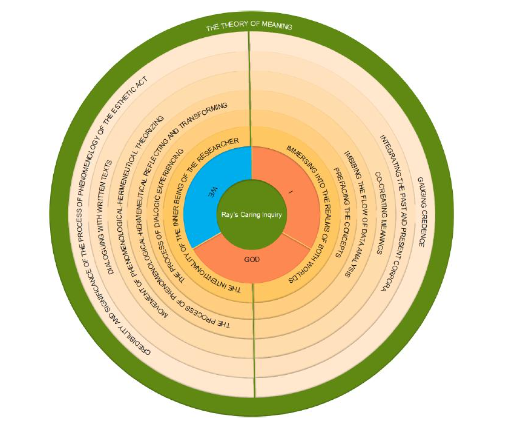
Methodological Structure of Ray’s Caring Inquiry
Ray’s Phenomenological Caring Inquiry Methodology is a deeply reflective, dialogical, and transformative process rooted in human science, theology, and the aesthetics of caring (Ray, 2013, 2019). It transcends traditional research paradigms by inviting both researcher and participant into a shared sacred space—where meaning unfolds not only through empirical observation but also through spiritual discernment. This methodology reflects a process of becoming and transformation, both personal and collective, and ultimately gives rise to new ways of knowing rooted in love, compassion, and divine presence.
The process begins with the Intentionality of the Inner Being of the Researcher, a foundational phenomenological phase where the researcher enters into a state of deep reflection. In this stage, the researcher must immerse herself in the inner realms of thought, memory, and spirituality, shedding preconceived notions and ego-based intentions. This act of intentional inwardness prepares the researcher to listen with openness and humility. It shifts the focus from “I” to “we,” fostering a sacred relational space where the phenomenon—such as nurses’ self-care—can be understood with authenticity and reverence. This inward journey echoes the contemplative tradition and is essential for grounding the research in empathy, sincerity, and spiritual attunement.
The second phase, known as Dialogic Experiencing, involves entering into ethical, heartfelt conversations with participants. These are not just interviews, but co-created dialogues where both the researcher and participants share in the compassionate exploration of lived experiences. The key question, “What does self-care mean to you?”—serves as an entry point for these conversations. The researcher’s role is not only to ask but to listen deeply, to probe gently, and to follow the natural unfolding of the participant’s narrative. This dialogical process embodies relational ethics and acknowledges the presence of the “compassionate we,” which includes the participant, the researcher, and the invisible sharer—God. Through this relational encounter, self-care is not merely described; it is lived, experienced, and spiritually illuminated.
Once the conversations are transcribed, the study moves into Phenomenological Reflection and Transformation. In this phase, the researcher engages in reflective analysis of the narrative data, seeking to uncover the thematic structures, metaphors, and meanings embedded within the participants’ stories. This process is both analytic and contemplative. The researcher must bracket her own assumptions—a process known as epoché (presuppositionlessness)—to allow the essence of the lived experience to surface. It is during this phase that the phenomenon begins to reveal its deeper meanings. For the study in question, this reflective work led to transformative insights about the nature of self-care, especially as it relates to spiritual grounding and holistic nursing.
Following this is the stage of Phenomenological-Hermeneutical Theorizing, where interpretation and theory-building converge. In this phase, the researcher does not impose theory but co-creates meaning with the data, guided by both intuition and analysis. From the narratives, the metaphor of “Seeing Self-in-Others” emerged—highlighting the interconnectedness between the personal and the collective, the carer and the cared-for, the human and the divine. This metaphor crystallized into a formal theory: The Total Self for God and Others. This theory encapsulates the essence of self-care as a sacred act of devotion—both to oneself and in service to others—rooted in the love of God and the relational fabric of humanity.
Dialoguing with Written Texts follows with the researcher then engaging in critical reflection and synthesis, comparing the emerging findings with the existing body of knowledge on self-care, spirituality in nursing, burnout, and caring science. This phase is vital for situating the new theory within the broader scholarly and theological landscape. It allows for a dialogical encounter between the past and present—between previously published works and the new insights generated through the inquiry. This recursive engagement deepens understanding and lends intellectual and historical context to the findings, enhancing the richness and relevance of the theory.
The final stage, Gauging Credence, serves as a validation process grounded in Ray’s five guiding concepts: Recognizing, Believing, Acknowledging, Affirming, and Confirming. These criteria are not merely procedural checks; they are existential and spiritual confirmations that the findings resonate with lived experience and convey truth in both empirical and theological dimensions. By applying these principles, the researcher ensures that the study maintains methodological integrity and ethical sensitivity, while also preserving the sacred nature of the inquiry.
Together, these phases form a coherent methodological tapestry—one that integrates the philosophical insights of Husserl, Van Manen, Ricoeur, and Reeder with the theological and aesthetic dimensions of caring. Ray’s Caring Inquiry Methodology thus becomes not only a research approach but a spiritual discipline, one that honors the dignity of persons, the sanctity of experience, and the transformative power of love in nursing and in life.
Emergence of a New Theory: The Total Self for God and Others
The theory that emerged presents self-care as an act of divine stewardship. Grounded in scriptural references (Deuteronomy 31:6; Hebrews 13:6; 1 John 4:18), it affirms that caring for oneself is a spiritual responsibility entrusted by God. The theory aligns with Florence Nightingale’s vision of nursing as rooted in Christ (McDonald, 2017; Nightingale, 1860; Ray, 1997), affirming the profession’s deep spiritual heritage.
This perspective reframes nursing as a spiritual vocation, and self-care as a transformative journey that integrates body, mind, and spirit. The “invisible sharer” (God) is actively involved in the reflective process, illuminating the researcher’s insights and grounding the theory in divine presence and grace.
Impact on Nursing Practice and Education
This theory holds significant implications for nursing practice, education, and research. It:
- Promotes a spiritually grounded framework for self-care in nursing.
- Encourages resilience and compassion through spiritual reflection.
- Validates the holistic nature of nursing, addressing physical, emotional, and spiritual dimensions.
- Offers a model for ethically sound, culturally relevant, and theologically informed care.
- Serves as a pedagogical tool for cultivating reflective, compassionate nursing students and practitioners.
Conclusion
This review affirms the profound contribution of The Total Self for God and Others to nursing knowledge. It elucidates the essence of the human and divine interrelatedness within the history and current environment of nursing. It presents answers to the technological dilemma of potential woundedness of artificial intelligence and the need for the implementation of maternal instincts by highlighting human intelligence (body, mind, heart, and soul) (Nightingale, 1860; Ray, 1981, 1997; Watson, 2008, 2025; von Hildebrand, 1965). By using Ray’s Caring Inquiry Methodology, the study not only illuminates self-care as a spiritual and ethical act but also reclaims nursing as a vocation grounded in divine love. This theory offers a compelling vision of self-care as integral to professional integrity, personal wholeness, and spiritual depth. In doing so, it empowers nurses to care more deeply for themselves, for others, and the sacredness of their calling.
Conflicts of Interest Statement:
The authors declare that they have no financial, personal, academic, or professional conflicts of interest that could have influenced the preparation, content, or submission of this manuscript.
Funding Statement:
This research received no specific grant from any funding agency in the public, commercial, or not-for-profit sectors.
Acknowledgments:
The authors extend their heartfelt gratitude to the nurses whose lived experiences gave depth and meaning to the original study on self-care, which became the foundation of this review. We are also profoundly grateful for the inspiration and guidance that sustained us throughout the completion of this work.
References:
- Alligood, M. (2022). Nursing theorists and their work. (10th ed.). Elsevier.
- Barron, R. (2007). The priority of Christ: Toward a postliberal Catholicism. Baker Academic.
- Bay, B. R. Z., Chua, J. Y. X., & Shorey, S. (2025). Experiences of Nurses Regarding Self‐Care: A Qualitative Systematic Review and Meta‐Synthesis. Nursing and Health Sciences, 27(1). https://doi.org/10.1111/nhs.70044
- Beck, C. (2021). Introduction to phenomenology: Focus on Methodology. Sage.
- Benner, P. (1989). The primacy of caring. Stress and coping in health and illness. Addison-Wesley.
- Bohm, D. (1980). Wholeness and the implicate order. Routledge.
- Bostrum, N. (2014). Superintelligence: Paths, dangers, strategies. Oxford University Press.
- Carel, H. (2014). Nursing and medicine [in phenomenology]. In S. Luft & S. Overgaard (Eds.), The Routledge companion to phenomenology (pp. 623-632). Routledge.
- Clarke, J. (2010). Body and soul in mental health care. Mental Health, Religion & Culture, 13 (6), 649-657. DOI: 10.1080/13674676.2010.488416
- Coyoca, G.S.E., Tuppal, C.P., & Ray, M.A. (2025). Eliciting the theory of meaning on Self-Care for Nurses: Application of Ray’s Caring Inquiry. Asia Pacific Journal of Social Innovation, 37 (1), 2-23. https://doi.org/10.62071/apjsi.v37i1.760
- Gadamer, H-G. (1990). Truth and method (2nd rev. ed.). Crossroad Publishing Corporation. (Original work published 1975).
- D’Arcy, E. (1963). Saint Thomas Aquinas, Summa Theologiae, The Emotions, Vol.19, Question, 26, Love (pp. 63-107). Eyre & Spottiswoode, and McGraw-Hill Book Company.
- Egan, M. (2025, August 14). The ‘godfather of AI’ reveals the only way humanity can survive superintelligent AI. CNN Business. https://edition.cnn.com/2025/08/13/tech/ai-geoffrey-hinton
- Geremias, R. L. (2025). Relating Workaholism to Job Stress: Serial Mediating Role of Job Satisfaction and Psychological Capital of Nurses in Angola. Nursing Reports, 15(2), 43. https://doi.org/10.3390/nursrep15020043
- Harrison, E.F. (1960). Baker’s dictionary of theology. Grand Rapids, Michigan: Baker Book House.
- Heidegger, M. (1962). Being and time (Trans. by J. Macquarrie & e. Robinson). Harper & Row.
- Heidegger, M. (1977). The question concerning technology. Harper Perennial.
- Helming, M. A. B., Shields, D. A., Avino, K. M., & Rosa, W. E. (2020). Dossey & Keegan’s holistic nursing: A handbook for practice. Jones & Bartlett Learning.
- Huckins, G. (2025, August 15). Why GPT-4o’s sudden shutdown left people grieving. MIT Technology Review. https://www.technologyreview.com/2025/08/15/1121900/gpt4o-grief-ai-companion/
- Husserl, E. (1931). Ideas: General introduction to pure phenomenology. Macmillan.
- Jaastad, T.A. Ueland, V., & Koskinen, C. (2024). Nursing students’ movement toward becoming a professional caring nurse. Nursing Ethics, 32(1):125-140. doi:10.1177/09697330241238343
- Lee, K-F. (2018). AI superpowers: China, Silicon Valley, and the new world order. Houghton, Mifflin, Harcourt.
- Leininger, M. (1977). Caring: The essence and central focus of nursing. In the phenomenon of caring. Part V. Nursing Research Report, 12(1), 14.
- Leininger, M. (1978). Transcultural nursing: concepts, theories and practices. John Wiley & Sons.
- McDonald, L. (2017). Florence Nightingale: A Very Brief History. Society for Promoting Christian Knowledge.
- Merleau-Ponty (1963). Phenomenology of perception. (Trans. by C. Smith). Routledge and Kegan Paul.
- Mickunas, A., & Pilotta, J. (2023). A Critical Understanding of Artificial Intelligence: A Phenomenological Foundation. https://doi.org/10.2174/97898151234011230101.
- Munhall, P. (1994), Nursing philosophy and nursing research. In apposition or opposition? Nursing Research, 31(3), 176-177, 181.
- Nightingale, F. (1860). Notes on Nursing: What it is, and what it is not. J. B. Lippincott and Company.
- Paterson, J. & Zderad, L. (1976) Humanistic nursing. John Wiley & Sons.
- Parse, R. (1981). Man-living-health: A theory of nursing. John Wiley & Sons.
- Peat, F. D. (2002). From certainty to uncertainty: The story of science and ideas in the twentieth century. Joseph Henry Press.
- Posluns, K., & Gall, T. L. (2020). Dear Mental Health Practitioners, Take Care of Yourselves: a Literature Review on Self-Care. IntJ Adv Couns, 42(1), 1-20. https://doi.org/10.1007/s10447-019-09382-w
- Ray, M. (1981). A philosophical analysis of caring within nursing. In M. Leininger (Ed. & Author). Caring: An essential human need (pp. 25-36). Charles B. Slack, Inc.
- Ray, M. (1985). A philosophical method to study nursing phenomena. In M.. Leininger, Qualitative research methods in nursing. Grune & Straton, Inc.
- Ray, M. (1997). Illuminating the meaning of caring: Unfolding the sacred art of divine love. In M. S. Roach (Ed.). Caring from the heart: The convergence of caring and spirituality (pp. 163-178). Paulist Press.
- Ray, M. (2013). Caring inquiry: The esthetic process in the way of compassion. In M. C. Smith, M. C. Turkel, & Z. R. Wolf (Eds.), Caring in nursing classics: An essential resource (pp. 339-345). Springer Publishing Company.
- Ray, M. (2019). Caring inquiry methodology: The aesthetic process in the way of compassion. In S. H.-D. W. Rosa, J. Watson, M. Ray, M. Smith, M. Turkel, D. Guillett & G. Hernandez-Kertland(Ed.), A handbook of caring science: Expanding the paradigm, (pp. 343-353). Springer Publishing Company.
- Ray, M. (2021). Evolution of Ray’s theory of bureaucratic caring. International Journal for Human Caring, 25(3), 159-175. https://dx.doi.org/10.20467/HumanCaring-D-20-00043
- Ray, M. & Locsin, R. (2023). Toward an adequate understanding of phenomenological and hermeneutic-phenomenological nursing research. Nursing and Health Sciences, 25, 3-8. DOI:10.1111/nhs.13015
- Reeder, F. (1983). Philosophical issues in the Rogerian science of unitary human beings. Advances in Nursing Science, 6(2), 14-23.
- Ricoeur, P. (1992). Oneself as another (Trans. by Kathleen Blamey). The University of Chicago Press.
- Roach, M. S. (1984). Caring: The human mode of being, Implications for nursing. Perspectives in Caring Monograph1, Faculty of Nursing, University of Toronto.
- Roach, M. S. (2002). Caring, the human mode of being (2nd rev. ed). CHA Press.
- Rogers, M. (1970). Introduction to the theoretical basis of nursing. F. A. Davis.
- Sokolowski, R. (2000). Introduction to phenomenology. Cambridge University Press.
- Stapleton, T. (1983). Husserl and Heidegger: The question of a phenomenological beginning. State University of New York.
- Stein, E. (1989). On the problem of empathy [in Phenomenology] (Trans. by Waltraut Stein, PhD). ICS Publications.
- Steiner, G. (1989). Real presence. Faber and Faber.
- Tanioka, T., Yasuhura, Y., Osaka, K. Ito, H. & Locsin R (2017). Nursing robots: Robotic technology and human caring for the elderly. Fukuro Shuppan Publishing.
- Teilhard de Chardin, P. (1967). On love and happiness. The Great Library Collection by R. P. Pyrene. (Reprint, 2015).
- Tuppal, C. P., Vega, P. D., & Tuppal, S. M. P. (2022). Towards a theory of communion‐in‐caring. Scandinavian Journal of Caring Sciences, 36(2), 524-535.
- van Manen, M. (1990). Researching lived experience: Human science for an action sensitive pedagogy. The Althouse Press.
- van Manen, M. (2014). Phenomenology of practice: Meaning-giving methods in phenomenological research and writing. Left Coast Press.
- Watson, J. (1979). The philosophy and science of caring. Appleton-Century-Crofts.
- Watson, J. (2008). Nursing: The philosophy and science of caring (Revised Edition). University Press of Colorado. (Original Publication, 1979).
- Watson, J. (2025). Metaphysic of Watson unitary caring science: A cosmology of love. Springer Publishing.
- Von, Hildebrand, D. (1965). The heart: An analysis of human and divine affectivity. St. Augustine’s Press.