






Physiological Demands in Wilderness Paramedic Selection
Profiling the Physiological Demands of a Wilderness Paramedics Selection Course
Schram Ben 1,2, Canetti Elisa FD 1,2, Marsh Elizabeth 1,2, Marvin Graham 1,2, Orr Robin 1,2
- Tactical Research Unit – Bond University; Faculty of Health Science and Medicine – Bond University
OPEN ACCESS
PUBLISHED 31 August 2025
CITATION Schram, B., Canetti, E., et al., 2025. Profiling the Physiological Demands of a Wilderness Paramedics Selection Course. Medical Research Archives, [online] 13(8). https://doi.org/10.18103/mra.v13i8.6870
COPYRIGHT © 2025 European Society of Medicine. This is an open-access article distributed under the terms of the Creative Commons Attribution License, which permits unrestricted use, distribution, and reproduction in any medium, provided the original author and source are credited.
DOI https://doi.org/10.18103/mra.v13i8.6870
ISSN 2375-1924
Abstract
Wilderness paramedics are specialised paramedics who are responsible for attending to medical emergencies in remote regions with limited accessibility. Entry to the wilderness paramedic units, like many other specialist first responder units, is governed by a selection course however little is known about these selection courses. A total of eight candidates completed an initial track walk of 4.8km wearing 20.4kg of load, and 10 candidates completed a follow on 9km mountain walk across various undulating terrains wearing 15kg of load. Participants were monitored with Polar Team Pro physiological harnesses to profile each walk, monitoring distance, speed, and heart rate response. Candidates were significantly quicker in the track walk than the mountain walk, average speeds were significantly higher in the track walk (7.6km/hr) than the mountain walk (3.6km/hr), however maximum speed was significantly higher in the mountain walk (13.7km/hr vs 10.4km/hr). Maximum heart rates were similar (track walk 179.0±12.7bpm, mountain walk 179.7±15.8 bpm), average heart rates slightly higher in the track walk (163.6±15.5bpm, mountain walk 156.6±14.7bpm) and minimum heart rates higher in the track walk (123.3±18.8bpm) when compared to the mountain walk (97.9±20.6bpm). Despite the differences both walks elicited a similarly high physiological response as measured by high peak heart rates. As such, the track work can serve as a precursor to the mountain walk, which is conducted in a more austere environment. Both walks appear to be occupationally relevant with candidates adopting different strategies based on terrain.
Keywords: search and rescue, emergency services, physical demands, paramedicine
Introduction
Wilderness Paramedics, also known as Wilderness Emergency Medical Technicians are medical professionals who undergo additional training to be able to respond to medical emergencies in areas that difficult to access. They are tasked with responding to incidents in geographically challenging areas, which may include deserts, mountains, rivers, oceans, and caves. Access to and treating patients is often further complicated by prolonged exposure to extremes of weather and limited access to equipment; restricted to what can be carried. As a minimum, these personnel have may carry medical pharmacological supplies, intravenous lines, monitoring equipment, along with trauma and ventilation devices. The external loads carried by these personnel across the aforenoted austere terrains can from 15 kg to 45 kg. Due to an increase in recreational activities in remote areas such as mountain biking, skiing, snowboarding, and hiking, there has been a greater focus on the role of Wilderness Paramedics, particularly in Australia. Although Wilderness Paramedic groups often rely on Helicopter Emergency Medical Services (HEMS) for assistance, certain tasks may be hindered by challenging terrain, limited access, or adverse weather conditions, preventing the use of these resources. This has led to the development of specialised paramedics, who possess survival skills, navigation, and radio communication ability and who have the capability to operate autonomously. These additional skills are on top of the high level of clinical proficiency in such areas as long term wound care, spinal cord protection, joint reductions and patient transport. The demands of this profession have led to it being described as finding unconventional solutions to common problems.
Given the specialised nature of these personnel and the additional skill sets required of them, entry into many units is governed by a selection course, similar to specialised military and police units. These selection courses assess both physical and technical skills, which for wilderness paramedic candidates include the clinical and survival skills essential for care of a casualty in potentially adverse environmental conditions. Also akin to other tactical selection courses, and given the occupational requirement, the wilderness paramedic selection courses require candidates to carry occupational loads. However, while load carriage is a critical requirement, it can also impart injury risk, notably injuries to the integumentary, musculoskeletal, and nervous systems. With selection courses known for high rates of potential injury and failure, ensuring that the load carriage element of the selection courses is conducted safely, but still meet the selection course intent, is of importance.
Given that each wilderness paramedic unit will have a particular geographic area which they are responsible for, the terrain and conditions may be unique for each separate unit. Despite the assumption that the ability to carry load and a high level of aerobic fitness would be generic occupational requirements for this role, the specific environmental and terrain demands may be much more variable based on the location of the unit. For the Wilderness Paramedic unit that forms the focus of this study, the terrain includes mountainous regions traversed across and through various terrain grades and types (e.g., snow and scramble tracks, etc.). Thus, the ability to traverse this terrain carrying load is specific and essential to the job. However, so as not to impart excessive risk to candidates, a load carriage event, conducted in a controlled environment, is proposed to be a progressive step in the selection process. Therefore, the main aim of this investigation was to profile the physiological demands of the two loaded walk elements of the selection course within a state wilderness paramedic unit. A secondary aim was to determine whether an initial loaded walk around a track, could serve as a physiological precursor to a loaded walk in a more austere environment.
Methods
A prospective study of candidates attending a state wilderness paramedics selection course in winter 2023 was employed in a staged manner. The state ambulance service conducting the selection course currently has only 30 active wilderness paramedics, highlighting the specialist nature of this unit. The selection courses consist of two separate assessments of physical capacity and an assessment of the clinical skills which are required to perform the role. Following completion of an expression of interest, candidates undertake a loaded track walk, followed several weeks later by a clinical skills assessment and finally, again several weeks later, a loaded mountain walk. As the clinical skill assessment does not focus on physiological readiness for the role, it was not included in this study.
Prior to the study commencing, candidates were provided information regarding the intent of the study and those who were interested in participating provided informed consent. Ethics approval for this study was provided by the Bond University Human Research Ethics Committee (Protocol number BS02205) and gatekeeper approvals were provided by the state ambulance service. Basic demographic information was captured, and a Polar Team Pro (Polar Electro, Finland) physiological monitor was fitted to each candidate. These units capture distance and movement speeds, and heart rate response through a chest worn monitor for the duration of the event. The polar team cloud provides minimum, average and peak speed, and heart rate (HR) data along with distance and a percentage of maximum predicted HR based off inputted demographic details.
Procedures
The first physical capacity assessment was a track walk around a 400m athletic track for a total of 4.83km (3 miles) carrying 20.4kg of external load in either a backpack or weighted vest. Candidates were required to complete the walk in no longer than 42 minutes and were not allowed to run at any stage. This required candidates to walk at 6.9km/hr to finish on time had to successfully complete the walk, to progress in the selection process. This walk is designed as a safe environment to ensure candidates can move quickly with occupational load prior to progressing to the subsequent assessment.
The second physical capacity assessment was a loaded mountain walk, which was only eligible to those who completed both the track walk and a prior clinical skills assessment. The mountain walk was conducted over a route of approximately 9km (measured via their GPS) around a local mountain which included an initial ascent of 567m and decent of 568m. Candidates were required to wear an external load of 15.5kg in their personal hiking backpack and were required to complete the course in no less than 2 hours and no more than 2 hours and 30 minutes, requiring a walking speed of between 3.6 and 4.5km/hr. A minimum time was set to ensure candidates did not run, as running is not appropriate in an operational environment as it may increase their risk of injury. This assessment required navigation skills and the ability to traverse unstable terrain while maintaining a given speed. An elevation profile of this mountain walk is seen in Figure 1.

As both loaded walks are assessments which govern entry into the units, and this pragmatic investigation was field based assessment of the candidates who presented for this state ambulance service’s selection course, hydration, caffeine ingestion, and previous rest or activity were not controlled for, as stipulating these restrictions on candidates may affect their success through the course.
Statistics
Key physiological data were extracted from the Polar Team cloud-based server and imported into Microsoft Excel (Version 2305, BLD 16501.20242: Microsoft) for visual inspection, with normality checked through visual inspections of histograms and the Kolmogorov-Smirnov test. Basic descriptive statistics including means, standard deviations, and ranges were then calculated for each assessment. As not all candidates were successful in the track walk, and candidates from other track walks were included in the mountain walk, independent samples t-tests were performed to compare distance, speed, and HR between the two walks. Effect sizes were calculated with Cohen’s d and considered to be small if = 0.2, medium if = 0.5 and large if = 0.8.
Results
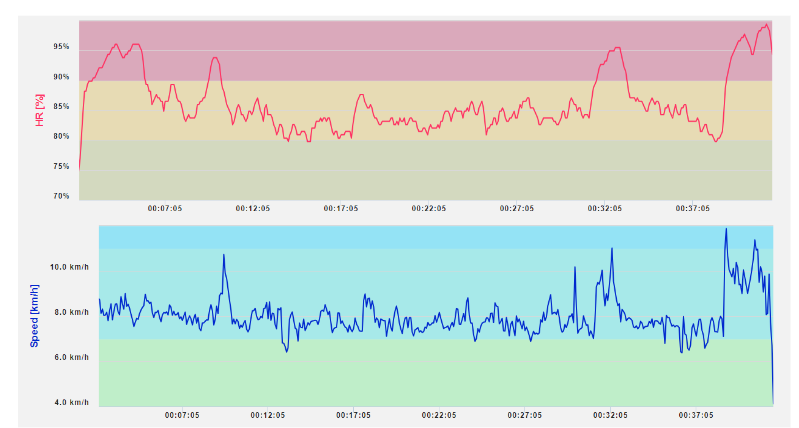
A total of nine candidates presented for the initial track walk, with all but one consenting to participating in the study. Of the eight participants, seven were male (178.6±6.4cm; 81.3±11.8kg; 38.3±7.5yrs), and one was female (descriptive data is not provided to maintain participant anonymity as per the ethics requirement). The walk was completed in cloudy conditions with the temperature ranging from 14.4 to 17.1°C, a 2km/hr South Westerly wind, and 95% humidity. All the candidates participating in the study completed the distance prior to the 42-minute cut off. An example of one candidate’s heart rate and speed trace is seen in Figure 2 below.
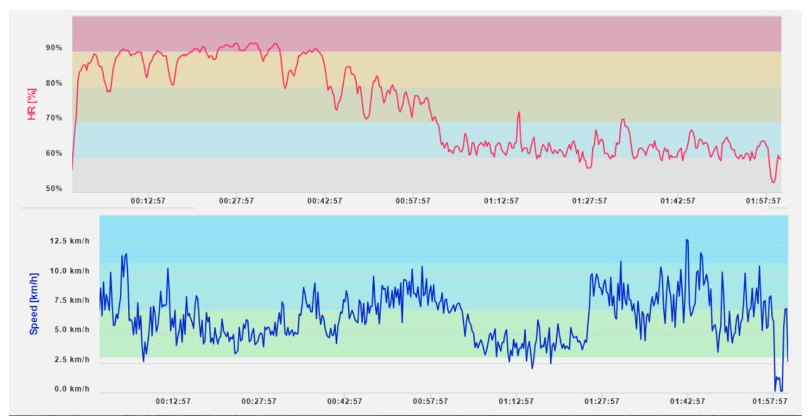
A further 17 candidates progressed to the mountain walk, of which 10 candidates, comprising seven males (177.9±6.9cm; 81.6±13.3kg; 39.7±9.9yrs) and three females (162.0 ±1.7cm; 61.3±2.3kg; 34.0±9.2yrs), consented to participate in this study. The walk was completed in overcast conditions, with some snow coverage at the highest elevations with temperature ranging from 3.1 to 8.4°C, 10km South Westerly wind and humidity ranging from 66.9 to 79.2%. Eight of the ten candidates made the cut off time for the mountain walk. An example of one candidate’s heart rate and speed trace during the mountain walk is provided in Figure 3.
| Track Walk | Mountain Walk | t | P value | Cohen’s d |
|---|---|---|---|---|
| Average Duration (h:min:sec) 0:39:00 ± 0:00:46 | 2:15:44 ± 0:16:49 | 15.322 | < .001 | 7.3 |
| Distance Covered (m) 4857.8 ± 60.1 | 8649.6 ± 199.0 | 49.835 | < .001 | 23.6 |
| Distance per min (m) 124.6 ± 2.1 | 65.0 ± 8.2 | -18.925 | < .001 | -9.0 |
| Maximum Speed (km/hr) 10.4 ± 0.9 | 13.7 ± 1.4 | 5.565 | < .001 | 2.6 |
| Average Speed (km/hr) 7.6 ± 0.2 | 3.6 ± 0.5 | -20.751 | < .001 | -9.8 |
| Min Heart Rate (bpm) 123.3 ± 18.8 | 97.9 ± 20.6 | -2.613 | 0.019 | -1.2 |
| Min Heart Rate (%max) 69.3±10.4 | 53.8±9.9 | 3.115 | 0.007 | 1.5 |
| Average Heart Rate (bpm) 163.6 ± 15.5 | 156.6 ± 14.7 | -0.956 | 0.353 | -0.5 |
| Average Heart Rate (% max) 91.9±8.7 | 86.4±8.3 | 1.320 | 0.205 | 0.6 |
| Max Heart Rate (bpm) 179.0 ± 12.7 | 179.7 ± 15.8 | 0.098 | 0.923 | 0.0 |
| Max Heart Rate (% max) 100.6±7.1 | 98.7±7.5 | 0.535 | 0.600 | 0.3 |
Discussion
The aim of this study was to profile the physiological demands of loaded walks within a selection course for wilderness paramedics, with a secondary aim to consider whether the initial load track walk could serve as a physiological precursor to a loaded walk in a more austere environment. Despite having different terrain, distances covered and load carriage requirements, the track walk and the mountain walk exhibited similar metabolic challenges to the candidates, made evident by the similar heart rate responses observed whereby the maximum heart rates were on average within one beat of each other. In addition, the ascent phase of the mountain walk elicited a similar average heart rate response (164.8±13.6bpm) to that of the track walk (163.6±15.5bpm), despite moving at less than half the average speed (ascent 3.2±1.8km/hr vs track 7.6±0.2) and carrying 5kg more less load in the mountain walk. These findings can be explained by the variables which influence load carriage intensity, including load weight, speed of movement, and terrain type and grade. As typified by proposed load carriage metabolic costs equations, manipulation of these variables alter metabolic cost to the point where speed of march and changes in terrain may have a greater impact on energy expenditure than increases in load weight. Whereas the loaded track walk was conducted with a heavier load (20.4 kg) and was conducted at a faster average speed (7.6 km/h), the terrain grade was flat. Conversely, while covering more challenging terrain grades and types during the mountain walk, load weights were lighter (15.5 kg) and the average pace was slower (3.6 km/h). These findings suggest that, not only can manipulation of the variables be used to accommodate changes in terrain, but as shown in this study, a heavier load at a faster pace in a controlled environment, can serve as a pre-curser to the metabolic cost when covering more austere terrain with slightly lighter loads and at slower speeds.
Despite being slower, as measured by distance per minute and average speed, candidates reached a higher maximum speed during the mountain walk, most likely by using the terrain to their advantage and shuffling down descents when possible. This can be seen in Figure 2 towards the end of the mountain walk, where the track was clearly marked, relatively smooth, and downhill. The lower minimum heart rate in the mountain walk is also most likely due to the slower average speed as seen in Figure 2 where candidates were required to navigate around obstacles on uneven terrain.
While little information exists to make comparisons, occupational profiles of HEMS paramedics walking 720m in 10 minutes with 25kg of load recorded an average HR of 153bpm and maximum HR of 180bpm, similar to the mountain walk average of 156bpm and maximum of 179.7bpm. Likewise, the average speed of HEMS paramedics was 4.6km/hr, slightly higher than the group average of 3.6km/hr in the mountain walk, albeit over a much longer duration (39mins vs 2hrs 15 mins). Figure 2 illustrated the increased cardiovascular demand during the mountain ascent, which was also observed during a simulated field-based callout for mountain rescue personnel tasked with retrieving a casualty. This scenario resulted in a comparable physiological response, indicating that the ascent was more physiologically demanding than the descent, even when carrying a loaded stretcher. Research again supported by the wider load carriage literature which suggests that load carriage up incline grades is more costly than decline grades.
Given the physiological demand of these loaded walks, and their relevance to the occupational demands reported in the literature, it is clear that high levels of fitness are required by Wilderness Paramedics. Previous studies have recommended a minimum VO2max of 40-45ml/kg/min for search and rescue roles, the field-based assessment of a specific simulated victim recovery by mountain rescue personnel by Callender et al recorded a VO2max of 51.1±3.3 ml/kg/min. As such, aerobic fitness appears to be a critical characteristic for this profession. While aerobic capacity underpins performance in prolonged efforts, it’s not the only factor influencing operational readiness. Chronic and acute fatigue, both of which are linked with decreased recovery and increased injury incidence, has been widely reported in paramedic populations, with one study noting that over 86% of urban paramedics attributed prior injuries to fatigue and over 70% felt exhausted despite rest days. These findings underscore the need for wilderness paramedic selection courses to stress-test fatigue tolerance and recovery mechanisms in tandem with aerobic capability.
Muscular strength, muscular endurance, and agility are also recognised as essential attributes in search and rescue situations, with muscle strength crucial for lifting and moving heavy objects, muscular endurance necessary for repetitive lifting or holding of lighter objects, and agility essential for effectively navigating and manoeuvring around various obstacles encountered during rescue operations. Further, research suggests that both aerobic fitness and strength are foundational fitness characteristics of load carriage, a critical task requirement for wilderness paramedics and other search and rescue occupations. Thus, aerobic fitness, muscle strength and endurance, and agility can be considered physical requirements that contribute to performance during the loaded walks (notably the mountain walk which may also require agility) and wilderness paramedic tasks in general. Finally, noting the importance of a combination of both aerobic fitness and strength for loaded walking, research suggests that loaded walk performance is the biggest predictor of future loaded walk performance. Thus, again supporting the supposition that the loaded track walk can serve as a precursor to the mountain walk in a more austere environment and furthermore supporting that using a loaded track walk would be more suitable than a generic aerobic or strength fitness assessment.
The load weights carried by these candidates (15.5 kg – 20.4 kg) are in line with previous studies reports of 25 kg of equipment carried by HEMS paramedics, the sum of personal equipment and an external load of 14 kg carried by mountain rescue personnel, and more generally from 15 kg to 45 kg carried by search and rescue personnel. Likewise, the distance ascended in the mountain walk in this study of 567m, is similar to the 472m of elevation in the simulated mountain rescue, which was based on recent callouts for that unit and conducted in a common accident blackspot. Analysis of callout data from a mountain rescue team revealed that the longest one-way distance covered to reach a casualty was 3600m, making the distance of 8600m in the mountain walk a valid distance in this population.
This investigation is limited by the relatively small sample size in both walks, however, is comparable to the studies by Callendar et al. (n=8 mountain rescue personnel), Meadley et al. (n=1 HEMS paramedic), and Carter et al (n=18 search and rescue personnel). Furthermore, data were reported on 70% of the available personnel of the entire state selection course and small sample sizes are a common limitation in tactical and first responder research. While this wasn’t a laboratory-based investigation, and the multitude of factors known to affect performance were not able to be controlled for, the information from this study does profile the physiological response of the individuals which presented for two loaded walks for selection into this distinct unit. Future research should focus on profiling the physiological response, load carried, and distances covered during job-related tasks within this occupation. This research will provide a deeper understanding of the distinctive nature of this profession and help substantiate the selection processes employed for entry into these units.
Conclusions
Two loaded walks utilised for selection into a specialised Wilderness Paramedic unit, featuring varying terrains, loads and distances, imposed a significant and comparable physiological demand. Both walks appear to be occupationally relevant with candidates adopting different strategies based on terrain. Furthermore, the loaded track walk conducted around a supervised track with heavier load weights and faster speeds, yet no terrain challenges, may serve as a physiological precursor to the more austere loaded mountain walk. The loads carried, distances covered, and physiological responses observed in these two assessments appear to accurately reflect the occupational demands encountered in wilderness paramedic work.
Funding details: No funding was received to conduct this research.
Disclosure statement: None.
Data availability statement: Raw data used in this analysis contains information which may allow for the identification of individuals. As such data are confidential and not available.
Acknowledgements: The authors would like to thank the individuals from the Ambulance service who assisted in the conduct of this study.
References
- Millin MG, Johnson DE, Schimelpfenig T, et al. Medical Oversight, Educational Core Content, and Proposed Scopes of Practice of Wilderness EMS Providers: A Joint Project Developed by Wilderness EMS Educators, Medical Directors, and Regulators Using a Delphi Approach. Prehospital emergency care. 2017;21(6):673-681.
- Hawkins S. Wilderness EMS. Philadelphia: Wolters Kluwer; 2018.
- Elsensohn F, Soteras I, Resiten O, Ellerton J, Brugger H, Paal P. Equipment of medical backpacks in mountain rescue. High altitude medicine & biology. 2011;12(4):343-347.
- Silk A, Lenton G, Savage R, Aisbett B. Job task characteristics of Australian emergency services volunteers during search and rescue operations. Ergonomics. 2018;61(2):265-272.
- Orr RM, Lockie R, Saari A, Paavola T, Muhlbauer D, Dawes J. Load carriage for emergency responders. Strength & Conditioning Journal. 2022:10.1519.
- Meadley BN, Horton E, Perraton L, Smith K, Bowles K-A. Physiological Response in a Specialist Paramedic During Helicopter Winch Rescue in Remote Wilderness and Extreme Heat. Journal of special operations medicine. 2021;21(3):41.
- Callender N, Ellerton J, Macdonald JH. Physiological demands of mountain rescue work. Emergency medicine journal : EMJ. 2012;29(9):753-757.
- Hawkins SC, Millin MG, Smith WR. Wilderness EMS. In: Hoboken, NJ, USA: John Wiley & Sons, Inc; 2021:392-405.
- Johnson DE. Wilderness emergency medical services: Wilderness Medicine. Emergency medicine clinics of North America. 2004;22(2).
- Hunt AP, Orr RM, Billing DC. Developing physical capability standards that are predictive of success on Special Forces selection courses. Military medicine. 2013;178(6):619-624.
- Schram B, Robinson J, Orr R. The Physical Fitness Effects of a Week-Long Specialist Tactical Police Selection Course. International journal of environmental research and public health. 2020;17(18):6782.
- Orr RM, Caust EL, Hinton B, Pope R. Selecting the best of the best: Associations between anthropometric and fitness assessment results and success in police specialist selection. International journal of exercise science. 2018;11(4):785.
- Orr RM, Pope R, Johnston V, Coyle J. Soldier occupational load carriage: a narrative review of associated injuries. International journal of injury control and safety promotion. 2014;21(4):388-396.
- Cohen J. Statistical power analysis for the behavioral sciences. In. Statistical power analysis for the behavioral sciences. New York: Academic Press; 1977.
- Orr R, Pope R, Lopes TJA, et al. Soldier load carriage, injuries, rehabilitation and physical conditioning: an international approach. International journal of environmental research and public health. 2021;18(8):4010.
- Soule RG, Pandolf KB, Goldman RF. Energy expenditure of heavy load carriage. Ergonomics. 1978;21(5):373-381.
- Soule RG, Goldman RF. Terrain coefficients for energy cost prediction. Journal of applied physiology. 1972;32(5):706-708.
- Crowder TA, Beekley MD, Sturdivant RX, Johnson CA, Lumpkin A. Metabolic effects of soldier performance on a simulated graded road march while wearing two functionally equivalent military ensembles. Military medicine. 2007;172(6):596-602.
- Santee WR, Allison WF, Blachard LA, Small MG. A proposed model for load carriage on sloped terrain. Aviat Space Environ Med. 2001;72(6):562-566.
- Pimental N, Pandolf KB. Energy expenditure while standing or walking slowly uphill or downhill with loads. Ergonomics. 1979;22(8):963-973.
- Lloyd R, Cooke CB. The oxygen consumption associated with unloaded walking and load carriage using two different backpack designs. Eur J Appl Physiol. 2000;81(6):486-492.
- Stewart IB, McDonald MD, Hunt AP, Parker TW. Physical capacity of rescue personnel in the mining industry. Journal of occupational medicine and toxicology (London, England). 2008;3(1):22-22.
- Marvin G, Orr R, Canetti E, Schram B. Self-Reported Fatigue and Injury in Paramedics. The European Society of Medicine. 2025;13(6).
- Marsh E, Orr R, Canetti EFD, Schram B. Profiling paramedic job tasks, injuries, and physical fitness: A scoping review. Applied Ergonomics. 2025;125:104459.
- Robinson J, Roberts A, Irving S, Orr R. Aerobic fitness is of greater importance than strength and power in the load carriage performance of specialist police. International journal of exercise science. 2018;11(4):987.
- Carter JM, Wilkinson D, Richmond V, Rayson M. Physiological Responses of Emergency Service Personnel Performing Urban Search and Rescue. Paper presented at: SPE Middle East Health, Safety, Security, and Environment Conference and Exhibition2012.