





Prevalence of Congenital Heart Disease in Bangladeshi Kids
Prevalence of Congenital Heart Disease of Bangladeshi Children – A Nationwide Survey
Prof. Dr. Mohd. Zahid Hussain¹, Dr. Tahmina Karim², Prof. Md. Tariqul Islam¹, Dr. Mohammad Shakhawat Alam²,
Dr. Chaity Barua³, Dr. Diana Islam⁴, Dr. Md. Mostafizur Rahman Bhuiyan⁴, Dr. Faizul Haque Ponir⁴, Dr. Porimal Kumar Das⁴, Dr. K.M Enayet⁴, Dr. Heera Nand Yadav⁴, Dr. Rezaul Hayat⁴, Dr. Kashid Omar⁴**
- Professor of Paediatric Cardiology, BSMMU, Shahbag, Dhaka, Bangladesh
- Associate professor Paediatric cardiology, BSMMU Shahbag, Dhaka, Bangladesh
- Assistant professor Paediatric cardiology, BSMMU Shahbag, Dhaka, Bangladesh
- Medical Officer Paediatric cardiology, BSMMU Shahbag, Dhaka, Bangladesh
ABSTRACT
Background— There is scarcity of data of Congenital heart disease (CHD) due to changing epidemiology. In this study we determined the prevalence of CHD, age distribution, and various forms of CHD including simple & complex CHD in the general population of Bangladesh.
Objective: To investigate the prevalence of congenital heart disease (CHD) in Bangladesh based on a large prospective multicenter screening study.
Study design: A total of 6146 consecutive children from 8 union of 8 division throughout Bangladesh between July 2021, and December 2022, were included. CHD cases were identified by clinical assessment and echocardiography.
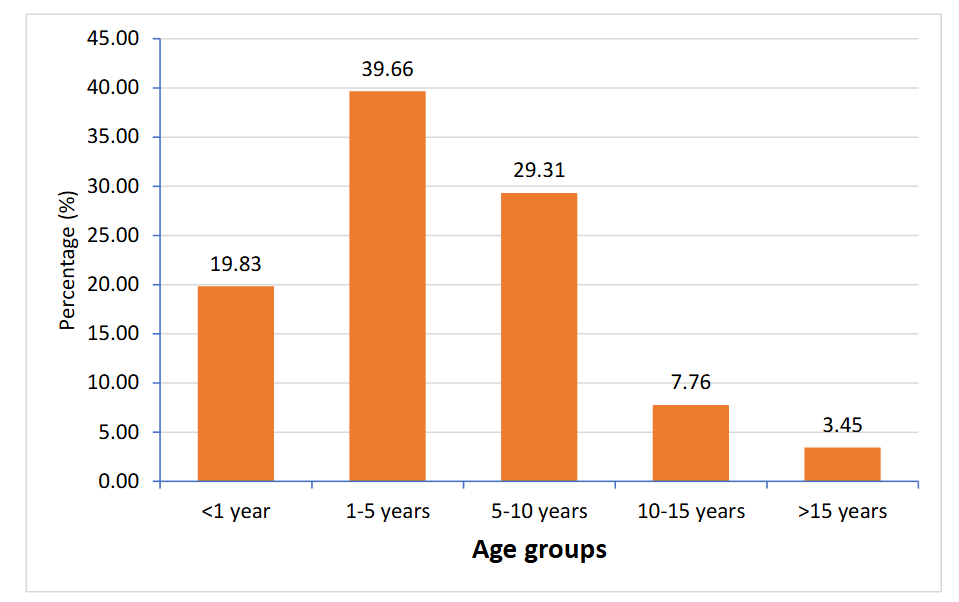
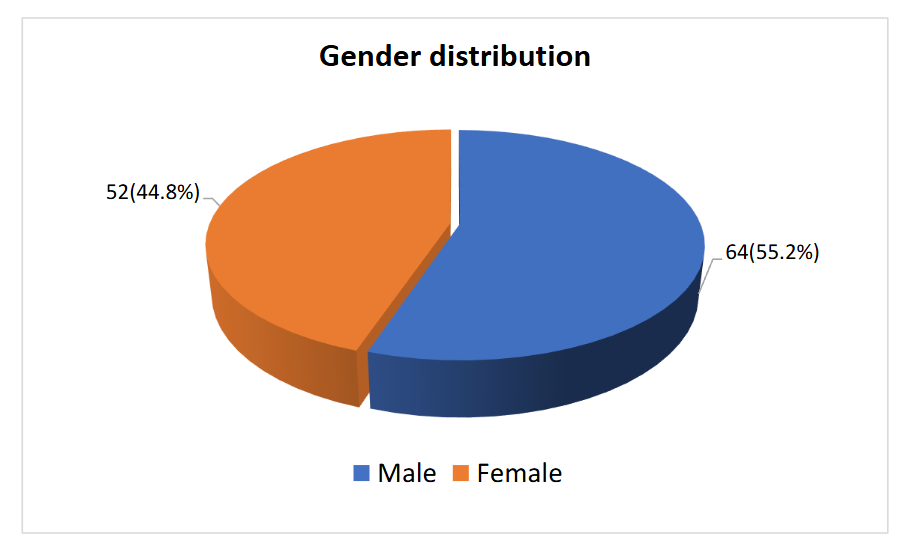
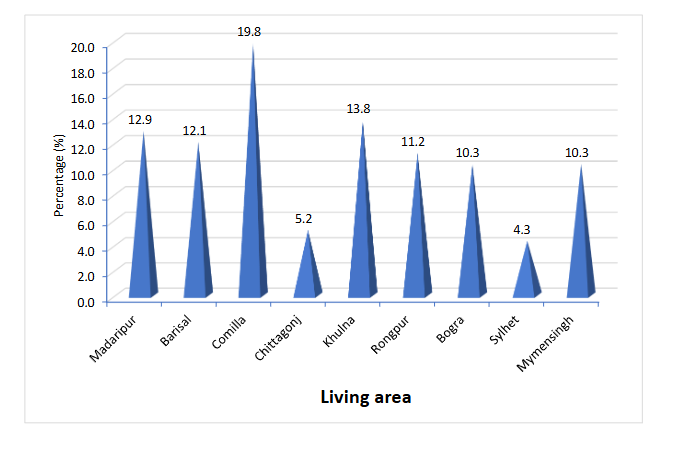
Results: The overall prevalence of CHD was 18.9 per 1000 live births. Out of 116 cases 64 (55.2%) were female & 52 were male (44.8%) with a ratio of 1.2:1. Age from 0 to 18 years were included and CHD were found mostly in 1 to 5 years (39.7%). Distribution of type of CHD were Acyanotic CHD 98 (84.5%) and Cyanotic CHD were 18 (15.5%). The most common CHD was atrial septal defect 33 (28.45%), followed by patent ductus arteriosus 28 (24.14%), ventricular septal defect 26 (22.41%), AV canal defect 4 (3.45%), tetralogy of Fallot 12 (10.34%), and DORV with VSD with PS & truncus arteriosus were 1 each (0.86%). Some combined lesions like VSD with ASD 2 (1.72%) and ASD, VSD with PDA 1 (0.86%). And other congenital heart diseases were HCM 2 (1.72%), DCM 1 (0.86%). Dextrocardia 1 (0.86%). Significantly higher rates of CHD were found in Comilla 23 (19.8%) district, followed by Khulna 16 (13.8%) and Madaripur 15 (12.9%).
Conclusions: The prevalence of CHD in given population in this study is high from data from Western studies. This screening study may provide more accurate and complete information on the overall prevalence of CHD.
Keywords: Prevalence, CHD, Bangladesh
OPEN ACCESS
PUBLISHED: 31 March 2025
CITATION: Hussain, M.Z., Karim, T., Islam, T., et al., Prevalence of Congenital heart disease of Bangladeshi Children – A Nationwide survey. Medical Research Archives, [online] 13(3).
https://doi.org/10.18103/mra.v13i3.6327
COPYRIGHT: © 2025 European Society of Medicine. This is an open-access article distributed under the terms of the Creative Commons Attribution License, which permits unrestricted use, distribution, and reproduction in any medium, provided the original author and source are credited.
DOI https://doi.org/10.18103/mra.v13i3.6327
ISSN 2375-1924
Keywords
- Congenital Heart Disease
- Bangladesh
- Prevalence
- Children
Background
Bangladesh is a densely populated country. Children as a share of the total population was 25.5% according to UNICEF Demographic data of Bangladesh. Congenital malformation contributes a large percentage in under five mortality, of which congenital heart disease is the most important one.
A congenital heart defect (CHD) is defined as a gross structural abnormality of the heart or of the major thoracic vessels¹. CHD has been reported to occur in 5-8 per 1000 live births². It is by far the most common birth defect & a significant cause of childhood morbidity & mortality. Congenital heart diseases are the most prevalent and serious of all recognized structural birth defects. Surviving infants often require surgery or interventions and lengthy hospitalizations and will have a lifetime of disability that imposes a significant burden of the families. Cost associated with the care of a child with CHD are significant even in the developing countries, particularly when lifetime costs of management are considered¹.
Patients with CHD and cyanosis, pulmonary hypertension, and congestive heart failure also accompanies growth failure and malnutrition and thus has increased chance of morbidity and mortality.³⁴ There is strong evidence that poor growth is associated with delayed mental development and that there is a relationship between impaired growth status and both poor school performance and reduced intellectual achievement.⁵ Growth retardation in early childhood is also associated with significant functional impairment in adult life and reduced work capacity, thus affecting economic productivity.⁶
In developed countries, advancements in paediatric cardiac care, early prenatal and postnatal diagnosis, and supportive and timely corrective interventions for cardiac lesions have allowed the patients with a better lifestyle.⁷ In contrast, like many developing countries, in Bangladesh paediatric cardiac cares are not fully established, and epidemiological data on CHD-related morbidity and mortality are lacking.
The present study aimed to describe the prevalence of congenital heart disease in children. The findings of the present study could be applied to current and future paediatric cardiac care practice, and also used for policy decision-making and future research.
Material & Methods
This Cross-sectional prospective study was conducted after obtaining ethical approval from Institutional Review board. The Study period was between July 2021, and December 2022. Bangladesh has 8 Divisions. So we randomly involved 8 union from 8 divisions of Bangladesh. In this study estimated sample size was 6146. Sample were collected by random sample technique.
INCLUSION CRITERIA INCLUDES –
-
children aged from 0 day to 18 years
-
all healthy and sick children
& EXCLUSION CRITERIA WERE –
Non-Bangladeshi resident & children and parents unwilling to participate in the study were excluded.
DATA COLLECTION –
The day before investigation, data collector visited each home where eligible children were available. They selected cases in view of cyanosis, low SPO2%, Heart murmur, high risk neonates, history of CHD in siblings. And they were asked to come on the day of investigation with their Expanded program on Immunization (EPI) card and they marked them with a marker at finger.
After taking written informed consent at the day of investigation meticulous history taking and clinical examination were done. Pulse oximetry were checked in both upper and lower limbs. Echocardiography were performed by Paediatric cardiologist by GE Echocardiography machine model no. VIVID IQ, using M4S and 6S probes.
Sedation used for those children who needed to be calm at the time of performing echocardiography. Patient were examined in supine and lateral position. And all standard echocardiographic views 2D, Color Doppler Echo.
were recorded. Those who were diagnosed as having congenital heart diseases were counted.
Data was described using mean, standard deviation, frequency and percent & analyzed using computer based statistical analysis (SPSS 22) and prevalence of CHD was measured. P value of <.05 was taken as significant.
Results
A total of 6146 children under went Echocardiographic assessment in this study.
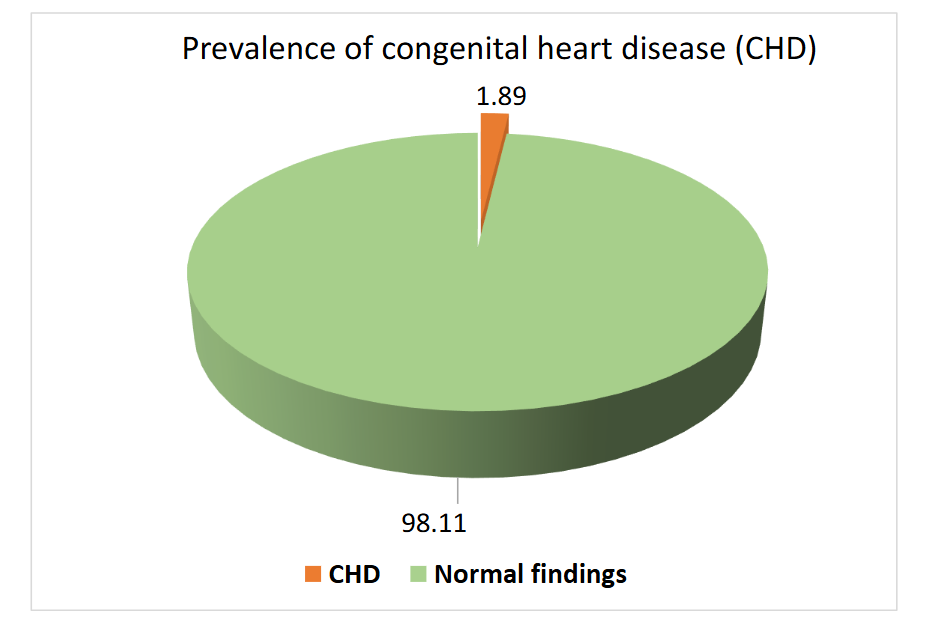
The overall prevalence of CHD was 18.9 per 1000 live births. Out of 116 cases 64(55.2%) were female & 52 were male (44.8%) with a ratio of 1.2:1. Age from 0 to 18 years were included and CHD were found mostly in 1 to 5 years (39.7%). Distribution of Type of CHD were Acyanotic CHD 98(84.5%) and Cyanotic CHD were 18(15.5%).
The most common CHD was atrial septal defect33 (28.45%), followed by patent ductus arteriosus 28(24.14%) ventricular septal defect 26 (22.41%), AV canal defect 4 (3.45%), tetralogy of Fallot 12 (10.34%), and DORV with VSD with PS & Truncus arteriosus were 1 each (0.86%).
Some combined lesions like VSD with ASD 2(1.72%) and ASD, VSD with PDA 1(0.86%) And other Congenital heart diseases were HCM 2(1.72%), DCM1(0.86%). Dextrocardia 1(0.86%).
Significantly higher rates of CHD were found in Comilla 23(19.8%) district, followed by Khulna 16 (13.8%) and Madaripur 15 (12.9%).
Table-1: Prevalence of CHD
| Findings | Number of respondents | Percent |
|---|---|---|
| Number of CHD | 116 | 1.89 |
| Acyanotic | 98 | 84.5 |
| Cyanotic | 18 | 15.5 |
| Normal findings | 6036 | 98.11 |
| Total | 6146 | 100.0 |
| Type of CHD | Frequency | Percentage (%) |
|---|---|---|
| Acyanotic CHD | 83 | 28.45 |
| VSD | 24 | 24.14 |
| Valvular PS | 22 | 22.41 |
| CoA | 1 | 1.02 |
| ASD | 27 | 27.31 |
| VSD+PDA+ASD | 1 | 1.02 |
| Others | 8 | 8.62 |
| Living area | Frequency | Percent (%) |
|---|---|---|
| Madaripur | 15 | 12.9 |
| Barisal | 14 | 12.1 |
| Comilla | 14 | 12.1 |
| Chittagong | 16 | 13.8 |
| Khulna | 13 | 11.2 |
| Rangpur | 12 | 10.3 |
| Sylhet | 5 | 4.3 |
| Mymensingh | 12 | 10.3 |
Discussion
Congenital heart disease is the most common birth defect. More than 40% of deaths include congenital heart disease (CHD) in study of pediatric cardiology. The prevalence of CHD has regional variation. The study conducted from China reported that the prevalence of congenital heart disease in children of South-Asian countries was 1.79% as compared to 1.7% in India. A meta-analysis showed that the prevalence of congenital heart disease in India was from 2.7 per every 1,000 study population conducted from 1979-1997. The incidence of CHD was also reported in the study of Pakistan. The prevalence of congenital heart disease in Bangladesh was reported as 1.2% in 2008. The prevalence of congenital heart disease in children of Bangladesh will help to strengthen health care services.
Conclusion
This is the only conducted data on prevalence of CHD in Bangladesh. Our observation is that, high burden of CHD in this region which reflecting continued increase in the reported birth prevalence of CHD. In our country hospital-based data of incidence of CHD was also found high. ASD was the most common Acyanotic CHD while TOF was the commonest cyanotic CHD. This data will help to strengthen health care services.
Ethical Clearance
Ethical approval to conduct the study was obtained from Dhaka International University Research board (Bangladesh).
Funding
None declared.
References
2. Boneva RS, Botto LD, Moore CA, Yang Q, Correa A, Erickson JD. Mortality associated with congenital heart defects in the United States: trends and racial disparities, 1979-1997. Circulation. 2001; 103(19): 2376-2381.
3. Pittman JG, Cohen P. The pathogenesis of cardiac cachexia. N Engl J Med 1964;271:453-60.
4. Linde LM, Dunn OJ, Schireson R. Rasof B. Growth in children with congenital heart disease. J Pediatr 1967;70:413-19.
5. Lavy V. Presenting symptoms and signs in children referred for palliative care in Malawi. Palliat Med 2007; 21:333-9.
6. Man WDC. Nutritional status of children admitted to hospital with different diseases and its relationship to outcome in the Gambia, West Africa. Trop Med Int Health 1998; 3: 678 -86.
7. Pelletier DL, Frongillo EA Jr. Habicht JP. Epidemiologic evidence for a potentiating effect of malnutrition on child mortality. Am J Public Health 1993: 83:1130-3.
8. Xie D, Fang J, Liu Z, et al. Epidemiology and major subtypes of congenital heart defects in Hunan Province, China. Medicine (Baltimore) 2018; 97(31): e11770
9. Jain PK, Lazarus M, et al. Prevalence and pattern of Congenital heart disease in Paediatric population—A study from central India. Int J Recent Surg Med Sci 2023;9:39-44. ISSN 2455-7420; DOI https://doi.org/10.1055/s-0042-1751085.
10. Van der Linde D, Konings EE, Slager MA, Witsenburg M, Helbring W A, Takkenberg JJ, et al. Birth prevalence of congenital heart disease worldwide: a systematic review and meta analysis. J Am Coll Cardiol2011;58(21):2241-47.
11. Mohsenzadeh a, Saket s, Ahmadipur s, Baharvand b . Prevalence and types of congenital heart disease in babies born in the city of Khorramabad (2007-2011). Scientific magazine yafte. 2014; 15(5):23-29.
12. Nikyar B, Sedehi Mn(2007-2008). Iran J, Mirfazeli A, Qorbani M, Gulalipur MJ. Prevalence and pattern of congenital heart disease among neonates in Gorgan, northern Iran J Ped. 2011;21(3):307-312
13. Parvar SY, Ghaderanah R, Naghshzan A. Prevalence of congenital heart disease according to the echocardiography findings in 8145 neonates, multicenter study in southern Iran. Health Sci. Rep. 2023 Apr 4;6(4):e1178. doi: 10.1002/hsr2.1178. eCollection 2023 Apr.
14. Qazi M, Saqib N. Spectrum of congenital heart disease in neonates in a tertiary care centre of Northern India. Int J Contemp Pediatr 2018;5 (04):1505–1508
15. Wanni KA, Shahzad N, Ashraf M, Ahmed K, Jan M, Rasool S. Prevalence and spectrum of congenital heart diseases in children.Heart India 2014;2:76–79
16. Chinawa JM, Eze JC. Obi I. et al. Synopsis of congenital cardiac disease among children attending University of Nigeria Teaching Hospital Ituku Ozalla, Enugu. BMC research Notes 2013;6: 475-481.
17. Abdulkadir M, Abdulkader J. A systemetic review of trends and pattern of congenital heart disease in children in Nigeria from1964-2015.Afri Health Sci 2016;16(2):367-377. http//dx.doi.org/10.4314/ahs.v16i2.5
18. Liu Y, Chen S, Zühlke L, Black GC, Choy MK, Li N, Keavney BD. Global birth prevalence of congenital heart defects 1970-2017: updated systematic review and meta-analysis of 260 studies. Int J Epidemiol. 2019 Apr1;48(2):455-463. doi: 10.109/ije/dyz009.PMID: 30783674
19. Meshram RM, Gajimwar VS. Prevalence, profile, and pattern of congenital heart disease in Central India: A prospective, observational study. Nig J Cardiol 2018;15:45–49
20. Kapoor R, Gupta S. Prevalence of congenital heart disease, Kanpur, India. Indian Pediatr 2008; 45(04):309–311
21. Misra M,Mittal M, Verma AM, Rai R, Chandra G, et al. Prevalence and pattern of congenital heart disease in school children of eastern Uttar Pradesh. Indian Heart J.2009;61:58-60.
Pubmed:http://www.ncbi.nlm.nih.gov/pubmed/19729691
22. McLaren MJ, Lachman AS, Barlow JB. Prevalence of congenital heart disease in black school children of Soweto, Johannesburg. Br.Heart J.1979;41: 554-558. PubMed: https:// www.ncbi.nlm.nih.gov/pubmed/465225
23. Marijon E, Tivane A, Vilanculos A, Jani D, et al. Prevalence of congenital heart disease in school children of Sub- Saharan Africa, Mozambique. Int J Cardiol.2006;113: 440-441. PubMed:
https://www.ncbi.nlm.nih.gov/pubmed/17011646