





Quality Outcomes in Inflammatory Bowel Disease Care
Quality care outcomes in Inflammatory Bowel Disease: Doing more with less
Rodger Wu¹˒²˒³˒⁴, Amy Healey¹, Victor Caquilpan²˒⁵, Renée Deschenes², Susan J Connor¹˒²˒³˒⁴, Jane M Andrews²˒⁶˒⁷
- Liverpool Hospital, Gastroenterology and Hepatology, Sydney, NSW, Australia
- Crohn’s Colitis Cure (CCure), Sydney, NSW, Australia
- Ingham Institute for Applied Medical Research, Sydney, NSW, Australia
- South West Sydney Clinical Campuses, UNSW Medicine and Health, UNSW, Sydney, NSW, Australia
- Australian Institute of Machine Learning, Adelaide, South Australia, Australia
- IBD Service, Royal Adelaide Hospital, Adelaide, South Australia, Australia
- Adelaide University, School of Medicine, College of Health, Adelaide, South Australia, Australia
OPEN ACCESS
PUBLISHED: 31 March 2026
CITATION: Wu, R., Healey, A., et al., 2026. Quality care outcomes in Inflammatory Bowel Disease: Doing more with less. Medical Research Archives, [online] 14(3).
COPYRIGHT: © 2026 European Society of Medicine. This is an open-access article distributed under the terms of the Creative Commons Attribution License, which permits unrestricted use, distribution, and reproduction in any medium, provided the original author and source are credited.
ISSN 2375-1924
Abstract
Introduction: Inflammatory bowel disease (IBD) care is increasingly complex, and substantial unwarranted variation in care delivery persists across services. While clinical quality registries are well positioned to support quality improvement, many rely on retrospective data collection and delayed feedback, limiting their impact on routine clinical practice. There is a need for timely, system-integrated approaches that improve visibility of care processes and outcomes without increasing clinician burden.
Methods: The IBD-PERFECT (Inflammatory Bowel Disease Performance Evaluation Review Framework for Excellence in Clinical Treatment) initiative is a planned 3-year, clinician-led quality improvement initiative. It uses routinely collected data from Crohn’s Colitis Care to populate real-time dashboards with an aim to optimise care. Currently six centre-level key performance indicators (KPIs) and corresponding data completeness metrics are generated across participating centres in Australia and New Zealand. KPIs include smoking status, corticosteroid and opiate use, clinically active disease, anaemia, and colorectal cancer surveillance eligibility. Results are reported as median and interquartile ranges across centres.
Results: IBD-PERFECT was launched in September 2025, and as of November 2025 included 20 centres with 16,988 individuals with IBD; 6,506 individuals comprised the active cohort. Median KPI values and interquartile ranges across centres were low for: current smoking (1.3% [IQR 0–4.8]); systemic corticosteroid use (1.1% [0.2–4.1]); opiate use (0.6% [0–1.6]); clinically active disease (7.9% [0.0–13.4]); and anaemia (0.1% [0–3.8]). The median proportion meeting colorectal cancer surveillance eligibility was 11.2% ([1.8–23.4]). Data completeness varied substantially: smoking status and opiate use status were not recorded in 16.4% (2.5–43.4), and 13.2% (2.3–44.2) respectively. Disease activity indices were not calculable in 41.8% (22.3–71.0), and haemoglobin was not recorded within 14 months in 90.9% (57.1–100.0) of the active cohort. Among those meeting colorectal cancer surveillance eligibility criteria, 95.6% (88.5–100.0) did not have a colonoscopy recorded within three years. Clinician roundtables provided positive feedback for the early implementation and identified healthcare utilisation and health-related quality of life measures as high-priority future functionality.
Conclusion: Early data demonstrate the acceptability and feasibility of real-time quality benchmarking in IBD care. Reporting data completeness alongside KPIs enables meaningful interpretation and supports reflective practice, local quality improvement, and system-level learning.
Keywords
Inflammatory bowel disease, quality improvement, clinical quality registries, real-time data, benchmarking
Introduction
Inflammatory bowel disease (IBD) is a chronic condition with rising global prevalence and substantial healthcare utilisation across diverse health systems. Delivering consistent, coordinated, high-quality care is essential to optimise outcomes and minimise complications. The growing number of available therapies and increasing complexity of disease management have heightened the need to systematically track care processes and outcomes. Despite the availability of international and local clinical guidelines, substantial variation in treatment approaches and care delivery persists across centres and treating teams, with evidence that recommended standards are not consistently applied in routine practice.
Care for people with IBD is frequently reactive, with clinicians tailoring management to symptom burden, disease activity and individual circumstances. Clinical attention is also often directed toward severe disease and emerging therapies, while basic aspects of care that are highly amenable to improvement receive less focus. Although electronic medical records (EMRs) have increased documentation and data capture, they have also increased cognitive load and often provide limited real-time feedback to make care delivery transparent and measurable. As healthcare systems become increasingly digitised, there remains a gap between the availability of structured clinical data and the delivery of real-time, disease-specific benchmarking that is embedded within routine workflows. In the absence of structured measurement and feedback, unwarranted clinical variation can emerge, which is a recognised barrier to high-quality IBD care. Clinicians may also overestimate how often key targets are achieved, while objective data may reveal meaningful differences in performance and outcomes relative to peers. This gap between perceived and measured performance underscores the need for systematic evaluation of healthcare structure, processes and outcomes to support quality improvement in IBD care, consistent with established quality-of-care frameworks.
The need for improved visibility of IBD care was recently reinforced in the 2025 State of the Nation in Inflammatory Bowel Disease report in Australia. The report identified inconsistencies in models of care, variable access to multidisciplinary services, and limited system-level visibility of care delivery and outcomes. Importantly, it highlighted the absence of coordinated, timely data to support quality improvement, service planning and policy development, despite the substantial and growing burden of IBD. The Australian Commission on Safety and Quality in Health Care (ACSQHC) recommends that health services should review their clinical variation by collecting care processes and patient outcomes and comparing performance with other health service organisations and providers for benchmarking of care. Clinical quality registries (CQRs) were established to meet this need, and there is evidence that well-designed registries can improve clinical processes and patient outcomes. However, many registries rely on retrospective data collection, are poorly integrated into routine clinical workflows and provide delayed feedback, limiting their ability to inform day-to-day clinical decision-making. With the advent of EMRs, digital dashboards and real-time reporting offer an opportunity to address these limitations by providing timely, accessible insights into care delivery and outcomes. Evidence suggests that dashboards embedded within clinical systems can support improvements in care processes and resource utilisation, although implementation remains uneven due to governance, funding and technical barriers.
IBD-PERFECT (Inflammatory Bowel Disease Performance Evaluation Review Framework for Excellence in Clinical Treatment) was developed in response to these challenges as a planned 3-year, clinician-led quality improvement initiative to improve the visibility of IBD care using routinely collected clinical data. The program is intended to evolve iteratively through multistakeholder engagement and consultation, including IBD clinicians, professional bodies, consumer organisations and pharmaceutical partners. The platform draws structured data from defined fields in Crohn’s Colitis Care (CCCare), an IBD-specific EMR used in routine care across Australia and New Zealand. Here, we describe the development of IBD-PERFECT, present baseline aggregated key performance indicators (KPIs) and data completeness across participating centres and discuss the implications of these early findings for quality improvement and policy in IBD care.
Methods
Data Source and Clinical Quality Registry
IBD-PERFECT draws on routinely collected clinical data captured in CCCare during IBD care. CCCare is a bespoke, cloud-based clinical management software to enable contemporaneous capture of demographic, clinical, disease activity, and treatment data, with integrated storage of de-identified data for quality improvement and research purposes. Data entered into CCCare are de-identified prior to inclusion in the CQR that underpins IBD-PERFECT. Registry data are used to generate aggregated outputs for benchmarking and quality improvement.
Platform Development and Implementation
IBD-PERFECT is a clinician-led quality improvement initiative that uses CCCare data to improve visibility of IBD care. Aggregated data are presented through interactive digital dashboards built using Microsoft Azure Power BI, which enables dynamic reporting through direct connection to the structured database hosting CCCare registry data. Dashboards are refreshed daily to reflect newly entered clinical information. The dashboards, including metric selection and presentation, were designed in collaboration with clinicians managing people with IBD across multiple participating centres. Emphasis was placed on usability, interpretability, and relevance to routine clinical practice, with the aim of supporting ongoing audit and quality improvement.
Access Levels and Data Visibility
IBD-PERFECT operates using tiered access levels that determine data visibility. A public-facing report displays aggregated data across all participating centres (https://ibdperfect.org/dashboards). Site-specific data are accessible only to authorised users at the relevant participating CCCare site and display both aggregated benchmark distributions and site-level results. An internal reporting environment is available to the CCCare team to support platform oversight and research activities. Users with site-specific or internal access may download de-identified patient-level data relevant to their own site using internal CCCare identifiers to support local audit and quality improvement activities. Users cannot view identifiable information or patient-level data from other sites.
Cohort Definitions
Three cohorts were defined for reporting. The total cohort included all people with IBD ever recorded in CCCare (including those documented for epidemiologic research only). The clinical cohort comprised individuals with at least one completed clinical assessment or management plan. The active cohort was defined as the subset of people from the clinical cohort assessed within the preceding 14 months. Unless otherwise specified, KPIs were calculated using the active cohort to reflect contemporaneous care.
Selection and Definition of Key Performance Indicators
An initial set of six KPIs was selected, informed by clinical relevance, importance to patient outcomes, and feasibility of capture during routine care. Indicators were chosen to represent high-yield domains of IBD management that are associated with adverse outcomes and potentially avoidable harm, including modifiable risk factors (smoking), medication-related harm (systemic corticosteroid and opiate exposure), disease control (clinically active disease), treatable complications (anaemia), and preventive care (colorectal cancer surveillance). These indicators were intended as a pragmatic starting point and are expected to evolve over time.
Current smoking status was defined as the proportion of the active cohort recorded as smoking at their most recent clinical assessment. Similarly, opiate use and systemic corticosteroid use were defined as the proportion of the active cohort recorded as receiving these medications at their most recent assessment. Clinically active disease was defined using established disease activity measures recorded at the most recent assessment. For Crohn’s disease, this included a Crohn’s Disease Activity Index (CDAI) or a patient-reported outcome (PRO3) score of 150 or greater, or a Harvey–Bradshaw Index score of 5 or greater. For ulcerative colitis, clinically active disease was defined as a partial Mayo score greater than 2 or a Simple Clinical Colitis Activity Index score of 5 or greater. Anaemia was defined as the proportion of the active cohort with a recorded haemoglobin measurement within the preceding 14 months meeting sex-specific thresholds (<130 g/L for men and <115 g/L for women), using an intermediate cut-off between consensus thresholds for non-pregnant and pregnant women. Eligibility for colorectal cancer surveillance was assessed within the clinical cohort and defined as patients with colonic IBD of at least eight years’ duration involving disease proximal to the rectum (ulcerative colitis: left-sided or pancolitis; Crohn’s disease >1/3 colonic involvement), or those with a diagnosis of primary sclerosing cholangitis.
Data Completeness Metrics
For each KPI, a corresponding data completeness metric was calculated. Data completeness was defined as the proportion of the relevant cohort with sufficient recorded information to calculate each KPI. For colorectal cancer surveillance, completeness was assessed among individuals who met surveillance eligibility criteria and reflected whether a colonoscopy was recorded within the preceding three years. Completeness metrics were reported alongside clinical indicators to support interpretation of observed variation and to identify documentation gaps.
Data Reporting
IBD-PERFECT reports aggregated, centre-level summaries using medians and interquartile ranges to describe variation across participating sites. All results presented here reflect registry data available at the time of dashboard extraction in November 2025.
Results
Launch and Implementation
IBD-PERFECT was formally launched in September 2025 during the joint World Congress of Gastroenterology and Australian Gastroenterology Week meeting. Following launch, participating CCCare sites across Australia and New Zealand were provided access to the IBD-PERFECT dashboards according to predefined access levels, enabling review of aggregated benchmark data alongside site-level results. Early feedback from clinicians at participating sites and consumers was supportive, highlighting the perceived value of transparent benchmarking outputs.
Participating Centres and Registry Cohorts
At the time of reporting, data from 20 participating centres were included in IBD-PERFECT. The registry contained records for 16,988 individuals with IBD. Of these, 10,178 (59.9%) comprised the clinical cohort, while 6,506 individuals (38.5% of the total cohort) formed the active cohort. Among all recorded individuals, 11,128 (65.5%) were receiving care in Australia, with the remainder in New Zealand. Crohn’s disease was recorded in 8,904 individuals (52.4%), ulcerative colitis in 7,171 (42.2%), and the remaining were classified as IBD-unclassified.
Baseline Key Performance Indicators
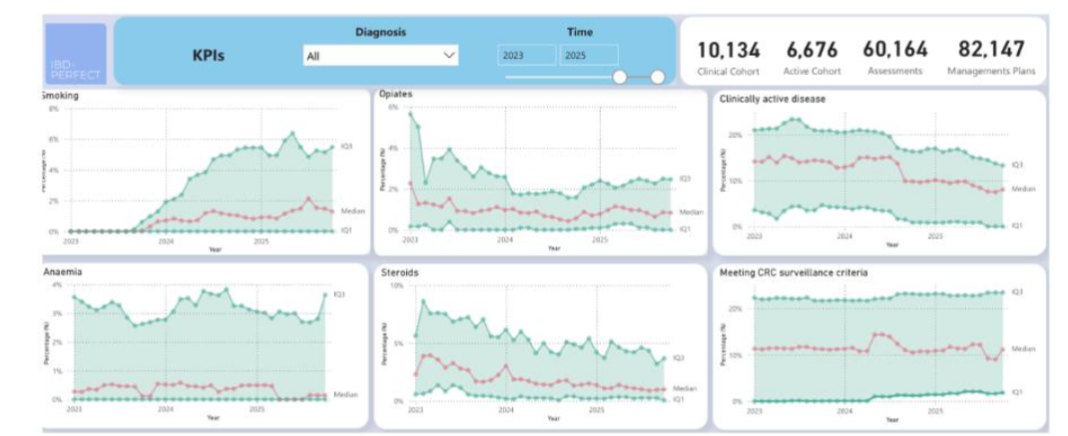
Baseline aggregated KPIs across participating centres are summarised in Table 1 and displayed graphically in Figure 1. Results are presented as medians and interquartile ranges to characterise variation between sites.
| Key performance indicator | Median | Q1 | Q3 |
|---|---|---|---|
| Individuals currently smoking | 1.3% | 0.0% | 4.8% |
| Individuals currently receiving opiates | 0.6% | 0.0% | 1.6% |
| Individuals with clinically active disease | 7.9% | 0.0% | 13.4% |
| Individuals with anaemia | 0.1% | 0.0% | 3.8% |
| Individuals currently receiving corticosteroids | 1.1% | 0.2% | 4.1% |
| Individuals meeting CRC surveillance criteria | 11.2% | 1.8% | 23.4% |
Overall, recorded rates of current smoking, systemic corticosteroid use, opiate use, clinically active disease and anaemia were low across centres. Eligibility for colorectal cancer surveillance was assessed within the clinical cohort. The median proportion of individuals meeting surveillance eligibility criteria across centres was 11.2% (IQR 1.8–23.4).
Data Completeness
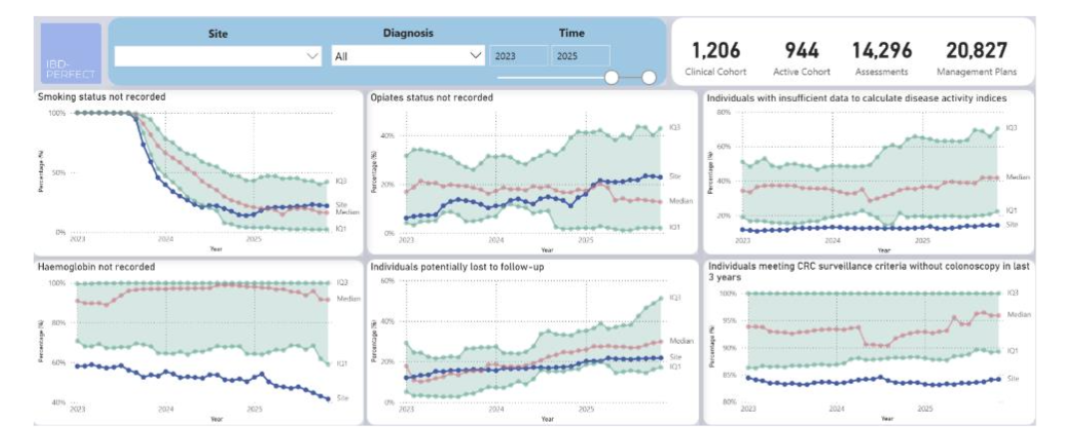
Data completeness for each KPI is summarised in Table 2 and shown in Figure 2. Completeness varied substantially across centres, and missing data limited interpretation of KPI values.
| Data completion variable | Median | Q1 | Q3 |
|---|---|---|---|
| Individuals with smoking status not recorded | 16.4% | 2.5% | 43.4% |
| Individuals with opiates status not recorded | 13.2% | 2.3% | 44.2% |
| Individuals with insufficient data to calculate disease activity indices | 41.8% | 22.3% | 71.0% |
| Individuals without haemoglobin recorded | 90.9% | 57.1% | 100.0% |
| Individuals without a clinical evaluation in the last 14 months | 29.6% | 17.8% | 51.4% |
| Individuals meeting CRC surveillance criteria without colonoscopy recorded in the last 3 years | 95.6% | 88.5% | 100.0% |
Data completeness is defined as the proportion of the relevant cohort with sufficient recorded information to calculate each indicator at the most recent assessment. Values are presented as medians and interquartile ranges across centres.
Discussion
Here we report the early implementation of IBD-PERFECT, an innovative data-driven platform designed to support real-time, disease-specific quality benchmarking across IBD care sites in Australia and New Zealand. By leveraging structured data captured during routine care, IBD-PERFECT provides near real-time visibility of KPIs at both site and system level, supporting reflective practice, local quality improvement, and system-level benchmarking. Using a cloud-based architecture, participation does not need to be limited by funding models (public vs private care) or by jurisdictions (states, local health districts/networks or discrete hospital sites). Whilst this has been initially deployed in Australia and New Zealand, the data approach could equally be used in any other global location.
The baseline findings demonstrate that real-time performance reporting across multiple centres is feasible when embedded within an IBD-specific clinical system. However, they also reinforce a critical principle for registry-enabled quality improvement. Apparent variation in care and outcomes can only be interpreted meaningfully when accompanied by transparent reporting of data completeness. Missing data should not be viewed simply as a limitation because it identifies where clinical workflows and documentation require improvement. Making these gaps visible enables targeted strategies to strengthen measurement, support fair benchmarking and over time, reduce unwarranted variation in high-yield aspects of IBD care that can be addressed without relying on expensive or scarce resources.
Early insights from implementation and baseline findings IBD-PERFECT was launched at the joint World Congress of Gastroenterology and Australian Gastroenterology Week meeting in September 2025, and the results reported here represent the first aggregated system-level snapshot following implementation. Several baseline KPIs appeared favourable across participating centres, including low recorded proportions of individuals who were current smokers, receiving systemic corticosteroids or opiates, or assessed as having clinically active disease. However, interpretation is limited by variation in data completeness, particularly in this early phase of platform adoption.
This interplay between recorded performance and data capture was most apparent for colorectal cancer surveillance. Although only a subset of the clinical cohort met eligibility criteria, a high proportion of eligible individuals did not have a colonoscopy recorded within three years. This is unlikely to represent a true deficit in care delivery and more plausibly reflects limitations in documentation, system integration, and the capture of investigations performed outside CCCare. Whilst this may not be the whole explanation, the approach used in IBD-PERFECT, with the provision of actionable insights back to sites, will enable them to explore the actual reasons behind missing data and/or KPI underachievement.
What we have learned
Several key insights have emerged from this initial phase. First, IBD-PERFECT demonstrates that timely benchmarking can be achieved across diverse services when digital data capture enables quality reporting from routine clinical workflows. This approach aligns with contemporary recommendations for CQRs and avoids the delays and administrative burden associated with retrospective data collection.
Second, making data missingness visible is a core quality improvement function of the platform. Transparent reporting of completeness identifies where care processes cannot yet be reliably measured, enabling sites to prioritise workflow, documentation and system-level improvements that strengthen the credibility of benchmarking. This is consistent with established registry and health informatics literature, which emphasises that data accuracy and completeness are prerequisites for meaningful quality improvement and valid benchmarking.
Third, the KPI set used in this early iteration intentionally focuses on high-yield and widely actionable aspects of IBD care that do not require scarce or expensive resources to address. Smoking cessation, minimising avoidable systemic corticosteroid exposure, reducing opiate use, recognising and treating anaemia, and ensuring appropriate colorectal cancer surveillance represent fundamental elements of high-quality IBD care. Improving performance in these domains is highly achievable through focused clinical attention and local service improvement, and increased visibility alone may be sufficient to drive substantial gains by prompting audit, reflection, and targeted follow-up.
Finally, IBD-PERFECT was designed to support improvement through constructive feedback rather than punitive comparison. Site-level results are presented alongside aggregated system-wide distributions rather than prescriptive thresholds. Evidence from audit and feedback research indicates that feedback is more likely to influence practice when it is timely, contextualised, non-punitive, and linked to actionable next steps. In this context, the ability for sites to download de-identified, site-specific patient lists using internal identifiers is a key enabling feature, supporting local validation, targeted follow-up, and quality improvement activity.
Future directions
These findings reflect an early implementation phase, and KPI estimates may change as documentation practices mature and site engagement increases. Indicators reliant on externally performed investigations may underestimate true performance where documentation is incomplete. IBD-PERFECT remains in its initial iteration and is designed to evolve. Immediate priorities include improving data completeness through clinician engagement and refinement of workflows, alongside iterative review of the KPI set to ensure ongoing relevance. Planned developments include paediatric-specific indicators and longitudinal evaluation of KPIs after at least 12 months of implementation to assess trends and determine whether enhanced visibility translates into measurable improvements in care processes.
Conclusion
Overall, IBD-PERFECT (https://ibdperfect.org/) provides a practical framework for real-time quality benchmarking in IBD care using routinely collected clinical data. By pairing actionable performance indicators with transparent reporting of data completeness, the platform supports reflective practice, meaningful benchmarking, and system-level learning as part of a scalable quality improvement approach.
Author Contributions:
JMA: Conceptualisation, Methodology, Supervision, Writing – review & editing
SJC: Conceptualisation, Methodology, Supervision, Writing – review & editing
RW: Methodology, Data curation, Writing – original draft, Writing – review & editing
AH: Writing – original draft, Writing – review & editing
VC: Methodology, Data curation, Writing – review & editing
RD: Methodology, Writing – review & editing
All authors critically reviewed the manuscript and approved the final version.
Acknowledgements
We gratefully acknowledge the contributions of the site leads of the Crohn’s Colitis Cure Data Insight Program who facilitated prospective data entry into the clinical quality registry that underpins this study. Their oversight and collaboration were essential in enabling access to high-quality, deidentified clinical data.
Site Leads (listed alphabetically by surname)
Dr Yoon-Kyo An – Mater Hospital, South Brisbane, QLD, Australia
A/Prof Jakob Begun – Mater Hospital, South Brisbane, QLD, Australia
Dr Ray Boyapati – Monash Health, Clayton, VIC, Australia
Dr Shoma Dutt – Children’s Hospital Westmead, Westmead, NSW, Australia
Prof Richard B Gearry – Christchurch Hospital, Christchurch, New Zealand
Dr Simon Ghaly – St Vincent’s Hospital, Darlinghurst, NSW, Australia
A/Prof Edward Giles – Monash Children’s Hospital, Clayton, VIC, Australia
A/Prof Craig Haifer – St Vincent’s Hospital, Darlinghurst, NSW, Australia
Prof Ian C Lawrance – St John of God Subiaco Hospital, Subiaco, WA, Australia
A/Prof Kate Lynch – Royal Adelaide Hospital, Adelaide, SA, Australia
A/Prof Gregory Moore – Monash Health, Clayton, VIC, Australia
A/Prof Graham Radford-Smith – Integrated Gut Health, Taringa, QLD, Australia
Dr Asif Shahzad—Logan Hospital, Meadowbrook, QLD, Australia
Prof Michael Schultz – Department of Medicine, University of Otago, Dunedin, New Zealand
Dr Heidi Su – Christchurch Hospital, Christchurch, New Zealand
Dr Watson Ng – Liverpool Hospital, Liverpool, NSW, Australia
Dr Christine Verdon – Campbelltown Hospital, Campbelltown, NSW, Australia
Dr Gareth Walker – Royal Brisbane and Women’s Hospital, Brisbane, QLD, Australia
Dr Gabrielle Wark – Liverpool Hospital, Liverpool, NSW, Australia
Conflict of Interest Disclosure
JMA has received honoraria for Advisory Board participation, speaker fees, educational support and/or research support from: Abbvie, Allergan, Anatara, Atmo Capsule, Bayer, BMS, Celgene, Celltrion, Falk, Ferring, Fresenius Kabi, Gilead, Hospira, Immuninc, Immunsan T, Janssen, MSD/Organon, Nestle, Novartis, Pfizer, Sandoz, Shire, Takeda, Vifor, Royal Adelaide Hospital research Fund and The Helmsley Charitable Trust.
SJC has received honoraria for Advisory Board participation, speaker fees, educational support and/or research support from: Abbvie, Agency for Clinical Innovation, Amgen, BMS, Chiesi, Celltrion, Cornerstones Health, DrFalk, Eli Lilly, Ferring, GSK, Janssen, Medical Research Future Fund, Organon, Pfizer, Sandoz, South Western Sydney Local Health District, Sydney IBD School, Sydney Partnership for Health, Research and Enterprise, Takeda and The Leona M and Harry B Helmsley Charitable Trust.
All other authors have no conflicts of interest to declare.
Funding Statement
This study was not funded by any external agency, and no funding body had any role in the study design; data collection, analysis, or interpretation; manuscript preparation; or the decision to submit for publication.
Data Availability Statement
The underlying consumer-level data reported on here are not publicly available due to privacy. Other data may be shared by the corresponding or senior author upon request and with appropriate approvals. Ongoing public data from this ongoing project can be accessed at https://ibdperfect.org/
References
- Ng SC, Shi HY, Hamidi N, et al. Worldwide incidence and prevalence of inflammatory bowel disease in the 21st century: a systematic review of population-based studies. Lancet. 2017;390(10114):2769-2778. doi:10.1016/S0140-6736(17)32448-0
- Ananthakrishnan AN, Kwon J, Raffals L, Sands B, Stenson WF, McGovern D, et al. Variation in treatment of patients with inflammatory bowel diseases at major referral centers in the United States. Clin Gastroenterol Hepatol. 2015;13(6):1197-1200.
- Jackson BD, Con D, Liew D, De Cruz P. Clinicians’ adherence to international guidelines in the clinical care of adults with inflammatory bowel disease. Scand J Gastroenterol. 2017;52(5):536-542.
- Andrews JM, Petch B. From audit to action: why Australia must fund real-time registries. Medical Republic. Published 2025. Accessed November 29, 2025. https://www.medicalrepublic.com.au/from-audit-to-action-why-australia-must-fund-real-time-registries/120430
- Jackson BD, De Cruz P. Quality of care in patients with inflammatory bowel disease. Inflamm Bowel Dis. 2019;25(3):479-489.
- Sutherland K, Levesque J. Unwarranted clinical variation in health care: definitions and proposal of an analytic framework. J Eval Clin Pract. 2020;26(3):687-696.
- Bryant RV, Costello SP, Schoeman S, Sathananthan D, Knight E, Lau SY, et al. Limited uptake of ulcerative colitis “treat-to-target” recommendations in real-world practice. J Gastroenterol Hepatol. 2018;33(3):599-607. doi:10.1111/jgh.13923.
- Donabedian A. The quality of care. How can it be assessed? JAMA. 1988;260(12):1743-1748. doi:10.1001/jama.260.12.1743
- Crohn’s & Colitis Australia. IBD State of the Nation Report. Published 2025. Accessed November 29, 2025. https://crohnsandcolitis.org.au/advocacy/our-projects/ibd-state-of-the-nation/
- Australian Commission on Safety and Quality in Health Care. User Guide for Reviewing Clinical Variation. Accessed November 29, 2025. https://www.safetyandquality.gov.au/our-work/healthcare-variation/user-guide-reviewing-clinical-variation
- Coiera E, Chan A, Brooke-Cowden K, Rahimi-Ardabili H, Halim N, Tufanaru C. Clinical and economic impact of digital dashboards on hospital inpatient care: a systematic review. JAMIA Open. 2025;8(4):ooaf078.
- Lloyd R, Zaarur L, Procopio B, McMahon L, Rodriguez C, Vaidya V, et al. Using a real-time dashboard to support population health in inflammatory bowel disease. Gastroenterology. 2023;164(4 Suppl 1):S85.
- Australian Commission on Safety and Quality in Health Care. Australian Framework for National Clinical Quality Registries. Published 2024. Accessed November 29, 2025. https://www.safetyandquality.gov.au/sites/default/files/2024-09/australian-framework-for-national-clinical-quality-registries-cqr-2024.pdf
- Ahern S, Evans S, Hopper I, Zalcberg J. Towards a strategy for clinical quality registries in Australia. Aust Health Rev. 2019;43(3):284-287.
- Pipicella JL, Dutt S, Thacker K, Connor SJ, Andrews JM, Vernon-Roberts A. Crohn’s Colitis Care, a disease-specific electronic medical record, enhances data capture in pediatric inflammatory bowel disease care. JGH Open. 2025;9(5):e70153.
- Krishnaprasad K, Walsh A, Begun J, Bell S, Carter D, Grafton R, et al. Crohn’s Colitis Care (CCCare): bespoke cloud-based clinical management software for inflammatory bowel disease. Scand J Gastroenterol. 2020;55(12):1419-1426.
- Baillie S, et al. Chronic abdominal pain in inflammatory bowel disease. Frontline Gastroenterol. 2024;15(2):144.
- To N, Gracie DJ, Ford AC. Systematic review with meta-analysis: the adverse effect of tobacco smoking on the natural history of Crohn’s disease. Aliment Pharmacol Ther. 2016;43(5):549-561. doi:10.1111/apt.13533
- Dignass AU, Gasche C, Bettenworth D, et al; European Crohn’s and Colitis Organisation (ECCO). European consensus on the diagnosis and management of iron deficiency and anaemia in inflammatory bowel diseases. J Crohns Colitis. 2015;9(3):211-222. doi:10.1093/ecco-jcc/jju009
- Ford AC, Bernstein CN, Khan KJ, Abreu MT, Marshall JK, Talley NJ, Moayyedi P. Glucocorticosteroid therapy in inflammatory bowel disease: systematic review and meta-analysis. Am J Gastroenterol. 2011;106(4):590-599. doi:10.1038/ajg.2011.70
- Gordon H, Biancone L, Fiorino G, et al. ECCO guidelines on inflammatory bowel disease and malignancies. J Crohns Colitis. 2023;17(6):827-854. doi:10.1093/ecco-jcc/jjac187
- Arts DG, de Keizer NF, Scheffer GJ. Defining and improving data quality in medical registries: a literature review, case study, and generic framework. J Am Med Inform Assoc. 2002;9(6):600-611. doi:10.1197/jamia.m1087
- Botsis T, Hartvigsen G, Chen F, Weng C. Secondary use of EHR: data quality issues and informatics opportunities. Summit Transl Bioinform. 2010;2010:1-5.
- Hysong SJ. Meta-analysis: audit and feedback features impact effectiveness on care quality. Med Care. 2009;47(3):356-363. doi:10.1097/MLR.0b013e3181893f6b
- Ivers N, Yogasingam S, Lacroix M, Brown KA, Antony J, Soobiah C, et al. Audit and feedback: effects on professional practice. Cochrane Database Syst Rev. 2025;3(3):CD000259. doi:10.1002/14651858.CD000259.pub4
- Bouhuys M, Lexmond WS, van Rheenen PF. Pediatric inflammatory bowel disease. Pediatrics. 2023;151(1):e2022058037. doi:10.1542/peds.2022-058037