






Questioning Strategies in COVID-19 Contact Tracing Calls
Question/answer-sequences in contact tracing telephone calls in Flanders during the Covid-19 pandemic
Stef Slembrouck1, Romeo De Timmerman1, Mieke Vandenbroucke2, Anne-Sophie Bafort2, Sofie Van de Geuchte3
- MULTIPLES, Linguistics Department, Ghent University.
- Grammar & Pragmatics, Linguistics Department, University of Antwerp.
- Linguapolis, University of Antwerp
OPEN ACCESS
PUBLISHED: 30 November 2024
CITATION: Slembrouck, S., De Timmerman, R., et al., 2024. Question/answer-sequences in contact tracing telephone calls in Flanders during the Covid-19 pandemic. Medical Research Archives, [online] 12(11). https://doi.org/10.18103/mra.v12i11.6097
COPYRIGHT © 2024 European Society of Medicine. This is an open-access article distributed under the terms of the Creative Commons Attribution License, which permits unrestricted use, distribution, and reproduction in any medium, provided the original author and source are credited.
DOI https://doi.org/10.18103/mra.v12i11.6097
ISSN 2375-1924
Abstract
Background: During the outbreak of COVID-19 in 2020, one of the critical strategies employed by governments around the world to contain the virus’s spread was contact tracing. In Belgium, contact tracing was mostly implemented through government-mandated call centres employing a mix of experienced and recently recruited telephone workers. As the collection of reliable information concerns a central goal of contact tracing interactions, the posing of questions by contact tracers becomes a highly consequential, yet challenging task to execute. Expansions which accompany questions may be useful as important vectors to manage the sensitivity of invasive questioning of index patients.
Objective: In this article, we zoom in on the multiple guises of how questions were posed by Flemish contact tracers in the period 2020-2021, with specific attention to the positioning of the contact tracers’ questions in adjacency pairs (expansions), and how this relates to the accomplishment of the goals of the contact tracing call (including obtaining relevant and truthful answers and managing the intrusive and sensitive aspects of questioning behaviour).
Methods: A corpus of 100 contact tracing calls conducted in Dutch between a contact tracer and index patient was gathered between late 2020 and early 2021. A quantitative analysis was conducted on the transcribed interactions to identify the type of expansion applied by contact tracers (pre-expansions, insert expansions and post-expansions) and the interactional meaning accomplished in the expansion (e.g., motivation for asking a question, apology for the intrusion, an explanation of a term used, etc.).
Results: Our results show that contact tracers mostly expand after an answer has been received, rather than anticipate the need to frame a question-answer sequence or guide the index patient enroute from question to answer. Most prevalent as pre-expansions are question announcements and recall of what was said earlier. In the case of insert expansion, the most prevalent interactional accomplishments are clarifications or time management signals. In the case of post-expansions, the prevalent types are backchannel, question clarifications and repetitions of the index patient’s answer as a form of acknowledgement or display of information processing.
Keywords
COVID-19, contact tracing, question-answer sequences, conversation analysis, public health
1. Introduction
The COVID-19 outbreak, which began in late 2019, rapidly evolved into a global pandemic, affecting millions of people worldwide. The highly contagious nature of the virus, primarily spread through aerosol particles, made containment challenging, particularly because many infected individuals were asymptomatic but still capable of spreading the virus. In light of these challenges, one of the critical strategies employed by governments around the world to contain the virus’s spread was contact tracing. Contact tracing activities by governments and health institutions at the time aimed to (i) identify individuals who had come into close contact with a COVID-19 infected person, (ii) notify them of their potential exposure, and (iii) advise them on necessary precautions, such as testing, quarantine, or isolation. In 2020, however, contact tracing was not a novel public health strategy, as it had been used in previous health crises such as the Ebola outbreaks, the HIV/AIDS epidemic, and tuberculosis control. Yet, the sheer scale of its use during the COVID-19 pandemic was unprecedented. In Belgium, and in a number of other countries, manual contract tracing through telephone calls was rolled out by governmental and public health agencies, and frequently supplemented with digital solutions, such as smartphone apps that used Bluetooth or location data to automatically trace individuals who had been in close proximity to confirmed COVID-19 cases.
The public’s cooperation and trust were essential for the success of these measures, although challenges such as privacy concerns and skepticism about data usage impacted the effectiveness of digital solutions in some regions. Next to the tracing and monitoring of infection rates, a key concern and goal for public authorities during the COVID-19 outbreak was to inform citizens and assist health-related decision-making. This gave rise to an almost unprecedented flow of public health communication, which contributed significantly to public awareness and health literacy worldwide. Centralized and decentralized initiatives, one of which was government-mandated contact tracing, were therefore essential in building public knowledge about infection rates and sensitizing citizens to the dangers of COVID-19 and the necessary safety measures in place at a given time.
In this article, we focus on the practice of COVID-19 contact tracing in Belgium which was operational between May 2020 and late 2022. In Belgium, contact tracing was mostly conducted through call centres contracted by the government and carried out by a mix of experienced and recently recruited telephone workers. The latter exemplifies how traditional methods were adapted to meet the pandemic’s scale. This upscaled intervention involved contacting large numbers of people on a daily basis through call centre agents to track transmission routes and inform citizens of their exposure risks and necessary precautions. When a person tested positive for COVID-19, known as the index patient (abbrev. as IP), they were contacted by a contact tracer (abbrev. as CTer) who gathered information about the IP’s recent contacts and provided instructions on follow-up and safety measures at home and in the public space. This telephone-based system marked a significant shift in public health operations in Belgium at the time, transforming contact tracing into an institutionalized activity designed to cope with a high volume of cases during two years of the pandemic.
Previous research into the nature of the COVID-19 contact tracing telephone conversation between the contact tracer and the index patient in Belgium has topicalized it as a distinct institutional activity-type and, arguably, a new genre of conversation. Indeed, even though contact tracing had been around in various forms and variants, internationally and within Belgium, the COVID-19 contact tracing telephone conversation emerged as a speech genre more or less overnight and it was still ‘unknown’ to large parts of the general public. Based on a large-scale interactional analysis of a corpus of COVID-19 contact tracing interactions, our project documents in detail both the hybrid nature of this genre of conversation, and the multi-functional balance CTers had to strike as part of their institutional brief. The genre’s hybrid nature connects, for instance, to the fact that, on the one hand, CTers had to collect highly sensitive and private information from IPs unknown to them – an intrusive matter which typically requires time, trust and delicacy – whilst, on the other hand, they were instructed to handle calls as efficiently and quickly as possible, in light of the large number of daily infections and calls that had to be managed by the call centre.
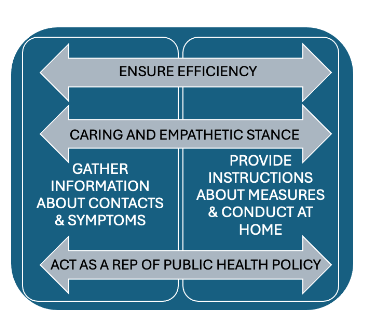
As can be deduced from this visual overview (Figure 1), two episodally-structured, core functions occur, alongside three more transversal ones. First, in the second stage of the talk, contact tracers collect data and information on the symptoms and contacts of the index patient. Before that, in an earlier stage of the call, they offer guidance on quarantine, isolation, and other safety protocols and provide instructions on how to manage life at home while in isolation. Third, transversally, the CTers are expected throughout the interaction with the IP to maintain an individual, patient-centered, supportive and caring stance and communicate empathetically. Fourth, they were instructed to accomplish the goals of the interaction and carry out these functions as efficiently as possible. Finally, they are expected to approach their communicative tasks in ways which align with their role as representatives of government public health policy (see Bafort et al, De Timmerman et al and Slembrouck et al., for detailed discussion and illustrative examples). As the COVID-19 telephone contact tracing interactions proceeded largely through call centres (i.e. without a visible interlocutor) and CTers who contacted IPs unknown to them to obtain and provide information, an interactional dimension which proved to be central to the contact tracing endeavour was the CTers’ formulation of questions and their management of the IPs’ answers. It is precisely this delicate matter which we zoom in on in this article.
How speakers pose questions and manage answers concerns one the key interests of the field of Conversation Analysis (abbrev. as CA). CA studies how participants in a conversation structure their talk when they interact with one another. CA contributes to our understanding of how interactions are organized in interactional sequences and how interactional meaning is co-constructed between participants. In studying the structure of conversation, CA scholars typically focus on turn-taking, i.e. the organized manner in which participants in a conversation alternate and “take turns” at speaking as part of the flow of the conversation. Typical interactional sequences which occur in the form of turn-pairs are: question-answer, apology-acceptance, accusation-admission, etc. Question-answer sequences, in particular, can serve multiple functions in conversation, ranging from seeking information, prompting action, or initiating particular types of social responses. Question-answers sequences are important tools for managing the interactional dynamic between speakers. Like the other turn types referred to above, questions invoke an “adjacency pair” structure, where the “first pair part” (the question) requires a “second pair part” (the answer). Question-answer sequences are important characteristics of institutional talk and form one of the core vehicles to reach the goal of the institutional encounter at hand, in this case the contract tracing call. Especially in institutional encounters which are more sensitive or delicate in nature (such as a doctor-patient conversations) the use of a question frame or question-projecting device allows interlocutors to handle the delicacy of suitable formulations. In the case of COVID-19 telephone contact tracing, the posing of (invasive) questions is both central and inevitable when the CTer queries particular bits of information (e.g. have you recently attended a public gathering?). Sensitivities equally arise when the CTer checks whether the IP has understood a particular piece of formulated advice. Whilst the occurrence of question-answer sequences as a specific type of adjacency pair characteristic of many if not all types of conversations may appear to be an ordinary and straightforward matter, posing a question is in reality not as simple as one would assume. Often, the interlocutor who poses the question will expand on it in some way, in order to negotiate or secure mutual understanding; they may clarify ambiguities, anticipate a desired answer, aim to maintain good or workable social relations while information is being exchanged, etc. Through so-called “expansions” of the adjacency pair, speakers can manage turn-taking, ensure alignment with their interlocutors, and handle any emerging issues within the conversation. For instance, if a speaker perceives that their original statement was misunderstood, they can use an expansion to clarify matters and/or ensure the conversation continues to proceed smoothly. Conversation analysts view these expansions as a fundamental part of how human communication operates. The interactional meaning orientation of specific expansions reflects the social relational and cognitive processes involved in interaction. Indeed, they show that conversation is not simply about the exchange of information, but is a highly coordinated, dynamic activity where participants must work together to achieve mutual understanding and satisfactory communication. Three types of expansions can be discerned depending on their position in the adjacency pair: pre-expansions, insert expansions and post-expansions. Applied to question-answer pairs, an expansion can occur before the actual question is posed, it may come after the question itself but before the answer is given, and/or it may unfold after the interlocutor has answered the question. Insert and post expansions may be initiated by either interlocutor (e.g. an IP requesting clarification before giving an answer; e.g. a CTer expressing gratitude when acknowledging receipt of the IP’s answer).
Against this larger background of COVID-19 contact tracing through call centres and the complexities of questions in spoken conversations, our interest in this article goes to the multiple guises of how questions are posed by CTers during their contact tracing practice, the positioning of the CTers’ questions in adjacency pairs and how this relates to the accomplishment of the goals of the CT call (including obtaining relevant and truthful answers and managing the intrusive and sensitive aspects of questioning behaviour).
2. Methods
This article reports on data collected within the context of a 1-year COVID-19 research project funded by the Research Foundation Flanders (FWO) in Belgium. Even though the main focus of the project was on interactional practice, i.e., to identify and optimize the interactional dynamics in contact tracing telephone conversations in Flanders, the project team was transdisciplinary in nature through a collaboration between a team of (socio)linguists, medical experts, epidemiologists, a moral scientist and a representative of the Flemish Agency of Health and Care. The data analysis and implementation was done in collaboration with one of the private call centre companies responsible for COVID-19 contact tracing in Flanders. As such, the project involved a collaboration between academic researchers, practitioners, and government representatives, all of whom were involved from the start in the formulation of the research questions, the methodological approach and the desired project outcomes.
The starting point of the project was a number of interactional problems which were perceived to hinder the effective functioning of contact tracing in Flanders, and which emerged in the project team’s early conversations with the stakeholders: e.g., calls remained too short; the talk was script-dominated; there was reluctance to divulge necessary information; there was a lack of rapport between interlocutors. The project’s central goal was then to diagnose the “interactional” state of telephone contact tracing on the basis of an interactional analysis of a corpus of recorded calls and to formulate evidence-based recommendations to improve contact tracing practice.
For this purpose, a corpus of 100 “1A” contact tracing calls conducted in Dutch between a contact tracer (CTer) and index patient (IP) was gathered between late 2020 and early 2021. The term “1A-call” refers to the initial contact tracing call with an infected IP immediately after the official registration of the diagnosis. The corpus did not include subsequent calls with reported contacts who were at risk. The calls were audio-recorded with informed consent of the CTers and the IPs and subsequently pseudonymized by transcription. The extent to which contact tracers frame the questions they ask was first analyzed from a quantitative perspective. To that end, a tabular dataset was created for all questions posed by the contact tracers. The dataset was coded for expansion type and interactional meaning orientation. We specifically coded for the following three possible expansion locations: pre-expansions, insert expansions and post-expansions. We additionally coded the expansions for their interactional meaning dimensions (e.g. apologize for asking the question, motivate why a particular question is important, clarify what is being asked, etc.).
In our analysis, we first examine in detail whether or not an expansion occurred. After that, in a finer-grained analysis of the corpus, we concentrate on the functional orientations in each of the three expansion types. In our analysis below, we refer to the binary variable as “naked” (i.e., no expansion occurs) or “non-naked expansions” (i.e., an expansion occurs). Note that for each question that was asked by the contact tracer during the phone call, up to three expansions could occur.
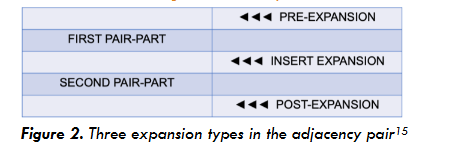
As mentioned in the introduction, expansion is a key notion for capturing how conversational sequences are extended or elaborated. They occur when the basic structure of an adjacency pair—such as a question and answer or greeting and response—is extended through additional talk. Expansions can provide context, repair misunderstandings, or allow speakers to further develop their interaction. Kendrick et al make the case for the universality of this type of sequence organization as observable in human conversational interaction.
The three types of expansion involved in the posing and interactional accomplishment of a question are:
- Pre-expansions occur before the production of the first part of an adjacency pair and are used to prepare or set the stage for the forthcoming action (in this case: a question posed by the CTer). Pre-expansions serve as a way for the CTer to signal that something is about to happen, they help to prime the recipient – the IP – for what is to come. In the case of questions, pre-expansion allows the CTer to smooth the path for the main question action.
- Insert expansions occur between the first and second parts of an adjacency pair. Instead of the second pair part following directly after the first, an additional sequence is initiated by one of the interlocutors after the initial question has been posed. This delays the response to the original question. Insert expansions help manage the flow of interaction by ensuring mutual understanding and, in the case of questions, they count as guidance enroute to the answer.
- Post-expansions occur after the completion of the adjacency pair and can extend the interaction beyond the basic exchange. Post-expansions can be brief but also more elaborate in nature. After the IP answers a question, for example, the CTer might follow up with a question which double checks the information received, or with comments on the answer.
In order to clarify the analytical focus, the extract below, taken from an audio-recorded contact tracing conversation part of the corpus, illustrates the three different types.
Extract 1: CTer = woman, 2 months experience; IP = woman, aged 25-30
203 CT okay . and was your last contact today and have you been uhm closer together than one and a half metres and longer than fifteen minutes and without a mask
204 IP yes
205 CT [ok]
206 IP [laughter] yes yes that’s right
207 CT and uhm . did you physic- sorry for this question but have you had any physical contact? you did kiss I would assume
208 IP . yes yes
209 CT sorry for having to ask this [laughter]
210 IP yes that’s alright [laughter]
211 CT [laughter] uuhh okay and then we will uhm
The highlighted part in turn 207 (“sorry for this question”) counts as a pre-expansion and entails an apology for asking a question which ventures into the IP’s private life. The second highlighted part (“you did kiss I assume”) provides a clarifying reformulation of the initial question and counts as an insert expansion, while in the post expansion (turns 209 to 211) a number of things are accomplished interactionally: we note a repeated apology for having asked the question (“sorry for having asked this”), the IP’s acceptance of the apology by cancelling its necessity (“yes that’s alright”) and the CTer’s wrap-up of this particular question-answer sequence (“uuhh okay”) together with an announcement of the transition to the next sequence (“and then we will uhm”).
In a further analysis of the corpus, we have concentrated on the specific range of functional orientations in the three expansion types. The following functional orientations were discerned in the analysis of the corpus as interactionally relevant meaning orientations which are raised to the foreground of interaction by means of an expansion:
- Announcement (announce that a question will be asked)
- Recall (refer back to an earlier part of the conversation)
- Information (provide information about the question)
- Mitigation (tone down the face-threatening nature of the question)
- Motivation (motivate why a particular question is asked)
- Direct address (the sequence opens with a direct address of the IP)
- Assumption (express an assumption about a likely response)
- Clarification (clarify what is meant by (part of) a question or answer– e.g. explain a term)
- Summary (rely on a summary of a previous response to introduce the next question)
- Answer (use a previous answer to introduce the next question)
- Time (offer time to think about an answer)
- Apology (apologize for asking the question)
- Narrative (use a small story to introduce the question)
- Qualification (interim comment while answer is given)
- Technical issue (signal incomprehension during (part of) the answer)
- Humour (joke or make a humourous comment when/after the answer is given)
- Positive feedback (signal that the answer is well-received)
- Backchannel (displays of active listening – e.g. mhm, yes, really)
- Repetition (repeat the IP’s answer)
- Addition (add an interpretative comment to the answer)
- Comforting (offer consolation to the IP)
- Delay (CT pauses to process the given answer)
- Negotiation (negotiate the import of an answer)
3. Analysis
In this section, we present the results of the corpus analysis with a focus on the occurrence of the three expansion types (section 3.1) and the functional orientations of the expansions (section 3.2).
3.1. QUANTITATIVE ANALYSIS OF THE THREE EXPANSION TYPES
Figure 3 below visualizes the aggregated occurrences of non-naked expansions by expansion type and call in the corpus. In other words, it shows the extent to which the individual contact tracers qualified their questions in each of the three expansion types we are interested in. The colour codes are “blue” for the pre-expansions, “orange” for insert expansions and “green” for post-expansions. The stacked bars show the absolute number of occurrences per CTer, ranked from low to high.
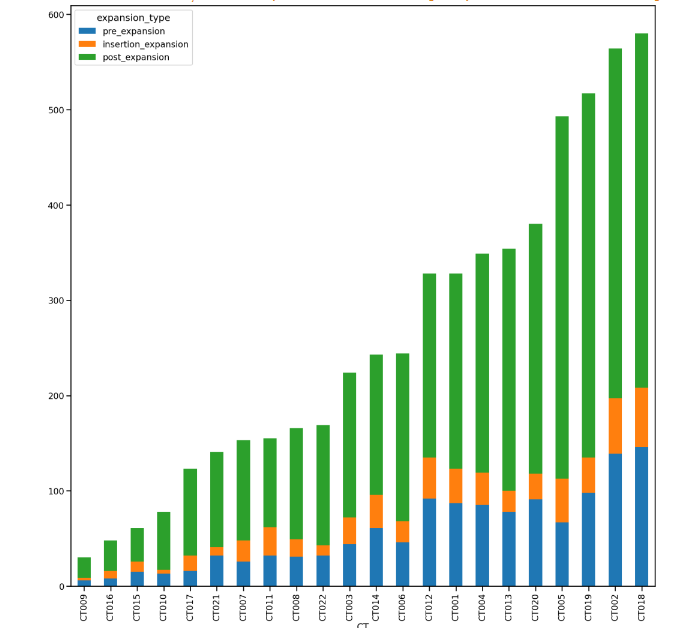
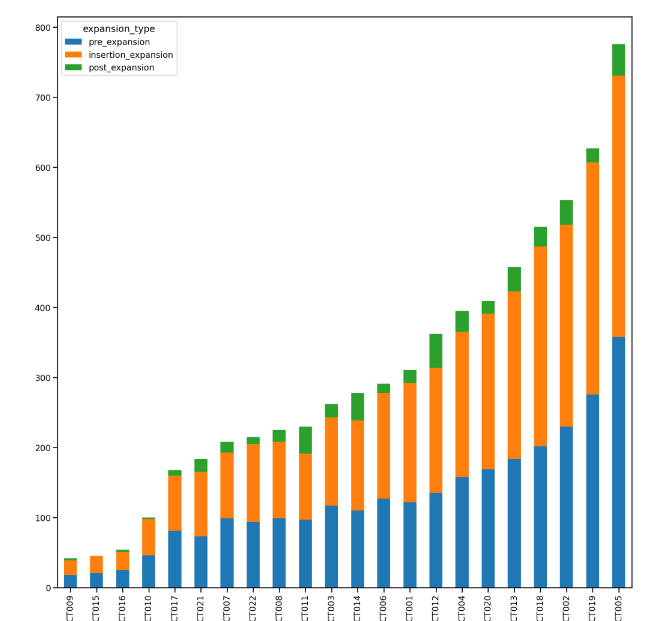
Figure 4 below provides parallel information for “naked expansions”. In other words, it visualizes the extent to which contact tracers did not frame their questions in each of the three possible expansion types. Note that, as these figures show absolute counts (not relative frequencies), the results for “naked expansions” in Figure 4 compared to “non-naked expansions” in Figure 3 are not straightforwardly each other’s mirror image. Each formulated question was coded in terms of the three possible expansion types: “pre”, “insert” or “post”. Individually, these may vary in terms of their realization (“naked” or “non-naked”).
Next, Figure 5 gives the relative frequency of non-naked expansions by expansion type and per contact tracer. We show these relative frequencies to gauge the extent to which CTers qualified their questions, regardless of the duration of the individual calls, or the absolute number of calls conducted by an individual tracer. In other words, Figure 5 most clearly shows the relative tendencies of CTers in engaging with question-framing behaviour. Note that the sum of the relative frequencies does not necessarily amount to “1” (or 100%). This is because the non-naked expansions are not mutually exclusive, i.e., as mentioned earlier, one and the same question-answer sequence may have a pre-expansion, an insert expansion and a post-expansion.
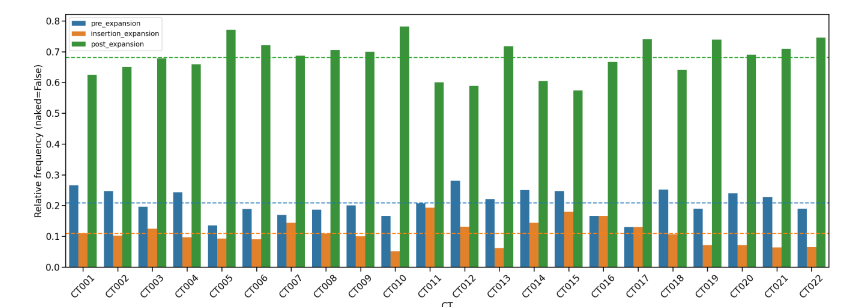
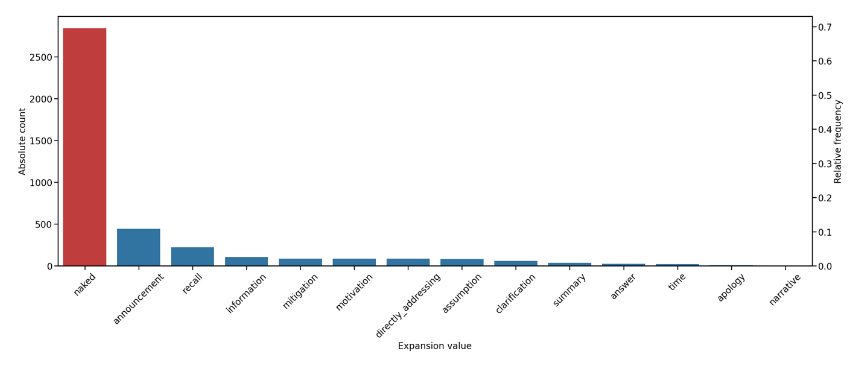
Figure 6 gives distributional results for pre-expansions, showing how ‘announcement’ and ‘recall’ are the most prevalent among the non-naked expansions, though these are drastically outnumbered by the naked expansions (shown in red).
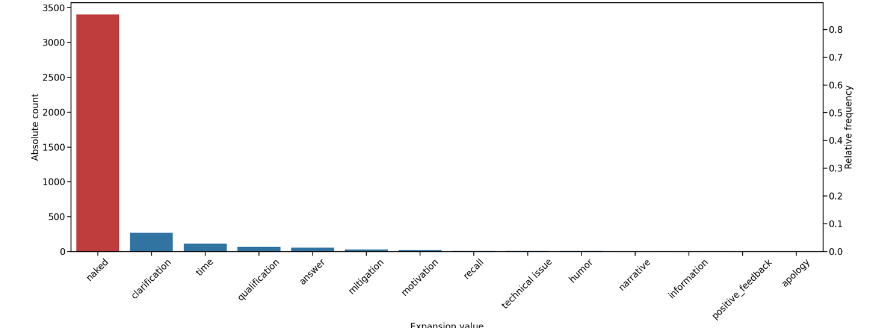
Distributional results can also be given for insert expansions, as visualized in Figure 7, showing how here too, naked expansions (colored in red) are by far the most prevalent. Among the non-naked expansions, ‘clarification’ and ‘time taken to answer the question’ are the most common.
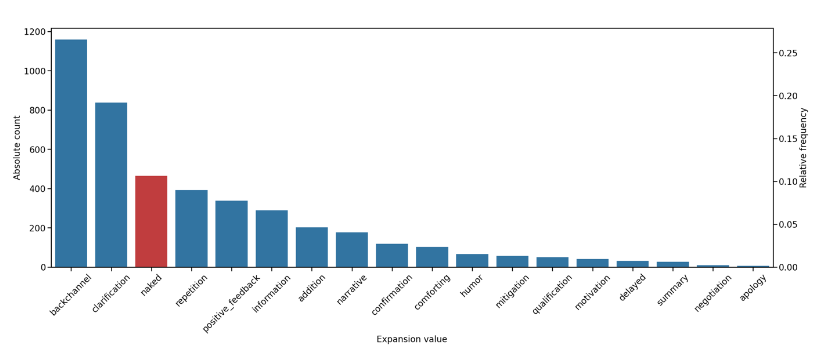
Finally, Figure 8, details the functional orientations in the case of expansions after the IP has answered the CTer’s question. In this case, naked expansions (shown in red) are only the third most prevalent. The two most commonly occurring functional orientations apart from backchannel (simple “mhm”s or “okay”s to signal uptake) are question clarifications and repetitions of the IP’s answer as a form of acknowledgement or as part of a display of information processing.
4. Discussion
Based on these results, we can note, first of all, that considerable variation occurs in the absolute number of questions posed by the CTer across the various calls in the corpus, and correspondingly that calls vary substantially in their duration. Additionally, in Figure 3 above we saw how a basic pattern emerges that CTers rely more often on post-expansions to frame their questions than on either of the other two expansion types. Note that CTers who conducted more calls in our corpus will invariably have higher values. We are not necessarily interested in the comparison between individual CTers, but instead wish to highlight the distribution of non-naked expansions across the three expansion types. The visualization of the aggregated occurrences for naked expansions (Figure 4) detailed the inverse trend: there are, in fact, very few questions without a post-expansion, as opposed to the high number of naked occurrences for pre- and insert expansions. While the aggregated count plots showed how naked and non-naked expansions vary across the three expansion types, it is hard to interpret their overall frequency because of the varying duration of the individual calls in the corpus. Therefore, Figure 7 gave the relative frequency of non-naked expansions by expansion type and per CTer, underlining how expansions are much more prevalent after an answer has already been formulated.
In summary, our initial quantitative analysis shows how, by and large, contact tracers in their question framing behaviour rely far less on the scaffolding function of pre-expansions, which help stage the question, or the enroute accompaniment of insert expansions, which guide the receiver to an answer by explaining or otherwise contextualizing the question. Instead, CTers’ question framing behaviour appears to be oriented mostly to post-expansion. The CTer’s interactional behaviour in this respect appears to be more oriented towards acting in response to the IP’s answer (e.g., acknowledge an expected answer) rather than towards anticipating the need to ask a question before it is asked (e.g., explain the relevance of a particular query) or guide the IP underway towards an answer (e.g., clarify the question before the answer is received).
Turning to the more qualitative part of our analysis, we can note how the low prevalence of the different non-naked functional orientations when a pre-expansion occurs reflects how little anticipatory framing moves are relied upon by the CTers. As detailed in Figure 6 above, when a question is preceded by a framing move, this is mostly done to announce the question or to refer back to what has been talked about earlier. These occur more often than the other listed framing possibilities. Extract 2 below illustrates how CTers may announce their questions explicitly as a pre-expansion.
Extract 2: CTer = man, 6 months experience; IP = man, aged 35-40
379 CT and then I have one more final question here
uh . In Belgium we’ve had the app Coronalert for about two months now
uh had you heard of this app before?
Extract 3 shows an example of pre-expansion which is used by the CTer to recall information that was previously mentioned by the IP to transition to a new question.
Extract 3: CTer = man, 1 month experience; IP = man, aged 55-60
230 CT so . uh . just now you mentioned a uh that you went on a business trip
uh . with which airline operator was this?
Extract 4 provides an example of a clarifying insert expansion.
Extract 4: CTer = man, 1 month experience; IP = woman, aged 45-50
284 CT and are they still going to school ?
(2) [the children]
285 IP [no=no]
286 CT ok
287 IP yes
they=they are students
288 CT yes that’s what I mean
289 IP but
290 CT yes in this situation of course not right
but generally speaking
they are still studying right
291 IP yes the=the eldest is twenty one
they’re studying in uh
[NAME CITY] biology and=and
292 CT oh
293 IP and the youngest is=they’re studying bio- yes
biomedical sciences yes
294 CT oh fantastic
Extract 5 illustrates how CTers often signalled that it is fine for the IP to look something up in order to answer a question.
Extract 5: CTer = woman, 6 months experience; IP = woman, aged 20-25
176 CT do you have his email address by any chance ?
177 IP . uh wait I will have to look it [up]
178 CT [yes] . take your time
179 IP (8) [EMAIL ADDRESS]
Extract 6 shows how CTers often asked for additional clarification regarding parts of the IP’s answer.
Extract 6: CTer = man, 1 month experience; IP = man, aged 55-60
19 IP I haven’t really had a fever, but I do feel a bit as if I have the flu
20 CT ah yes . so by flu you actually mean uh the typical flu symptoms
[like uh] pain in the joints, muscle pain, things like that ?
21 IP [yes a bit] uh
a runny nose . yes
22 CT a runny nose . alright . ok
23 IP yes yes
24 CT ok
Extract 7 illustrates how CTers often simply repeat an IP’s answer to signal uptake.
Extract 7: CTer = man, 6 months experience; IP = man, aged 35-40
20 CT so in fact the last time you had contact with your colleague that was when exactly ?
21 IP Fri- Friday=
22 CT =Friday . okay
5. Conclusions and recommendations for practice
In our analysis, we have shown that the bulk of contact tracers’ interactional efforts while asking questions to index patients goes into responding after an answer has been received, rather than either anticipating the need to frame a question-answer sequence ahead of the question being asked or guiding the IP enroute from question to answer. Some work in CA suggests that post-expansions may be more common than pre-expansions and insert expansions in everyday conversation more generally, due to the natural tendency for conversations to evolve after a response has been given (see Schegloff on the tendency to evaluate a response before moving on; see Heritage and Raymond on minimal post expansions which signal the alignment needed to move the conversation forward). At the same time, we must note that there is less large-scale quantitative work specifically comparing the relative frequency of these expansions, as has been done in this study.
When it comes to advice to practitioners on how questions are best asked and how answers are best received, it is not possible to formulate a blanket advice which would be applicable to all situations or formulate the ingredients for the perfect way of asking a question. As Goffman underlines, there is much that can happen between a question and an answer: asking a question is governed by a dynamics of expectations, projections, displays, recognitions, and so on. The basic realization is that interaction is managed as it unfolds, and that interpreted meaning manifests itself in the course of the sequence. This provides conversationalists with a space within which to act responsively in ways which are tailored to the particular stage the conversation is at, and sensitive to the earlier and current move(s) made by their interlocutors. An overarching recommendation for practice is thus to see what comes and assess how best to respond to it in the moment of the unfolding conversational sequence. Practitioners can adapt and tailor their questioning behaviour as necessary, while acting inside the conversational sequence. In Gumperz’ formulation, while the dynamics of communication in institutionalized procedures indeed often poses problems, it is equally true that the adaptivity of communication while it unfolds provides the main resource for attending to and addressing such problems.
However, the above recommendation does not imply that the flexibility and relative open-endedness of a professional or occupational practitioner’s responsive behaviour amounts to an absolute freedom to act as one pleases. Acting responsively inevitably results in certain aspects of meaning being placed in the interactional foreground. As noted earlier and detailed also in the qualitative examples, contact tracers may apologize for the intrusive nature of their questioning, they may cancel the assumption that they are judging the index patient when asking a particular question, they may explain why it is important to ask a particular question, etc. While one of our conclusions is undoubtedly that the possibility to frame question-answer sequences in the Flemish corpus of CT calls was being under-utilized, we equally want to stress that reflexive self-awareness about the interactional meaning dimensions which are relevant and can be drawn upon as interactional resources is bound to result in more effective interactional practice. The examples we gave in our discussion section detail the range of relevant meaning dimensions, as well as the nature of the responsiveness which has been accomplished. We would argue that the importance of fostering language awareness about relevant meaning dimensions, about what is accomplished when a particular meaning dimension is being foregrounded, as well as the pitfalls that can occur, applies not only to the specific activity type of the contact tracing call, but also to institutional interactions more generally. The best way to proceed in this direction is undoubtedly to engage directly with practitioners by making use of real-life recorded examples of optimal and less optimal framing practices, their affordances and constraints, as well as encourage the development of professional sensitivity to the relevant meanings which are highlighted by the use of particular expansion types and strategies.
Conflict of Interest Statement
Romeo De Timmerman, Anne-Sophie Bafort and Sofie Van de Geuchte were employed by the project as research assistants. The authors declare that the research was conducted in the absence of any commercial or financial relationships that could be construed as a potential conflict of interest.
Funding statement
This study was carried out through Project Grant G0G6120N of the Flemish Science Foundation (‘Fonds voor Wetenschappelijk Onderzoek, Vlaanderen’). The project’s title was “Effective information exchange and care orientation in COVID-19-related contact tracing phone calls. An applied sociolinguistic and conversation analytic enquiry into optimizing interactional dynamics and pragmatic awareness”. The 2020 project funding line Covid-19 (2nd call) was limited to jointly-held inter-university projects. Stef Slembrouck was the PI for Ghent University part; for the University of Antwerp part, the PI was Mieke Vandenbroucke.
Acknowledgements
The authors recognize the intellectual contributions of the project’s co-PI’s and their role in managing the project: Robert Colebunders (Global Health Institute, UAntwerp), Hilde Bastiaens (ELIZA, UAntwerp) and Dirk Wildemeersch (Flemish Agency for Health & Care).
6. References
- Gyselen A. Tuberculosis in Belgium: past, present and future. Acta Clin Belg. 1994;49:125-131.
- Samoff E, Koumans E, Katkowsky S, Shouse R, Markowitz L; Fulton County Disease Investigation Working Group. Contact-tracing outcomes among male syphilis patients in Fulton County, Georgia. Sex Transm Dis. 2007;34:456-460.
- Lin H, He N, Ding Y, et al. Tracing sexual contacts of HIV-infected individuals in a rural prefecture, Eastern China. BMC Public Health. 2012;12:1-11.
- Greiner A, Angelo K, McCollum A, Mirkovic K, Arthur R, Angulo F. Addressing contact tracing challenges – critical to halting Ebola virus disease transmission. Int J Infect Dis. 2015;41:53-55.
- Mbvinjo E, Lynch M, Huws J. Measles outbreak investigation process in low-and middle-income countries: a systematic review of the methods and costs of contact tracing. J Public Health. 2021;30:2407-2426.
- Barrat A, Cattuto C, Kivelä M, Lehmann S, Saramäki J. Effect of manual and digital contact tracing on COVID-19 outbreaks: a study on empirical contact data. J R Soc Interface. 2021;18(178).
- Proesmans K, Hancart S, Braeye T, et al. COVID-19 contact tracing in Belgium: main indicators and performance, January-September 2021. Arch Public Health. 2022;80:1-10.
- Jacob S, Lawarée J. The adoption of contact tracing applications of COVID-19 by European governments. Policy Design Pract. 2021;4:44-58.
- Bafort AS, Slembrouck S, Vandenbroucke M, De Timmerman R, Van de Geuchte S. COVID-19 telephone contact tracing in Flanders as a ‘contested’ new genre of conversation: discrepancies between interactional practice and media image. Front Commun. 2023;7. doi:10.3389/fcomm.2022.965226.
- De Timmerman R, Bafort AS, Van de Geuchte S, Vandenbroucke M, Slembrouck S. Formulations of risk and responsibility in COVID-19 contact tracing telephone interactions in Flanders, Belgium. In: Ädel A, Östman JO, eds. Risk Discourse and Responsibility. Vol. 336. Amsterdam: John Benjamins; 2023:118-141. doi:10.1075/pbns.336.05det.
- Slembrouck S, Vandenbroucke M, De Timmerman R, Bafort AS, Van de Geuchte S. Transformative practice and its interactional challenges in COVID-19 telephone contact tracing in Flanders. Front Psychol. 2023;14. doi:10.3389/fpsyg.2023.1203897.
- Heritage J. Garfinkel and Ethnomethodology. Cambridge: Polity Press; 1984.
- Schegloff E. Turn organization: one intersection of grammar and interaction. In: Ochs E, Schegloff EA, Thompson SA, eds. Interaction and Grammar. Cambridge: Cambridge University Press; 1996:52-133.
- Schegloff E. Preliminaries to preliminaries: ‘Can I ask you a question?’. Sociol Inq. 1980;50(3-4):104-152.
- Schegloff E. Sequence Organization in Interaction: A Primer in Conversation Analysis, Volume 1. Cambridge: Cambridge University Press; 2007.
- Stivers T. An overview of the question–response system in American English conversation. J Pragmatics. 2010;42(10):2772-2781.
- Boyd E, Heritage J. Taking the history: questioning during comprehensive history-taking. In: Heritage J, Maynard DW, eds. Communication in Medical Care: Interaction Between Primary Care Physicians and Patients. Cambridge: Cambridge University Press; 2006:151-184.
- Clayman S, Heritage J. Questioning presidents: journalistic deference and adversarialness in the press conference of Eisenhower and Reagan. J Commun. 2002;52:749-775.
- Linell P, Hofvendahl J, Lindholm C. Multi-unit question turns in institutional interactions: sequential organizations and communicative functions. Text. 2003;23:539-571.
- Peräkylä A. AIDS Counselling: Institutional Interaction and Clinical Practice. Cambridge: Cambridge University Press; 1995.
- Lindström J, Lindholm C, Laury R. The interactional emergence of conditional clauses as directives: constructions, trajectories and sequences of actions. Lang Sci. 2016;58:8-21. doi:10.1016/j.langsci.2016.02.008.
- Kendrick K, Brown P, Dingemanse M, et al. Sequence organization: a universal infrastructure for social action. J Pragmatics. 2020;168:119-138.
- Heritage J, Raymond G. Navigating epistemic landscapes: acquiescence, agency and resistance in responses to polar questions. In: de Ruiter J, ed. Questions: Formal, Functional and Interactional Perspectives. Cambridge, UK: Cambridge University Press; 2012:179-192.
- Goffman E. Replies and responses. Lang Soc. 1976;5:257-313
- Gumperz J. On interactional sociolinguistic method. In: Sarangi S, Roberts C, eds. Talk, Work and Institutional Order: Discourse in Medical, Mediation and Management Settings. Berlin: Mouton de Gruyter; 1999:453-471.