

Rational Drug Use Literacy in Grocery Operators in Narathiwat
Factors Associated with Rational Drug Use Literacy and Amanah Store Certification Among Grocery Operators in Narathiwat
Sofia Siriwallop¹, Roungtiva Muenpa²
- Narathiwat Provincial Public Health Office
- Pharmacy Department, Lampang Hospital
OPEN ACCESS
PUBLISHED: 31 May 2025
CITATION: Siriwallop, S. and Muenpa, R., 2025.
Factors Associated with Rational Drug Use Literacy and Amanah Store Certification Among Grocery Operators in Narathiwat. Medical Research Archives, [online] 13(5).
https://doi.org/10.18103/mra.v13i5.6511
COPYRIGHT: © 2025 European Society of Medicine. This is an open-access article distributed under the terms of the Creative Commons Attribution License, which permits unrestricted use, distribution, and reproduction in any medium, provided the original author and source are credited.
DOI https://doi.org/10.18103/mra.v13i5.6511
ISSN 2375-1924
ABSTRACT
Objective: This study aimed to examine the relationship between rational drug use literacy among grocery store operators and their qualification under the Amanah Grocery Store assessment criteria in Narathiwat Province, Thailand.
Methods: A cross-sectional analytical study was conducted among 106 grocery store operators in Narathiwat Province. The research instrument consisted of a structured questionnaire covering general demographic information and drug use literacy scores. Quantitative data were analyzed using descriptive statistics, including frequency distribution, mean, and standard deviation. Differences in drug use literacy scores between Amanah-certified grocery store operators and general grocery store operators were compared using the student’s t-test. The relationships between relevant factors and Amanah store status were analyzed using either the Chi-square test or the student’s t-test, depending on the data type. A p-value of less than 0.05 was considered statistically significant.
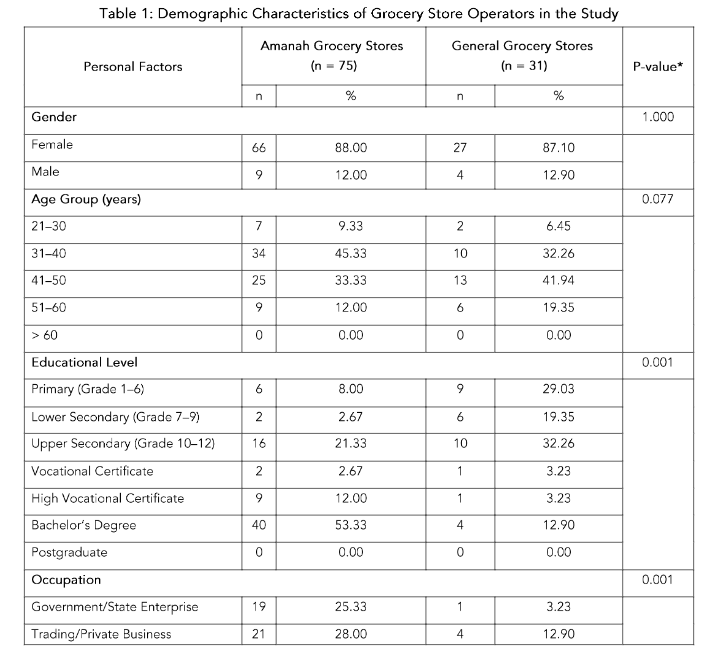
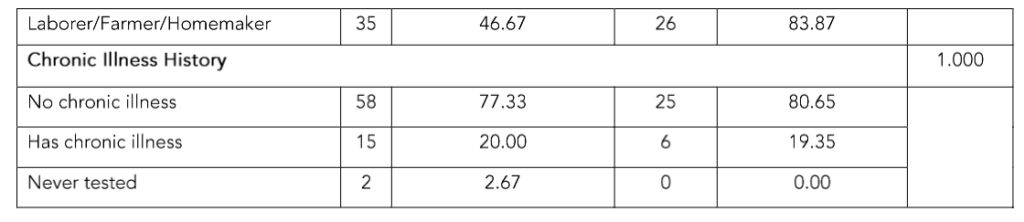
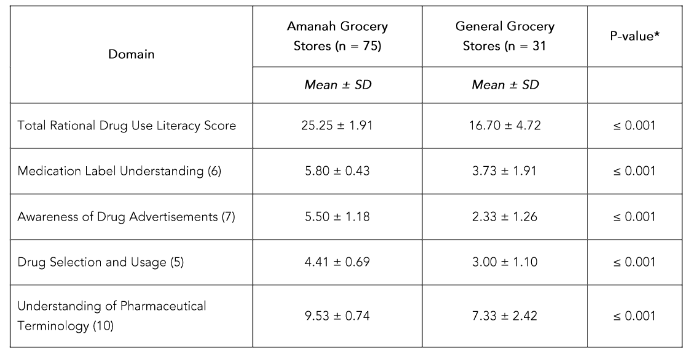
Results: Among the participants, 75 (70.75%) were operators of Amanah-certified grocery stores. The majority were female (87.10%), aged between 31 and 40 years (41.50%), and held a bachelor’s degree (41.50%). The drug use literacy scores of Amanah-certified grocery store operators were significantly higher than those of general grocery store operators (p-value ≤ 0.001). Furthermore, educational level and occupation were significantly associated with Amanah store status (p-value ≤ 0.001). Drug use literacy in four key areas—medication labeling, critical awareness of advertising, drug selection and usage, and understanding of medical terminology—was also significantly associated with Amanah store status (p-value ≤ 0.001).
Conclusion and Recommendations: Promoting rational drug use literacy among grocery store operators can enhance the development of Amanah-certified grocery stores. Therefore, training and capacity-building programs should be implemented to equip store operators with knowledge and understanding of standardized health products, enabling them to select safe and appropriate health products for their communities.
Keywords: Rational Drug Use Literacy, Amanah Grocery Stores, Narathiwat Province
Introduction
Rational drug use literacy is a key component in developing an effective community health system. Enhancing grocery store operators’ understanding of rational drug use not only improves their ability to provide accurate information about medication use, but also supports policy implementation through the dissemination of accurate knowledge. This literacy fosters individuals’ capacity to manage and take responsibility for their own medication use effectively. Achieving this goal requires collaboration from both individual store operators and the broader community to integrate efforts toward sustainable improvements in drug use quality.
Grocery store operators play an important role in providing first-line healthcare through the distribution of household medicines, especially in remote areas where pharmacies are not readily accessible. In such areas, grocery stores often serve as an alternative source for healthcare products. If store operators lack knowledge in distributing safe health products, it can negatively impact public health. Therefore, it is essential to establish standardized assessment criteria for grocery stores to build community confidence in their ability to provide safe household medicines and health products.
Amanah Grocery Stores are those that have passed a quality standard assessment based on four categories: store premises, product quality (food and health products), medicinal products, and knowledge and practices of store operators. To be certified, a store must achieve at least 22 out of 28 points and have no critical deficiencies. Promoting rational drug use literacy and supporting the development of general grocery stores into Amanah-certified stores is therefore crucial for gaining community trust and ensuring the safe selection of health products for sale.
Narathiwat Province, located in the southern border region of Thailand adjacent to Malaysia, is characterized by cultural diversity. Local communities often access health products from neighboring countries, and the local Muslim population tends to use the Malay language in daily communication. These cultural and linguistic factors are important in promoting rational drug use, especially when interventions are initiated by hospitals and health service providers across the province’s 13 districts. Efforts to promote rational drug use in Narathiwat involve five main activities: Surveillance by hospitals and communities, Public participation, Support from the private sector (e.g., pharmacies and grocery stores), Educational programs aimed at increasing drug use literacy among grocery store operators. This research aims to assess and compare the rational drug use literacy of Amanah-certified store operators and general store operators to support better understanding and safe health practices within communities. The overall goal is to improve public health by encouraging safe and effective use of medicines and health products.
The objectives of this study are twofold. First, to compare the rational drug use literacy scores of Amanah-certified grocery store operators with those of general grocery store operators, highlighting the differences in their knowledge and understanding of proper medication use. Second, to explore the factors associated with rational drug use literacy among Amanah store operators, identifying key elements that influence their knowledge and practices. The findings aim to inform the development of policies and strategies to promote rational drug use literacy within communities, ultimately enhancing public health and ensuring the safe use of medicines and health products.
Methodology
This research employed a quantitative cross-sectional design, approved by the Human Research Ethics Committee of the Narathiwat Provincial Public Health Office.
POPULATION AND SAMPLE
The study population consisted of grocery store operators in Narathiwat Province between January 2024 and July 2024. The inclusion criterion was
References
1. Bureau of Health Administration. Rational drug use literacy. In: Singhirannusorn C, editor. Guidelines for the development of the Rational Drug Use Community (RDU Community). 1st ed. Nonthaburi: Service System Support Development Group, Office of the Permanent Secretary, Ministry of Public Health; 2020. p. 14–15.
2. Narathiwat Provincial Public Health Office. Area, population, religion, and language [Internet]. [cited 2025 Apr 28]. Available from:
http://drp.ntwo.moph.go.th/moph-nwt/info-history
3. Bureau of Health Administration. Evaluation of the 5 key activities process. In: Working Group for the Development of Rational Drug Use and Safe Community Systems, editor. Details and indicators for monitoring and evaluating the development of the Rational Drug Use Community. 1st ed. Nonthaburi: Office of the Permanent Secretary, Ministry of Public Health; 2023. p. 29–32.
4. Bureau of Health Administration. Rational drug use literacy assessment tool. In: Service System Support Development Group, Bureau of Health Administration, editor. Guidelines for the development of the Rational Drug Use Community. 1st ed. Nonthaburi: Office of the Permanent Secretary, Ministry of Public Health; 2020. p. 91–94.
5. Poomtong S. Assessment of rational drug use literacy among grocery store operators. Rational Drug Use from Community to National Level [Internet]. 2020;11(45):29–30. Available from:
https://www.thaidrugwatch.org/download/series/series45.pdf
6. Urairuekkul C. Components of drug literacy [Internet]. 2017 [cited 2025 Jul 9]. Available from: https://doh.hpc.go.th/bs/topicDisplay.php?id=451
7. Bureau of Health Administration. Rational drug use literacy (RDU Literacy). In: Service System Support Development Group, Bureau of Health Administration, editor. Guidelines for the development of the Rational Drug Use Community. 1st ed. Nonthaburi: Office of the Permanent Secretary, Ministry of Public Health; 2020. p. 84–85.
8. Ismail Lutfi Chapakia. Amanah: Duties and responsibilities [Internet].[cited 2025 Jul 9]. Available from: https://www.islammore.com/view/2703
9. Ministry of Public Health. Rational Drug Use Districts (RDU District) [Internet]. 2024 [cited 2025 Jul 9]. Available from: https://healthkpi.moph.go.th/kpi2/kpi-list/view/?id=1917
10. National Drug Policy. National policy on rational drug use [Internet]. 2023 [cited 2025 Jul 8]. Available from:
https://ndp.fda.moph.go.th/rational-drug-use/rdu-country-policy-detail/
11. Bureau of Health Administration. Quality Grocery Stores (Amanah Grocery Stores) and Rational Drug Use (G-RDU). In: Service System Support Development Group, Bureau of Health Administration, editor. Guidelines for the development of the Rational Drug Use Community. 1st ed. Nonthaburi: Office of the Permanent Secretary, Ministry of Public Health; 2020. p. 76–82.
12. Bureau of Health Administration. Promoting rational drug use literacy among the public. In: Service System Support Development Group, Bureau of Health Administration, editor. Guidelines for the development of the Rational Drug Use Community. 1st ed. Nonthaburi: Office of the Permanent Secretary, Ministry of Public Health; 2020. p. 89–93.
13. Bureau of Health Administration. Health literacy levels of individuals. In: Service System Support Development Group, Bureau of Health Administration, editor. Guidelines for the development of the Rational Drug Use Community. 1st ed. Nonthaburi: Office of the Permanent Secretary, Ministry of Public Health; 2020. p. 84–85.
14. Ketsilp J, Ruenruay S. Development of Uthai Thani Province toward becoming a Rational Drug Use Province. Thai Journal of Pharmacy Practice. 2022;15(3):1–14. Available from: https://he01.tci-thaijo.org/index.php/TJPP/article/view/259154/175239
15. Ponyon N. Development of rational drug use literacy among village health volunteers. Sakon Nakhon Hospital Journal (Online). 2023;26(1):89.
16. Dechasinlapachai R. Factors associated with drug knowledge among grocery store officers of local administrative organizations in municipal areas [Master’s thesis]. Nakhon Pathom: Silpakorn University; 2023.
17. Bureau of Health Administration. Promoting rational drug use in the private sector (Good Private Sector). In: Service System Support Development Group, Bureau of Health Administration, editor. Guidelines for the development of the Rational Drug Use Community. 1st ed. Nonthaburi: Office of the Permanent Secretary, Ministry of Public Health; 2020. p. 73–75.
18. Thanasukarn C. Concepts of health literacy. In: Department of Health 4.0 Project Office for Public Health Literacy, editor. Principles of the Health Literacy Organization. 1st ed. Nakhon Pathom: Faculty of Public Health, Mahidol University; 2018. p. 9–16.
19. Sørensen K, Van den Broucke S, Fullam J, Doyle G, Pelikan J, Slonska Z, et al. Health literacy and public health: A systematic review and integration of definitions and models. BMC Public Health [Internet]. 2012 [cited 2025 Apr 28];12:80. Available from: https://bmcpublichealth.biomedcentral.com/articles/10.1186/1471-2458-12-80
20. Songsri C. Southern Thai Dialects in Cultural Contexts. Parichart Journal [Internet]. 2016 Oct 26 [cited 2025 Apr 28];11(2):47–53. Available from: https://so05.tci-thaijo.org/index.php/parichartjournal/article/view/69895
21. Sittisaman K. The effects of communication through local Malay dialects on drug knowledge and attitudes in the community [Internet]. Bangkok: King Prajadhipok’s Institute; 2014 [cited 2025 Apr 28]. Available from:
https://www.kpi-lib.com/elib/cgi-bin/opacexe.exe?op=mmvw&db=Main&skin=&mmid=12481&bid=30254
22. Kreuter MW, McClure SM. The role of culture in health communication. Annu Rev Public Health [Internet]. 2004 [cited 2025 Apr 28];25:439–455. Available from:
https://www.researchgate.net/publication/5390788_The_Role_of_Culture_in_Health_Communication
23. Isler AO, Pamuk G, Aksoy H, Ongel K. Health literacy levels of individuals aged 18–65 years and its effect on rational drug use. Eurasian Journal of Family Medicine [Internet]. 2022 [cited 2025 Apr 28];11(2):127–135. Available from: https://doi.org/10.33880/ejfm.2022110207
24. Kaewkambong J, Ruangsupan S, Wisutpipatsakul S, Rakwichanan S. Development of model grocery stores through the community safe drug use promotion project, Nakhon Ratchasima Province. Journal of Health Consumer Protection. 2024;4(1).
25. Pattamasarawut P, Muenpa R. Development of model grocery stores through the Pracharath Ruam Jai Safe Drug Use in Communities Project. Thai J Pharm Pract. 2020;13(3): page numbers. Available from: https://tjpp.pharmacy.psu.ac.th
26. Ponyon N. Development of health literacy and health behaviors in rational drug use among village health volunteers, That Phanom District, Nakhon Phanom Province. J Sakon Nakhon Hosp [Internet]. 2024 Jun 25 [cited 2025 Apr 28];26(1): 89–100. Available from:
https://he05.tci-thaijo.org/index.php/JSakonNakHosp/article/view/2775
27. Seeha AJY, Saksiri W. Development of a surveillance model for drug safety in grocery stores in Kamalasai District, Kalasin Province. Journal of Research and Development in Health System. 2024;15(1).