


Sensitivity of Onboard Imaging in Radiotherapy: A Study
A cavity generation method in testing onboard imaging system
Kaile Li1˒2 PhD, Esmail Parsai1,2 PhD, Corbin Helis2 MD, Jeremy Karlin2, MD*
- Decypher
- Alexander T. Augusta Military Medical Center
OPEN ACCESS
PUBLISHED: 31 October 2025
CITATION: ČEBATARIŪNIENĖ, Alina. A cavity generation method in testing onboard imaging system. Medical Research Archives, [S.l.], v. 13, n. 10, oct. 2025. Available at: <https://esmed.org/MRA/mra/article/view/7006>.
COPYRIGHT: © 2025 European Society of Medicine. This is an open-access article distributed under the terms of the Creative Commons Attribution License, which permits unrestricted use, distribution, and reproduction in any medium, provided the original author and source are credited.
DOI: https://doi.org/10.18103/mra.v13i10.7006
ISSN 2375-1924
Abstract
Background: Radiotherapy is a successful therapeutic strategy to limit cancer metastases and control tumor grow locally. However, the cancer lesion could be displaced due to the intrinsic movement of an alive patient. Modern LINAC with onboard imaging system could possibly provide real-time information for observation of these variations during treatment process.
Purpose: To analyze the sensitivity of an on-board imaging system with cavity generation method.
Methods: An Arc Check system from Sun Nuclear company was used as pseudo patient, the Arc CHECK system has two inserts which are the inner plug, and the larger water equivalent outer plug. Three scenarios were generated with all plugs inserted, inner plug being out, and no plugs insert to the Arc CHECK system, And the megavoltage panel at onboarding imaging system was extended for receiving radiation dose passing through the Arc Check patient. Then a Volumetric Modulated Arc Therapy (VMAT) plan was delivered to the ARC CHECK System, and the onboarding was used to record the delivery dose, and the plan recorded dose were analyzed with portal dosimetry software from Varian Medical System. The permutational evaluation variables included distance to agreement, dose difference, and resolution.
Results: In the permutational combination orders, which were comparison of recorded images with both plugs in to inner plug out, both plugs in to both plugs out, and inner plug out versus both plug out, and the gamma value for portal dosimetry system were 95.35%, 71.10%, and 72.4% at 2% dose difference and 2.0mm distance to agreement setting.
Conclusions: An offline experimental strategy was developed with a quality assurance equipment in radiotherapy with cavity generation method; and this initial study provided operational experience in using onboard imaging system in real time tracking the therapeutical procedure in radiation oncology department. Moreover, the easy usage of the onboard imaging system in this study suggests that the clinical application plausibility of cancer radiotherapy for therapeutical outcome improvement; Furthermore, the imaging clinical resolution improvement could be a future radiotherapy direction when multiple onboard imaging modalities system are available.
Keywords: Cavity Generation Method, Radiotherapy, Cancer Treatment, Linear Accelerator, Quality Assurance, Onboard Imaging System.
1. Introduction
Radiotherapy is an effective therapeutic approach for limiting cancer metastases and controlling local tumor growth and has evolved from late-19th century radium and orthovoltage x-rays to megavoltage linear accelerators, conformal planning, image guidance, and modern particle (ion-beam) therapy—reflecting more than a century of technical and clinical advances. Early practice (1895–1939) established foundational techniques and indications, comprehensive reviews summarize the 20th-century transition to megavoltage and fractionation, and historical accounts trace the development of proton and heavy-ion therapy. Away from historical point of view mentioned above, Radiotherapy’s clinical value is firmly established by large individual-patient meta-analyses demonstrating substantial reductions in local recurrence and disease-specific mortality across key breast cancer settings. Yet, evidence-based modeling indicates that population-level utilization still falls short of need, with ~50% of patients expected to benefit when guideline-concordant indications are applied, highlighting persistent implementation gaps. In parallel, documented barriers to evidence-based practice within clinical radiography underscore the importance of systematic QA, education, and workflow redesign to translate evidence into consistent care. In vivo verification provides a practical bridge between planning and delivery: EPID-based dosimetry offers a mature, widely reviewed framework for detecting deviations during treatment, while the advent of MRI-guided radiotherapy enables real-time, soft-tissue–based adaptation at the linac. Complementary motion-management imaging—such as respiratory-correlated cone-beam CT—further contextualizes intra-fraction anatomy, supporting safer, more consistent dose delivery. Despite different variety of the improvement directions especially during the process of treatment course, tumor positioning may also have different types of variation in different scales and surrounding environment due to the natural movements of a living patient. With the availability of the resource, which is onboard imaging system mounted on modern linear accelerator systems, our facility has the potential to provide real-time data, allowing for continuous monitoring of these variations throughout the treatment process. As cavity structures exist widely in different part of human body, we developed a cavity generation method to observes these variations with controllable adjustments. More specifically, in this study, our objectives majorly include following initial studies. Firstly, we are going to develop a new pre-treatment quality assurance application of megavoltage imaging system for Volumetric Modulated Arc Therapy (VMAT) and secondly, we will evaluate the efficiency and effectiveness of multi-fraction radiotherapy treatment consistency; and thirdly, to investigate the clinical feasibility of using an onboard megavoltage imaging system for real-time tracking of dose distribution variations during radiotherapy delivery; finally, we tried to provide small field dosimetry simulation improvement directions with the scale and sensitivity of the onboard imaging system analysis.
2. Materials and Method
An Arc Check system from Sun Nuclear company was used as pseudo patient, the Arc Check system has two inserts which are the inner plug, and the large water equivalent outer plug.
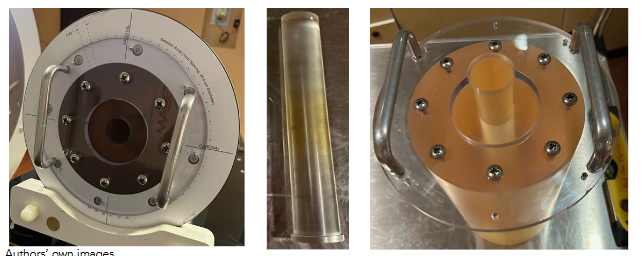
With this apparatus, three scenarios were generated with 1) all plugs inserted, 2) inner plug being out, and 3) no plugs inserted to the Arc Check system. Then, an MLC delivery pattern was selected based on an anonymized patient plan shows in
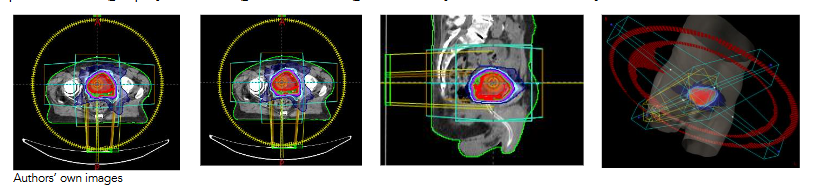
, which displays a 2 Arcs VMAT plan. In this figure, the dose distributions around the treatment target were showed in 3 different views from a patient computed tomography (CT) image set. The right-side image is a 3-dimensional view. The two Arcs were modulated with the target volume shape. To implement the dose requirement, both delivery aperture and delivery speed were controlled with a complexity of multi-leaf collimator, optimal operation of the gantry rotation and varying dose rate provided by a modern linear accelerator (LINAC), which is a TrueBeam LINAC manufactured by Varian Medical System.
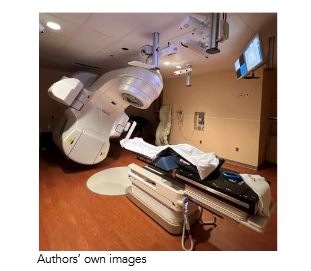
And the megavoltage Electronic Portal Imaging Device (EPID) was extended for receiving radiation dose passing through the Arc Check device. The onboard EPID was on a TrueBeam Linac from Varian Medical System. And the Linac and its onboard imaging system is showed in this study, the treatment plan was delivery to the Arc Check system, which was placed on the couch. Simulated target condition was changed with different inserts. And each Arc fields was delivered 3 times with the same alignments and the MV imaging panel was extended. Therefore, total 6 images were attained for this analysis.
scenarios are showed in figure 4 at below. In this figure, the left image was generated at condition 1, middle image was generated by condition 2 and right-side image was generated at condition 3.
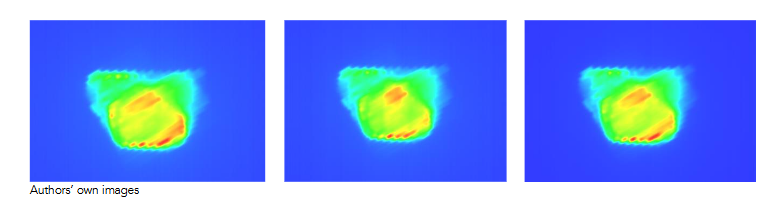
Figure 4. Recoded Portal doseimetry images for 3 conditions.
To evaluate these images, there are different methods such as structure similarity index, learned perceptual image patch similarity, and so on. One of solution is to find the similarity level of these images were with Portal doseimetry Software from Varian Medical system. A gamma index [4] was used as compared these three images with permutational combinational order. The formula of the gamma index [5] is redescribed for convenience as following:
γ(r)=minr′(D(r)−D′(r′)ΔD)2+(∣r−r′∣Δd)2\gamma(r) = \min_{r’} \sqrt{\left(\frac{D(r)-D'(r’)}{\Delta D}\right)^2 + \left(\frac{|r-r’|}{\Delta d}\right)^2}
• where
– D(r): Dose at position r in the reference image.
– D’(r’): Dose at nearby position r’ in the evaluated image
– ΔD: Dose difference criterion
– Δd: Distance to agreement criterion
In the formula, the gamma index value was unified with dividing dose difference by dose different criteria, and divided geometry distance with distance to agreement criterion. And these approaches make gamma index value into a number without units, which is purified into quantities of different physical value into a combined number. Philosophically, this unit unifying method can be expanded to different clinical practice, however, the correlation between the actual outcome and the value of this mathematical number needs more investigated.
Table 1 Gamma<1 pass rate at different Dose difference and distance to agreement
3. Results
In the permutational combination orders, which were comparison of recorded images with three combinations which were 1) both plugs in to inner plug out; 2) both plugs in to both plugs out, and 3) inner plug out versus both plugs out. Following Gamma analysis results were obtained: at condition 1) Gamma values were 95.35%, at condition 2) 71.10% and at condition 3) 72.4% at 2% dose difference and 2.0mm distance to agreement settings. A detailed data collection information is showed in
| No. | Systems | Gamma Setting | Gamma < 1 Pass Rate |
|---|---|---|---|
| 1 | Portal Dosimetry F1 | 2% 2.0mm | 95.50% |
| 1% 1.0mm | 94.40% | ||
| 2 | Portal Dosimetry F1 | 2% 2.0mm | 70.80% |
| 1% 1.0mm | 60.20% | ||
| 3 | Portal Dosimetry F2 | 2% 2.0mm | 95.20% |
| 1% 1.0mm | 94.20% | ||
| 4 | Portal Dosimetry F2 | 2% 2.0mm | 71.30% |
| 1% 1.0mm | 60.70% |
And in table 1, the two arc fields F1 and F2 were attained by megavoltage imaging panel and expresses as portal dosimetry for the images being caught including both geometry and dose information for an appropriate calibration of the imaging panel. Two criteria of gamma index were computed and shows in table 1. The dose difference selection was 1% and 2%, and distance to agreement was 1.0mm and 2.0 mm. Accordingly, the pass rates in percentage for the gamma less than 1.0 were different. More specifically, the percentage difference between the inner plug out versus outer plugs out was at the level of 10%. However, for inner plug out condition, the difference is only about 1.0%. And these data showed the non-linear characteristics of the gamma index.
4. Discussion
Firstly, an offline experimental strategy was developed using quality assurance equipment in radiotherapy with cavity generation method. And this step includes simulation parameter import and model calibration setting. Then, a commissioning procedure also carried out to confirm the system satisfies the requirement the IMRT or VMAT quality assurance requirement suggested by American Association of Physics in Medicine. Secondly, this initial study provided operational experience in utilizing an onboard imaging system for real-time tracking of therapeutic procedures in the radiation oncology department. As we know, the images catching is accomplished by the electronic scanning process frame by frame. Therefore, by shorting the frame taken temporal period, the real time tracking may become plausible. Thirdly, this cavity system sensitivity to radiotherapy dose delivery was evaluated with gamma index computation. There could be different ways to magnify the effect of cavities based on recently study in reciprocal space method, which checking the image similarity in different dimensions. This method through Fast Fourier Transformation of acquired images, then images was compared in reciprocal space. And the result showed significantly magnification of image signals. Moreover, the ease of use demonstrated in this study suggests the clinical feasibility of onboard imaging for enhancing therapeutic outcomes in cancer radiotherapy, which means this application of the onboarding imaging system could be utilized for clinical request purpose. Furthermore, improving imaging resolution could be a future direction for radiotherapy, especially with the integration of multiple onboard imaging modalities. Tracking the imaging process in different scale and improve model accuracy still need both research efforts and clinical data support.
Conclusion
A Cavity Generation Method was introduced, and initial study had been carried with On board imaging system in tracking the radiation variation due to cavity effect.
Conflict of Interest Statement: None.
Funding Statement: None.
Acknowledgements: None.
Disclaimer: The views expressed in this article are those of the authors and do not necessarily reflect the official policy or position of A. T. Augusta Military Medical Center (ATAMMC), the Defense Health Agency (DHA), Department of Defense (DoD) or U.S. Government. Discussion of any commercial products within this article does not create or imply any Federal/DoD endorsement.
References
- Bernier J, Hall EJ, Giaccia A. Radiation oncology: a century of achievements. Nat Rev Cancer. 2004; 4(9):737-747.
- Lederman M. The early history of radiotherapy: 1895–1939. Int J Radiat Oncol Biol Phys. 1981;7(5): 639-648. doi:10.1016/0360-3016(81)90379-5.
- Slater JM. From X-Rays to Ion Beams: A Short History of Radiation Therapy. In: Linz U, ed. Ion Beam Therapy. Berlin, Heidelberg: Springer; 2012: 3-16. doi:10.1007/978-3-642-21414-1_1.
- Delaney G, Jacob S, Featherstone C, Barton M. The role of radiotherapy in cancer treatment: estimating optimal utilization from a review of evidence-based clinical guidelines. Cancer. 2005; 104(6):1129-37.
- Early Breast Cancer Trialists’ Collaborative Group (EBCTCG); Darby S, McGale P, Correa C, et al. Effect of radiotherapy after breast-conserving surgery on 10-year recurrence and 15-year breast cancer death: meta-analysis of individual patient data for 10,801 women in 17 randomised trials. Lancet. 2011;378(9804):1707-1716. doi:10.1016/S0140-6736(11)61629-2.
- EBCTCG; McGale P, Taylor C, Correa C, et al. Effect of radiotherapy after mastectomy and axillary surgery on 10-year recurrence and 20-year breast cancer mortality: meta-analysis of individual patient data for 8,135 women in 22 randomised trials. Lancet. 2014;383(9935):2127-2135. doi:10.1016/S0140-6736(14)60488-8.
- Barton MB, Jacob S, Shafiq J, et al. Estimating the demand for radiotherapy from the evidence: a review of changes from 2003 to 2012. Radiother Oncol. 2014;112(1):140-144. doi:10.1016/j.radonc.2014.03.024.
- Al Balushi H, et al. Research and evidence-based practice in clinical radiography: a systematic review of barriers and recommendations for a new direction. Radiography. 2024;30(2):538-59.
- van Elmpt W, McDermott LN, Nijsten S, Wendling M, Lambin P, Mijnheer B. A literature review of electronic portal imaging for radiotherapy dosimetry. Radiother Oncol. 2008;88(3):289-309.
- Raaymakers BW, Lagendijk JJW, Overweg J, et al. First patients treated with a 1.5 T MRI-linac: clinical proof of concept of a high-precision, high-field MRI-guided radiotherapy treatment. Phys Med Biol. 2017;62(23):L41-L50.
- Sonke JJ, Zijp L, Remeijer P, van Herk M. Respiratory correlated cone-beam CT. Med Phys. 2005;32(4):1176-1186.
- Standring S, ed. Gray’s Anatomy: The Anatomical Basis of Clinical Practice. 42nd ed. Elsevier; 2020. (See sections on cranial cavity & meninges; vertebral canal/spinal meninges; thoracic cavity/mediastinum; abdominopelvic cavity.)
- Dalley AF II, Agur AMR. Moore’s Clinically Oriented Anatomy. 9th ed. Wolters Kluwer; 2023. (See regional overviews: Head/Back for cranial cavity & vertebral canal; Thorax for pleura/mediastinum/pericardium; Abdomen & Pelvis for abdominopelvic subdivisions.)
- Sun Nuclear. Accessed September 24, 2025. https://www.sunnuclear.com
- Low DA. Gamma dose distribution evaluation tool. J Phys Conf Ser. 2010;250:012071.
- Li K, Beardmore A, Able A. Optimizing parameters in imaging for accurate EPID exit dosimetry application. Presented at: AAPM Annual Meeting; 2012.
- Li, K, Reciprocal Imaging Process Method in Magnifying Information of Radiotherapy Delivery Variation. Presented at: IUPESM World Congress on Medical Physics and Biomedical XXVII; 2025.