


Social Media Use and Well-being in Emerging Adults
Social Media Exposure and Well-being of Emerging Adult Students
Manami Bhadra 1
- Research Scholar, Department of Education, Gujarat University, Ahmedabad, India
OPEN ACCESS
PUBLISHED: 31 August 2025
CITATION: Bhadra, M., 2025. Social Media Exposure and Well-being of Emerging Adult Students. Medical Research Archives, [online] 13(8). https://doi.org/10.18103/mra.v13i8.6507
COPYRIGHT:© 2025 European Society of Medicine. This is an open-access article distributed under the terms of the Creative Commons Attribution License, which permits unrestricted use, distribution, and reproduction in any medium, provided the original author and source are credited.
DOI https://doi.org/10.18103/mra.v13i8.6507
ISSN 2375-1924
ABSTRACT
Life in 21st century cannot be imagined without social media. It has become an integral part of common life of all age groups. The increased engagement with social media in recent years has enabled users to obtain vast information from different sources. It has moved well beyond simple entertainment and now has a profound effect on many areas of functioning. Research indicates that interaction with social media in one way or another have influenced young behaviours, attitudes and choices. The impression of link between social networks, media use and the sense of well-being holds a strong emphasis on adolescent and professional perspectives although there is little research that underlies these beliefs. Studies highlight that youth of modern era use smartphones and other gadgets in high numbers which leads to chronic sleep deprivation having a detrimental impact on cognitive abilities and socio-emotional functioning. Social media and depression are however there have been inconsistent results in certain areas. Emerging adults (18-23 age) in a crucial and vulnerable stage of development in life professionally, financially, personally are reported to use social networking sites the most. In this context this research aims to highlight how emerging behaviour and well-being has been influenced by changing pattern of social media exposure. It was hypothesized that there will be no statistically significant relationship between the degree of social media use and sense of well-being the crosstab of which validated the hypothesis. Results contradicted previous research which showed social media has a complicated relationship with well-being. This research also explores the impact of demographic features on media engagement and sense of well-being. Results indicate no significant impact of gender and streams of study of the emerging adults on their sense of well-being. Neither the social fabric of the location of their Institute had any impact on their sense of well-being. However, a comparative analysis of well-being pattern among the different degree of social media engagement highlights reverse relationship, more clearly speaking high media user have worst wellbeing. Excessive Social media exposure has become detrimental to overall well-being irrespective of the demographic features. It concludes with the merging needs of policy advocacies emerging social media usage.
Keywords:
Social media, cognitive abilities, socio-emotional functioning, well-being, demographic features.
THE EUROPEAN SOCIETY OF MEDICINE
Medical Research Archives, Volume 13 Issue 8
RESEARCH ARTICLE
Introduction
Social Media & Millennial Generation
Pre-teen and adult-teen are two buzz words in contemporary social psychology in recent global research literature. Remaining mentally and socio-emotionally healthy is a precondition for ideal adulthood to navigate meaningful citizenship. The social life of a teenager has radically shifted with the onslaught of digital media; truly they are digital natives growing up in an era of a massive influx of technology. Teens have a limited capacity for self-regulation and are susceptible to peer pressure; they are at some risk as they engage in and experiment with digital media. Study found that adolescents exposed heavily in digital world are impaired in social interactions that require perspective taking in cognitively demanding multitasking situations. In recent years, mental disorders and psychosocial disabilities have been increasingly recognized as global development issues. The bare fact is that nearly 50% of all mental health-related challenges occur before the age of 14, while statistical data claims that up to one in five adolescents experience a mental disorder each year. Globally poor sense of social-emotional wellbeing is intricately related to a range of risky behaviors, even leading to self-harm. Emerging adults who live in a ubiquitous digital environment wherein socialization through and with digital gadgetry is now atypical teenage behavior, it is of utmost importance to try to understand what social processes are going on resulting from their digital consumption. Mills, after an in-depth literature study identified some area, as noted below, of concern of effect of digital exposure on cognitive development of adolescent learners which might challenge their skills needed for 21st century. Thinking Social Cues Competence Evaluation. Such kinds of deviated behavioral disorders might persist along the stretches of the length of life and consequently might have serious implications that in turn act as a hindrance in learning and living a life of an ideal citizen in future. Social media “build on the ideological and technological foundations of Web 2.0, allow the creation and exchange of user-generated content. As such, self-presentation is centrally involved in impression management and the projection of an online identity. At the same time, because of their inexperience, limited capacity for self-regulation, and susceptibility to peer pressure, young adults may not fully understand the possible repercussions of internet use and are at some risk as they navigate and experiment with social media. Concerns have been expressed about the amount of time young adults spend online, lack of parental control over teenage internet use, privacy, risky behavior such as sexting, cyberbullying, depression, and exposure to inappropriate content. Teens who are the heaviest media users report being less content and are more likely to report that they get into trouble a lot, are often sad or unhappy, and are often bored.
Wellbeing of Emerging adults
Mental well-being makes up an integral part of an individual’s capacity to lead a fulfilling life. Deviation of an individual’s mental well-being can adversely compromise these capacities and choices, leading not only to diminish functioning at the individual level but also broader welfare losses at the household and societal level. Therefore, there is a need for in-depth study to unfold the kind of relationship does exist in between nature of social media exposure and kind of challenges emerging adults are facing in core social and emotional competencies, such as self-esteem, self-regulation, and relationship management, and overall sense of well-being which are very instrumental in maintaining healthy relationships and the necessary skills for leading a meaningful life in the 21st century.
Background of the study
Emerging adults used to face a variety of developmental challenges in terms of their psycho-social challenges and such developmental tasks fundamental to the acquisition of social, emotional and cognitive skills are supposed to take place. These include making demands of autonomy from parents, friendship development, having first romantic relationships, etc. Emerging adults appear to be at the most risk, as research has shown that the age group from 18-24 use social networking sites the most. Research on upper secondary and UG level students revealed that they use electronic messaging it nearly everywhere; whether at home, or at institutions, traveling, out with friends, etc. While there is certainly a lot of evidence that social networking site use can have negative effects, there is also research that shows that it can also have positive effects for users. Few major areas where social networking site use can cause dysfunction, sense of wellbeing, self-esteem and interpersonal relationships management. Since their emergence, social networking sites have continually changed the way individuals communicate and form relationships. Use of social media and depression in teens are however there have been inconsistent results in certain areas (such as relationship between time spent on social media and mental health issues) and the quality of data is generally low. Using social media may increase the risk of self-harm, loneliness and a decrease in empathy based on particular studies. Other research showed no harm or suggested that certain people may benefit from using social media. Social media increasingly has taken a key place in young lives due to the rapid evolution of technology landscape in recent years. Both huge new obstacles and fascinating new opportunities have been brought forth by social media. Modern research highlights how social media are affecting young mental health. Research on relationship social media use pattern and sense of well-being is either absent or inadequate. Though the body of research knowledge regarding such impacts of social media exposure and overall wellbeing is growing, it is highly inadequate in the Indian context. Further to that most of the study have tried to address typical age group children, adolescent, adult and old age. But such population who are in transitions, are left out. So, the specific knowledge about the nature of social media use with the sense of wellbeing are either suffering from inadequacy or missing in research literature, in particular in Indian context. Such a scenario established the need for in-depth research regarding changing paradigm of relationship of emerging overall sense of wellbeing with their pattern of social media engagement. In this context the present study has explored and commented on the nature of association-ship between the social media engagement pattern and overall sense of well-being among the emerging adult students of the State and accordingly the following objectives were framed.
- To study the pattern of social media use among the young adults age range from 16 to 23 years who are all students by profession.
- To study the relationship exists between young degree of engagement with social media with their sense of wellbeing.
- To study the impact of demographic features on the nature of association between emerging degree of engagement with social media and their sense of wellbeing.
Hypotheses
In the context of research background and framed objectives, the researcher navigated the research through the following hypotheses:
- HO1- The pattern of social media use does not differ-
- HO1.1: In between male and female emerging adult respondents
- HO1.2: In between respondents of Kolkata Metropolitan and Urbanized Rural academic Institutions
- HO1.3: In between Humanities and Science emerging adults
- HO2- There will be statically no significant impact on the status of sense of well being
- HO2.1: In between male and female emerging adult respondents
- HO2.2: In between emerging adult respondents of Kolkata Metropolitan and Urbanized Rural Institutes
- HO2.3: In between emerging adult respondents of Humanities and Science streams
- HO3- The status of well-being of respondent emerging adults are not impacted by their social media use pattern.
Method
The aim of this study was to explore the impact of social media engagement on the sense of well-being of respondents. It adopted a quantitative survey method. The two major variables considered were degree of social media engagement and sense of well-being and three categorical variables were considered. Sample was purposely selected based on age group of respondents, their localities of Institute and their gender thus aligning with purposive sampling techniques. Quantitative data was obtained from research instrument in the form of questionnaire obtained mainly from 1st and 2nd semester undergraduate students of selected colleges who are considered here as emerging adult and from students of senior secondary section in few schools. The age group selected for sample was from 17 to 24 years, of different streams (Science and Humanities) and both metropolitan and urbanized institutions. Comprised students in this study were both male (48) and females (88), and their colleges being located in Hooghly district, Kolkata district, Burdwan district, Murshidabad, north 24 Pargana and South 24 Pargana district of West Bengal.
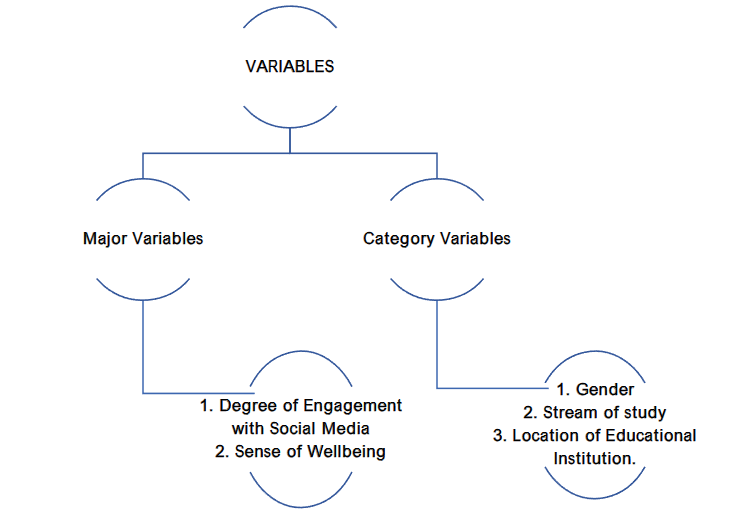
Population & Sample
A sample of 136 students of undergraduate were selected as respondents of the study. The sample was taken with due representation to Gender (Males and Females), Locality (Metropolitan and urbanized rural), and Streams of learning (Science and Humanities). Respondents below the age of 17 and above the age of 24 were excluded. Respondents who do not sufficiently complete the survey were also excluded.
Inclusion Criteria of the Respondents:
- Age: 17-24 years.
- Sex: Male, Female
- Education Qualification: Studying at UG level.
- Residential Area: Metropolitan, Urbanized Rural.
Instrumentation
By means of literature review and conceptualizing the theoretical proposition, the researcher has developed a tool to understand the pattern of social media exposure of the young adults and a standardized instrument was adopted to collect relevant data regarding sense of well-being as proposed in the research objectives.
Social media Use pattern scale: By means of literature review and conceptualizing the theoretical proposition, Social Media Use pattern scale developed by Mukherjee, Maity and Bhadra has been developed here.
Wellbeing Scale: Bech P., measuring the dimensions of psychological general well-being by the WHO-5, was the scale used here to measure the wellbeing of the respondents. This is a standardized scale used widely in the global spectrum towards measuring the wellbeing.
Data analysis
Data was collected by administering the tools following standard norms and ethics of research. Data analysis was done both with Microsoft Excel and SPSS program version 22.00. Analysis included finding of relation of the two variables, Independent Variable (Media engagement) and Dependent variable (Well-being category). Respondents were classified into three categories based on media engagement time. Those who used media for less than (2 hours) per day were classified as low media users, (2-4 hours) of media engagement was classified to moderate users and more than 4 hours of media users were stratified to High Users. Appropriate inferential statistics was conducted to ascertain the nature of relationship existing between the dependent and independent variables. Test of comparison in-between the categorical variables and their relation were ascertained through Chi-Square test.
Table 1: Distribution of Sample of the study
| Category | N | Percentage (%) | |
|---|---|---|---|
| Gender | Female | 88 | 64.7 |
| Male | 48 | 35.3 | |
| Stream of Study | Humanities | 72 | 52.9 |
| Science | 64 | 47.1 | |
| Location of Institutions | Kolkata Metropolitan | 38 | 27.9 |
| Urbanized Rural | 98 | 72.1 |
Results Overview:
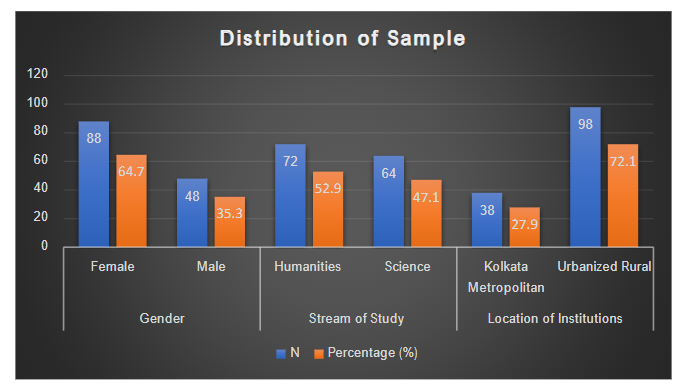
The overall sample had 64.7% female respondents, 35.3% of male respondents, 52.9% of respondents from Humanities stream of learning and 47.1% from science stream of learning. 27.9% respondents were from Kolkata metropolitan and 72.1% of respondents from rural locality.
Table 2: Overview of the pattern of use of types of social media
| Frequency | Percent | |
|---|---|---|
| All | 55 | 40.4 |
| 12 | 8.8 | |
| 7 | 5.1 | |
| 1 | 0.7 | |
| 61 | 44.8 |
The table above is an overview of the percentage of respondents using different types of media. 40.4% percentage of respondents are using all the different types of social media taken under consideration. Respondents reflected highest media engagement through WhatsApp (44.8%) and lowest through Twitter (0.7%). Facebook and Instagram have the media engagement frequency of 8.8% and 5.1%.
Table 3: Overview of the types of social media used by respondents
| TYPES OF SOCIAL MEDIA USED | PERCENTAGE (N=136) |
|---|---|
| ONLY ONE TYPE | 25.0 |
| TWO TYPES | 16.9 |
| THREE TYPES | 29.4 |
| MORE THAN THREE TYPES | 28.6 |
The table gives an overview of the percentage of respondents in the pattern of use of each type of social media. 25% of the respondents use only one type of social media, 16.9% of respondents use only two types of social media, 29.4% of respondents use three types of social media and 28.6 % of respondents engage themselves in more than three types of social media.
Table 4: Overview of the total time of media engagement (Hour-wise) by respondents
| FREQUENCY | PERCENT | CUMULATIVE PERCENT | |
|---|---|---|---|
| High | 42 | 30.9 | 30.9 |
| Low | 52 | 38.2 | 69.1 |
| Moderate | 42 | 30.9 | 100.0 |
This table gives an idea about the percent of media engagement by the respondents. 30.9% of respondents are high and moderate media users and 38.2% are low media users.
Inferential Statistics for testing hypothesis:
Variation of Social Media Engagement in terms of Demographic variables:
Table 5: Influence of gender on social media engagement
| Media Engagement | High | Low | Moderate | |
|---|---|---|---|---|
| Gender | Female | Count 28 | 31 | 29 |
| % within Gender | 31.8% | 35.2% | 33.0% | |
| Male | Count 14 | 21 | 13 | |
| % within Gender | 29.2% | 43.8% | 27.1% |
*Not statistically significant at .05 level
The association between Media engagement pattern and gender of respondents are depicted in table 5. The Chi square value (χ2) is 0.604 at df (2). The χ2 result revealed here is insignificant at 0.05 level. Thus, the Null Hypothesis H01 is accepted and the assumption is truly reflected that the media engagement pattern does not differ in between the male and female respondents.
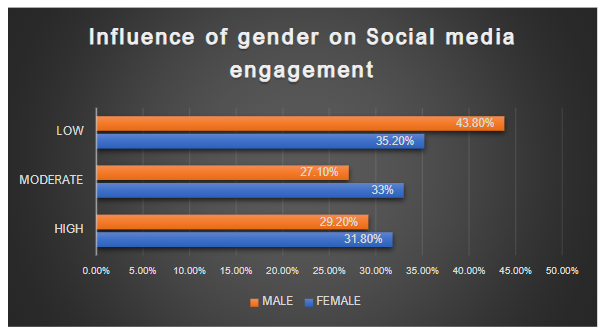
The observed percentage of males in low category of media engagement is much higher (43.80%) than the females (35.20%). This clearly indicates that the number of males engaged in social media is less than the number of females engaged in social media.
Table 6: Influence of streams of study on social media engagement
| Media Engagement | High | Low | Moderate | |
|---|---|---|---|---|
| Stream of study | Humanities | Count 23 | 25 | 24 |
| % within Stream | 31.9% | 34.7% | 33.3% | |
| Science | Count 19 | 27 | 18 | |
| % within Stream | 29.7% | 42.2% | 28.1% |
Not statistically significant at .05 level
The association between Media engagement pattern and streams of learning are depicted in table 6. The Chi square value (χ2) is 0.655 at df (2). The χ2 result revealed here is insignificant at 0.05 level. Thus, the Null Hypothesis H02 is accepted and the assumption is truly reflected that the media engagement pattern does not differ in between the respondents of different streams of learning.
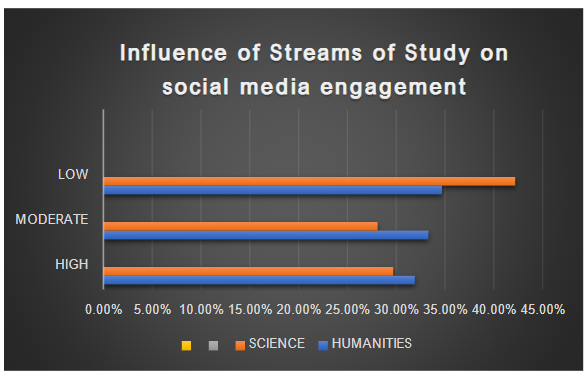
The observed percentage of respondents of science stream in low category of media engagement is much higher (42.20%) than the respondents of Humanities stream (34.70%). This clearly indicates that the number of students in science stream of learning engaged in social media is less than the number of emerging adult students engaged in social media from Humanities stream.
Table 7: Influence of Locality of Institute on social media engagement
| Media Engagement | High | Low | Moderate | |
|---|---|---|---|---|
| Location of Institution | Kolkata Metropolitan | Count 16 | 12 | 10 |
| % within Location | 42.1% | 31.6% | 26.3% | |
| Urbanized Rural | Count 26 | 40 | 32 | |
| % within Location | 26.5% | 40.8% | 32.7% |
Not statistically significant at 0.05 level
The association between Media engagement pattern and Locality of Institute of respondents are depicted in table 7. The Chi square value (χ2) is 0.210 at df (2). The χ2 result revealed here is insignificant at 0.05 level. Thus, the Null Hypothesis H03 is accepted and the assumption is truly reflected that the media engagement pattern does not differ in between the respondents of Institutes from different localities.
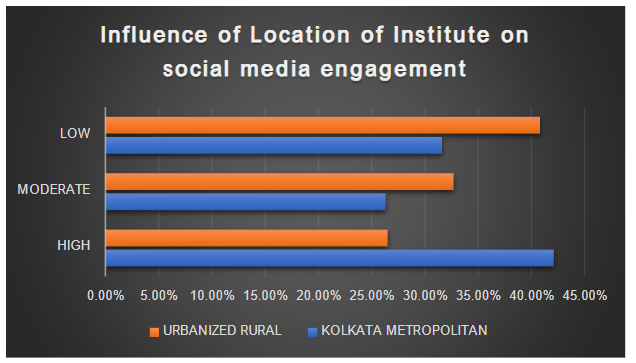
The observed percentage of respondents from Urbanized rural locality is much higher (40.80%) than the respondents from Kolkata metropolitan locality (31.60%). This clearly indicates that the emerging adult students from Kolkata metropolitan locality is much more engaged in media than the respondents from urbanized rural areas.
Variation of Sense of Well-being in terms of Demographic variables:
Table 8: Influence of gender on Sense of Well-Being
| Wellbeing_Category | Good | Moderate | Worst | |
|---|---|---|---|---|
| Gender | Female | Count 23 | 45 | 20 |
| % within Gender | 26.1% | 51.1% | 22.7% | |
| Male | Count 22 | 15 | 11 | |
| % within Gender | 45.8% | 31.3% | 22.9% |
Not statistically significant at .05 level
The association between Sense of Well-being and gender of respondents are depicted in table 8. The Chi square value (χ2) is 0.040 at df (2). The χ2 result revealed here is insignificant at 0.05 level. Thus, the Null Hypothesis H04 is accepted and the assumption is truly reflected that gender of respondents has no influence on their sense of well-being.
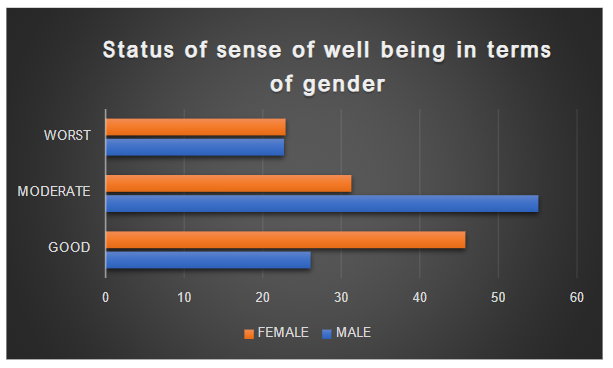
The observed percentage of females having moderate sense of well-being is 51.1% and those having worst sense of well-being is 22.7%. In contrast males are having greater sense of well-being than, those having moderate wellbeing being 31.3% and worst well-being 22.9%. Though Chi square results do not reflect significant gender-based differences in sense of well-being yet category wise percentage distribution shows slight differences in-between the two.
Table 9: Influence of Streams of study on Sense of Well-Being
| Wellbeing_Category | Good | Moderate | Worst | |
|---|---|---|---|---|
| Stream of study | Humanities | Count 22 | 38 | 12 |
| % within Stream | 30.6% | 52.8% | 16.7% | |
| Science | Count 23 | 22 | 19 | |
| % within Stream | 35.9% | 34.4% | 29.7% |
Not statistically significant at .05 level
The association between Sense of Well-being and streams of learning of respondents are depicted in table 9. The Chi square value (χ2) is 0.067 at df (2). The χ2 result revealed here is insignificant at 0.05 level. Thus, the Null Hypothesis H05 is accepted and the assumption is truly reflected that stream of learning of respondents has no influence on their sense of well-being.
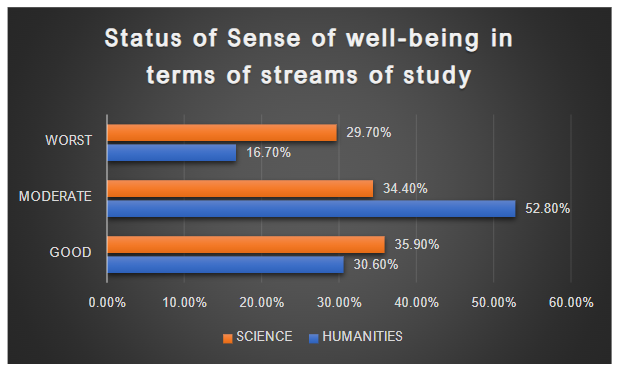
The observed category wise percentage of distribution of respondents reflect that majority of respondents from Humanities group have moderate sense of well-being (52.80%) and emerging adult students from science stream of learning has good sense of wellbeing (35.90%).
Table 10: Influence of Locality of Institute on Sense of Well-Being
| Wellbeing_Category | Good | Moderate | Worst | |
|---|---|---|---|---|
| Location of Institution | Kolkata Metropolitan | Count 11 | 19 | 8 |
| % within Location | 28.9% | 50.0% | 21.1% | |
| Urbanized Rural | Count 34 | 41 | 23 | |
| % within Location | 34.7% | 41.8% | 23.5% |
Not statistically significant at 0.05 level
The association between Sense of Well-being and location of the Institute of the respondents are depicted in table 10. The Chi square value (χ2) is 0.757 at df (2). The χ2 result revealed here is insignificant at 0.05 level. Thus, the Null Hypothesis H06 is accepted and the assumption is truly reflected that the locality of Institutes of respondents has no influence on their sense of well-being.

The observed category wise percentage of distribution of respondents reflect that majority of respondents from Kolkata Metropolitan locality have moderate sense of well-being (50.00%) and emerging adult students from Urbanized rural locality has good sense of well-being (34.70%).
Statistical Relationship between Sense of well-being and media engagement
Table 11: Not statistically significant at 0.05 level. H03 is accepted. There lies no impact of social media engagement pattern on the status of well-being of respondents.
| Chi-Square Tests | Value | Df | Asymptotic Significance (2-sided) |
|---|---|---|---|
| Pearson Chi-Square | 4.915 | 4 | 0.296 |
| Likelihood Ratio | 5.094 | 4 | 0.278 |
| N of Valid Cases | 136 |
The association between Sense of Well-being and media engagement pattern is depicted in table 11. The Chi square value (χ2) is 0.296 at df (2). The χ2 result revealed here is insignificant at 0.05 level. Thus, the Null Hypothesis H07 is accepted and the assumption is truly reflected that media engagement pattern of respondents has no influence on their sense of well-being.
Table 12: Percentage wise distribution of respondents with Good, Moderate, and Worst well-being status within High, Moderate and Low media user category
| Media Engagement | Well-being Category | Good | Moderate | Worst |
|---|---|---|---|---|
| High | Count 10 | 19 | 13 | |
| % within Media Engagement | 23.8% | 45.2% | 31.0% | |
| Low | Count 20 | 20 | 12 | |
| % within Media Engagement | 38.5% | 38.5% | 23.1% | |
| Moderate | Count 15 | 21 | 6 | |
| % within Media Engagement | 35.7% | 50.0% | 14.3% |
The percentage wise distribution of the respondents over the three categories (High, Low and Moderate) media use clearly reflects that respondents who are high media users have a moderate sense of well-being (45.2%) whereas low media users are having high and moderate sense of well-being (38.5%) respectively.
Comparative analysis-wellbeing pattern in different media engagement
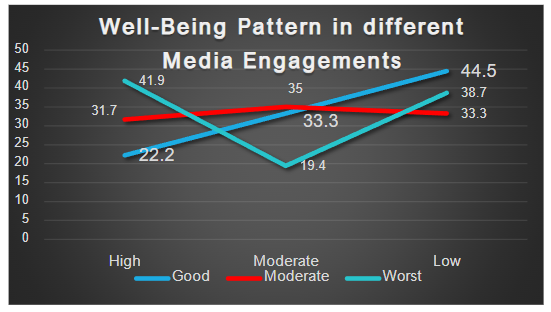
The blue line highlights the good well-being pattern with respect to different media exposure. The slope of the line clearly indicates that when media exposure is high the good well-being is low or vice-versa. In case of worst well-being (green line) high media exposure reflects higher well compared to low media exposure and moderate media users have worst. Moderate well-being patters is not well established with respect to the different media exposure as the red line is almost horizontal.
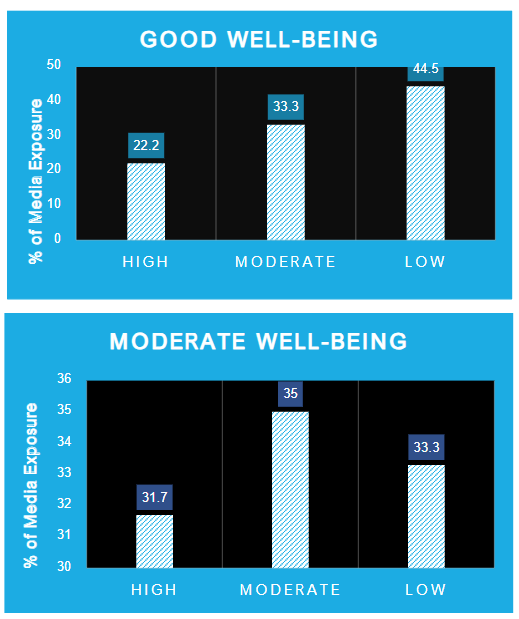
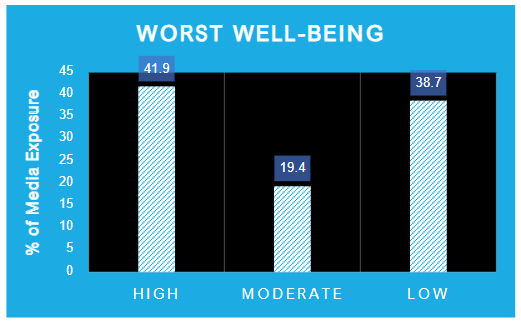
Figure10: Graphical representation of variation of status of good, moderate and worst well-being of respondents with percentage of their media exposure.
High percentage media users have a very low Good-well-being which clearly indicates that the extreme use of social media is hampering the sense of well-being of respondents. The low media user having highest representation of good well-being. The moderate well-being graph reflects that moderate media users are having moderate sense of well-being.
Tenability of Hypotheses
Table 13: Tenability of Hypotheses
| HYP. NO. | STATEMENT OF HYPOTHESIS | VALUE | STATUS |
|---|---|---|---|
| H01 | The pattern of social media engagement does not differ between male and female | 1.007 | Retained |
| H02 | The pattern of social media engagement does not differ between Humanities and Science students | 0.847 | Retained |
| H03 | The pattern of social media engagement does not differ in respondents belongs to Metropolitan and Urbanized rural academic institutions | 3.118 | Retained |
| H04 | The status of wellbeing does not differ between male and female | 6.426 | Retained |
| H05 | The status of wellbeing does not differ between Humanities and Science students | 5.418 | Retained |
| H06 | The status of wellbeing does not differ in respondents belongs to Metropolitan and Urbanized rural academic institutions | 0.757 | Retained |
| H07 | The status of wellbeing of the respondent emerging adults is not impacted by their social media use pattern. | 4.915 | Retained |
Discussion:
From the theoretical lens to practice, this study helped the researcher to understand the present context of the Internet Addiction related to Mental Well-being and Resilience. The findings along with their probable reasons are discussed further.
1. Influence of Gender of respondents on the Media engagement pattern and their status of Well-being:
The findings of this study highlight any significant influence of gender on social media engagement pattern and sense of well-being. In other words, no prominent difference is observed in between male and female respondents with media use pattern and their well-being. Various previous research highlights significant differences in sense of well-being in between genders which indicate adolescent girls to be engaged more on smartphones, social media, texting, general computer use, and online, and boys spent more time gaming. On the contrary there are studies which have shown that men tend to spend more time on social media compared to women. However, the differences are not limited to the amount of time spent on social media, but also to the effects the exposure has on them. Despite women spending less time on social media, it has a greater impact on their academic performance compared to men. Previous research also indicates women exposed longer to social media usage are more susceptible to body image dissatisfaction and the two are highly associated with correlation. Body comparison with media was associated with body dissatisfaction which act as a mediator between self-esteem, depressive mood. Another study conducted by Zwillich and Vorderer (2017) indicates that cyber-ostracism had a more negative impact on belonging, self-esteem and meaningful existence in females more than male. However, findings of this study do not reflect any difference in media engagement pattern with respect to gender. It may be so due to the excessive advancement in online and blended mode of learning in post covid period and increased competition and pressure of technology oriented academic enhancement, the young generation irrespective of gender is quite efficient in wisely using media for maximizing their learning outcomes. There may have been a slight change in their mindset in not misusing media rather to wisely use them for self-learning and progress. Previous studies have also reflected on the moderating role of emotional self-efficacy towards social media and well-being of adolescents. Studies highlighted that higher social media use was related to higher depressive symptoms, lower affective well-being and lower life satisfaction among girls with lower emotional self-efficacy. Conversely, high social media use was related to higher affective well-being and higher life satisfaction for girls with higher emotional self-efficacy. Thus, emotional self-efficacy and emotional regulation might have played an instrumental role here among the respondents irrespective of their gender in determining their sense of well-being.
2. Influence of Streams of learning (Humanities/ science) of respondents on the Media engagement pattern and their status of Well-being:
Development of technology and especially social media has changed how information in various spheres is disseminated and assessed. Studies have highlighted previously that social media significantly impacts the dissemination of research in Humanities and Social Sciences especially in increasing public reach and interaction. On the other context most Science materials are abstract, conceptual and complex requiring visualization. Conventional learning makes students feel bored because the material is difficult to understand. Using adequate media can build students understanding and interest especially in conceptual and abstract material. Audiovisual media with both the combination of audio and visual features and will incredibly help mastery of concepts and avoid misconceptions. In addition, students prefer flexible and easy learning materials which is in very much line with the social media characteristics. Some popular social media platforms like WhatsApp, Facebook, Twitter, Instagram is among the most popular because it connects users through images, feeds, reels and short captions. Studies reflected that social media being a dynamic platform can visually represent abstract Science concepts. However, this study does not reflect any significant difference in pattern of use of social media among the respondents of two streams of learning. It may be so that post covid circumstances with a complete paradigm shift in blended mode of learning and a digitalized and technology-oriented mode of learning system has compelled the young learners to be technologically upgraded and dependent irrespective of their streams of learning. It may be so that learners from both Science and Humanities and Social Science streams of study are equally using social media as a platform of their studies and consultation with group. It may also be that the emerging adults of both the streams of learning visualize social media as a part and parcel of their academic journey which has been reflected in their responses leading to no differences in media use pattern. In a nutshell the responses of this study highlight that social media can be used in the learning process at various levels of education has become a trend over the past few years.
3. Influence of Locality of Institute of respondents on the Media engagement pattern and their status of Well-being:
The findings of this study do not reflect any significant influence of Locality of Institute of the respondents on their media engagement pattern and sense of well-being. The results align with previous research that explored the pattern of internet use in Urban and Rural areas and its impact on mood states. The results indicated no significant differences in terms of internet use in different localities as well as in terms of gender. However, significant difference exists with respect to Internet use and its relation to depression, anxiety and stress. A study in the Southeast Asia, highlighted the prevalence of severe Problematic internet use/internet addiction ranged from 0 to 47.4%, whereas the prevalence of Internet overuse/possible internet addiction ranged from 7.4% to 46.4%. The problematic internet users also reported presence of disturbance in sleep (26.8%), daytime sleepiness (20%), and eye strain (19%). In another study in Indian context, the prevalence of Internet addiction was 25.3% among 380 subjects with mean age of 19.1 users. Internet addiction was significantly associated with higher family income, greater screen time, always online status, and greater duration of internet use per week. The excessive use has also been associated with a loss of control over Internet use, social dysfunctions caused by a desire to be longer on online, academic disturbance or work performance due to neglecting activities, and negative health consequences such as disrupted sleep from spending too much time online. The greater duration of use per week, depression, anxiety and stress were found to be predictor of internet addiction. Anxiety and internet addiction relationship was seen among college students of Mumbai. In this research locality of the Institute of the respondents have not played any significant impact in determining their pattern of media use. It may be so that post covid blended mode of learning along with the increased bridging of gap of digital divide, emerging adults from both the localities have equal exposure and awareness about effective internet use. The healthy use of technology and its holistic impact on the emotional well-being might have been incorporated within the young minds through proper training, education and awareness programs. It might be so that both parental education and school education in the context of efficient use of technology from early childhood both in metropolitan and urbanized rural areas have shaped the personality of these emerging adults to a judicious and intellectual use of social media.
4. Comparative analysis of well-being pattern in different media engagement pattern:
Findings of this study highlights that high media exposures lead to low wellbeing of individuals and vice-versa. Previous studies have highlighted link between mental health and social media. Misuse of social media had led to potential harmful effects on mental health. Some teens have reported to experience anxiety from social media that had to do with the fear of missing out which made them check out all posts and messages constantly. The fear of missing out had started to affect their self-esteem, disturb their sleep led to anxiety and depression. Schneider et al., looked at a construct called cyber-ostracism. They found its negative impact on belonging, self-esteem and meaningful existence. In their search for link between social media engagement and emotional well-being, they found that cyber-ostracism negatively affected the well-being. Previous studies also have concerns with specific social media sites like Facebook that had an impact of body image and eating pathology among adolescent girls. Facebook use that focused on images was associated with self-objectification. The findings of this previous research completely align with the findings of present research which also reflects the low well-being of respondents with high social media engagement. Negative impacts of social media on the overall psychological, emotional, social well-being can cause profound effects on the individual.
Conclusion:
Social media has a prominent role in society and has become popular with all generations. Previous studies indicate many beneficial aspects of social media including the ability to stay in touch with friends and family, learn about recent developments and connect with people from all around the world. Society has become so fixated on social media that they fully understand what they are opening themselves up to. Parents, educators and everyday social media users must understand and be aware of positive and negative connotations of social media usage in order to provide healthy development of youth in society. It is crucial that the opinions we make about influential topic such as the pattern of media usage are researched and grounded data. One social media site may not be harmful but a prolonged usage of media can lead to harmful effects in development. Social media can have many positive aspects that keep users engaged and stimulated but there can be negative aspects as well that affect major dimensions of development. And it is very important to judge both the sides in order to stay informed. Misuse of social media can lead to potentially harmful effects on mental health. Psychological issues that come from social media are real and can be severe depending on individual and the scenario. This completely aligns with the findings of this study in which the comparative analysis of well-being pattern in different media usage clearly indicates that High percentage media users have a very low Good-well-being which clearly indicates that the extreme use of social media is hampering the sense of well-being of respondents. The low media user having highest reorientation of good well-being. The moderate well-being graph reflects that moderate media users have moderate sense of well-being. Previous research raised concerns with specific social media sites such a Facebook. Research highlighted that it was not the total time on Facebook that would lead to negative views of themselves, but it would be the time that is spent on viewing photos that would result negative views. There is dearth of research on the effect of social media and academic achievement when compared to other aspects such a psychological well-being but there are few that highlights the negative impact of social media usage on academic achievements. One argument was made by Karpinski which describes Facebook users having lower CGPA than students who are not users. On the contrary research by Hargittai et.al., have noted important limitations of Karpinski study and believe that Facebook usage has no significant relationship to academic achievement.
Limitation and Future Research
Some limitations are prevalent in this study the first being all the measures and responses were self-reported. With self-reported measures participants responses may be subjective for a variety of reasons. Respondents may try to paint themselves or their situation in a more positive light. The other limitation was the demographics of the participants. The researcher has selected a particular age group of emerging adults. However, with the change of socio-psychological maturity perception may change towards incidents. Hence the results may not be as applicable to the general population. This study focused on the amount of time of social media use and its effect on global well-being. Future researchers might look at the different ways how global well-being is being affected by media engagement pattern. There may be other parameters of exploration by future research that how self-esteem, peer relationship management, parenting style is affected by media engagement. This study has only focused on few social media impact like Facebook, Twitter, WhatsApp. Future researchers may also look at different types of social media sites affecting global well-being. There has been little focus on how the use of such sites such as Pinterest, Snapchat and Twitter affect Global well-being. Research on different population of young adults might also be beneficial. Furthermore, young adults who are not involved in higher education or any profession may warrant attention.
Conflict of Interest Statement:
None.
Funding Statement:
None.
Acknowledgements:
None.
References:
- Ives E. iGeneration: The Social Cognitive Effects of Digital Technology on Teenagers. Published online 2013. doi:https://doi.org/10.33015/dominican.edu/2013.edu.09
- GS, Clarke-Pearson K. The Impact of Social Media on Children, Adolescents, and Families. Pediatrics. 2011;127(4):800-804. doi: https://doi.org/10.1542/peds.2011-0054
- Mills K. Literacy theories for the digital age: social, critical, multimodal, spatial, material and sensory lenses. In: New Perspectives in Language and Education; 2015. doi:10.21832/9781783094639
- Votruba N, Eaton J, Prince M, Thornicroft G. The importance of global mental health for the Sustainable Development Goals. Journal of Mental Health. 2014;23(6):283-286. doi:https://doi.org/10.3109/09638237.2014.976857
- World Health Organization. Child and Adolescent Mental and Brain Health. www.who.int. Published 2022. https://www.who.int/activities/improving-the-mental-and-brain-health-of-children-and-adolescents
- Mills KL. Possible Effects of Internet Use on Cognitive Development in Adolescence. Media and Communication. 2016;4(3):4-12. doi: https://doi.org/10.17645/mac.v4i3.516
- Kaplan AM, Haenlein M. Users of the world, unite! The Challenges and Opportunities of social media. Bus Horiz. 2010;53(1):59-68. doi:10.1016/j.bushor.2009.09.003
- Gross EF. Adolescent Internet use: What we expect, what teens report. Journal of Applied Developmental Psychology. 2004;25(6):633-649. doi:https://doi.org/10.1016/j.appdev.2004.09.005
- Wang R, Bianchi SM, Raley SB. Internet Use and Family Rules: A Research Note. Journal of Marriage and Family. 2005;67(5):1249-1258. doi: https://doi.org/10.1111/j.1741-3737.2005.00214.x
- Rideout V, Foehr U, Roberts D. Generation: Media in the Lives of 8- to 18-Year-Olds. Henry J Kaiser Family Foundation; 2010.
- Mukherjee M. Challenges of Mental Wellbeing of Digital Native Adolescent: Promotion of Mental Health. 2020;2(1):28-46. https://www.researchgate.net/publication/354820546_Challenges_of_Mental_Wellbeing_of_Digital_Native_Adolescent_Promotion_of_Mental_Health
- Murphy J, Hill C, Dean E. 2013. Social Media, Sociality, and Survey Research. doi:10.1002/9781118751534.ch1
- Raacke J, Bonds-Raacke J. An investigation of the dimensions of SMS communication use by college students. Individ Differ Res. 2011;9(4):210-218. https://www.researchgate.net/publication/288405210_An_investigation_of_the_dimensions_of_SMS_communication_use_by_college_students
- Howard, Clayton, “Social Media and Young Adult’s Well-Being” (2014). Theses. 62. https://scholars.fhsu.edu/theses/62
- Kraut R, Patterson M, Lundmark V, Kiesler S, Mukopadhyay T, Scherlis W. Internet paradox. A social technology that reduces social involvement and psychological well-being? Am Psychol. 1998; 53(9):1017-1031. doi:10.1037//0003-066x.53.9.1017.
- Berryman C, Ferguson CJ, Negy C. Social media use and mental health among young adults. Psychiatr Q. 2018 June;89(2):307-314. doi:10.1007/s11126-017-9535-6. DOI: 10.1007/s11126-017-9535-6.
- Bech P. WHO-5 Well-Being Index.; 2004. https://ogg.osu.edu/media/documents/MB%20Stream/who5.pdf
- Twenge JM, Martin GN. Gender differences in associations between digital media use and psychological well-being: evidence from three large datasets. J Adolesc. 2020;79:91-102. doi:10.1016/j.adolescence.2019.12.018.