


Soil Degradation’s Impact on Human Nutrition and Health
Soil Degradation Effects on Human Malnutrition and Under-Nutrition
Rattan Lal1
- CFAES Rattan Lal Center for Carbon Management and SequestrationThe Ohio State University Columbus, OH 43210 USA
OPEN ACCESS
PUBLISHED:31 October 2024
CITATION: Lal, R., 2024. Soil Degradation Effects on Human Malnutrition and Under-Nutrition. Medical Research Archives, [online] 12(10). https://doi.org/10.18103/mra.v12i10.5753
COPYRIGHT: © 2024 European Society of Medicine. This is an open-access article distributed under the terms of the Creative Commons Attribution License, which permits unrestricted use, distribution, and reproduction in any medium, provided the original author and source are credited.
DOI https://doi.org/10.18103/mra.v12i10.5753
ISSN 2375-1924
ABSTRACT
Fertile and productive soil is a finite, fragile and precious resource. Soil health and its productive capacity are dependent on land use and management. Among primary causes of soil degradation are physical (decline of soil structure, crusting, compaction, hard-setting, erosion by water and wind, drought), chemical (salinization, acidification, elemental imbalance, nutrient depletion), biological (decline in soil organic matter content, decline in activity and species diversity of soil biodiversity, buildup of pests and pathogens) and ecological [(decoupling and disruption of coupled cycling of water and essential elements such as N, P, S, Ca, Mg, K, Fe, Zn, Se, I, Mo) and imbalance of energy and water]. Soil degradation is also affected by civil strife and political instability. Indeed, soil health is a victim of any war. Modern war based on explosives and heavy equipment leads to compaction, cratering, pollution and contamination with adverse effects on quality and quantity of food and its nutritional composition. Contamination of soil by heavy metals (Hg, Pb, As) is a serious health hazard for human and wildlife. Restoration of contaminated and polluted soil may occur at decadal and centennial scale. There is strong need for change in curricula from kindergarten to primary and secondary school regarding the importance of soil and environment on human health and wellbeing. Soil Health Act must be enacted and implemented to protect and sustainably manage the precious soil resource. Public awareness must be enhanced about the importance of healthy diet as medicine.
Keywords: Soil degradation, contamination, pollution, soil health, plant nutrition, human nutrition, One Health Concept, Rights-of-Soil, Soil Health Act, Ecosystem services
INTRODUCTION
The Green Revolution of 1960s was a global success story. Between 1961 and 2020, human population increased by 2.5 times from 3.1 B to 7.8 B. However, the cereal production increased 3.3 times from 880 Mt to 2.9 Bt. Consequently, the per capita cereal production increased by 32% from 284 kg to 376 kg. This agricultural miracle that saved hundreds of millions from starvation can be called as the “The Norman Borlaug Effect”. Six decades later however, there is an urgent need to revisit the basic premise of the Green Revolution. There are several second generation issues which must be addressed. Notable among these are ever increasing: i) risks and extent of soil degradation and ecosystem desertification, ii) agricultural emission of greenhouse gases at the rate of ~1% per year and the global emission of fossil fuel at ~10 Pg C per year along with about 1Pg C per year from deforestation and land use conversion, iii) tragedy of undernutrition despite the miracle of Green Revolution affecting 821 million (1 in 10) people who are food-insecure globally, and 2-3 billion (2 to 3 in eight) are prone to malnutrition, iv) water pollution, eutrophication along with decline in renewability, v) food wastage estimated at ~30% for grains and 40% or more for fruits and vegetables, and vi) cereal centric approach with focus on merely three cereals (rice, wheat, and maize) while neglecting traditional food crops which produce nutrient-rich food with lower inputs. Thus, it may be argued that the cereal-centric Green Revolution, while making staple cereals more affordable, may have worsened the malnutrition or hidden hunger by increasing the price of non-staple or micro-nutrient rich non-staple food and thus making it less available to poor people. Pimentel et al. estimated that nearly 60% of the human population (of 6.9 B in 2010) was malnourished. Land degradation, affecting 33% to 40% of land area, aggravates global warming, and has adverse effects on quality and quantity of food production and on other ecosystem services (ESs) critical for human well-being. Global food systems are not delivering good nutrition for all. Thus, there is an urgent need to bring about a paradigm shift in transforming agricultural and food systems to alleviate persistent and widespread problem of malnutrition and undernutrition. As much as 95% of the food consumed is grown on soil. Globally, 40% of the land already degraded affects half of humanity, and an estimated 3.2 billion people are negatively impacted by desertification. Thus, soil degradation affects agronomic productivity and nutritional quality of food by depleting soil organic matter (SOM) content, reducing activity and species diversity of soil biota, declining plant available water capacity by increasing losses from water runoff and evaporation, reducing effective rooting depth, aggravating soil erosion by hydric and eolian processes, depleting plant nutrient (both macro and micro) reserves, and degrading the resource base by acidification, salinization and other degradative processes. Crops grown and animals raised on degraded and depleted soils not only have low productivity, but also produce poor nutritional quality of the food grown on these degraded soils. Specifically, grain crops and forages grown on depleted soils are deficient in some of the 17 critical micronutrients, protein amount and amino acid composition, and in vitamins and other constituents essential to human health and wellbeing. Thus, soil degradation is a major cause of human under-nutrition due to low agronomic productivity and malnutrition because of poor nutritional quality of food produced. Indeed, restoration and sustainable management of soil health is a global priority.
Sustainable management of natural resources (i.e., soil, water, air, biodiversity) depends on the manner by which humanity interacts with the planet Earth. Because of the ever-increasing pressure of growing and increasingly affluent human population, it is prudent to pro-actively and judiciously guide the future we want for the coming generations to live in harmony rather than passively adapting to what may occur. It is thus, important to consider the type of future (e.g., climate, soil, water, habitat for biodiversity, landscape) we want for the coming generations and then decide the transformative actions needed to ascertain the attainment of desired goals. Over 80 years since the end of World War II circa 1944, human population reached 6 billion by the end of the 20th century, but the global economy increased by 15-fold. However, the petroleum consumption increased by a factor of 3.5 over the same period, with acceleration of the anthropogenic global warming. The prudent strategy is to use advances in scientific knowledge about the pedosphere, hydrosphere, biosphere, and lithosphere to attain the desired goals for wellbeing of human and nature. Indeed, the concept of sustainable development, as outlined by the World Commission on Environment and Development, is a viable option to addressing the global issues of the 21st century.
Food and nutritional insecurity has been aggravated over the 21st century, partly because of severe soil degradation caused by a range of processes including physical (i.e., soil erosion by water and wind, crusting, compaction, drought/flood syndrome), chemical (i.e., salinization, alkalization, acidification, elemental imbalance), and biological (depletion of soil organic matter or SOM content). Globally, about 40% of the land area is degraded by these processes, and the extent and severity of degradation is being aggravated by an accelerated growth in human population and increase in its affluent lifestyle. The number of food-insecure people has increased to >1 billion in 2024 due to war and political instability. Any war or political unrest is an important factor of soil degradation and the attendant human undernutrition and malnutrition that has been on the rise since 2023 prior to war in the Middle East and Eastern Europe because of decline in agronomic productivity and reduction in nutritional quality of food grown on contaminated soils. Soil degradation, both by war and land misuse or soil mismanagement, is an important cause of human malnutrition because of the poor nutritional quality of the food produced. Whether missiles are fired because of hatred or fear, both people and soil suffer. War degraded soil and polluted/contaminated water and air take decadal/centennial time scale to purify and restore. There are 3 stakeholders in any war: two nations or communities and the soil/land on which they fight. The soil/land/nature is the silent victim that no one talks or cares about. Yet, nobody has any authority to destroy the precious, finite and the fragile soil resource on which depend the wellbeing of present and future generations. Therefore, the objective of this article is to discuss importance of soil protection, restoration, and sustainable management through adoption of scientifically proven practices of land use and soil/crop management which enhance and sustain soil health for producing nutritive, safe, and healthy food.
Soil Degradation and Human Mal-Nutrition
Soil degradation by many processes has adverse effects on nutritional quality of the food grown (Figure 1). In addition to widely known processes of soil degradation (e.g., physical, chemical, biological, and ecological) other emerging but important factors are war and poverty or desperateness which leads to over exploitation. For example, war in Eastern Europe since 2022 has contaminated Chernozems by heavy metals released by explosives and other ammunitions. There is a widespread chemical contamination of soil, water, air and biodiversity. The most productive soil, Chernozem, is being degraded and polluted with severe adverse effects on diet quality of food being produced on the heavily contaminated soil.

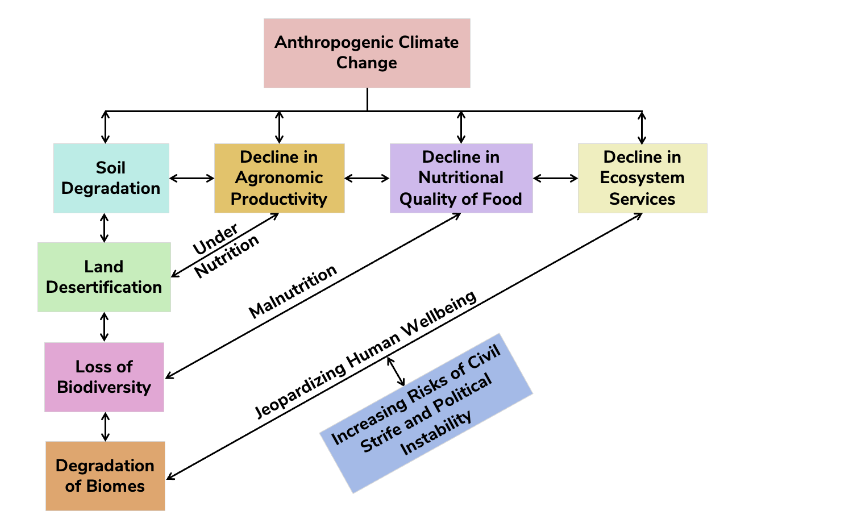
An example of over exploitation of land by resource-poor small land holders is that from Burundi by Megerle et al. who observed decline in soil fertility and yield because of accelerated soil erosion aggravated by deforestation. Over-exploitation can lead to mass impoverishment of farmers and growing rate of malnutrition in the countryside. In Nepal, Paudel et al. reported that as much as two-third of Nepal is geologically fragile where the risks of extremely high soil erosion are estimated at 87 Mg /ha per year. The severe problem of soil degradation has adverse effects on soil quality and agronomic productivity, along with increasing risks of malnutrition, out migration, biodiversity loss, and economic instability. Effects of soil degradation on increased livelihood vulnerabilities among indigenous population in Andes of Ecuador were reported by Blackmore et al. who observed that land overuse and excessive erosion lead to decline in productivity and migration to cities. Blackmore and colleagues reported high prevalence of low height for age (59.5%), low weight for age (26.1%), and anemia (78%) in children under 5 and 30% among mothers. Indeed, the severity of malnutrition in population attributed to soil degradation indicates the need to address the agricultural production and consumption challenges in these fragile ecosystems. In Western Highlands of Guatemala, dominated by small scale farming in indigenous communities, González-Esquivel et al. reported the consequences of soil degradation leading to decrease in agronomic yields and aggravating poverty and malnutrition. Sidle et al. studied human malnourishment under complex climate patterns and environmental attributes in high mountains of Central Asia because of droughts, soil degradation, and other hazards. Poverty, strained subsistence existence, conflicts and agriculturally marginal lands aggravate vulnerability of residents to malnutrition, stunting and other health hazards. The soils of these regions are typically infertile, depleted of their SOM stocks and shallow topsoil depth because of accelerated soil erosion by water runoff and splash. Sidle and colleagues observed that overgrazing of highland pastures is another factor of soil degradation and natural hazards which affect food and nutritional security. Effects of soil degradation processes on diet quality and human health are aggravated by anthropogenic climate change and the attendant increase in intensity and frequency of extreme events (Figure 2). Soil degradation aggravates anthropogenic climate change because of the positive feedback and the emission of greenhouse gases (GHGs). Similarly, anthropogenic climate change aggravates the risks of soil degradation because of the severity and frequency of extreme events. Widely reported adverse effects of anthropogenic global warming on human health are partly due to increase in risks of malnutrition and under nutrition. The interactive and mutually reinforcing effects of soil degradation and global warming lead to loss of productivity of agricultural lands, desertification and degradation of ecosystems, which also lead to increase in incidence of non-communicable diseases (NCDs) along with risks of malnutrition during famine. Thus, adoption of improved methods of soil and crop management, chosen for soil-specific situation may alleviate soil-related constraints and improve the nutritional quality. Similarly, an integrated soil and crop management, chosen for soil-specific situation can minimize risks of soil degradation and improve nutritional quality of food with positive effects on human health and wellbeing. Similar to the use of chemical fertilizers for increasing agronomic production, pesticides are also used to reduce the incidence of pests and pathogens and increase productivity. However, an indiscriminate and excessive use of pesticides (and other agro-chemicals) is an important factor that can contaminate food with adverse effects on human health. Pesticides used on crops comprise of a large group of compounds with a wide range of physico-chemical compounds. Pesticide residues on food can adversely affect human health. Gomes et al. reported that effects of pesticides on human health range from headaches, nausea, skin and eye irritation among others. Gomes and colleagues also reported some chronic effects of pesticide residues on food such as cancer, neurological disorders. Soil pollution by pesticides can also contaminate water, air, plants and above and below-ground biodiversity and thus have a cascading effect on human health and wellbeing.
Drought Effects on Food Quality
Droughts are major problems for production of adequate amount and nutritious food in many regions of the world. Malnutrition and even starvation follow the regions affected by drought. Lack of an adequate quantity of green water supply (plant-available water) in the root zone at the critical periods of crop growth has severe adverse effects on agronomic productivity and nutritional quality of the food being produced. The drought problem is being aggravated by the current and future global warming. A survey conducted in South Asia by Muralikrishnan et al. showed that drought leads to reduced surface and groundwater availability, soil degradation, partial or complete crop failure and the attendant decrease in agricultural yield. Several respondents indicated reduction in consumption of fruits, vegetables, dairy products and fish leading to malnutrition and health hazards.
Diet Quality, Environmental Factors, and Cardiovascular Diseases
Modern living and dietary habits have a strong effect on cardiovascular diseases globally and equally in both developed and developing countries. A review by Mancuso et al. documented evidence that healthy dietary patterns have strong positive effects on cardiovascular health, stroke and heart diseases, and that healthy life style has a multiplier effect on the benefits of healthy diet. Mancuso and colleagues also reported increase in the risks of cardiovascular diseases by food contaminants including artificial sweeteners, additives and adulterants. It was also documented that cardiovascular risks were aggravated by environmental factors such as exposure to heavy metals and food contaminants which can lead to artery injury and oxidative stress.
Heavy Metal Contamination of Food
Contamination of soils of agroecosystems by heavy metals is a major health hazard for human. The concentration of heavy metals in soils and nature in general is increasing due to rapid urbanization and industrialization. It is also argued that heavy metal contamination has been aggravated since the COVID-19 pandemic. Soil contamination of heavy metals with adverse impacts on human health and public safety include As, Cd, Pb, Ni, and Hg, and increase in their concentration in food aggravates the public health risks. Adverse effects on public health can be aggravated by poor waste management (e.g., urban and industrial) and increasing but also indiscriminate use of industrial pesticides and herbicides. Dreshaj et al. observed that presence of some heavy metals in nature (soil, air, water, and vegetation) leading to contamination of food and the attendant adverse impacts on public health include Cu, Fe, Mg, Mn, Ni, Se, Zn, Co, and Cr among others listed above. High concentration of these metals in food can lead to severe health damages. In some cases, even small concentration of heavy metals in food can cause great damage to human and animal organs. Yet, some of these are also micronutrients whose deficiency in soil can lead to malnutrition in human.
Malnutrition in Human Related to Soil Degradation
There is a thin line between toxic level and deficiency of some micronutrients in food in the context of human health. Deficiency of micronutrients is a major cause of malnutrition affecting 2-3 billion people globally. Deficiency of Zn is one of the major factors affecting human health of children and women in developing countries. Maqbool and Beshir described the strategy of Zn biofortification by agronomic and genetic techniques to alleviate deficiency of Zn in soils of the developing countries. Pertinent among agronomic techniques to alleviate Zn deficiency in soils are seed priming and foliar and soil spray application. Genetic approaches may include an increase of Zn bioavailability or increase of Zn kernel concentration. Maqbool and Beshir also observed that Zn bioavailability could be improved by decreasing anti-nutritional factors and increasing the bioavailability enhancers. Concentration of Zn in kernels can also be improved by hybridization and selections and genetically engineered varieties that could further improve Zn uptake from soil and eventually improving the kernel Zn concentration.
Plastic Pollution
Plastic mulch has been widely used in East Asia and elsewhere since mid 1980s. Since then, the distribution of plastic waste, from agro ecosystems and urban/industrial uses is humongous with severe environmental consequences. Use of environmentally controlled facilities to grow food in urban systems is one of the options to minimise plastic pollution, enhance productivity and have positive effects on human health. Plastic has been widely used as surface mulch to grow vegetables around the world, and its use has increased since the second half of the 20th Century (1960s). Being resistant to microbial decomposition, plastic pollution of soils of agroecosystems is a serious global issue. Tomato (Solanum lycopersicum) is a popular and globally grown vegetable which has a high nutritional value for human consumption. Two widely used plastics applied as mulch for growing tomato and other vegetables are polyethylene terephthate (PET) and polyvinyl chloride (PVC). Dainelli et al. assessed the impact of these two plastic mulches on tomato growth, productivity and fruit quality, and observed that both microplastics decreased the number of fruits and with PVC also the fresh weight of fruit along with a marked increase in contents of Ni and Cd. Simultaneously, there was a decline in the lycopene, total soluble solids, and total phenols which are nutritionally important components. Dainelli and colleagues concluded that microplastics not only limit crop productivity but also negatively impact fruit quality while aggravating the food safety hazards and increasing health risks for consumers.
Food as Medicine
Good food, safe and nutritious, is a good medicine. It can prevent and cure many common ailments. Furthermore, good food comes from crops and animals raised on a healthy soil. As is stated in Ayurveda, an ancient Sanskrit text, “When diet is wrong, medicine is of no use; when diet is correct, medicine is of no need.” The fact remains that the way food is produced and consumed affects the health of soil, plants, animals, people, ecosystems and the planet itself. This is the original concept of Sir Albert Howard and that of Eve Balfour.
Soil Health Act for Soil Protection
There is also an urgent need to establish “Soil Health Act” for protection, restoration, and sustainable management of finite and fragile soil resources. The Soil Health Act, established at state and national level and with global implementation, must have provisions to reward farmers/ranchers/land managers through payments for ecosystem services. Compensation to land managers at US $50/credit of CO2 eq is essential to transform agriculture into a part of the solution to advance Sustainable Development Goals of the Agenda 2030 of The United Nations. Nature-positive and emission-negative agriculture is a win-win-win option for advancing food/nutritional security, adapting and mitigating climate change, and improving water quality and renewability. Soil protection policies are also needed to establish Maximum Residue Limits MRLs of pesticides on food for different types of food and specific chemical compounds. Gomes et al. suggested that chromatographic techniques and mass spectrometry analysis are needed in establishments of MRLs and implementation of soil/diet protection policies. Specific policies; based on crops, soil, pesticide; are needed for county, state, national, continental and global implementation. Consumer safety necessitates global implementation of these MRLs. Green Agenda is being widely adopted in Europe and elsewhere, and thus new policies are needed to promote sustainable farming practices which lead to sparing some land for nature. In this context, Food Revolution for UK would consist of in-country production of food (e.g., fruits, vegetables) by using low-cost controlled environment using modern innovations. Such systems, in addition to producing safe food, will also have low environmental footprint.
The Soil-Human Health-Nexus
There exists strong evidence in scientific literature regarding the inter-connectivity between soil health and human health. Most of the calorie-intake by human comes from food grown on soil. Management of soil functions and processes can have strong effects on the quality of diet and thus on human health. Poor nutritional quality of food, leading to maternal and child malnutrition, adversely affects about half of the world population. Commonly observed micro-nutrient deficiencies include Fe, I, Zn, and vitamins, and causes 50% of under 5 deaths. These deficiencies are aggravated by food grown on degraded and depleted soils. Soil functions, based on properties and processes, can have both adverse and beneficial effects on human health. Examples of adverse effects include those caused by exposure to heavy metals in soil (e.g., As, Pb, Cd, Cr, Cu, Hg, Ni, Zn) through contact (ingestion, inhalation, and consuming food grown on contaminated polluted soils). Presence of human pathogens and parasites, along with nutrient imbalance (toxicity or deficiency) can adversely affect human health. Application of micro-nutrients to soil deficit in these essential elements can lead to increase in concentration of these elements in food with positive effects on human health. For example, Fe and Zn are essential micronutrients for both plant growth and human nutrition. Soil factors with strong impact on plant growth and quality of food and feed SOM content, soil structure and texture along with clay mineralogy, pH, cation exchange capacity, soil temperature, plant-available water capacity, rooting depth, etc. These properties are also strongly affected by soil management including input of amendments (organic and inorganic), tillage methods (e.g. conservation agriculture vs. plow tillage), cover cropping, water management (e.g. drainage and irrigation). Site specific management system can strongly impact nutritional quality of the food, and science-based soil management can strongly impact micro-nutrient uptake, because their deficiency have negative impact on children, and on maternity and child health. Thus, inter-disciplinary studies are needed to study the impact of environment (e.g., soil, water, air, landscape, biodiversity) and its management on the health and well-being of communities. Behavior of these communities, adoption of modern innovations, on cycling of micronutrients, can affect their health and wellbeing.
Conclusions
Under-nutrition and malnutrition are among the serious global issues of the 21st century. Soil misuse and land mismanagement affects soil quality, functions, and nutritional quality of the plant- and animal-based food grown on soil. In the context of human nutrition and wellbeing, soil health refers to its capacity to sustain multiple ecosystem services for human wellbeing and nature conservancy through coupled cycling of carbon with water and essential plant nutrients (N, P, K, S, Ca, Mg, Fe, Zn, Mo, Se, etc.). Soil is a living entity. Just as universal rights of human, rights of animals, there must also be rights of soil, and rights of nature. As the essence of all life, soils have rights to be protected, restored, thrive and managed judiciously. Prime agricultural land, and ecologically sensitive ecoregions must be protected. In addition to common factors of soil degradation and desertification, war and civil strife are also among major factors of soil degradation and desertification with adverse effects on human health and wellbeing. Peace and political stability is an essential pre-requisite to producing adequate, healthy and safe food. Indeed, global peace is also a scientific issue, and science must be given a chance to promote peace and harmony. Advancing science of soil health, nutrition-sensitive agriculture, food processing and biofortification etc. are critical and high priority scientific issues with strong impact on world peace and stability by building bridges across nations. Advancing science of sustainable soil management for producing healthy and nutritious food is critical to promoting peace which can only happen when the fire burning in the pit of an empty stomach has been quenched by a loaf of bread made from grains grown on a healthy soil. Thus, soil stewardship and care must be embedded in every fruit and vegetable eaten, in each grain ground into the bread consumed, in every cup of water used, and in every breath of air inhaled, and in every scenic landscape cherished. Eroding soils and denuded lands, depleting soil organic matter and declining soil fertility, recurring drought and intensifying heat waves, low crop yields and perpetual hunger, and marginal living and desperateness are as real threats to global peace and security as are intercontinental ballistic missiles (ICBMs) and weapons of mass destruction (WMDs), and thus the soil and natural resources must be protected, restored, used judiciously and never ever taken for granted. Famines and wars are man-made tragedies We must make famine and mass-starvation politically intolerable, morally toxic, ethically unthinkable, and humanely unacceptable. The basic mantra in terms of managing and sustaining human health is that “Healthy Soil = Healthy Diet = Healthy People = Healthy Ecosystems = Healthy Planetary Processes = World Peace”.
Acknowledgement
Help received by Ms. Hannah Shively in typing the manuscript and concepting the references is greatly acknowledged.
References
- FAO. The State of Food and Agriculture 2023. Published online November 6, 2023. https://doi.org/10.4060/cc7724en
- FAO, IFAD, UNICEF, WFP, WHO. The State of Food Security and Nutrition in the World 2024: Financing to end hunger, food insecurity and malnutrition in all its forms. Published online 2024. https://www.fao.org/publications/home/fao-flagship-publications/the-state-of-food-security-and-nutrition-in-the-world/en
- Pimentel D, Whitecraft M, Scott Z, et al. Will Limited Land, Water, and Energy Control Human Population Numbers in the Future? Human Ecology. 2010;38(5):599-611. doi:10.1007/s10745-010-9346-y
- Intergovernmental Panel on Climate Change (IPCC). Climate Change and Land: IPCC Special Report on Climate Change, Desertification, Land Degradation, Sustainable Land Management, Food Security, and Greenhouse Gas Fluxes in Terrestrial Ecosystems. Cambridge University Press; 2022. doi:10.1017/9781009157988
- FAO. Desertification and Drought Day 2024: United for Land, Our Legacy, Our Future. Published online 2024. https://www.fao.org/neareast/news/details/desertification-and-drought-day-2024–united-for-land–our-legacy–our-future/en
- Blackmore I, Iannotti L, Rivera C, Waters W, Lesorogol C. Land degradation and the link to increased livelihood vulnerabilities among indigenous populations in the Andes of Ecuador. Land Use Policy. 2021;107. doi:10.1016/j.landusepol.2021.105522
- Kelly McCann. Soil Nutrient Depletion: Harming Your Health? April 28, 2023. https://drkellymccann.com/soil-nutrient-depletion-how-is-industrial-agriculture-harming-your-health/
- Pozza LE, Field DJ. The science of Soil Security and Food Security. Soil Security. 2020;1:100002. doi:10.1016/j.soisec.2020.100002
- Silver W, Perez T, Mayer A, Jones A. The role of soil in the contribution of food and feed. Philosophical Transactions Of The Royal Society B-Biological Sciences. 2021;376(1834). doi:10.1098/rstb.2020.0181
- Wezel A, Herren B, Kerr R, Barrios E, Gonçalves A, Sinclair F. Agroecological principles and elements and their implications for transitioning to sustainable food systems. A review. Agronomy For Sustainable Development. 2020;40(6). doi:10.1007/s13593-020-00646-z
- Rickson RJ, Deeks LK, Graves A, Harris JAH, Kibblewhite MG, Sakrabani R. Input constraints to food production: the impact of soil degradation. Food Security. 2015;7(2):351-364. doi:10.1007/s12571-015-0437-x
- Vinisa Saynes Santillán. Status and Challenges of Soils for Nutrition. Presented at: Global Symposium on Soils for Nutrition; July 26, 2022. https://www.fao.org/fileadmin/user_upload/GSP/GSOIL4N/Presentations/26Jul/016_vinisa_GSOIL4N_Status_and_Challenges_S4N.pdf
- UNEP. Record-breaking World Environment Day Spotlights Land Restoration, Desertification and Drought Resilience. https://www.unep.org/news-and-stories/press-release/record-breaking-world-environment-day-spotlights-land-restoration#:~:text=Riyadh%2C%2005%20June%2. June 5, 2024.
- Lal R. Soil degradation as a reason for inadequate human nutrition. Food Security. 2009;1(1):45-57. doi:10.1007/s12571-009-0009-z
- Brevik EC, Burgess LC. The Influence of Soils on Human Health. Nature Education Knowledge. 2014;5(12):1-1.
- Brevik EC, Pereg L, Steffan JJ, Burgess LC. Soil ecosystem services and human health. Current opinion in environmental science & health. 2018;5:87-92. doi:10.1016/j.coesh.2018.07.003
- Braga B, Chartres C, Cosgrove W, et al. Water and the Future of Humanity: Revisiting Water Security.; 2014. doi:10.1007/978-3-319-01457-9
- Burton i. Our common future – the world-commission-on-environment-and-development. Environment. 1987;29(5):25-29. doi:10.1080/00139157.1987.9928891
- Hryhorczuk D, Levy B, Prodanchuk M, et al. The environmental health impacts of Russia’s war on Ukraine. Journal of Occupational Medicine And Toxicology. 2024;19(1). doi:10.1186/s12995-023-00398-y
- Megerle H, Niragira S. The Challenge of Food Security and the Water-Energy-Food Nexus: Burundi Case Study. In: Biesalski H, ed. Hidden Hunger And The Transformation of Food Systems: How To Combat The Double Burden of Malnutrition. Vol 121.; 2020:183-192. doi:10.1159/000507488
- Paudel P, Devkota B, Kubota T. Land Degradation in Nepal: A Review on its Status and Consequences. Journal Of The Faculty of Agriculture Kyushu University. 2009;54(2):477-479.
- González-Esquivel C, Camacho-Moreno E, Larrondo-Posadas L, et al. Sustainability of agroecological interventions in small scale farming systems in the Western Highlands of Guatemala. International Journal of Agricultural Sustainability. 2020;18(4):285-299. doi:10.1080/14735903.2020.1770152
- Sidle R, Khan A, Caiserman A, Qadamov A, Khojazoda Z. Food security in high mountains of Central Asia: A broader perspective. Bioscience. 2023;73(5):347-363. doi:10.1093/biosci/biad025
- Rossati A. Global Warming and Its Health Impact. International Journal of Occupational and Environmental Medicine. 2017;8(1):7-20. doi:10.15171/ijoem.2017.963
- Gomes H, Menezes J, da Costa J, Coutinho H, Teixeira R, Nascimento R. A socio-environmental perspective on pesticide use and food production. Ecotoxicology and Environmental Safety. 2020;197. doi:10.1016/j.ecoenv.2020.110627
- Maybank J, Bonsal B, Jones K, et al. Drought as a natural disaster. Atmosphere-Ocean. 1995;33(2):195-222. doi:10.1080/07055900.1995.9649532
- Muralikrishnan L, Padaria R, Choudhary A, et al. Climate Change-Induced Drought Impacts, Adaptation and Mitigation Measures in Semi-Arid Pastoral and Agricultural Watersheds. Sustainability. 2022;14(1). doi:10.3390/su14010006
- Mancuso G, Violi F, Nocella C. Food contamination and cardiovascular disease: a narrative review. Internal and Emergency Medicine. Published online May 14, 2024. doi:10.1007/s11739-024-03610-x
- Dreshaj A, Millaku B, Abazi A, Gashi A. Soil Pollution Factors Affecting the Quality of Crops (Solanum Tuberosum L.). Journal of Ecological Engineering. 2022;23(3):109-115. doi:10.12911/22998993/145469
- Maqbool M, Beshir A. Zinc biofortification of maize (Zea mays L.): Status and challenges. Plant Breeding. 2019;138(1):1-28. doi:10.1111/pbr.12658
- Cusworth S, Davies W, McAinsh M, Stevens C. Sustainable production of healthy, affordable food in the UK: The pros and cons of plasticulture. Food and Energy Security. 2022;11(4). doi:10.1002/fes3.404
- Dainelli M, Pignattelli S, Bazihizina N, et al. Can microplastics threaten plant productivity and fruit quality? Insights from Micro-Tom and Micro-PET/PVC. Science of the Total Environment. 2023;895. doi:10.1016/j.scitotenv.2023.165119
- Ahmed T, Hossain M, Sanin K. Global Burden of Maternal and Child Undernutrition and Micronutrient Deficiencies. Annals of Nutrition and Metabolism. 2012;61:8-17. doi:10.1159/000345165
- Fergusson J. The Heavy Elements. In: Chemistry, Environmental Impact and Health Effects. Pergamon Press; 1990:211-212.
- Steffan JJ, Brevik EC, Burgess LC, Cerdà A. The effect of soil on human health: an overview. European Journal of Soil Science. 2018;69(1):159-171. doi:10.1111/ejss.12451
- Dickinson N, Macpherson G, Hursthouse A, Atkinson J. Micronutrient deficiencies in maternity and child health: a review of environmental and social context and implications for Malawi. Environmental Geochemistry and Health. 2009;31(2):253-272. doi:10.1007/s10653-008-9207-4
- Bhan M, Sommerfelt H, Strand T. Micronutrient deficiency in children. British Journal of Nutrition. 2001;85:S199-S203. doi:10.1079/BJN2001315