





Symptoms of Digital Addiction in Estonian Students
Symptoms of digital addiction of Estonian primary school students
Riin Seema1, Johanna Valja2 and Piret Opi3
- Head of Studies, Kindergarten Kalli-kalli
- School Development Researcher, School of Educational Sciences, Tallinn University
OPEN ACCESS
PUBLISHED: 30 November 2024
CITATION: Seema, R., Valja, J., & Opi, P. (2024). Symptoms of digital addiction of Estonian primary school students. Medical Research Archives, Volume 12 Issue 11.https://doi.org/10.18103/mra.v12i11.1592
COPYRIGHT: © 2025 European Society of Medicine. This is an open-access article distributed under the terms of the Creative Commons Attribution License, which permits unrestricted use, distribution, and reproduction in any medium, provided the original author and source are credited.
DOI: https://doi.org/10.18103/mra.v12i11.5902
ISSN 2375-1924
ABSTRACT
The goal of the present work was to map Estonian primary school students’ ratings of symptoms of digital addiction and to determine both class and gender differences. The sample included 5493 primary school pupils from 46 schools in Estonia participating in the 2022 Student Survey conducted by the Centre for Educational Innovation at Tallinn University. The results indicated that the digital addiction symptoms scores were highest among 8th and 9th graders. Girls and those students who did not disclose their gender, scored higher than boys on digital addiction symptom statements. Symptoms of digital addiction showed a moderate positive correlation with screen time on both school days and weekends, as well as with school burnout. There was a weak negative correlation between digital addiction symptoms and feeling refreshed in the morning. Since only a relatively small group of students showed a few symptoms of digital addiction and maintained a healthy pattern of using digital devices, policymakers need to develop digital addiction prevention measures or programs within the educational system.
INTRODUCTION
Different digital tools, and in particular the internet, have transformed the way young people live, learn, interact and participate in society¹⁹. Since the onset of the Covid-19 crisis, the time spent on digital devices and media has increased⁴¹. As the constant use and carrying of digital devices has become a social norm, people often do not realise that they may be experiencing symptoms of digital device overuse⁵⁹. Studies have shown that excessive use of digital devices over a prolonged period can lead to behavioural addiction¹,³¹, similar to other addictive disorders²⁷, developing because of habit formation and self-control problems². The findings of a meta-analysis conducted by Meng and colleagues (2022) also showed that the crisis exacerbated the prevalence of digital addiction symptoms.
The propensity to overuse devices increases with the age of students⁵⁴, and it is the primary school age group, 15–16 year olds, who are at the greatest risk⁵⁹. Younger children are more vulnerable due to a lack of interest and need for movement²⁸. Girls have also been found to be the most vulnerable group of young people⁴⁸.
Previous studies have shown that recreational screen time is associated with changes in children’s mental health problems and health status⁵. Prolonged use of digital devices affects students’ sleep, leading to sleep disturbance³⁴, and sleep deprivation in turn negatively affects students’ physical and psychological health²² and their ability to concentrate on learning at school³⁸. Furthermore, it has been found that online addiction can be one of the negative consequences of burnout in schools⁵⁷. School burnout is associated with school dropout and predicts later excessive internet use⁶. Pupils with low academic performance have higher levels of digital addiction symptoms⁵⁷. At the same time, habitually frequent use of digital devices affects students’ academic performance¹⁶, disrupting students’ attention and focus on learning¹³. As a student’s academic performance increases, the prevalence of digital addiction symptoms decreases⁵⁸.
In Estonia, during the pandemic, schools implemented distance learning²³, and students spent more time using screens, so this topic requires additional research and mapping of digital tool usage. This study aims to map Estonian primary school students’ ratings of digital addiction symptoms and to identify differences based on class and gender. It also seeks to explore the relationships between digital addiction symptoms and screen time, school burnout, and feeling refreshed in the morning. Data for this study were collected through a larger e-survey conducted across Estonian schools in early 2022, during a period when periodic distance learning was still in effect.
THE CONCEPT OF DIGITAL ADDICTION
In the current study we define digital addiction as a broad term that encompasses a range of digital devices and activities³ and includes addiction to the internet, social media, smartphones, digital devices and video games, and other digital devices or media means being unable to reduce use and justifying ever-increasing use, which in turn has a negative impact on school life and relationships and sleep¹⁸.
The concept of digital addiction is relatively new in the field of mental health, and it has not yet been formally recognized as a disorder⁴⁶. To date, digital addiction has been officially recognised by the World Health Organisation as a global problem, citing that excessive online activity and internet use lead to an inability to manage time, energy and attention during the day and cause sleep disturbance and insomnia²⁶. Addiction to smartphones and social media among school students has been the subject of much research in recent years, and the prevalence of these addictions is the fastest in recent years³⁹.
Digital addiction is described as the compulsive need to use devices to an extent that interferes with everyday life and prevents you from doing the things that matter⁵⁶. Often people fail to control their time use of digital devices and media, using devices more than they intend³¹. Thus, digital addiction refers to the compulsive, prolonged and uncontrolled use of digital devices and related activities, with detrimental effects on the user’s psychological and physical health¹,³⁹.
Digital addiction is classified as a behavioural addiction³². Similar to any other addiction⁶⁴, it can be classified as either passive (watching TV) or active (playing computer games)²¹. It is important to highlight that the characteristics of the technology contribute to addictive tendencies²¹. The more interactive the application, the greater the development of addictive behaviours⁶⁵. Modern apps often contain algorithms designed to increase people’s temporal use and liking of the app to a level that leads to addiction⁴⁵. Overuse of the internet has an impact on the dopamine system²⁴, leading to repeated use, or compulsive overuse of digital tools. A recent meta-analysis concluded that a large proportion of people might be affected by at least one subtype of digital addiction, either social media, smartphone or gaming addiction¹. Thus, the study of digital addiction is currently topical and relevant worldwide²⁹.
Digital addiction is habit-forming and partly due to problems with self-control² and excessive use of digital devices in turn has a negative impact on school life³⁵. In the case of students, the boundary between problematic and purposeful use has been found to cross at the point where the student becomes disengaged from relationships because of device use, and other areas of life suffer because device use dominates over other activities³⁴. Students with symptoms of digital addiction who have longer screen time have lower subjective well-being scores than teens with lower symptoms of digital addiction who use digital devices for less time⁵².
However, the overuse of digital devices and digital addiction are difficult to measure, as neither time criterion alone nor digital addiction scale scores are sufficient to define addictive tendencies. It can be defined through two interrelated components, i.e., emotional reactions to digital media and behavioural symptoms of addiction, i.e., compulsive use in different settings, and if the person experiences symptoms of addiction along with difficulties in living and coping at school⁵².
One way of defining digital addiction is in terms of the time spent online and the fascination with the online world¹⁰,⁵⁹. For example, in China, students with addictive features use devices for 8 hours a day²⁵. Pupils with an online addiction may spend nearly three times as much time online as those without¹⁵. In a recent study of digital addiction among Estonian teenagers, a cluster analysis found that students with digital addiction symptoms used digital devices for an average of 5 hours on weekdays and 7 hours on weekends⁵². Time use of devices was also high in a study four years earlier, which found that only 33% of teenagers used screens at a healthy rate of 2 hours per day⁵⁵.
The time spent with electronic devices with a screen, watching television and playing a video game, are called “screen time”⁴⁰. However, there are conceptual concerns in the literature that measurements are likely to contain a significant amount of measurement error. There are a variety of self-report measures used to assess screen time. Some studies have examined overall “total screen time” within a specific period, such as a week or a day, while others ask participants to estimate their screen time, differentiating between weekdays and weekends or school days and non-school days³⁰. In the current study, we have also used self-assessment and differentiated between school days and non-school days.
RELATIONSHIP BETWEEN SCHOOL BURNOUT AND DIGITAL ADDICTION
Student burnout in school is linked to a number of different components, such as loss of interest in school activities, overwhelming learning demands, feelings of incompetence and pressure from teachers or parents to perform, and overload from homework⁴. School burnout has been found to be related to problematic use of social media⁶¹ and with online addiction⁵⁷. Internet addiction can be one of the negative consequences of school burnout, as it reduces commitment to studying for exams, doing homework and actively participating in school lessons⁵⁷.
Salmela-Aro et al. (2017) have found that school burnout is reciprocally related to excessive internet use, i.e. when a student feels burnout or exhaustion at school, excessive internet use increases and engagement in school decreases. Also vice versa – spending too much time online increases the three components of student burnout, i.e. feelings of incompetence, exhaustion and cynical attitudes towards school⁵⁰. In addition, Seema and colleagues (2022) have found relations with digital addiction and school burnout and perceived learning difficulties of Estonian teenagers.
ASSOCIATIONS OF SLEEP QUALITY WITH DIGITAL ADDICTION
The construct of sleep quality has a common core, yet the different components and their possible types have distinct characteristics that have been measured with different scales. The most important components of sleep quality include the extent to which one seems to be feeling refreshed (or not) in the morning and the continuity of sleep throughout the night²⁶.
Excessive use of digital devices over long periods is associated with excessive feelings of fatigue, increasing the risk of anxiety, sleep disturbance and symptoms of depression⁷,²⁴,⁴⁸. A link has been found between social media use, sleep disturbance and inadequate sleep³³. Sleep deprivation leads to problems with memory and performance, and in adolescents in particular, disrupted sleep can lead to poorer performance at school³⁸. Young (1996), a researcher of internet addiction, has also pointed out that excessive use of various internet applications and computer gaming addiction leads to sleep deprivation, as people stay up later and feel tired in the morning. Similarly, the quality of sleep of young people is affected by the use of mobile phones and devices in the bedroom before bedtime with Internet use and turning-off time⁴. A recent DigiGen study reported that students are aware of negative consequences and experience physical problems such as fatigue, eye and headaches from excessive device use¹⁹.
GENDER DIFFERENCES IN DIGITAL DEVICE USAGE PATTERNS
Boys’ and girls’ interests and reasons for using the equipment are different⁵¹. Girls are more likely to use digital devices for social media, socialising, listening to music and sending messages, i.e. mainly for socialising¹¹. For example, levels of smartphone absence anxiety or nomophobia are higher in girls⁵¹. Boys prefer to play games using different apps, mainly using computers and tablets, and thus have higher levels of computer game addiction than girls¹². Compared to girls, they also rate internet use higher⁵⁷. However, there are also opposite results, with girls having higher addiction rates compared to boys, using devices for 3–6 hours per day, mainly for social media⁴⁸. The same result was found in a digital survey of Estonian teenagers, with girls showing more digital addiction symptoms than boys⁵². A recent Portuguese study found that girls have statistically higher scores of digital addiction than boys⁴⁴.
OBJECTIVE AND RESEARCH QUESTIONS
The goal of this study is to map Estonian primary school students’ ratings of symptoms of digital addiction and to identify any class and gender differences. It also aims to find correlations between the following constructs: digital addiction, screen time, school burnout and assessment of feeling refreshed in the morning.
Research question 1: What are the average primary school pupils’ perceptions of their use of digital devices in 2022?
Hypothesis 1 (H1): The mean score of digital addiction among Estonian primary school pupils in 2022 is similar to or higher than the score found in the previous Estonian study at the beginning of the COVID-19 crisis⁵².
Research question 2: What are primary school pupils’ perceptions of their use of digital devices by grade?
Hypothesis 2 (H2): Students in grades 6–9 will have different ratings of their digital media use¹¹, with each higher grade level showing an increase in ratings of addiction symptoms²⁸.
Research question 3: What are primary school pupils’ perceptions of their use of digital devices by gender?
Hypothesis 3 (H3): Students’ ratings of digital device use will differ based on gender³⁹, with girls showing higher ratings of digital addiction symptoms compared to boys⁴⁴,⁴⁸.
Research question 4: What are the associations between school burnout and feeling refreshed in the morning with their perceived digital addiction symptoms and screen time?
Hypothesis 4 (H4): Higher ratings of digital addiction symptoms and increased screen time is associated with higher school burnout⁵⁰, and is linked to feeling less refreshed in the morning⁷,³⁴,⁴⁸.
Methods
SAMPLE
The initial sample of the survey included 5493 pupils from 46 schools in the 2022 Student Survey conducted by the Centre for Educational Innovation (CIE) of Tallinn University. A total of 46 schools from all over Estonia participated. Based on the survey questions and the purpose of the study, young people with non-responses and non-logical answers were eliminated from the sample, which totalled 301 pupils. The final sample consisted of 5192 students, of 2365 boys (45.6%) and 2526 girls (48.6%) and 301 students (5.8%) responded “other/do not want to disclose” to the gender question. Of these, 1256 pupils (24.2%) were in year 6, 1536 (29.6%) in year 7, 1310 (25.2%) in year 8 and 1090 (21.0%) in year 9. The mean age of the students was 13.8 years (SD = 1.19).
DATA COLLECTION
The study uses data from the Student Survey 2022 conducted by the Centre for Educational Innovation (CIE) of Tallinn University. The data collection took place between 17 January and 28 February 2022. All Estonian schools were invited to participate in the survey, and the participation was voluntary, but paid for by the schools. Invitation and information on participation were sent to schools that had previously participated in the school survey or had cooperated with Education Innovation, and information on how to register was also made available on the CIE website. A link to a questionnaire was sent to each school, which took on average 30 minutes to complete. The questionnaire for the student survey consisted of 12 different thematic blocks, of which only one part has been used in this work: digital use and addiction and related topics. The questionnaire consisted of both open and closed questions. The survey was conducted using the Qualtrics survey environment. The students’ responses were anonymous and the data are confidential. The current study is linked with a master thesis⁶⁰.
MEASURING INSTRUMENTS
Digital Addiction Scale for Teenagers (DAST)⁵² was used to assess the symptoms of digital addiction.
This self-report scale has two versions and can be used in two ways: as the DAST (Digital Addiction) symptoms of digital addiction and as the UDDS (Using Digital Devices Scale) questionnaire to distinguish between healthy and addictive digital device use and to use the questionnaire for reflection with students. The questionnaire used in this work describes a person’s behaviour and self-perception in relation to the use of digital devices. The scale consists of ten statements, of which six statements assess emotional dependency (e.g., “I feel anxious when I don’t know what my friends are saying on social media.”) and four statements assess continuous or behavioural use habits (e.g. “I use my digital device to play games or chat in the evening before I go to bed.”). The scale is used in this work as a single construct, i.e. all 10 statements together (Cronbach’s in this sample α = 0.86). The statements were scored using the Likert 7-point frequency scale, where 1 = never, 2 = rarely, 3 = somewhat rarely, 4 = so-so, 5 = somewhat often, 6 = often, 7 = very often. Summary score of ten items or the total score up to 23 points are considered as a healthy using pattern while a summary score above 48 points shows digital addiction⁵².
School Burnout Inventory is an adapted and shortened Estonian version of the School Burnout Inventory⁴⁹. In the current study we used five items on a 7-point Likert scale (ranging from completely disagree to completely agree). Sample: “I feel a lack of motivation for my schoolwork and often think of giving up”. Cronbach’s alpha was α = .85.
To assess the sleep quality indicator “refreshed from sleep in the morning”, the following single question was asked: “Now think about the last two months. How often have you felt well rested in the morning after getting up?”. The scale response options were as follows: 1 = Always or almost always; 2 = 5 to 6 times a week; 3 = 3 to 4 times a week; 4 = 1 to 2 times a week; 5 = Very rarely or never. The scale was in reverse to other scales, since smaller numbers indicated higher frequency. Therefore, the answers were reversed.
Two single questions were used to measure screen time of digital tools. “How many hours do you usually spend using digital devices on a school day (before and after school); How many hours do you usually spend using digital devices during a non-school day (weekend, school holidays)? These were open-ended questions and the student had to write the answer in figures. There were students who gave some unrealistic answers like 24/7. We considered logical up to 17 h of screen time during school days and 20 h during non-school days and we removed the outliers.
DATA ANALYSIS
Data were analysed using the statistical software IBM SPSS Statistics. Descriptive statistics were used to answer the first and second research question and analysis of variance (ANOVA) was used to compare differences between grade levels and genders of students.
To answer the fourth research question, correlational analysis was used to analyse relationships between variables of digital addiction, screen time, school burnout and feeling refreshed in the morning.
Results
STUDENTS’ RATINGS OF DIGITAL ADDICTION SYMPTOM STATEMENTS
Primary school students’ ratings of statements describing symptoms of digital addiction (see Table 1). Students rated the use of their digital devices to play games at night before going to bed as highest (M = 4.57, SD = 1.95). Students also reported using their device for longer than they had originally planned (M = 4.45, SD = 1.63). The lowest rated use of digital devices was during school hours (M = 2.83, SD = 1.68). The arithmetic mean of the digital addiction symptom summary score (M = 35.02 SD = 11.28), revealed that the average students were estimated to experience digital addiction symptoms a little more than the average result on the scale, since the scale minimum was 10 points and maximum 70 points.
In the study sample, 13% of students (N = 676) had DAST scores over 48 points or higher, showing symptoms of digital addiction, while only 15.7% (N = 814) were 23 points or less, and form the healthy range. The cut points are fixed in the original DAST development study⁵².
Table 1. Descriptive statistics for student ratings of digital addiction symptoms.
| Items | Mean | Std. Deviation |
|---|---|---|
| 1. I feel bored if I cannot use my digital device | 4.34 | 1.47 |
| 2. I feel uneasy when I do not know what my friends are saying on social media | 2.93 | 1.65 |
| 3. I am grumpy if I cannot use digital devices | 3.09 | 1.56 |
| 4. I end up spending more time using my digital device than initially planned | 4.45 | 1.64 |
| 5. As soon as I put my device away, I feel the urge to use it again | 3.38 | 1.61 |
| 6. I keep an eye on the digital device even when I talk to someone | 3.12 | 1.70 |
| 7. I use a digital device while eating | 3.36 | 1.84 |
| 8. I keep an eye on my digital device during lessons | 2.83 | 1.68 |
| 9. I play or chat on my device while walking on the street | 2.95 | 1.66 |
| 10. I play or chat on my device when in bed before falling asleep | 4.57 | 1.95 |
| Digital addiction summary score Mean | 35.02 | 11.28 |
Note. N = 5192.
The questionnaire was introduced as follows: “Below you will find statements describing the use of digital devices and the ways it makes the user feel. How often do these situations apply to you?”
The seven-point scale was: Never-1, rarely-2, somewhat rarely-3, so-so-4, often-5, somewhat often-6, very often-7.
STUDENTS’ RATINGS OF DIGITAL ADDICTION SYMPTOM STATEMENTS BY GRADE AND GENDER
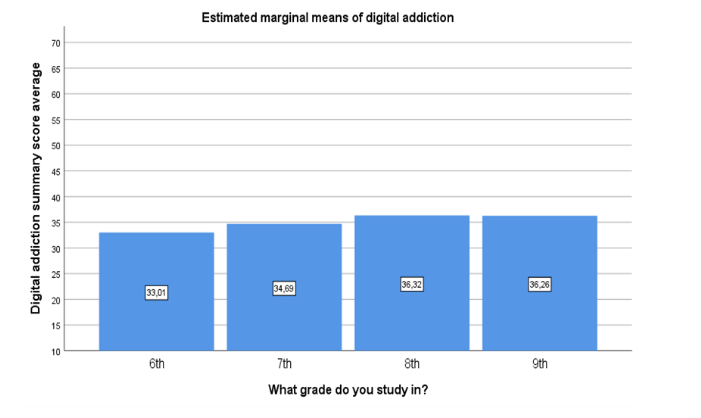
The highest digital addiction symptom ratings (Figure 1) were in grade 8 (M = 36.32, SD = 11.31) and grade 9 (M = 36.3, SD = 10.57), and the lowest digital addiction symptom ratings were in grade 6 (M = 33.01, SD = 11.4). We carried out a univariate analysis of variance.
Differences between grades were statistically significant, F (3, 5188) = 24.395, p < .001.
Levene’s test showed that error variances of dependent variables were not equal across groups, and the Games-Howell post hoc test multiple comparisons showed that ratings at 6th and 7th grades were statistically significantly different from other grades (p < .001).
There was no statistically significant difference between 8th and 9th grades (p < 1.00) (Figure 1).
One-Way Anova analysis for a comparison between gender groups (Figure 2) showed that girls’ ratings of digital addiction (M = 37.05, SD = 11.84) were statistically significantly higher than boys’ ratings (M = 32.68, SD = 10.13) and higher than the third group who chose “Other/do not want to answer” (M = 36.43, SD = 11.42), F (2, 5188) = 87.55, p < .001.
Levene’s Test indicated that the two groups had not equal variances (p < .001); therefore, the Games-Howell nonparametric test was suitable as a post-hoc test.
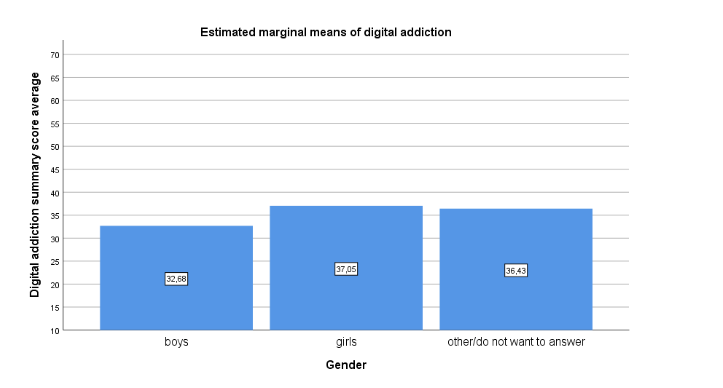
Figure 2. Digital addiction arithmetic mean score by gender.
RELATIONS BETWEEN DIGITAL ADDICTION, SCHOOL BURNOUT, SCREEN TIME AND FEELING RESTED
Students’ digital addiction summary scores were moderately positively related to school burnout, screen time during school days, and weekends and weakly negatively related to feeling refreshed in the morning. All correlations were statistically significant. Table 2 presents the correlations between the DAST scores and other measures.
Table 2. Correlations between (DAST) digital addiction symptoms and other characteristics
| Digital addiction | School burnout | Screen time on school days | Screen time on weekends | Feeling refreshed in the morning | |
|---|---|---|---|---|---|
| Digital addiction | 1 | ||||
| School burnout | .45** | 1 | |||
| Screen time on school days | .41** | .25** | 1 | ||
| Screen time on weekends | .40** | .25** | .71** | 1 | |
| Feeling refreshed in the morning | -.24** | -.37** | -.18** | -.18** | 1 |
Note: Correlation is significant, p < .001.
Discussion
The aim of this study was to examine Estonian primary school students’ ratings of digital addiction symptoms and to identify differences between classes and genders. It also aimed to find out the correlations between students’ perceived symptoms of digital addiction, screen time, school burnout and perceived feeling of being rested in the morning. The current study is a screening that does not diagnose an individual, but generalises the frequency of occurrence of the phenomenon in one population – Estonian primary school students. Digital addiction at an individual level cannot be defined solely based on digital addiction scale ratings or time of use, but in combination with perceived low satisfaction with life or coping at school, or with the wellbeing scale⁵².
The current study revealed that students constitute a heterogeneous group with significant variation in perceived symptoms of digital addiction as measured by the DAST. On average, Estonian students report experiencing digital addiction symptoms slightly more than the average extent indicated by the scale. Our study confirmed our hypotheses (H1) that the arithmetical mean score of digital addiction is similar or even higher than the result gained with the previous Estonian study at the beginning of Covid crises ⁵². The students’ mean score at the beginning of 2022 was only a bit higher (M = 35.02, SD = 11.28) than the mean score reflected by the study two years earlier (M = 34.8, SD = 11.0) (⁵²).
In the current study, 13% of students’ DAST scores showed high symptoms of digital addiction and unhealthy use of digital devices while only a relatively small group of students (15.7%) showed a few symptoms of digital addiction, thus having a healthy pattern of using digital devices. The survey found that students are most likely to use their devices during out-of-school hours, with high ratings for using digital devices to play games or socialise with friends before going to bed. It was also found that digital devices are being used for longer than originally planned.
The results showed that students’ ratings of digital addiction symptom statements increase with each grade level, until the 8th grade, partly confirming the hypothesis (H2). The highest digital addiction symptom ratings were found in 8th and 9th grade. Previous studies have shown that excessive use of digital devices and related behavioural addictions increases as students get older. Internet addiction²⁸,³⁷,⁵⁴ and gaming addiction¹¹ prevalence is highest among 15–16 years old. This may be due to the fact that the symptoms of digital addiction increase over the years, as the symptoms develop over a longer period of time ¹, but it may also be caused by older children’s better ability to assess and recognise the symptoms of digital addiction due to their better metacognitive ability to accurately monitor own behaviour⁴³. By learning that the problem is becoming more severe in the final years of primary school, school leaders and parents are able to recognise the existence of the problem early and identify at-risk pupils in order to fulfil the fundamental process of educational institutions, i.e. to support the development and learning of the learner to the maximum, school leaders have an important role to play in ensuring that support systems are in place and implemented. In this context, it is also important to educate support specialists, teachers and parents on this issue at national level¹⁴,⁶⁰.
In addition, it was found that there were differences of digital addiction scores between genders. Girls’ ratings of digital addiction symptoms were higher than boys’ symptoms, which confirmed the hypothesis (H3) of this study, which suggested that gender differences exist³⁹. Some previous studies have shown that girls have higher Internet addiction scores¹⁴,⁴⁹, is also in line with the results of a previous Estonian study that found higher prevalence of digital addiction symptoms in teenage girls⁵². Another interesting finding in our study was the fact that the third gender group had also significantly higher scores of digital addiction than boys. Therefore, it is important for further study
The last research question aimed to find out which factors are related to digital addiction symptoms. Screen time, school burnout, and feeling refreshed in the morning were found to be associated with the presence of symptoms of digital addiction, which confirmed hypothesis (H4). Similarly, Seema and colleagues (2022) found that the presence of symptoms of digital addiction was associated with poorer engagement in learning, higher levels of burnout due to learning, and the presence of learning disabilities⁵²,⁵³. One of the reasons may be the habitual use of frequent digital devices, which diverts attention away from learning¹³. At the same time, excessive academic challenges can cause students to become stressed, in turn leading them to spend more time online to increase their wellbeing³. Adolescents who experience more stress and poor mental health may use screens to cope with stressors and negative feelings. Better coping with stressors and support in academic issues could reduce digital addiction symptoms among students⁴³.
Students reported not being refreshed in the morning, which is an important and positive sleep quality characteristic – feeling refreshed in the morning³⁶ and by our knowledge, no other studies have assessed the same sleep quality criteria in relation to students’ digital addiction. However, a previous study has found connections between young adults’ electronic media use in bed before going to sleep, insomnia symptoms and daytime sleepiness²⁰. Honmore (2023) showed that adolescents with high social media addiction suffer from poor sleep quality. Dresp-Langley and Hutt (2022) even provided a conceptual basis for understanding digital addiction as one of the major reasons why adolescents sleep less and less well in the digital age.
Conclusion
In light of the results, it is worth highlighting the suggestion to teachers that young people should be guided to use digital tools purposefully and to monitor the time spent on purposeful activities. Teachers can use the digital addiction scale used in this work, in their humanities or computer science classes to shape the development of digital competences through self-assessment of students⁶⁰. Knowing that the symptoms of digital addiction are associated with self-regulation problems because of habit formation and in part due to self-control problems², it is important to propose that teachers could teach self-regulation skills to young people and increase students’ self-awareness and procedural knowledge for preserving their health in a digitally rich environment⁵².
However, knowing that digital technology plays a major role in today’s society and that devices are an important part of young people’s lives, agreements need to be put in place in schools to ensure effective learning. One suggestion is to consider the creation of smart-free school breaks, as implementing 45-minute school classes leave little time for children to wind down; as time spent on social media platforms during a break can take a sufficient amount of time before a student can switch to learning activities⁶⁰. When creating a digitally-friendly schedule, it is important to provide time to develop creativity, playfulness and be active, so that students’ desire to spend time on digital devices is reduced⁴². In addition, students could be given the opportunity to have, for example, an outdoor lesson. This would require finding the necessary resources at school level and ensuring that the necessary arrangements are in place⁶⁰.
Developing proper digital addiction literacy through educational initiatives is critical to preventing and detecting digital addiction. A proactive approach could help individuals understand and manage their digital device usage before it escalates to a level requiring intervention¹⁷. In a digitally rich environment, it is important to draw young people’s attention to the need to monitor the purpose of their use of digital tools and the time resources available to them, so that time spent on digital tools does not come at the expense of other important activities and interest in other activities is not lost.
In conclusion, it is important for education leaders to be aware of the issue, by shaping the school
culture and involving the network. It is important to raise the awareness of adults around teenagers, especially teachers and parents, of the dangers of excessive use and to provide the knowledge necessary for prevention in order to create the best possible environment for development and learning. A further suggestion for policymakers is to develop possible prevention measures or programmes⁶⁰. A literature review by Ding and Li (2023) have suggested at least five different types of digital addiction prevention interventions, which could be implemented and studied with teenagers. Those are cognitive-behavioural therapies (CBT) and CBT-based intervention, family therapy, digital-based intervention, and other interventions.
Limitations and future research directions
In the light of the results of this work, it is important to bear in mind the following limitations. Firstly, the Student Survey 2022 was carried out during the corona period, when many children were in distance learning, so the result on the time spent by students using digital devices may be higher due to this. Secondly, there is the potential subjectivity of the results, as they are students’ estimates of their own use habits and time, which may affect the reliability of the results. However, the students did not know that the questionnaire was a questionnaire of measuring their digital addiction symptoms, but mapping of usage behaviour, as the DAST scale has two names and purposes, and therefore the responses can be considered more reliable. Adolescents frequently engage in multitasking on screens, making it challenging to assess total screen time, which may lead to either underestimation or overestimation⁴⁷.
Another limitation is that the extensive questionnaire of the Student Survey is time-consuming to fill in and many children may not have responded with full seriousness, so many responses had to be deleted due to their unreliability. A previous study also found that answering a long questionnaire is difficult, therefore there may be students with learning difficulties whose answers were left out of analysis. Students with learning difficulties may need some extra attention and help with filling in any long questionnaire⁵³.
This study used a cross-sectional survey approach; future investigations could enhance understanding by employing a longitudinal research perspective. Future research could also focus on primary and secondary school pupils, using qualitative research methods and research designs that could explain cause and effect. Future studies could assess more students’ sleep quality indicators in relation to digital addiction, screen time and school burnout. In addition, different school and classroom practices and interventions could be explored in terms of how agreements on the use of pupils’ personal digital devices have been made, both during lessons and in class, and how this has changed pupils’ learning attitudes.
Conflict of Interest:
The authors declare no conflicts of interest.
Funding Statement:
This research received no external funding.
Acknowledgements:
We would like to thank the teachers who conducted the questionnaires among their students and all the students who participated in the survey.
Author Contributions:
Conceptualization, R.S., J.V., P.O., methodology R.S and P.O., resources and data collection P.O., analysis R.S., J.V., P.O., writing R.S., J.V., reviewing and editing P.O. All authors have read and agreed to the published version of the manuscript.
References
1. Al-Khani AM, Saquib J, Rajab AM, Khalifa MA, Almazrou A, Saquib N. Internet addiction in Gulf countries: A systematic review and meta-analysis. Journal of behavioral addictions. 2021;10(3):601-610. doi:10.1556/2006.2021.00057
2. Allcott H, Gentzkow M, Song L. Digital addiction. Am Econ Rev. 2022;112(7):2424-2463. doi:10.1257 /aer.20210867
3. Almourad MB, McAlaney J, Skinner T, Pleya M, Ali R. Defining digital addiction: Key features from the literature. Psihologija. 2020;53(3):237-253.
4. Aypay A. Secondary School Burnout Scale (SSBS). Educ Sci Theory Pract. 2012;12(2):782-787.
5. Babic MJ, Smith JJ, Morgan PJ, Eather N, Plotnikoff RC, Lubans DR. Longitudinal associations between changes in screen-time and mental health outcomes in adolescents. Ment Health Phys Act. 2017;12:124-131. doi:10.1016/ j.mhpa.2017.04.001
6. Bask M, Salmela-Aro K. Burned out to drop out: Exploring the relationship between school burnout and school dropout. Eur J Psychol Educ. 2013;28:511-528. doi:10.1007/s10212-012-0126-5
7. Bener A, Al-Mahdi H, Bhugra D. Lifestyle factors and internet addiction among school children. Int J Community Fam Med. 2016;1(2). doi:10.15344 /2456-3498/2016/118
8. Bruni O, Sette S, Fontanesi L, et al. Technology use and sleep quality in preadolescence and adolescence. doi:10.5664/jcsm.5282
9. Cai H, Xi HT, An F, et al. The association between internet addiction and anxiety in nursing students: A network analysis. Front Psychiatry. 2021;12:723 355. doi:10.3389/fpsyt.2021.723355
10. Cash H, Rae C, Steel A, Winkler A. Internet addiction: A brief summary of research and practice. Curr Psychiatry Rev. 2012;8(4):292-298. doi:10.2174/157340012803520513
11. Chang FC, Chiu CH, Chen PH, et al. Children’s use of mobile devices, smartphone addiction and parental mediation in Taiwan. Comput Human Behav. 2019;93:25-32. doi:10.1016/j.chb.2018.11.048
12. Chang E, Kim B. School and individual factors on game addiction: A multilevel analysis. Int J Psychol. 2020;55(5):822-831. doi:10.1002/ijop.12645
13. Chen L, Nath R, Tang Z. Understanding the determinants of digital distraction: An automatic thinking behaviour perspective. Comput Human Behav. 2020;104:106195. doi:10.1016/j.chb.2019.106195
14. Chemnad K, Aziz M, Abdelmoneium A, et al. Adolescents’ internet addiction: Does it all begin with their environment? Child Adolesc Psychiatry Ment Health. 2023;17:87. doi:10.1186/s13034-023-00626-7
15. Chou C, Hsiao MC. Internet addiction, usage, gratification, and pleasure experience: The Taiwan college students’ case. Comput Educ. 2000;35(1) :65-80. doi:10.1016/S0360-1315(00)00019-1
16. Chung TW, Sum SM, Chan MW. Adolescent internet addiction in Hong Kong: Prevalence, psychosocial correlates, and prevention. J Adolesc Health. 2019;64(6) doi:10.1016/j.jadohealth.2018.12.016.
17. Ding K, Li H. Digital Addiction Intervention for Children and Adolescents: A Scoping Review. Int J Environ Res Public Health. 2023;20(6):4777. doi:10.3390/ijerph20064777. PMID: 36981687; PMCID: PMC10049137.
18. Dresp-Langley B, Hutt A. Digital Addiction and Sleep. Int J Environ Res Public Health. 2022;19(11): 11. doi:10.3390/ijerph19116910.
19. Eickelmann B, Casamassima G, Labusch A, et al. Children and young people’s narratives and perceptions of ICT in education in selected European countries complemented by perspectives of teachers and further relevant stakeholders in the educational context. Zenodo. Published 2022. doi:10.5281/ZENODO.7152391.
20. Fossum IN, Nordnes LT, Storemark SS, Bjorvatn B, Pallesen S. The association between use of electronic media in bed before going to sleep and insomnia symptoms, daytime sleepiness, morningness, and chronotype. Behav Sleep Med. 2014;12(5):343-357. doi:10.1080/15402002.2013.819468.
21. Griffiths M. Technological addictions. Clin Psychol Forum. 1995;(76):14. doi:10.53841/bpscp f.1995.1.76.14.
22. Hale L, Guan S. Screen time and sleep among school-aged children and adolescents: A systematic literature review. Sleep Med Rev. 2015;21:50-58. doi:10.1016/j.smrv.2014.07.007.
23. HITSA. Schools in Estonia have switched to digital remote learning. Published March 21, 2020. Accessed at: https://www.hitsa.ee/about-us/news/estonia-has-switched-to-digital-remote-learning.
24. Hou H, Jia S, Hu S, et al. Reduced striatal dopamine transporters in people with internet addiction disorder. J Biomed Biotechnol. 2012;2012:854524. doi:10.1155/2012/854524.
25. Honmore VM. Social Media Addiction, Loneliness, Sleep Quality and Gender among Adolescents. Indian J Health Wellbeing. 2023;14(4):473-476. Available at: https://journals.indexcopernicus.com/api/file/viewByFileId/1902842.
26. International Classification of Diseases (ICD). World Health Organization. 2020. Accessed at: https://www.who.int/standards/classifications/classification-of-diseases.
27. Joseph R, Hamilton-Ekeke J-T. A Review of Digital Addiction: A Call for Safety Education. J Educ E-Learning Res. 2016;3(1):17-22. doi:10.20 448/journal.509/2016.3.1/509.1.17.22.
28. Karacic S, Oreskovic S. Internet Addiction Through the Phase of Adolescence: A Questionnaire Study. JMIR Ment Health. 2017;4(2). doi:10.2196/mental.5537.
29. Karakose T, Tülübaş T, Papadakis S. Revealing the Intellectual Structure and Evolution of Digital Addiction Research: An Integrated Bibliometric and Science Mapping Approach. Int J Environ Res Public Health. 2022;19(22):14883. doi:10.3390/ ijerph192214883.
30. Kaye LK, Orben A, Ellis DA, Hunter SC, Houghton S. The Conceptual and Methodological Mayhem of “Screen Time.” Int J Environ Res Public Health. 2020;17(10). doi:10.3390/ijerph17103661.
31. Kesici A, Tunç NF. Investigating the Digital Addiction Level of the University Students According to Their Purposes for Using Digital Tools. Univ J Educ Res. 2018;6(2):235-241. doi:10.13189/ujer.2018.060204.
32. Kim K, Ryu E, Chon M-Y, et al. Internet addiction in Korean adolescents and its relation to depression and suicidal ideation: A questionnaire survey. Int J Nurs Stud. 2006;43(2):185-192. doi:10. 1016/j.ijnurstu.2005.02.005.
33. Levenson JC, Shensa A, Sidani JE, Colditz JB, Primack BA. The association between social media use and sleep disturbance among young adults. Prev Med. 2016;85:36-41. doi:10.1093/sleep/zsx113.
34. Li J-B, Lau JT, Mo PK, et al. Insomnia partially mediated the association between problematic Internet use and depression among secondary school students in China. J Behav Addict. 2017;6(4):554-563. doi:10.1556/2006.6.2017.085.
35. Liao CH, Wu JY. Deploying multimodal learning analytics models to explore the impact of digital distraction and peer learning on student performance. Comput Educ. 2022;190:104599. doi:10.1016/j.compedu.2022.104599.
36. Libman E, Fichten C, Creti L, et al. Refreshing Sleep and Sleep Continuity Determine Perceived Sleep Quality. Sleep Disord. 2016;2016:7170610. doi:10.1155/2016/7170610. PMID: 27413553; PMCID: PMC4927978.
37. Malak MZ, Khalifeh AH, Shuhaiber AH. Prevalence of Internet Addiction and associated risk factors in Jordanian school students. Comput Hum Behav. 2017;70:556-563. doi:10.1016/j.chb. 2017.01.011.
38. Medic G, Wille M, Hemels ME. Short- and long-term health consequences of sleep disruption. Nat Sci Sleep. 2017;9:151-161. doi:10. 2147/NSS.S134864.
39. Meng SQ, Cheng JL, Li YY, et al. Global prevalence of digital addiction in general population: A systematic review and meta-analysis. Clin Psychol Rev. 2022;92:102128. doi:10.1016 /j.cpr.2022.102128.
40. Merriam-Webster Dictionary. Screen time [noun]. Accessed at: https://www.merriam-webster.com/dictionary/screen%20time.
41. Mohan A, Sen P, Shah C, Jain E, Jain S. Prevalence and risk factor assessment of digital eye strain among children using online e-learning during the COVID-19 pandemic: Digital eye strain among kids (DESK study-1). Indian J Ophthalmol. 2021;69(1):140-144. doi:10.4103/ijo.IJO_2535_20.
42. Muidre J, Raudkivi J. Use of digital tools in school in an inclusive education based on the example of 5th grade students in two primary schools. [Master’s thesis]. ETERA. Published 2022. https://www.etera.ee/s/ofIwwUK7Dk.
43. Nagata JM, Cortez CA, Cattle CJ, et al. Screen Time Use Among US Adolescents During the COVID-19 Pandemic: Findings from the Adolescent Brain Cognitive Development (ABCD) Study. JAMA Pediatr. 2022;176(1):94-96. doi:10.10 01/jamapediatrics.2021.4334.
44. Patrão I, Borges I, Sobral P, Moreira A. Portuguese Validation of a Reduced Version of the IAT (Internet Addiction Test) Scale—Youth Version. Psychiatry Int. 2024;5:89-100. doi:10.3390/psychia tryint5010007.
45. Peper E, Harvey R. Digital addiction: increased loneliness, anxiety, and depression. NeuroRegulation. 2018;5(1):3. doi:10.15540/nr.5.1.3.
46. Pies R. Should DSM-V designate “Internet addiction” a mental disorder? Psychiatry (Edgmont). 2009;6(2):31.
47. Raney H, Testa A, Jackson DB, Ganson KT, Nagata JM. Associations between Adverse Childhood Experiences, Adolescent Screen Time and Physical Activity during the COVID-19 Pandemic. Acad Pediatr. 2022;22(8):1294-1302.
48. Saikia AM, Das J, Barman P, Bharali MD. Internet addiction and its relationships with depression, anxiety, and stress in urban adolescents of Kamrup District, Assam. J Family Community Med. 2019;26(2):108. doi:10.4103/ jfcm.JFCM_93_18.
49. Salmela-Aro K, Kiuru N, Leskinen E, Nurmi J-E. School Burnout Inventory (SBI): Reliability and validity. Eur J Psychol Assess. 2009;25(1):48-57. doi:10.1027/1015-5759.25.1.4.
50. Salmela-Aro K, Upadyaya K, Hakkarainen K, Lonka K, Alho K. The Dark Side of Internet Use: Two Longitudinal Studies of Excessive Internet Use, Depressive Symptoms, School Burnout and Engagement Among Finnish Early and Late Adolescents. J Youth Adolesc. 2017;46(2):343-357. https://pubmed.ncbi.nlm.nih.gov/27138172/.
51. Santl L, Brajkovic L, Kopilaš V. Relationship between Nomophobia, Various Emotional Difficulties, and Distress Factors among Students. Eur J Investig Health Psychol Educ. 2022;12(7). doi:10.3390/ejihpe12070053.
52. Seema R, Heidmets M, Konstabel K, Varik-Maasik E. Development and Validation of the Digital Addiction Scale for Teenagers (DAST). J Psychoeduc Assess. 2022;40(2):293-304. doi:10. 1177/07342829211056394.
53. Seema R, Varik-Maasik E. Students’ digital addiction and learning difficulties: shortcomings of surveys in inclusion. Front Educ. 2023;8. doi:10.3389/feduc.2023.1191817.
54. Sipal RF, Bayhan P. Preferred computer activities during school age: Indicators of internet addiction. Procedia-Soc Behav Sci. 2010;9:1085-1089. doi:10.1016/j.sbspro.2010.12.290.
55. Sukk M, Soo K. Preliminary results of the EU Kids Online Estonia 2018 survey. In: Kalmus V, Kurvits R, Siibak A, eds. Tartu: University of Tartu, Institute of Social Sciences; 2018. https://sisu.ut.ee/sites/default/files/euko/files/eu_kids_online_eesti_2018_raport.pdf.
56. Time to Log Off. Digital Addiction. Published 2016.https://www.itstimetologoff.com/digital-addiction/.
57. Tomaszek K, Muchacka-Cymerman A. Examining the relationship between student school burnout and problematic internet use. Educ Sci Theory Pract. 2020;20(2):16-31. doi:10.12738/jestp .2020.2.002.
58. Turel Y, Toraman M. The relationship between Internet addiction and academic success of secondary school students. Anthropologist. 2015;20.
59. Turner L, Bewick BM, Kent S, Khyabani A, Bryant L, Summers B. When Does a Lot Become Too Much? A Q Methodological Investigation of UK Student Perceptions of Digital Addiction. Int J Environ Res Public Health. 2021;18(21). doi:10.339 0/ijerph182111149.
60. Väljas J. Digital devices usage habits of Estonian primary school students based on the results of the Student Survey 2022. [Master’s thesis]. Tallinn University. Published 2023. https://www.etera.ee/zoom/200233/view?page=1&p=separate.
61. Walburg V, Mialhes A, Moncla D. Does school-related burnout influence problematic Facebook use? Child Youth Serv Rev. 2016;61:327-331. doi:10.1016/j.childyouth.2016.01.009.
62. Wang H, Zhou X, Lu C, Wu J, Deng X, Hong L. Problematic Internet Use in High School Students in Guangdong Province, China. PLOS ONE. 2011;6(5). doi:10.1371/journal.pone.0019660.
63. Weil LG, Fleming SM, Dumontheil I, et al. The development of metacognitive ability in adolescence. Conscious Cogn. 2013;22(1):264-271. doi:10.1016/j.concog.2013.01.004. PMID: 23 376348; PMCID: PMC3719211.
64. Weinstein AM. An update overview on brain imaging studies of internet gaming disorder. Front Psychiatry. 2017;8:185. doi:10.3389/fpsyt.2017.00185.
65. Young KS. Internet addiction: The emergence of a new clinical disorder. Cyberpsychol Behav. 1998;1(3):237-244. doi:10.1089/cpb.1998.1.23.